Quick Summary
- Group your ideas by the business job they do, not by format.
- Most people reading your posts won't buy for months. Write so they remember you when they do.
- Every idea below has a hook, an example and a time cost.
You know you should post on LinkedIn. You do, sometimes.
A post goes out, a few peers and friends like it, maybe someone leaves a supportive comment and then… nothing.
No conversation with the people who might actually buy from you. No sign that the hour you spent writing made a difference.
After a few rounds of that, it is reasonable to wonder whether LinkedIn is worth the effort.
Here’s the problem: you’re probably not short of ideas. You’re short of ideas that do something useful for the business.
A post can show a buyer how you think. It can help them understand a problem they have not solved yet.
It can give them evidence that you know what you’re doing. It can make the people behind your business more familiar.
Or it can start a conversation that would never have happened if you had stayed quiet.
That is a much more useful way to choose what to post than asking, “Should I write a text post, make a carousel or run a poll?”
This guide gives you 42 LinkedIn post ideas, organised by the job each one does.
For every idea, you’ll get a hook you can adapt, an example or practical template, why the idea works and a realistic indication of how much time it takes.
You’ll also see which familiar LinkedIn post ideas are probably not worth carrying into 2027.
Where a real LinkedIn post shows an idea well, we’ve linked to it so you can see the idea in action.
This blog post is the idea bank. If you want the whole system, including positioning, content pillars, cadence and measurement, that’s in our LinkedIn content strategy guide for founders.
The best LinkedIn post ideas for founders are ideas that do a job for the business: show how you think, teach what your buyers are stuck on, prove your work, show the people behind it, start useful conversations or reuse work you’ve already done. Pick ideas by the job, then choose the format.
Most of the people who come across your posts will not be ready to buy when they read them. That does not make the post wasted effort.
The aim is to give the right people useful reasons to remember your name, understand your expertise and know what you stand for before a need becomes urgent.
How to use these LinkedIn post ideas (and why they’re grouped by job, not format)
Most LinkedIn post idea lists start with formats: write a text post, make a carousel, record a video, run a poll.
That can help when you already know what you want to say. But it answers the wrong question first.
For a founder, the more useful question is: what does this post need to do for the business?
Maybe you need to show a potential buyer how you think. Maybe your market does not fully understand the problem you solve yet.
Maybe someone is comparing you with three alternatives and needs proof. Or maybe you simply need a useful post you can create in 15 minutes from work you have already done.
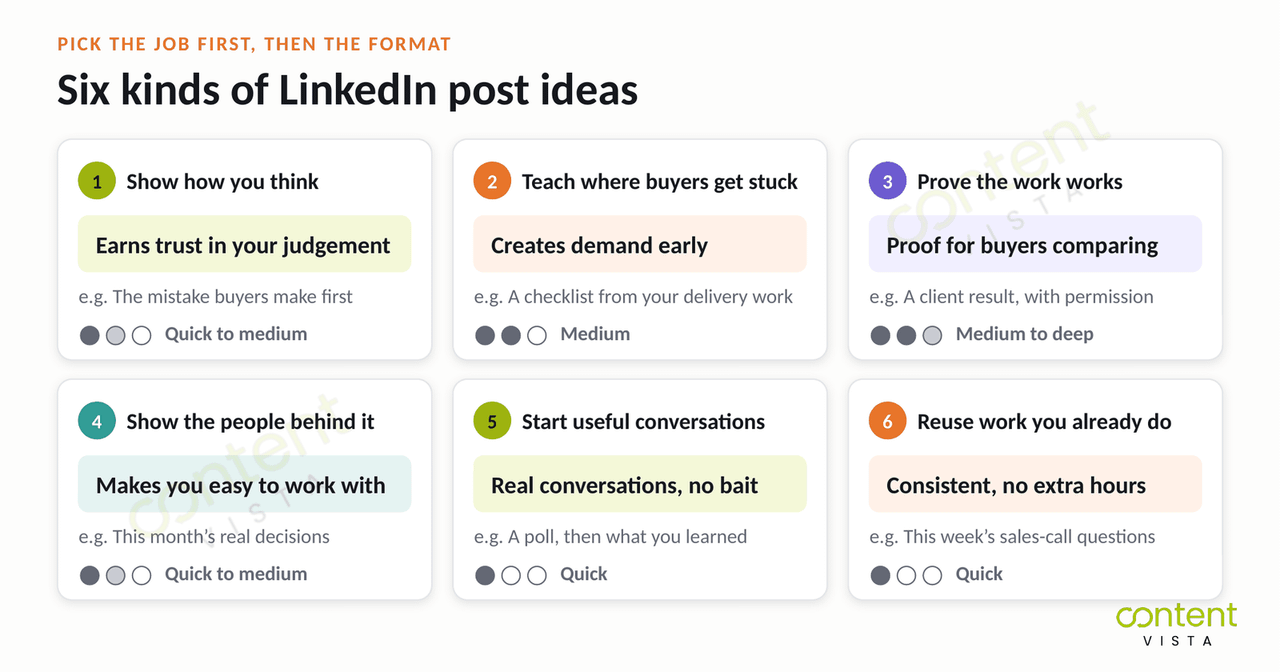
Start with the job. Choose the format afterwards.
| Group | The job it does | Who it reaches | Example idea | Typical effort |
|---|---|---|---|---|
| Ideas that show how you think | Earns trust in your judgement | Buyers who aren’t shopping yet and people who influence deals but rarely talk to sales | The mistake you see buyers make before they hire someone like you | Quick to medium |
| Ideas that teach what your buyers are stuck on | Creates demand by helping people before they’re ready to buy | Buyers who aren’t shopping yet | A checklist from your delivery work | Medium |
| Ideas that prove the work works | Gives proof to people who are comparing options | Buyers who are actively shopping | A client result breakdown, with permission | Medium to deep |
| Ideas that show the people and process behind your business | Makes you a business people want to work with | Everyone around a deal: buyers, partners, future hires | Building in public: this month’s real decisions | Quick to medium |
| Ideas that start useful conversations | Starts real conversations without engagement bait | Peers and buyers who like to weigh in | A poll, then a follow-up post on what you learned | Quick |
| Ideas you can lift from work you already do | Keeps you consistent without adding hours to your week | All of the above | The questions from this week’s sales calls | Quick |
Think about it this way: most people reading your posts are not buying right now.
Professor John Dawes’ 95:5 rule, developed through the Ehrenberg-Bass Institute for the LinkedIn B2B Institute in 2021, suggests that only around 5% of B2B buyers are in-market at a given time. You can read more in the Ehrenberg-Bass Institute’s write-up of the 95:5 rule.
It is a useful heuristic, not a precise law or a rule saying that 95% of your posts must be educational.
The practical lesson is simpler: if you only write for people ready to buy today, you ignore most of the people who could buy later.
Your posts therefore need to do more than generate an immediate lead. They need to make the right people remember your name, understand how you think and trust your expertise before a buying need appears.
That is also why social media for demand generation is bigger than posting promotional content and waiting for enquiries.
And some of those readers may influence a purchase without ever appearing on a sales call.
Edelman and LinkedIn’s 2025 B2B Thought Leadership Impact Report found that 95% of these “hidden buyers” said strong thought leadership makes them more receptive to outreach, while 71% have little or no interaction with sales.
So what does that mean for your LinkedIn post ideas? A useful post can be doing its job even when the person reading it does not comment, DM you or book a call that day.
There is another reason substance matters. In March 2026, LinkedIn announced it was upgrading how its feed ranks content using larger AI models, and reducing “repetitive, low-substance posts and engagement bait”.
LinkedIn’s own engineers describe their feed-ranking models as predicting actions such as long reading time (dwell), likes, comments and shares.
In plain terms: focus on giving the right person something worth reading rather than trying to outsmart the feed.
Once you know the job your post needs to do, then choose the format. Our guide to LinkedIn post types and formats covers that decision separately.
The Founder Authority & Audience Engine Benchmark gives you an authority score and your biggest gap in about three minutes. It’s a self-assessment: it doesn’t scan your profile.
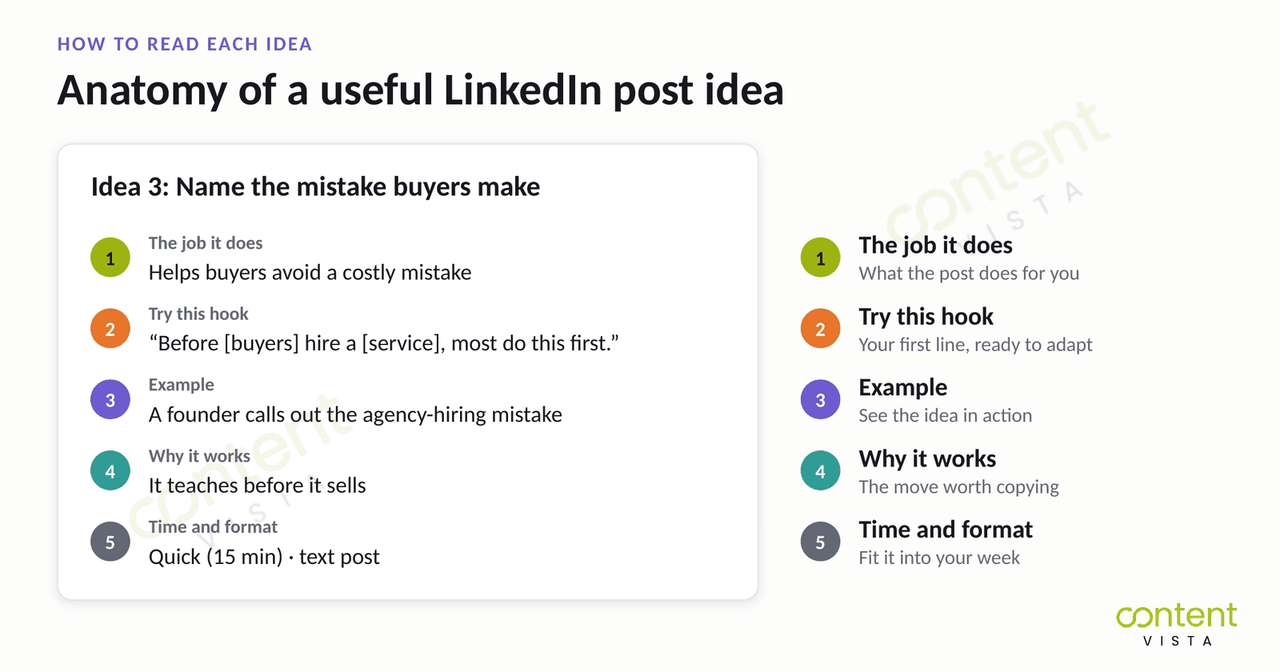
Here’s how to read each idea below.
Ideas that show how you think
These ideas earn trust in your judgement: the thing buyers are really evaluating before they ever book a call.
Use them when people know of you but don’t yet know how you think.
1. Share a contrarian take on common advice in your field
The job it does: Shows independent judgement to buyers who may not need you today but are forming an opinion about whose thinking they trust.
Try this hook: “Everyone in [industry] says [common advice]. Here’s why we stopped following it.”
Example:
What this could look like: “Everyone in [industry] says you should [common advice]. We did that for [time period]. It gave us [disappointing result]. So we switched to [your approach], and here’s what changed: [specific outcome or observation].”
Why it works: Disagreement is only useful when you can explain why you disagree.
Ground the take in something you have seen in your own projects, customers or decisions, then explain what you do instead.
Contrarian for its own sake is just another form of engagement bait.
Time and format: Medium (~30-45 min) · text post
2. Explain a decision you’d make differently now
The job it does: Shows buyers that your judgement evolves with experience rather than staying fixed around whatever you once believed.
Try this hook: “I used to think [belief]. After [number] [clients/projects], I think [new belief].”
Example:
What this could look like: “I used to think every [type of project] should start with [approach]. After [number] projects, I’d now start with [different approach]. The reason isn’t [obvious explanation]. It’s [a lesson from experience].”
Why it works: Buyers do not expect you to have been right about everything from day one. Showing what changed your mind reveals how you learn and make decisions.
The useful part is the evidence or experience behind the change. Simply announcing that your opinion is different now isn’t enough.
Time and format: Quick (~15 min) · text post
3. Name the mistake buyers make before they hire someone like you
The job it does: Helps prospective buyers avoid a mistake before they spend money, while quietly showing that you understand the patterns that happen before someone reaches you.
Try this hook: “Before [buyers] hire a [your service], most of them do this first. It costs them [consequence].”
Example: Anindya Sidhant opens one of his posts by calling out what he sees as a costly mistake founders make before hiring a marketing agency: starting with “Which agency is the best?” rather than first identifying the business problem they are trying to solve.
He then makes the distinction concrete with examples such as weak positioning and an unclear offer. Read Anindya’s post on LinkedIn.
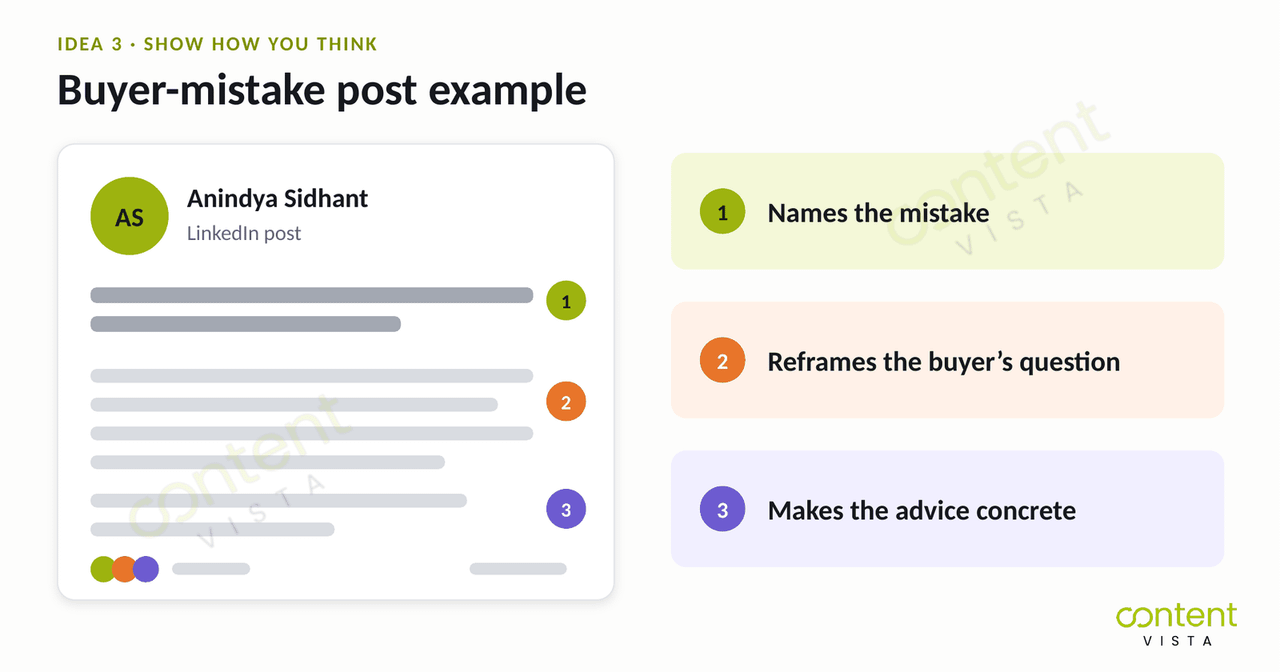
Why it works: The post teaches before it sells. Instead of saying “hire me,” it helps founders diagnose whether hiring an agency is even the right next move.
That makes the author’s experience visible through the pattern he notices and the better question he recommends asking.
Here’s where most founders go wrong: they turn this type of post into a disguised pitch. Protect the buyer first. Your expertise becomes obvious without needing to announce it.
Time and format: Quick (~15 min) · text post
4. Correct the idea your market gets wrong
The job it does: Positions you as someone who can distinguish a useful principle from an oversimplified belief your market keeps repeating.
Try this hook: “The biggest myth in [industry]: [myth]. Here’s what actually happens.”
Example: HR professional Floyd Fernandes used a short post to bust a common HR myth, and it drew plenty of discussion from his network. See Floyd’s myth-busting post on LinkedIn.
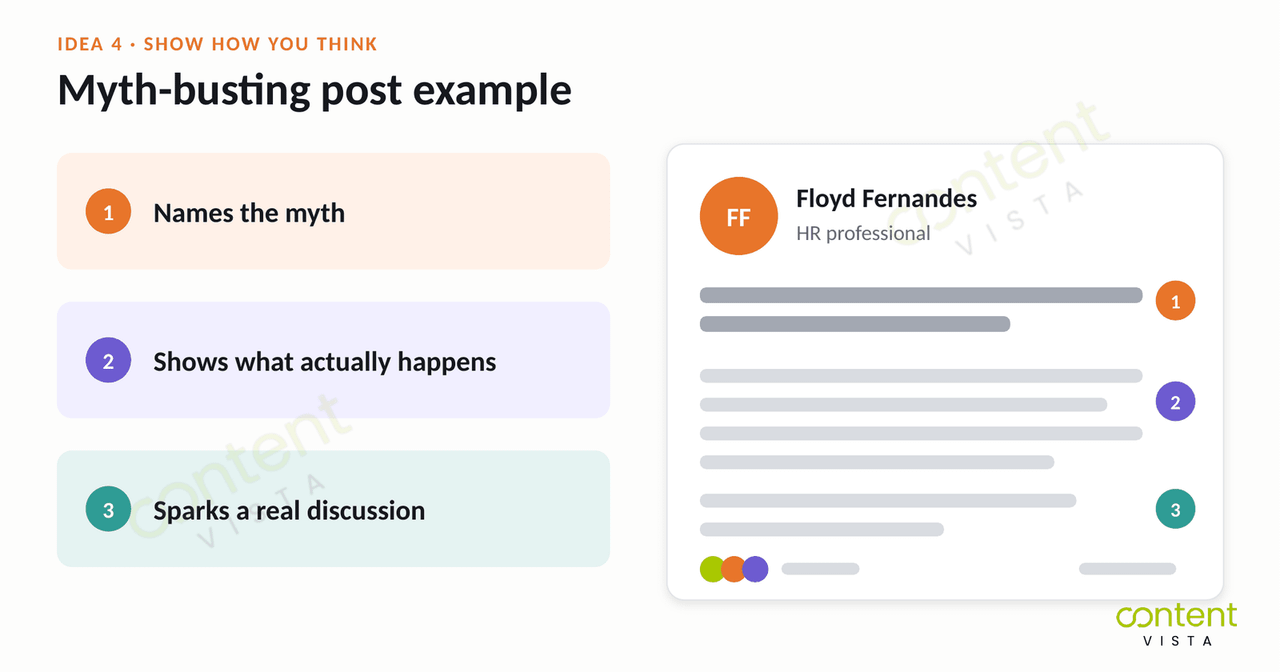
Why it works: Buyers hear the same advice repeatedly. Correcting a misconception gives them a sharper way to understand the problem.
Keep the correction specific: name the belief, explain where it breaks down and show what you have observed instead.
Time and format: Medium (~30-45 min) · text or document post
5. Give your read on industry news and what it means for your buyers
The job it does: Makes you the person who translates industry change into practical consequences for the people you serve.
Try this hook: “[News] happened this week. Here’s what it means if you’re a [buyer type].”
Example:
What this could look like: “[Company/regulator/platform] just announced [change]. If you’re a [buyer type], I wouldn’t focus on [obvious reaction]. I’d look at these two implications instead: [implication] and [implication].”
Why it works: Your buyer can get the news anywhere. What they cannot get everywhere is your interpretation of what changes, what does not and whether they need to act.
Stick to developments your buyers will genuinely feel. Otherwise, you risk becoming another news feed.
Time and format: Quick (~15 min) · text post
6. Make a prediction and show your reasoning
The job it does: Demonstrates forward thinking by giving buyers a view they can understand now and test against what happens later.
Try this hook: “My prediction for [industry] over the next 12 months: [prediction]. Here’s my reasoning.”
Example:
What this could look like: “My prediction for [industry] over the next 12 months: [specific prediction]. Three things are pushing me there: [signal 1], [signal 2] and [signal 3]. I could be wrong, but here’s what I’d watch over the next [time period].”
Why it works: The prediction itself matters less than the reasoning underneath it. Showing the signals you are watching lets readers inspect your judgement instead of simply agreeing or disagreeing with a bold claim.
Make the prediction specific enough that you can revisit it later.
Time and format: Medium (~30-45 min) · text post
7. List the red flags buyers should watch for
The job it does: Builds trust by helping buyers evaluate providers more intelligently, even when that advice could lead them to choose someone else.
Try this hook: “If a [vendor type] tells you [claim], ask this question first.”
Example:
What this could look like: “If a [vendor type] promises [claim] before asking about [important context], ask how they arrived at that recommendation. A good answer should cover [criterion 1], [criterion 2] and [criterion 3].”
Why it works: This gives readers something they can use in an actual buying conversation.
Strong red-flag posts explain what to question and what a credible answer looks like. They do not simply turn competitors into villains.
That willingness to help buyers evaluate everyone is what makes the advice trustworthy.
Time and format: Quick (~15 min) · text or document post
Ideas that teach what your buyers are stuck on
These ideas create demand by helping people solve real problems before they’re ready to buy.
They’re how you become the obvious name when the need finally arrives.
8. Break down a problem your buyers keep running into
The job it does: Shows buyers that you understand their world well enough to explain a problem they may be struggling to diagnose themselves.
Try this hook: “If you’re a [buyer] dealing with [problem], here’s what’s usually going on underneath.”
Example:
What this could look like: “If you’re a [buyer] dealing with [symptom], the cause usually isn’t [obvious culprit]. In most of the [projects/accounts] we see, it comes down to one of three things: [cause 1], [cause 2] or [cause 3]. Here’s how to tell which one you’ve got.”
Why it works: A buyer often experiences the symptom before they understand the cause.
A useful post connects the two: “You’re seeing X. Here are the three things I’d check before trying to fix it.” That makes your expertise useful before a sales conversation ever happens.
Done consistently, this is the basis of content-led demand: helping buyers understand their problem well enough to recognise whose expertise they trust.
Time and format: Medium (~30-45 min) · text or document post
9. Share a checklist from your delivery work
The job it does: Gives buyers something immediately useful while showing the level of rigour behind how you work.
Try this hook: “The [number]-point checklist we run before every [deliverable].”
Example:
What this could look like: “Before we send any [deliverable] to a client, we check these five things: [check 1], [check 2], [check 3], [check 4], [check 5]. Number three catches more problems than you’d expect.”
Why it works: Let’s make this practical: don’t create a generic checklist because you need something to post. Start with one you genuinely use.
A pre-launch check, discovery checklist, QA process or handover list reveals more about your standards than saying, “We care about quality.”
Time and format: Medium (~30-45 min) · document post
10. Explain a trade-off: option A vs option B and when each wins
The job it does: Helps buyers make a decision when two reasonable options look equally convincing from the outside.
Try this hook: “[Option A] or [Option B]? It depends on one thing most people don’t check.”
Example: Digital transformation leader Kathrin Lindner built a whole post around one comparison: spending versus investing. A simple two-sided contrast like this is easy to read and easy to remember. See Kathrin’s spend vs invest post on LinkedIn.
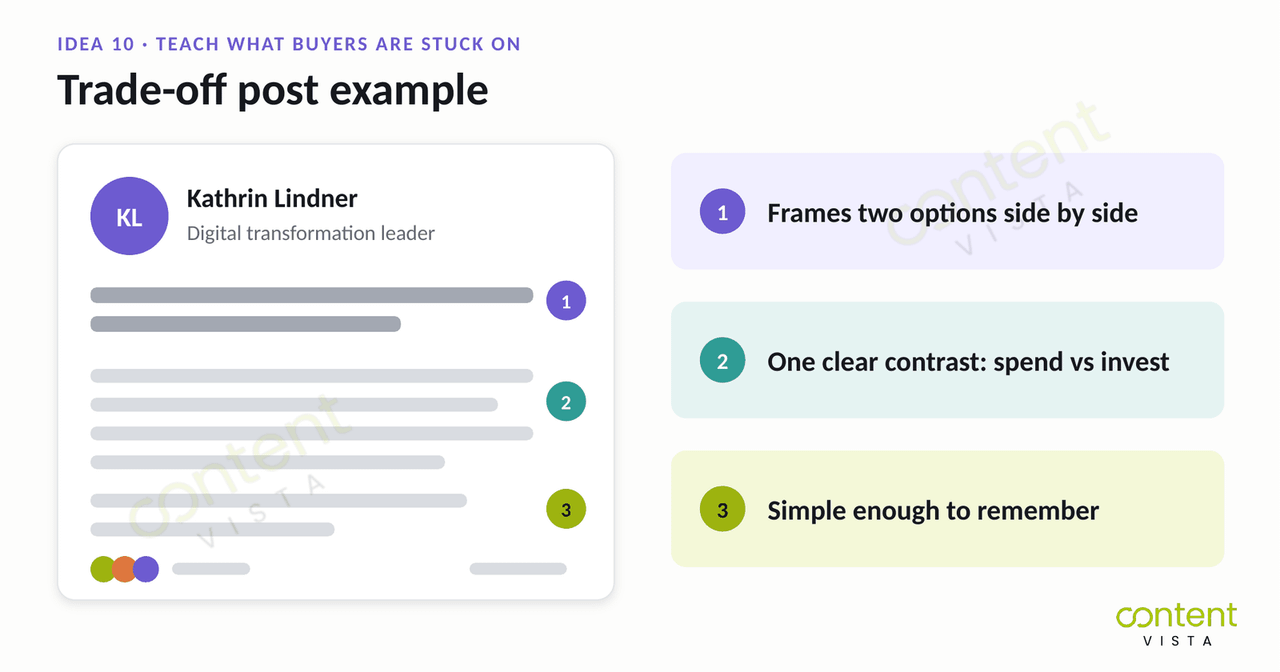
Why it works: Good advice is rarely “A is always better than B.” Buyers need to know what changes the answer.
Explain the deciding variable: budget, stage, urgency, complexity, internal capability or another factor relevant to your work. Then show when you would choose each route.
That demonstrates judgement rather than preference.
Time and format: Medium (~30-45 min) · text post
11. Write “what I’d do in your seat”
The job it does: Shows practical judgement by applying your expertise to a specific situation rather than offering advice broad enough to fit anyone.
Try this hook: “If I were a [stage/type] founder with [constraint], here’s exactly what I’d do first.”
Example:
What this could look like: “If I were a [type of founder] with [specific constraint], I wouldn’t start with [common first move]. I’d spend the next [time period] doing three things: [step 1], [step 2], [step 3]. Here’s why I’d do them in that order.”
Why it works: Constraints make advice useful. “Here’s how to grow” says very little.
“Here’s what I’d prioritise with a small team and three months to prove demand” forces you to make choices. Those choices are what reveal how you think.
Time and format: Medium (~30-45 min) · text post
12. Answer the question you get asked every week, properly
The job it does: Removes a recurring objection or confusion at scale instead of answering the same question privately every time it comes up.
Try this hook: “I get asked [question] almost every week. Here’s the full answer.”
Example:
What this could look like: “I get asked whether [common question] almost every week. Short answer: [direct answer]. Longer answer: it depends on [factor 1], [factor 2] and [factor 3]. Here’s how I’d decide.”
Why it works: Repeated questions are useful content signals because they come directly from the market.
Don’t pad a two-line answer into a long post. Answer the question immediately, then explain the conditions, exceptions or trade-offs a buyer needs to make a better decision.
Time and format: Quick (~15 min) · text post
13. Walk through the process you actually use, step by step
The job it does: Makes your expertise tangible by showing buyers what happens between the problem they have and the outcome they want.
Try this hook: “Here’s the exact [number]-step process we use to [outcome].”
Example:
What this could look like: “Here’s the five-step process we use to [outcome]: 1. [step], 2. [step], 3. [step], 4. [step], 5. [step]. Most problems appear at step [number], because [reason].”
Why it works: Process posts turn invisible expertise into something buyers can inspect. Use the real sequence you follow and explain why the steps happen in that order.
There is no need to invent an acronym or give an ordinary workflow a clever name. The value is in the process itself.
Time and format: Medium (~30-45 min) · document post
14. Share data only you have
The job it does: Turns patterns from your own work into original insight that buyers cannot get from another roundup of public statistics.
Try this hook: “We looked at [number] [projects/calls/proposals] from the last year. Here’s what we found.”
Example: Dr. Sheetal Jain, founder and CEO of Luxe Analytics, used a short post to share an insight on the most valuable luxury brands, the kind of category data an analytics founder is well placed to interpret. Your version doesn’t need to be an industry ranking: the same approach works with patterns from your own client work. See Sheetal’s data post on LinkedIn.
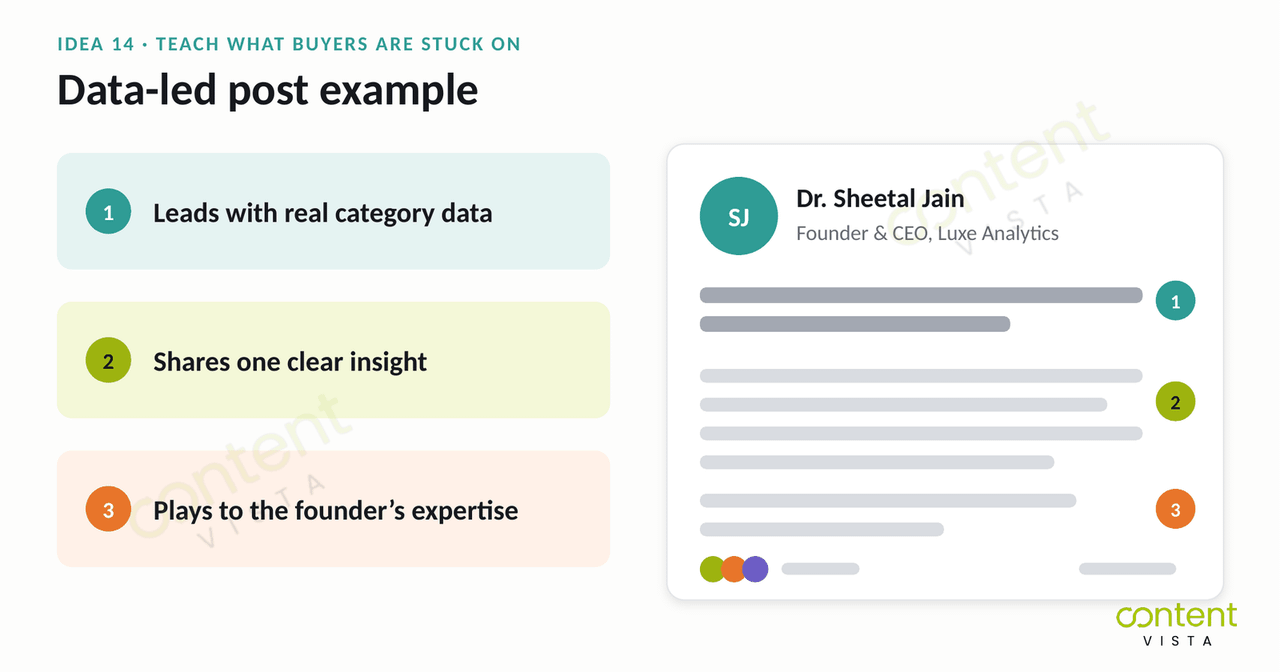
Why it works: You may already be sitting on useful data: recurring questions from sales calls, patterns across proposals, common delivery problems or anonymised trends across projects.
The useful post is not the spreadsheet dump. Pick one finding, explain what surprised you and tell the reader what it changes.
Anonymise client information and remove anything confidential before publishing.
Time and format: Deep (~60-90 min) · text post with a simple chart or document post
15. Turn a short guide into a document post
The job it does: Packages useful teaching into a structured resource people can work through, save and pass to someone else.
Try this hook: “I turned [topic] into a [number]-page guide. Swipe through.”
Example:
What this could look like: A six-page document post. Page 1: “[Problem your buyers keep hitting], explained in 6 pages.” Page 2: why it happens. Pages 3 to 5: one step or decision per page, each with a short example. Page 6: the one thing to do this week, plus a question for the comments.
Why it works: Some topics need more room than a text post gives them.
A short guide works when each page moves the reader forward: define the problem, break down the decision or process, give practical examples and finish with a useful next step.
Don’t stretch one idea across ten slides simply to create a document post.
The format should serve the teaching. If you’re deciding whether a document, text post, video or another format fits the idea better, see our guide to LinkedIn post types and formats.
Time and format: Deep (~60-90 min) · document post
Ideas that prove the work works
These ideas give proof to buyers who are actively comparing options. Use them sparingly and specifically: vague wins read like ads.
Edelman and LinkedIn’s 2024 thought leadership research, based on 3,500 B2B decision-makers, found that 86% would be likely to invite organisations producing valuable thought leadership into an RFP, while 60% would pay a premium to work with them.
Proof posts are where that trust turns into shortlists.
16. Break down a client result (with permission)
The job it does: Gives prospective buyers proof that’s specific enough to believe and detailed enough to understand how the result happened.
Try this hook: “[Client type] came to us with [problem]. Here’s what changed in [timeframe] and the part that almost didn’t work.”
Example: Here’s one from our own co-founder. Harshit Bhatia used a LinkedIn post to share a client story from our work, and it brought a good amount of likes, shares and comments from his network. See Harshit’s client story on LinkedIn.
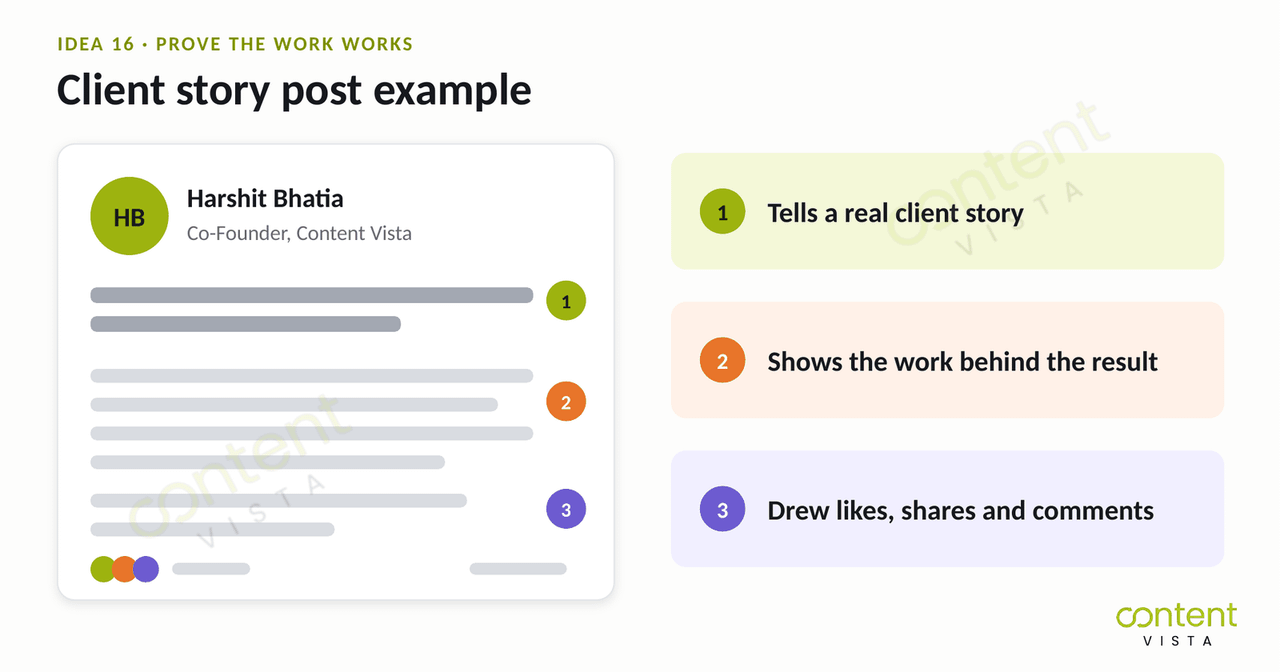
Why it works: The strongest result posts show the starting point, what you changed and what happened next.
Include the complication, constraint or decision that made the work difficult. That is often where your expertise becomes visible.
Always get the client’s permission and use numbers you can substantiate. In short: tell a useful project story, and skip the victory lap.
Time and format: Deep (~60-90 min) · text or document post
17. Show a before and after
The job it does: Makes the change visible quickly, then gives buyers enough context to understand what produced it.
Try this hook: “Before: [state]. After: [state]. Here’s what we changed in between.”
Example:
What this could look like: “Before: [specific starting state]. After: [specific changed state]. The interesting part isn’t the before-and-after. It’s what happened between them. We changed [action 1], [action 2] and [action 3].”
Why it works: Before-and-after posts make progress easy to grasp, but the comparison alone is not proof of expertise.
Explain the decisions between the two states. Otherwise, the reader sees an outcome without learning why you were responsible for it.
Time and format: Medium (~30-45 min) · image or document post
18. Tear down how a project actually ran
The job it does: Shows prospective buyers what working with you looks like before they have to ask on a sales call.
Try this hook: “Here’s how a [project type] really runs, week by week, including the messy bits.”
Example:
What this could look like: “Week 1: [discovery/work]. Week 2: [decision/work]. Week 3: we hit [problem], so we changed [approach]. Week 4: [next step]. Here’s what I’d keep and what I’d change next time.”
Why it works: Buyers rarely see the work behind the polished case study.
A project teardown shows how you communicate, make decisions and respond when something does not go according to plan.
Keep client-sensitive details out, but don’t polish the process until it looks unrealistically smooth.
Time and format: Deep (~60-90 min) · document post
19. Share the project that went wrong and what you changed
The job it does: Builds trust by showing how you respond when your judgement, process or execution falls short.
Try this hook: “We got [project] wrong. Here’s what happened and what we do differently now.”
Example: Saira Pasha, an attorney and business owner, wrote openly about a recent mistake she had made. Owning a mistake in public is exactly what this idea asks of you. See Saira’s post about her mistake on LinkedIn.
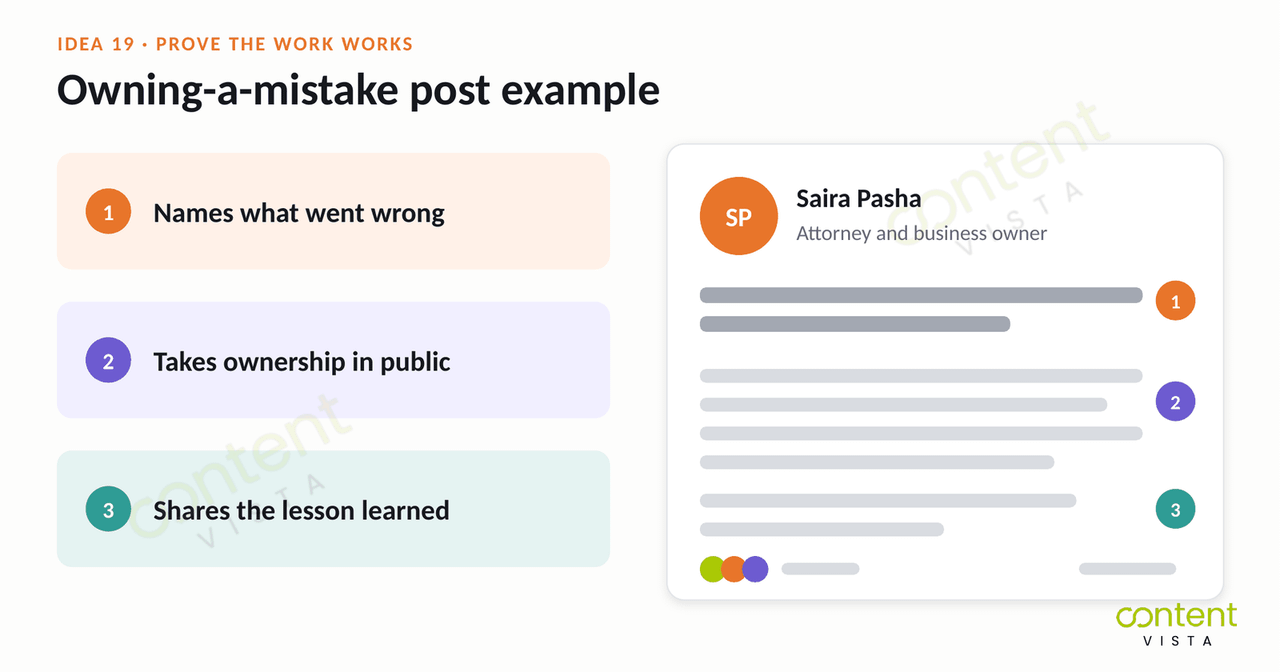
Why it works: A feed containing nothing but wins eventually starts to feel curated.
A useful failure post is different from performative vulnerability: name what went wrong, take responsibility for the part you controlled and explain the concrete change that followed.
The lesson should be useful even to someone who never hires you.
Time and format: Medium (~30-45 min) · text post
20. Share a client’s own words (with permission)
The job it does: Provides social proof in the language a buyer naturally uses rather than in polished marketing copy.
Try this hook: “A client sent this last week. I want to share why it matters.”
Example:
What this could look like: Share a short screenshot of genuine client feedback, then add: “This line stood out to me: ‘[approved client quote].’ It says something about [the problem, process or outcome] that a testimonial page never would.”
Why it works: The client’s language can reveal what they actually valued about the work.
Add context instead of dropping a testimonial screenshot with “Great feedback from another happy client.”
Get permission before sharing identifiable feedback. Otherwise, blur names and identifying details.
Time and format: Quick (~15 min) · image post
21. Explain why a client chose you, or why one didn’t
The job it does: Surfaces the objections and decision criteria that other prospective buyers may be quietly weighing.
Try this hook: “We lost a deal last month. The reason surprised me.”
Example:
What this could look like: “We lost a deal last month. I expected the reason to be [reason you expected]. It was actually [actual reason]. Looking back, the buyer was right about one thing: [lesson]. Here’s what we’ve changed since.”
Why it works: Lost deals can teach your audience as much as won ones.
Instead of criticising the prospect or competitor, unpack the decision criterion and what you learned from it.
If you discuss a won deal, focus on why the buyer chose you rather than simply announcing that they did.
Time and format: Medium (~30-45 min) · text post
22. Tell the story behind one number
The job it does: Turns a metric into evidence by showing the decisions, work and context behind it.
Try this hook: “[Number]. Here’s what that actually took.”
Example:
What this could look like: “[Verified result]. That’s the number we’d normally put in the headline. What it doesn’t show is [constraint], [decision] and [work behind the result]. Here’s what actually went into it.”
Why it works: Numbers attract attention, but isolated metrics can sound like boasting. The story behind the number explains what the result represents and what someone can learn from it.
Use a figure you can verify, give it enough context to be interpreted correctly and resist turning one result into a universal promise.
Time and format: Medium (~30-45 min) · text post
What proof can look like before the sales conversation
Personam, an AI threat-detection company, started with no brand, no website and no content.
Content Vista built the founder’s LinkedIn presence alongside the company page, growing their combined following from zero to 1,000+. The first newsletter issue reached a 41.8% open rate and a 21.2% click-through rate.
In a trust-driven category like cybersecurity, the founder showing up consistently gave buyers a reason to trust the company before they’d met anyone.
See how we built a cybersecurity founder’s LinkedIn presence from zero.
We’ve seen the same pattern with Akshar Business Consulting, where founder-led positioning built 4,000+ newsletter subscribers and an estimated £200K+ in pipeline.
Proof is most useful when it helps the reader evaluate you. It shouldn’t feel like a request for applause.
And when the right people do respond, the next job is to turn post engagement into real conversations without forcing every interaction into a sales pitch.
Ideas that show the people and process behind your business
These ideas make you a business people want to work with.
Buyers don’t just buy expertise. They buy the people they’ll deal with every week.
23. Tell your origin story through the customer problem you solve
The job it does: Makes your “why” relevant to buyers by connecting the reason you started the business to a problem they recognise.
Try this hook: “I started [business] after watching [customer type] struggle with [problem] for [time].”
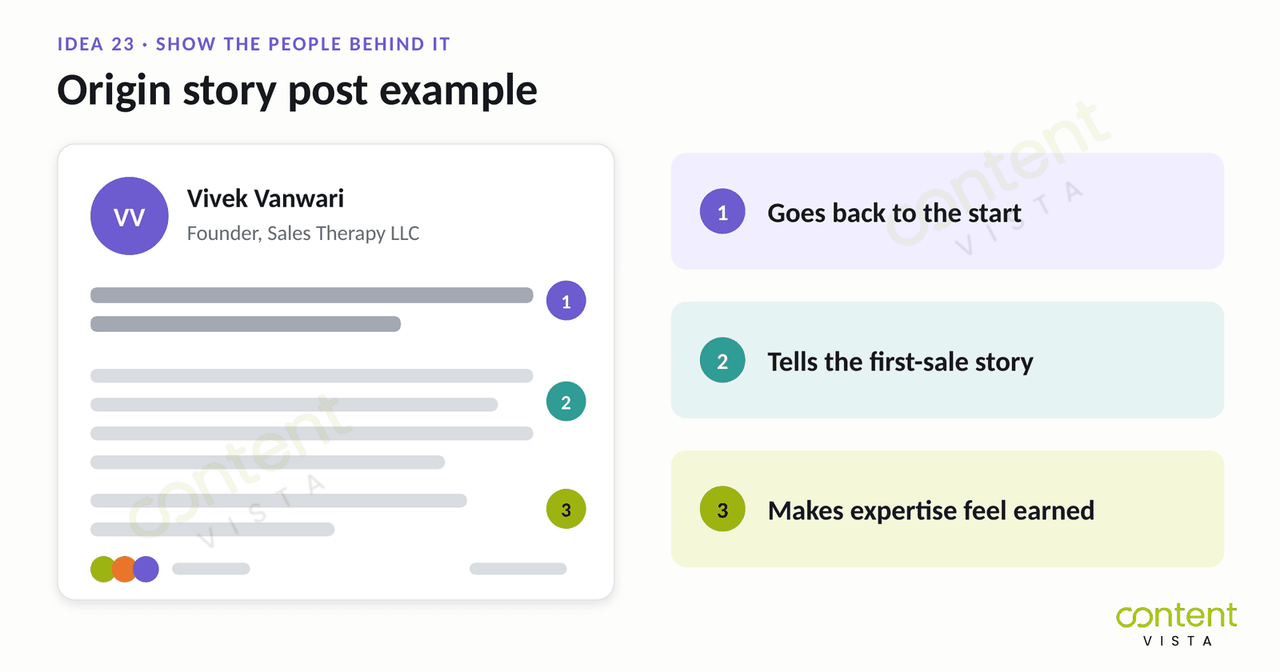
Example: Vivek Vanwari, founder of Sales Therapy LLC, went back to the beginning and told the story of his very first sales experience. Starting stories like this make your expertise feel earned, and they make you easier to remember. See Vivek’s first-sale story on LinkedIn.
Why it works: Most origin stories spend too long on the founder and not enough on the reason the business needed to exist.
Start with the problem you kept seeing. Then explain what frustrated you about the existing options and what you decided to do differently.
The reader should finish the post understanding the customer problem more clearly, not simply knowing your career history.
Time and format: Medium (~30-45 min) · text post
24. Build in public: share this month’s real decisions
The job it does: Lets buyers watch how you think and operate over time instead of only seeing the polished outcome.
Try this hook: “This month we decided to [decision]. Here’s what we weighed.”
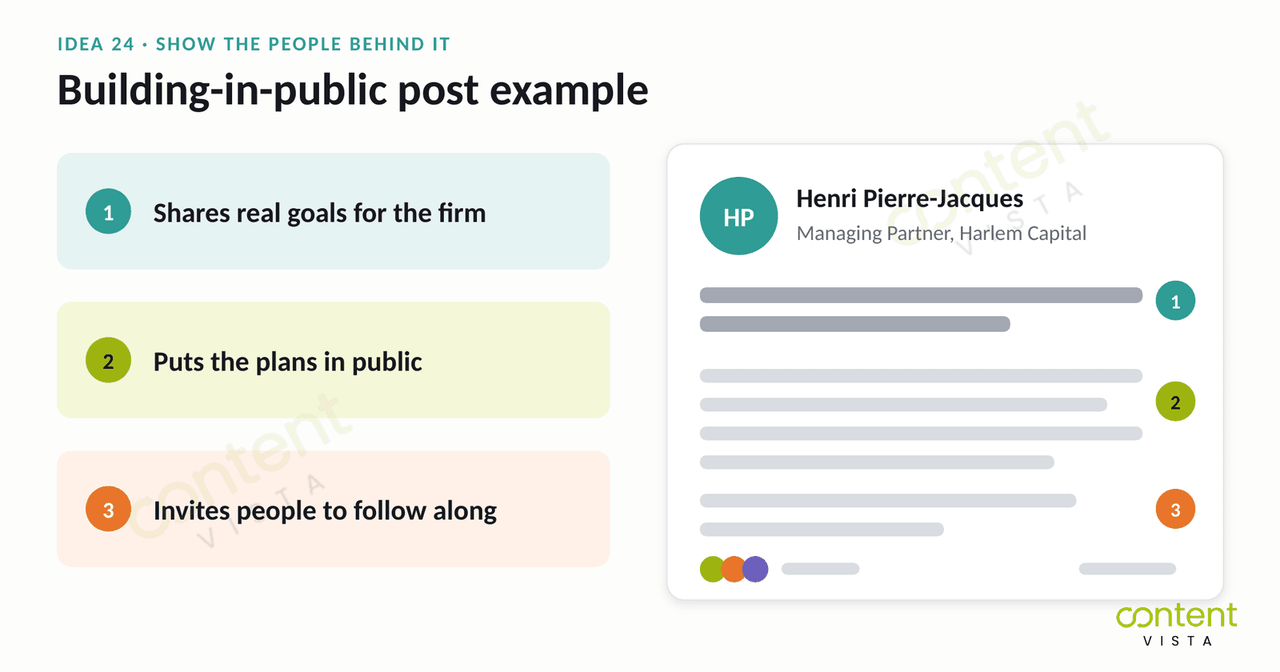
Example: Henri Pierre-Jacques, Managing Partner at Harlem Capital, shared his goals for the firm in a public post. Putting your plans where your market can see them invites people to follow along and hold you to them. See Henri’s goals post on LinkedIn.
Why it works: “Building in public” does not have to mean publishing revenue dashboards or narrating every day of running the company.
A useful version shares a real decision: what you were choosing between, what constraints mattered and why you chose one route.
Over time, those posts give buyers a clearer sense of how you operate when decisions are not obvious.
Time and format: Quick (~15 min) · text post
25. Write a hiring post that explains what you’re building
The job it does: Turns a recruitment update into a useful signal about where the company is going, for potential hires and buyers alike.
Try this hook: “We’re hiring a [role]. Here’s what they’ll help us build and why.”
Example:
What this could look like: “We’re hiring a [role]. We’re building [capability/area] and this person will own [specific responsibility]. Here’s why that matters for where we’re taking the business next.”
Why it works: A standard job post says what the candidate will do. A stronger founder post explains why the role exists now.
That gives prospective hires useful context while showing customers which capabilities you are investing in.
Keep the focus on the work being built rather than turning the vacancy into a company-culture speech.
Time and format: Quick (~15 min) · text post
26. Spotlight a team member through client work
The job it does: Shows buyers the people they may actually work with instead of making the founder the only visible expert in the business.
Try this hook: “Meet [name]. Last month she [specific client outcome].”
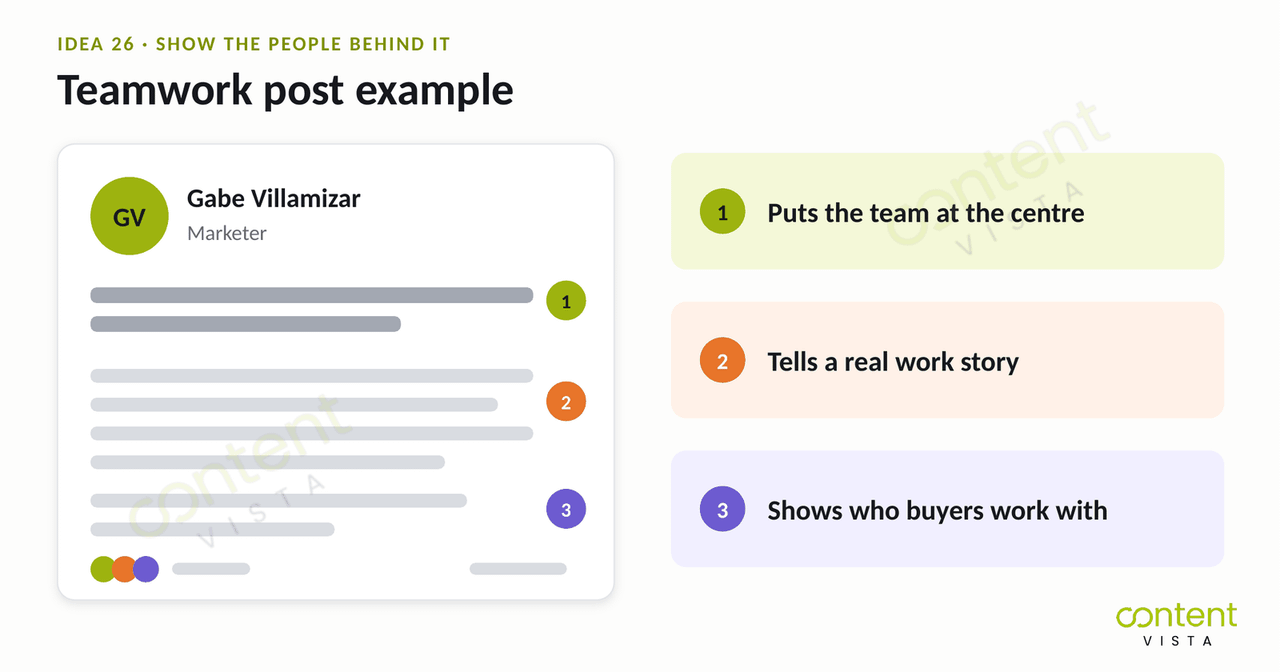
Example: Marketer Gabe Villamizar shared an authentic teamwork story that put colleagues at the centre of the work. See Gabe’s teamwork post on LinkedIn.
What this could look like for your team: “Meet [name], our [role]. Last month she helped [client type] [specific approved outcome]. The part most people didn’t see was [decision/problem she handled]. That’s a good example of what she brings to our client work.”
Why it works: Generic “meet the team” posts often read like internal announcements. Give the reader a reason to care by showing the person’s expertise in action.
A real decision, contribution or client outcome tells a buyer far more than a list of hobbies and favourite foods.
Get permission before sharing client-specific details or results.
Time and format: Quick (~15 min) · image post
27. Share one habit or workflow that changed your output
The job it does: Gives readers a practical look at how you run the business while sharing something they may be able to use themselves.
Try this hook: “One change to how we [work task] gave us back [time/quality gain].”
Example:
What this could look like: “We changed one thing about how we [work task]: [specific workflow change]. Before, [old process/problem]. Now, [new process]. The biggest difference turned out to be [practical effect on the work].”
Why it works: Small operational changes reveal how you think about quality, efficiency and collaboration.
Keep it tied to the work: a better review process, meeting structure, handover or client workflow.
This isn’t the place for a 5 a.m. routine unless waking up at 5 a.m. somehow improves the work your buyer receives.
Time and format: Quick (~15 min) · text post
28. Share the pitch you lost and the lesson
The job it does: Uses a real setback to reveal how you respond to feedback and improve the business.
Try this hook: “We lost a pitch we really wanted. Here’s the feedback that stung and what we changed.”
Example:
What this could look like: “We lost a pitch we really wanted. The feedback was [feedback]. My first reaction was [honest reaction]. Once we looked at it properly, they had a point about [issue]. We’ve since changed [specific part of process/pitch].”
Why it works: The interesting part isn’t that you lost. It’s what you learned once the disappointment wore off.
Explain the feedback, where you agreed or disagreed and what changed as a result.
Avoid naming the prospect or turning the post into an explanation of why they made the wrong decision.
Time and format: Medium (~30-45 min) · text post
29. Share the values call that cost you money
The job it does: Shows what you stand for through a decision with a real consequence, rather than through a list of values on your website.
Try this hook: “We turned down [work/client] last year. Here’s why.”
Example:
What this could look like: “We turned down [work/client] last year even though [why the opportunity was commercially attractive]. The issue was [specific conflict with how you work/what you believe]. Saying no cost us [non-sensitive consequence], but accepting it would have meant [trade-off you weren’t willing to make].”
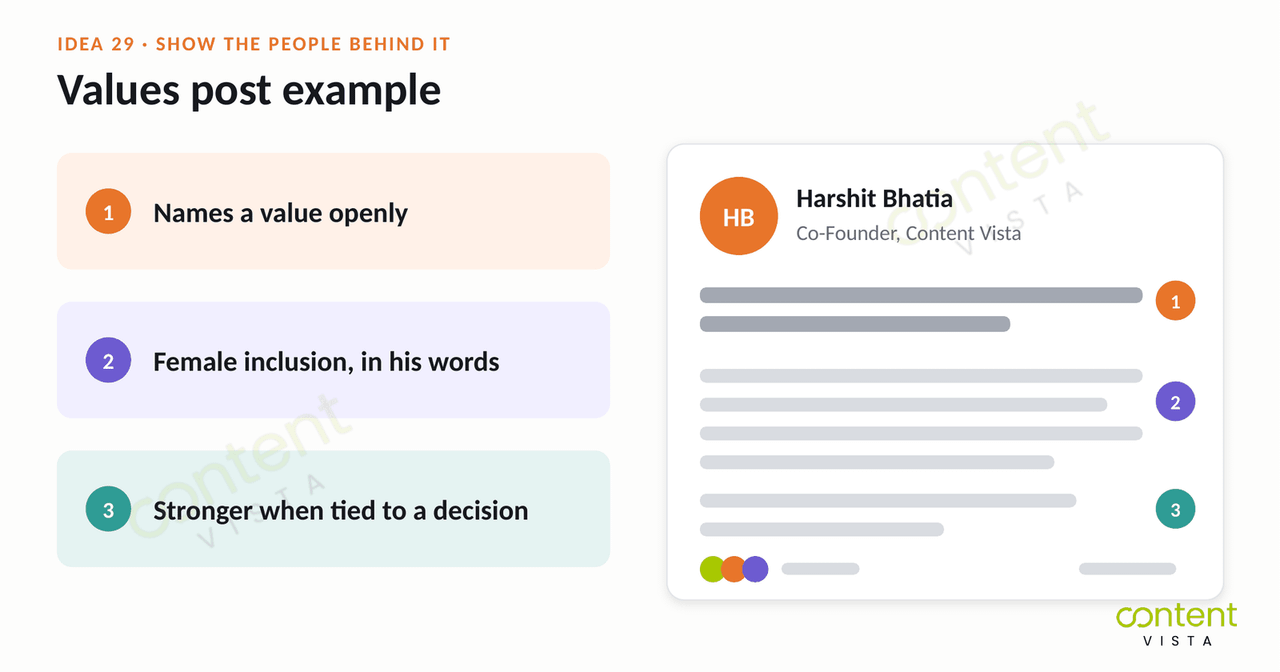
For a related example, here’s our co-founder Harshit Bhatia writing about female inclusion, a value we talk about openly. See Harshit’s post on female inclusion on LinkedIn. If you can tie a value like this to a specific decision, as this idea suggests, the post becomes even more believable.
Why it works: Values become believable when they influence a decision you could reasonably have made differently.
Be specific about the trade-off without exposing confidential details or using the post to make yourself look morally superior.
The reader should be able to see what you would do in a similar situation, not just what you say you believe.
Time and format: Medium (~30-45 min) · text post
Ideas that start useful conversations
These ideas start real conversations, the kind that lead to DMs and calls, without engagement bait.
The test is simple: would you actually read and use the answers? If not, don’t ask the question just to collect comments.
30. Ask peers one specific question you genuinely want answered
The job it does: Gives you real input while creating a natural reason for relevant peers and buyers to talk to you.
Try this hook: “Genuine question for [role]s: how are you handling [specific problem] right now?”
Example:
What this could look like: “Genuine question for [role]s: how are you handling [specific problem] right now? We’ve been seeing [brief observation] in our work and I’m curious whether you’re seeing the same thing. What are you doing differently?”
Why it works: Specific questions attract more useful answers than broad prompts such as “What’s your biggest challenge?”
Give enough context to show why you’re asking, then leave room for people to disagree or share a different approach.
The replies can give you new language, objections and problems to explore in future posts.
Time and format: Quick (~15 min) · text post
31. Run a poll, then post what you learned
The job it does: Turns a low-effort poll into a second post that interprets what your audience told you.
Try this hook: “Last week I asked [number] of you [question]. The answer surprised me.”
Example:
What this could look like: Week 1, a poll: “What’s slowing down [specific decision] in your business right now? [Option A] / [Option B] / [Option C] / Something else (tell me below).” Week 2, the follow-up: “Last week [number] of you answered my poll on [topic]. I expected [option] to win. It didn’t. [Winning option] came out on top, and the comments explained why: [insight]. Here’s what I’d do about it.”
Why it works: The poll itself is only the input.
The more useful content comes afterwards: explain what you expected, what respondents said, where the comments added nuance and what you now think differently.
That gives participants a reason to return and gives everyone else something more useful than a percentage chart.
Time and format: Quick (~15 min) for the poll + Medium (~30-45 min) for the follow-up · poll, then text post
32. Ask for counter-examples to your own view
The job it does: Shows confidence in your thinking without pretending your experience is the only valid one.
Try this hook: “I believe [view]. Prove me wrong: what’s the best counter-example you’ve seen?”
Example:
What this could look like: “I believe [specific view] because [brief reason]. But I’m sure there are situations where the opposite works. What’s the strongest counter-example you’ve seen?”
Why it works: Instead of asking people to agree, you invite them to improve the argument.
That tends to produce a more useful discussion because respondents have something specific to challenge.
If someone changes your mind, saying so is often more interesting than defending the original take at all costs.
Time and format: Quick (~15 min) · text post
33. Use fill-in-the-blank posts only when the answers are useful
The job it does: Makes participation easy while helping you see how people in your market describe a topic in their own words.
Try this hook: “The most underrated skill in [industry] is ______.”
Example:
What this could look like: “The most underrated skill in [industry] is ______. Mine is [your answer], because [one-sentence reason]. Curious what practitioners on the other side of this would choose.”
Why it works: A good fill-in-the-blank question has a purpose beyond collecting replies.
Use it when the answers could reveal priorities, vocabulary or perspectives worth exploring. If you would not read the responses or do anything with what you learn, skip it.
Time and format: Quick (~15 min) · text post
34. Turn your best comment thread into a post
The job it does: Reuses a conversation that has already shown you people care about the subject.
Try this hook: “I left a comment on [topic] last week and the replies went somewhere interesting.”
Example:
What this could look like: “I left a comment on a post about [topic] last week. My point was [view]. Then someone replied with [counterpoint], which made me reconsider [part of the issue]. Here’s where I landed.”
Why it works: You don’t always need a new idea. Comments can be useful testing grounds for arguments, questions and examples.
When a thread develops into something substantial, turn the insight into a standalone post rather than simply screenshotting the conversation.
Credit the original discussion where appropriate.
Time and format: Quick (~15 min) · text post
35. Ask your audience what to cover next
The job it does: Helps you find out what your audience genuinely wants explained instead of guessing at every topic yourself.
Try this hook: “I’m planning my next [number] posts. What should I cover?”
Example:
What this could look like: “I’m planning my next five posts on [specific area]. Which would be most useful: [topic A], [topic B], [topic C] or something I’ve missed?”
Why it works: Narrow the choice enough to get answers you can act on.
Asking “What should I post about?” makes the audience do too much work. Offering three relevant areas makes the question easier to answer while still leaving space for something you have overlooked.
Then close the loop by actually creating content from the responses.
Time and format: Quick (~15 min) · text post or poll
LinkedIn content ideas you can lift from work you already do
These ideas keep you consistent without adding hours to your week. The best content ideas are already sitting in your calendar.
That’s the real issue for most founders: consistency is harder than creativity.
You don’t necessarily need another brainstorming session. You need to notice the useful thinking already happening in sales calls, proposals, client delivery, newsletters and events, then turn it into something another buyer can use.
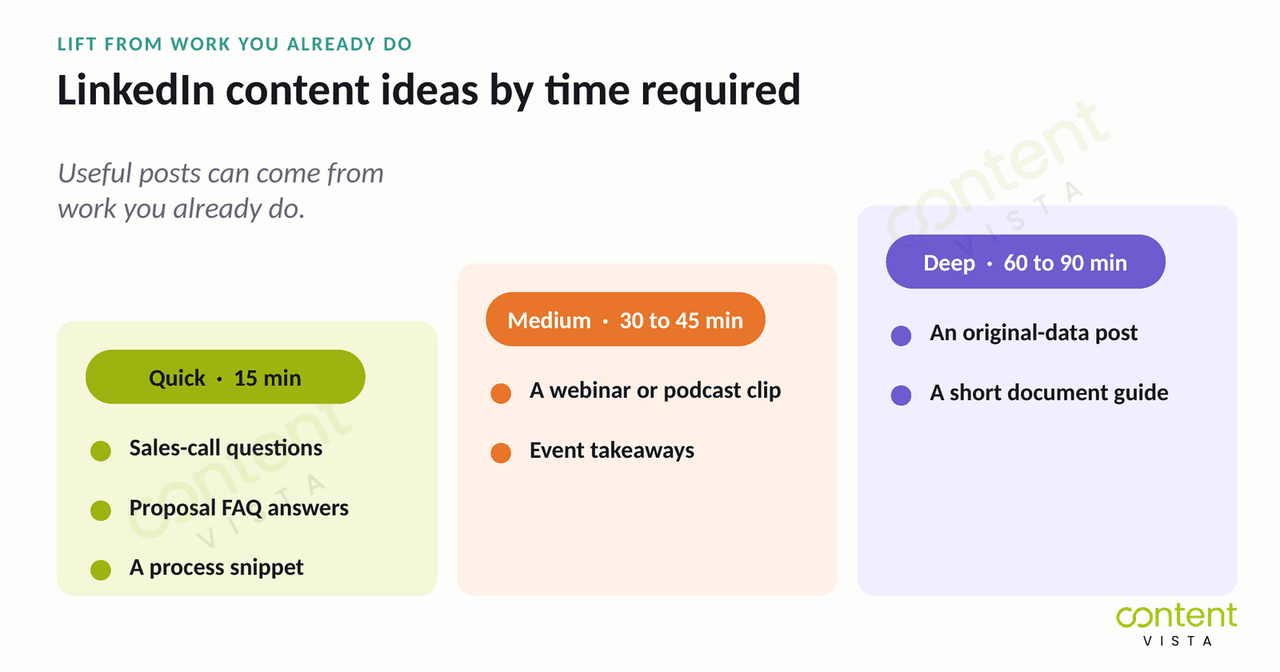
36. Turn this week’s sales-call questions into posts
The job it does: Answers the exact questions buyers are asking right now, using language that comes directly from real sales conversations.
Try this hook: “Three questions I got on sales calls this week and my answers.”
Example:
What this could look like: “Three questions I got on sales calls this week: 1. ‘[Question 1]’ My answer: [short answer]. 2. ‘[Question 2]’ My answer: [short answer]. 3. ‘[Question 3]’ This one comes up more than any other, so here’s the longer answer: [answer].”
Why it works: Sales calls are a live source of content ideas because buyers tell you what they’re unsure about, comparing or trying to solve.
Keep a simple running note of repeated questions. If the same question comes up twice, there is probably a post in it.
Remove anything that could identify the prospect, then answer the question as clearly as you would on the call.
Time and format: Quick (~15 min) · text post
37. Post the answers from your proposal FAQ
The job it does: Handles common objections and practical questions before a prospective buyer reaches the proposal stage.
Try this hook: “Every proposal we send answers these [number] questions. Here’s one of them.”
Example:
What this could look like: “Every proposal we send answers this question: [question]. The short answer is [answer]. But there are two situations where that changes: [situation 1] and [situation 2]. Here’s how we’d decide.”
Why it works: If a question matters enough to appear repeatedly in proposals, other prospective buyers are probably wondering about it too.
Look for questions around processes, timelines, responsibilities, trade-offs or what happens next. Explain the answer rather than copying proposal language into LinkedIn.
Time and format: Quick (~15 min) · text post
38. Clip a moment from a webinar or podcast you’ve done
The job it does: Reuses your best spoken thinking instead of leaving it buried inside a longer recording.
Try this hook: “I said this on [show] last month and people kept asking about it.”
Example:
What this could look like: Take a short clip where you answer one clear question or make one useful argument. Introduce it with: “I said this on [show] last month: [one-sentence takeaway]. Here’s the part I’d want a [buyer type] to hear.”
Why it works: You have already done the thinking. The job now is extraction.
Pick a clip that makes sense without watching the entire conversation. Add enough written context to tell readers why it matters rather than posting a video with “Great conversation with [name].”
Time and format: Medium (~30-45 min) · native video
39. Turn a newsletter issue into a post
The job it does: Gets more mileage from your deeper thinking by adapting one useful argument for people who may never see the original newsletter.
Try this hook: “From this month’s newsletter: [key insight].”
Example:
What this could look like: “In this month’s newsletter I wrote about [topic]. The part readers replied to most was this: [key insight in one or two lines]. Here’s the short version for LinkedIn: [three practical points]. The full issue goes deeper on [what the newsletter covers].”
Why it works: Don’t paste the whole newsletter into LinkedIn. Pull out one argument, example or question that can stand on its own and rewrite it for the feed.
One strong newsletter can produce several posts without repeating the same piece word for word.
Here’s a fuller process for how to turn your newsletter into posts.
Time and format: Quick (~15 min) · text or document post
40. Share a snippet from your client onboarding notes or process docs
The job it does: Shows prospective buyers how organised working with you is before they experience the process themselves.
Try this hook: “Here’s the first thing every new client gets from us.”
Example:
What this could look like: “Here’s the first thing every new client gets from us: [non-confidential checklist/process snippet]. It covers [item], [item] and [item]. We started using it because [problem it prevents].”
Why it works: Internal documents contain practical expertise that rarely makes it into marketing content.
A useful onboarding checklist, briefing question or process note can show how you prevent problems and set expectations.
Strip out client names, private data, commercial terms and anything else confidential before sharing.
Time and format: Quick (~15 min) · image or document post
41. Recommend a book or resource you’d hand a client (with your take)
The job it does: Shows your taste and judgement by explaining why a resource matters rather than simply recommending it.
Try this hook: “If you’re a [buyer] dealing with [problem], read [resource]. Here’s the one chapter that matters.”
Example: Sahil Shah, founder of Netsavvies Media Co., used a post to recommend a podcast to his network. The recommendation is the hook; what makes a post like this useful is your view on who it’s for and what to take from it. See Sahil’s podcast recommendation on LinkedIn.
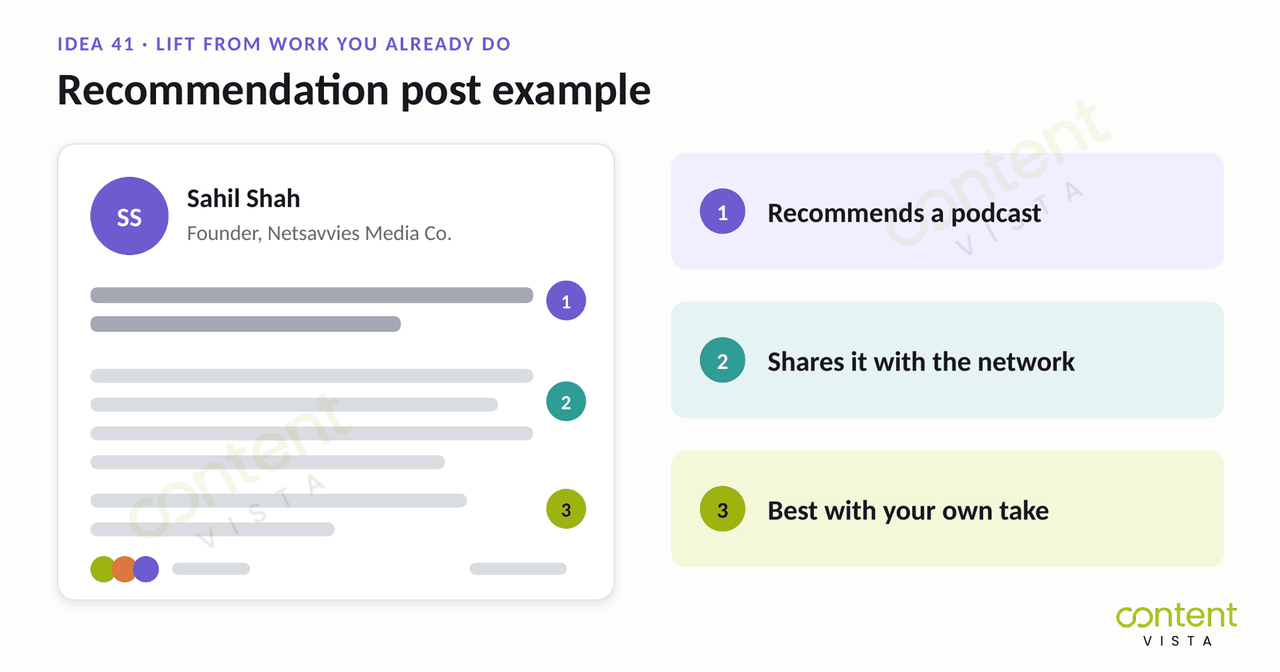
What this could look like for you: “If you’re a [buyer] dealing with [problem], I’d hand you [resource]. Start with [chapter/section] because it explains [specific idea]. The part I’d apply immediately is [your takeaway].”
Why it works: Curation becomes useful when you add a point of view.
Explain who the resource is for, which part deserves their attention and how you would apply it. Your interpretation is the content, and the recommendation is simply the starting point.
Time and format: Quick (~15 min) · text post
42. Share event takeaways for people who weren’t there
The job it does: Turns the time you spend at an event into useful information for people who could not attend.
Try this hook: “I spent [time] at [event]. Here are the [number] things worth knowing.”
Example: Kristen Rae Pucci, Principal at KRAE Consulting, shared her experience of an event she attended in a short, well-crafted post. See Kristen’s event post on LinkedIn.
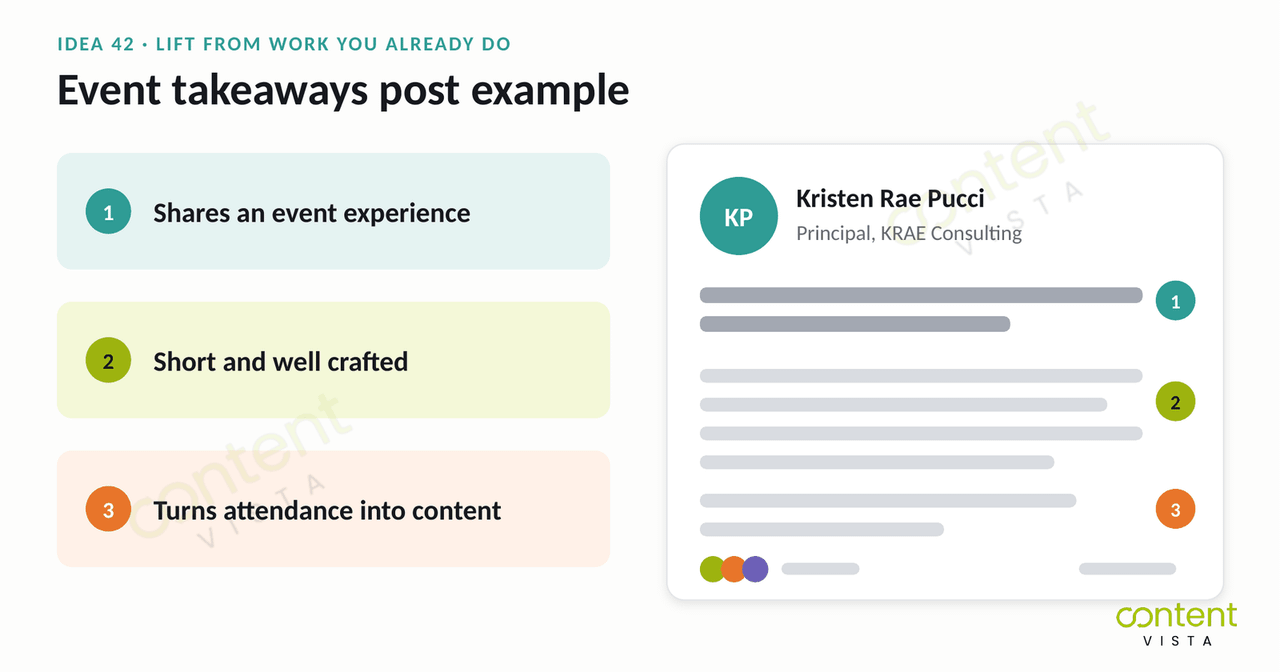
What this could look like for you: “I spent [time] at [event]. If you’re a [buyer/role] who wasn’t there, these are the three points I’d take away: [takeaway 1], [takeaway 2], [takeaway 3]. The one I’m still thinking about is [point], because [your interpretation].”
Why it works: Skip the venue photos and “great networking” recap unless they add something.
Filter the event through your buyer’s priorities: what changed, what surprised you, what people disagreed about and what deserves attention next. That turns attendance into useful analysis.
Time and format: Medium (~30-45 min) · text or document post
A note on using AI for LinkedIn content
Use AI to help draft, structure and edit a post. Keep the underlying idea yours.
Originality.ai’s July 2026 analysis of 5,000 long-form LinkedIn posts estimated that 81.2% were likely AI-generated.
That’s exactly why your own work is such a useful source: nobody else has your sales calls, projects, client questions or operating decisions.
AI can speed up writing. The thinking should still be yours.
Our Founder & Executive Positioning work turns what you know into a consistent LinkedIn presence and newsletter that brings buyers to you.
Where to start: LinkedIn post ideas for founders, consultants, agencies and B2B SaaS
You don’t need to use all 42 ideas.
Start with three that fit how your business earns trust and what a prospective buyer needs to understand before choosing you.
| If you’re a… | Start with these ideas | Why |
|---|---|---|
| Consultant or coach | #3 the mistake buyers make · #11 what I’d do in your seat · #36 sales-call questions | Your judgement is the product, so show it in action |
| Agency founder | #16 client result breakdown · #18 project teardown · #7 red flags buyers should watch for | Buyers are comparing agencies; proof and process separate you |
| B2B SaaS founder | #8 a problem buyers keep running into · #14 data only you have · #24 build in public | Teach the problem before you sell the product |
| Service-business owner | #12 the question you get every week · #20 a client’s own words · #26 team spotlight | Trust and familiarity win local and service buyers |
For consultants and coaches, that means making your judgement visible: show how you diagnose a problem, what you would recommend and how you answer the questions prospects already ask.
For an agency founder, proof matters more: show the work, the process behind it and the warning signs buyers should understand before choosing a partner.
B2B SaaS founders can start one step earlier. Instead of making every post about the product, teach buyers to understand the problem, use proprietary or first-hand data when you have it and share the decisions you’re making as you build.
For service-business owners, familiarity matters too: recurring customer questions, genuine client feedback and the people doing the work are strong places to start.
Three ideas are enough to begin. Use them repeatedly with different problems, examples and lessons rather than trying a completely different style every time.
Deciding which ideas to prioritise for your goals is a bigger question. See our guide on what to post on LinkedIn.
Ideas to retire in 2027
Some LinkedIn post ideas are still recommended across the internet because they are easy to execute or once helped generate visible engagement.
But visible activity is not the same as buyer attention.
Some of these tactics cost you time, attract the wrong interactions or can actively work against how you want prospective buyers to perceive you.
The mistake is simple: optimising the post for reactions instead of making it useful to the people you actually want to reach.
| Retire this | Why | Do this instead |
|---|---|---|
| “Comment GUIDE and I’ll send it to you” | LinkedIn said in March 2026 that it is reducing engagement bait in the feed, and the comments rarely come from buyers | Share the useful part in the post itself (#9, #15) |
| Posts built around trending hashtags | A trending hashtag says nothing about your expertise and pulls you towards topics your buyers may not care about | Pick a topic your buyers care about (#8) |
| Memes and generic motivational quotes | They entertain peers but say nothing about how you think | A contrarian take with evidence (#1) |
| “Good morning” posts and holiday filler | Easy to post, impossible to remember | Build in public (#24) |
| “Here’s a growth hack” | Tricks attract people looking for shortcuts, not buyers looking for partners | The process you actually use (#13) |
| Tagging well-known people for reach | It reads as borrowing attention and annoys the people you tag | Turn your best comment thread into a post (#34) |
| Engagement pods | Artificial engagement from people who will never buy | Ask peers a real question (#30) |
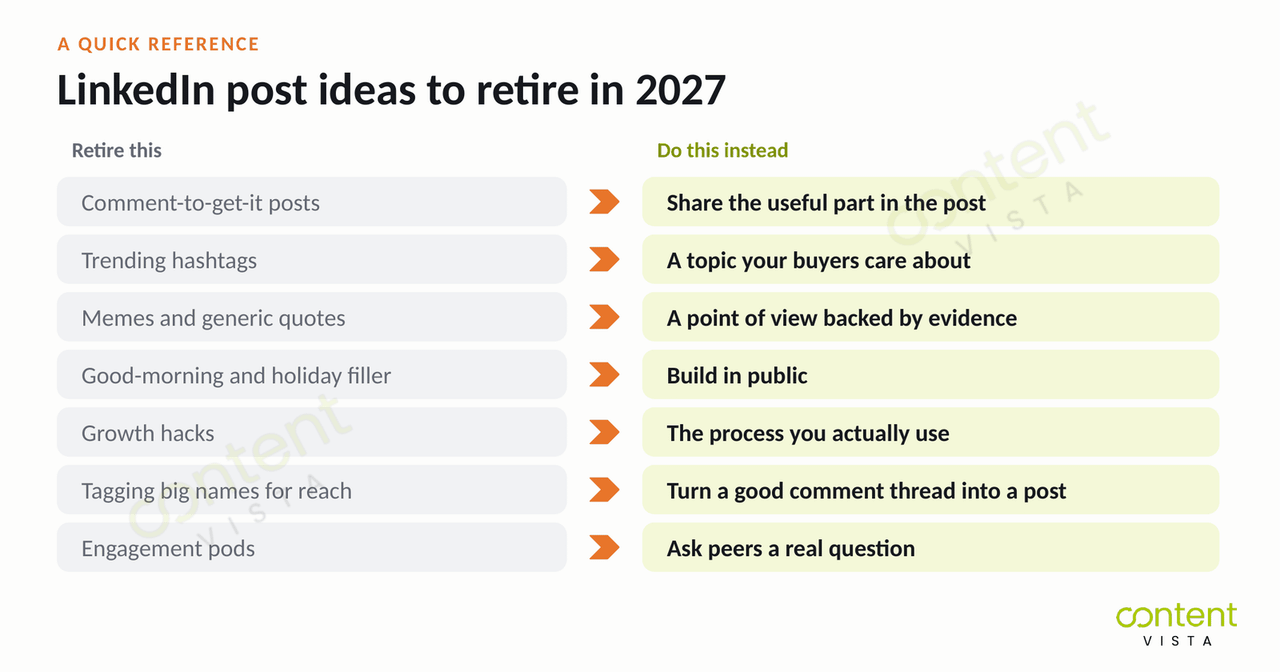
On engagement bait specifically, LinkedIn’s March 2026 feed update named “comment to agree” style prompts among the repetitive, low-substance posts it is working to reduce.
This is not an argument for making every LinkedIn post serious, educational or directly commercial. A founder’s personality can be part of why people remember and trust them.
The distinction is whether the post gives the intended audience something worth taking away: an idea, an observation, a useful question, a glimpse into how you work or a reason to remember you.
That also means you do not need to delete every hashtag, stop celebrating company moments or refuse to post something simply because it is fun. The point is to stop treating those things as a content strategy on their own.
None of this means you can’t be human or have fun on LinkedIn. It means every post should still do something for the people you want to work with.
LinkedIn “rules” you’ll hear about, checked
You’ll see the 95-5, 4-1-1 and 3-2-1 “rules” repeated in LinkedIn advice. The problem is that their origins and meanings often get lost along the way.
Here’s where each one comes from, what it actually says and how much weight it deserves when deciding what to post.
| Rule | What people say | Where it comes from | How much weight to give it |
|---|---|---|---|
| The 95-5 rule | Post 95% value, 5% promotion | Professor John Dawes, Ehrenberg-Bass Institute, for the LinkedIn B2B Institute (2021). It’s about buyers, not posts: roughly 5% of B2B buyers are in-market at any time | Useful as a reminder that most readers will buy later. It’s a heuristic and it was never a posting ratio |
| The 4-1-1 rule | For every self-promotional post, share four useful pieces of content and one re-share | Coined by Andrew Davis of Tippingpoint Labs and Joe Pulizzi as a Twitter-era guideline for sharing links, documented in 2012 | No evidence base for LinkedIn. Founders win with original thinking, not curation |
| The 3-2-1 rule | Three educational, two personal, one promotional or, in another version, engage with three posts and comment on two | No single source. Several conflicting versions circulate | A rough mix prompt at most. The lack of one definition tells you it isn’t a rule |
If you want to check the origins yourself, see the Ehrenberg-Bass Institute’s write-up of the 95:5 rule and Contently’s 2012 explainer on where the 4-1-1 rule came from.
Here’s the thing: these ratios can feel useful because they remove a decision. Instead of asking what your buyers need to hear, you simply fill the next slot in the formula.
But a founder selling expertise, software or a high-consideration service needs more flexibility than that.
The useful question isn’t “Have I hit my educational-post quota?” It’s “What does the right buyer need to understand, believe or see from me next?”
The same caution applies to posting frequency. You’ll often hear that two or three posts a week outperform posting more frequently, but the largest study available does not support that as a universal rule.
Buffer’s 2025 analysis of more than 2 million LinkedIn posts from 94,000+ accounts found that impressions per post increased with posting frequency.
That doesn’t mean you should post every day. It means there isn’t a magic number that works for every founder.
The practical answer is to post as often as you can sustain while still having real ideas worth sharing. For a deeper look at the evidence and trade-offs, see how often to post.
When more ideas won’t help
There is a point where another list of LinkedIn post ideas won’t solve the problem.
If someone reads five of your posts and still can’t tell who you help, what problems you understand or what you want to be known for, the issue isn’t a shortage of content ideas. It’s positioning.
More posting can actually make that lack of clarity more visible.
Before increasing your output, look across your recent posts as a buyer would. Is there a recognisable area of expertise?
Do your examples consistently speak to the kinds of problems you want to be hired to solve? Would someone know when to recommend you?
If the answer is no, work on the positioning before worrying about another content ratio or posting schedule.
That’s the role of founder and executive positioning: making the expertise behind the content clear enough for the right people to recognise and remember.
LinkedIn post ideas FAQs
What are good LinkedIn post ideas for founders?
Good LinkedIn post ideas for founders do a business job: show how you think, teach what buyers are stuck on, prove results, show the people behind the work, start useful conversations or reuse work you’re already doing.
You don’t need all 42 ideas at once. Start with three that fit your business and buyers.
What’s the difference between LinkedIn post ideas and LinkedIn content ideas?
Very little in practice. “LinkedIn content ideas” usually refers to the broader themes you return to, while “LinkedIn post ideas” are the individual posts you publish within those themes.
On this page, the six groups give you recurring themes, while the 42 individual ideas give you specific posts to create.
What is the 95-5 rule on LinkedIn?
The 95-5 rule isn’t a rule to post 95% value and 5% promotion. Professor John Dawes developed the heuristic for the LinkedIn B2B Institute in 2021: roughly 5% of B2B buyers are in-market at a given time.
You can read the Ehrenberg-Bass Institute’s summary of the 95:5 rule. For founders, the practical takeaway is that most readers may buy later, so post to be remembered.
What is the 4-1-1 rule on LinkedIn?
The 4-1-1 rule says that for every self-promotional post, you should share four useful pieces of content and one re-share. It was coined by Andrew Davis of Tippingpoint Labs and Joe Pulizzi as a Twitter-era link-sharing guideline.
There isn’t an evidence base showing founders should use that ratio on LinkedIn, so don’t treat it as a posting formula.
What is the 3-2-1 rule on LinkedIn?
There isn’t one agreed 3-2-1 rule for LinkedIn. One version recommends three educational posts, two personal posts and one promotional post; other versions describe completely different activities.
That lack of a consistent definition is the clue: use it as a rough prompt for variety if useful, not as an evidence-backed rule.
What kinds of LinkedIn posts perform best?
There isn’t one universally “best” LinkedIn post format. Format studies can disagree and often analyse company pages rather than founder accounts.
For founders, a more useful test is whether the right people spend time with the post and contribute thoughtful comments. LinkedIn’s own feed-ranking research describes predicting exactly those kinds of actions: long reading time, likes, comments and shares. See LinkedIn post types and formats.
How often should founders post on LinkedIn?
Post as often as you can sustainably produce ideas worth reading. Buffer’s analysis of more than 2 million LinkedIn posts found that impressions per post increased as posting frequency increased.
That doesn’t mean everyone should post daily. It means there isn’t a universal two-or-three-times-a-week rule. Consistency beats short bursts. See how often to post.
Can I use AI to write my LinkedIn posts?
Yes. Use AI to help draft, structure or edit your LinkedIn posts, but keep the underlying idea your own.
Originality.ai’s July 2026 analysis estimated that 81.2% of long-form LinkedIn posts were likely AI-generated. Your sales calls, projects, mistakes, customer questions and first-hand observations are much harder for someone else to replicate.
Do hashtags still help on LinkedIn?
The evidence is mixed. A 2025 peer-reviewed study of 991 LinkedIn posts found that posts with tags and hashtags were associated with more reactions.
So one or two relevant hashtags for context won’t hurt. What doesn’t work is building a post around whatever hashtag happens to be trending. Start with a topic your buyers care about instead.
Should I put links in my LinkedIn posts?
Yes, when the link genuinely helps the reader. There is no confirmed LinkedIn figure proving a universal “link penalty,” so don’t treat avoiding links as an algorithm rule.
Make the post valuable enough to stand alone, then judge whether including a link works from your own results. See how the LinkedIn algorithm works.
Pick three ideas and start this week
You don’t need to use all 42 ideas. Pick posts by the job they need to do, start with three that fit your business and look first at the work you’re already doing for useful material.
Retire the bait and put that time into posts that help the right buyers understand how you think, what you know and what working with you might look like.
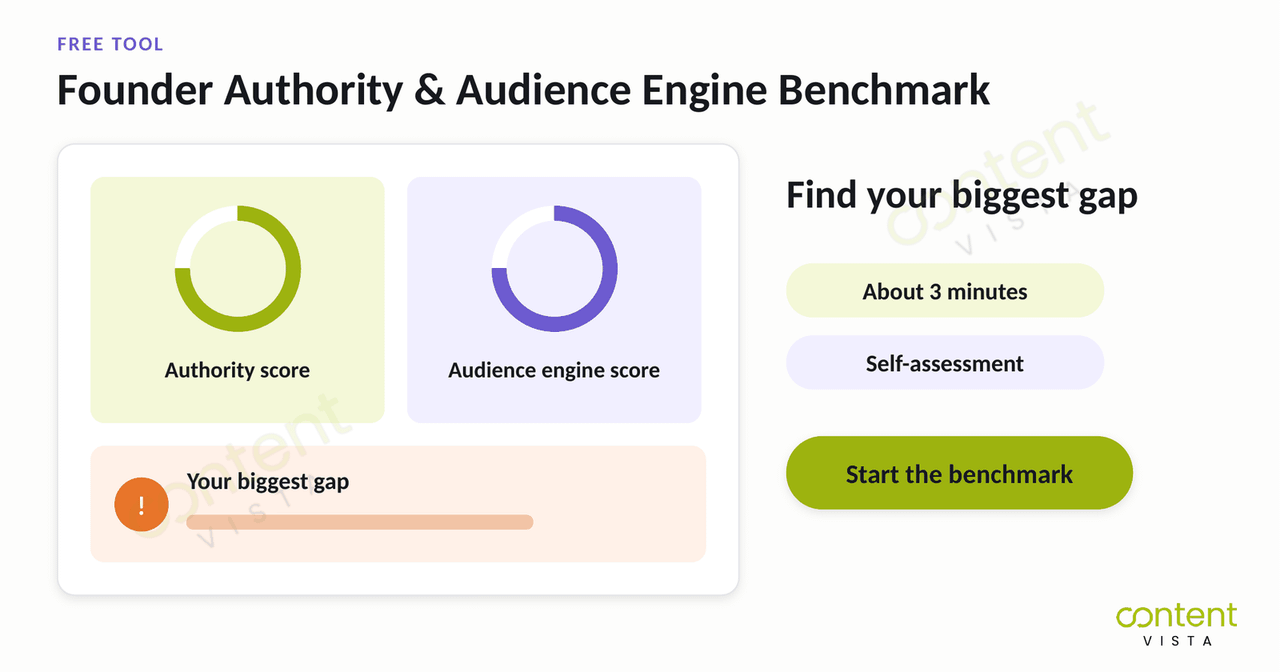
The Founder Authority & Audience Engine Benchmark shows your authority score, your audience engine score and your biggest gap in about three minutes. It’s a self-assessment: it doesn’t scan your LinkedIn profile.
Benchmark my founder authorityWant help turning your expertise into a steady presence? See how we work on founder and executive positioning.