Quick Summary
- LinkedIn has 12 post formats. Choose each one based on the job you need it to do.
- Document (PDF) posts lead on reach and saves for personal profiles.
- Images and longer, substantive text posts perform strongly on engagement.
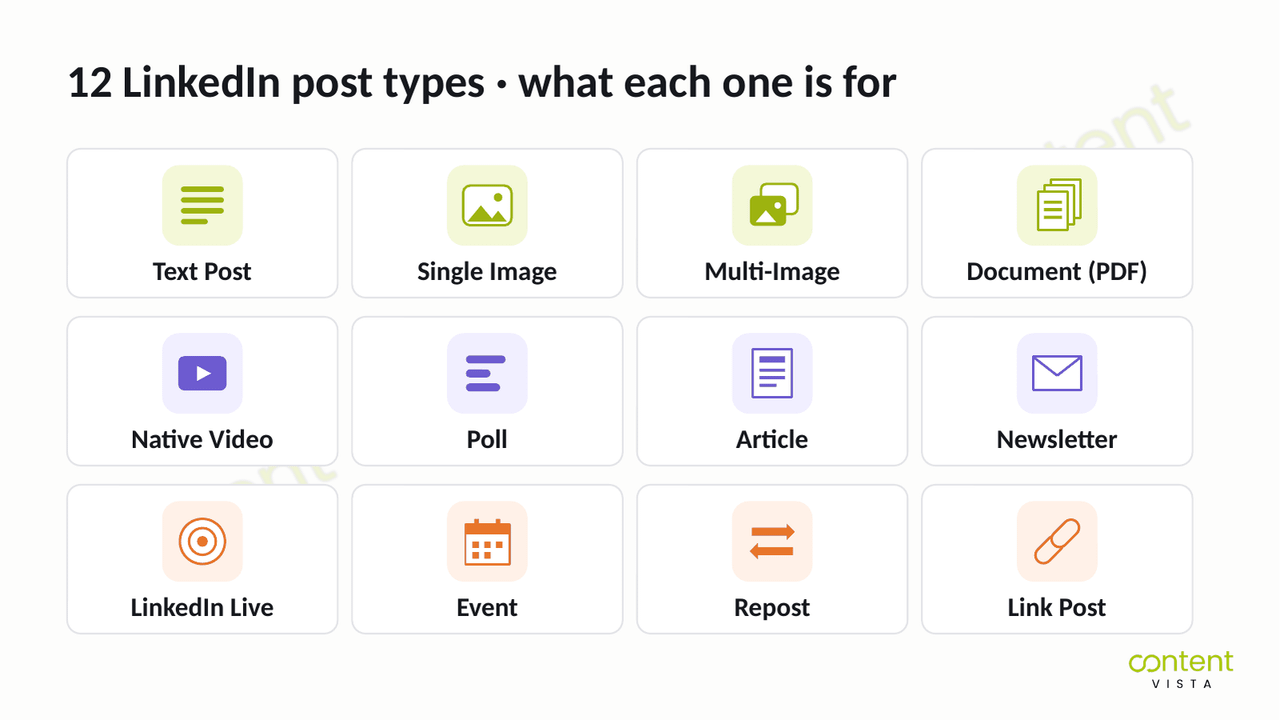
LinkedIn has 12 post formats you can use today, from text posts and images to PDF documents, videos, polls, newsletters and events. There are also a few share-box options, but those aren't really content formats.
Here's the problem: most guides to LinkedIn post types tell you what's available. Very few help you decide what's worth your time.
And if you're a founder or executive, that's the question that matters.
You're not posting just to collect impressions or grow a follower count. You want the right people to recognise your expertise, trust your perspective and remember you when they need what your business offers.
That changes how you should choose a format.
A document post might help you explain a complex idea. A text post might start a conversation with a potential buyer. A newsletter might keep you visible to people who aren't ready to buy yet.
But not every format deserves a place in your content strategy.
This guide breaks down all 12 LinkedIn post formats, including their current specifications, what each works best for and when you should avoid using them.
You'll also learn which features LinkedIn has discontinued, what recent performance studies actually show, and why the format getting the most reach isn't necessarily the one building the most credibility.
The goal is simple: help you spend less time guessing what to post and more time becoming known for something valuable.
What are the different types of LinkedIn posts?
LinkedIn has 12 main post formats, including text, images, documents, video, polls, articles and newsletters. But choosing the right type isn't just about knowing what's available. It's about understanding what each format helps you achieve.
LinkedIn post types are the different ways you can publish content on LinkedIn. There are two layers: the format you choose (text, image, document, video, poll, article, newsletter, Live, event, repost or link) and the content type you share within it, such as a story, how-to guide, opinion, client example or research finding.
For founders, that distinction matters.
You can share a valuable insight in a text post, turn it into a downloadable PDF document or explain it in a short video. The underlying expertise hasn't changed. Only the way people experience it has.
And different formats serve different purposes.
Some are better suited to getting your ideas discovered. Others help people understand how you think, encourage meaningful comments or give interested buyers something they can return to later.
Here's a quick reference to help you choose.
| Format | What it is | Best job it does | Founder verdict |
|---|---|---|---|
| Text post | Written post, up to 3,000 characters | Building credibility and starting conversations | Your everyday workhorse. Write longer than you think. |
| Single-image post | One photo or graphic with text | Getting comments and conversation | Low effort, high return. Use real photos of real work. |
| Multi-image post | Up to 20 images in one post | Showing a moment, event or project | Great for moments, weaker for teaching |
| Document post (PDF "carousel") | Uploaded PDF, PPT or DOC that readers swipe through | Reach, saves and teaching | The best authority-per-hour format for most founders |
| Native video | Video uploaded directly to LinkedIn | Showing your thinking and personality | Worth it when it's substantive. Otherwise, skip it. |
| Poll | A question with up to four answer options | Quick visibility and buyer research | Good for visibility, weak for authority |
| Article | Long-form piece published on LinkedIn | A reference you can point people to | A useful reference shelf with limited reach |
| Newsletter | Recurring long-form series people subscribe to | Building a subscriber audience | The best depth format, if you can keep a schedule |
| LinkedIn Live | Scheduled live video broadcast | Real-time conversation with your market | Powerful, but only with a reason to go live |
| Event | An online or in-person event page people can register for | Turning interest into registrations | Use it when you actually have an event |
| Repost | Sharing someone else's post, with or without your thoughts | Supporting others | A generous gesture that won't build your authority on its own |
| Link post | A post that shares an external URL | Sending people to your site | Make the post stand on its own, or expect less reach |
LinkedIn also offers three share-box utility options: Celebrate an occasion, Share that you're hiring and Find an expert. These serve specific purposes but aren't really content formats. We'll cover them separately later.
One thing worth keeping in mind: you don't need to use all 12 formats.
A founder who consistently shares useful thinking through text posts and documents may build more relevant authority than someone experimenting with every format without a clear purpose.
The better starting point is to decide what you want people to understand, remember or do after seeing your content. Then choose the format that delivers that outcome with the least unnecessary effort.
If you're building your broader LinkedIn approach from scratch, start with our guide to LinkedIn content strategy for founders. This article focuses on one specific part of that strategy: choosing the right post formats.
Format vs content type: the difference most guides blur
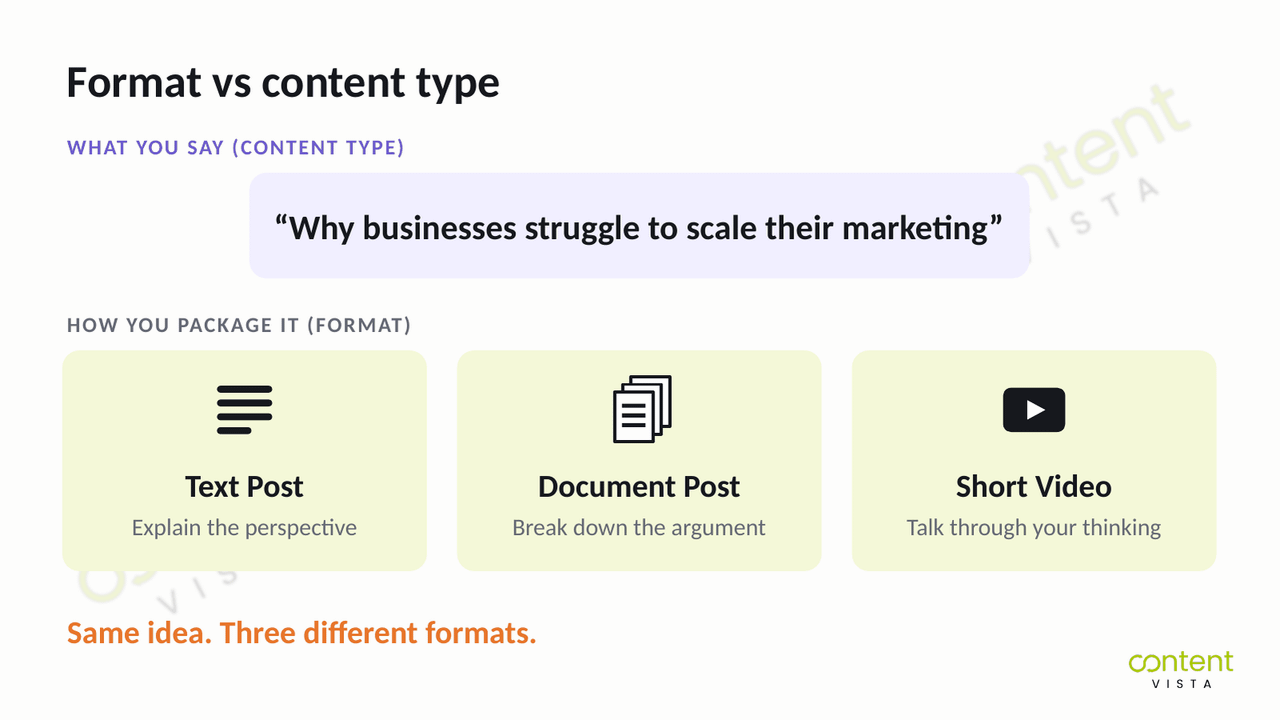
A LinkedIn post format is how you present your content. A content type is what you're actually saying. They're two different decisions, and understanding the difference makes choosing what to publish much easier.
Here's where the confusion starts.
When someone recommends posting more "educational content", they're talking about a content type. When they recommend more "carousels", they're talking about a format.
Those aren't interchangeable.
Think about it this way: you're a founder with a strong opinion about why businesses struggle to scale their marketing.
You could share that exact perspective in three ways:
Text post: Explain your argument in a few substantive paragraphs, with an example from your experience.
Document post: Break the argument into a series of slides showing the problem, its causes and your recommended approach.
Short video: Explain the same perspective directly to camera, so people can hear how you think about it.
The underlying idea stays the same. Only the delivery changes.
Here's how common content types translate into different LinkedIn formats.
| Content type | Formats it travels well in |
|---|---|
| How-to or teaching | Document post, text post, video |
| Story or lesson learned | Text post, single image, video |
| Point of view or contrarian take | Text post, document post, newsletter |
| Proof (client result, case, behind the scenes) | Single image, multi-image, document post |
| Data or research | Document post, single image, article |
| Conversation starter | Text post, poll |
So what does that mean for your LinkedIn strategy?
Decide what you want to say before deciding how to package it.
If you're sharing a personal lesson, a text post may communicate it perfectly. If you're explaining a process with several steps, a document post could make it easier to follow.
If your delivery and personality add something important, video might be worth the extra effort.
Don't create a PDF carousel simply because you've heard carousels perform well. Start with an idea worth sharing, then choose the format that helps people understand it.
Need things to actually say? Our guide to LinkedIn post ideas for founders groups ideas by the job they do.
Which LinkedIn post type should you use? Start with the job
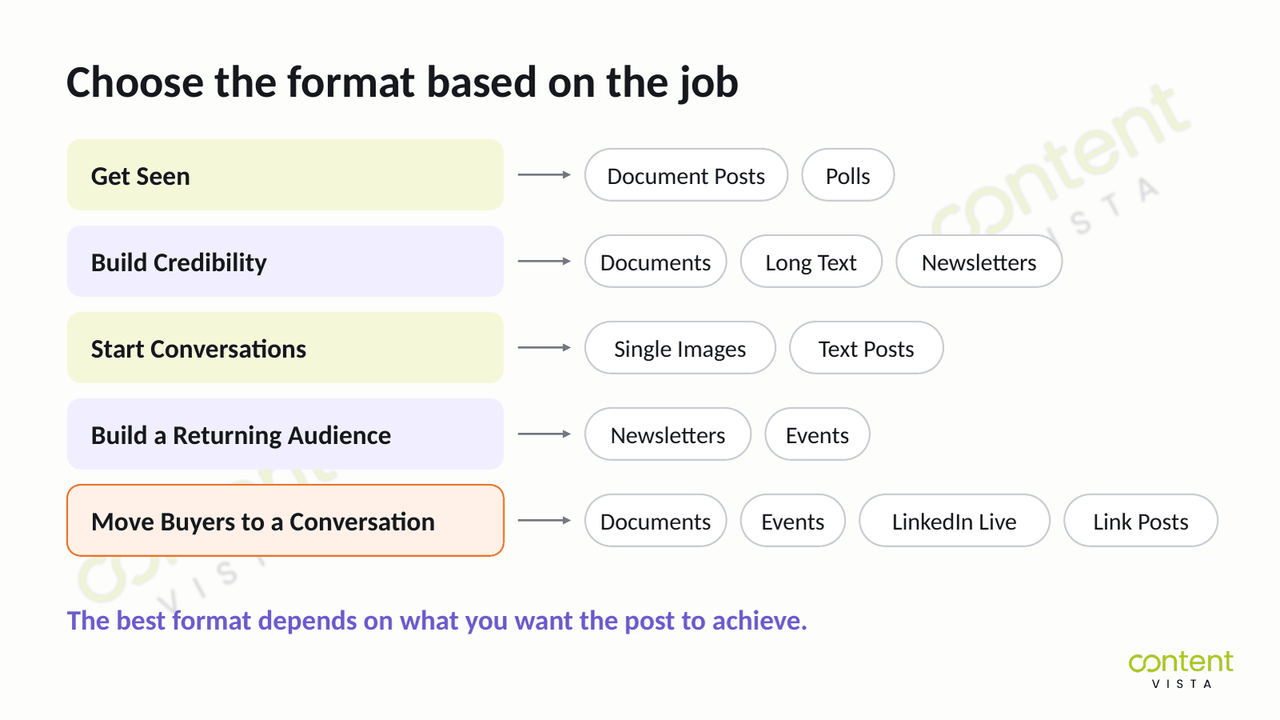
Choose your LinkedIn post format based on what you need the post to achieve. Picking formats at random, or because they're trending, is how founders end up publishing regularly without becoming known for anything specific.
Before creating a post, ask yourself one question: What should happen because someone sees this?
Do you want more of the right people to discover you? Do you want potential buyers to understand your expertise? Are you trying to start a conversation, build a subscriber audience or move an interested buyer closer to speaking with you?
Those are different jobs. And they don't all need the same format.
This matters particularly when you're selling expertise, consulting or complex services.
The 2025 Edelman–LinkedIn B2B Thought Leadership Impact Report found that 95% of hidden buyers, people involved in purchasing decisions whom a seller may never meet, are more receptive to outreach after seeing strong thought leadership.
The report was based on a survey of 1,934 respondents and was co-produced with LinkedIn.
So what's the implication? Your content needs to give the right people a reason to trust your thinking before they ever speak to you. Publishing more won't do that on its own.
Match the format to the outcome
Let's make this practical. The comparison below connects five common founder objectives to the formats most suited to them, using available performance evidence.
| The job you need done | Formats that fit best | What the evidence says | Watch out for |
|---|---|---|---|
| Get seen by more of the right people | Document posts, polls | For personal profiles, documents reached 1.39x and polls 1.78x a profile's usual reach (AuthoredUp, 3M+ posts, Mar 2025–Feb 2026). | Polls get reach but very little conversation. |
| Build credibility with buyers | Document posts, long text posts, newsletters | Documents account for under 5% of posts but nearly 13% of all saves; text posts of 20+ sentences outperform shorter ones on reach and engagement (AuthoredUp). | Thin slides or short one-liner posts can undercut credibility. |
| Start conversations | Single-image posts, text posts | Images had the highest engagement multiplier for personal profiles at 1.33x (AuthoredUp). | LinkedIn says it is reducing the reach of engagement bait, such as "comment to agree" prompts. |
| Build an audience that keeps coming back | Newsletters, events | LinkedIn newsletter subscribers receive notifications of new editions; event registrants provide an audience for relevant follow-up. | Both require a schedule you can realistically maintain. LinkedIn newsletter subscribers stay on LinkedIn's platform, so they aren't an email list you control. |
| Move buyers toward a conversation | Document posts, events, LinkedIn Live, link posts to your best content | No independent study directly links these formats to pipeline. Track inbound messages and answers to "Where did you hear about us?" | Link posts on personal profiles tend to receive less reach. |
The important distinction is between attention and buyer interest.
A poll might reach more people, but that doesn't mean those people understand what you do. A detailed document might attract fewer reactions yet give a prospective buyer a reason to save your thinking and revisit your profile.
Neither outcome automatically becomes a sales opportunity.
The evidence has a limit: no independent study cited here establishes that a particular organic LinkedIn format directly produces more meetings, deals or revenue.
Most available studies measure reach, engagement and saves. Treat those as early indicators, then look for what follows: relevant profile visits, messages from potential buyers and conversations that reference your content.
You also need a posting routine you can maintain.
The practical takeaway? Start with the job, choose a format that suits it, and judge success by the response you wanted to create. A smaller audience of relevant buyers can be more valuable than a large audience that never needs your expertise.
Choosing formats is one piece of the puzzle. Want to know whether your expertise is actually turning into authority and audience? The Founder Authority & Audience Engine Benchmark takes about three minutes and helps identify your biggest gap.
The 12 LinkedIn post types, explained for founders
Not every LinkedIn format deserves an equal share of your time. These 12 formats run roughly from the everyday options most founders can use consistently to the more specialised ones that work best for particular goals.
For each, we'll cover the practical specifications, what it's good for, how you might use it, what the available evidence says, and when the effort isn't worth it.
The effort ratings are our own editorial judgement, based on the time a founder typically needs to produce each format well.
1. Text posts
LinkedIn text posts can contain up to 3,000 characters, according to LinkedIn Help. Only the opening lines appear in the feed before readers need to click "see more". LinkedIn doesn't publish a fixed character count for that cut-off.
What they're best for: Sharing a point of view, explaining a lesson or telling a story. Text posts are one of the simplest ways to demonstrate how you think without needing a designer or video editor.
How a founder would use them: Suppose a prospect asks during a sales call, "Why hasn't hiring more salespeople improved our revenue?" Instead of turning that into a promotional post, explain the factors you'd examine before recommending another hire.
You're showing your judgement. That's more persuasive than any advert.
What the data says: In AuthoredUp's analysis of more than 3 million personal-profile posts published between March 2025 and February 2026, text posts achieved 1.07 times a profile's usual reach but only 0.78 times its usual engagement.
Length made a difference. Posts containing 20 or more sentences achieved 1.14 times usual reach and 1.18 times engagement. Posts with fewer than five sentences achieved just 0.64 times usual reach.
That doesn't mean every post should be long. It suggests that substance deserves more attention than the familiar advice to keep everything short.
When not to use them: If your explanation needs diagrams, comparisons or several sequential steps, a document post will probably make it easier to understand.
Founder verdict: Your everyday workhorse. Write substantive posts rather than forcing every insight into a catchy one-liner. · Effort: Low.
The opening lines still matter. For a deeper treatment, see how to write LinkedIn captions and hooks.
2. Single-image posts
A single-image post combines one photograph or graphic with accompanying text. LinkedIn for Nonprofits recommends images of at least 552 × 276 pixels and no larger than 5 MB.
LinkedIn Help also notes that a post can display images or a link preview, but not both.
What they're best for: Making an insight visual, showing evidence of real work and encouraging conversation.
A genuine photograph can give your written point context that a generic graphic cannot.
How a founder would use them: Imagine you've just finished a client workshop. You photograph the whiteboard showing how the team mapped its biggest operational bottleneck, then explain one lesson from the exercise.
You don't need to reveal confidential client information. The value comes from showing how you approach a problem.
What the data says: AuthoredUp's study of personal-profile posts found that image posts, combining single-image and multi-image formats, achieved 1.20 times usual reach and 1.33 times usual engagement.
Images also represented 57.16% of all posts in that dataset, making them the most commonly used format.
LinkedIn's own undated guidance claims that posts containing at least one image typically receive twice as many comments. Treat that as LinkedIn's own claim. No independent study has confirmed it.
The important limitation is that AuthoredUp groups single and multiple images together, so these figures cannot isolate single-image performance.
When not to use them: Avoid stock photographs, decorative images and generic quote graphics that add nothing to your actual message.
A picture of two people shaking hands doesn't demonstrate expertise. A photograph of your genuine work might.
Founder verdict: Low effort, strong potential for conversation. Prioritise real photographs and useful visuals over polished but empty graphics. · Effort: Low.
3. Multi-image posts
LinkedIn allows up to 20 images in a single post, according to LinkedIn Help. Older guides may still mention a nine-image limit, but that information is outdated.
The first image receives the most visual emphasis, making its selection particularly important.
What they're best for: Showing an event, project, milestone or behind-the-scenes moment through several related photographs.
Unlike a document post, a multi-image post doesn't require the audience to follow a designed sequence of slides.
How a founder would use them: Suppose you've spoken at an industry conference. Rather than uploading 15 nearly identical photographs, select five that tell the story: the event, your session, a useful discussion and a moment that illustrates your main takeaway.
Then explain what you learned from the experience.
The photographs establish context. Your interpretation creates the value.
What the data says: In Socialinsider's analysis of 1.3 million company-page posts, multi-image posts averaged a 6.45% engagement rate in 2025, second only to document posts.
In Q3 2026, multi-image posts tied with documents at 6.40%.
These are company-page benchmarks. They shouldn't be treated as evidence that a founder's personal profile will achieve the same results.
When not to use them: Don't choose multiple images when the reader needs to follow instructions in a specific order.
If you're explaining a five-step process, a document post gives you better control over the progression.
And don't upload every photograph from an event simply because the platform allows 20.
Founder verdict: Excellent for showing real moments and building familiarity, but less effective for structured teaching. · Effort: Low–Medium.
4. Document posts (the "carousels" people still search for)
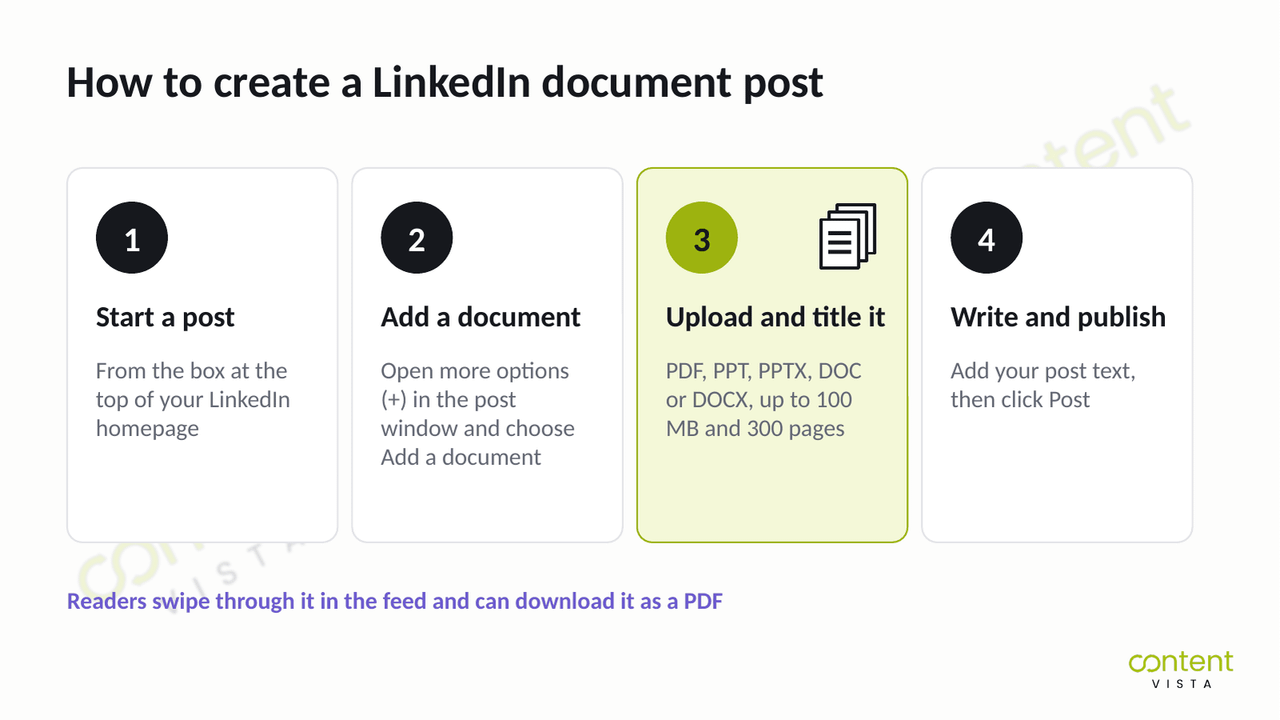
LinkedIn document posts support PDF, PPT, PPTX, DOC and DOCX files up to 100 MB and 300 pages, according to LinkedIn Help. Readers can move through the document inside their feed and download it as a PDF.
Here's an important distinction: LinkedIn discontinued native organic carousel posts on 14 December 2023. When people refer to LinkedIn carousels today, they generally mean document posts. Carousel advertisements still exist.
What they're best for: Explaining complex ideas, presenting frameworks, teaching processes and creating material people want to save.
For founders, documents are particularly useful because they show not only what you believe but how you approach a problem.
How a founder would use them: Take a process you regularly explain to clients and turn it into an eight-slide walkthrough.
For example, show how you would diagnose a company struggling with inconsistent sales performance: what you'd examine first, which assumptions you'd question and how you'd prioritise possible fixes.
The document should leave readers with something they can apply.
What the data says: AuthoredUp found that document posts on personal profiles achieved 1.39 times usual reach and 1.30 times usual engagement.
Among the top 5% of profiles, those figures increased to 1.72 times reach and 1.63 times engagement.
More interestingly, documents represented just 4.88% of posts but 12.92% of all saves in the study. That suggests they are disproportionately useful as reference material.
On company pages, Socialinsider reported that documents achieved the highest average engagement rate in 2025, at 7.00%, a 14% year-on-year increase.
When not to use them: Avoid documents made of nearly empty slides, generic advice or sales brochures disguised as educational material.
Creating ten slides doesn't automatically make an idea more useful than one well-written paragraph.
Founder verdict: One of the strongest authority-building formats relative to the effort for most founders, provided the content genuinely teaches something. · Effort: Medium–High.
5. Native video
Native video means uploading a video file directly to LinkedIn rather than sharing a link to an external video platform.
According to LinkedIn Help, videos can run from 3 seconds to 15 minutes on desktop, or up to 10 minutes on mobile, with supported file sizes ranging from 75 KB to 5 GB.
What it's best for: Demonstrating your thinking, personality and presence.
Video lets prospective buyers hear how you explain complex subjects, handle uncertainty and communicate ideas.
How a founder would use it: Record a four-minute explanation of a problem your clients repeatedly encounter.
Speak directly to the camera, explain why the issue happens and walk through what you'd examine before recommending a solution.
Add captions so the message remains accessible without sound.
What the data says: The evidence differs considerably depending on whose posts you're measuring.
On company pages, Socialinsider reported an average video engagement rate of 6.00% in 2025.
However, AuthoredUp's personal-profile study found that video achieved only 0.86 times a profile's usual reach, with video reach declining 36% year on year.
Duration also mattered. Videos longer than three minutes achieved 1.21 times usual reach, compared with 0.96 times for videos under 30 seconds.
Meanwhile, TechCrunch reported in February 2025 that LinkedIn video uploads had increased 36% year on year. That shows increased platform activity. It doesn't mean better results for individual founders.
When not to use it: Avoid polished promotional clips that offer no useful insight, or short videos created simply because you've heard video is essential.
Production effort is wasted if the message doesn't justify the format.
Founder verdict: Valuable when your explanation and personality add something meaningful. Otherwise, a strong document or text post may be a better investment. · Effort: High.
6. Polls
LinkedIn polls let you ask a question with up to four answer options, each limited to 30 characters. According to LinkedIn for Nonprofits, polls can remain open for one day, three days, one week or two weeks.
What they're best for: Quick visibility, gathering directional feedback and understanding how your audience thinks about a particular problem.
A good poll should help you learn something. Clicks on their own tell you very little.
How a founder would use them: Suppose you work with businesses struggling to connect marketing activity with revenue.
You could ask which issue causes the greatest difficulty: inconsistent tracking, disconnected systems, unclear ownership or slow follow-up.
After the poll closes, publish a short explanation of what the responses suggest, including any limitations.
The value lies in the question and subsequent interpretation.
What the data says: In AuthoredUp's personal-profile dataset, polls achieved the highest reach multiplier of any format at 1.78 times usual reach.
But their engagement multiplier was just 0.37 times usual engagement, one of the weakest results apart from reposts.
On company pages, Socialinsider reported an average poll engagement rate of 4.20% in 2025.
That combination makes polls interesting for visibility but considerably less convincing as an authority-building format.
When not to use them: Avoid vague questions such as "Agree or disagree?" or polls designed purely to attract votes.
Poll responses are also self-selected. Don't treat them as representative market research without acknowledging that limitation.
Founder verdict: A useful visibility and audience-research tool. It won't demonstrate your expertise on its own. · Effort: Low.
7. LinkedIn articles
LinkedIn articles are long-form pieces published through LinkedIn's own publishing tool, available to all members.
LinkedIn for Nonprofits recommends keeping articles under 1,000 words, although that's editorial guidance rather than a strict limit.
What they're best for: Creating a substantial reference piece that you can return to or share with prospects during business conversations.
Unlike a regular feed post, an article gives you room to explain a subject without squeezing everything into a short update.
How a founder would use them: Write a definitive explanation of a recurring problem your buyers face, including how you diagnose it, which approaches you recommend and which common assumptions you disagree with.
Then, when a prospect raises the same question, you have something useful to share.
If you're republishing an article from your company website, publish it on your own site first and link back to the original. Your website should remain the primary home for your most valuable content.
What the data says: AuthoredUp's personal-profile research found that LinkedIn articles achieved only 0.69 times usual reach and 0.44 times usual engagement.
That makes them a relatively weak option for broad feed discovery.
But reach isn't their only potential value. An article can serve as a durable reference for someone already interested in your expertise.
When not to use them: Don't make standalone LinkedIn articles your primary discovery strategy.
If you intend to publish long-form content regularly, a newsletter may offer a better way to build a returning readership.
For a broader explanation of how educational content supports business growth, see our guide to building a content-led demand engine.
Founder verdict: A useful reference shelf with limited reach. Prioritise your website for foundational content and consider newsletters for recurring insights. · Effort: High.
8. LinkedIn newsletters
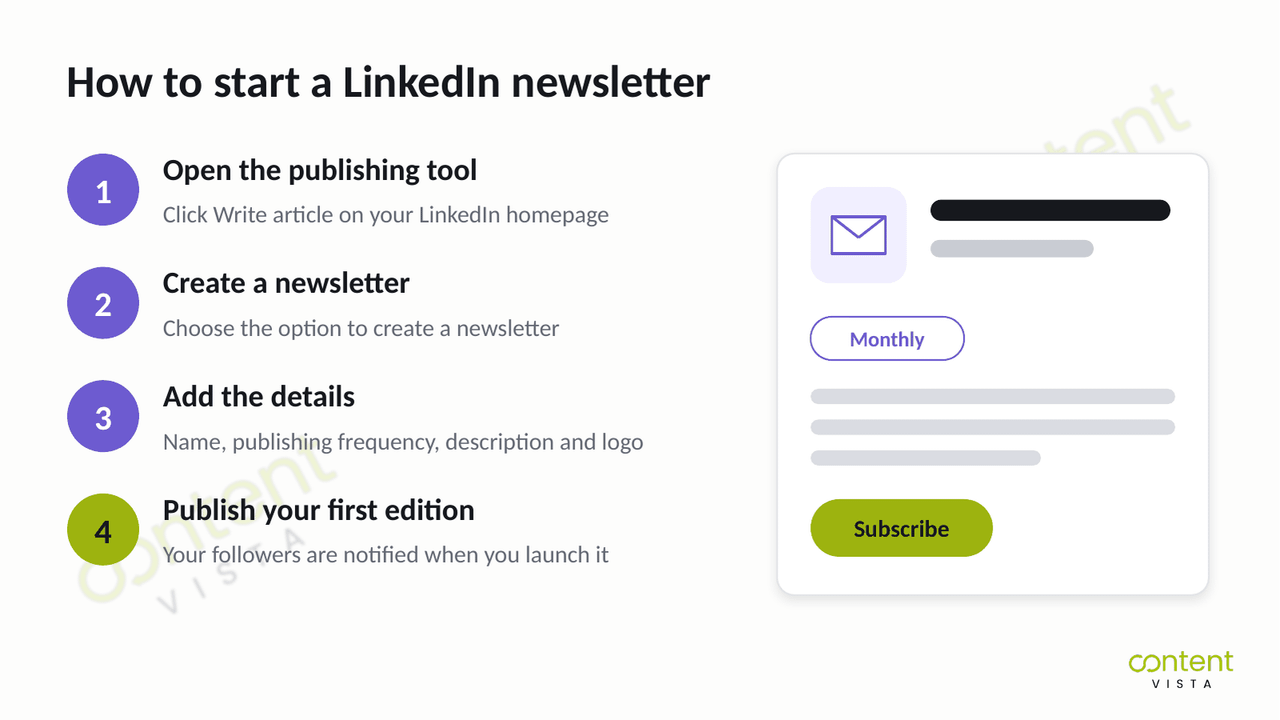
A LinkedIn Newsletter is a recurring long-form publication that members can subscribe to.
LinkedIn for Nonprofits states that the platform notifies followers when you create your first newsletter, while subscribers receive notifications when new editions are published.
You no longer need to activate Creator Mode to start one. LinkedIn removed the Creator Mode toggle in March 2024 and made its creator tools available to eligible members.
What they're best for: Developing deeper relationships with people interested in your expertise and giving them a reason to return regularly.
How a founder would use them: Publish one thoughtful monthly edition examining a recurring buyer problem.
Instead of collecting five unrelated updates, explore one question properly, explain its implications and offer a practical perspective readers can apply.
What the data says: LinkedIn analyst Richard van der Blom said in a 2026 interview on the Creator Science podcast that newsletters outperform regular posts on reach and engagement.
Treat that as directional. It comes from an interview discussing a paid report and isn't an independently verified, like-for-like benchmark.
There's also an important difference between a LinkedIn subscriber audience and an email list you control.
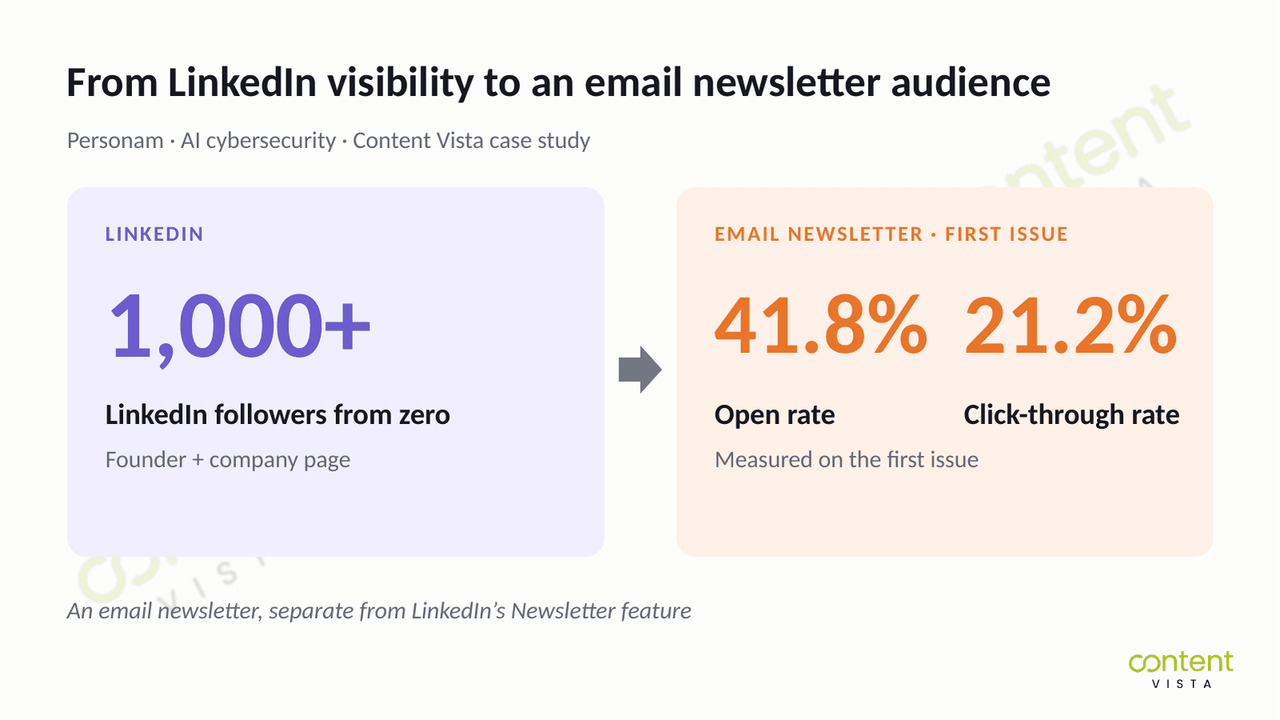
Consider Content Vista's work with Personam, an AI cybersecurity company.
We helped Personam build its LinkedIn presence from zero. The founder and company pages together grew to 1,000+ followers.
We also launched a monthly email newsletter (an email newsletter, separate from LinkedIn's Newsletter feature). Its first issue achieved a 41.8% open rate and 21.2% click-through rate.
The lesson from how Personam built its LinkedIn presence from zero is that founder-led visibility combined with a regular newsletter you control can turn attention into a more directly accessible audience.
For that second part, see our guide to email newsletters for lead nurturing.
When not to use them: Don't launch a newsletter if you cannot maintain a regular publishing schedule. An abandoned series gives subscribers little reason to return.
Founder verdict: One of the strongest formats for sustained depth, provided you can deliver consistently. · Effort: High.
9. LinkedIn Live
LinkedIn Live lets eligible members broadcast video to their profile, company Page or an event. It requires a third-party streaming tool; you cannot stream directly from LinkedIn.
According to LinkedIn Help's access criteria, eligibility includes more than 150 followers and/or connections, an account at least 30 days old, good standing under LinkedIn's Professional Community Policies and access from a supported geography.
Since 22 June 2026, LinkedIn Live broadcasts must be scheduled in advance. Spontaneous broadcasting is no longer supported, although an event can be scheduled shortly before it begins.
What it's best for: Real-time conversations, interviews, Q&As and discussions where audience participation makes the experience more valuable.
How a founder would use it: Host a monthly 30-minute Q&A about one difficult question your buyers regularly face.
Create a LinkedIn Event in advance, invite relevant participants and prepare a few substantive questions to guide the discussion.
The point is to create an exchange that genuinely benefits from happening in real time.
What the data says: We haven't found a reliable, recent benchmark that quantifies LinkedIn Live performance.
You'll encounter older claims suggesting that live video delivers 24 times more engagement. That figure shouldn't be presented as a current performance expectation.
Instead, assess whether the session attracted relevant attendees, produced worthwhile questions and led to subsequent conversations.
When not to use it: Avoid live broadcasts without a clear reason for people to attend or a plan to promote the session.
If your material is better delivered as a concise explanation, record a native video instead.
For sessions designed around audience acquisition, our guide to building a webinar lead generation funnel covers the wider process.
Founder verdict: Powerful when real-time interaction adds value, but only with a clear topic, relevant audience and promotion plan. · Effort: High.
10. LinkedIn events
LinkedIn Events let you create dedicated pages for online or in-person events, including LinkedIn Live sessions and events hosted through external links. People can register or indicate attendance through the event page.
Companies can also sponsor eligible member posts linking to an event.
What they're best for: Turning general interest into a specific action: registering for a session, joining a discussion or attending an event.
Unlike a regular informational post, an event gives interested people an immediate next step.
How a founder would use them: Organise a quarterly roundtable addressing a specific problem your ideal buyers are dealing with.
Create the event page, explain who should attend and what they will learn, then share it through your personal profile.
A narrowly focused conversation is more useful than inviting everyone to a vague discussion about industry trends.
What the data says: We haven't found a credible, recent benchmark that establishes an average engagement or reach advantage for LinkedIn Events.
That doesn't make the format ineffective. It means success should be evaluated through event-specific outcomes rather than generic feed statistics.
Measure relevant registrations, attendance, participation and meaningful follow-up conversations.
Also distinguish between someone registering and someone actually attending. Those are different levels of interest.
When not to use them: Don't create an event page for a product announcement, ordinary company update or piece of content that doesn't involve an actual event.
And don't collect registrations without considering what useful follow-up participants will receive.
If you're designing a repeatable event-based acquisition process, explore Content Vista's webinar and lead capture funnels.
Founder verdict: Use LinkedIn Events when you have a genuine event worth attending. The built-in registration step makes the format especially useful for moving interested people towards a defined interaction. · Effort: Medium–High.
11. Reposts (and reposts with your thoughts)
LinkedIn reposts let you share another member's content, either as it originally appeared or with your own commentary added above it.
What they're best for: Supporting clients, colleagues, partners and peers by drawing attention to work that deserves recognition.
Reposting can be a useful professional gesture. But it shouldn't become the foundation of your LinkedIn presence.
How a founder would use them: Suppose a client announces an important milestone.
Rather than simply clicking repost, add two or three lines explaining why the achievement matters, what makes the work significant or what others in the industry could learn from it.
Keep the focus on the original author and their achievement rather than turning their announcement into your own promotion.
What the data says: AuthoredUp's analysis of personal-profile posts found that reposts were the weakest-performing format in its dataset.
They achieved just 0.29 times a profile's usual reach and 0.22 times its usual engagement.
These findings suggest that relying heavily on shared content is unlikely to produce the visibility you might expect from original posts.
The distinction matters because a repost doesn't necessarily tell prospective buyers what you know, how you think or which problems you can solve.
When not to use them: Don't use reposts as a substitute for developing your own ideas.
If most of your activity consists of sharing other people's content, readers may recognise the people you support without learning much about your expertise.
That doesn't mean reposting is pointless. Supporting others can be worthwhile even when the post receives little engagement.
Founder verdict: A generous professional gesture. On its own, it won't build your authority, so use reposts selectively and add genuine context when appropriate. · Effort: Low.
12. Link posts
A LinkedIn link post shares an external URL, typically with a clickable preview card. According to LinkedIn Help, posts can display a link preview or uploaded images, but not both.
What they're best for: Directing interested readers towards useful content outside LinkedIn, such as an article, research report, case study or resource on your website.
How a founder would use them: Imagine you've published a detailed article explaining why companies struggle to turn marketing activity into revenue.
Don't write "New blog is live. Check it out!" and expect people to click.
Instead, explain the article's strongest insight directly in your LinkedIn post. Give readers something valuable even if they never leave the platform, then include the link for anyone who wants the full explanation.
What the data says: LinkedIn has stated that value-led posts containing external links aren't automatically penalised, according to Buffer's reporting on the LinkedIn algorithm.
However, independent performance data shows an important distinction.
Metricool's 2026 LinkedIn Study, covering 673,658 posts, found that link posts on personal profiles received 27% fewer impressions and 20% fewer interactions.
On company pages, link posts received 51% more impressions.
But Socialinsider's company-page research found that link posts had the lowest average engagement rate of any format in 2025, at 3.25%.
These findings aren't necessarily contradictory. They measure different populations and outcomes. More impressions don't automatically mean stronger engagement or more qualified interest.
When not to use them: Avoid posts that contain little more than a URL and a request to visit your website.
If your goal is credibility, the post should demonstrate some expertise before asking readers to leave LinkedIn.
For the wider process, read our guide to turning LinkedIn attention into pipeline or explore our LinkedIn lead generation service.
Founder verdict: A practical distribution format, particularly for company pages. On personal profiles, lead with a useful insight rather than relying on the link to do the work. · Effort: Low.
Three share-box options that aren't really content
Besides the 12 LinkedIn post formats, there are three additional options in LinkedIn's share box: Celebrate an occasion, Share that you're hiring and Find an expert.
These are useful for specific situations, but they're not formats you need to build a content strategy around.
Celebrate an occasion
This option helps you announce professional milestones, such as starting a new role or marking a work anniversary.
LinkedIn previously offered ready-made celebration templates. However, in late 2024, it retired several of them, including Appreciation, Welcome and Skill Assessment Badge templates.
Members can still celebrate through their own text, images and videos, as reported by Social Media Today.
Founder verdict: Celebrate genuine milestones. A real photograph and a few honest lines about what the occasion means will usually feel more personal than a generic template.
Share that you're hiring
This option lets you create and share a job opening with your LinkedIn network.
For founders, it's a practical way to let relevant connections know you're recruiting. But a job announcement serves a specific hiring purpose rather than an ongoing authority-building goal.
Founder verdict: A useful hiring tool. Use it when you're genuinely recruiting.
Find an expert
This option lets you ask your network to recommend a professional or service provider.
It can help you tap into trusted connections when you need specialist support or expertise.
Founder verdict: Useful when you genuinely need a recommendation. It won't do anything for your own authority.
In short: These three options serve occasional professional needs. Your regular LinkedIn presence should still be built around formats that help people understand your expertise and remember what you stand for.
What's been discontinued or changed on LinkedIn
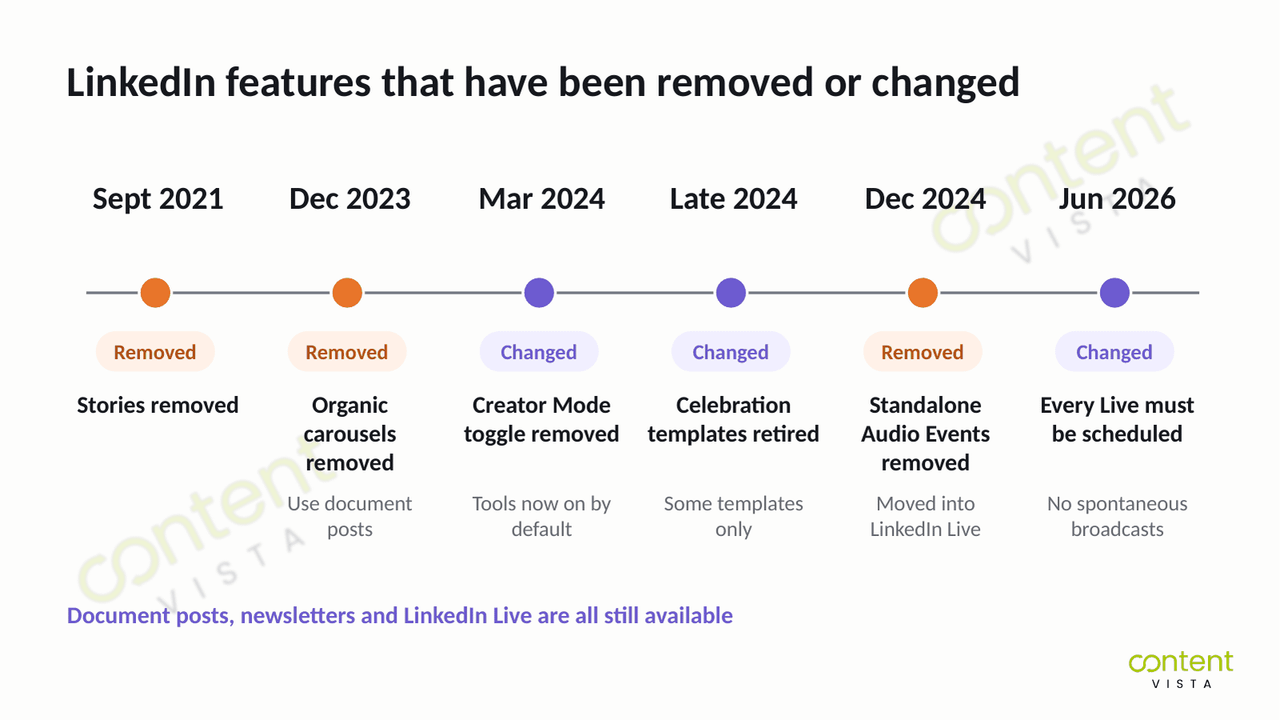
Several LinkedIn formats and publishing features have been removed or changed over the years. Here's what no longer exists, what's been replaced and what you can still rely on heading into 2027.
| Format or feature | What happened | When |
|---|---|---|
| LinkedIn Stories | Removed entirely | 30 September 2021 |
| Organic carousel posts | Removed; today's "carousels" are PDF document posts. Carousel ads still exist. | 14 December 2023 |
| Creator Mode toggle | Removed; its tools, including the follow button, newsletters and Live access, are available to eligible members by default. | March 2024 |
| Several "Celebrate an occasion" templates | Appreciation, Welcome and Skill Assessment Badge templates retired. | Late 2024 |
| Audio Events | New standalone audio events can no longer be created; live audio moved into LinkedIn Live. | 2 December 2024 |
| Going live without scheduling | Every LinkedIn Live must now be scheduled in advance, even if only minutes before the broadcast. | 22 June 2026 |
These changes are documented in TechCrunch's coverage of LinkedIn Stories, LinkedIn's carousel guidance, NBK Social's Creator Mode explanation, Social Media Today's celebration-template update, Engadget's report on Audio Events and LinkedIn's current Live requirements.
Why does this matter? Older LinkedIn guides still recommend features such as Stories, standalone audio events and native organic carousels as if they're available.
You could spend time planning content around something you can no longer publish.
The practical takeaway is simple: use document posts when a guide recommends organic carousels, check current eligibility for newsletters and Live and don't build your strategy around discontinued features.
What the data actually says about LinkedIn post formats
Document posts and images perform strongly on LinkedIn, but the best-performing format depends on whether you're measuring a personal profile or a company page. That's why LinkedIn benchmarks often appear to contradict one another.
Here's where most guides go wrong: they quote engagement rates without explaining whose posts were studied.
A founder's personal profile and a company page operate in different contexts. Their audiences, publishing behaviour and performance patterns aren't identical.
So a benchmark from one shouldn't automatically become a recommendation for the other.
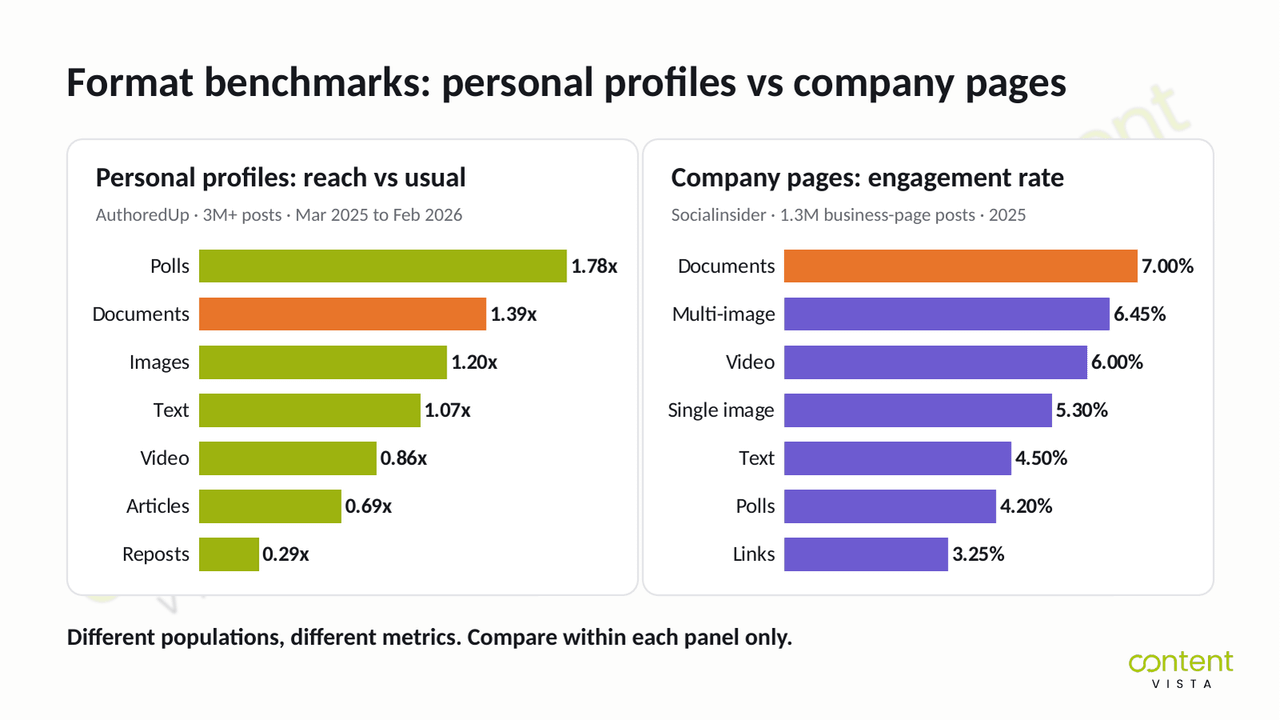
Two large studies illustrate the difference: AuthoredUp's analysis of personal-profile posts and Socialinsider's company-page benchmarks.
LinkedIn format performance: personal profiles vs company pages
| Format | Personal profiles: reach vs your usual | Personal profiles: engagement vs your usual | Company pages: engagement rate (2025) |
|---|---|---|---|
| Document post | 1.39x | 1.30x | 7.00% |
| Images (single and multi) | 1.20x | 1.33x | 5.30% single / 6.45% multi |
| Text post | 1.07x | 0.78x | 4.50% |
| Native video | 0.86x | 0.93x | 6.00% |
| Poll | 1.78x | 0.37x | 4.20% |
| Article | 0.69x | 0.44x | Not reported |
| Repost | 0.29x | 0.22x | Not reported |
| Link post | Not reported (Metricool: 27% impressions on personal profiles) | Not reported | 3.25% |
Personal profiles: AuthoredUp, 3M+ posts, Mar 2025–Feb 2026, each figure compared with that profile's own typical post. Company pages: Socialinsider 2026 LinkedIn benchmarks, 1.3M business-page posts, 2025 data. Link posts: Metricool 2026 LinkedIn Study.
Methodology note: The studies measure different populations, periods and performance metrics. Multipliers and engagement rates are not directly interchangeable.
No independent study cited here establishes that a specific organic format produces more meetings, deals or revenue.
Why video appears to perform well and poorly at the same time
Look at native video.
On company pages, video achieved a 6.00% engagement rate in 2025. But on personal profiles, it reached only 0.86 times a profile's usual reach.
That isn't a contradiction. One study measures company-page engagement rates; the other measures personal-profile performance relative to each profile's baseline.
Socialinsider's Q3 2026 update also shows engagement softening across formats: documents and multi-image posts tied at 6.40%, video stood at 5.25%, and link posts at 2.50%.
For founder-led content, read the personal-profile figures first. Use company-page benchmarks when evaluating your brand's own publishing activity.
How LinkedIn's feed treats different formats
LinkedIn doesn't rank posts on format alone. Its feed considers how relevant content is to individual members and how they are likely to interact with it.
A February 2026 LinkedIn research paper describes a ranking signal called long dwell: whether someone spends longer than a specified amount of time on a post. Importantly, that time threshold depends on the post type.
This helps explain why content that holds attention matters, although it doesn't prove that any one format automatically receives a ranking advantage.
There's another important change.
In the LinkedIn Engineering Blog on 12 March 2026, Hristo Danchev described a redesigned AI-powered feed that matches posts to members' professional interests. Its ranking system examines more than a thousand historical interactions per member to understand what they read, engage with or skip.
On the same day, LinkedIn said it is reducing the reach of repetitive, low-substance posts and engagement bait, such as "comment to agree" prompts.
So what does that mean for founders?
Consistently publishing substantive content about the problems you want to be known for matters more than chasing whichever format is trending.
A useful document, thoughtful text post or well-explained video can all support that goal. The deciding factor is whether the content gives relevant people a reason to pay attention.
For a deeper explanation, see how the LinkedIn algorithm works.
Founder profile or company page: does it change which format you use?
Yes. Your personal LinkedIn profile is where you build founder authority. Your company page should support and amplify it. Both have a role, but they don't need identical content or formats.
The data makes a strong case for prioritising your personal presence.
Metricool's 2026 LinkedIn Study, analysing 673,658 posts from 63,108 accounts, found that:
Personal profiles had a 63% higher engagement rate than company pages.
Personal profiles received 237% more comments per post.
Only 7% of company pages grew their follower counts during the study period.
These are aggregate findings. They don't guarantee that every founder profile will outperform its company page.
What should you publish on each?
On your founder profile: Prioritise document posts, substantive text posts and genuine images. Share your perspective, explain how you solve problems and give potential buyers a reason to trust your judgement.
On your company page: Use link posts to distribute useful website content, native video where appropriate, event pages and reshares of the founder's strongest posts.
Link posts and video generally face fewer performance disadvantages here than on personal profiles.
Think of the relationship this way: your founder profile gives the business a recognisable voice. Your company page provides an official presence and reinforces that voice.
Neither should operate in isolation. A connected approach helps turn individual expertise into sustained market visibility, which we explore further in social media for demand generation.
For the complete division of responsibilities between founders and company pages, see our guide to LinkedIn content strategy for founders.
Can your company put paid budget behind a founder's post?
Yes. LinkedIn's Thought Leader Ads let your company sponsor eligible posts from its founder, executives, employees and other members, so a post that's already resonating reaches more of your ideal buyers.
Here's how it works.
You pick the post, and the member is notified and can approve or decline the sponsorship, according to LinkedIn Marketing Solutions. The post itself stays as the author wrote it.
There's a format catch.
LinkedIn's Thought Leader Ads specifications list single-image and video posts as eligible. Posts with multiple images, documents or polls are excluded.
So what does that mean for you?
Your best-performing document post can't be sponsored as it is. If you plan to put budget behind a founder post, a strong single-image or video version is the one to boost.
When does it make sense? When a post is already earning comments and saves from the right people, and you want more of your ideal buyers to see it.
Boosting a post nobody engaged with organically rarely fixes the underlying problem.
If you want help planning that kind of campaign, see Content Vista's paid advertising work.
LinkedIn format myths worth ignoring
A lot of LinkedIn advice is recycled folklore. Here's what the evidence actually says about the claims you'll hear most often.
| The claim | Where it comes from | The verdict |
|---|---|---|
| "Video gets 5x more engagement (and Live gets 24x)" | Old LinkedIn best-practice material from before 2023 | Outdated. On personal profiles, video reached 0.86x a profile's usual reach in 2025–2026 data. |
| "Carousels are dead" | LinkedIn removed native organic carousels in December 2023 | Half true. PDF document posts replaced them and now lead on reach and saves. |
| "Polls are dead" | Online claims about a 2026 algorithm update that don't trace to a credible source | False. Polls still get high reach, but very little real conversation. |
| "Posts with links get no reach" | Creator folklore | Overstated. LinkedIn says value-led link posts aren't penalised; independent data shows lower reach on personal profiles. |
| "A model called 360Brew decides who sees your posts" | A 2025 LinkedIn research paper | Unconfirmed. It's a research model, and LinkedIn's March 2026 description of its live feed doesn't name it. |
| "Follow the 4-1-1 (or 5:3:2) rule" | Generic social media content-mix heuristics | Not evidence-based for LinkedIn. Reposts are the weakest format for founders, so weight your mix towards original posts. |
The 360Brew claim traces back to LinkedIn's 2025 research paper on the model. It's real research. What creators get wrong is presenting it as confirmed to be running your feed today.
One more myth worth clearing up: the "ideal post length".
You'll see "1,800–2,100 characters" quoted everywhere, but we haven't found a credible source for it.
The better evidence comes from AuthoredUp's personal-profile data, which shows fuller, more substantive posts (20+ sentences) outperforming short ones on both reach and engagement.
How to tell whether a format is working for you
Judge each format by the signal it's built to create, then look for the conversations that follow.
Here's the problem: likes and impressions are easy to count but tell you very little about buyer interest. Each format has a more useful signal to watch.
| Format | The signal to watch |
|---|---|
| Text post | Comments from people in your buyer market, profile views |
| Image post | Comments and the conversations they start |
| Document post | Saves, reposts and profile views |
| Native video | How much of the video people watch, and comments |
| Poll | Who votes (are they buyers?) and how your follow-up post performs |
| Article | Views, and how often you share it in sales conversations |
| Newsletter | Subscriber growth and replies |
| LinkedIn Live or event | Registrations, attendance and follow-up conversations |
| Link post | Clicks to your site and what those visitors do next |
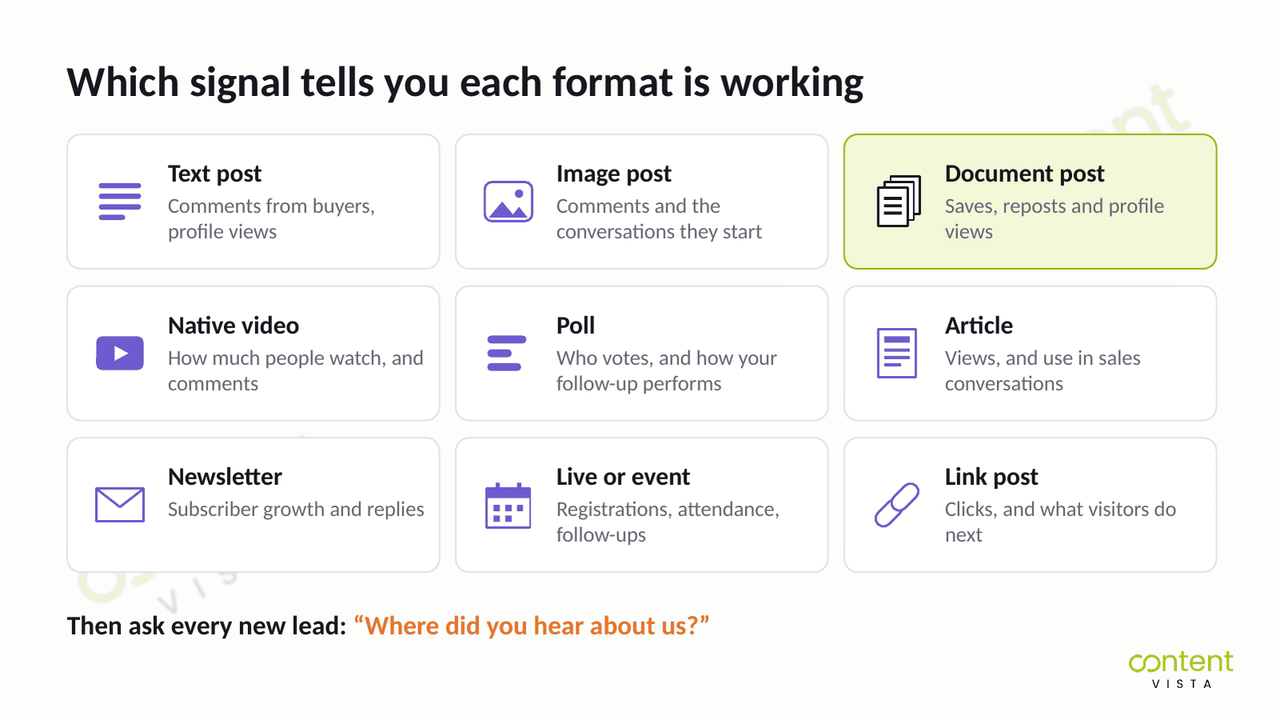
Above everything else, watch for inbound messages and conversations from people in your buyer market.
When a new conversation starts, ask, "Where did you hear about us?" That simple habit tells you more than any dashboard.
For the full measurement picture, see our guide to measuring your LinkedIn content strategy.
Picking the right formats is one input.
The Founder Authority & Audience Engine Benchmark shows you where you really stand. Answer a few questions about your LinkedIn activity, audience, content cadence and inbound leads, and you'll get an authority score, an audience engine score and your biggest gap in about three minutes.
It's a self-assessment based on your answers. It doesn't scan your LinkedIn profile.
Benchmark my authority
FAQs about LinkedIn post types
What kinds of posts do well on LinkedIn?
For personal profiles, document posts lead on reach and saves, while images and long, substantive text posts lead on engagement. Format isn't everything, though. LinkedIn said in March 2026 that it is reducing the reach of low-substance posts and engagement bait, so useful content matters more than any single format.
What are the best formats for LinkedIn posts?
It depends on the job. For reach and saves, use document posts. For conversation, use images and long text posts. Polls give reach without much conversation. For depth and a returning readership, newsletters work best, provided you can keep a regular schedule.
What type of posts are most popular on LinkedIn?
By volume, images. They made up 57.16% of personal-profile posts in AuthoredUp's 2025–2026 study. Document posts were only 4.88% of posts despite outperforming most other formats on reach, engagement and saves, which makes them an opportunity for founders.
What is the 4-1-1 rule on LinkedIn?
The 4-1-1 rule is a content-mix heuristic: four shared posts, one original post and one promotional post. It isn't a LinkedIn rule. Since reposts are the weakest format for personal profiles (0.29x usual reach), founders should weight their mix towards original posts.
What is the 5:3:2 rule for social media posts?
The 5:3:2 rule suggests that out of every 10 posts, 5 should be curated from others, 3 should be original and 2 should be personal. It's a generic social media heuristic with no LinkedIn-specific evidence behind it, so treat it loosely.
Do carousels still exist on LinkedIn?
Native organic carousel posts were removed on 14 December 2023. When people say "LinkedIn carousel" today, they mean a document post: a PDF or slide deck that readers swipe through in the feed. Carousel ads still exist for paid campaigns.
Which LinkedIn post type gets the most reach?
Polls had the highest reach multiplier in AuthoredUp's personal-profile data, at 1.78x a profile's usual reach, but very low engagement. Document posts, at 1.39x reach and 1.30x engagement, offer the best balance of reach and meaningful interaction.
Do LinkedIn polls still work?
Yes, for visibility and quick research. They still get strong reach, but they draw few comments, so they won't build much authority on their own. Ignore claims that polls stopped working after a 2026 update; we couldn't trace them to a credible source.
Should a founder use LinkedIn articles or a newsletter?
If you'll publish on a regular schedule, choose a newsletter. Subscribers are notified of each new edition, which helps you build a returning readership. Standalone articles reached about 0.69x a profile's usual reach in AuthoredUp's data, so they work better as reference pieces.
Do external links hurt LinkedIn reach?
LinkedIn says value-led posts with links aren't penalised. Independent data from Metricool shows link posts on personal profiles got about 27% fewer impressions, though. Write the post so it's useful on its own, then include the link for readers who want more.
How long can a LinkedIn post be, and how many images can it have?
LinkedIn text posts can run up to 3,000 characters, according to LinkedIn Help. You can add up to 20 images to a single post. Only the first few lines show before readers click "see more", so the opening still matters.
Can a company promote its founder's LinkedIn posts?
Yes. Thought Leader Ads let a company sponsor eligible posts from its founder, employees or other members, who can approve or decline the sponsorship. Single-image and video posts qualify; posts with multiple images, documents or polls don't.
The bottom line: pick two or three formats and stick with them
In short: you don't need all 12 LinkedIn post formats.
Pick two or three that fit the jobs you need done, use them well and show up consistently.
For most founders, that means substantive text posts, a regular document post that teaches something, and genuine images from real work. Add a newsletter or events when you can sustain them.
Remember that formats are only one part of the picture. Founder content works best when it's connected to how your business actually wins work, with every post adding to what buyers already know and trust about you.
Random acts of marketing rarely build that kind of trust. That's the thinking behind our approach to content and thought leadership.
Once you've chosen your formats, see where your authority really stands with the Founder Authority & Audience Engine Benchmark.
And if you'd rather have a team turn your expertise into a consistent LinkedIn presence, take a look at our founder and executive positioning work.