Quick Summary
- AI has picked up a bad reputation, and most clients can't tell mindful, skilled use from mindless AI slop.
- Some ask what they're even paying for if we use AI; the honest answer is, then why don't you do it yourself?
- AI is a samurai sword. The tool is everywhere, but very few people can actually wield it.
"This was made with AI, wasn't it?"
A client said that to my co-founder Harshit once, in the tone you'd use to point out a stain on someone's shirt. It wasn't really a question. It was a verdict.
And honestly, I understood the instinct.
AI has had a rough couple of years. Somewhere between the hype and the flood of generated junk, "made with AI" stopped meaning "made well" and started meaning "made carelessly."
People have been burned by slop; the bland blog post, the soulless image, the email that reads like it was written by a toaster. So now the phrase carries a sneer.
Here's the problem, though: most people can't actually tell the difference.
They can't tell craft from slop
When a client says "this is AI," what they usually mean is "this feels cheap." But they can't separate the two things that matter most: whether AI was used mindfully or mindlessly, and whether the output is any good.
Those are not the same question. And the gap between them is the whole game.
A skilled operator and a lazy one can use the exact same tool and produce wildly different things. One produces slop. The other produces work you'd never tag as AI-assisted at all, because the judgement, the edits, the taste, the thousand small decisions underneath it are human.
The tool didn't make the work. The person did. The tool just made them faster.
But that nuance is invisible from the outside. So the entire category gets tarred with the same brush.
"Then why don't you?"
There's a tougher version of this objection. I've heard it, and so has Harshit; usually not aimed at us directly, but said out loud all the same: "If you're just using AI, what am I even paying you for? I'll do it myself."
And my honest answer, every time, is: then why don't you?
Go ahead. The tools are right there. They're cheap, often free, and the same ones everyone uses. Nobody is stopping you.
Here's what I've noticed, though: almost nobody does. And the ones who try tend to come back.
Because the tool was never the hard part.
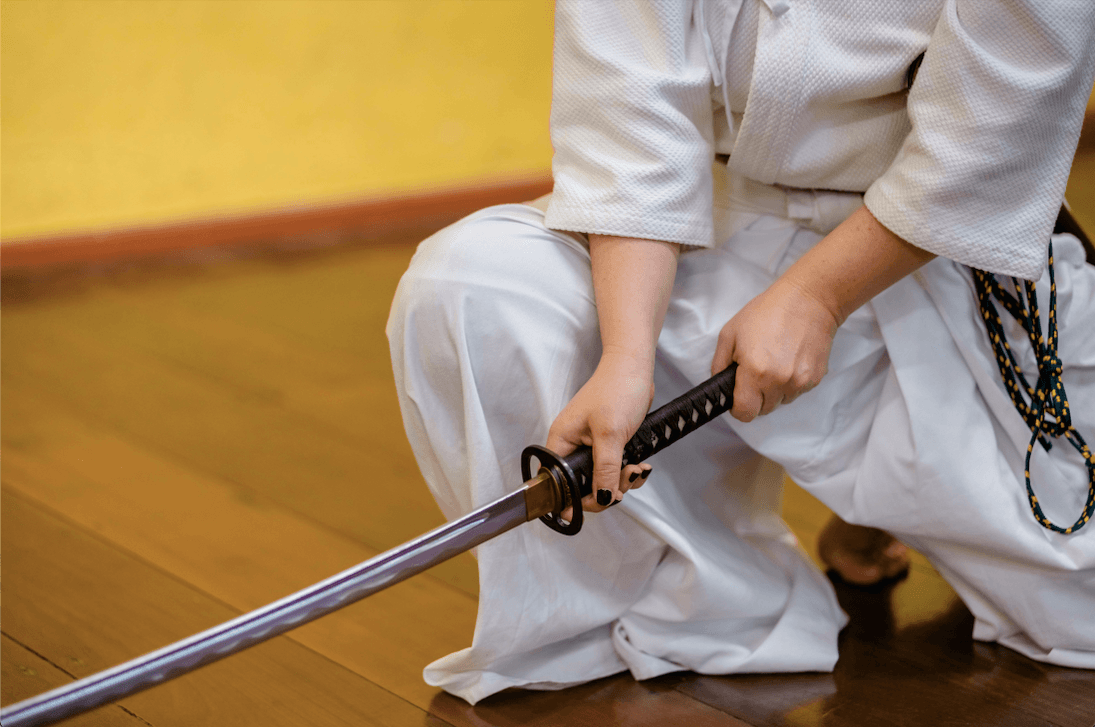
AI is a samurai sword
I've said this to Harshit more than once: AI is a samurai sword.
A katana is one of the most lethal weapons ever made. But hand one to an untrained person and it's useless, or dangerous to the person holding it. The blade doesn't make you a swordsman. It just raises the ceiling for someone who already is. Most people can't wield it. Not even most warriors can.

That's exactly how AI behaves. In trained hands, it's an extraordinary multiplier; it takes someone with judgement and taste and lets them do in an hour what used to take a week.
In untrained hands, it produces confident nonsense at scale. Same blade. Completely different outcome.
And there's one thing the blade can never do: answer for the cut. A tool can't sit across the table from a client and defend a strategic call, and a prompt can't take responsibility when a direction turns out wrong.
The judgement, and the accountability that comes with it, still belong to a person.
A multiplier, not an adder
Underneath the metaphor there's a piece of arithmetic, and once you see it you can't unsee it.
AI is a multiplier, not an adder. It doesn't add a fixed quantity of quality to whatever you feed it. It scales what's already there.
So multiply real judgement by a powerful tool and you get something remarkable. Multiply weak judgement by that same tool and you get weak work, faster, and in far greater volume. And multiply nothing at all, and you still have nothing; just a great deal more of it, arriving much sooner.
That's the whole explanation for the sneer. The market got flooded with output from people whose base was close to zero, and multiplication was extremely efficient at distributing it.
A multiplier is only ever as good as the number you point it at. Applied to nothing, it faithfully returns nothing.
Which means the interesting question was never "does this person use AI." It's "what is the number being multiplied."
| Dimension | What people assume changed | What actually changed |
|---|---|---|
| Speed | The work got faster, so it must be worth less. | The work did get faster. Speed was always the cheapest part of the value. |
| The quality ceiling | Anyone can now produce expert-level output. | The ceiling rose for people who could already recognise expert-level output. For everyone else it did not move. |
| The bottleneck | The bottleneck was access to capability, and that's now solved. | The bottleneck moved from production to judgement, which is far harder to buy. |
| Accountability | If the tool did the work, the tool carries the risk. | Nothing moved at all. A person still has to defend the decision and answer for the outcome. |
So here's a question worth asking before you hand anything to a model. Call it the baseline question:
Could I tell whether this output is good, without the tool's help?
If the answer is yes, you're delegating. The model is doing the fast part while you keep the part that matters. If the answer is no, you're not delegating at all; you're gambling, and you won't know you've lost until a client tells you.
That single question sorts most AI use into the two piles everyone else is struggling to tell apart.
AI didn't erase expertise. It exposed who actually had it before the tool showed up.
It's called intelligence for a reason
Here's something the sneer misses. AI is artificial intelligence. Sit with the second word for a moment.
Intelligence isn't just information. It's the ability to take in a situation and do something useful with it, toward some end. And a good model, prompted well by someone who knows what they're asking, can genuinely do that.
In a specific moment, on a specific problem, it can reach further than a single human mind could on its own. That's not hype. That's just what the tool is now.
But intelligence on its own is aimless. It waits to be pointed at something. Left to its own devices, it will answer the wrong question beautifully.
What decides the question, the direction, the judgement, the point of it all, is the person holding it. The model supplies the intelligence. You supply the purpose.
So we stopped explaining
For a while, I tried to convince people of all this. To walk them through how we use AI; carefully, with review, with craft layered on top.
I don't bother any more.
Not because the explanation is wrong, but because it's the wrong conversation. Explaining your methods just invites people to grade your methods. And methods are means.
What a client actually buys is the end: the outcome, the result, the thing that moves their business.
So now, as a company, that's all we talk about. Not how we'll get there. What you'll get. The means are ours to solve. The ends are what you're paying for.
If you ever want to see what that looks like when the means are our problem to solve, it's the whole idea behind how we use AI to create marketing systems. But that's a conversation for another day.
It took me my whole life
There's a story about Picasso. I can't promise every detail is true; these things grow in the telling, but it has stuck with me.
He's sitting in a café when someone recognises him and asks him to sketch something. He does it in a few minutes, hands it over, and names a large price. The person is taken aback. "But it only took you a few minutes."
And Picasso says: "No. It took me my whole life."

That's the part people miss when they watch someone use AI well and see only the few minutes.
The prompt took a minute. The judgement behind it, knowing what good looks like, what to reject, how to shape raw output into something with a point of view, took years.
Maybe a whole career. That's how skill works: it compounds quietly, for a long time, with nothing to show for it, until one day it looks like magic done in a minute.
And here's the part the panic gets exactly backwards. If the tool multiplies whatever base you bring it, then the value of patiently building that base just went up, not down. A bigger multiplier makes a bigger number out of judgement, and a bigger nothing out of nothing.
So the next time someone waves off real work because "AI did it," let them. Hand them the sword.
Most people, it turns out, would rather not find out that they can't swing it.