Quick Summary
- Cold email lead generation still works but not as a volume-first numbers game.
- The campaigns most likely to create a qualified pipeline today are usually built around narrow targeting, signal-based relevance, deliverability discipline, thoughtful follow-up, and reply-quality measurement.
- The goal is not to maximise opens or blast more inboxes. It is to start relevant commercial conversations with people who are realistically a fit.
Why Cold Email Has a Spam Problem
Cold email has a bad reputation for a reason.
Most of it is irrelevant, lazy, and impossible to distinguish from spam.
That does not mean cold email lead generation is dead. It means the old volume-first version of it is.
Here’s the problem: too many teams still treat outbound like a numbers game. They buy a giant list, throw AI-generated copies into a sequence, add fake “personalisation,” and hope a tiny percentage replies.
The result is predictable: ignored emails, spam complaints, weak reply quality, damaged sender reputation, and outreach that creates activity without creating a pipeline.
And buyers are far less tolerant of that now.
Inbox providers are stricter. Spam filtering is smarter. Decision-makers are overwhelmed with low-effort outreach. A generic “Hey {{FirstName}}, noticed your company is growing…” email is no longer enough to earn attention because everyone is doing it.
That’s the real issue.
Cold email does not fail because email stopped working. It fails because the message does not deserve a reply.
The better way to think about cold outreach is this:
Cold email is not a mass-blast tactic. It is a controlled outbound system.
That system includes:
narrow targeting
clear offer positioning
signal-based relevance
deliverability discipline
measured follow-up
reply handling
CRM visibility
pipeline tracking
In short: cold email works best when it behaves like one channel inside a broader lead generation system, not as an isolated “send more emails” activity.
That distinction matters because the goal is not more.
It is a more qualified conversation.
And the companies still generating pipeline from cold outreach in 2026 are usually the ones treating relevance, infrastructure and measurement as part of the same system, not separate problems.
What Cold Email Lead Generation Actually Means
A lot of confusion around cold email comes from the fact that people use the same term to describe completely different behaviours.
A targeted outbound email to a relevant decision-maker is not the same thing as blasting thousands of generic messages to scraped lists.
That distinction matters.
Cold email lead generation is the process of sending relevant, targeted outbound emails to people who have not opted in, with the goal of starting qualified commercial conversations that can become pipeline without relying on bulk-blast tactics that damage trust or deliverability.
The key idea is not “cold.”
It is relevant.
The purpose of cold email is not to force attention from strangers. It is to start a commercial conversation that has a legitimate reason to exist.
That means the outreach should be:
targeted to a defined segment
connected to a real problem, trigger, or business context
personalised beyond merge fields
measured against reply quality and pipeline contribution
handled responsibly from a deliverability and compliance perspective
In short: cold email is not the same as blasting a list. Done properly, it is a controlled outbound system.
That is why strong outbound teams usually think about cold email as one channel inside a broader lead generation system, not as an isolated growth hack.
The difference shows up quickly in execution.
Spammy outreach usually optimises for sending volume.
Effective cold outreach optimises for relevance, qualified replies and downstream opportunities.
One approach creates inbox fatigue.
The other creates conversations that can realistically turn into pipeline.
Cold Email vs Spam vs Email Marketing
One reason cold email gets misunderstood is that people often group three very different things together:
cold outreach
spam
email marketing
But they are not the same.
Here’s the simplest way to separate the three.
| Factor | Cold Email | Spam | Email Marketing |
|---|---|---|---|
| Audience relationship | No prior relationship, but outreach is targeted and relevant | Usually no relationship and little relevance | Existing subscriber, customer or opted-in contact |
| Intent | Start a relevant commercial conversation | Push volume regardless of fit | Nurture, educate, promote or retain |
| Targeting | Narrow and intentional | Broad and indiscriminate | Based on subscriber lists or audience segments |
| Personalisation | Contextual and signal-based | Generic or misleading | Often segmented and behaviour-based |
| Permission status | Usually non-opt-in outreach | Often ignores consent expectations | Typically opt-in |
| Messaging style | Direct, relevant, low-friction | Aggressive, deceptive, repetitive, or manipulative | Campaign-style newsletters, promotions, updates |
| Success metrics | Qualified replies, meetings, pipeline contribution | Send volume or vanity metrics | Engagement, conversions, retention, revenue |
| Deliverability impact | Can remain healthy with good practices | Often damages sender reputation | Usually safer when list hygiene is maintained |
| Compliance expectations | Must respect applicable outreach and data-use rules | Often ignores compliance requirements | Generally structured around subscriber consent |
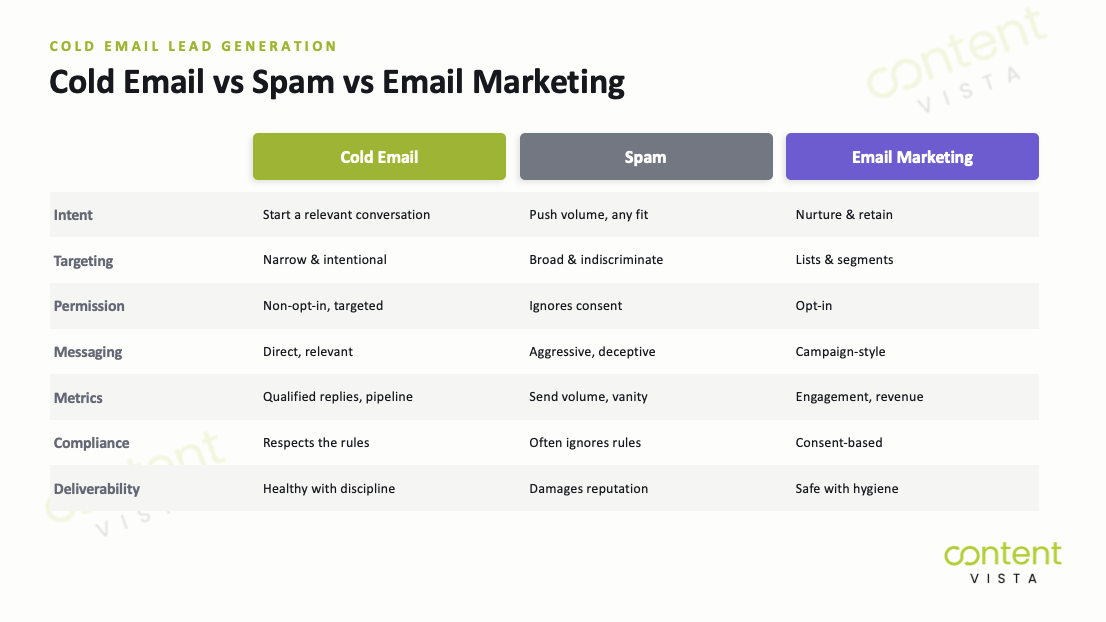
The important distinction is relevance and intent.
Cold email is not automatically spam simply because the recipient did not subscribe to a newsletter.
A relevant message sent to a narrowly targeted prospect with a legitimate business reason behind it is very different from blasting thousands of generic emails with misleading subject lines or fake personalisation.
That said, cold outreach still carries responsibility.
Inbox providers, regulators, and buyers increasingly expect senders to respect deliverability standards, unsubscribe requests, data usage rules, and complaint risk. Depending on the location, audience, and business context, frameworks such as FTC / CAN-SPAM guidance in the US and ICO / PECR / UK GDPR guidance in the UK and Europe may apply differently. This article is not legal advice, and businesses should confirm applicable requirements for their own market and outreach practices.
In practice, the line between cold email and spam is usually simple:
If the outreach is irrelevant, deceptive, untargeted or impossible to opt out from, recipients will treat it like spam even if the sender calls it lead generation.
Is Cold Email Still Effective in 2026?
So, does cold email still work?
Yes.
But only if you stop treating it like a volume game.
Cold email is no longer a channel where generic sequences and massive send counts reliably create opportunities. Inbox providers are stricter, buyers are harder to impress, and AI-generated outreach has made low-effort messaging even easier to ignore.
That is why many outbound campaigns now produce mediocre results despite sending huge volumes of email.
The mistake is assuming that more outreach automatically creates more pipeline.
In reality, cold email performance is heavily shaped by:
targeting quality
offer relevance
sender reputation
deliverability setup
list hygiene
follow-up discipline
timing
messaging context
When those pieces are weak, cold email becomes expensive noise.
When they work together, cold outreach can still generate qualified conversations at a predictable enough level to matter.
It is important to keep expectations realistic, though.
Average cold email reply rates are often in the low single digits, especially across broader or less relevant outreach. (Instantly 2026 Cold Email Benchmark Report) More targeted campaigns with stronger segmentation, clearer signals, and tighter offer alignment can perform significantly better but there are no guaranteed benchmarks because industry, market sophistication, pricing, trust requirements and execution quality all change the outcome.
That is why serious outbound teams do not obsess over vanity metrics anymore.
Open rates, in particular, have become less dependable because privacy protections and inbox behaviour can distort tracking data. A campaign can show inflated opens while generating weak commercial outcomes.
Think about it this way:
A high open rate with no meaningful replies is not a win.
A high reply rate from bad-fit prospects is not a win either.
The real goal is qualified pipeline contribution.
That means measuring whether cold outreach is creating relevant conversations, sales-ready opportunities and downstream revenue potential: not just email activity.
We will break down the exact metrics that matter later in this guide, because this is where many cold email strategies quietly fail: they measure visibility instead of business impact.
When Cold Email Is the Right Channel and When It Is Not
Here’s where most teams go wrong: they ask whether cold email works before asking whether cold email fits.
Cold email is not automatically the best acquisition channel for every business, market or growth stage.
In some situations, it can create highly efficient conversations with the right buyers.
In others, it simply amplifies weak positioning, vague targeting or low trust.
That distinction matters because cold email works best when the business underneath it is already reasonably clear.
Cold email is a good fit when…
Cold email tends to perform better when buyers are identifiable and the outreach can be tied to a specific problem, trigger or business context.
That usually means:
you know who the decision-makers are
the offer is considered, high-value, or outcome-driven
the audience can be segmented narrowly
the pain point is specific enough to create relevance
the team can respond to replies quickly
CRM tracking and follow-up processes exist or can be built
This is why cold email often works well for:
agencies
consultants
B2B services
niche operators
software companies with defined ICPs
high-ticket or specialised offers
outbound-led sales teams
The common pattern is simple: The narrower the relevance, the more likely the outreach feels legitimate instead of intrusive.
Cold email is a poor fit when…
Cold email becomes much harder when the business itself is still unclear.
For example:
the offer is vague
the ICP keeps changing
the market definition is too broad
the pricing is too low to justify manual relevance
the sales process is weak
the team cannot handle responses consistently
the service or product is not operationally ready for growth
It also struggles in markets where trust usually needs to exist before direct outreach works.
Some businesses first need visibility, authority, referrals, education or audience trust before outbound becomes effective.
In those situations, aggressive cold outreach often creates resistance instead of demand.
That is why many companies should first build demand before capture rather than immediately scaling outbound sends.
What to use instead if cold email is not the first move
If cold email is not the right first channel, that does not mean lead generation is impossible.
It usually means another growth constraint needs to be solved first.
| Situation | Better First Move |
|---|---|
| Offer positioning is unclear | Clarify messaging, ICP, and growth strategy first |
| The market is too broad | Narrow the audience and segment by pain/problem |
| Buyers require trust before responding | Build authority through content, referrals, or [demand generation](https://contentvista.com/services/demand-generation) |
| No follow-up or CRM process exists | Build operational sales infrastructure before scaling outreach |
| The team cannot handle replies | Improve internal sales capacity first |
| The product/service is still unstable | Fix delivery and conversion foundations before pipeline expansion |
| The offer is low-ticket and volume-dependent | Explore Inbound-led or Paid-led systems, partnerships, or lifecycle marketing instead |
Cold email is strongest when relevance can outweigh interruption.
If the business cannot yet explain who the outreach is for, why it matters or what happens after replies arrive, scaling outbound usually creates noise faster than pipeline.
The important takeaway is this:
Cold email should be treated like a precision channel, not a universal growth shortcut.
When targeting, relevance, follow-up and operational capacity are aligned, it can become a valuable outbound engine.
When they are not, more sends usually make the underlying problems more obvious.
If cold email is a fit, build it as a conversion system: not a spam campaign.
Explore the Cold Email Conversion Lab or the broader lead generation service.
The Cold Email Readiness Checklist
Before you scale sends, run a quick readiness check.
Cold email rewards preparation, not urgency. The CLEAN system you’ll see next only works when the operational basics are already in place — so treat this as the gate before scaling, not the clean-up after.
Cold Email Readiness Checklist
You are ready to run cold email when you can tick all of these:
* A narrow, clearly defined segment — not “anyone who could buy”
* A credible, specific offer tied to a real problem
* Verified contact data and basic list hygiene
* Compliant data sourcing and usage for your market
* Authenticated sending domains (SPF, DKIM, DMARC)
* A reply-handling process with clear ownership
* CRM visibility for routing and stage tracking
* Follow-up capacity to handle responses consistently
* A way to measure source-to-pipeline contribution
Can’t tick one? Fix that gap first. A weak link here is usually a system problem, not a lead problem — and scaling outbound on top of it just creates noise faster than pipeline.
Once those basics hold, the question shifts from “should we?” to “how?” — and that is exactly what the next section is built around.
The CLEAN Cold Email Framework
Let’s make this practical.
If cold email is going to generate a pipeline without damaging trust, five things need to work together.
Most outbound problems do not come from one bad email.
They come from disconnected systems:
weak targeting
fake personalisation
poor deliverability
aggressive asks
no reply process
no measurement beyond opens
That is exactly what the CLEAN framework is designed to prevent.
CLEAN is a relevance-first outbound framework built around one core principle:
Cold email should feel intentional, contextual and operationally controlled — not like mass-produced spam.
The CLEAN Cold Email Framework
C — Choose a narrow segment and one clear offer
L — Link the email to a real signal, problem, or trigger
E — Engineer deliverability and compliance before scaling
A — Ask for one low-friction next step
N — Nurture with measured follow-up, reply handling and CRM handoff
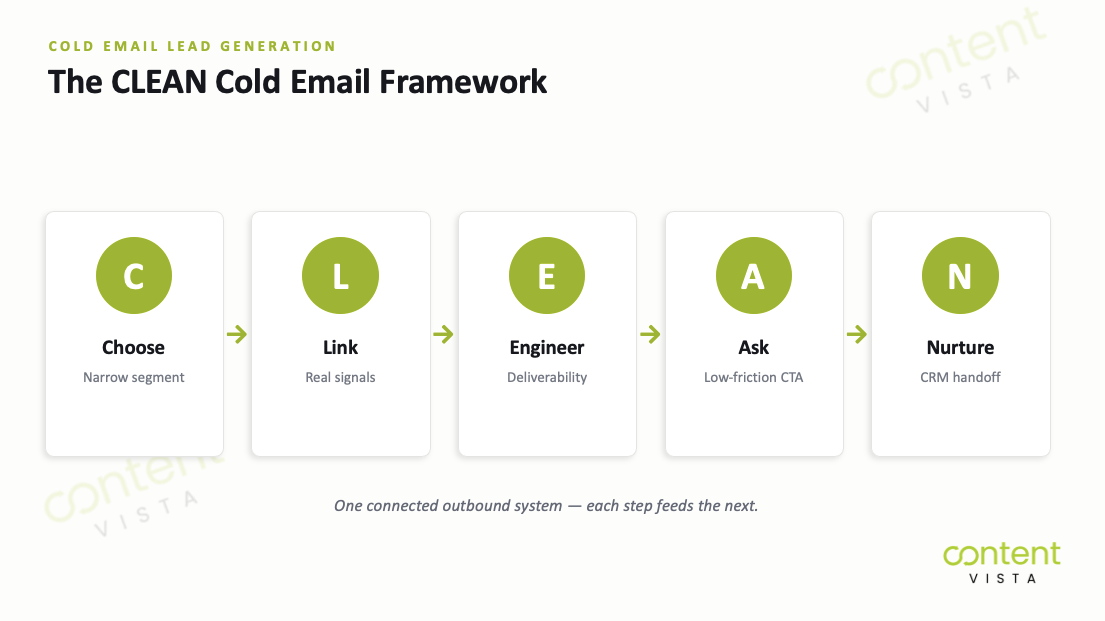
Each part matters because cold email failures are usually connected.
For example, broad targeting creates vague messaging.
Vague messaging lowers replies.
Lower replies push teams toward higher send volume.
Higher volume increases complaint risk and deliverability pressure.
And once sender reputation weakens, even relevant emails become harder to land in inboxes.
That is why treating cold email like a copywriting problem alone usually fails.
The better way is to think of outbound as a controlled system.
Choose
Start with a narrow segment and a clear offer.
The more specific the audience, the easier it becomes to create relevance. One email should not try to speak to five different buyer types at once.
Link
Connect the outreach to something real:
a trigger
a pain point
a business context
a role-specific problem
an observable signal
The goal is not fake familiarity. It is legitimate relevance.
Engineer
Deliverability and compliance are not technical afterthoughts.
Authentication, sender reputation, unsubscribe handling, bounce control and responsible sending practices all affect whether the outreach is even seen.
Ask
Most cold emails ask for too much too quickly.
A low-friction next step usually performs better because it reduces resistance and makes replying easier.
Nurture
One email is rarely enough.
But good follow-up is measured, contextual, and operationally managed. Replies should be handled properly, routed into CRM and connected back to pipeline visibility.
In short, CLEAN is designed to move cold email away from volume-first outreach and toward qualified conversation systems.
That shift matters because sustainable outbound is rarely about sending more.
It is about making relevance, trust and execution work together consistently.
Step 1 - Choose a Narrow Segment and One Clear Offer
The email is not where cold email starts.
The segment is.
A lot of cold outreach fails long before anyone writes a subject line because the targeting is too broad to create real relevance.
When a list includes five different industries, three buyer types, and multiple business models, the messaging becomes generic by default. The sender tries to sound relevant to everyone and ends up sounding relevant to no one.
That is why strong cold email systems usually begin with segmentation discipline, not copywriting tricks.
Define the segment tightly
Narrow targeting improves almost everything downstream:
message clarity
reply quality
deliverability
personalisation
offer positioning
follow-up relevance
Think about it this way:
It is much easier to write a meaningful email to:
founders of B2B agencies with 10-30 employees
operations leaders at logistics firms expanding internationally
consultants already using LinkedIn outreach but struggling with follow-up
…than to “business owners” in general.
Useful segmentation can include:
role
industry
company size
business model
growth stage
buying trigger
operational pain
market category
acquisition maturity
The goal is not just to identify who could buy.
It is to identify who is most likely to recognise the problem quickly enough to care about the message.
Match the offer to a specific pain
Good cold email usually connects one clear offer to one specific business problem.
Weak outreach often tries to sell too many things at once:
lead generation
branding
automation
SEO
ads
AI
consulting
That creates confusion instead of relevance.
A stronger approach is narrower and easier to understand.
For example:
improve reply handling for outbound-heavy sales teams
build deliverability-safe cold outreach systems
increase qualified consultations from LinkedIn-led outreach
reduce pipeline leakage between outbound and CRM
Specificity makes cold email easier to trust because the message feels intentional instead of mass-produced.
And this is where many businesses realise the real problem is not copy.
It is ICP clarity, positioning or offer structure.
If that foundation is weak, fixing the messaging alone usually does not solve the pipeline issue. In those cases, it often makes more sense to revisit the broader growth strategy or Marketing OS Sprint before scaling outbound.
Avoid “anyone who could buy” targeting
Here’s one of the fastest ways to damage cold email performance:
building lists around possibility instead of fit.
A broad list may look impressive in a spreadsheet, but it usually creates:
weaker reply quality
lower conversion potential
more complaints
vague messaging
poor deliverability signals
Good cold outreach depends heavily on list quality and verified contact data.
That means:
verified email addresses
accurate role information
updated company data
clean segmentation
basic list hygiene practices
One email should not try to speak to five different buyer types at once.
The tighter the segment, the easier it becomes to create outreach that feels relevant instead of interruptive.
And in modern outbound, relevance is usually the difference between a qualified reply and another ignored email.
Step 2 - Link the Message to a Real Signal, Problem or Trigger
Most cold emails fail at the exact moment they try to sound personalised.
Why?
Because they confuse surface-level customisation with relevance.
“The goal is not to prove you found their first name. The goal is to prove the message belongs in their inbox.”
That is the real difference between meaningful personalisation and fake personalisation.
Why fake personalisation fails
Most buyers can instantly recognise low-effort outreach.
Especially when the email opens with something like:
“Hi {FirstName}, I noticed {CompanyName}…”
“Loved your recent post…”
“Saw you are doing great work in the industry…”
The problem is not that these lines are technically personalised.
The problem is that they do not create relevance.
They usually signal that the sender scraped a profile, inserted a merge field and sent the same email to hundreds of other people.
That is why fake personalisation often feels more spammy than honest directness.
Real personalisation connects the message to something meaningful:
a business trigger
a role-specific pain
a growth stage
a recent operational change
a hiring pattern
a visible acquisition problem
a market shift
a strategic priority
In other words, the outreach should answer an unspoken question quickly:
“Why does this email make sense for me specifically?”
Four types of useful personalisation
Useful personalisation is contextual, not cosmetic.
And different buyer types respond to different kinds of signals.
| Personalisation Type | What It Uses | Best Fit For | Example |
|---|---|---|---|
| Individual-based | Role, responsibilities, public activity, leadership priorities | Founders, executives, consultants | Referencing operational bottlenecks tied to their role |
| Company-based | Business model, company size, market category, growth stage | Agencies, service firms, scaling teams | Messaging tied to expansion, hiring, or acquisition goals |
| Activity-based | Content activity, podcast appearances, hiring, launches, partnerships | Socially active operators or GTM teams | Connecting outreach to recent outbound or marketing activity |
| Trigger-based | Funding, expansion, hiring spikes, new offers, tech adoption | High-growth or changing businesses | Outreach linked to visible operational shifts |
| Industry-based social proof | Similar client problems, market patterns, niche challenges | Risk-sensitive buyers | Showing relevance through comparable industry situations |
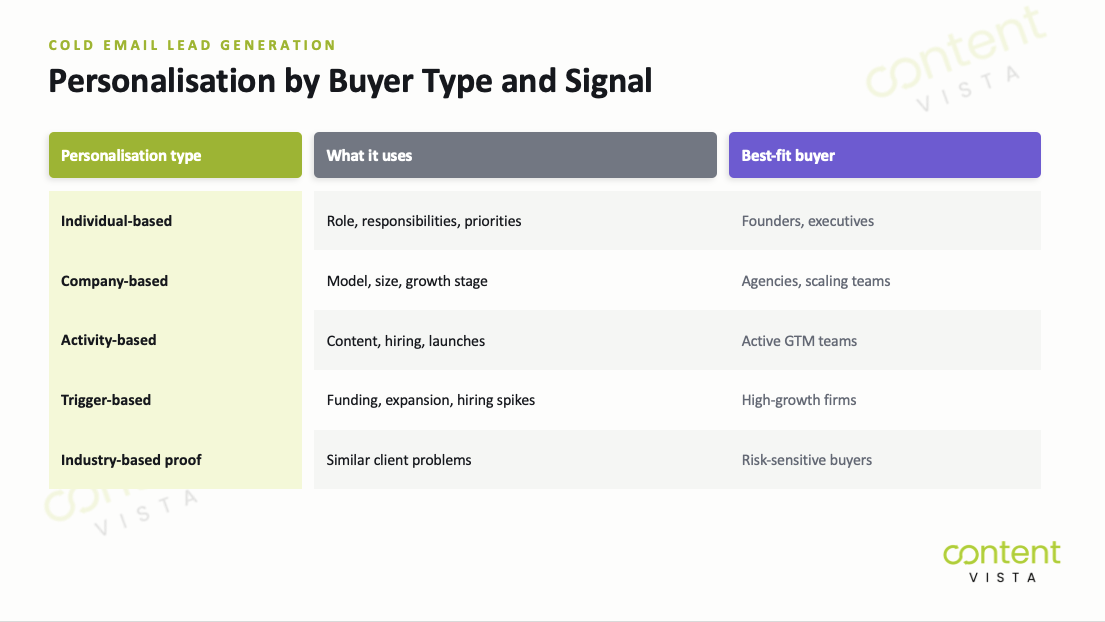
The important point is this:
Not every buyer needs deep manual personalisation.
A founder at a 15-person agency may respond well to a sharp industry-specific insight.
A sales leader managing outbound reps may care more about deliverability or reply quality.
An operator at a fast-growing company may respond to timing and operational pressure instead of conversational tone.
That is why strong outbound teams personalise differently depending on:
buyer seniority
market sophistication
available signals
outreach volume
deal value
relationship context
How to choose the right signal
A useful signal is something that increases the odds the message is relevant now.
That timing element matters.
Good signals often come from:
hiring patterns
expansion activity
visible outbound efforts
LinkedIn activity
operational bottlenecks
new service launches
CRM or growth-stage changes
acquisition pressure
This is where the LinkedIn Growth Engine and social signal research can become valuable. Public activity often reveals what a company is prioritising long before a sales call happens.
But there is a catch:
More personalisation is not automatically better.
Over-researched cold emails can feel invasive, performative or artificial especially when the sender forces irrelevant observations into the opening lines.
The better approach is usually simpler: use enough context to make the outreach feel intentional and credible.
Because the goal is not to impress the recipient with research.
It is to make the relevance obvious quickly enough to earn a reply.
Good personalisation does not sound like:
“I found information about you.”
It sounds like:
“This problem, timing or opportunity is probably relevant to your situation.”
Step 3 - Engineer Deliverability and Compliance Before You Scale
“Deliverability is not the boring technical part. It is the difference between outreach and invisibility.”
A lot of cold email campaigns fail before the recipient ever sees the message.
Not because the copy is weak.
Because the infrastructure underneath the outreach is weak.
Modern inbox providers pay close attention to sender behaviour, authentication standards, complaint signals, bounce patterns and engagement quality. That means cold email is no longer just a messaging problem. It is also a reputation-management problem.
If sender trust drops, inbox placement usually drops with it.
And once that happens, increasing send volume often makes the situation worse.
Authenticate before sending
Before scaling outreach, the sending infrastructure should be properly configured.
That includes:
SPF
DKIM
DMARC
domain alignment
mailbox configuration
reply handling
bounce management
These authentication standards help receiving inboxes verify that the emails are coming from legitimate infrastructure rather than spoofed or suspicious sources.
Without them, even relevant cold outreach may struggle to land reliably.
Domain reputation also matters.
If a domain suddenly starts sending high volumes of low-engagement outreach, inbox providers may treat that behaviour as risky. That is why strong outbound systems usually ramp sending gradually instead of blasting thousands of emails immediately.
List quality matters here too.
Poorly verified contacts create unnecessary bounces, and high bounce rates can damage sender reputation quickly.
Keep complaint rates low
Spam complaints are one of the clearest indicators that outreach is not landing well with recipients.
And the causes are usually predictable:
irrelevant targeting
misleading subject lines
deceptive messaging
over-aggressive follow-up
poor list hygiene
sending at too much scale too quickly
This is why deliverability cannot be separated from targeting strategy.
If the outreach is irrelevant, the infrastructure eventually suffers.
The safest long-term approach is usually:
narrower segmentation
better-fit recipients
realistic send volumes
cleaner lists
lower-friction messaging
more disciplined follow-up
That may feel slower initially.
But it is often more sustainable than chasing volume while inbox placement deteriorates quietly in the background.
Make unsubscribing easy
One of the fastest ways to create frustration is making it difficult for recipients to opt out.
Good outbound systems make unsubscribing straightforward and visible.
That is increasingly important because inbox and sender requirements have become stricter around recipient control, complaint reduction, and sender transparency. One-click unsubscribe support is now part of the broader deliverability conversation, especially for larger-scale outreach environments. (Google email sender guidelines)
The practical point is simple:
If someone does not want the outreach, letting them leave cleanly is better than generating complaints.
Respect compliance rules by market
Cold email compliance rules vary depending on:
geography
audience type
business context
data source
outreach intent
That means there is no universal compliance checklist that applies perfectly everywhere.
Businesses sending outbound email should understand the requirements relevant to their market and audience. Depending on location, frameworks such as FTC / CAN-SPAM guidance in the US and ICO / PECR / UK GDPR guidance in the UK and Europe may apply differently.
This article is not legal advice, and businesses should confirm applicable obligations with qualified legal guidance where appropriate.
The broader principle, however, is consistent:
Responsible outreach should prioritise transparency, relevance, respectful targeting and recipient control.
Deliverability and Compliance Checklist
| Area | What to Check |
|---|---|
| Domain authentication | SPF, DKIM, and DMARC configured correctly |
| Sending reputation | No sudden volume spikes or suspicious sending behaviour |
| Contact quality | Verified contacts and active email validation |
| Bounce control | Remove invalid or risky addresses quickly |
| Complaint monitoring | Watch spam complaints and negative engagement signals |
| Unsubscribe handling | Make opting out clear and easy |
| Targeting quality | Narrow segmentation and relevance-first outreach |
| Follow-up discipline | Avoid excessive or repetitive sequences |
| Reply handling | Monitor inboxes and process responses properly |
| CRM visibility | Route replies and opportunities into CRM systems |
| Compliance awareness | Confirm applicable rules by geography and audience |
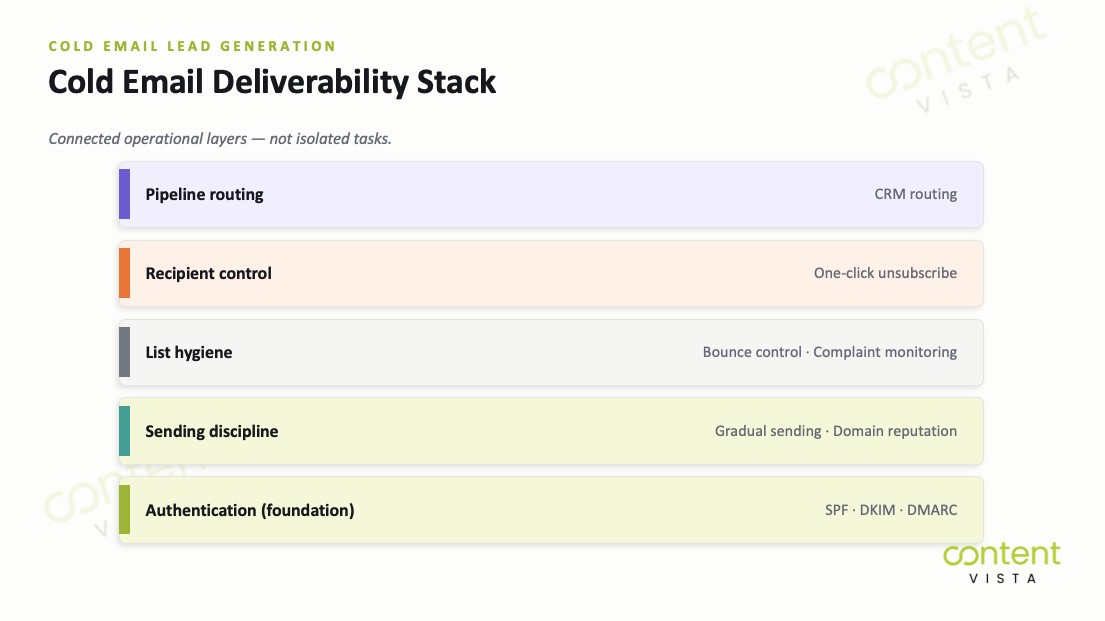
The important takeaway is this:
Deliverability is not separate from strategy.
It is part of the strategy.
Strong cold email systems usually treat targeting, infrastructure, compliance awareness, reply handling and CRM routing as connected operational layers not isolated tasks owned by different teams.
That is also why many businesses eventually realise they do not just need outreach software.
They need stronger deliverability and CRM infrastructure underneath the outbound process itself.
If deliverability, CRM and routing are weak, fix the infrastructure before scaling sends.
Step 4 - Ask for One Low-Friction Next Step
One of the biggest mistakes in cold email is asking for too much too early.
The outreach is cold. The relationship is minimal. Trust is limited.
And yet many emails jump immediately to:
“Can we book a 45-minute demo?”
“Do you have time for a strategy call this week?”
“Would you like a full proposal?”
That creates unnecessary resistance.
“The first ask should not feel like a sales call invitation. It should feel like an easy next reply.”
That is why low-friction CTAs usually work better in cold outreach.
The goal of the first email is not to close the deal.
It is to open the conversation.
A good cold email CTA reduces pressure while keeping the conversation commercially relevant.
For example:
“Worth a quick look?”
“Should I send the breakdown?”
“Open to seeing the gap?”
“Would this be relevant?”
“Want me to send the example?”
“Curious if this is already being solved internally?”
These asks work because they feel lightweight and easy to respond to.
They do not force the recipient into a meeting commitment before enough trust exists.
That matters because awareness levels differ.
Some buyers already know they have a problem. Others only vaguely recognise friction. Some have not connected the issue to a solution yet at all.
The CTA should match that reality.
A highly aware buyer with active acquisition pressure may be open to a call quickly.
A colder or more sceptical buyer may only be willing to engage with:
a short insight
a diagnostic
a teardown
a benchmark
a brief explanation
a simple yes/no reply
That is still progress.
In many cases, the reply matters more than the meeting link.
Weak vs Better Cold Email CTAs
| Weak CTA | Better Low-Friction CTA |
|---|---|
| “Can we schedule a 60-minute demo?” | “Worth a quick look?” |
| “Let’s book a strategy call.” | “Open to seeing how this compares to your current process?” |
| “Do you have time tomorrow at 2 PM?” | “Would this even be relevant right now?” |
| “Can I walk you through our solution?” | “Should I send the short breakdown?” |
| “Book a consultation here.” | “Happy to send details if useful.” |
Another common mistake is combining a big ask with big claims.
For example:
“We can 10x your pipeline.”
“Guaranteed leads in 30 days.”
“We help companies scale instantly.”
Overclaiming increases scepticism, especially in cold outreach where trust has not been earned yet.
A calmer, more contextual approach usually performs better because it feels more credible.
The best cold email CTAs often sound less like persuasion and more like relevance testing.
That subtle shift matters.
Because when the ask feels easy, replying feels easier too.
Step 5 - Build a Follow-Up Sequence Without Harassing People
A lot of cold outreach becomes spam during the follow-up stage.
Not because follow-up itself is wrong.
Because the sender keeps repeating the same irrelevant ask with increasing pressure.
“Follow-up is not the problem. Repeating the same irrelevant ask is.”
That distinction matters.
Good follow-up helps recipients engage when timing, attention or context prevented a response earlier.
Bad follow-up feels like automated persistence without awareness.
Why one email is rarely enough
People miss emails for legitimate reasons:
timing
inbox overload
competing priorities
travel
internal deadlines
lack of immediate urgency
That is why stopping after one message usually leaves opportunities unrealised.
But the answer is not aggressive persistence.
The answer is structured, measured follow-up.
Strong outbound sequences usually assume:
not everyone will reply immediately
not every recipient is equally aware
timing affects response quality
context may need reinforcement gradually
The goal is not to “wear people down.”
It is to make responding easier if the topic becomes relevant.
What a sensible follow-up sequence includes
Good follow-up sequences add value, clarity or context.
They do not simply resend the same pitch four times.
A healthier structure usually looks something like this:
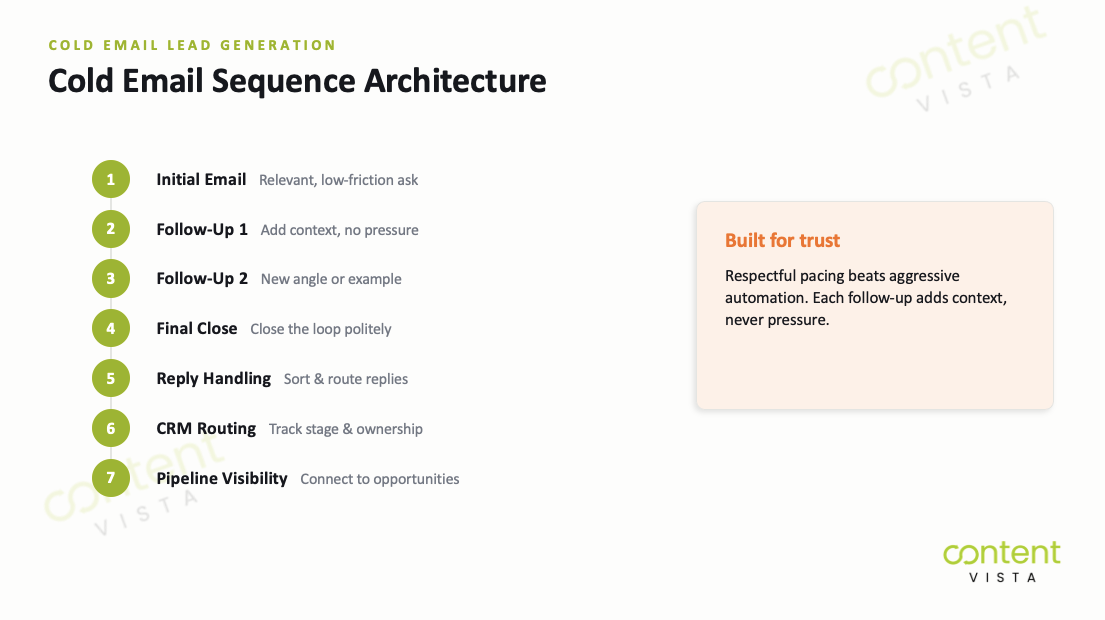
Example Cold Email Sequence Architecture
1. Initial Email
* Short, relevant outreach tied to a real signal or problem
* Low-friction CTA
2. Follow-Up 1
* Add context, clarification, or another angle
* Reinforce relevance without pressure
3. Follow-Up 2
* Introduce a practical example, insight, or operational gap
* Keep the ask lightweight
4. Final Polite Close
* Respectfully close the loop
* Leave the door open for future relevance
5. Reply Handling
* Route replies quickly and appropriately
* Separate positive, neutral, referral, and unsubscribe responses
6. CRM Routing
* Track conversation stage, ownership, and follow-up status
Notice what is missing:
guilt-based messaging
manipulative urgency
fake breakup theatrics
repeated “just bumping this up”
escalating pressure tactics
The sequence should evolve based on signals.
For example:
a prospect who clicked a link may justify a different follow-up than someone completely disengaged
a referral response should route differently from a pricing objection
an executive-level recipient may need fewer touchpoints than a mid-level operator evaluating vendors
This is where many outbound systems break down operationally.
The outreach exists.
But the reply handling does not.
How replies should be handled and routed
A cold email is not complete when someone replies.
That is where the real work starts.
Strong outbound systems usually define:
who owns replies
response time expectations
qualification criteria
CRM routing logic
meeting handoff process
pipeline stage visibility
Without this structure, leads get lost between inboxes, spreadsheets and disconnected sales processes.
That is why follow-up should be treated as part of a broader operational system, not just an automated email sequence.
A well-managed outbound process feels coordinated internally and respectful externally.
And that matters because recipients notice the difference quickly.
The companies that damage trust with cold outreach are rarely the ones sending one thoughtful follow-up.
They are usually the ones automating persistence without relevance, timing awareness or reply discipline.
Need a done-for-you cold email conversion system?
Explore the Cold Email Conversion Lab.
Measure the Metrics That Actually Create Pipeline
A lot of cold email reporting looks impressive while producing very little business impact.
That usually happens when teams optimise for visibility metrics instead of pipeline metrics.
“Opens are a weak scoreboard. Replies are better. Qualified opportunities are better still.”
This matters even more now because open-rate tracking has become less dependable. Privacy protections, email client behaviour and automated inbox activity can distort open data significantly. (Postmark on Apple Mail Privacy Protection)
An email marked as “opened” does not necessarily mean:
the message was read
the recipient cared
the outreach was relevant
the campaign created pipeline
That is why modern outbound systems should treat opens as directional data at best not as the primary definition of success.
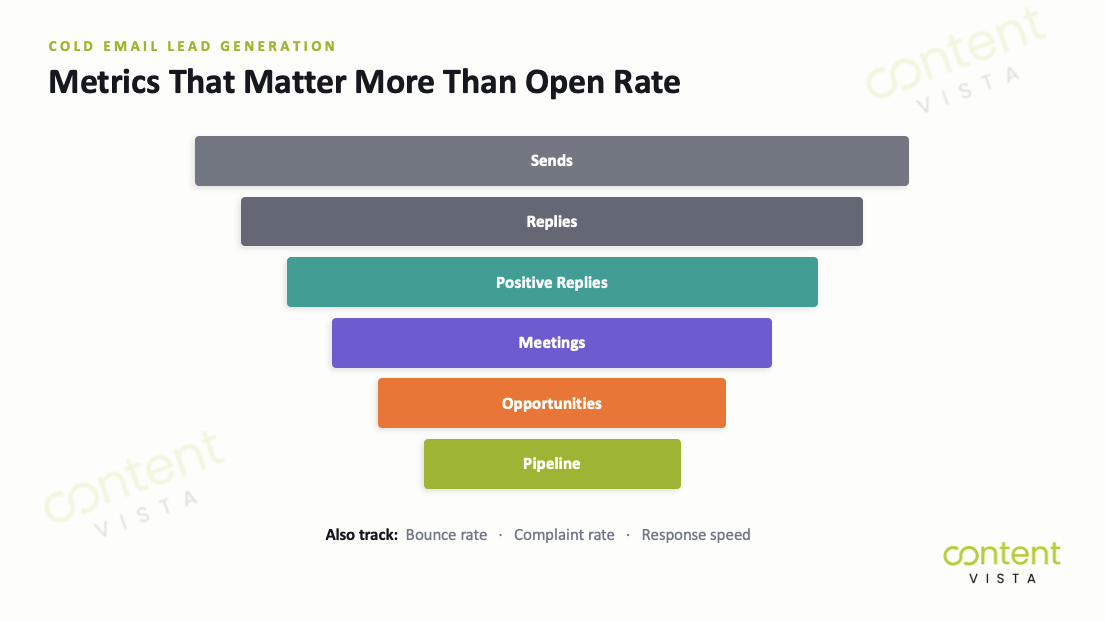
Metrics That Matter More Than Open Rate
| Metric | What It Actually Measures | Why It Matters |
|---|---|---|
| Reply rate | Total percentage of recipients who replied | Indicates whether the message generated engagement |
| Positive reply rate | Percentage of replies showing genuine interest | Better signal of commercial relevance |
| Bounce rate | Percentage of emails that failed delivery | Reflects list quality and deliverability health |
| Complaint rate | Spam complaints or negative engagement | Signals targeting and messaging quality |
| Meetings booked | Qualified conversations scheduled | Shows conversion movement beyond replies |
| Opportunity rate | Conversations becoming real sales opportunities | Connects outreach to pipeline creation |
| Source-to-pipeline conversion | Pipeline generated from outbound source | Measures business impact instead of email activity |
| Response time | How quickly replies are handled internally | Affects conversion quality and pipeline leakage |
Key Metrics That Actually Matter
* Are the right people replying?
* Are replies commercially relevant?
* Are meetings turning into opportunities?
* Is outbound contributing to the pipeline consistently?
* Is deliverability staying healthy while scaling?
* Is the system improving over time?
These questions matter far more than inflated open-rate screenshots.
A high open rate with no replies is not success.
And a high reply rate filled with bad-fit prospects is not success either.
Cold email should ultimately be judged by:
qualified conversations
opportunity creation
pipeline contribution
downstream revenue potential
That shift changes how outbound gets managed.
Instead of asking: “How many emails did we send?”
The better questions become:
How many relevant conversations started?
Which segments produced qualified opportunities?
Which messaging angles converted best?
Which acquisition sources created the strongest pipeline quality?
Where are leads leaking between outreach and sales follow-up?
This is where CRM visibility becomes critical.
Without proper tracking, teams often cannot connect:
sends → replies
replies → meetings
meetings → opportunities
opportunities → revenue outcomes
And once that visibility breaks, optimisation becomes guesswork.
Estimate what cold email actually needs to contribute
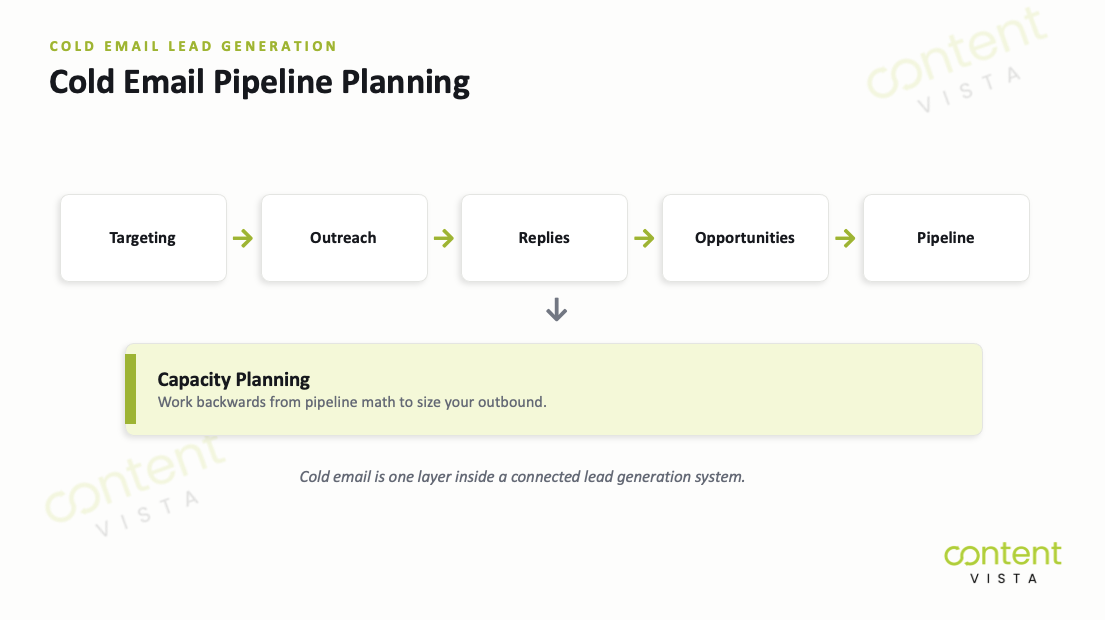
One of the most useful ways to evaluate outbound is to work backwards from pipeline requirements.
For example:
revenue target
required opportunities
expected close rate
meetings needed
positive reply requirements
estimated outreach capacity
This changes cold email from a vague “growth activity” into a measurable pipeline system.
It also helps businesses understand whether outbound expectations are realistic.
Many teams expect cold email alone to compensate for:
weak positioning
low conversion rates
unclear offers
poor follow-up
limited sales capacity
But cold email is only one layer inside a broader lead generation engine.
The more clearly the pipeline math is understood, the easier it becomes to decide:
how much outbound is required
whether the system is commercially viable
where bottlenecks actually exist
Calculate what your cold email engine actually needs to contribute to your pipeline.
Use the Lead Generation Capacity Calculator.
Where AI Helps and Where It Makes Cold Email Worse
AI has changed outbound quickly.
But not always for the better.
A lot of spammy cold email became even worse once teams started automating generic messaging at scale with AI-generated copy.
“AI can make good outbound faster. It can also make bad outbound louder.”
That is the real issue.
AI works best as a support layer inside a strong outbound system — not a replacement for targeting, positioning, judgment or commercial thinking.
What AI can support
Used properly, AI-assisted workflows can reduce operational friction across outbound systems.
That includes:
prospect research
segmentation
signal identification
draft personalisation
list enrichment
sequence variation
CRM note generation
reply categorisation
reporting summaries
For example, AI can help:
identify companies hiring aggressively
summarise LinkedIn activity
cluster prospects by market category
generate message variations by segment
classify replies into pipeline stages
surface patterns across outbound performance data
That can save teams significant time operationally.
It can also make outbound systems more adaptive and easier to manage.
But notice what AI is doing in those examples: It is assisting workflow execution.
It is not replacing strategic judgment.
What AI should not replace
AI becomes dangerous when businesses use it to automate relevance instead of improve it.
That usually leads to:
generic messaging at scale
invented personalisation
fake contextual references
exaggerated claims
low-quality outreach volume
disconnected automation
Recipients notice this quickly.
Especially when the email sounds technically polished but commercially hollow.
For example:
referencing irrelevant company activity
inventing operational assumptions
pretending familiarity where none exists
over-personalising trivial details
generating vague “growth opportunity” language
AI can produce language that sounds convincing without actually being meaningful.
That creates a dangerous illusion: The outreach appears sophisticated while relevance quietly collapses underneath it.
And once that happens, the system usually scales bad targeting faster instead of improving results.
Why AI-generated relevance still needs human judgment
The hardest part of cold email is not writing sentences.
It is understanding:
who should receive the outreach
why the message matters
when timing is relevant
what level of ask makes sense
whether the offer actually fits the buyer
Those are judgment problems.
Not automation problems.
That is why human review still matters especially in higher-value or more complex outbound environments.
Strong AI-assisted workflows usually combine:
human positioning
human segmentation decisions
operational automation
structured CRM systems
selective AI augmentation
Instead of: “Let the AI send 10,000 emails.”
The better question is: “How can AI help the outbound system become more relevant, organised and measurable?”
That distinction matters because the future of outbound is probably not fully manual or fully automated.
It is coordinated.
Cold email, LinkedIn outreach, CRM workflows, content signals and AI-assisted operations increasingly work together as part of one acquisition infrastructure.
If you need cold email, LinkedIn, content, CRM and automation working together, explore the integrated AI Client Acquisition Stack.
What Cold Email Costs in Time and Effort
A lot of cold email content online makes outbound look deceptively simple.
Buy a tool. Generate some AI copy. Upload a list. Press send.
In reality, sustainable outbound is operational work.
“There is no free version of cold email. You either pay with time, expertise, tools, deliverability discipline or outsourced execution.”
That does not mean every business needs a large outbound team.
But it does mean businesses should understand what they are actually committing to before trying to scale cold outreach.
Because the work is not just writing emails.
It includes:
segmentation
research
list building
contact verification
deliverability setup
sequence creation
follow-up management
reply handling
CRM tracking
reporting
optimisation
The more pipeline a business expects from outbound, the more important operational consistency becomes.
Build Options: Founder-Led vs Assisted vs Done-for-You
| Model | Time Investment | Operational Complexity | Best Fit For | Main Risks |
|---|---|---|---|---|
| Founder-led manual outreach | High | Moderate | Early-stage founders validating positioning or niche demand | Inconsistent execution, founder bandwidth limits |
| Assisted outbound | Medium | Moderate to high | Small teams needing support with research, lists or systems | Fragmented ownership and process gaps |
| Done-for-you cold email system | Lower internal time requirement | Managed externally but still operationally structured | Businesses wanting outbound without building the entire system internally | Dependency on provider quality and alignment |
| Integrated client acquisition system | Highest strategic coordination but broader long-term leverage | High | Businesses combining outbound, CRM, content, LinkedIn and automation into one acquisition engine | Complexity without strong systems ownership |
Founder-led outreach often works well early because founders usually understand:
the market
the pain points
the language buyers use
the objections
the offer nuance
That can create highly relevant conversations.
But it is difficult to sustain once outbound volume, follow-up requirements and CRM coordination grow.
At that point, businesses often move toward assisted workflows or external systems support.
The challenge is that outbound complexity compounds quietly.
For example:
better targeting increases research demands
more sends increase deliverability pressure
more replies increase operational handling needs
more meetings increase CRM coordination requirements
Without structure, cold email becomes messy fast.
That is why many businesses eventually separate:
strategic ownership
operational execution
infrastructure management
pipeline reporting
There is also an important difference between:
“sending cold emails”
and
building an acquisition system.
The second approach usually integrates:
outbound
LinkedIn activity
CRM workflows
content signals
reporting
automation
sales visibility
That is where solutions like the Cold Email Conversion Lab or a broader AI Client Acquisition Stack become relevant for businesses that need outbound operating as part of a larger growth infrastructure. When that work needs to be run for you end to end, it sits with the email outreach and cold outreach service.
The key point is not that every company needs outsourced support.
It is that cold email becomes significantly more effective when businesses understand the operational reality behind it before scaling sends.
Common Mistakes That Make Cold Email Look Like Spam
The mistakes are not complicated.
But they are exactly why so much cold email feels like spam.
Most poor outbound systems fail in predictable ways:
weak targeting
low relevance
operational shortcuts
automation without judgment
no connection to pipeline quality
And once several of those problems combine, the outreach stops feeling like business communication and starts feeling like inbox pollution.
Common Cold Email Mistakes That Damage Trust and Performance
1. Buying huge generic lists
Large low-fit lists usually create vague messaging, weak replies, high bounce rates and complaint risk.
2. Targeting too broadly
“Anyone who could buy” is not a usable outbound segment.
3. Using fake compliments
Generic lines pretending familiarity rarely create trust.
4. Relying only on merge fields
Personalisation is not just inserting names and company variables.
5. Over-automating with AI
AI-generated copy without strategic relevance often scales mediocrity faster.
6. Sending before authentication is configured
Weak SPF, DKIM, DMARC or sender setup can damage inbox placement quickly.
7. Ignoring unsubscribes
Making opt-outs difficult increases complaints and damages sender reputation.
8. Using hard CTAs too early
Cold prospects rarely want immediate demos or aggressive sales calls.
9. Sending too many follow-ups
Persistence without relevance eventually feels like harassment.
10. Tracking opens instead of opportunities
High open rates do not automatically mean pipeline impact.
11. Not routing replies into CRM
Untracked conversations create lead leakage and poor pipeline visibility.
12. Treating deliverability, copy, follow-up and measurement as separate problems
Outbound performance usually depends on how the entire system works together.
A common pattern behind many of these mistakes is impatience.
Teams want pipeline quickly, so they:
increase send volume
reduce targeting precision
automate more aggressively
lower messaging quality
skip operational discipline
That can create temporary activity.
But it rarely creates sustainable outbound performance.
For example, a weak campaign often responds to poor reply rates by sending more emails instead of improving relevance.
That creates a dangerous cycle:
lower engagement
worse deliverability
more inbox filtering
lower trust
weaker pipeline quality
And eventually the outreach becomes harder to recover.
Another major issue is fragmentation.
Many businesses treat:
copywriting
deliverability
list building
follow-up
CRM management
reporting
…as disconnected tasks.
But recipients experience all of it as one interaction.
A technically authenticated email with weak targeting still feels irrelevant.
A well-written email with poor reply handling still creates pipeline leakage.
A high-reply campaign with no CRM structure still becomes operational chaos.
That is why strong cold email systems usually behave more like coordinated acquisition infrastructure than isolated email campaigns.
The important takeaway is not that cold email is risky by default.
It is that most spammy outreach is usually the result of multiple small operational mistakes compounding together.
And fixing those problems rarely requires “growth hacks.”
It usually requires:
better segmentation
better judgment
stronger systems
more disciplined execution
clearer measurement
When Not to Build a Cold Email Engine Yet
Sometimes cold email is not the problem.
The foundation underneath cold email is.
A lot of businesses assume outbound will solve pipeline issues automatically:
more emails
more automation
more sequences
more AI-generated outreach
But if the underlying positioning, targeting or sales process is weak, cold email usually amplifies the problem instead of fixing it.
That is why scaling outbound too early can become expensive noise.
Do not build a cold email engine yet if:
* the offer is unclear
* the ICP is undefined
* the market is too broad
* the business cannot handle replies consistently
* the sales process is weak or inconsistent
* the audience requires trust before outreach works
* deliverability infrastructure is not ready
* the team wants volume without relevance
* the real bottleneck is positioning, messaging, or conversion
In those situations, scaling outbound usually creates activity faster than pipeline.
For example, if the offer itself is vague, no amount of personalisation will make the outreach compelling.
If the ICP keeps changing, the targeting will stay inconsistent.
If the business cannot respond quickly to qualified replies, opportunities will leak after the outreach succeeds.
And if the audience requires authority or trust first, direct cold outreach may feel premature compared to:
content
referrals
LinkedIn visibility
partnerships
demand-generation-led acquisition
This is especially common in:
high-trust consulting environments
strategic services
premium B2B offers
complex enterprise sales
founder-led advisory businesses
In those cases, outbound often works better after market credibility already exists.
Another major issue is operational readiness.
Cold email is not just:
sending messages
getting replies
booking calls
It also creates:
follow-up obligations
qualification work
CRM management
reporting needs
deliverability maintenance
pipeline coordination
If the business is not ready operationally, more outbound volume can overwhelm the system quickly.
That is why many companies should first clarify:
ICP
positioning
funnel structure
conversion process
acquisition strategy
operational ownership
…before scaling cold outreach aggressively.
In practice, the businesses that succeed with outbound long term are usually the ones treating it as part of a broader go-to-market system not as a shortcut around unclear strategy.
If the foundations are unclear, fix your ICP, offer, funnel strategy and GTM plan before scaling outbound.
Explore the Marketing OS Sprint or broader growth strategy support.
Want to diagnose whether cold email is even capable of supporting your pipeline goals?
Use the Lead Generation Capacity Calculator.
Example: What a Non-Spammy Cold Email System Looks Like
Here’s what changes when cold email is treated as a system instead of a sending habit.
Instead of starting with: “How many emails can we send?”
The process starts with: “Who is this specifically relevant to, and why now?”
Imagine a hypothetical outbound campaign for a consultancy helping B2B agencies improve lead handling and conversion infrastructure.
The process might look something like this:
Step 1: Choose a narrow segment
Instead of targeting “business owners,” the campaign focuses on:
B2B agencies
10–50 employees
already investing in outbound or LinkedIn acquisition
visibly hiring for sales or account-management roles
That narrower segment immediately improves message clarity.
Step 2: Identify a real trigger
The outreach is tied to observable signals such as:
increased hiring
growing outbound activity
visible lead-generation efforts
operational scaling pressure
The point is not to invent urgency.
It is to connect the outreach to a plausible business context.
Step 3: Write a relevance-based first email
The first message stays focused:
one operational problem
one clear angle
one low-friction CTA
Instead of: “Let’s book a call.”
The ask might be: “Open to seeing where outbound replies are leaking between acquisition and follow-up?”
That feels more contextual and easier to engage with.
Step 4: Add useful follow-ups
The follow-up sequence does not simply repeat: “Just checking if you saw this.”
Instead, later emails might:
clarify the problem
introduce another operational angle
mention a common outbound bottleneck
reference pipeline visibility or CRM issues
close the loop politely if there is no interest
The tone stays measured.
Step 5: Route replies into CRM
Once replies arrive, the system matters more than the sequence itself.
Replies are:
categorised
routed correctly
assigned ownership
tracked by stage
connected to opportunity visibility
Without this step, outbound performance becomes difficult to measure accurately.
Step 6: Connect outbound to pipeline math
The final layer is measurement.
The business tracks:
positive replies
meetings booked
opportunities created
pipeline contribution
source-to-opportunity conversion
That changes outbound from: “sending emails”
…into: “measuring acquisition performance.”
And that is usually the biggest difference between spammy cold outreach and sustainable outbound systems.
The better systems are not necessarily louder.
They are more relevant, more measurable and more operationally coordinated.
FAQs About Cold Email Lead Generation
What is cold email lead generation?
Cold email lead generation is the process of sending relevant outbound emails to people who have not opted into your list, with the goal of starting qualified commercial conversations that can become pipeline. Effective cold outreach focuses on relevance, targeting, deliverability, follow-up and measurable business outcomes — not bulk email volume.
Is cold emailing legal?
It depends on your location, audience, and how the outreach is conducted. Different regions have different requirements around commercial email, consent, unsubscribe handling, and data usage. Businesses should understand the rules that apply in their market and seek qualified legal guidance where necessary. This article is not legal advice.
What is the difference between cold email and spam?
Cold email is targeted outreach tied to a relevant business context. Spam is usually irrelevant, deceptive, untargeted or excessive. The difference is not just whether the recipient opted in. It is whether the outreach is responsible, relevant and respectful.
How many follow-ups should I send?
There is no universal number, but most sensible cold email sequences include:
an initial email
1-2 contextual follow-ups
a final polite close
The important factor is relevance. Follow-ups should add value or context rather than repeat the same ask aggressively.
What is a good cold email reply rate?
Reply rates vary heavily by:
industry
targeting quality
offer fit
deliverability
outreach relevance
market sophistication
In many outbound environments, average reply rates are often in the low single digits. (Instantly 2026 Cold Email Benchmark Report) More relevant and tightly segmented campaigns can perform better, but there are no guaranteed benchmarks.
How much personalisation is enough?
Enough to make the outreach feel intentional and contextually relevant.
That does not always require deep manual research. Good personalisation usually connects the message to:
a real business problem
a trigger
a role-specific challenge
a market situation
a visible operational signal
Fake compliments and forced familiarity often reduce trust instead of increasing it.
What metrics matter most now that open rates are less dependable?
The most useful outbound metrics usually include:
reply rate
positive reply rate
bounce rate
complaint rate
meetings booked
opportunity creation
source-to-pipeline conversion
Open rates are less dependable now because privacy protections and inbox behaviour can distort tracking data. (Postmark on Apple Mail Privacy Protection)
When should I avoid cold email?
Cold email is usually a poor fit when:
the offer is unclear
the ICP is undefined
the audience is too broad
the business cannot handle replies operationally
trust needs to be built before outreach
deliverability infrastructure is weak
the sales process itself is inconsistent
In those situations, fixing positioning, conversion systems or demand generation often matters more than scaling outbound.
What should AI automate in outbound?
AI-assisted workflows can support:
prospect research
segmentation
list enrichment
signal identification
draft personalisation
reply categorisation
CRM notes
reporting summaries
AI should not replace targeting judgment, positioning strategy, or relevance decisions. Automating bad outreach usually creates spam faster.
How many emails can I safely send per inbox?
There is no universal safe number because inbox providers evaluate:
sender reputation
authentication quality
complaint rates
engagement signals
sending behaviour
domain health
Safe scaling usually depends more on deliverability discipline and relevance quality than arbitrary volume targets. (Topo on safe cold email sending limits)
Does cold email work for non-SaaS businesses?
Yes.
Cold email can work for many types of businesses, including:
agencies
consultants
professional services
niche B2B operators
manufacturing
logistics
recruitment
financial services
specialised service providers
The key requirement is not being SaaS. It is having identifiable buyers, a relevant offer, and a credible reason for outreach.
Should cold email be used alone or with other channels?
Cold email usually performs better as part of a broader acquisition system.
That can include:
LinkedIn outreach
content marketing
referrals
CRM automation
demand generation
sales follow-up systems
When outbound works alongside other trust-building and conversion channels, reply quality and pipeline consistency are often stronger than relying on cold email alone.
Conclusion: Cold Email Works When It Is Built Like a System
Cold email is not dead.
But spammy cold email is becoming increasingly fragile.
The old approach: broad lists, generic automation, aggressive follow-ups and vanity metrics is harder to sustain because inbox providers, buyers and markets are less tolerant of low-relevance outreach.
The businesses still generating pipeline from outbound are usually doing something different.
They are treating cold email like a system.
That means:
narrow targeting
relevance-first messaging
deliverability discipline
thoughtful follow-up
CRM visibility
pipeline measurement
…all working together instead of operating as disconnected activities.
Because the goal is not more sends.
It is more qualified conversations that can realistically become opportunities.
That is also why cold email should not be viewed in isolation. The strongest outbound systems usually operate as part of a broader lead generation system where acquisition, conversion, follow-up, and reporting connect clearly.
The next step is not guessing whether outbound “works.”
It is understanding what cold email actually needs to contribute to your pipeline and whether the current system is capable of supporting that outcome.
Use the Lead Generation Capacity Calculator to see how many qualified opportunities your outbound engine needs to create.