Quick Summary
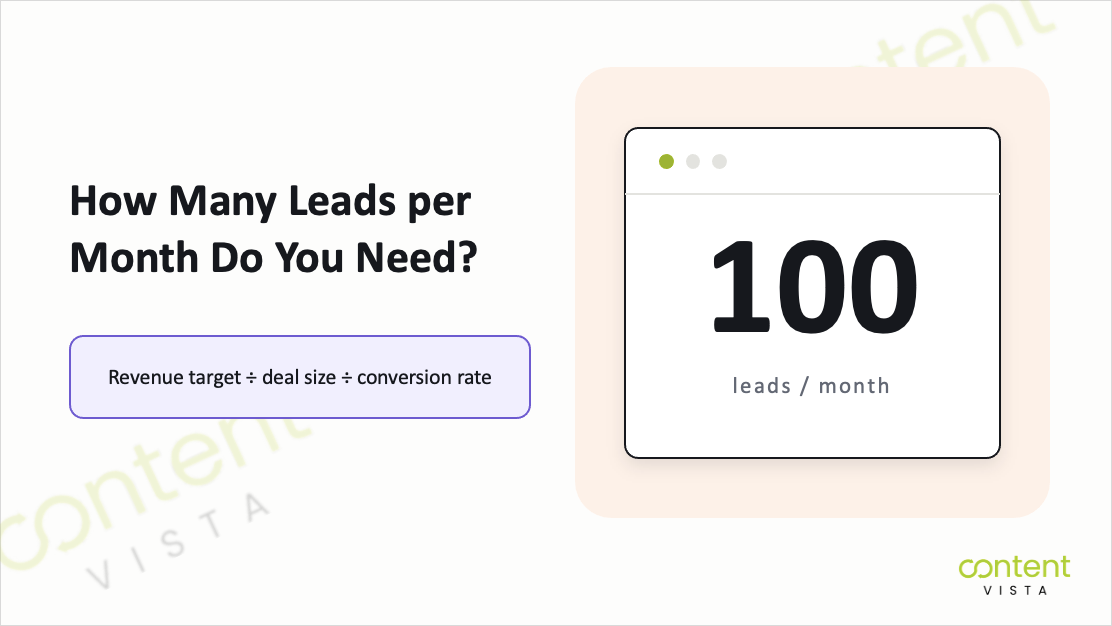
- Here’s the formula to calculate how many leads per month you need. 👇
- Start with your revenue target. Divide that by your average deal size to get the number of deals needed. Then divide the deals needed by your lead-to-customer conversion rate to calculate the qualified leads required.
- Formula: Revenue target ÷ average deal size = deals needed
Why “More Leads” Is the Wrong Starting Point
Here’s the problem: most teams do not actually know how many leads they need. They just know they want more.
That sounds reasonable at first. More leads should mean more sales conversations. More sales conversations should mean more revenue. But in practice, lead volume by itself is a weak target.
If your conversion rate is low, more leads can simply create more pipeline leakage. If lead quality is poor, your sales team spends more time filtering than selling. If follow-up is slow, even good leads lose intent before anyone has a proper conversation with them.
Too few qualified leads and you miss your sales target.
Too many poor-fit leads and you overload the system.
That is why a useful lead target does not start with a random monthly number. It starts with revenue-to-lead planning.
The better question is not:
“How many leads can we generate this month?”
The better question is:
“How many qualified leads do we need to generate this month to support our revenue target, based on our deal size, conversion rate, sales capacity and funnel health?”
This is also where many lead generation plans break. Teams set a target like “500 leads per month” without checking whether those leads are qualified, whether sales can handle them or whether the conversion rate can realistically turn that volume into revenue.
A stronger lead generation system works backwards. It starts with the revenue number, then calculates the deals needed, opportunities required, qualified leads required and finally the raw inquiries or traffic needed to create that volume.
Building that system end to end is a bigger job, and that guide covers it. This page covers one number inside it: how many qualified leads you need each month, and whether that number is realistic.
That is what this article will help you do.
You will calculate the number of leads you actually need, then pressure-test whether that number is realistic. Because sometimes the answer is more leads. Sometimes the answer is better leads. And sometimes the real fix is improving conversion, follow-up, positioning or the system underneath the lead target.
What Counts as a Lead in This Calculation?
So what does that mean? Before you calculate the number, you need to define what kind of lead you are counting.
A raw inquiry is not always a qualified lead. Someone who downloads a guide, fills a contact form, attends a webinar or replies to an outreach message may be interested, but that does not automatically mean they are a real sales opportunity.
That distinction matters because your lead target should usually be based on qualified leads, not every form fill or contact in your CRM.
Lead generation capacity is the number of qualified leads your business needs to generate in a defined period to support a revenue target. It is calculated by working backwards from revenue goals through average deal size, conversion rates, sales capacity and pipeline requirements.
In a proper lead generation system, each stage needs a clear definition:
A raw inquiry is an early signal of interest. This could be a website form fill, event registration, content download, chatbot inquiry, ad response or referral introduction. Some raw inquiries are valuable. Some are not a fit at all.
An MQL, or marketing qualified lead, is someone who meets the marketing team’s qualification criteria. They may match the right audience, show relevant intent, engage with the right content or fit a basic scoring threshold.
An SQL, or sales qualified lead, is a lead that sales has accepted as worth pursuing. This usually means there is stronger fit, clearer need, better timing or enough buying intent to justify direct follow-up.
An opportunity is not just a lead. It is a real sales conversation or active deal that has moved into the pipeline. At this stage, there is usually a defined requirement, potential value, and next step.
A customer is the final closed-won outcome.
Using the wrong definition can distort the entire calculation.
For example, if you say you need 100 leads per month, do you mean 100 raw inquiries or 100 qualified leads? Those are completely different targets. Depending on your qualification rules, 100 raw inquiries may only become 30 qualified leads. That means your actual usable lead volume is much lower than the headline number.
This is why “how many leads do we need?” is incomplete. The better question is: how many qualified leads do we need and how many raw inquiries are required to create them?
The Revenue-Pipeline Backcast Method
Let’s make this practical. You do not start with leads. You start with revenue and work backwards.
That is the idea behind the Revenue-Pipeline Backcast Method.
Instead of asking, “How many leads should we generate this month?” this method asks a sharper question:
“How many qualified leads are required to support the revenue target, based on how our funnel actually converts?”
That shift matters because lead targets are often set in isolation. A business may decide it wants 300 leads per month because the number sounds ambitious. Or sales may ask for “more leads” because pipeline feels thin. Or marketing may increase last month’s lead target by a random percentage and call it a plan.
But none of those approaches connect lead volume to revenue.
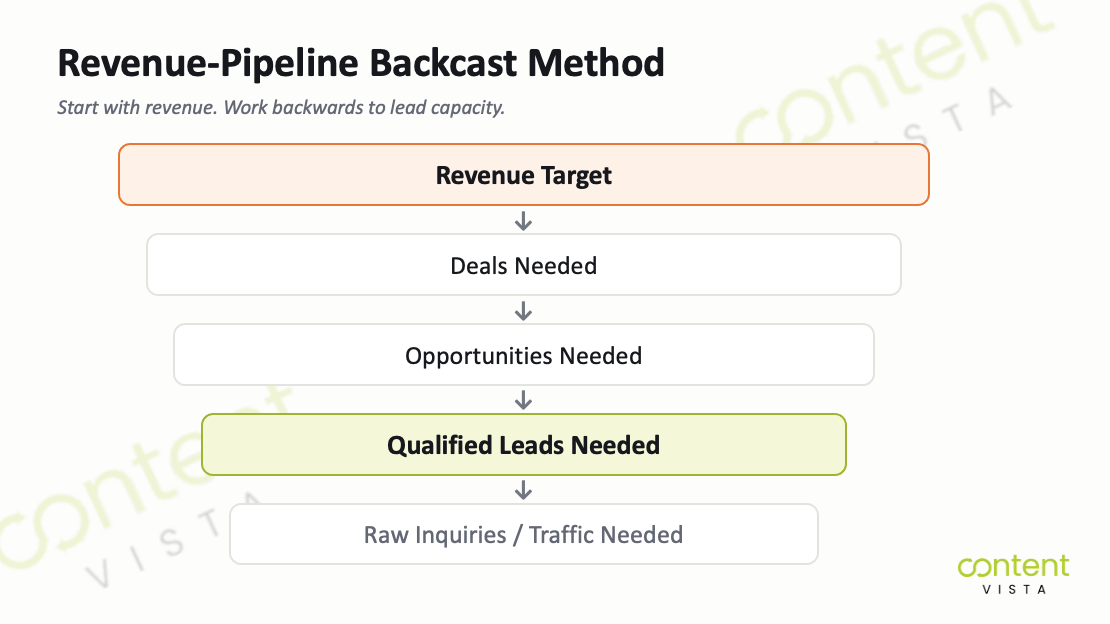
The Revenue-Pipeline Backcast Method works backwards through five layers:
1. Revenue target
2. Deals needed
3. Opportunities needed
4. Qualified leads needed
5. Raw inquiries or traffic needed
Each layer answers a different planning question. The revenue target tells you what the business needs to generate. The deals-needed layer tells you how many customers or clients must close. The opportunity layer shows how much real pipeline is required. The qualified lead layer gives marketing and sales a practical lead generation target. The raw inquiry or traffic layer shows whether your current campaigns, website, content, outreach, ads, referrals or events can generate enough early demand.
| Step | What You Calculate | Formula / Question | Why It Matters |
|---|---|---|---|
| Revenue target | Monthly or quarterly revenue goal | What revenue are you trying to generate? | Sets the commercial target |
| Deals needed | Number of customers or clients required | Revenue target ÷ average deal size | Converts revenue into sales volume |
| Opportunities needed | Number of qualified opportunities required | Deals needed ÷ opportunity-to-win rate | Shows how much real pipeline is required |
| Qualified leads needed | Number of sales-ready or marketing-qualified leads required | Opportunities needed ÷ lead-to-opportunity rate | Sets the lead generation target |
| Raw inquiries / traffic needed | Number of early-stage leads, inquiries, or visitors required | Qualified leads needed ÷ inquiry-to-qualified rate | Shows whether traffic or campaign volume is enough |
This method prevents a common mistake: treating lead generation as an early-stage activity only.
In reality, your lead target depends on the whole revenue system.
If your average deal size is low, you may need more customers. If your opportunity-to-win rate is weak, you need more opportunities to close the same number of deals. If your lead-to-opportunity rate is poor, you need more qualified leads to create enough pipeline. If your inquiry-to-qualified rate is weak, you may need much more traffic or campaign volume than expected.
That is why a simple lead target can be misleading.
For example, a team may say it needs 200 leads per month. But the backcast may show that it actually needs 200 qualified leads, not 200 raw inquiries. If only a portion of inquiries become qualified, the actual raw inquiry requirement may be much higher.
Or the opposite may be true. The team may already generate enough inquiries, but too few become opportunities because qualification, nurturing, CRM handoff or sales follow-up is weak. In that case, more traffic may not be the best answer. The better move may be to fix the conversion layer between inquiry and opportunity.
The Revenue-Pipeline Backcast Method helps separate these problems.
It shows whether the pressure is coming from revenue ambition, average deal size, win rate, lead quality, qualification, traffic volume or sales capacity. That makes the lead target more useful because it becomes a diagnostic number, not just a campaign goal.
A strong lead target should answer three questions:
Can this lead volume support the revenue target?
Can the business realistically generate this many qualified leads?
Can the sales and funnel system convert them into opportunities and customers?
If the answer is yes, you can build a channel plan around the number. If the answer is no, the backcast shows what needs to improve before you scale campaigns.
Step 1 - Start With Your Monthly Revenue Target
The first mistake is calculating leads against the wrong revenue number.
Before you decide how many leads you need, you need to define the revenue target those leads are supposed to support. This can be a monthly target or a quarterly target, depending on how your business sells.
Monthly planning works well when your campaigns, sales activity, and reporting rhythm are monthly. It helps you keep execution tight. You can see whether lead volume, lead quality, and follow-up are moving in the right direction every few weeks.
But if your sales cycle is long, quarterly planning may be more realistic. Leads generated this month may not close this month. In that case, your monthly lead generation target should support a quarterly pipeline goal, not just this month’s closed revenue.
The important part is that the target must be tied to the business model. A service business, consultancy, SaaS company, agency, high-ticket offer and local business may all define revenue differently. You need to be clear about what number you are trying to grow.
Are you calculating leads for:
New revenue?
Retained revenue?
Expansion revenue?
Marketing-sourced revenue?
Marketing-influenced revenue?
Those are not the same thing.
For this calculation, the cleanest starting point is usually the revenue that must come from new marketing-generated or marketing-influenced opportunities. If some revenue is already likely to close from the existing pipeline, do not make your lead generation target carry that full burden. If sales is expected to self-source part of the revenue, subtract that too.
That does not make the lead target smaller for convenience. It makes it more accurate.
For example, if the business wants $100,000 in new monthly revenue, but $30,000 is likely to come from existing pipeline and $20,000 is expected from sales self-sourced activity, then marketing does not need to generate leads for the full $100,000. The marketing-sourced target is $50,000.
| Input | What It Means | Example |
|---|---|---|
| Monthly revenue target | New revenue you want to generate this month | $100,000 |
| Existing pipeline contribution | Revenue likely to close from current opportunities | $30,000 |
| Sales self-sourced contribution | Revenue expected from non-marketing sources | $20,000 |
| Marketing-sourced target | Revenue marketing needs to support with new leads | $50,000 |
This is why lead planning should never be disconnected from revenue planning. If you are building a lead generation plan, the first question is not “How many leads can we get?”
The first question is: “How much revenue must this lead generation system support?”
Once that number is clear, every later step becomes more useful. Average deal size tells you how many deals you need. Conversion rate tells you how many qualified leads you need. Sales capacity tells you whether the number is realistic. Funnel health tells you whether the system can actually produce it.
Without the right revenue target, every lead target after it becomes guesswork.
Step 2 - Use Average Deal Size to Calculate Deals Needed
This is where the number starts becoming real.
Once you know the revenue target, the next step is to convert that revenue target into the number of customers, clients or deals required.
The formula is simple:
Revenue target ÷ average deal size = deals needed
So if your revenue target is $100,000 per month and your average deal size is $10,000, you need 10 closed deals to hit that revenue target.
But the important part is choosing the right average deal size.
Average deal size can mean different things depending on the business model. For a service business, it may be the average project value. For an agency or consulting firm, it may be the monthly retainer value. For a SaaS or subscription business, it may be ACV. For a business with repeat purchases, it may be first-sale value or customer lifetime value, depending on what you are planning against.
The rule is this:
Use the deal value that matches the revenue target period.
If you are calculating monthly new revenue, use the value that realistically contributes to that month’s revenue. If you are planning annual revenue, ACV may make sense. If you are calculating first-month cash flow, do not use lifetime value unless that revenue is actually realized over the planning period.
This distinction matters because using the wrong deal size can make your lead target look easier or harder than it really is.
| Metric | Example Value | Formula / Result |
|---|---|---|
| Revenue target | $100,000 per month | Starting target |
| Average deal size | $10,000 | Use average closed-won value |
| Deals needed | 10 deals | $100,000 ÷ $10,000 |
If your deal sizes are fairly consistent, a single average deal size may be enough for planning.
But if deal size varies widely, one blended average can distort the calculation. For example, if you sell one offer at $3,000 and another at $30,000, averaging them together may give you a number that does not reflect how either funnel actually behaves.
In that case, segment the calculation.
You might calculate separately for:
Small-ticket offers
Mid-ticket services
High-ticket consulting
Retainers
Enterprise deals
Expansion or upsell revenue
This gives you a cleaner view of how many deals are needed from each part of the business, instead of forcing one average across very different sales motions.
Higher average deal size usually means fewer leads are needed. But that does not automatically make the growth plan easier.
A $25,000 deal may require fewer customers than a $5,000 deal, but it may also need more trust, stronger proof, better sales enablement, longer nurturing, more stakeholder alignment and a slower sales cycle.
That is why average deal size is not just a math input. It is a strategy signal.
If the deal size is low, you may need more volume and a tighter acquisition engine. If the deal size is high, you may need fewer leads, but better-fit leads and a stronger conversion system.
The goal is not to choose the number that makes the lead target look comfortable. The goal is to use the average deal size that reflects how your business actually earns revenue.
Step 3 - Apply Your Real Conversion Rate
Here’s where most teams go wrong: they plug in the conversion rate they want, not the conversion rate their funnel actually has.
Once you know how many deals you need, you need to calculate how many qualified leads are required to produce those deals. This is where your conversion rate becomes critical.
The basic formula is:
Deals needed ÷ lead-to-customer conversion rate = qualified leads needed
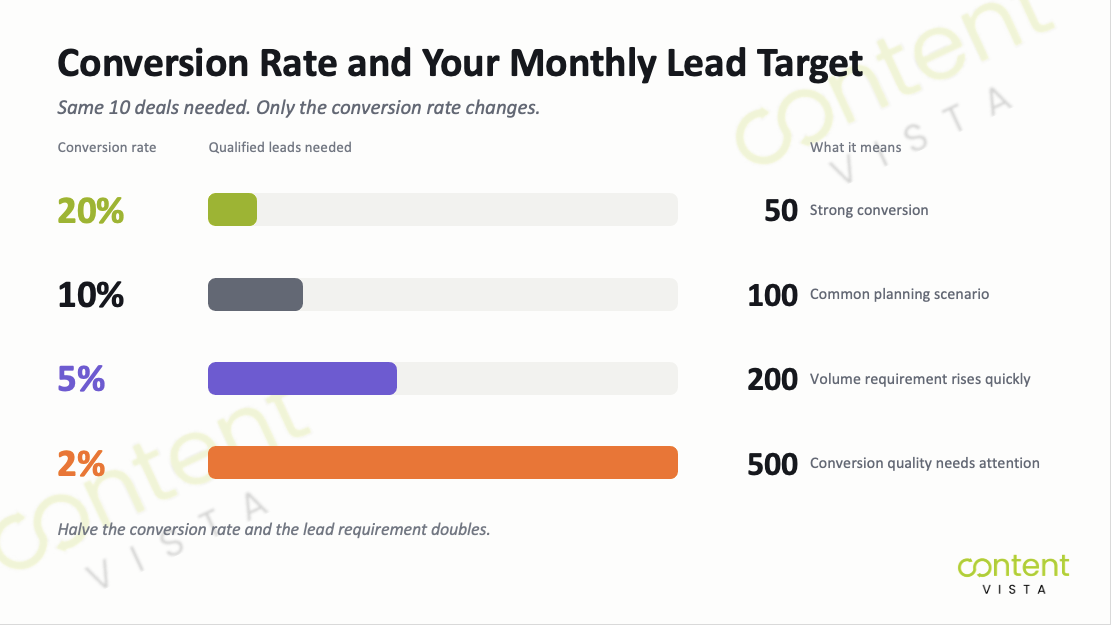
So if you need 10 deals and your lead-to-customer conversion rate is 10%, you need 100 qualified leads.
But if your real conversion rate is 5%, you need 200 qualified leads.
If your real conversion rate is 2%, you need 500 qualified leads.
The revenue target and average deal size may stay exactly the same, but the lead requirement can change dramatically based on conversion performance.
Lead-to-customer conversion rate
Your lead-to-customer conversion rate shows how many qualified leads eventually become paying customers.
This is usually the simplest way to calculate monthly leads needed, especially if your CRM data is clean enough to show a clear path from qualified lead to closed customer.
For example:
If 100 qualified leads usually produce 10 customers, your lead-to-customer conversion rate is 10%.
If 100 qualified leads usually produce 5 customers, your lead-to-customer conversion rate is 5%.
The more accurate this number is, the more useful your lead target becomes.
Use historical data wherever possible. Look at actual closed-won deals, not just expected performance. If your business has enough past data, calculate conversion by lead source, offer type, customer segment and sales motion.
A referral lead may convert very differently from a cold outbound lead. A webinar lead may need more nurture before becoming sales-ready. A paid search lead with high purchase intent may behave differently from an out-of-market content download. Partner, inbound, outbound, paid, referral and event leads should not automatically be treated as equal.
Lead-to-opportunity conversion rate
Sometimes, lead-to-customer conversion is too broad. In that case, it helps to break the journey into stages.
Instead of asking, “How many leads become customers?” you ask:
How many qualified leads become real sales opportunities?
Then:
How many opportunities become customers?
This is useful when sales cycles are longer or when the business has a clear opportunity stage in the CRM. It also helps you see where the funnel is breaking.
It also connects back to the five layers you saw earlier. Lead-to-customer is simply those two steps compressed into one number. If your CRM tracks an opportunity stage properly, use the two-step version: it is more accurate, and it tells you where the problem actually sits. If it does not, a single blended rate is fine to plan with, as long as you know it is hiding detail.
For example, if qualified leads are not becoming opportunities, the problem may be lead fit, sales acceptance, follow-up speed or qualification criteria.
If opportunities are being created but not closing, the issue may be pricing, proof, proposal quality, sales process, offer fit or competitive positioning.
That is why conversion rate should not be treated as one flat number unless your funnel is simple enough to justify it.
| Deals Needed | Lead-to-Customer Rate | Leads Needed | What This Means |
|---|---|---|---|
| 10 deals | 20% | 50 qualified leads | Strong conversion; likely requires high-fit leads and strong sales follow-up |
| 10 deals | 10% | 100 qualified leads | Moderate conversion; common planning scenario for many lead funnels |
| 10 deals | 5% | 200 qualified leads | Weak or early-stage conversion; volume requirement rises quickly |
| 10 deals | 2% | 500 qualified leads | More leads may not be the right fix; conversion quality likely needs attention |
Why benchmarks are only a starting point
Benchmarks can help when you have no internal data, but they should not become the foundation of your lead target.
Conversion rates vary widely by industry, lead source, deal size, sales cycle, pricing, audience, qualification rules, offer clarity, sales follow-up and brand trust. A high-intent inbound lead may convert faster than a cold outbound contact. A high-ticket offer may need more proof and nurturing than a low-ticket purchase. A long sales cycle may make monthly conversion look weak even when pipeline quality is healthy.
So how wide is "widely"? First Page Sage's lead-to-opportunity benchmarks, drawn from its own client and internal sales data between 2019 and 2025, put the rate at 3.0% for IT and managed services, 4.7% for engineering, 6.2% for B2B SaaS and 11.8% for HVAC.
Same measurement point. Roughly a fourfold spread.
That is exactly why a borrowed number is dangerous. A conversion rate that looks healthy in one industry is a warning sign in another, and neither figure tells you anything reliable about your funnel. Use published benchmarks as a sanity check on your own number, not as a replacement for it.
If you do not have reliable historical data, use conservative planning assumptions.
Do not use an optimistic conversion rate just to make the lead target look achievable. That may make the spreadsheet look better, but it will create problems later when the revenue target is missed.
A realistic conversion rate may reveal an uncomfortable truth. You may need far more qualified leads than expected. Or the lead target may be so high that the better move is not more lead generation, but better qualification, stronger nurturing, improved sales follow-up, clearer positioning or a more focused channel mix.
This is the point of the calculation. It is not meant to give you a convenient number. It is meant to show what the system must actually produce.
Step 4 - Adjust for Lead Quality, Source and Sales Capacity
The formula gives you the first answer. These factors tell you whether that answer is usable.
If the calculation says you need 100 qualified leads per month, that does not automatically mean any 100 leads will do. The source, quality, timing, intent level and sales capacity behind those leads can completely change what the number means.
Ten high-fit referral leads may be more valuable than 100 low-fit inquiries. A warm inbound lead who has already compared options may be closer to a sales conversation than someone who downloaded a broad educational checklist. A webinar attendee may need segmentation and nurture before sales should step in. An outbound lead may need repeated follow-up before they are ready to engage.
This is why lead planning cannot stop at “qualified leads needed.” You also need to ask what kind of qualified leads, from which sources and whether your sales system can handle them.
Lead source changes the number
Different lead sources behave differently.
Inbound leads may convert well when they come from high-intent pages, such as service pages, pricing-related searches, comparison content or specific problem-solving articles. But not every inbound lead has the same intent. Someone reading a beginner guide may still be early-stage, while someone requesting help after reading a solution page may be closer to action.
Outbound leads often need more context, education, and follow-up. They may fit your ICP, but they did not necessarily raise their hand first. That means the same number of outbound leads may require more nurture and stronger sales sequencing than inbound leads.
Referral and partner leads can be more trust-led because they arrive through an existing relationship or recommendation. But they may be harder to control at volume.
Webinar and lead magnet leads usually sit somewhere in the middle. They have shown interest, but not always buying intent. Before handing them to sales, you may need to segment them by fit, engagement level, problem urgency and readiness.
That is why source-level calculation is better than one blended conversion rate wherever possible. For a deeper comparison, see inbound lead generation vs outbound and webinar lead generation funnel.
Lead quality changes the number
Lead quality directly affects the number of leads required.
If your leads are high-fit, well-targeted, and aligned with your offer, you may need fewer leads to create the same number of opportunities. If your leads are broad, poorly matched or low-intent, you may need much higher volume to produce the same revenue outcome.
This is where raw lead targets become dangerous. If a campaign generates a large number of form fills, but most of those people are not qualified, the headline volume creates a false sense of progress.
A better planning move is to focus on qualified leads, not just inquiries.
That means defining fit and intent clearly. A qualified lead should usually match the right audience, have a relevant problem, show some level of buying or solution interest, and be worth a sales or nurture action.
Sales capacity changes the number
More leads can reduce performance if the sales team cannot follow up properly.
If the team is already overloaded, adding more leads may create slower response times, inconsistent follow-up, weaker discovery calls, lower sales acceptance and more missed opportunities. In that situation, the problem is not just lead generation capacity. It is sales handling capacity.
A useful lead target should match the team’s ability to respond, qualify, nurture and move opportunities forward.
If you generate more leads than the team can handle, you do not create more revenue. You create a backlog.
This is where CRM routing, automation, lead scoring, follow-up workflows and clear handoff rules become important. Without those systems, even good leads can leak. This is also why lead volume planning often connects directly to marketing automation and CRM systems, not just campaign execution.
Sales cycle length changes the timing
Monthly lead volume does not always equal monthly revenue.
If your sales cycle is short, leads generated this month may create revenue this month. But if your sales cycle is longer, this month’s leads may support next quarter’s pipeline instead.
That means you need to plan for pipeline velocity, not just monthly volume.
A long sales cycle changes how you should interpret the number. You may still need a monthly lead target, but it should be tied to pipeline creation, not immediate closed revenue. Otherwise, the team may judge campaigns too early or expect leads to produce revenue faster than the sales process allows.
Lead planning should answer both questions:
How many qualified leads do we need?
And when should those leads be expected to become opportunities, pipeline and revenue?
| Variable | How It Changes the Number | Common Mistake | Better Planning Move |
|---|---|---|---|
| Lead source | Different sources convert at different rates | Treating inbound, outbound, referral and paid leads the same | Calculate by source where possible |
| Lead quality | Poor-fit leads require more volume to produce deals | Optimising for raw form fills | Plan around qualified leads |
| Sales capacity | Overloaded sales teams convert fewer leads | Generating more than the team can follow up with | Match volume to response capacity |
| Sales cycle length | Long cycles delay revenue impact | Expecting this month’s leads to close this month | Plan monthly activity against quarterly or pipeline goals |
| Pipeline leakage | Weak pages, nurture or CRM handoff lower conversion | Buying more traffic before fixing leaks | Improve conversion before scaling spend |
The point is not to make the calculation complicated. It is to make it honest.
A simple formula can tell you that you need 100 qualified leads. But your real growth system must answer whether those leads are high-fit, whether they are coming from the right channels, whether they need nurture, whether sales can follow up quickly and whether the funnel can convert them.
If those conditions are weak, more lead volume will not fix the problem. It will amplify it.
That is why monthly lead planning should always include source mix, qualification rules, sales capacity, nurture and pipeline timing. For leads that are not ready for immediate sales follow-up, a structured lead nurturing sequence may be the difference between wasted volume and usable pipeline.
Let's make this practical. Before you commit to any monthly lead number, run it through the Lead Target Reality Check.
The Lead Target Reality Check
• Have you subtracted existing pipeline contribution and sales self-sourced revenue from the revenue target?
• Is the deal size you used the value that actually lands inside your planning period?
• Is your conversion rate taken from closed-won history rather than from what you hope it will be?
• Are you counting qualified leads, or raw inquiries dressed up as leads?
• Have you calculated by source, or blended channels that behave nothing alike?
• Can sales realistically respond to, qualify and follow up with this volume?
• Does the timing work, given how long your deals actually take to close?
• If any of the above is a no, do you know which one to fix first?
If you cannot answer yes to most of these, the number you calculated is a draft, not a plan.
Example Lead Calculations by Business Scenario
This is why the same revenue target can require 20 leads for one business and 300+ leads for another.
The formula is the same. The inputs change.
A business with a higher average deal size may need fewer customers to hit the same revenue target. A business with a stronger lead-to-customer conversion rate may need fewer qualified leads to produce those customers. But when deal size is lower or conversion rate is weak, the required lead volume rises quickly.
These examples are planning scenarios, not guaranteed benchmarks. They are meant to show how the math works, not what every business should expect.
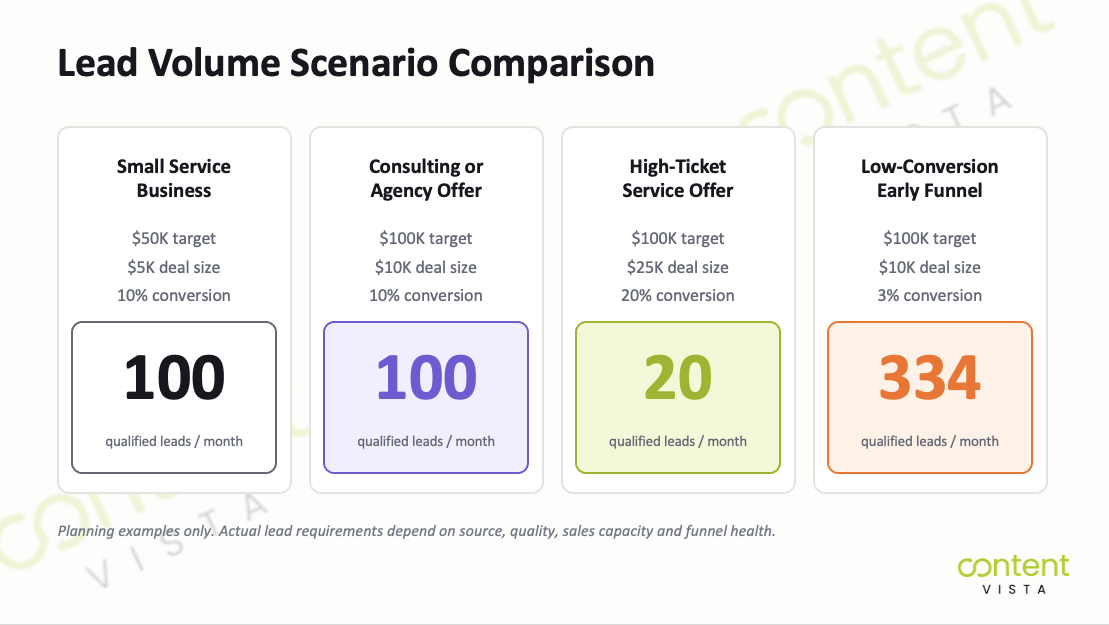
Let’s compare four situations.
| Scenario | Revenue Target | Average Deal Size | Conversion Rate | Leads Needed |
|---|---|---|---|---|
| Small service business | $50,000 / month | $5,000 | 10% lead-to-customer | 100 qualified leads / month |
| Consulting or agency offer | $100,000 / month | $10,000 | 10% lead-to-customer | 100 qualified leads / month |
| High-ticket service offer | $100,000 / month | $25,000 | 20% lead-to-customer | 20 qualified leads / month |
| Low-conversion early funnel | $100,000 / month | $10,000 | 3% lead-to-customer | 334 qualified leads / month |
In the small service business example, the company wants $50,000 per month and the average deal size is $5,000. That means it needs 10 customers. If 10% of qualified leads become customers, the business needs 100 qualified leads per month.
In the consulting or agency example, the revenue target doubles to $100,000 per month, but the average deal size also doubles to $10,000. The business still needs 10 customers. At a 10% lead-to-customer conversion rate, it also needs 100 qualified leads per month.
This is an important point. A higher revenue target does not automatically mean a higher lead target if average deal size also increases.
The high-ticket service offer looks very different. With a $100,000 monthly target and a $25,000 average deal size, the business needs only 4 customers. If it converts 20% of qualified leads into customers, it needs 20 qualified leads per month.
That sounds easier, but it may not be.
Higher deal size often brings higher trust requirements. The buyer may need more proof, more education, more stakeholder alignment, more proposal support, and more confidence before moving forward. So while the lead number is smaller, the quality bar is higher.
The low-conversion early funnel shows the other side of the calculation. The revenue target is $100,000 per month and the average deal size is $10,000, so the business needs 10 deals. But at a 3% lead-to-customer conversion rate, it needs 334 qualified leads per month.
That is where the number can become unrealistic very quickly.
If a team looks at that result and simply says, “We need 334 leads,” it may miss the real message. The calculation may be telling them that conversion quality is too weak, lead fit is too broad, sales follow-up is inconsistent, the offer is unclear or the funnel is not ready to scale.
This is why lead volume planning should always be diagnostic.
The number is not only a target. It is a signal.
If the required lead volume looks reasonable, you can build a channel plan around it. If it looks too high, the answer may not be “generate more leads.” It may be to improve conversion rate, increase average deal size, tighten qualification, repair the sales handoff or improve the trust assets that help leads move forward.
A useful lead target should pass three checks:
Can you realistically generate this many qualified leads?
Can sales follow up with them properly?
Can the funnel convert them at the assumed rate?
If the answer to any of those is no, the lead target needs more than traffic. It needs a better growth system behind it.
What If the Number Looks Unrealistic?
If the number feels impossible, do not panic. The calculation may be telling you which part of the system needs to change.
This is one of the most useful outcomes of lead-volume planning. The goal is not just to arrive at a monthly lead target. The goal is to understand whether that target is realistic for your business model, funnel, team and current growth stage.
If your calculation says you need 500 qualified leads per month, but your team can only follow up with 80 properly, the answer is not to force 500 leads into the system. That will create waste.
If your calculation says you need thousands of raw inquiries to produce a small number of qualified leads, the issue may not be traffic volume. It may be targeting, offering clarity, landing page quality or qualification.
If you need far more qualified leads than your current channels can produce, lead volume is only one lever. You may need to improve the rest of the system.
Possible fixes include:
Increasing average deal size.
Improving lead-to-customer conversion rate.
Improving lead quality.
Reducing pipeline leakage.
Strengthening sales follow-up.
Improving nurture.
Refining ICP and positioning.
Changing channel mix.
Increasing budget or execution capacity.
Extending the timeframe.
Adjusting the revenue target.
The point is simple: when the required number looks too high, do not immediately assume you need more acquisition. Ask which part of the Revenue-Pipeline Backcast Method is creating pressure.
| Problem | What It Usually Means | Better Move | Useful Internal Link |
|---|---|---|---|
| Too many raw inquiries required | Traffic-to-qualified conversion may be weak | Improve targeting, landing page and offer clarity | Website Conversion Leak Audit |
| Too many qualified leads required | Lead-to-customer conversion may be weak | Improve nurturing, sales follow-up, proof, and qualification | Sales Enablement and Lead Nurturing |
| Sales cannot handle the required volume | Capacity or process is constrained | Improve qualification, automation, CRM routing or sales capacity | Marketing Automation and CRM Systems |
| Revenue target requires unrealistic acquisition | Deal size, offer, pricing or positioning may need work | Fix strategy before scaling lead generation | Marketing OS Sprint |
Notice the pattern: each row points at a different layer of the system. And if more than one applies to you, the order you fix them in matters.
Work closest to revenue first. Sales handoff and follow-up before nurture. Nurture before traffic. Traffic before budget. Fixing acquisition while the conversion layer is still leaking just pushes the same waste further down the line at a higher cost.
Lead volume is only one lever. If the number looks unrealistic, the smarter question is not “How do we get more leads?” It is “Which part of the growth system needs to improve so this target becomes achievable?”
A useful lead target should create clarity, not panic. If the number is achievable, build the channel plan. If it is not achievable, use the calculation as a diagnostic tool.
Sometimes the best growth move is more leads.
Sometimes it is better leads.
Sometimes it is better conversion.
And sometimes it is a more realistic revenue plan.
Use the Lead Generation Capacity Calculator to pressure-test your target before you scale campaigns.
When More Leads Are Not the Answer
Sometimes the lead target is not the problem. The system underneath the target is. In other words: it is a system problem, not a lead problem.
That is why the calculation should not automatically trigger more acquisition spend. If the number looks high, the instinct may be to run more ads, increase outreach, publish more content or push sales harder. But if the foundation is weak, more leads may only create more noise.
More leads are not the right first move when your ICP is unclear. If you do not know exactly who you are trying to attract, lead volume will be broad by default. You may get inquiries, but they may not match the offer, budget, urgency or buying context.
More leads are also not the right first move when positioning is weak or the offer is vague. In that case, the problem is not that enough people have not seen the offer. The problem is that the right people may not understand why it matters, why now or why you.
The same applies when traffic quality is low, conversion data is missing, or CRM tracking is broken. If you cannot clearly see how raw inquiries become qualified leads, opportunities, and customers, then the lead target is still based on guesswork.
Sales feedback is another major signal. If sales rejects most leads, more volume will not fix the problem. It will simply give sales more poor-fit conversations to filter. If follow-up is slow or inconsistent, more leads may actually reduce performance because good prospects do not get timely attention.
And if nurturing does not exist, many early-stage leads will never move forward. Webinar attendees, lead magnet downloads, cold outbound replies and low-intent inbound inquiries often need education, segmentation, proof and follow-up before they are ready for a sales conversation.
| Warning Sign | Why It Matters | Better Next Step |
|---|---|---|
| Sales rejects most leads | More volume will create more waste | Fix qualification and sales handoff first |
| Conversion rate is unknown | The lead target is based on guesswork | Clean tracking and CRM reporting first |
| Sales team is overloaded | More leads may reduce follow-up quality | Improve routing, qualification, or capacity |
| ICP is unclear | Leads may not match the offer | Clarify audience and positioning first |
| Pipeline is leaking | More traffic will not fix weak conversion | Audit landing pages, nurture and follow-up |
A low lead-to-opportunity rate is especially important. It usually means the issue is not only raw inquiry volume. It may point to weak fit, unclear qualification rules, poor sales handoff, slow response time or lack of readiness.
The website and landing pages matter too. If they leak demand, more traffic simply sends more people into a weak conversion path. Before increasing spend, it may be more useful to check whether the page clearly explains the offer, qualifies the right audience, answers objections and gives the reader a clear next step. That is the groundwork of landing page conversion rate optimization, and it usually costs less than another month of ad spend.
More leads help only when the system can attract, qualify, follow up with, nurture and convert them. If any of those layers are weak, volume alone can make the problem bigger.
This is where diagnosis matters.
If you suspect your website or landing pages are leaking demand, use the Website Conversion Leak Audit before scaling traffic.
If the issue feels broader than one page or campaign, the Marketing Growth Maturity Assessment can help identify whether the bottleneck sits in content, CRM, handoff, automation, strategy or system maturity.
If the revenue target itself needs stronger growth infrastructure, the Marketing OS Sprint may be more relevant than simply increasing lead volume.
The goal is not to avoid lead generation. The goal is to make sure lead generation is solving the right problem.
Key Metrics to Track After You Set the Number
The number is only useful if you can track whether the system is actually producing it.
Once you calculate your monthly lead target, do not measure only “leads per month.” That is too broad. You need to track the movement from raw interest to qualified leads, opportunities, customers, and revenue.
Otherwise, you may hit the lead target and still miss the revenue target.
For example, if raw inquiries increase but qualified leads stay flat, the issue may be traffic quality or qualification. If qualified leads increase but opportunities do not, the issue may be sales acceptance, handoff, lead fit or follow-up. If opportunities increase but deals do not close, the issue may sit in the sales process, offer, proof, pricing or positioning.
This is why lead planning needs a measurement layer.
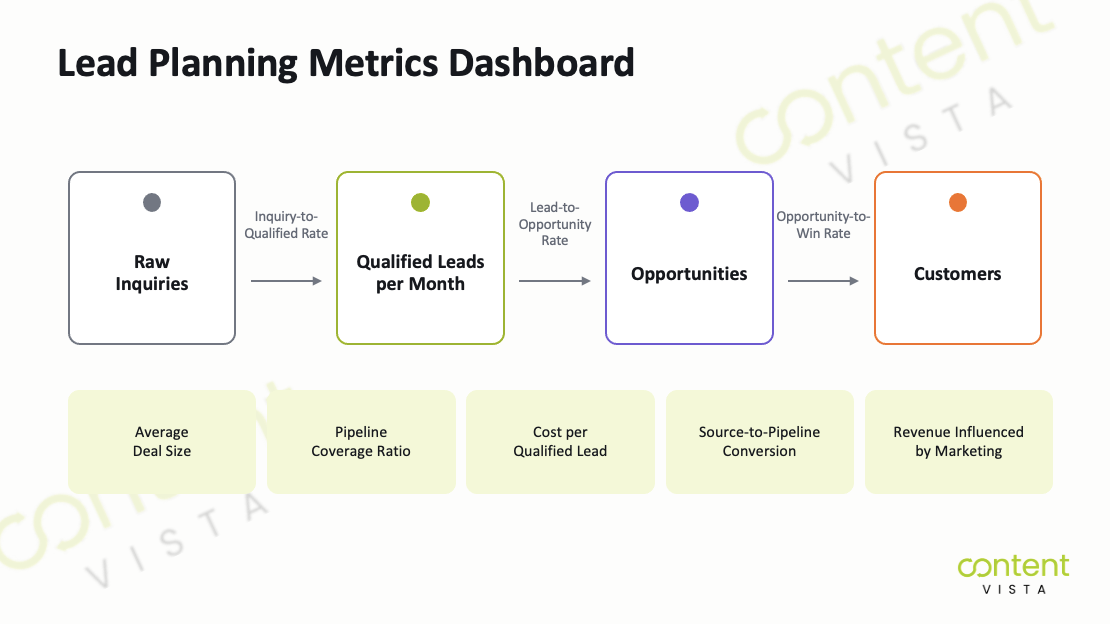
You should track both volume and movement.
Monthly qualified leads show whether you are reaching the required lead generation capacity. Raw inquiries show whether there is enough early-stage demand. Inquiry-to-qualified rate shows whether your campaigns are attracting the right people. Lead-to-opportunity rate shows whether those leads are strong enough to become a real pipeline.
From there, opportunity-to-win rate tells you whether sales can turn pipeline into customers. Average deal size affects how many deals you need. Sales cycle length tells you when the revenue impact is likely to show up. Pipeline coverage ratio helps you understand whether there is enough active pipeline to support the revenue target.
Pipeline coverage deserves a moment of its own, because most teams inherit the wrong number for it.
Coverage is simply the value of your open qualified pipeline divided by the revenue target for the same period. $300,000 of pipeline against a $100,000 target is 3x coverage. You will hear 3x repeated everywhere as the standard. But there is no research behind that figure. It is a rule of thumb that survived by repetition, and it quietly assumes you win roughly a third of the opportunities you create.
Most B2B businesses do not. First Page Sage's close-rate benchmarks put sales-qualified-lead to closed-won at 12% in B2B SaaS, 13% in manufacturing, 15% in software development and 20% in IT and managed services.
So derive your own instead. Divide 1 by your opportunity-to-win rate. If you win 15% of opportunities, you need roughly 6.7x coverage, not 3x. Then add a margin for deals that slip into the next period.
Cost also matters, but cost per lead is not enough. Cost per qualified lead is more useful because it tells you what it costs to generate a lead that is actually usable. Even better, source-to-pipeline conversion tells you which channels create real sales opportunities, not just activity.
| Metric | What It Shows | Why It Matters |
|---|---|---|
| Qualified leads per month | Whether you are hitting the lead target | Tracks capacity against the plan |
| Inquiry-to-qualified rate | How many raw inquiries become usable leads | Shows lead quality and qualification strength |
| Lead-to-opportunity rate | How many leads become real sales opportunities | Shows handoff and fit quality |
| Opportunity-to-win rate | How many opportunities become customers | Shows sales effectiveness and offer fit |
| Average deal size | Average value of closed deals | Changes how many deals and leads are required |
| Pipeline coverage ratio | Pipeline value compared with revenue target | Shows whether there is enough active pipeline |
| Cost per qualified lead | Cost to generate usable leads | Helps judge channel efficiency |
| Source-to-pipeline conversion | How each channel contributes to opportunities | Helps decide where to invest next |
Along with these, track sales acceptance rate and response time.
Sales acceptance rate tells you whether sales agrees that the leads are worth pursuing. If marketing marks a lead as qualified but sales rejects it, there may be a mismatch in qualification criteria.
Response time matters because lead intent decays when follow-up is slow. And slow is far more common than most teams assume. When Harvard Business Review audited 2,241 US companies on how quickly they replied to a web-generated lead, the average response time among those that replied at all was 42 hours, and 23% never responded at all.
If a qualified lead waits that long, the problem is not lead volume. It is operational pipeline leakage.
You should also track revenue influenced by marketing. Not every sale will be purely marketing-sourced. Some deals may come through sales, referrals, existing relationships or partnerships but still be influenced by content, campaigns, nurture, events or remarketing. This helps you understand the wider role marketing plays in pipeline creation, not just direct lead capture.
To measure this properly, your CRM, automation, landing pages, forms and reporting need to be connected. If your tracking is fragmented, you may know how many leads came in but not which sources created pipeline or revenue. That is where marketing automation and CRM systems and broader systems, conversion and growth infrastructure become part of lead planning.
A lead target is not a one-time number. It should be reviewed regularly against actual performance.
If qualified leads are on target but revenue is not, look deeper.
If revenue is improving but lead volume is flat, conversion or deal size may be improving.
If lead volume is rising but the pipeline is not, source quality or handoff may be weak.
The purpose of tracking is not to create a bigger dashboard. It is to help you decide what to fix next.
Use the Lead Generation Capacity Calculator
You can do the math manually. But if you want the faster path, plug your numbers into the calculator.
By this point, you have seen the logic behind the calculation:
Revenue target.
Average deal size.
Deals needed.
Conversion rate.
Qualified leads needed.
Raw inquiries or traffic required, if you are planning from raw inquiry volume.
The manual calculation is useful because it shows how the system works. But once you start changing assumptions, the numbers can shift quickly. A small change in average deal size, conversion rate, or monthly revenue target can create a very different lead requirement.
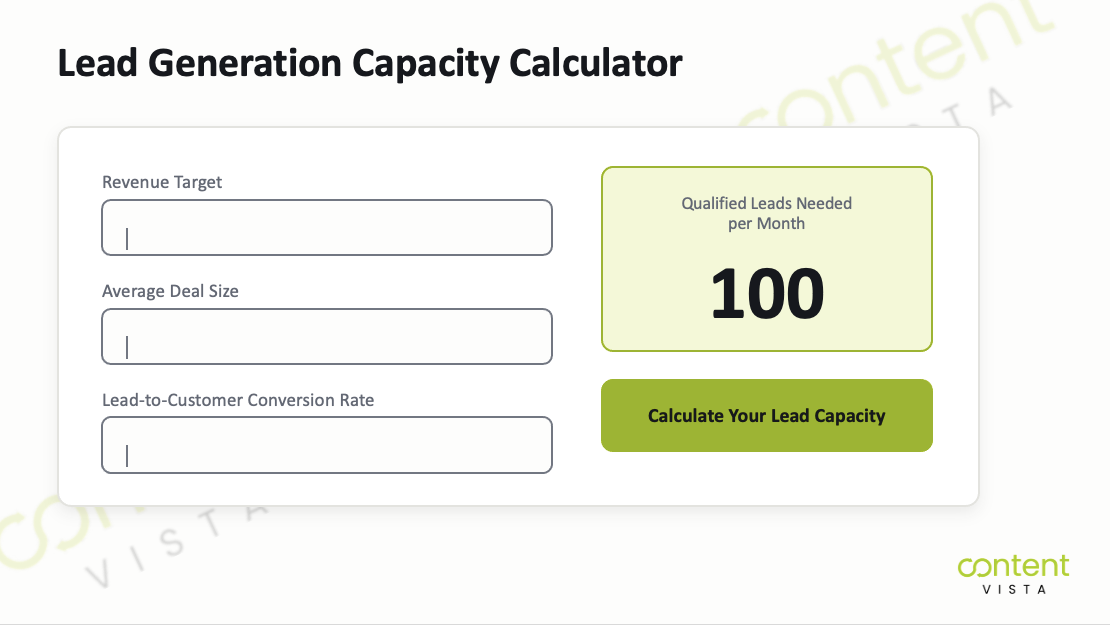
That is where the Lead Generation Capacity Calculator becomes useful.
Instead of working through every scenario manually, you can plug in your real numbers and compare different versions of the plan.
For example, you can test:
What happens if the revenue target increases?
What happens if average deal size improves?
What happens if the conversion rate drops?
What happens if you need to plan for qualified leads instead of raw inquiries?
What happens if the monthly lead target is too high for your current sales capacity?
This matters because lead planning is rarely a one-time calculation. You may need to model several scenarios before deciding what to do next.
Before you commit to a new campaign, ad budget, hiring plan, outbound volume, webinar target, or content calendar, pressure-test the numbers first. It is better to find out early that the target depends on unrealistic conversion assumptions than to discover it after months of execution.
The calculator should not replace strategic thinking. It should make the thinking clearer.
Use it to understand the lead volume required, then ask the more important operational question: can your current growth system actually produce, qualify, follow up with and convert that number?
Cost, Time and Effort: Can You Actually Generate That Many Leads?
A lead target without a capacity plan is just a spreadsheet wish.
You may calculate that you need 100 qualified leads per month. But the next question is more operational: can your business actually generate, qualify, nurture and follow up with that many leads?
That is where many plans become unrealistic.
A team may set a lead target without checking whether the channel mix can support it. Or they may plan for high lead volume without enough sales capacity. Or they may focus on cost per lead, while ignoring whether those leads become qualified opportunities.
Lead generation is not only a volume problem. It is a capacity problem.
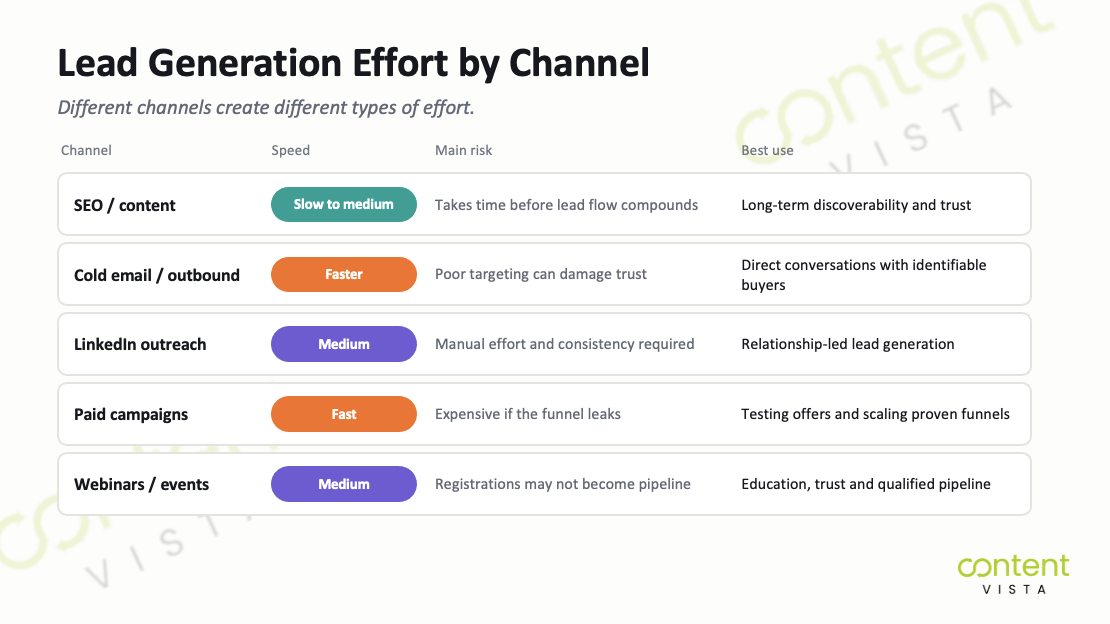
Different channels create different types of effort.
SEO and content can compound over time, but they rarely create predictable lead flow immediately. They need strategy, publishing consistency, search intent alignment, internal linking, authority building and time.
Outbound can create conversations faster, but it depends heavily on list quality, message relevance, follow-up, deliverability and targeting. Poor outbound may increase activity without creating meaningful pipeline.
LinkedIn outreach can work well when it is relationship-led, but it takes consistency. The profile, content, social proof, conversation quality and follow-up rhythm all matter.
Paid campaigns can scale faster, but only if the funnel is ready. If landing pages, offers, tracking or follow-up are weak, paid spend can become expensive quickly.
Webinars and events can create trust, but registrations are not the same as opportunities. The topic, audience, promotion, event quality, segmentation and post-event nurture decide whether the channel becomes pipeline.
Referrals may convert well because trust is already present, but they are often harder to control at a predictable monthly volume.
So when you calculate your lead target, do not ask only, “How many leads do we need?”
Ask:
Which channels can realistically produce these leads?
How long will each channel take?
What budget, people, content, systems or follow-up will it require?
Can sales handle the volume?
How many of these leads are likely to become qualified opportunities?
| Channel | Speed | Main Effort | Main Risk | Best Use |
|---|---|---|---|---|
| SEO / content | Slow to medium | Strategy, publishing, authority building | Takes time before lead flow compounds | Long-term discoverability and trust |
| Cold email / outbound | Faster | List building, messaging, deliverability, follow-up | Poor targeting can damage trust | Direct conversations with identifiable buyers |
| LinkedIn outreach | Medium | Profile, content, conversations, social proof | Manual effort and consistency required | Relationship-led lead generation |
| Paid campaigns | Fast | Budget, creative, landing pages, conversion tracking | Expensive if funnel leaks | Testing offers and scaling proven funnels |
| Webinars / events | Medium | Topic, promotion, event delivery, follow-up | Registrations may not become pipeline | Education, trust, and converting interest into qualified pipeline |
This is also why cost per lead can be misleading.
A campaign that generates cheap leads is not automatically efficient. If most of those leads are poor-fit, unqualified or unlikely to become opportunities, the low cost per lead may hide a weak growth system.
Cost per qualified lead is more useful.
Cost per qualified opportunity is even more useful.
A channel may look expensive at the lead level but strong at the opportunity level. Another channel may look cheap at the inquiry level but weak once qualification and sales acceptance are considered.
For example, a broad paid campaign may create many low-cost form fills, but if only a small portion become qualified leads, the true cost of usable pipeline may be much higher than expected. On the other hand, a more targeted outbound or LinkedIn campaign may produce fewer leads, but if those leads are better-fit, the channel may be more efficient at the opportunity stage.
This is why channel planning should connect back to the Revenue-Pipeline Backcast Method. You are not trying to generate activity. You are trying to create enough qualified leads and opportunities to support the revenue target.
A practical next step is to compare channel effort before committing to volume. For example, if your plan depends on outbound, understand what it will take to build lists, write relevant messaging, and follow up properly. If it depends on LinkedIn, consider the content and relationship-building rhythm needed. If it depends on webinars, plan the nurture system after registration, not just the registration target.
These related guides can help with channel-specific planning: inbound lead generation vs outbound, cold email lead generation, LinkedIn lead generation strategy and webinar lead generation funnel.
The best channel is not always the one that produces the cheapest leads. It is the one that can produce qualified leads, usable opportunities, and revenue at a cost and effort level your business can sustain.
Before scaling spend, outreach, content production, or event volume, check whether the economics make sense beyond the lead count. If the plan depends on paid or multi-channel acquisition, the True CAC & Marketing ROI Calculator can help you evaluate whether the cost of acquiring usable pipeline supports the revenue target.
Mini Examples: How the Calculation Changes in Real Growth Systems
Here’s what changes when you stop treating lead volume as the only lever.
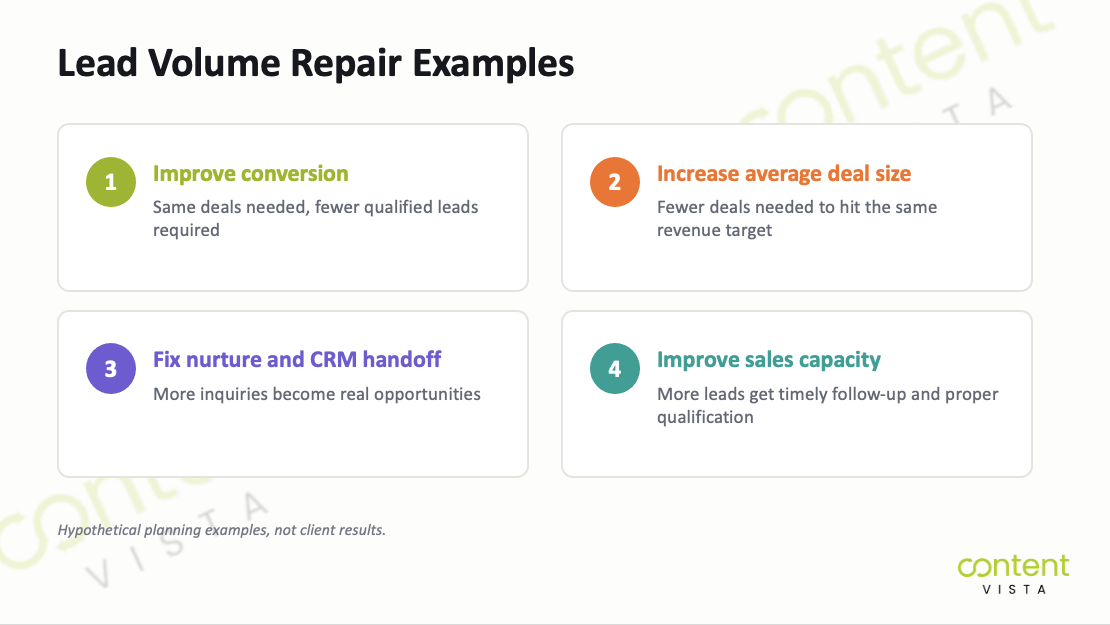
The same revenue target can become easier or harder depending on what improves inside the growth system. Sometimes the business does not need more leads. It needs better conversion, stronger deal value, cleaner handoff or more realistic sales capacity.
The examples below are hypothetical planning examples. They are not client results or guaranteed benchmarks. They are included to show how the calculation changes when different parts of the system improve.
Example 1: A service business improves conversion and needs fewer leads
Imagine a service business needs 10 new customers per month.
At a 5% lead-to-customer conversion rate, it needs:
10 deals ÷ 5% = 200 qualified leads
If the business improves qualification, strengthens follow-up and raises the conversion rate to 10%, the same revenue goal now needs:
10 deals ÷ 10% = 100 qualified leads
The revenue target has not changed. The deal target has not changed. But the required lead volume has been cut in half because the conversion system improved.
This is why conversion quality can be more valuable than simply increasing traffic or inquiries.
Example 2: A consultancy increases average deal size and reduces required volume
Now imagine a consultancy wants $100,000 in monthly revenue.
If the average deal size is $10,000, it needs 10 deals.
If the average deal size improves to $20,000, it needs only 5 deals.
At the same 10% lead-to-customer conversion rate, the first version needs 100 qualified leads. The second version needs 50 qualified leads.
That does not mean higher pricing is automatically easy. A higher-ticket offer may need stronger positioning, more trust, better proof and a tighter sales process. But the calculation shows why average deal size is one of the biggest levers in lead planning.
Example 3: A company fixes nurture and CRM handoff
In another scenario, a company is generating enough raw inquiries, but very few of them become opportunities.
The issue is not raw inquiry volume. The issue sits between inquiry, qualification, nurturing and sales handoff.
If leads are not routed properly, not segmented by intent, or not followed up with at the right time, the lead-to-opportunity rate stays weak. The business may keep asking for more leads when the real problem is that the existing leads are not moving through the system.
Fixing nurture and CRM handoff can improve the usable pipeline from the same inquiry volume. That may include clearer qualification rules, better lead scoring, faster routing, stronger nurture sequences and better sales context before outreach.
In this case, the calculation changes because more of the same lead flow becomes usable.
Example 4: A business discovers sales capacity is the bottleneck
Sometimes the calculation says the business needs 150 qualified leads per month, but the sales team can only handle 60 properly.
That is not a lead generation problem alone.
If the team cannot follow up quickly, qualify consistently, and move conversations forward, adding more leads may lower conversion. The business may need better routing, automation, prioritisation, sales capacity or qualification before increasing acquisition volume.
In this scenario, the lead target is not wrong. It is revealing a capacity gap.
Lead volume changes when the system changes. Improve conversion, deal size, nurture, CRM handoff or sales capacity, and the number of leads required to hit the same revenue target can change significantly.
These examples show why lead planning should be diagnostic. The calculation should not only tell you how many leads you need. It should show which part of the system deserves attention next.
For approved examples of Content Vista’s work, you can review the portfolio and relevant case study pages such as Confido, SalesFed, Akshar Business Consulting, and Smart Solutions.
Common Mistakes When Calculating Monthly Lead Targets
The mistakes are simple. But they are exactly why lead targets become either unrealistic or meaningless.
A monthly lead target should help the business plan revenue, sales capacity, channel activity and pipeline creation. But when the inputs are wrong, the number stops being useful.
The most common mistake is counting raw inquiries as qualified leads. A form fill, webinar registration, content download or cold reply is not automatically a sales-ready lead. If you treat every inquiry as equal, your lead target may look achievable while your pipeline stays weak.
Another mistake is using optimistic conversion rates. If the team wants to believe that 20% of leads will become customers, but the real number is much lower, the target will collapse during execution. Use actual CRM data where possible. If you do not have reliable data, use conservative assumptions.
Average deal size is another common blind spot. A business targeting $100,000 in revenue with a $5,000 deal size needs a very different lead plan from a business with a $25,000 deal size. If you ignore average deal size, you cannot calculate deals needed properly.
Teams also forget to subtract existing pipeline or sales self-sourced revenue. If part of the revenue target will come from opportunities already in progress, referrals, renewals, sales outreach or account expansion, your marketing-sourced lead target should reflect that.
Common Mistakes When Setting a Monthly Lead Target
• Counting raw inquiries as qualified leads.
• Using the conversion rate you want instead of the conversion rate you actually have.
• Ignoring average deal size.
• Ignoring existing pipeline contribution.
• Ignoring sales self-sourced revenue.
• Using one conversion rate across every channel.
• Not accounting for long sales cycles.
• Assuming more leads will fix weak conversion.
• Generating more leads than sales can handle.
• Tracking leads but not opportunities.
• Ignoring lead quality.
• Setting lead goals without CRM visibility.
• Not reviewing the number monthly.
• Focusing on cost per lead instead of cost per qualified opportunity.
One of the biggest planning errors is using one conversion rate across every source. Inbound, outbound, referral, paid, webinar, partner and content-led leads can behave very differently. A blended conversion rate may be useful as a starting point, but it can hide which channels are actually producing qualified pipeline.
Sales cycle length also changes the calculation. If leads take three months to close, this month’s lead target may support future pipeline, not this month’s revenue. Ignoring that timing creates pressure on marketing and sales to produce revenue faster than the buying process allows.
Another common mistake is assuming more leads will fix weak conversion. If the website leaks demand, nurture is missing, CRM routing is poor or sales follow-up is slow, adding volume can make the system messier.
Sales capacity matters too. If the team cannot handle more conversations, extra leads may reduce response quality. That means the business may need better qualification, automation, routing or sales process before increasing volume.
Finally, do not track only leads. Track opportunities, source-to-pipeline conversion, sales acceptance rate, cost per qualified lead and cost per qualified opportunity. A cheap lead that never becomes pipeline is not really cheap.
The lead target should be reviewed regularly. Your revenue target, deal size, conversion rate, channel mix, pipeline and sales capacity can change. If the number is not updated, the plan becomes stale.
A good lead target is not a fixed guess. It is a working number that should improve as your data improves.
FAQs About Calculating Monthly Lead Volume
How do I calculate how many leads I need per month?
Start with your revenue target. Divide it by your average deal size to calculate how many deals you need. Then divide the number of deals needed by your lead-to-customer conversion rate.
Formula:
Revenue target ÷ average deal size = deals needed
Deals needed ÷ lead-to-customer conversion rate = qualified leads needed
That gives you the number of qualified leads required, not just raw inquiries.
What conversion rate should I use?
Use your historical data wherever possible. Your actual lead-to-customer conversion rate is more useful than a generic average.
If you do not have enough reliable data, use conservative assumptions. Do not use an optimistic conversion rate just to make the lead target look achievable. Your conversion rate should reflect your real funnel, including source, offer, deal size, sales cycle, qualification rules and follow-up quality.
Should I count raw inquiries, MQLs, SQLs, or opportunities?
For lead target calculation, qualified leads are usually more useful than raw inquiries.
Raw inquiries show early interest, but not every inquiry is a real lead. MQLs show marketing qualification. SQLs show sales acceptance. Opportunities show active pipeline.
The right number depends on what you are planning. If you are planning marketing volume, start with qualified leads. If you are planning sales pipeline, track opportunities. If you are planning website or campaign volume, you may also need to calculate raw inquiries required.
How does average deal size affect the number of leads needed?
Average deal size has a major impact on lead volume.
If your average deal size is higher, you usually need fewer customers to hit the same revenue target. That can reduce the number of qualified leads required.
But higher deal size may also require more trust, stronger proof, longer nurturing, better sales enablement and a longer sales cycle. So the lead number may be lower, but the quality and conversion requirements are often higher.
What if my sales cycle is longer than one month?
If your sales cycle is longer than one month, do not expect this month’s leads to close this month.
In that case, monthly lead generation should support future pipeline, not only immediate revenue. You may need to plan using quarterly targets, pipeline coverage and sales cycle length.
The monthly lead target still matters, but it should be connected to pipeline creation and future revenue timing.
What if my sales team generates some revenue without marketing leads?
Subtract sales self-sourced revenue from the revenue number that marketing needs to support.
For example, if your total monthly revenue target is $100,000 and sales is expected to self-source $20,000, then marketing-generated or marketing-influenced leads may only need to support the remaining $80,000.
This makes the lead target more accurate. It also prevents marketing from being measured against revenue it was not expected to source directly.
What if I already have a full pipeline?
If you already have active pipeline likely to close, subtract the expected contribution before calculating new lead requirements.
A full pipeline may reduce the number of new qualified leads needed in the short term. But you should still keep generating enough leads to avoid a future gap.
Pipeline can look healthy today and become thin later if new qualified leads stop entering the system.
What if the number of leads required looks impossible?
Treat it as a diagnostic signal.
If the required lead volume looks unrealistic, the answer may not be “more leads.” You may need to improve conversion rate, increase average deal size, improve lead quality, fix sales follow-up, strengthen nurture, adjust the channel mix, extend the timeframe or revisit the revenue target.
An unrealistic lead target usually means one part of the growth system needs attention before you scale acquisition.
Should I focus on more leads or better conversion?
It depends on the bottleneck.
Focus on more leads if conversion is healthy, sales can follow up properly and the pipeline needs more volume.
Focus on better conversion if you already have enough inquiries but too few qualified leads, opportunities, or customers. In that case, improving lead quality, nurture, sales handoff, offer clarity or follow-up may create more revenue than simply adding volume.
How many leads can one salesperson handle?
There is no universal number because it depends on lead quality, deal complexity, sales cycle, follow-up requirements, automation and the salesperson’s role.
A salesperson handling high-intent inbound inquiries may manage a different volume from someone working cold outbound or complex high-ticket deals.
Instead of using a generic benchmark, track response time, follow-up quality, sales acceptance rate, opportunity creation and close rate. If those decline as volume rises, sales capacity is becoming a bottleneck.
What is the difference between lead capacity and marketing ROI?
Lead capacity tells you how many qualified leads you need to support a revenue target.
Marketing ROI tells you whether the cost of generating those leads and customers is commercially worthwhile.
Lead capacity is about volume and pipeline requirement. Marketing ROI is about efficiency and return. You need both. A business may generate enough leads but spend too much to acquire them. Or it may have strong ROI but not enough volume to hit its revenue target.
How often should I recalculate my lead target?
Recalculate your lead target regularly, especially when revenue goals, average deal size, conversion rates, channel mix, sales capacity or pipeline status change.
A monthly review is useful for active campaigns and recurring execution. Quarterly review may be better for longer sales cycles or strategic planning.
The lead target should become more accurate as your CRM data improves. Do not treat it as a fixed number for the entire year.
Conclusion: Calculate the Number, Then Fix the System That Has to Produce It
Calculating leads is not about guessing a monthly target.
It is about aligning revenue, average deal size, conversion rate, sales capacity and funnel performance into one practical number. That number should tell you how many qualified leads you need, whether your current system can produce them and what needs to change if the target looks unrealistic.
If the number is realistic, the next step is to build the channel plan. Decide how much lead volume should come from inbound, outbound, paid, referrals, webinars, partnerships or content. Then connect that plan to tracking, CRM visibility, follow-up and conversion improvement.
If the number is unrealistic, do not treat it as a failure. Treat it as diagnosis.
Maybe the conversion rate is too weak.
Maybe lead quality is too broad.
Maybe the average deal size is too low for the revenue target.
Maybe sales follow-up is inconsistent.
Maybe the website is leaking demand.
Maybe the growth foundation needs work before more acquisition spend makes sense.
A strong lead generation system does not simply produce more leads. It produces the right number of qualified leads for the revenue target, then gives the team a clear way to convert them into predictable pipeline and customers. That is the difference between a lucky month and predictable lead generation.
Use the Lead Generation Capacity Calculator to see exactly how many qualified leads you need each month.
And if your calculation shows that conversion is the bottleneck, run the Website Conversion Leak Audit before scaling traffic or campaigns.
Start with the number. Then fix the system that has to produce it.