Quick Summary
- A webinar lead generation funnel is the connected system that moves prospects from registration to qualified pipeline through structured engagement, nurture, qualification, CRM routing and sales follow-up.
- It is not just a webinar landing page or live event.
- Strong webinar funnels align the promise, registration path, attendance journey, live or on-demand engagement, segmentation logic, follow-up workflows and sales handoff into one connected conversion system.
Why Most Webinar Funnels Underperform After the Registration Page
Getting people to register is not the hard part.
Turning those registrations into qualified pipeline is where most webinar funnels break.
That is the gap many businesses fail to see.
A webinar registration page is not the funnel. It is only the entry point into a much larger registration-to-pipeline system.
And that system usually starts leaking conversions long before the webinar even begins.
Some webinars attract the wrong audience because the promise is too broad.
Some generate registrations but weak attendance because there is no structured pre-event nurture path.
Others get decent attendance but fail to create opportunities because the webinar itself is passive, generic or disconnected from buyer intent.
Then comes the most common breakdown:
the webinar ends, a replay email gets sent, and nothing meaningful happens next.
No segmentation.
No qualification logic.
No CRM routing.
No sales handoff.
No nurture sequence tied to engagement behavior.
The result is what many teams mistake for a "lead quality problem."
But it is almost always a system problem, not a lead problem. The leads were fine. The funnel design around them was not.
Registrations are not qualified leads. Attendance is not a pipeline. A webinar funnel only becomes commercially effective when it can consistently move engaged prospects into structured follow-up, qualification and sales workflows.
This is why webinar funnels often create activity without creating revenue visibility.
Marketing celebrates registration numbers.
Sales says the leads were weak.
And leadership cannot clearly trace how webinar engagement influenced qualified opportunities.
The underlying issue is usually not the webinar itself.
It is the disconnected system around it.
A strong webinar funnel is designed backward from pipeline creation: not forward from the event date.
That means thinking beyond:
registration pages
reminder emails
slide decks
replay links
And instead designing:
qualification paths
nurture sequences
engagement tracking
CRM visibility
routing logic
follow-up ownership
conversion workflows
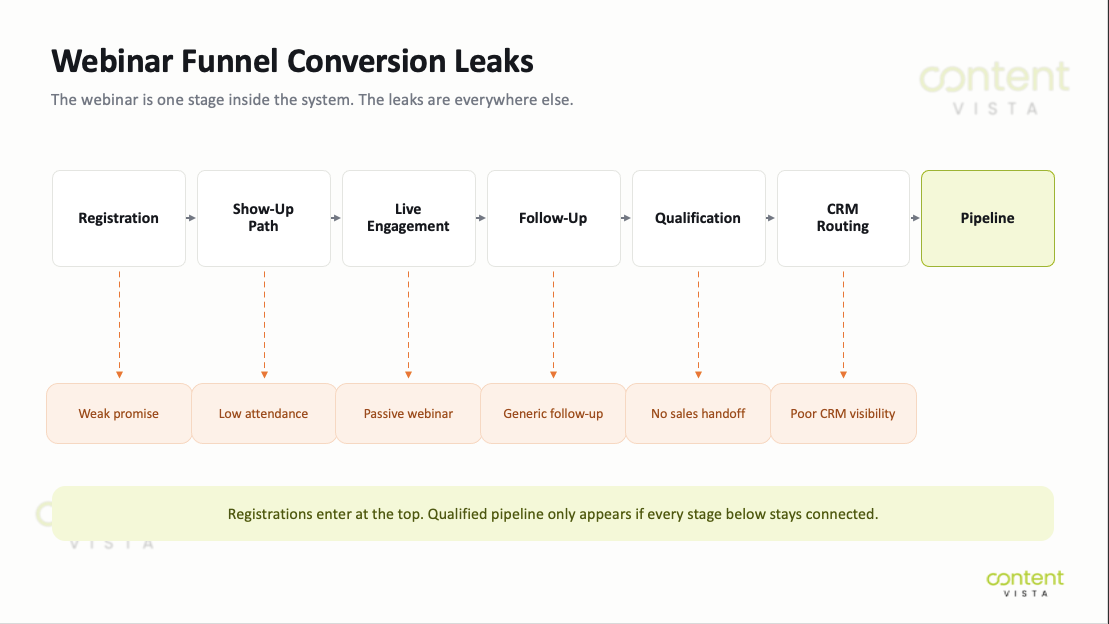
This is the same systems-first thinking that separates random acts of marketing from predictable pipeline. It is the thinking behind every working lead generation system.
Throughout this guide, we will look at where webinar funnels typically leak conversions and how to design a webinar lead generation funnel that turns engagement into predictable pipeline instead of isolated event activity.
What Is a Webinar Lead Generation Funnel?
Many businesses think they are "running webinar funnels" when they are really just hosting webinars.
That distinction matters more than most teams realise.
A webinar itself is simply the event or content experience:
the live session
the workshop
the training
the presentation
the Q&A
The registration page is only the mechanism that captures interest.
Neither of those alone creates qualified pipeline.
In short: the webinar is not the funnel. The webinar is one moment inside the funnel.
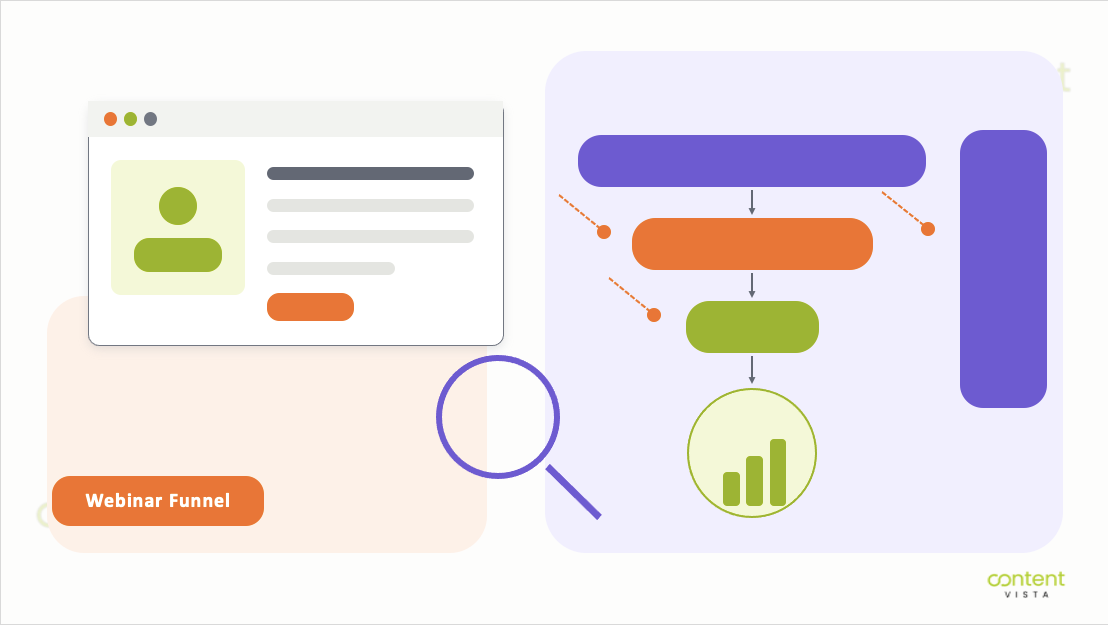
A webinar lead generation funnel is the connected system that turns webinar interest into qualified leads by managing the full path from topic promise and registration to attendance, engagement, replay follow-up, lead scoring, CRM handoff, and sales next steps.
That "connected system" part is where most webinar strategies either succeed or break.
A webinar funnel starts before someone registers and continues long after the webinar ends.
It includes:
the positioning and promise used to attract the right audience
the registration experience
reminder sequences
show-up optimisation
live engagement structure
replay delivery
segmentation logic
nurture workflows
lead qualification
CRM visibility
sales routing
pipeline tracking
Without those connected layers, webinars often become isolated marketing events instead of revenue-generating systems.
For example, two companies may generate the same number of registrations.
But their outcomes can look completely different.
One company:
sends generic reminders
delivers a passive webinar
sends one replay email
never tracks engagement
has no structured follow-up
treats all registrants the same
The webinar creates activity, but little commercial impact.
The other company:
filters for higher-intent registrants
tracks attendance behavior
scores engagement signals
segments attendees by interest level
routes qualified prospects into sales workflows
nurtures lower-intent leads through follow-up content
tracks webinar influence inside the CRM
The webinar becomes part of a larger acquisition system.
That is the real difference between "doing webinars" and building a webinar lead generation funnel.
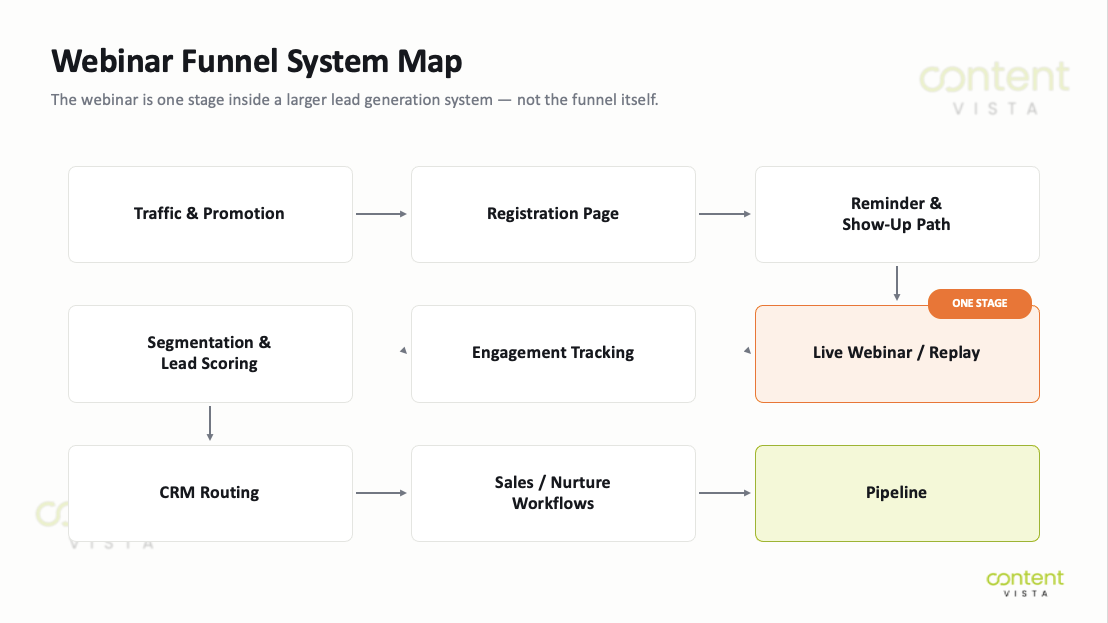
This is also why webinar funnels should not operate separately from the broader lead generation infrastructure.
The strongest webinar funnels plug directly into:
CRM workflows
lifecycle stages
nurture systems
qualification logic
pipeline reporting
sales follow-up processes
That systems-first approach is what turns educational engagement into measurable business outcomes inside a connected lead generation system.
Why Webinars Still Matter for Lead Generation in 2026
Webinars are not new.
What has changed is how businesses use them.
For years, webinars were often treated as isolated events:
a promotional campaign
a live presentation
a replay link
a short-term lead spike
That model still exists, but it is also why many webinar programs underperform.
In 2026, webinars work best when they operate as part of a connected lead generation system rather than standalone marketing activity.
Webinars are not magic.
But they do something most content formats struggle to do: they create visible engagement signals.
A blog post may attract traffic.
A social post may generate impressions.
An ad may generate clicks.
But webinars create deeper behavioral visibility.
You can see:
who registered
who attended
how long they stayed
which questions they asked
which polls they answered
whether they engaged with the offer
whether they watched the replay
which follow-up links they clicked afterward
That level of engagement data makes webinars valuable far beyond simple attendance numbers.
The strongest webinar funnels do not just generate attention. They help businesses identify intent, qualify engagement, segment prospects and trigger more relevant follow-up workflows.
This is especially important in longer or higher-trust buying journeys where prospects often need education before they are ready for direct sales conversations.
A webinar can support multiple stages of the buyer journey at once.
For example:
out-of-market webinars can introduce a problem or market shift to buyers who are not searching yet
educational webinars can explain frameworks, systems or implementation approaches
product or service webinars can reduce buyer uncertainty
workshop-style webinars can build authority and trust
customer webinars can support retention and expansion
sales enablement webinars can help move opportunities closer to decision-making
That flexibility is one reason webinars remain a core part of many modern demand generation systems.
Live webinars also create something increasingly rare in digital marketing: real-time interaction.
Questions, polls, chat participation, objections and engagement moments all create signals that static content usually cannot provide.
A prospect asking implementation questions during a webinar often indicates a very different intent level than someone casually downloading an ebook.
That distinction matters because webinar engagement data can improve:
lead scoring
segmentation
qualification logic
sales prioritisation
nurture personalisation
CRM visibility
For example:
highly engaged attendees may move into faster sales follow-up
low-engagement registrants may enter longer nurture sequences
replay viewers may receive different messaging than live attendees
attendees asking technical or pricing questions may indicate stronger buying intent
That is where webinars become operationally powerful.
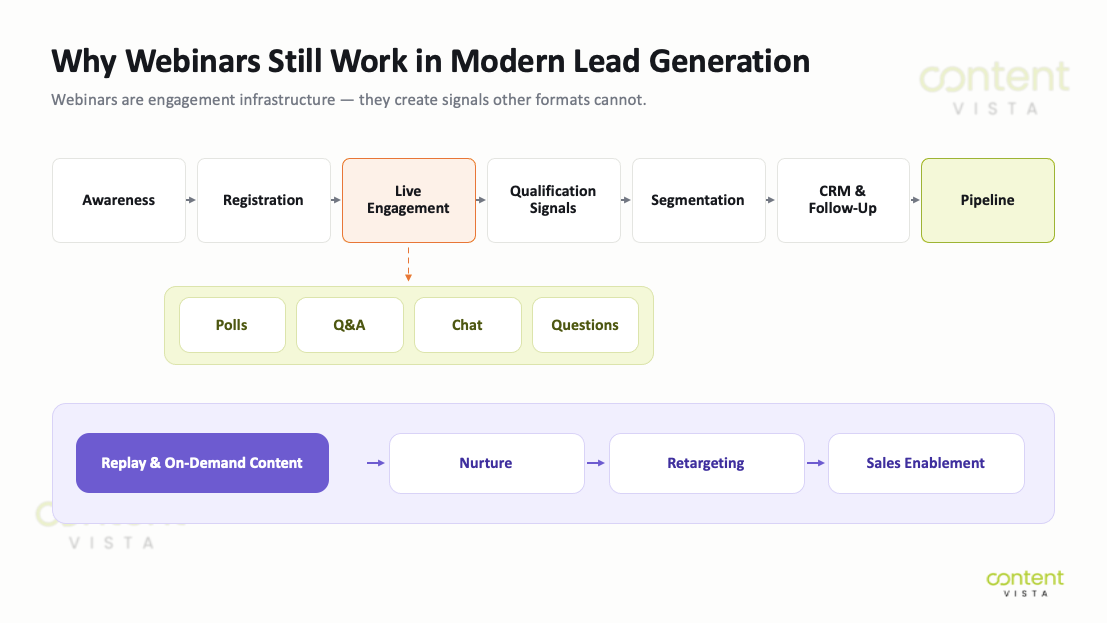
Another reason webinars continue to matter is content longevity.
A live webinar is not limited to one event date.
The same webinar can often be repurposed into:
on-demand webinars
nurture assets
short-form clips
blog content
sales enablement resources
onboarding materials
replay funnels
follow-up sequences
That extends the value of the original asset far beyond the live session itself.
The key, however, is understanding that webinars only create commercial impact when the surrounding system is designed intentionally.
Without segmentation, follow-up, CRM visibility, and sales routing, even high-attendance webinars often fail to influence real pipeline.
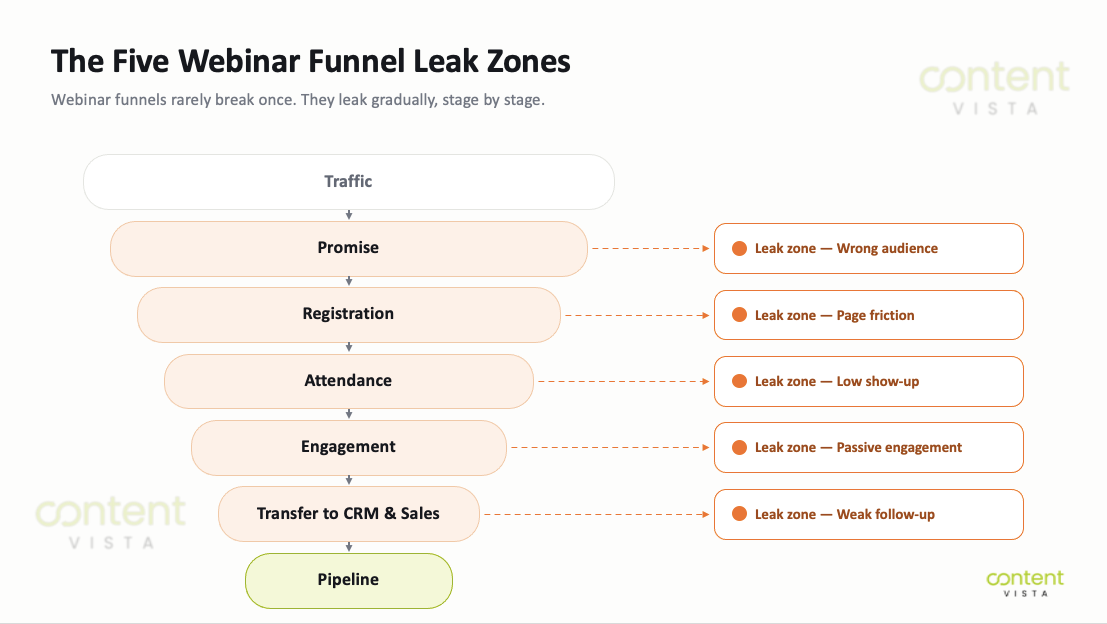
The Five Webinar Funnel Leak Zones
Most webinar funnels do not fail because webinars "stopped working."
They fail because conversion leaks exist throughout the system surrounding the webinar.
Here's where most teams go wrong: they blame the webinar when the leak is actually somewhere else.
A weak registration page gets blamed on the topic.
Low attendance gets blamed on the platform.
Poor pipeline results get blamed on "bad leads."
But in reality, webinar funnels usually break across multiple stages at once.
That is why improving one part of the funnel without diagnosing the full system often produces disappointing results.
For example:
increasing ad spend will not fix weak webinar positioning
improving slides will not fix poor follow-up
generating more registrations will not solve bad qualification
sending more reminders will not compensate for low buyer intent
adding automation will not fix missing sales ownership
A webinar funnel should be diagnosed as an operational system, not as a single campaign asset.
Here is where webinar funnels quietly lose conversion momentum between registration and pipeline creation.
| Leak Zone | What Breaks | Common Symptom | What to Fix |
|---|---|---|---|
| Promise leak | Weak positioning, vague outcomes, wrong audience targeting | High registrations but low-fit attendees or poor engagement | Clarify the transformation, tighten ICP targeting, improve topic specificity |
| Registration leak | Weak landing page structure, unclear value proposition, excessive friction | Traffic clicks without registration conversion | Improve messaging clarity, reduce friction, strengthen offer relevance |
| Attendance leak | Weak reminder system, low anticipation, poor calendar integration | Large registration numbers but weak live attendance | Build stronger pre-event nurture, reminder cadence and attendance incentives |
| Engagement leak | Passive webinar structure, weak interaction, unclear next steps | Attendees stay passive and take no action afterward | Add polls, Q&A, interaction moments, stronger CTA transitions and engagement triggers |
| Transfer leak | Poor segmentation, generic follow-up, weak CRM routing, unclear sales ownership | Webinar activity never turns into qualified opportunities | Build lead scoring, segmentation logic, CRM workflows, and sales handoff systems |
Promise Leak
The first leak usually happens before someone even registers.
A webinar topic may attract attention but still attract the wrong audience.
This often happens when the webinar promise is:
too broad
too educational without commercial relevance
disconnected from buyer intent
unclear about outcomes
optimised for clicks instead of fit
For example: "Marketing Trends in 2026" may generate curiosity.
But "How B2B SaaS Teams Reduce Pipeline Leakage With AI-Assisted Lead Qualification" filters for a much more qualified audience.
Strong webinar funnels attract the right people, not just more people.
Registration Leak
The next leak happens on the registration page itself.
Many webinar pages create friction instead of clarity.
Common issues include:
vague webinar descriptions
weak headlines
unclear outcomes
generic speaker bios
long forms
confusing layouts
no urgency or relevance
A webinar registration page should answer three questions quickly:
Why should I care?
What specific outcome will I get?
Is this relevant to my situation?
If those answers are weak, traffic leaks before conversion ever happens.
Attendance Leak
Registration alone does not create engagement.
Attendance is heavily influenced by what happens between registration and the live session.
Many businesses underestimate this stage entirely.
They send:
one generic reminder email
no calendar integration
no pre-event content
no anticipation-building
no contextual follow-up
The result: people forget, deprioritise or disengage before the webinar even starts.
Strong webinar funnels intentionally build attendance momentum through reminder systems, pre-event positioning and expectation-setting.
Engagement Leak
Even high attendance does not guarantee commercial impact.
This is where passive webinars become expensive.
If attendees:
listen silently
multitask
disengage early
never interact
never understand the next step
…the funnel loses momentum fast.
The strongest webinar funnels create interaction intentionally.
That includes:
polls
Q&A
live feedback
objection handling
use-case discussions
CTA transitions
engagement checkpoints
These moments do more than improve participation. They also create qualification signals.
Someone asking implementation questions behaves very differently from someone who leaves after 10 minutes.
Transfer Leak
This is usually the most expensive leak zone because it happens after the webinar appears "successful."
The webinar ends.
The replay email gets sent.
Then the system breaks.
Everyone receives the same generic follow-up regardless of:
attendance duration
engagement level
poll responses
questions asked
buyer intent
lifecycle stage
Sales may never see the lead.
Marketing may never score engagement properly.
The CRM may never reflect webinar influence accurately.
As a result, pipeline opportunities disappear into operational gaps.
Most webinar funnels do not fail from one catastrophic problem. They fail through multiple smaller leaks across positioning, registration, attendance, engagement and follow-up systems.
The businesses generating consistent webinar pipeline usually are not the ones with the "best webinars."
They are the ones with the strongest systems around the webinar.
Find where your webinar funnel is leaking before you rebuild the whole system.
Run the Website Conversion Leak Audit.
The Five Layers a Webinar Funnel Needs to Generate Pipeline
Let's make this practical.
If a webinar is going to generate pipeline, five things need to work together.
Not just the webinar itself.
Not just the registration page.
Not just the follow-up emails.
The entire registration-to-pipeline system has to function as one connected workflow.
That is where most webinar funnels break.
So here is the important part: a webinar funnel is not its own system. It is one acquisition path inside a lead generation system — the system Content Vista builds through the VISTA framework.
Run a webinar through it and five things have to work.
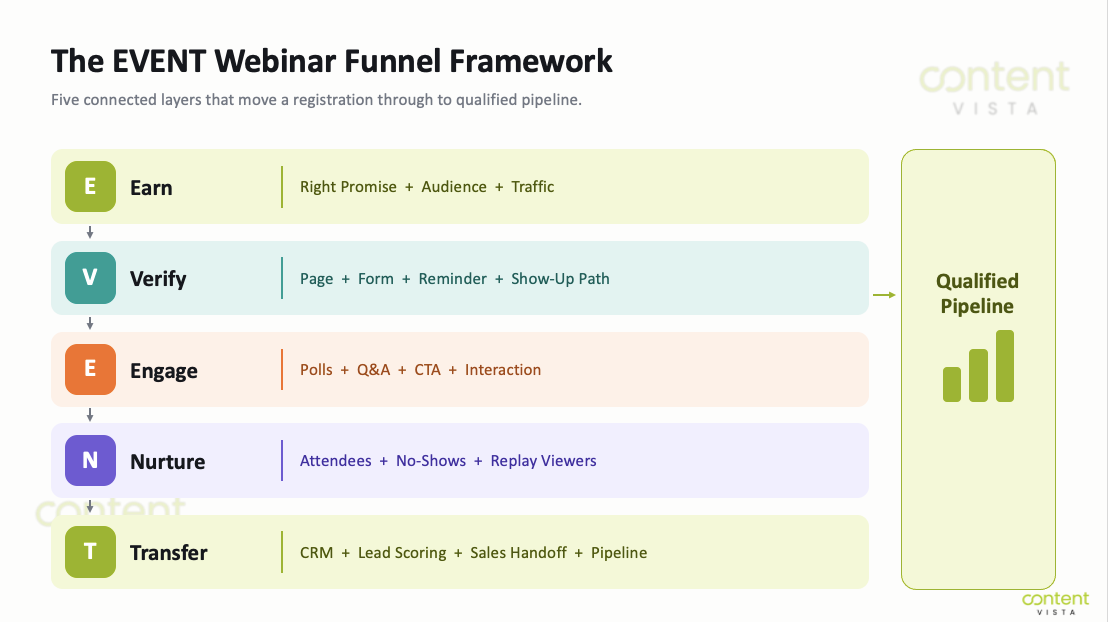
An easy way to remember them: EVENT — Earn, Verify, Engage, Nurture, Transfer.
Each one tells you what has to happen operationally, and what breaks when it doesn't.
| Stage | What It Means | Main Goal | Primary Risk |
|---|---|---|---|
| Earn | Attract the right audience with the right webinar promise, positioning, and traffic sources | Generate qualified registrations | Attracting low-intent or poor-fit registrants |
| Verify | Optimise the registration experience, form flow, reminders, and attendance path | Maximise registration conversion and show-up quality | High drop-off before attendance |
| Engage | Create interactive webinar experiences with polls, Q&A, resources and CTA moments | Generate intent signals and engagement | Passive attendees with no conversion movement |
| Nurture | Segment and follow up differently based on attendance behavior and engagement | Move prospects toward sales readiness | Generic follow-up that ignores buyer intent |
| Transfer | Route engagement and qualification signals into CRM workflows and sales processes | Convert webinar engagement into qualified pipeline | Leads disappearing after the webinar |
Earn
The first stage is about earning the registration from the right audience.
This sounds obvious, but many webinar funnels optimise for volume instead of fit.
A webinar topic should attract people who are commercially relevant to the business, not just people who find the subject interesting.
That means aligning:
webinar topic
audience pain points
buyer intent
traffic sources
positioning
promised outcome
For example: a webinar titled "AI Trends in Marketing" may attract broad curiosity.
But "How B2B Teams Use AI to Reduce Lead Qualification Bottlenecks" filters for a much more specific audience with stronger operational intent.
The goal is not maximising registrations. The goal is maximising qualified engagement.
Verify
Once someone registers, the next priority is verifying the conversion path.
This stage includes:
registration page clarity
form friction
confirmation flow
calendar integration
reminder sequences
pre-event nurture
attendance preparation
Many funnels lose momentum here because the system assumes registration equals commitment.
It does not.
People forget webinars constantly.
Schedules change.
Attention shifts.
Strong webinar funnels reduce attendance friction intentionally.
That means:
simple registration experiences
clear expectations
reminder cadence
pre-event anticipation
obvious calendar actions
contextual follow-up before the event
The registration-to-attendance path is infrastructure, not a series of one-off sends.
Engage
This is the stage most businesses think about first but often execute too passively.
A webinar should not feel like a long presentation followed by "Any questions?"
Strong engagement requires intentional interaction design.
That can include:
live polls
Q&A checkpoints
audience prompts
resource drops
objection discussions
implementation examples
strategic CTA transitions
The goal is not entertainment.
The goal is generating visible engagement signals.
Someone asking detailed implementation questions is behaving differently from someone who joins late, stays silent and exits early.
That distinction matters operationally because engagement behavior can influence:
segmentation
lead scoring
follow-up priority
sales readiness
nurture workflows
Those signals only matter if the system captures and scores them. An interaction nobody records is not a qualification signal.
The webinar itself is not just content delivery. It is a qualification environment where prospects reveal intent through behavior, interaction and engagement depth.
Nurture
One of the biggest webinar funnel mistakes is treating every registrant the same afterward.
Attendees, no-shows, replay viewers, and highly engaged participants should not receive identical follow-up.
Yet many webinar funnels still send:
one replay email
one generic CTA
one nurture sequence for everyone
That approach ignores intent signals entirely.
A stronger nurture system segments based on:
attendance duration
engagement level
questions asked
CTA clicks
poll responses
replay activity
lifecycle stage
For example:
highly engaged attendees may receive faster sales outreach
no-shows may receive replay-focused nurture
low-intent attendees may move into educational sequences
high-intent participants may receive consultation prompts or strategic follow-up
This is where webinar funnels become operational systems rather than isolated events.
Transfer
The final stage is where webinar engagement becomes pipeline infrastructure.
This is also where many funnels silently fail.
Without proper transfer systems:
engagement data stays trapped in webinar software
sales teams never see qualification signals
CRM stages never update
follow-up ownership becomes unclear
webinar influence disappears from reporting
A strong transfer system connects:
webinar engagement
CRM workflows
lead scoring
lifecycle stages
sales routing
attribution tracking
pipeline visibility
Only then does webinar influence show up in pipeline reporting instead of staying trapped in event software.
The webinar then stops being "an event."
It becomes part of a connected lead generation engine designed to create measurable conversion movement.
If your webinar needs to become a lead-capture system, not just an event, explore Content Vista's Webinar & Lead Capture Funnels.
Choose the Right Webinar Objective and Format Before You Build the Funnel
Before you build the funnel, ask a harder question: should this even be a webinar?
That question is often skipped.
Many businesses decide to "do a webinar" before deciding:
what the business outcome should be
who the webinar is actually for
how much buyer education is required
whether live interaction is necessary
whether the topic deserves long-form attention at all
The result is a webinar that feels forced instead of strategically useful.
Not every idea needs a webinar.
And not every webinar should follow the same format.
The right structure depends on:
buyer intent
complexity of the topic
sales cycle length
trust requirements
audience maturity
operational capacity
funnel objective
Some webinar funnels are designed for demand generation.
Others support sales enablement.
Some qualify prospects. Others nurture existing interest.
Choosing the wrong format creates friction before the funnel even launches.
So before you pick a format, run the topic through this checklist.
| Check | Why It Matters | If the Answer Is No |
|---|---|---|
| Does the topic need discussion, not just explanation? | Webinars earn their cost through interaction, objection handling and live Q&A | Use a blog post, checklist or short-form video instead |
| Is there a specific business outcome attached to the topic? | Vague topics attract curiosity, not qualified registrants | Narrow the topic to a decision, a mistake or an operational problem |
| Is the topic specific enough to filter for fit, not just interest? | Broad promises fill seats with the wrong people | Tighten the promise around ICP pain points before building the page |
| Does the audience trust you enough to give you 45 minutes? | Webinars ask for more commitment than any other content format | Build authority and positioning first, then run the webinar |
| Is there a realistic promotion path to fill the room? | Strong webinars still fail without distribution | Build the Inbound-led or Outbound-led System first |
| Does someone own follow-up before the webinar goes live? | Unowned leads stall inside operational gaps | Define routing, nurture thresholds and sales responsibility first |
| Can the CRM capture and act on engagement signals? | Signals that are not recorded cannot influence qualification | Build CRM and routing infrastructure first |
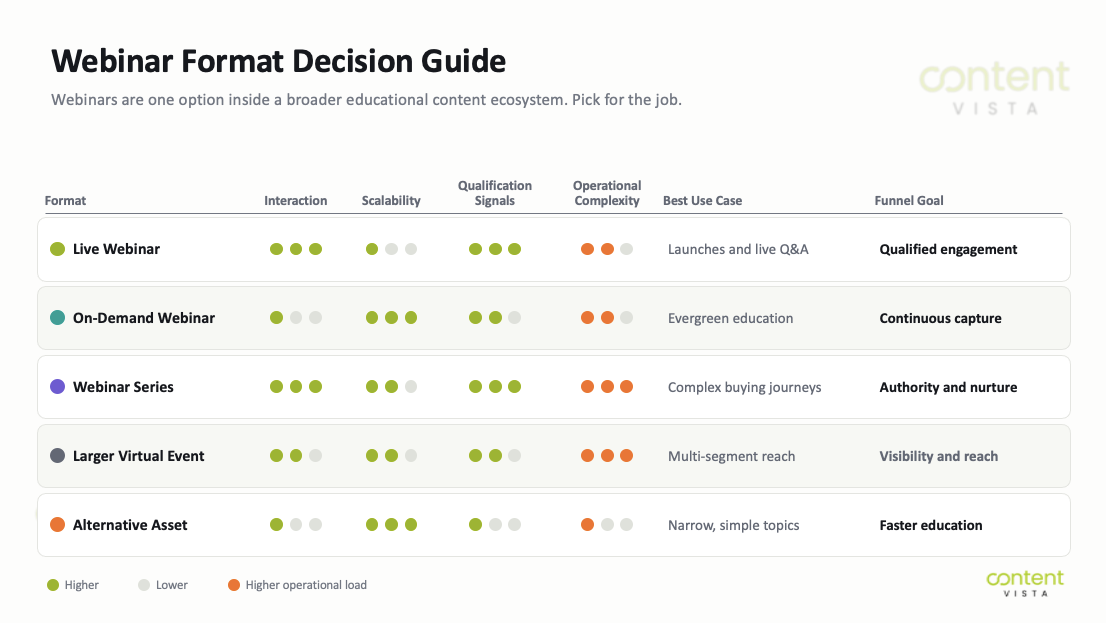
If most of those answers are yes, the next question is which format fits.
| Format | Best For | Main Strength | Main Risk | Ideal Next Step |
|---|---|---|---|---|
| Live webinar | Real-time education, launches, Q&A, community interaction | Strong engagement and intent visibility | Attendance dependency and scheduling friction | Follow with segmented nurture and sales workflows |
| On-demand webinar | Evergreen education and self-paced buyer journeys | Long-term scalability and continuous lead capture | Lower urgency and weaker live interaction | Connect replay engagement to nurture and scoring systems |
| Webinar series | Complex topics requiring repeated education | Builds authority and sustained engagement over time | Operational complexity and audience fatigue | Use progressive segmentation and lifecycle nurture |
| Larger virtual event | Multi-topic education, partnerships, or broad audience reach | Expanded visibility and networking potential | Complex logistics and diluted focus | Route attendees into specialised follow-up tracks |
| Different asset / not a webinar yet | Narrow, simple, or low-engagement topics | Faster content production and easier consumption | Less interaction and weaker qualification signals | Convert into blog, checklist, lead magnet, podcast or short-form content |
Live Webinar
Live webinars are still one of the strongest formats for interaction-driven lead generation.
They work especially well when:
buyer trust matters
objections need discussion
audience participation is valuable
urgency helps conversion
the sales process benefits from human interaction
Live sessions create real-time engagement signals through:
Q&A
chat
polls
reactions
live demonstrations
implementation discussions
That interaction is difficult to replicate through static content alone.
For example, a founder asking detailed operational questions during a live webinar often reveals stronger buying intent than someone passively downloading a PDF.
Live webinars also create psychological momentum.
People are more likely to prioritise attendance when:
the event feels timely
the audience expects participation
the host creates anticipation
the topic solves an urgent problem
The trade-off is operational dependence.
Live webinars require:
scheduling coordination
attendance management
speaker readiness
live moderation
technical reliability
If the business cannot support those operational layers consistently, the funnel weakens quickly.
On-Demand Webinar
On-demand webinars solve a different problem.
They reduce timing friction and support self-paced buyers.
This format works well when:
the topic remains evergreen
buyers research independently
audience schedules vary heavily
the sales cycle is longer
traffic arrives continuously through search, content or paid acquisition
An on-demand webinar can function like a long-form educational asset that continuously captures and nurtures demand.
This is especially useful inside broader demand generation systems where educational content compounds over time.
The challenge is engagement depth.
Without live interaction:
urgency decreases
participation weakens
feedback disappears
intent signals become harder to interpret
That means the surrounding nurture and segmentation system becomes even more important.
Webinar Series
Some problems are too large for one webinar.
That is where webinar series become useful.
A webinar series works best when:
the buying process is complex
multiple stakeholders are involved
implementation requires education
trust develops over time
the audience benefits from progressive learning
For example:
a three-part operational workshop
a monthly industry briefing
a product adoption series
a transformation roadmap sequence
The biggest advantage is relationship depth.
Repeated engagement creates:
stronger familiarity
improved authority positioning
clearer qualification signals
more sustained nurture opportunities
The risk is fatigue.
Without a clear progression structure, webinar series often become repetitive and lose momentum.
Larger Virtual Event
Sometimes the objective extends beyond one webinar entirely.
A larger virtual event may make more sense when:
multiple audience segments exist
several speakers contribute expertise
partnerships or sponsorships are involved
networking matters
multiple educational tracks are required
This format behaves more like a digital conference than a traditional webinar.
It can generate significant visibility and reach, but it also creates complexity:
more coordination
more segmentation
more operational infrastructure
more post-event routing requirements
Without strong follow-up systems, larger events often generate activity without conversion clarity.
When the Topic Should Be a Different Asset
Sometimes the best webinar strategy is not running a webinar.
If the topic:
is too narrow
lacks interaction value
can be explained quickly
does not justify live attention
has low discussion depth
…another content asset may perform better.
That could include:
a checklist
a lead magnet
a blog article
a short-form video
a podcast episode
a framework guide
a downloadable resource
In many cases, businesses force webinar formats onto topics that would work better through simpler content experiences.
That is why webinar strategy should connect closely with broader content and thought leadership and lead magnet and asset creation planning rather than operating independently.
The best webinar funnels are not built around "doing webinars." They are built around choosing the right educational format for the buyer journey, intent level and conversion objective.
Step 1 - Earn the Registration With the Right Promise, Page and Promotion Mix
Most webinar funnels start too late.
Teams focus on reminder emails, attendance rates or follow-up workflows before fixing the first problem: earning the right registration in the first place.
The registration page has one job: make the right person believe the webinar is worth their time.
Not everyone's time.
The right person's time.
That means the registration experience should filter, qualify and persuade simultaneously.
A weak registration strategy creates downstream problems everywhere else in the funnel:
low attendance quality
weak engagement
poor-fit leads
generic follow-up
disappointing pipeline impact
Strong webinar funnels start by aligning:
the topic
the promise
the audience
the page
the traffic source
the conversion flow
Build the Topic Around a Specific Pain or Decision
The fastest way to weaken a webinar funnel is choosing a topic that is too broad.
Broad topics attract curiosity. Specific topics attract intent.
For example:
"Marketing Trends for 2026" creates general interest
"How B2B Teams Reduce Pipeline Leakage Between Marketing and Sales" attracts a more commercially relevant audience
A strong webinar topic usually helps the audience:
solve a problem
avoid a mistake
make a decision
understand a shift
evaluate an approach
improve an operational outcome
The topic should clearly communicate:
who the webinar is for
what they will understand afterward
why the topic matters now
what practical outcome they will leave with
Weak webinar topics often sound informational but create no urgency or relevance.
Examples:
"Everything You Need to Know About AI"
"Business Growth Strategies"
"Digital Marketing Best Practices"
These topics are too broad to create meaningful buyer intent.
More focused topics usually perform better because they filter for stronger relevance.
Write a Clear Webinar Promise
The webinar promise is more important than the webinar title itself.
The title captures attention. The promise creates conversion motivation.
A strong promise tells the audience:
what they will learn
what problem they will solve
what outcome they will move toward
what decision they will make more confidently
That promise should appear consistently across:
ads
email invitations
LinkedIn posts
outreach
landing pages
reminder sequences
One of the biggest conversion leaks happens when the webinar promotion promises something valuable, but the registration page feels vague or generic afterward.
The audience experiences friction immediately.
Strong webinar promises usually:
emphasise specificity
clarify business relevance
connect to operational pain points
avoid hype-heavy language
imply practical outcomes
The goal of the registration page is not maximising signups from everyone. The goal is attracting qualified people who are likely to engage, convert or enter nurture intentionally.
Reduce Registration-Page Friction
Many webinar pages accidentally create hesitation instead of momentum.
Common issues include:
vague copy
unclear outcomes
cluttered layouts
excessive form fields
weak speaker positioning
generic CTA buttons
unclear next steps
no trust indicators
A strong webinar registration page should quickly answer:
Who is this for?
Why should I care?
What will I learn?
Why should I trust this?
What happens after I register?
The registration experience should also balance conversion with qualification.
For example, asking for:
name
email
company
role
may improve segmentation without creating excessive friction.
But asking for:
phone number
company revenue
detailed operational information
multiple qualification questions
too early may reduce conversion unnecessarily.
The right balance depends on:
traffic source
audience intent
sales cycle complexity
webinar objective
| Page Element | What It Should Do | Common Leak | Fix |
|---|---|---|---|
| Headline / promise | Clarify the webinar outcome and relevance | Vague or overly broad messaging | Make the outcome specific and audience-focused |
| Audience clarity | Help visitors identify whether the webinar is for them | Generic positioning | Define role, industry, or business context clearly |
| Agenda bullets | Show practical learning outcomes | Abstract or unclear takeaways | Use outcome-driven agenda points |
| Speaker proof | Build credibility and trust | Weak or irrelevant bios | Emphasise operational expertise and relevance |
| Form fields | Capture enough information for qualification | Excessive friction | Keep forms concise and strategically useful |
| CTA | Encourage clear next-step action | Generic button language | Reinforce the webinar value proposition |
| Trust signals | Reduce hesitation and uncertainty | No proof or credibility indicators | Add relevant authority or contextual trust elements |
| Confirmation path | Prepare attendees for show-up and follow-up | Dead-end thank-you pages | Add calendar actions, reminders, and next steps |
Match Promotion Channels to the Audience
The best webinar funnel can still fail if the promotion strategy attracts the wrong traffic.
Different channels create different intent quality.
For example:
LinkedIn promotion may work well for professional targeting
outbound email may help activate specific accounts
partner promotion may increase credibility
communities may improve niche relevance
paid campaigns may scale reach
existing email lists may generate higher attendance quality
The right promotion mix depends on:
audience behavior
trust level
buying cycle
topic specificity
funnel objective
That is why webinar promotion should connect to broader Inbound-led and Outbound-led Systems rather than functioning independently. The goal is the right channels acting as one coordinated acquisition system — not all channels running in parallel.
Relevant supporting strategies may include:
Inbound Lead Generation vs Outbound: Which Growth System Fits Your Stage?
Cold Email Lead Generation: Book Leads Without the Spam [Outreach Strategy]
How to Build a LinkedIn Lead Gen Strategy That Creates Qualified Conversations
The key is consistency.
The traffic source, registration page, webinar promise, and follow-up workflow should all reinforce the same positioning and audience expectation.
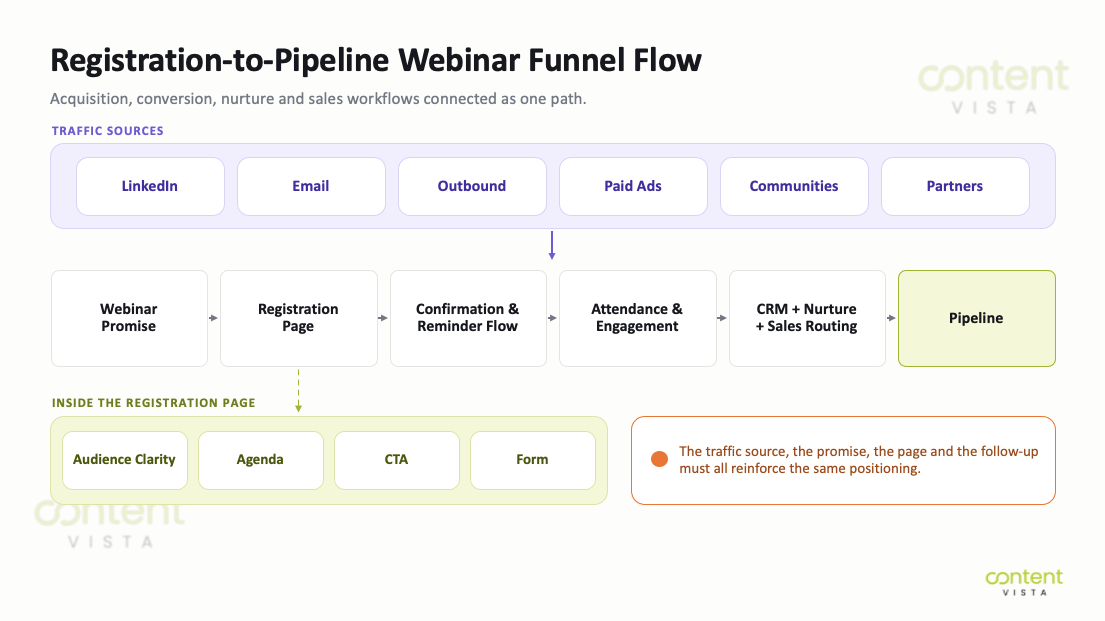
When those elements align, registrations become more than email captures.
They become the starting point of a qualification and pipeline-building system.
Find where your webinar funnel is leaking before you rebuild the whole system.
Run the Website Conversion Leak Audit.
Need webinar pages designed for both conversion and lead qualification?
Explore Content Vista's Landing Pages & Funnel Builds.
Step 2 - Increase Show-Up With Reminders, Calendar Paths and Pre-Event Priming
A no-show problem often starts immediately after registration.
Many webinar funnels assume that once someone submits the form, the conversion work is done.
It is not.
Registration only signals initial interest. Attendance depends on what happens next.
This is where many webinar funnels quietly lose momentum.
People register while multitasking.
Calendars shift.
Priorities change.
The perceived importance of the webinar fades quickly.
Without a structured show-up path, attendance rates often decline because the funnel fails to maintain relevance and commitment between registration and the live event.
The strongest webinar funnels treat this stage as a separate conversion journey.
The Thank-You Page Should Continue the Funnel
Most webinar thank-you pages are operational placeholders.
"Thanks for registering."
"Check your inbox."
"See you there."
That approach wastes momentum.
The thank-you page should reinforce:
why the webinar matters
what attendees will gain
what they should expect next
how to secure attendance
It should also guide the next micro-conversion: adding the webinar to the calendar.
This matters because attendance friction is often logistical, not intentional.
If attendees must manually remember the webinar later, drop-off risk increases immediately.
A stronger thank-you experience includes:
calendar links
event timing clarity
timezone confirmation
speaker reminder
agenda preview
expectation-setting
optional pre-event resource
This stage is often managed inside broader landing pages and funnel builds systems where the thank-you flow functions as part of the conversion infrastructure rather than a dead-end confirmation screen.
Calendar Paths Reduce Friction
One of the simplest attendance improvements is also one of the most overlooked: making the webinar easy to remember.
Calendar integration reduces the cognitive load required to attend later.
It also increases commitment psychologically.
When someone adds the event to their schedule, they are more likely to:
prioritise attendance
recognise the webinar as intentional
remember the event context
return at the correct time
That sounds basic, but many funnels still create unnecessary friction by hiding or weakening calendar actions.
The calendar step should feel obvious and immediate.
Reminder Emails Should Reinforce Relevance
Reminder emails are not simply operational notifications.
They are persuasion assets.
Many webinar reminders fail because they only repeat:
the date
the time
the webinar title
the attendance link
But the attendee already registered. The bigger challenge is helping them believe the webinar is still worth attending.
Strong reminders reinforce:
the practical outcome
the business relevance
the urgency
the problem being solved
the value of attending live
For example, instead of: "Reminder: Webinar starts tomorrow."
A stronger reminder may reinforce:
the operational problem being discussed
the decision framework attendees will receive
the live Q&A opportunity
the implementation insight being shared
That subtle shift changes the reminder from logistical communication into conversion reinforcement.
Pre-Event Priming Improves Engagement Before the Webinar Starts
One of the most underused webinar strategies is pre-event priming.
This means giving attendees a reason to think about the webinar before it begins.
That can include:
a short teaser video
a poll question
a worksheet
a diagnostic question
an agenda preview
a framework preview
a preparation prompt
Pre-event priming works because it increases mental investment.
The attendee stops behaving like a passive registrant and starts behaving like an active participant.
That shift often improves:
attendance quality
interaction
retention
question volume
CTA responsiveness
It also creates early engagement signals that can later support segmentation or personalisation.
| Funnel Moment | Goal | Common Leak | Fix |
|---|---|---|---|
| Thank-you page | Reinforce value and guide the next action | Dead-end confirmation experience | Add calendar actions, expectations and next steps |
| Calendar add | Reduce attendance friction | Registrants forget the webinar | Make calendar integration immediate and obvious |
| Confirmation email | Verify registration and reinforce commitment | Generic operational messaging | Re-emphasise outcomes and relevance |
| Reminder sequence | Maintain attention and urgency | Weak reminders focused only on timing | Reinforce value, outcomes, and live participation benefits |
| Pre-event teaser | Increase anticipation and mental engagement | Attendees remain passive before the event | Share a preview, question, worksheet or framework |
| Final reminder | Maximise live attendance conversion | Last-minute drop-off or forgetfulness | Send contextual reminders with direct access links |
Attendance optimisation is not about sending more reminders. It is about reducing friction while continuously reinforcing why the webinar deserves attention.
Strong show-up systems are usually supported through connected marketing automation and CRM systems workflows that coordinate:
reminders
segmentation
engagement tracking
CRM visibility
behavioral follow-up
When those systems work together, attendance becomes more intentional and the webinar starts with a more engaged audience instead of passive registrants.
Step 3 - Engage Live and On-Demand to Capture Buying Intent
Many webinar funnels treat engagement as a vanity metric.
"How many poll responses did we get?"
"How active was the chat?"
"How many people stayed until the end?"
Those questions matter, but not for the reasons many teams assume.
Engagement is not just a nice webinar metric. It is a clue about buyer intent.
The strongest webinar funnels do not simply measure participation. They interpret engagement behavior operationally.
That means understanding:
which attendees showed active interest
which behaviors signal commercial relevance
which participants may need nurture
which prospects may be ready for direct follow-up
which accounts show buying momentum
This is where webinars become more than educational content. They become qualification environments.
Live Engagement Signals
Live webinars create real-time behavioral data that most static content formats cannot provide.
When attendees:
answer polls
ask implementation questions
download resources
participate in chat
engage with examples
respond to CTA moments
…they reveal varying levels of attention, urgency, and interest.
Not every interaction signals buying intent equally.
For example: someone casually answering a poll may indicate topical interest.
But someone asking:
implementation questions
pricing concerns
integration questions
workflow-specific problems
often signals a deeper evaluation stage.
That distinction matters because webinar engagement should influence:
segmentation
lead scoring
follow-up priority
nurture logic
CRM routing
sales visibility
Without that operational layer, webinar interaction data becomes unused noise instead of conversion intelligence.
Strong webinar funnels intentionally create interaction opportunities throughout the session rather than saving engagement for the last five minutes.
That can include:
strategic polls
Q&A checkpoints
framework exercises
downloadable resources
worksheets
implementation prompts
live use-case discussions
These interaction moments help keep attention high while simultaneously generating qualification signals.
On-Demand Engagement Signals
One of the biggest webinar funnel mistakes is treating replay viewers as lower-value leads automatically.
In reality, many buyers prefer asynchronous evaluation.
They:
watch later
share internally
revisit sections
consume content independently
evaluate solutions privately before engaging
That means on-demand viewers should still be treated as active funnel participants.
Their behavior still creates meaningful signals.
For example:
replay completion
repeat viewing
CTA clicks
resource downloads
section rewatches
internal sharing behavior
can all indicate sustained interest.
In some cases, replay viewers may actually be more intentional than live attendees because they chose to engage independently rather than casually joining a scheduled event.
The operational mistake happens when webinar funnels:
stop tracking replay engagement
send generic replay emails
fail to segment replay viewers
ignore post-webinar behavior entirely
A stronger system treats live and on-demand engagement as part of the same qualification ecosystem.
That is especially important inside connected webinar and lead capture funnels, where webinar behavior feeds broader conversion and nurture systems.
CTA Moments During the Webinar
CTA timing changes webinar performance more than many teams realise.
A CTA delivered too early may feel aggressive before enough trust exists.
A CTA delivered too late may miss high-intent engagement moments completely.
Strong webinar funnels treat CTAs as progression moments rather than abrupt sales interruptions.
That means:
aligning the CTA with the educational flow
introducing next steps naturally
reinforcing relevance before the ask
connecting the CTA to the operational problem being discussed
For example: a CTA placed immediately after demonstrating a costly operational bottleneck may convert more effectively than waiting until the webinar closes.
The CTA itself also matters.
Weak webinar CTAs often sound generic:
"Book a demo"
"Contact us"
"Schedule a call"
Stronger CTAs usually connect directly to the audience's stage of intent.
Examples:
assessment invitations
implementation workshops
strategy reviews
framework walkthroughs
audit-based next steps
resource access
operational consultations
The webinar should create momentum toward the next logical action rather than forcing a disconnected sales transition.
| Signal | What It May Indicate | Follow-Up Use | CRM / Scoring Note |
|---|---|---|---|
| Poll response | Topical interest or operational relevance | Segment by challenge, maturity, or priority | Moderate engagement signal |
| Question asked | Active evaluation or implementation interest | Prioritise personalised follow-up | Higher-intent engagement signal |
| Resource downloaded | Desire for deeper education or evaluation | Trigger nurture or resource-based workflows | Useful qualification indicator |
| CTA clicked | Commercial or solution-oriented interest | Route toward sales or strategic next step | Strong conversion signal |
| Stayed to end | Sustained attention and relevance | Prioritise engaged-attendee nurture | Useful retention signal |
| Watched replay | Continued interest despite missing live session | Trigger replay-specific nurture sequence | Valuable asynchronous engagement signal |
| Shared with team | Internal discussion or multi-stakeholder evaluation | Flag account for higher-priority follow-up | Potential buying-group signal |
The goal of webinar engagement is not maximising activity for its own sake. The goal is identifying which behaviors indicate interest, urgency, fit or commercial intent.
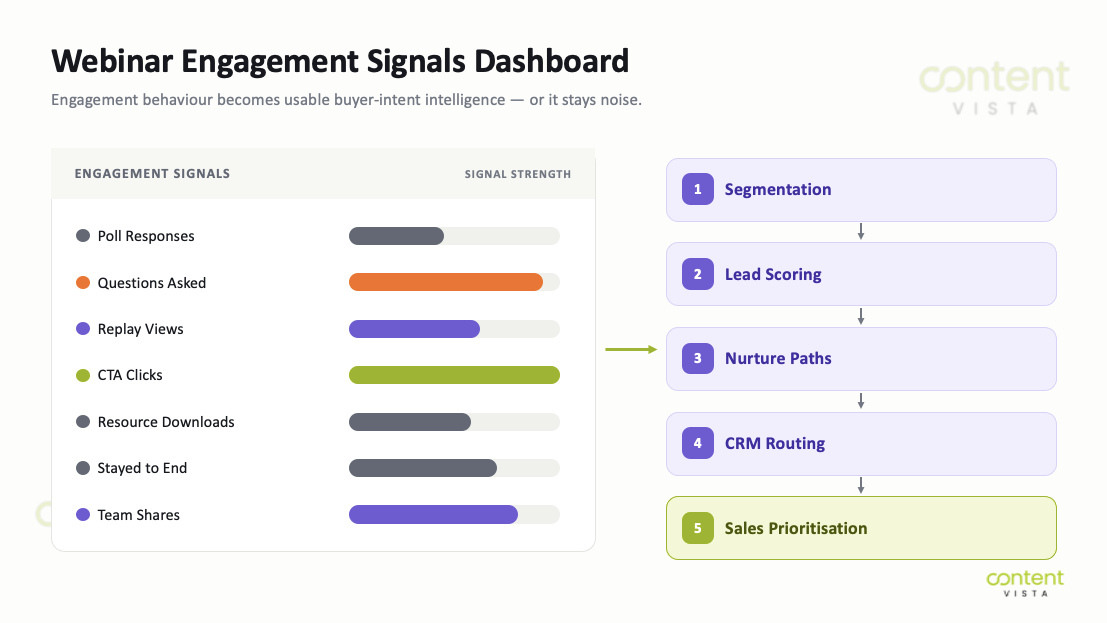
When webinar engagement data flows into connected systems, conversion and growth infrastructure, webinars stop functioning like isolated marketing events.
They become measurable intent-capture systems that help marketing and sales prioritise the right opportunities more intelligently.
Step 4 - Nurture Attendees, No-Shows and Replay Viewers Differently
The biggest post-webinar mistake is sending the same follow-up to everyone.
Most webinar funnels still behave this way:
everyone receives the same replay email
everyone gets the same CTA
everyone enters the same nurture sequence
That approach ignores the most valuable thing the webinar created: behavioral context.
Different attendees showed different levels of intent.
Some stayed until the end.
Some asked questions.
Some clicked the CTA.
Some disengaged after 10 minutes.
Some watched the replay later.
Some never attended at all.
Those differences matter because webinar follow-up should adapt to engagement behavior, not treat every registrant identically.
The webinar itself generates qualification signals. The nurture system should respond accordingly.
Follow-Up for Engaged Attendees
Engaged attendees are often the highest-opportunity segment inside the funnel.
These are participants who:
stayed for most of the webinar
interacted with polls or chat
downloaded resources
asked implementation questions
clicked CTA links
showed active attention
This does not automatically mean they are sales-ready.
But it usually means they have stronger contextual interest than passive attendees.
The mistake many businesses make is delaying or weakening follow-up at this stage.
Engaged attendees often benefit from:
deeper implementation resources
diagnostic tools
framework walkthroughs
strategic consultations
use-case examples
operational next steps
The key is contextual continuity.
The follow-up should connect directly to:
the webinar topic
the questions discussed
the operational challenges raised
the CTA introduced during the session
Generic follow-up breaks momentum.
Strong follow-up extends the conversation naturally.
Follow-Up for Passive Attendees
Not every attendee is ready for a direct sales conversation.
Some people attend because they are:
early-stage researchers
evaluating options slowly
exploring a problem
learning terminology
gathering internal information
These attendees may:
watch quietly
avoid participation
stay partially engaged
consume content passively
That does not make them useless leads.
It simply means they may require a different nurture path.
Passive attendees often respond better to:
educational follow-up
additional examples
guides and frameworks
comparison content
implementation walkthroughs
supporting resources
The goal here is not immediate conversion pressure.
It is continued relevance.
This is where broader content ecosystems and lead magnet and asset creation strategies become valuable because the webinar can feed attendees into more appropriate educational journeys rather than forcing premature sales motion.
Follow-Up for No-Shows
No-shows are frequently mishandled.
Many webinar funnels either:
ignore them entirely
send one replay link
or treat them as low-quality leads automatically
That is often a mistake.
People miss webinars for many reasons:
scheduling conflicts
timezone issues
internal meetings
distractions
changing priorities
Missing the live session does not always indicate low intent.
The key is reducing friction quickly.
A strong no-show workflow should:
acknowledge they missed the event
provide a fast replay path
reinforce why the webinar matters
summarise key takeaways
make re-engagement easy
Timing matters here.
If replay delivery takes too long, attention fades and the lead loses contextual momentum.
A stronger replay sequence may also:
highlight important sections
summarise practical insights
include timestamp navigation
reinforce the next CTA
offer supporting resources
The objective is not guilt-driven follow-up. It is reactivation.
Follow-Up for Replay Viewers
Replay viewers should not be treated as invisible participants.
In many webinar funnels, replay behavior receives almost no operational attention.
That creates a major blind spot.
Replay viewers may:
watch more carefully
revisit important sections
share internally
consume content asynchronously
evaluate solutions privately
Their behavior still reveals intent.
For example: someone who watches 80% of a replay and clicks a resource CTA may demonstrate stronger evaluation behavior than a passive live attendee.
That is why replay engagement should ideally connect into:
lead scoring
CRM activity
segmentation logic
nurture workflows
sales visibility
| Segment | What They Did | Best Follow-Up | Next CTA |
|---|---|---|---|
| Engaged attendee | Participated actively and stayed engaged | Personalised follow-up with deeper implementation resources | Diagnostic, strategy session, or consultation |
| Passive attendee | Attended with limited interaction | Educational nurture and supporting content | Additional resource or framework guide |
| No-show | Registered but missed the webinar | Fast replay delivery with re-engagement prompts | Watch replay or access summary resource |
| Replay viewer | Consumed webinar asynchronously | Replay-based nurture and engagement tracking | Follow-up resource or implementation content |
| CTA clicker | Responded to webinar call-to-action | Accelerated qualification or sales routing | Assessment, consultation, or next-step workflow |
| Sales-ready participant | Demonstrated strong intent and qualification signals | Direct sales or strategic outreach | Discovery call or opportunity creation |
The webinar is not the end of the funnel. The webinar creates behavioral context that should shape what happens next for each participant.
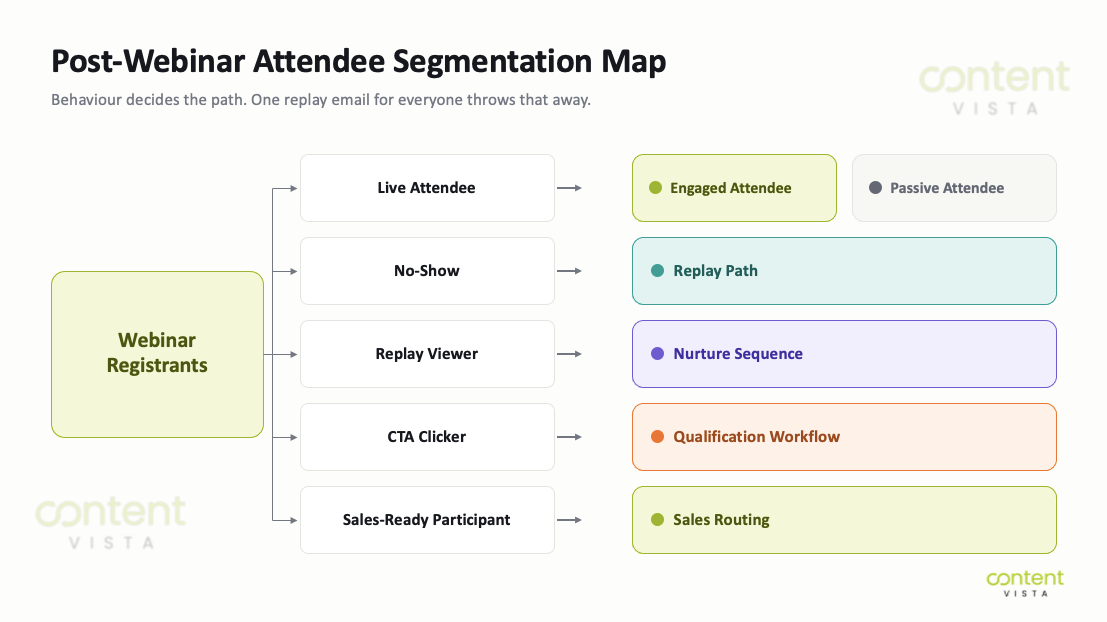
When webinar funnels segment participants properly, follow-up becomes more relevant, lead scoring becomes more accurate and conversion paths become easier to personalise.
That is what transforms webinars from one-time events into connected nurture and pipeline systems.
Need supporting assets that extend webinar engagement into nurture and qualification?
Explore Content Vista's Lead Magnet & Asset Creation services.
Step 5 - Transfer Intent Into CRM, Lead Scoring and Sales Follow-Up
The webinar does not create qualified pipeline until intent is transferred into a follow-up system.
This is where many webinar funnels silently fail.
The webinar itself may perform well:
strong attendance
active engagement
good questions
high replay consumption
CTA interaction
But if that engagement data never reaches the CRM, sales workflows or nurture system, the funnel breaks after the event.
The result is familiar: marketing celebrates webinar activity while sales sees little pipeline impact.
That disconnect usually happens because webinar engagement remains trapped inside the webinar platform instead of becoming operational intelligence.
Webinar Data Should Flow Into the CRM
A webinar platform should not function like an isolated reporting dashboard.
It should behave like a connected signal source inside the wider revenue system.
That means the CRM should ideally capture:
registration status
attendance status
engagement duration
poll participation
questions asked
resource downloads
replay activity
CTA clicks
segmentation labels
qualification indicators
Without that visibility, webinar follow-up becomes generic because the system cannot differentiate between:
passive registrants
engaged attendees
replay viewers
high-intent participants
sales-ready leads
This is one of the biggest operational gaps in webinar funnels.
The data exists but the workflow connection does not.
Strong webinar funnels integrate webinar behavior into:
lifecycle stages
lead scoring
sales routing
nurture logic
account visibility
attribution reporting
That is where webinars start functioning like measurable revenue infrastructure rather than standalone marketing campaigns.
Lead Scoring Should Reflect Behavior, Not Just Registration
Many webinar funnels still score leads too simplistically.
For example:
+5 points for registration
+10 points for attendance
That structure misses most of the meaningful intent signals.
Registration alone rarely indicates strong buying intent.
Behavior does.
A stronger scoring model evaluates:
attendance duration
interaction depth
replay engagement
CTA clicks
questions asked
resource downloads
repeat engagement
account-level participation
For example, someone who:
stays until the end
asks implementation questions
downloads a framework
clicks the CTA
shares the replay internally
…likely demonstrates more intent than someone who simply registered.
That distinction matters because lead scoring should help prioritise attention intelligently.
The purpose of webinar lead scoring is not assigning arbitrary points. It is identifying which engagement behaviors indicate fit, urgency, evaluation or commercial intent.
The strongest webinar funnels connect behavioral scoring directly into:
nurture sequences
lifecycle movement
sales alerts
follow-up prioritisation
CRM visibility
This is often managed through integrated marketing automation and CRM systems that coordinate webinar engagement with broader marketing and sales workflows.
Sales Follow-Up Should Match Intent Level
One of the fastest ways to weaken webinar conversion is treating all follow-up the same.
Not every attendee should receive:
aggressive sales outreach
immediate demo requests
identical nurture emails
The follow-up should match:
engagement level
buyer readiness
business fit
interaction depth
webinar behavior
For example: a highly engaged participant from a target account who clicked the CTA may justify direct outreach quickly.
Meanwhile, a passive attendee may benefit more from:
educational follow-up
nurture content
implementation examples
supporting resources
This is where marketing and sales alignment becomes critical.
Define Ownership Clearly
Many webinar funnels break because nobody clearly owns the next step.
Questions often become unclear:
Who follows up?
Which leads go to sales?
Which leads stay in nurture?
When should outreach happen?
What qualifies as sales-ready?
Which behaviors trigger escalation?
Without clear ownership, leads stall inside operational gaps.
A stronger webinar system defines:
qualification criteria
routing logic
nurture thresholds
follow-up timing
CRM stage movement
sales responsibility
For example:
engaged enterprise accounts may trigger immediate sales alerts
mid-intent attendees may enter structured nurture
low-engagement registrants may remain in educational workflows
replay viewers may trigger secondary qualification logic
The goal is not pushing every attendee toward sales immediately.
The goal is routing people into the correct next-stage workflow.
| Data Point | Why It Matters | Owner | Follow-Up Action |
|---|---|---|---|
| Registered | Indicates initial interest and topic relevance | Marketing | Add to reminder and nurture workflows |
| Attended live | Signals active engagement | Marketing + CRM | Trigger segmented follow-up sequence |
| Asked question | May indicate evaluation or implementation intent | Sales + Marketing | Prioritise personalised outreach or qualification |
| Downloaded resource | Suggests deeper educational interest | Marketing | Route into supporting nurture content |
| Clicked CTA | Indicates conversion-oriented behavior | Sales | Trigger next-step outreach or qualification workflow |
| Watched replay | Shows continued asynchronous interest | Marketing | Add replay-engagement nurture path |
| No-show | Missed event but may still hold intent | Marketing | Deliver replay and re-engagement sequence |
| Sales-qualified | Meets readiness and fit criteria | Sales | Move into opportunity or pipeline workflow |
The operational difference between a "successful webinar" and a pipeline-generating webinar is usually not the presentation itself.
It is the transfer system afterward.
Need webinar engagement connected properly to automation, segmentation and CRM workflows?
Explore Content Vista's Marketing Automation & CRM Systems.
Want webinar engagement to flow into a measurable growth infrastructure instead of disconnected tools?
Metrics That Matter More Than Registrations
Registrations tell you interest exists.
They do not tell you whether pipeline is being created.
This is one of the biggest webinar reporting problems.
Many teams focus heavily on:
registration volume
attendance totals
cost per registrant
Those metrics matter, but only as early-stage indicators.
A webinar funnel should ultimately be measured by:
engagement quality
qualification movement
sales readiness
opportunity creation
pipeline influence
Otherwise, it becomes easy to optimise for activity instead of revenue outcomes.
For example: a webinar with fewer registrations but higher attendee-to-opportunity conversion may outperform a larger webinar with weak engagement and no pipeline movement.
That is why webinar measurement should follow the entire registration-to-pipeline path rather than stopping at attendance.
Early-Stage Metrics Matter - But Only in Context
Registration-page conversion rate still matters because it helps identify:
messaging clarity
audience relevance
offer strength
traffic quality
friction issues
Show-up rate matters because it reflects:
reminder effectiveness
topic urgency
perceived value
audience commitment
But those metrics alone cannot explain:
buying intent
qualification quality
commercial relevance
sales readiness
That is where deeper engagement metrics become more valuable.
Engagement Metrics Reveal Intent Signals
The middle of the webinar funnel is where buyer intent becomes more visible.
Metrics like:
poll participation
Q&A participation
attendance duration
CTA clicks
resource downloads
replay consumption
help identify who is actively engaging versus passively observing.
For example, someone who:
stays until the final CTA
asks operational questions
downloads supporting resources
watches the replay afterward
is behaving differently from someone who registers and disappears.
These behavioral differences should influence:
lead scoring
nurture segmentation
sales prioritisation
lifecycle movement
The most valuable webinar metrics are the ones that help explain conversion readiness, not just audience size.
Replay and No-Show Metrics Matter More Than Many Teams Realise
Many webinar dashboards under-prioritise replay behavior entirely.
That creates a blind spot because some prospects engage asynchronously.
Tracking replay engagement helps identify:
delayed interest
continued evaluation
internal sharing
self-paced research behavior
Similarly, no-show conversion tracking matters because some registrants may still convert later through:
replay nurture
supporting resources
retargeting
follow-up sequences
Without replay and no-show visibility, webinar reporting often underestimates actual funnel influence.
Pipeline Metrics Are the Real Performance Layer
The most important webinar metrics happen after the webinar itself.
These include:
attendee-to-qualified rate
sales handoff rate
opportunity creation
source-to-pipeline conversion
influenced revenue
lifecycle progression
These metrics help answer the real business question: Did the webinar create commercially meaningful movement?
That is the difference between a webinar functioning as a content event and a webinar functioning as a pipeline-generating system.
| Stage | Metric | Why It Matters |
|---|---|---|
| Registration | Registration-page conversion | Measures message relevance, traffic quality and conversion friction |
| Attendance | Show-up rate and attendance rate | Indicates audience commitment and reminder effectiveness |
| Engagement | Poll participation, Q&A activity, CTA clicks | Reveals interaction quality and buying-intent signals |
| Replay | Replay views and replay completion | Tracks delayed engagement and asynchronous evaluation |
| Nurture | No-show conversion and follow-up engagement | Measures re-engagement effectiveness after the event |
| Sales handoff | Sales-qualified rate and handoff acceptance | Indicates lead quality and sales relevance |
| Pipeline | Opportunity creation and source-to-pipeline conversion | Measures actual business and revenue impact |
Key Webinar Funnel Metrics
- Registration-page conversion
- Show-up rate
- Attendance duration
- Poll participation
- Q&A participation
- CTA clicks
- Replay views
- No-show conversion rate
- Attendee-to-qualified rate
- Sales handoff rate
- Opportunity creation
- Source-to-pipeline conversion
A webinar funnel becomes far more valuable when measurement extends beyond attendance reporting and into operational conversion visibility.
That visibility helps teams diagnose:
where leads disengage
where qualification weakens
where sales handoff breaks
where pipeline movement slows
which webinar topics create stronger commercial intent
Without that full-funnel measurement layer, webinars often generate activity that looks successful on the surface but creates little measurable pipeline impact underneath.
What a Webinar Funnel Costs in Time and Effort
Many businesses underestimate webinar costs because they think primarily about software.
They compare webinar platforms, look at subscription pricing and assume that is the investment.
But a webinar is not expensive only because of the platform. The real cost is planning, promotion, follow-up and the system around it.
This matters because webinar funnels are operational systems, not just content assets.
Even a relatively simple webinar requires coordination across:
positioning
content creation
landing pages
promotion
reminders
automation
live delivery
follow-up
CRM workflows
sales routing
The more sophisticated the funnel becomes, the more operational complexity increases.
That does not mean webinar funnels are not valuable. It means the investment level should match the business objective.
A One-Off Live Webinar Has the Lowest Barrier
A single live webinar is usually the simplest starting point.
This model works well when:
testing a topic
validating audience interest
launching a campaign
running a timely educational event
experimenting with webinar-driven lead generation
The operational burden is relatively manageable because the webinar is temporary rather than ongoing.
However, businesses still underestimate the workload involved:
topic development
page creation
email promotion
audience targeting
reminder workflows
slide preparation
live moderation
follow-up execution
The biggest risk with one-off webinars is inconsistency.
Without a broader funnel system, results often become:
unpredictable
difficult to scale
dependent on short-term promotion
Webinar Series Require More Operational Discipline
A webinar series increases both strategic value and operational complexity.
This model works best when:
buyer education requires repetition
the sales cycle is longer
the audience needs ongoing engagement
the business wants recurring authority positioning
The advantage is continuity.
A webinar series creates:
repeated engagement opportunities
stronger nurture depth
improved audience familiarity
more behavioral data over time
But it also requires:
editorial planning
recurring promotion
content scheduling
audience retention management
ongoing follow-up workflows
Without operational consistency, webinar series often lose momentum after the first few sessions.
Evergreen and On-Demand Funnels Shift the Workload
Evergreen webinar funnels reduce live delivery demands but increase system requirements.
This model works well when:
the topic remains relevant long-term
traffic is continuous
the audience prefers asynchronous consumption
the business wants scalable lead generation infrastructure
The operational burden shifts toward:
automation
segmentation
nurture workflows
replay optimisation
CRM integration
behavioral tracking
Unlike live webinars, evergreen systems depend heavily on connected infrastructure.
That often includes:
landing pages
automated reminders
behavioral triggers
lead scoring
nurture sequences
conversion workflows
This is where webinar funnels increasingly overlap with larger systems like the AI Client Acquisition Stack, designed to support scalable acquisition and qualification workflows.
Integrated Webinar Acquisition Systems Require the Most Coordination
The highest-effort model is using webinars as one component inside a broader acquisition system.
This usually combines:
inbound traffic
outbound campaigns
retargeting
webinar funnels
CRM automation
sales workflows
nurture systems
attribution tracking
AI-assisted qualification
conversion reporting
At this level, the webinar itself becomes only one operational layer.
The business is no longer simply "running webinars." It is building a coordinated pipeline-generation infrastructure.
This model creates the strongest long-term leverage but also requires:
cross-functional coordination
CRM discipline
sales alignment
automation management
reporting visibility
ongoing optimisation
| Model | Best For | Effort Level | Main Risk | When to Choose It |
|---|---|---|---|---|
| One-off live webinar | Testing topics, launches, or audience interest | Moderate | Inconsistent results and weak follow-up systems | When validating webinar demand or starting small |
| Webinar series | Long-term education and recurring audience engagement | High | Audience fatigue and operational inconsistency | When repeated education supports the buying journey |
| Evergreen/on-demand funnel | Scalable and continuous lead generation | High | Weak automation and poor segmentation logic | When long-term demand capture is the priority |
| Integrated acquisition system | Full-funnel qualification and pipeline generation | Very high | Operational complexity across systems and teams | When webinars support a mature growth infrastructure |
The right webinar model depends less on budget and more on operational readiness. A complex funnel without the systems to support it often performs worse than a simpler webinar executed consistently.
This is why webinar strategy should match:
business maturity
team capacity
sales complexity
audience sophistication
operational infrastructure
For some businesses, a focused live webinar may be enough.
For others, webinars work best when integrated into larger webinar and lead capture funnels systems that connect content, automation, CRM workflows and sales qualification into one coordinated acquisition engine.
When Not to Build a Webinar Funnel Yet
Sometimes the webinar is not the problem. The foundation underneath the webinar is.
This is important because many businesses try to solve weak positioning, unclear offers or inconsistent lead flow by launching a webinar.
But webinars amplify existing systems. They rarely fix broken ones.
A webinar funnel works best when:
the audience problem is clear
the positioning is defined
the conversion path exists
the follow-up system is operational
the business can consistently deliver useful insight
Without those foundations, the webinar often creates activity without meaningful pipeline movement.
That is why, in some situations, the best decision is not building a webinar funnel yet.
The Offer Is Still Unclear
If the business cannot clearly explain:
what it does
who it helps
what outcome it creates
why the solution matters
…a webinar usually magnifies that confusion.
The webinar topic becomes vague.
The registration page feels generic.
The CTA lacks direction.
Strong webinars require a strong core proposition underneath them. You cannot skip that and expect the rest of the system to hold.
The Topic Is Too Broad or Too Weak
Some webinar topics simply do not justify long-form attention.
For example:
broad "industry trends" webinars
generic educational overviews
low-urgency topics
ideas without practical depth
These often attract passive curiosity instead of meaningful engagement.
In many cases, the idea may work better as:
a blog post
a checklist
a short-form video
a podcast episode
a downloadable guide
a lead magnet
The format should match the complexity and interaction value of the topic.
The Audience Does Not Trust the Brand Yet
Webinars require a higher level of audience commitment than most content formats.
People are giving:
time
attention
schedule space
mental energy
If trust is low, webinar conversion becomes difficult regardless of the topic quality.
In these cases, businesses may first need:
stronger positioning
educational content
audience-building
authority development
thought leadership
proof of expertise
before asking prospects to commit to a webinar experience.
This is often where broader marketing strategy and growth consulting work becomes more important than funnel execution alone.
There Is No Promotion Path
Even strong webinars fail without distribution.
Some businesses build webinar funnels before answering:
How will people discover this?
Which channels will drive registrations?
Is there an audience already?
Is outbound required?
Is paid promotion available?
Are partnerships or communities involved?
Without a realistic promotion system, webinar funnels often underperform regardless of webinar quality.
There Is No Follow-Up Owner
Many webinar funnels break operationally after the event.
No one owns:
follow-up timing
lead routing
nurture sequences
sales outreach
qualification review
CRM updates
This creates one of the most damaging webinar outcomes: engagement without conversion movement.
A webinar without clear follow-up ownership is usually just a temporary content event.
The CRM and Sales Process Are Not Ready
If webinar engagement cannot flow into:
lead scoring
segmentation
CRM visibility
lifecycle stages
sales workflows
…the funnel will struggle to create measurable pipeline.
This is especially true in longer or more complex buying journeys where webinar engagement should influence:
prioritisation
qualification
nurture timing
sales context
Without operational infrastructure, valuable engagement signals disappear.
| Warning Sign | Why It Matters | Better Next Move |
|---|---|---|
| Unclear offer | Weak positioning creates confusing webinar messaging | Clarify the offer and ICP first |
| Weak audience trust | Webinar commitment requires credibility and relevance | Build authority through educational content and positioning |
| No promotion path | Strong webinars still need audience acquisition | Build inbound, outbound, or audience systems first |
| No follow-up system | Engagement will not convert into pipeline consistently | Define nurture and sales workflows first |
| No CRM handoff | Webinar intent signals become operationally invisible | Build CRM and routing infrastructure first |
| Topic too simple or too broad | The webinar format may not fit the content depth | Use a blog, checklist, lead magnet or video instead |
| Foundations unclear | Webinar funnels amplify weak systems underneath | Strengthen positioning, ICP and acquisition foundations first |
A webinar funnel performs best when it sits on top of a clear positioning strategy, operational follow-up system and defined conversion path. Without those foundations, the webinar often becomes disconnected activity instead of measurable pipeline infrastructure.
Sometimes the most strategic move is not launching another webinar.
It is strengthening the systems underneath the webinar first.
Need to strengthen positioning, systems, ICP clarity and conversion infrastructure before scaling webinar funnels?
Explore the Marketing OS Sprint.
Example: What a Webinar Funnel Looks Like in Practice
Here's what changes when a webinar is treated as a funnel instead of a calendar event.
The webinar stops functioning like a standalone presentation.
Instead, it becomes:
a qualification layer
a segmentation mechanism
a nurture trigger
a conversion pathway
a CRM signal source
a sales enablement asset
The examples below focus on workflow structure rather than vanity metrics because the real operational difference usually comes from how the system is connected.
Webinar-Led Funnel Example
A webinar-led funnel typically works best when:
the audience requires education
trust matters before conversion
the offer benefits from discussion or context
engagement signals improve qualification
A simplified example workflow may look like this:
1. The webinar topic targets a specific audience problem or transformation goal.
2. Traffic arrives through email promotion, social content, partnerships, community outreach and paid campaigns.
3. The registration page qualifies visitors by clearly defining who the webinar is for, the expected outcome, and the transformation or insight being discussed.
4. Registrants enter reminder workflows, calendar paths and pre-event priming sequences.
5. During the webinar, engagement signals are captured through polls, Q&A, chat interaction, CTA clicks and resource downloads.
6. Attendees are segmented afterward based on attendance behavior, engagement depth, replay activity and CTA interaction.
7. Higher-intent participants move toward consultations, assessments, applications and strategic conversations.
8. Lower-intent participants enter nurture workflows, replay sequences and educational content paths.
The webinar itself becomes one layer inside a larger acquisition and qualification system rather than an isolated campaign.
Here's what that looks like when it actually runs.
Content Vista built this exact structure for SalesFed, an AI proposal tool launching into federal contracting with no brand, no audience and no pipeline.
The webinar — "The Intervention of AI in Government Contracting" — was promoted to 4,000+ prospects and produced 200+ registrations and 77 live participants.
But the registrations were not the result.
The result came from what the system did next.
Poll responses captured during the session were packaged into a Post-Webinar Market Insights Report and used as a nurture asset. Engagement was routed into a CRM built with defined pipeline stages before the event ever went live. Follow-up ownership was assigned in advance.
That transfer layer produced 9 demo calls and 2 sales-qualified opportunities carrying $400K in combined pipeline value.
Worth being precise about that number: $400K is pipeline value from two qualified opportunities, not revenue booked.
And the point is not the figure. The point is that a webinar with 77 live attendees produced traceable pipeline because the Turn and Analyse layers existed before the webinar did.
Relevant case studies: SalesFed and Namoham Retreats
Asset-Led or Replay-Led Funnel Example
Not every webinar funnel depends primarily on live attendance.
Some funnels use webinar content more like an evergreen educational asset.
This model is common when:
buyers research independently
scheduling friction is high
the topic remains relevant long-term
the sales cycle is extended
asynchronous consumption is normal
In this structure:
the webinar replay becomes a lead-generation asset
replay engagement becomes part of lead scoring
nurture systems adapt based on viewing behavior
For example, a prospect may:
discover a webinar replay through search or nurture
register to access the recording
watch selected sections
download related resources
click a CTA afterward
enter segmented follow-up workflows
This creates a slower but more scalable funnel structure.
The replay asset may also support:
sales enablement
onboarding
retargeting
nurture campaigns
outbound support
content repurposing
In this model, the webinar operates less like a live event and more like a persistent qualification and education system.
Relevant case study: Smart Solutions
The operational difference between weak webinar funnels and strong ones is rarely the webinar itself. It is usually the connected system around positioning, segmentation, nurture, CRM routing and follow-up.
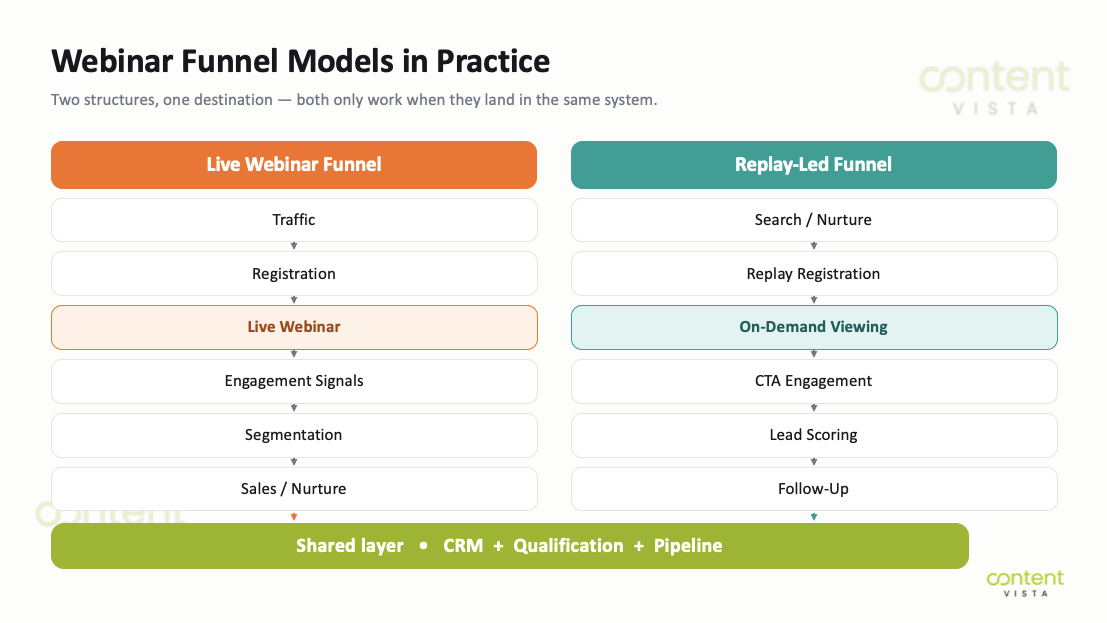
Common Mistakes in Webinar Lead Generation Funnels
- Treating the registration page as the funnel instead of the entry point into it
- Choosing the webinar topic for registration volume instead of audience fit
- Assuming registration equals commitment, and under-building the show-up path
- Running a passive webinar that produces no engagement signals worth scoring
- Sending one replay email to everyone, regardless of attendance or engagement
- Leaving engagement data trapped inside the webinar platform instead of the CRM
- Scoring leads on registration and attendance alone rather than behavior
- Launching a webinar with no named owner for follow-up
- Reporting on registrations and attendance instead of qualified opportunities
- Building a webinar funnel on top of unclear positioning, then blaming the webinar
FAQs About Webinar Lead Generation Funnels
What is a webinar lead generation funnel?
A webinar lead generation funnel is the connected system that moves prospects from webinar discovery and registration into engagement, nurture, qualification, CRM tracking and sales follow-up. It includes much more than the webinar page itself.
How do webinar funnels generate leads?
Webinar funnels generate leads by attracting relevant audiences around a specific topic, capturing registrations, creating engagement during the webinar and converting that engagement into follow-up workflows, nurture sequences or sales conversations.
What is the difference between a webinar page and a webinar funnel?
A webinar page is usually just the registration landing page.
A webinar funnel includes:
promotion
registration
reminders
attendance flow
live or replay engagement
segmentation
CRM routing
nurture
sales follow-up
pipeline tracking
The webinar itself is only one stage inside the funnel.
Should I run a live webinar or an on-demand webinar?
It depends on the buyer journey and operational goal.
Live webinars work well for:
interaction
Q&A
urgency
community engagement
real-time qualification
On-demand webinars work well for:
evergreen education
self-paced buyers
scalable lead generation
asynchronous research behavior
Some businesses use both together.
What is a good webinar show-up rate?
There is no universal benchmark because attendance rates vary based on:
audience quality
topic relevance
promotion source
reminder strategy
industry
webinar format
A stronger indicator is whether attendees engage meaningfully and move into qualified follow-up or pipeline stages afterward.
How do I improve webinar attendance?
Improving webinar attendance usually involves:
reducing registration friction
adding calendar links
improving reminder sequences
reinforcing the webinar outcome
using pre-event teasers or agenda previews
increasing perceived relevance before the event
Attendance problems often begin immediately after registration.
What should happen after the webinar ends?
After the webinar, attendees should enter segmented follow-up workflows based on behavior and engagement.
That may include:
replay delivery
nurture sequences
sales outreach
educational content
diagnostic offers
qualification workflows
CRM updates
The webinar should continue the funnel rather than ending with a replay email.
How should I follow up with no-shows?
No-shows should usually receive:
a fast replay path
a summary of key takeaways
contextual follow-up
a reason to re-engage
supporting resources where relevant
Missing the live session does not automatically indicate low intent.
What metrics matter most in a webinar funnel?
The most useful webinar funnel metrics usually include:
registration-page conversion
show-up rate
engagement depth
poll participation
Q&A activity
CTA clicks
replay engagement
attendee-to-qualified rate
sales handoff rate
opportunity creation
source-to-pipeline conversion
Registrations alone are not enough to measure webinar performance accurately.
When is a webinar funnel the wrong next move?
A webinar funnel may not be the right next move if:
the offer is unclear
the topic is too broad
there is no audience trust yet
promotion systems do not exist
CRM and follow-up systems are weak
no one owns sales follow-up
the webinar format is not appropriate for the topic
Sometimes the business needs positioning or funnel foundations first.
How do I connect webinar engagement to CRM and sales?
Webinar engagement should flow into:
lead scoring
segmentation
lifecycle stages
CRM activity tracking
nurture workflows
sales alerts
Useful engagement signals may include:
attendance duration
poll responses
questions asked
replay views
resource downloads
CTA clicks
The goal is turning webinar engagement into actionable sales and marketing intelligence.
Can webinars work for service businesses, consultants and not just SaaS?
Yes.
Webinar funnels can work for:
consultants
agencies
coaches
B2B service providers
education companies
healthcare businesses
advisory firms
SaaS companies
They are especially useful when:
buyer education matters
trust influences conversion
the sales process is consultative
the audience benefits from demonstrations, frameworks or strategic discussion
The structure of the funnel may change, but the core system principles remain similar.
Conclusion: Fix the Funnel Before You Run Another Webinar
A webinar by itself is not a lead generation system.
It is one moment inside a larger registration-to-pipeline process.
That is the core shift many businesses miss.
When webinar funnels underperform, the problem is often not:
the webinar platform
the slide deck
the speaker
or even the attendance number
The real issue is usually somewhere inside the surrounding system.
The leak may exist in:
the promise
the registration experience
the show-up path
engagement design
follow-up segmentation
CRM routing
sales ownership
nurture infrastructure
That is why simply "running another webinar" rarely fixes the underlying problem. It is a system problem, not a lead problem.
The businesses generating consistent webinar pipeline are usually not the ones producing the most webinars. They are the ones connecting webinar engagement to qualification, nurture, CRM visibility and sales workflows more effectively.
A strong webinar funnel should move people intentionally from:
registration
to engagement
to qualification
to follow-up
to pipeline movement
That requires operational alignment across marketing, automation, CRM systems and sales follow-through.
In other words: the webinar is not the system. The webinar feeds the system.
This is the same reason webinar funnels work best when connected to a broader lead generation system instead of functioning like isolated campaigns.
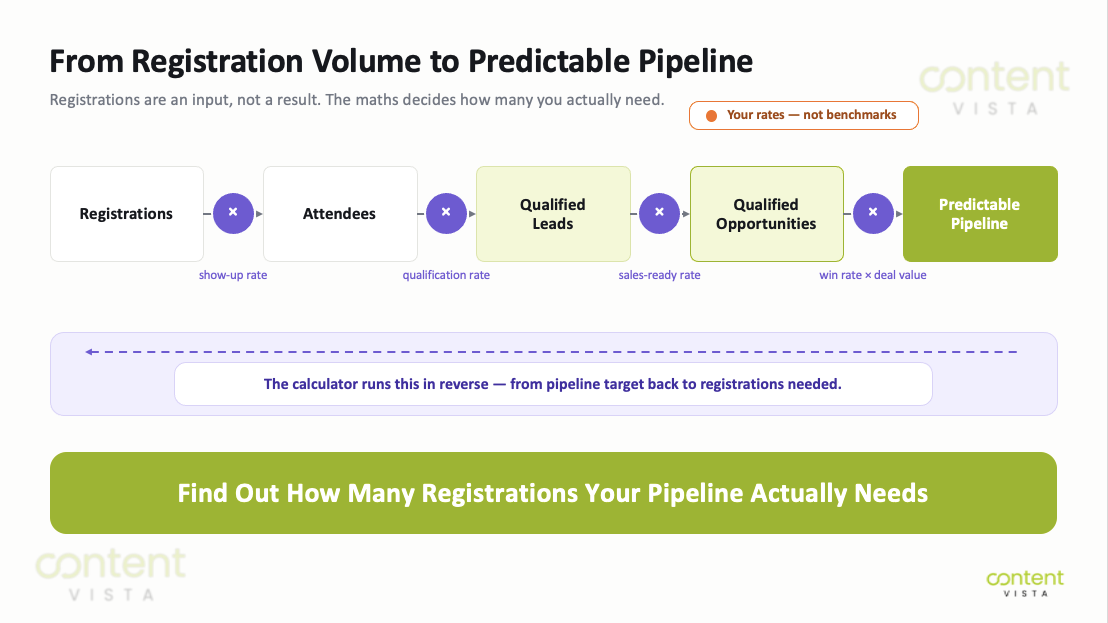
The next step is not rebuilding everything blindly.
The next step is knowing what the maths actually requires.
Start with the pipeline math. Use the Lead Generation Capacity Calculator to work out how many qualified registrations your webinar funnel actually needs to hit your pipeline target.
Then find the leak. Use the Website Conversion Leak Audit to see where your webinar funnel is losing leads between registration and pipeline.