Quick Summary
- A good lead nurturing sequence should move a lead from initial interest to genuine sales readiness: not just keep sending follow-up emails indefinitely.
- The strongest lead nurturing sequence examples are built around trigger, buyer stage, lead source, behavioural signals and qualification intent.
- A webinar no-show should not receive the same sequence as a high-intent demo request or a cold outbound reply.
Why Most Lead Nurturing Sequences Underperform
Here’s the problem: most nurture sequences are not too short. They are too generic.
A lead downloads a guide, books a webinar, replies to a cold email, requests a demo or goes silent after a proposal and many businesses still push all of them into the same automated sequence.
Same emails. Same timing. Same CTA. Same assumptions.
That is usually where lead nurturing starts breaking down.
The issue is rarely “we need more emails.” The real issue is weak sequence logic.
A person who downloaded an educational resource is in a very different state from someone who already requested pricing. A webinar no-show needs re-engagement. A stalled proposal needs objection handling. A cold outbound reply often needs trust and context before any sales push happens.
Those are different buying situations. Yet most nurture systems treat them as identical.
That is why many lead nurturing sequences generate activity but not progression.
The goal of nurturing is not simply to “stay top of mind” or keep leads warm. A good sequence should move someone from one stage of readiness to the next.
That requires a trigger-to-sales-readiness system.
In practice, that means understanding:
where the lead came from
what action triggered the sequence
how aware the lead already is
what level of commercial intent exists
what the next conversion step should be
Most teams automate before they define any of that.
They build workflows before clarifying qualification rules. They set up email cadences before deciding what signals actually indicate buying intent. They connect tools before defining progression logic.
The result is usually predictable:
low engagement
poor lead-to-opportunity conversion
confused CRM stages
frustrated sales teams
sequences that feel automated instead of relevant
That is also why effective nurturing is tightly connected to a larger lead generation system, not isolated email automation. When nurture keeps underperforming, it is usually a system problem, not a lead problem.
In the sections ahead, we will break down seven lead nurturing sequence examples, grouped into six trigger scenarios, based on trigger, funnel stage and buyer intent so you can build sequences that actually help pipeline progression instead of simply increasing email volume.
What Is a Lead Nurturing Sequence?
A lead nurturing sequence is not just an automated follow-up campaign.
It is a progression system designed to move a lead from one level of awareness, trust, or buying intent to the next.
That distinction matters because many businesses confuse “sending emails consistently” with actual nurturing.
A lead may open every email you send and still never become sales-ready.
Why?
Because progression did not happen.
The messaging may not match the lead’s intent. The sequence may have arrived too early, too late, or without enough context. Or the system may have focused on activity instead of qualification.
In short: nurture is not just staying in touch. It is guided progression.
A lead nurturing sequence is a structured series of follow-up messages and actions designed to move a lead from initial interest toward a more qualified next step. Strong nurture sequences are based on trigger, buyer stage, fit, behaviour, and intent — not just a fixed set of generic emails.
That “series of actions” can include much more than email.
A modern nurturing system may involve:
automated email sequences
CRM tasks
sales follow-up reminders
LinkedIn touchpoints
retargeting ads
webinar reminders
lead scoring updates
content recommendations
qualification workflows
pipeline stage changes
For example, someone who downloads an educational guide may initially enter an email-led nurture flow. But if they repeatedly visit pricing pages, reply to outreach or book a strategy session, the system should evolve beyond automated content delivery and move toward sales qualification.
That is where many nurturing systems break down.
They continue sending awareness-stage content long after the lead has already shown buying intent.
Or worse, they escalate too early before trust or problem-awareness exists.
That is why nurture sequences should be based on context, not just time.
A “Day 1 → Day 3 → Day 7” sequence by itself is not a strategy. Timing only matters when it is connected to:
trigger source
funnel stage
lead fit
behavioural signals
sales readiness
next-step intent
This is also why lead nurturing works best inside a larger lead generation system instead of functioning as isolated email automation.
The most effective nurture systems create movement:
from curiosity to consideration
from interest to qualification
from engagement to pipeline
from marketing ownership to sales readiness
That is the real job of nurturing.
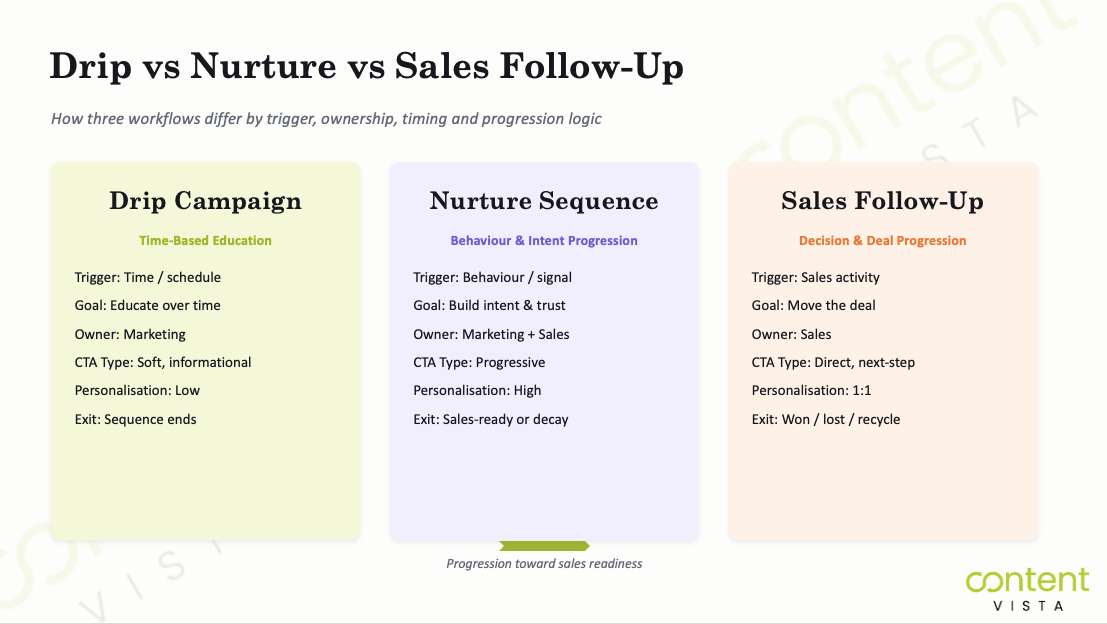
Drip Campaign vs Nurture Sequence vs Sales Follow-Up
One reason lead nurturing becomes confusing is that teams often use three different terms interchangeably:
drip campaign
nurture sequence
sales follow-up
But they are not the same thing.
Yes, they can overlap. A lead may move from a marketing drip into a nurture workflow and eventually into direct sales follow-up. But each system serves a different purpose and should operate with different logic.
The mistake is simple: teams call everything nurture, then wonder why the sequence does not move anyone forward.
A time-based onboarding series is not automatically a nurturing system.
And a sales rep manually following up on a proposal is not the same thing as an automated lead education flow.
The differences matter because each system should use different:
triggers
messaging
timing
ownership
qualification rules
exit conditions
CTAs
For example, a newsletter subscriber may only need educational content and occasional engagement prompts. But a lead who requested pricing may need objection handling, urgency clarification, and direct sales coordination.
Treating both people the same usually creates friction:
low reply rates
poor qualification
disconnected CRM stages
sales complaints about lead quality
sequences that feel irrelevant
A strong revenue system separates these workflows clearly.
| Type | Trigger | Main Goal | Typical Owner | CTA Style |
|---|---|---|---|---|
| Drip campaign | Time-based signup, download, or subscription | Educate and stay visible | Marketing | Read, download, watch, learn more |
| Nurture sequence | Behaviour, stage, source, fit, or intent signal | Move the lead toward a more qualified next step | Marketing, revenue team, or shared owner | Compare, self-identify, register, reply, book, request audit |
| Sales follow-up | Sales-ready action, booked call, proposal, high-intent response | Progress the conversation or deal | Sales or founder/operator | Reply, confirm, schedule, decide, approve next step |
The key distinction is progression logic.
A drip campaign usually runs on time.
For example:
Day 1 welcome email
Day 3 educational article
Day 7 case study
Day 14 webinar invite
That can work for early-stage awareness. But it does not automatically adapt to buyer behaviour.
A nurture sequence should.
If a lead suddenly starts visiting pricing pages, replying to emails, or repeatedly engaging with commercial content, the workflow should evolve. The messaging, CTA, and ownership may need to change.
That is why nurture sequences are better understood as behaviour-responsive systems rather than static email timelines.
Sales follow-up becomes relevant when intent is already visible.
At that point, the goal is no longer general education. The goal becomes:
qualification
objection handling
stakeholder alignment
commercial clarity
moving toward a decision
That usually requires more human involvement.
The strongest nurturing systems do not treat automation and sales as separate worlds. They connect marketing activity, behavioural signals, CRM visibility, and sales readiness into one progression system.
This is also why “more automation” does not automatically improve nurturing.
If the trigger logic is weak, the system simply automates irrelevance faster.
Why Generic Nurture Advice Is Weaker Now
A lot of lead nurturing advice still assumes the buyer is starting from zero.
That assumption is becoming less reliable.
Today, many leads arrive already informed. In HubSpot's 2026 State of Marketing data, nearly 70% of marketers said leads now reach them later in the buying process because they have done more AI-assisted research, and 37% said leads are more informed thanks to AI. They may have spent hours researching the problem before they ever entered your funnel. They may have compared vendors, watched YouTube breakdowns, asked AI tools for recommendations, read Reddit discussions, reviewed pricing models or explored implementation concerns independently.
Think about it this way: your lead may be new to your brand, but they may not be new to the problem.
That changes how nurturing should work.
Older nurture models often followed a slow educational arc:
introduce the problem
explain the basics
provide awareness content
slowly build toward commercial discussion
That still works for some early-stage audiences.
But it is not universally effective anymore.
A mid-funnel lead who already understands the category may not want another generic “What is X?” article sequence. They may be looking for:
implementation clarity
risk reduction
proof
pricing logic
comparison guidance
stakeholder buy-in
operational confidence
integration answers
timing validation
If the sequence ignores that context, the nurturing experience starts feeling disconnected from the buyer’s actual intent.
This is especially important in B2B and service-led sales environments where different triggers often signal very different readiness levels.
For example:
someone downloading a checklist may still be exploring the problem
someone attending a webinar may already be evaluating approaches
someone clicking a pricing page may be assessing commercial fit
someone replying to cold outreach may be validating relevance
someone stalling after a proposal may be dealing with objections, timing or internal approvals
Those are not equivalent situations.
Yet many nurture systems still send nearly identical educational sequences to all of them.
That is where generic nurture advice becomes weaker.
The issue is not that education stopped mattering. Creating that awareness in the first place is what demand generation is for. The issue is that timing, intent and progression matter more now.
A lead who is already commercially aware often needs:
clarity faster
friction removal
better qualification
stronger context
more relevant next steps
Not necessarily “more content.”
The strongest nurture systems do not assume every lead starts at the awareness stage. They identify where the lead actually is and adjust messaging, timing and progression logic accordingly.
This does not mean every buyer is suddenly “ready to buy.”
That would be an oversimplification.
Some leads still need substantial education and trust-building. Others may move very slowly through evaluation. And in many industries, buying cycles remain long and multi-stakeholder-driven.
The point is more strategic than absolute: modern nurture systems work better when they respond to buyer context instead of forcing every lead through the same educational timeline.
That is why trigger-based nurturing matters so much.
The trigger itself often reveals:
awareness level
urgency
relationship temperature
buying intent
likely objections
next-step readiness
A lead who repeatedly engages with solution-focused content should not remain trapped in a beginner education sequence for three more weeks simply because the automation says “Day 14 email.”
Likewise, a low-intent subscriber should not immediately receive aggressive sales CTAs before trust exists.
Strong nurturing adapts to progression signals.
Weak nurturing follows a fixed calendar regardless of behaviour.
That difference is becoming increasingly important as buyers become more self-educated before entering the funnel.
The BRIDGE Lead Nurture Framework
Most teams start with the wrong question.
They ask: “What emails should we send?”
But that usually comes too early.
The better questions are:
What triggered this lead?
What stage are they actually in?
How qualified are they?
What signals are they showing?
What should happen next?
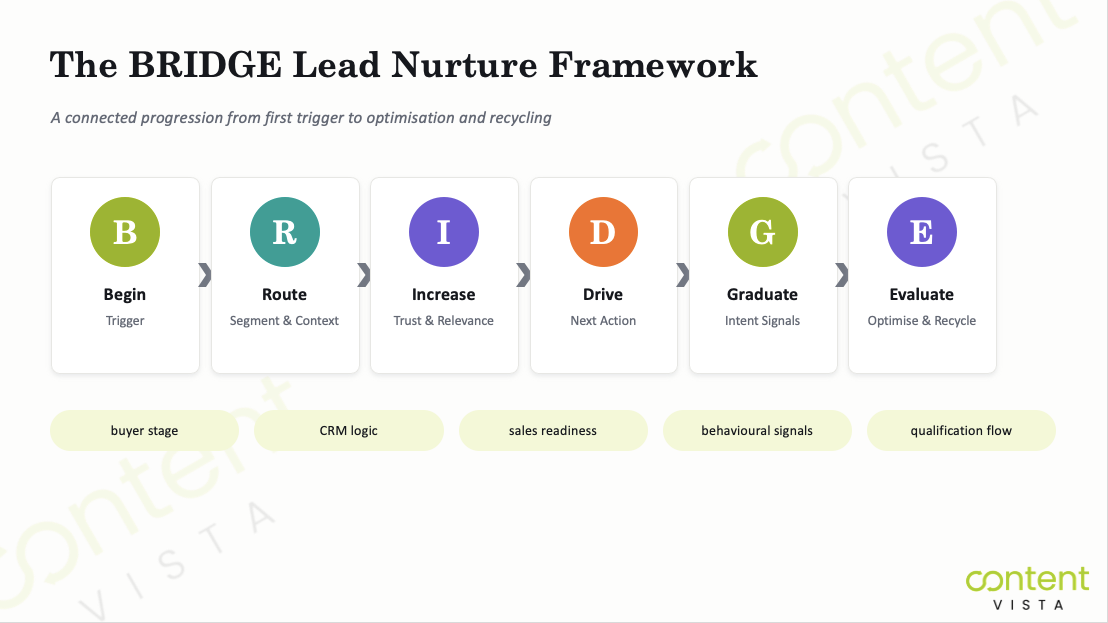
That is the purpose of the BRIDGE Lead Nurture Framework.
It is a design sequence for one layer of your funnel: the nurture flows that sit between a lead entering and a lead becoming sales-ready. It does not replace the wider lead generation system around it. It just makes sure this layer is built around progression logic instead of generic automation timelines.
Let’s make this practical. Before you write the sequence, run it through BRIDGE.
BRIDGE stands for:
B - Begin with the trigger
R - Route by source, stage and fit
I - Increase trust with education, proof and relevance
D - Drive one next action per email
G - Graduate on intent signals
E - Evaluate, decay and recycle
The framework forces a shift from “email-first thinking” to system-first thinking.
Instead of building one long automation for everyone, you start by understanding:
why the lead entered the funnel
what behaviour occurred
how commercially aware the lead may already be
what level of progression is appropriate
For example, a webinar attendee and a pricing-page visitor may both enter your CRM on the same day, but they should not automatically receive the same sequence.
One may need education and trust-building.
The other may need qualification and sales coordination.
BRIDGE helps separate those paths clearly.
| Stage | What It Means | Main Goal | Main Risk If Ignored |
|---|---|---|---|
| Begin | Start with the lead trigger, not the email template | Understand what happened and why the lead entered the sequence | Every lead receives the same generic sequence |
| Route | Segment by source, stage, fit and behaviour | Match nurture to context | Low-intent and high-intent leads get treated the same |
| Increase | Build trust with education, proof and relevance | Help the lead feel understood and safer to move forward | The sequence feels robotic or premature |
| Drive | Give each email one clear next action | Reduce confusion and create progression | Emails become newsletters with no purpose |
| Graduate | Move leads based on intent signals | Route sales-ready leads at the right time | Hot leads stay trapped in nurture |
| Evaluate | Measure, decay, recycle and improve | Keep the system clean and useful | Old scores, stale leads and weak data distort decisions |
The first stage - Begin - is where most nurture systems fail.
Teams often start with a template instead of a trigger.
But the trigger is what gives the sequence meaning.
Did the lead:
download a checklist?
attend a webinar?
request a proposal?
reply to outbound outreach?
revisit pricing pages?
disappear after a sales call?
Those are fundamentally different situations.
The second stage - Route - prevents every lead from entering the same automation path.
Routing logic should consider:
acquisition source
buyer stage
ICP fit
behavioural engagement
commercial intent
relationship temperature
Without routing, nurture becomes generic very quickly.
The Increase stage focuses on trust.
Not endless content.
Not random “checking in” emails.
Trust increases when the messaging feels relevant to the lead’s actual situation. That may involve:
educational clarity
proof
implementation guidance
objection handling
risk reduction
operational transparency
The Drive stage is where many sequences lose momentum.
A surprising number of nurture emails contain no meaningful next step. They educate continuously without creating progression.
Each touchpoint should guide the lead toward one logical action:
reply
register
compare
self-identify
request an audit
schedule a call
review a resource
confirm fit
Otherwise, the sequence becomes passive content distribution instead of pipeline movement.
The Graduate stage is critical because not every lead should stay in nurture indefinitely.
Strong systems monitor intent signals:
repeated high-intent page visits
reply behaviour
booking activity
proposal engagement
webinar attendance
lead score changes
CRM activity
Those signals should trigger escalation, routing or sales involvement.
Hot leads should not remain stuck inside a generic awareness workflow simply because the automation sequence has not finished yet.
Finally, Evaluate keeps the system healthy over time.
This includes:
lead decay rules
stale lead recycling
CRM cleanup
score adjustments
reporting reviews
sequence optimisation
conversion analysis
BRIDGE stops teams from asking “What emails should we send?” before asking “What happened, who is this lead and what should happen next?”
That shift sounds simple, but it changes how nurture systems are designed entirely.
Instead of building campaigns around content calendars, you build them around buyer progression.
And that usually leads to far stronger lead-to-opportunity movement.
If your nurture sequence problem is really a maturity problem, diagnose the gaps before you add more automation.
Marketing Growth Maturity AssessmentHow to Choose the Right Nurture Sequence First
Most businesses do not need seven nurture sequences immediately.
They need the one sequence that fixes the biggest progression gap in their funnel.
That distinction matters because many teams overbuild too early. They create elaborate automation systems before identifying where leads are actually getting stuck.
Here’s where most teams go wrong: they build the sequence they saw online, not the sequence their funnel actually needs.
A lead magnet nurture sequence solves a very different problem from a proposal follow-up sequence.
Likewise:
a webinar no-show workflow is about recovering attention
a stalled proposal sequence is about reducing friction and helping a decision happen
a dormant-lead recycle sequence is about re-qualification
a cold outreach nurture flow is about continuing relevance without becoming pushy
Different progression problems require different systems.
That is why choosing the right nurture sequence should start with diagnosis, not templates.
The most useful starting questions are:
What trigger created this lead?
What stage is this person likely in?
What behaviour are they showing?
Where is progression currently breaking?
What operational capacity does the team actually have?
Which leads are closest to revenue impact?
For example, if your business generates many webinar registrations but very few consultations afterward, your biggest problem may not be lead generation at all. It may be post-event progression.
If proposals frequently stall after being sent, adding another awareness-stage drip campaign probably will not help much.
And if cold outreach generates replies but conversations fade quickly, the issue may be nurture continuity rather than outbound volume.
This is why sequence selection should be tied to:
buyer stage
sales readiness
trigger source
lead quality
funnel bottlenecks
operational ownership
Not simply “best practices.”
Lead source belongs on that list too. The way you nurture an inbound lead and the way you nurture an outbound one should not look identical, because the two arrive with completely different levels of permission and context. If that distinction is fuzzy in your funnel, start with inbound versus outbound lead generation before you design the sequence.
A small team with limited sales capacity often benefits from starting with one or two high-leverage sequences instead of trying to automate the entire funnel at once.
In many cases, the highest-impact first sequence is the one closest to conversion:
proposal follow-up
demo no-show recovery
sales re-engagement
high-intent lead qualification
Because those sequences directly affect pipeline movement.
Meanwhile, businesses with large inbound top-of-funnel volume may benefit more from:
lead magnet nurturing
webinar progression
lead scoring workflows
early-stage qualification paths
The key is matching the sequence to the actual progression problem.
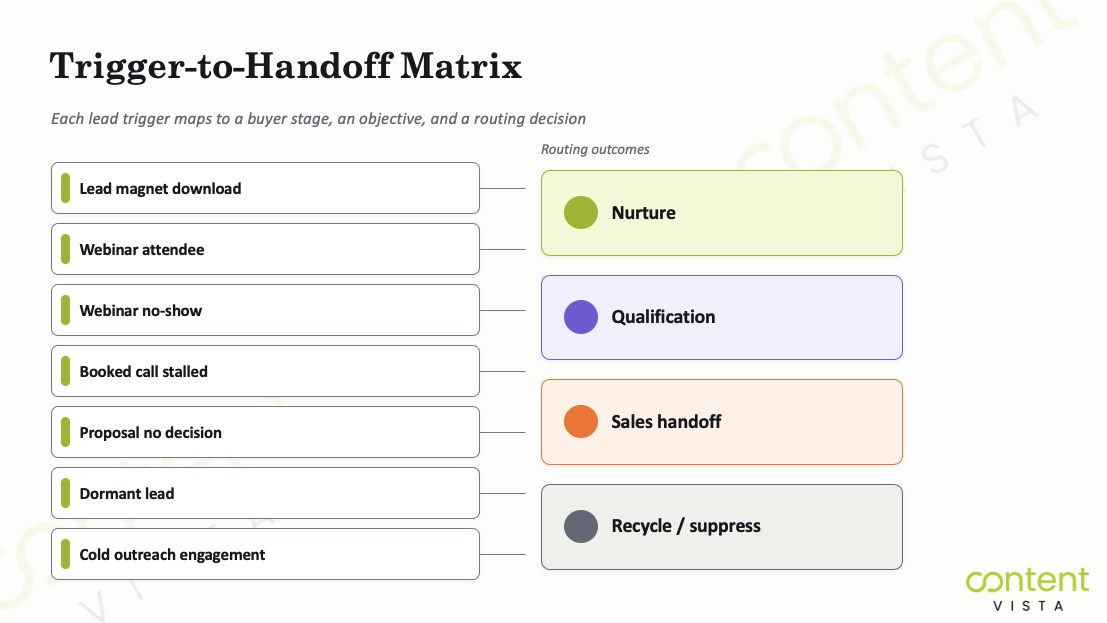
| Trigger | Lead Stage | Sequence Goal | Best CTA | Handoff / Exit Rule |
|---|---|---|---|---|
| Lead magnet download | Early to mid-stage | Educate, qualify and identify intent | Read next asset, answer question, book audit, view case study | Move to sales if repeated high-intent actions occur |
| Webinar attendee | Mid-stage | Convert engagement into next step | Watch replay, download resource, request audit, book consult | Route engaged attendees or CTA clickers to sales |
| Webinar no-show | Early to mid-stage | Recover interest and drive replay engagement | Watch replay, answer one question, download notes | Recycle if no replay or click activity |
| Booked call did not progress | Mid to late-stage | Rebuild momentum and clarify next step | Reply, reschedule, review case study, answer objection | Sales owns follow-up; recycle if no response after defined attempts |
| Proposal sent / no decision | Late-stage | Remove friction and support decision-making | Review proof, discuss concern, confirm next step | Sales owns; exit to long-term nurture if no decision |
| Dormant but once-engaged lead | Unknown / recycled | Re-qualify interest | Choose topic, reply, use tool, view new resource | Reactivate if engaged; suppress or recycle if inactive |
| Cold email or LinkedIn engagement | Early to mid-stage | Continue relevance without over-following-up | View resource, reply, compare options, use diagnostic | Route based on reply or repeated engagement |
Notice that the “best CTA” changes depending on the trigger.
That is intentional.
A lead who downloaded an educational resource may not be ready for a sales conversation yet. But a proposal-stage lead probably does not need another introductory guide.
Strong nurture systems adapt the next action to the lead’s likely context.
They also define clear handoff rules.
That is one of the biggest differences between mature nurturing systems and generic automation.
A mature system knows:
when marketing owns the lead
when sales should step in
when a lead should recycle
when the sequence should stop
when intent is strong enough to escalate
Without those rules, leads often become trapped in endless nurture loops that never create pipeline progression.
The best first nurture sequence is usually the one connected to your biggest progression leak: not the one with the most automation complexity.
As we move into the sequence examples next, use this matrix as your decision framework.
The goal is not to implement every workflow immediately.
The goal is to identify which trigger, stage and progression problem matters most for your funnel right now.
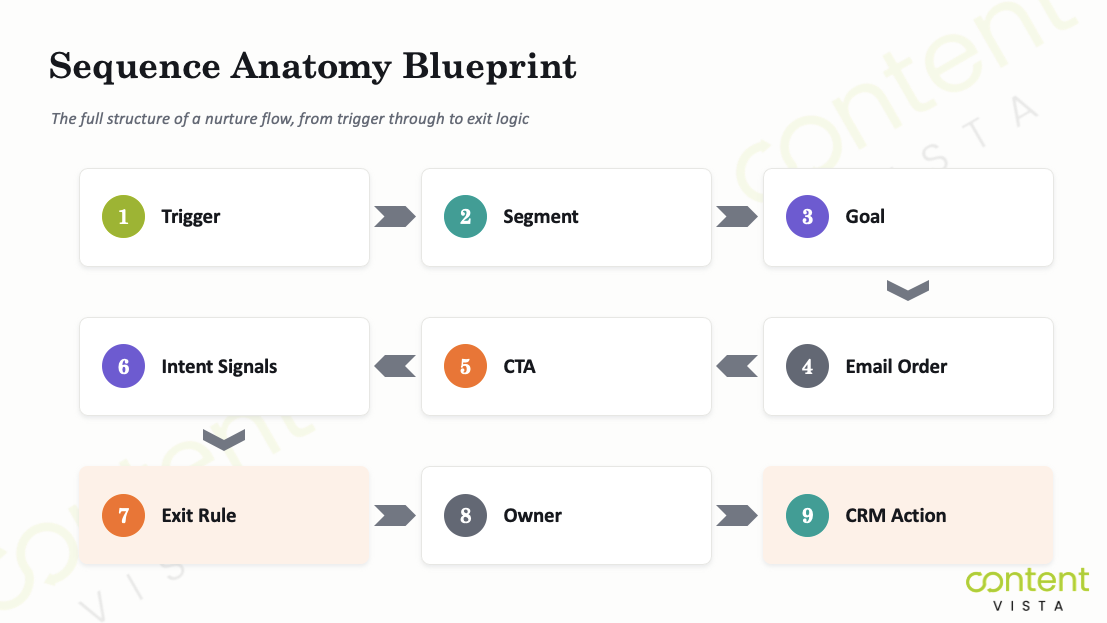
Sequence Anatomy: What Every Nurture Flow Needs
A good nurture sequence is not just a list of emails. It is a path with rules.
That is an important distinction.
Many nurture systems fail because they are built like content calendars instead of progression systems. The emails may look polished, but the workflow underneath has no real logic:
no clear trigger
no segmentation
no progression goal
no handoff conditions
no ownership rules
no exit logic
As a result, leads continue receiving emails whether they are highly engaged, completely inactive, already sales-ready or no longer relevant.
That is not nurturing.
That is automated broadcasting.
Strong nurture systems work differently. Every sequence should define:
why the lead entered
what the lead likely needs next
what progression should look like
what signals matter
when the sequence should stop
who owns the next step
This is what separates an operational nurture system from a random email series.
The structure below is the blueprint we will use throughout the rest of this article for all seven sequence examples.
| Component | What It Defines | Why It Matters | Example |
|---|---|---|---|
| Trigger | What caused the sequence to start | Prevents generic nurture | Downloaded guide, attended webinar, proposal sent |
| Segment | Who the lead is and where they came from | Shapes relevance and CTA strength | Consultant, founder, agency, high-intent visitor |
| Goal | What the sequence should move them toward | Keeps emails purposeful | Book consult, view case study, answer question |
| Email order | What each email does in sequence | Creates progression | Deliver value → build proof → address objection → ask |
| CTA | The action each email asks for | Prevents vague emails | Reply, read, compare, book, use tool |
| Exit rule | When the lead leaves this sequence | Stops over-nurturing | Sales-ready, inactive, recycled, converted |
| Owner | Who acts next | Prevents handoff confusion | Marketing, sales, founder, CRM automation |
The trigger is the foundation of the sequence.
Without a clear trigger, the workflow becomes generic immediately.
A lead who attended a webinar is not behaving the same way as someone who downloaded a checklist or requested pricing. The trigger reveals context, awareness, urgency and probable intent.
The segment then determines how aggressively or softly the sequence should move.
For example:
a founder evaluating agencies may need proof and strategic clarity
a junior marketer may need educational confidence
a high-fit inbound lead may need faster qualification
a cold outbound responder may need trust-building first
That is why segmentation affects not only messaging, but also CTA strength, cadence and handoff timing.
The sequence goal is equally important.
A surprising number of nurture workflows have no clearly defined outcome beyond “keep engagement high.”
But effective nurturing should move the lead toward a measurable next step:
reply
qualification
consultation
sales conversation
product exploration
stakeholder alignment
reactivation
pipeline progression
Without that goal, sequences drift into passive content delivery.
Email order creates the progression path.
A strong sequence usually follows a logical movement such as:
1. establish relevance 2. provide clarity or value 3. reduce uncertainty 4. build proof 5. encourage a decision or next action
The exact order changes depending on trigger and buyer stage, but the progression logic matters more than the email count itself.
The CTA should also match the lead’s likely readiness level.
That is where many nurture systems become misaligned.
For example:
an early-stage lead may only need a low-friction “read this next” CTA
a high-intent lead may need a direct booking or reply CTA
a stalled proposal lead may need objection-resolution prompts instead
The stronger the intent signal, the stronger the CTA can usually become.
Exit rules are one of the most overlooked parts of nurture design.
Every sequence should define:
when a lead becomes sales-ready
when they should recycle
when they should suppress
when ownership changes
when nurturing should stop entirely
Without exit logic, leads often become trapped inside automation loops long after the workflow stopped being relevant.
Finally, ownership prevents operational confusion.
Many businesses struggle because marketing thinks sales is following up while sales assumes the lead is still being nurtured automatically.
Clear ownership rules reduce that gap.
A nurture sequence becomes far more effective when every stage has defined triggers, progression logic, ownership and exit conditions.
As we move into the sequence examples next, this anatomy blueprint will act as the structure behind each workflow.
The goal is not just to show emails.
The goal is to show how a complete progression system actually works.
Example 1 - Lead Magnet Follow-Up Sequence
When to use this sequence
This sequence works when someone downloads:
a guide
a checklist
a calculator result
an audit
a worksheet
a template
another educational resource
At this stage, the lead is usually interested but not necessarily sales-ready.
That distinction matters.
The first mistake is treating a download like a buying signal. It may be interest. It is not always intent.
Someone may download a resource because:
they are researching a problem
they are comparing approaches
they are validating ideas internally
they are casually exploring
they want tactical guidance
they are evaluating providers
they are preparing for future implementation
Those are very different situations.
That is why the purpose of a lead magnet follow-up sequence is not aggressive selling.
The real goal is to:
educate intelligently
increase relevance
identify stronger intent
surface qualified opportunities
separate active evaluators from passive subscribers
This sequence also works best when connected to a strong landing-page and asset strategy instead of isolated email automation. In practice that means pairing the sequence with proper lead magnet and asset creation and a landing page built to convert, which we cover in conversion rate optimization for lead funnels.
Suggested sequence flow
The first email should simply deliver the asset and set expectations clearly.
This sounds obvious, but many teams immediately overload the lead with unrelated promotions, multiple CTAs or premature sales messaging.
The first touchpoint should reduce friction:
confirm delivery
reinforce relevance
explain what the resource helps solve
preview what comes next
The second email should expand on the problem behind the asset.
For example, if the lead downloaded a conversion audit checklist, the follow-up should help them understand:
where conversion problems typically occur
why those problems happen
what weak systems usually look like
how businesses misdiagnose the issue
This moves the lead from resource consumption toward problem awareness.
The third email should introduce a practical example, implementation insight or common mistake.
This is where many nurture sequences become more effective because the messaging starts feeling operational instead of generic.
Instead of broad educational content, the sequence becomes more situational:
what usually breaks
what gets overlooked
what creates hidden friction
what stronger implementation looks like
The fourth email should introduce proof or decision-support content.
That does not always mean formal case studies.
It may involve:
comparison logic
before-and-after workflows
strategic observations
process examples
implementation frameworks
operational trade-offs
The goal here is to reduce uncertainty.
The fifth email introduces a stronger next step:
diagnostic tool
audit
consultation
qualification form
implementation discussion
next-stage resource
At this point, the sequence should start distinguishing between:
engaged evaluators
lightly interested subscribers
inactive leads
The sixth email handles routing.
Highly engaged leads may move into:
sales qualification
consultation workflows
proposal discussions
deeper evaluation sequences
Lower-engagement leads may recycle into:
long-term nurture
newsletter education
topic-based segmentation
lower-frequency touchpoints
| Purpose | CTA | Exit / Routing Signal | |
|---|---|---|---|
| Email 1 | Deliver the asset and confirm what they will learn | Access the resource | Click confirms delivery engagement |
| Email 2 | Explain the problem the asset helps diagnose | Read related guide or answer one question | Click or reply shows problem interest |
| Email 3 | Show a common mistake or practical example | View example, checklist or case insight | High-intent click increases score |
| Email 4 | Add proof or decision support | View case study or comparison | Case-study click signals evaluation |
| Email 5 | Offer a next diagnostic step | Use tool, request audit or book consult | Tool use or booking routes to sales |
| Email 6 | Recycle or continue nurture based on activity | Choose topic or stay subscribed | Inactive leads enter long-term nurture |
Best CTAs and exit rules
One of the biggest mistakes in lead magnet nurturing is using sales CTAs too aggressively too early.
A low-intent lead who downloaded a checklist yesterday may not be ready to “Book a Strategy Call Now.”
That creates friction instead of progression.
The strongest CTAs usually match the lead’s likely readiness level:
read the next guide
compare approaches
answer one question
use a calculator
review an example
explore a framework
request an audit
reply with a challenge
As engagement increases, the CTA strength can increase too.
The exit rules matter just as much.
A mature nurture system should define:
when a lead becomes sales-ready
what engagement threshold triggers escalation
when the sequence stops
when long-term nurture begins
when inactive leads suppress entirely
Without those rules, every lead keeps receiving the same emails regardless of behaviour.
That usually reduces relevance over time.
The best lead magnet nurture sequences are designed to identify intent gradually: not force conversion immediately.
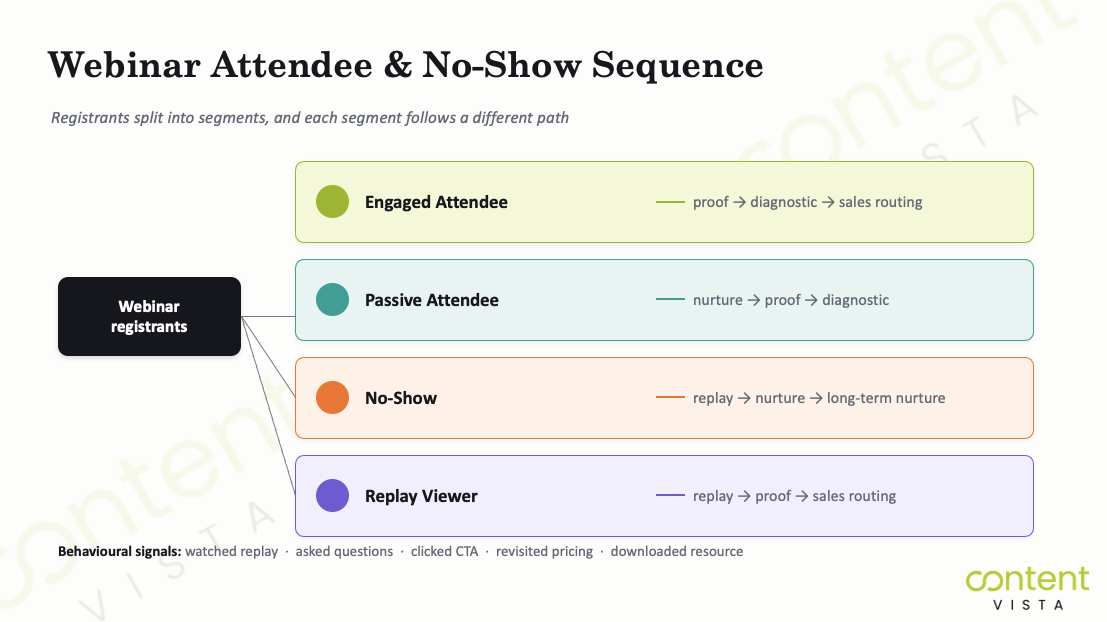
Example 2 - Webinar Attendee and No-Show Sequence
Webinar nurture sequences are often under-segmented.
A business runs a webinar, exports the registration list and sends the same replay email to everyone.
That is usually a mistake.
The biggest post-webinar mistake is sending the same email to the person who asked three questions and the person who never showed up.
Those are not the same leads.
One may already be evaluating solutions seriously. The other may barely remember registering.
That is why webinar nurture works best when follow-up adapts to:
attendance behaviour
engagement level
replay activity
CTA clicks
sales readiness signals
A webinar is not just a content event.
It is an intent signal.
And different webinar behaviours often reveal different levels of buyer progression.
This is especially important if you are running webinar and event lead funnels, building structured webinar and lead capture funnels, or connecting those funnels to marketing automation and CRM systems.
Attendee follow-up
An engaged attendee is often one of the strongest mid-funnel signals in a nurture system.
Especially if the person:
stayed until the end
clicked webinar CTAs
asked questions
interacted in chat
revisited resources afterward
watched product or implementation sections closely
Those leads usually need progression support, not more generic awareness content.
The first follow-up should reference the webinar directly:
recap a key insight
reinforce the problem discussed
acknowledge engagement if possible
connect the topic to a practical next step
The second follow-up should introduce proof, decision-support material or implementation clarity.
This is where many webinar sequences become too passive.
Instead of helping the lead move forward, they simply continue broadcasting educational content indefinitely.
But an engaged attendee often needs:
comparison guidance
implementation examples
audit frameworks
qualification conversations
operational clarity
objection handling
That is why stronger CTAs become appropriate:
request an audit
use a diagnostic tool
schedule a consultation
review a framework
discuss implementation
The goal is progression.
Not just replay consumption.
No-show follow-up
No-shows require a completely different approach.
A person who did not attend may still be interested, but the absence itself suggests lower immediate engagement.
That means the sequence should focus first on reactivation.
The replay email should not simply say: “Here’s the recording.”
It should explain why the webinar is still worth watching:
what insight they missed
what problem was covered
what framework was explained
what practical takeaway exists
A short replay summary often works better than a generic replay link alone.
The second follow-up can introduce:
key takeaways
downloadable notes
a condensed framework
a useful supporting asset
a practical implementation insight
The goal is to recover attention without sounding overly promotional.
If replay engagement occurs later, the lead can move into stronger nurture or qualification logic.
If not, the lead may continue into lower-frequency educational nurture instead.
Replay viewer follow-up
Replay viewers are often overlooked operationally.
That is a missed opportunity.
A replay viewer who watches:
pricing discussions
implementation sections
ROI explanations
framework breakdowns
service comparisons
Q&A segments
may actually demonstrate stronger intent than some live attendees.
But many systems fail to track or route those signals properly.
That is why replay behaviour should connect directly into:
lead scoring
CRM visibility
nurture branching
sales routing
CTA escalation
A replay viewer who repeatedly engages with commercial sections should not continue receiving only awareness-stage webinar reminders.
The follow-up should adapt.
This is where nurture becomes behaviour-responsive instead of time-based.
Sales-ready attendee follow-up
Some webinar attendees become sales-ready immediately.
That does not always mean they book a call during the webinar itself.
The intent may appear through:
repeated CTA clicks
high engagement duration
post-webinar replies
implementation questions
resource downloads
pricing-page visits
multiple stakeholder visits
Those signals should trigger escalation.
At that point, the workflow often shifts from nurture to coordinated sales progression.
That may include:
founder follow-up
sales outreach
qualification calls
implementation discussions
proposal workflows
account-based follow-up
Strong webinar nurture systems are designed to identify these moments quickly.
Weak systems keep every attendee trapped inside the same generic replay flow regardless of intent.
| Segment | First Follow-Up | Second Follow-Up | Best CTA | Exit / Routing Signal |
|---|---|---|---|---|
| Engaged attendee | Recap key insight and reference engagement | Share proof or decision resource | Request audit, book consult, use diagnostic | CTA click or reply routes to sales |
| Passive attendee | Send recap and useful resource | Send related guide or objection-handling content | Read more, download, compare | Continued engagement increases score |
| No-show | Send replay with short reason to watch | Send key takeaway or missed-resource email | Watch replay, download notes | Replay engagement moves to nurture or sales |
| Replay viewer | Follow up based on watched topic or CTA clicked | Offer next diagnostic step | Tool, audit, reply, consult | High engagement routes to sales |
The strongest webinar nurture systems do not optimise for replay views alone. They optimise for progression signals after the webinar.
Example 3 - Booked Call or Demo That Did Not Progress
This sequence is for leads that already showed meaningful intent.
They booked a call. They attended a demo. They had a qualified conversation. Something real happened.
And then momentum slowed down.
That is an important distinction because these leads usually do not need more top-of-funnel education. They already crossed an intent threshold.
The problem is often:
unclear next steps
unresolved objections
internal delays
timing shifts
stakeholder friction
competing priorities
loss of urgency
weak follow-up structure
Silence after a call does not always mean no. Sometimes it means the next step was not clear enough.
This is where structured post-call nurturing becomes valuable.
Not aggressive chasing.
Not endless “just checking in” emails.
But thoughtful follow-up that:
reinforces relevance
reduces uncertainty
keeps momentum alive
makes replying easier
clarifies the decision path
This type of sequence often works well alongside sales enablement and lead nurturing, and inside broader lead generation work.
When to use this sequence
This workflow is useful when:
someone booked but did not attend
a discovery call happened but stalled afterward
a demo ended without a clear next step
a proposal conversation paused
a qualified lead went quiet
the sales team needs structured follow-up without sounding repetitive
The key difference between this sequence and early-stage nurture is context.
You already know something about the lead:
the problem they discussed
their goals
their objections
their use case
their timing concerns
their implementation questions
That means the follow-up should feel contextual and specific.
Not generic.
Suggested sequence flow
The first follow-up should recap the conversation and confirm the next step.
This email should reduce ambiguity.
A surprising number of deals stall simply because nobody clearly defined:
who owns the next action
what should happen next
what timeline exists
what decision criteria matter
The best first follow-up usually:
references the original conversation
confirms the problem discussed
restates the expected outcome
clarifies the proposed next step
This is especially important after demos or consultations where multiple stakeholders may be involved.
The second email should reinforce relevance.
This is where useful proof becomes valuable:
implementation examples
use-case alignment
workflow examples
practical outcomes
relevant frameworks
decision-support resources
The goal is not to overwhelm the lead with content.
The goal is to help them feel:
understood
confident
lower-risk
clearer about fit
The third email should address the likely hesitation.
That does not mean forcing urgency artificially.
It means acknowledging that most stalled conversations usually involve:
internal prioritisation
budget timing
stakeholder uncertainty
implementation concerns
comparison evaluation
unclear ROI
bandwidth concerns
A good follow-up sequence gives the lead a safe way to express those concerns instead of disappearing silently.
The fourth email should lower friction even further.
Instead of asking for a major commitment again, ask one simple question:
“Still relevant?”
“Would it help if I shared X?”
“Should I close the loop for now?”
“Has priority shifted internally?”
Low-friction questions often restart stalled conversations because they reduce response pressure.
The fifth email closes respectfully.
This matters more than many teams realise.
Over-following-up indefinitely can damage positioning and create unnecessary friction.
A strong closing email:
acknowledges timing realities
leaves the relationship positive
offers continued value
provides a future re-entry path
routes inactive leads into long-term nurture
That keeps the system clean without permanently burning the relationship.
| Purpose | CTA | Owner / Exit Rule | |
|---|---|---|---|
| Email 1 | Recap the context and confirm the next step | Reply, reschedule or confirm priority | Sales or founder owns |
| Email 2 | Reinforce relevance with proof or use case | View case study or related resource | Engagement keeps lead active |
| Email 3 | Address likely hesitation or decision blocker | Reply with concern or choose next step | Reply routes to sales |
| Email 4 | Ask one low-friction question | “Still relevant?” or “Should I close the loop?” | No response triggers recycle rule |
| Email 5 | Close politely and offer future resource path | Stay subscribed or choose topic | Move to long-term nurture |
One important operational point: this sequence should usually have stronger sales ownership than early-stage nurture workflows.
At this stage, the relationship is already partially human.
That means:
CRM notes matter more
conversation context matters more
timing sensitivity matters more
personalisation matters more
Automation can support the process, but overly automated messaging here often feels obvious very quickly.
Mid-funnel follow-up works best when it reduces uncertainty and friction, not when it increases pressure.
Example 4 - Proposal Follow-Up or No-Decision Sequence
A proposal-stage lead is very different from an early-stage nurture lead.
They already understand the problem. They already evaluated your solution enough to request a proposal or pricing conversation. In many cases, they are actively comparing options internally.
That means the follow-up strategy should change.
A proposal follow-up sequence should not beg for a reply. It should make the decision easier.
This sequence is designed for situations where:
a proposal was sent but no reply came back
the deal slowed down unexpectedly
stakeholders need alignment
the buyer is comparing vendors
implementation concerns emerged
timing shifted internally
nobody explicitly said “no,” but progress stopped
At this stage, the biggest risks are usually:
uncertainty
internal friction
unclear ROI
timing hesitation
competing priorities
decision fatigue
implementation anxiety
That is why effective proposal follow-up should focus on clarity and decision support rather than pressure.
This works especially well inside structured sales enablement and lead nurturing, and alongside broader marketing strategy and growth consulting.
Suggested flow
The first follow-up should confirm receipt and clarify the decision process.
Not every proposal delay is negative.
Sometimes:
stakeholders were unavailable
internal reviews are happening
procurement slowed down
budget timing changed
priorities shifted temporarily
A calm, operational follow-up usually works better than urgency-heavy messaging.
The goal is to understand:
whether the proposal was reviewed
who else is involved
what timeline exists
whether additional clarification is needed
This helps prevent silent drift.
The second email should reframe the business case.
By proposal stage, many buyers are no longer evaluating features alone. They are evaluating risk, confidence and business justification.
That means the follow-up should reinforce:
expected outcomes
operational improvements
implementation clarity
strategic fit
cost of inaction
simplification benefits
workflow efficiency
The strongest follow-ups at this stage help the buyer explain the decision internally.
The third email should address likely objections directly.
Not aggressively.
Not defensively.
Just practically.
Many late-stage decisions slow down because unresolved concerns remain hidden:
“Will implementation become difficult?”
“Do we have bandwidth right now?”
“What if the results take too long?”
“What if leadership disagrees?”
“What if switching becomes disruptive?”
A useful follow-up sequence creates space for those concerns to surface naturally.
This is also where personalised follow-up often matters more than automation alone.
The fourth email introduces proof.
That may include:
relevant case-style examples
comparable workflows
implementation stories
operational examples
before-and-after process improvements
strategic decision frameworks
The goal is not to overwhelm the buyer with testimonials.
The goal is to reduce uncertainty by showing:
relevance
familiarity
practical feasibility
reduced risk
The fifth email should ask directly but respectfully what is preventing the decision.
This is often the most useful message in the sequence because it creates clarity.
A stalled proposal without context creates pipeline confusion for everyone:
sales
founders
marketing
forecasting
delivery planning
A simple, low-pressure question often works better than another persuasive pitch:
“Is timing the issue right now?”
“Has priority shifted internally?”
“Is there a concern we have not addressed yet?”
“Would it help to revisit scope or rollout sequencing?”
The sixth email closes the loop politely.
This matters.
Many businesses damage positioning by chasing indefinitely after inactive proposal-stage leads.
A respectful close:
keeps the relationship healthy
preserves future opportunity
reduces CRM clutter
prevents endless follow-up cycles
creates a clean nurture transition
Some leads simply need:
more time
a future budget cycle
internal alignment
market timing
operational readiness
That does not automatically make them bad-fit leads.
It just means the buying window is not active right now.
| Purpose | CTA | Exit / Routing Rule | |
|---|---|---|---|
| Email 1 | Confirm receipt and decision process | Confirm timeline or stakeholder needs | Active reply stays with sales |
| Email 2 | Reframe the business case | Review summary or ask question | Click or reply signals evaluation |
| Email 3 | Address risk, budget, timing or complexity concern | Reply with blocker | Sales handles objection |
| Email 4 | Add relevant proof or comparable example | View case study or proof asset | Case-study engagement increases intent |
| Email 5 | Ask what is preventing a decision | Reply with status or concern | Reply routes to sales |
| Email 6 | Politely close loop or recycle | Keep resource path open | Move to long-term nurture if inactive |
Late-stage nurture works best when it reduces decision friction, clarifies uncertainty and supports stakeholder confidence: not when it creates pressure for the sake of urgency.
Example 5 - Re-Engagement or Dormant Lead Sequence
Not every inactive lead is a dead lead.
Sometimes the timing was wrong. Sometimes the budget disappears. Sometimes priorities shifted internally. Sometimes the problem simply became less urgent for a while.
That is why dormant lead nurture should focus on re-qualification: not pressure.
Re-engagement is not about pretending the lead is still hot. It is about checking whether the problem is relevant again.
This sequence works well when:
a once-engaged lead went quiet
old MQLs never became opportunities
subscribers stopped clicking
past prospects disappeared after evaluation
a buying cycle stalled
older pipeline contacts may now have different priorities
One of the biggest mistakes in re-engagement campaigns is acting as if nothing changed.
Leads notice that quickly.
A generic: “Just checking in…”
usually adds very little value.
A stronger re-engagement sequence acknowledges reality:
time passed
priorities may have shifted
the market changed
the lead’s business context may be different now
That creates a more respectful and relevant conversation.
Suggested flow
The first email should reopen the conversation with relevance.
This is not the place for a hard sales push.
The goal is simply to reconnect around:
a meaningful update
a changed industry condition
a new framework
a new resource
a revised insight
a recurring operational problem
The messaging should make it easy for the lead to re-engage without feeling pressured or “called out” for going quiet.
The second email introduces useful insight or fresh value.
This may include:
a new guide
updated benchmark thinking
operational lessons
implementation patterns
strategic shifts
market observations
a new workflow example
The key is usefulness.
Not persistence for its own sake.
The third email should encourage self-segmentation.
This is one of the most effective parts of dormant-lead nurture because it allows the lead to declare:
current priorities
timing changes
active interests
current challenges
future plans
For example:
“Still working on lead generation?”
“Focused on conversion now instead?”
“Planning for next quarter?”
“Need more operational infrastructure first?”
That response helps route the lead into more relevant nurture paths instead of keeping everyone in the same recycled sequence.
The fourth email introduces a low-friction diagnostic CTA.
This works particularly well because dormant leads often re-engage more easily through:
assessments
calculators
maturity frameworks
audits
self-evaluation tools
rather than immediate sales calls.
The CTA should feel exploratory instead of high-pressure.
The fifth email handles suppression or recycling respectfully.
This stage matters operationally.
Many CRMs become bloated because inactive leads remain:
artificially scored
incorrectly qualified
endlessly nurtured
operationally noisy
A mature re-engagement system should know when to:
recycle
suppress
reduce cadence
continue low-frequency nurture
reactivate sales follow-up
archive inactive paths
That keeps reporting cleaner and improves future routing accuracy.
| Purpose | CTA | Exit / Routing Signal | |
|---|---|---|---|
| Email 1 | Re-open the conversation with relevance | View update or choose interest | Click signals renewed interest |
| Email 2 | Share new insight or useful resource | Read, watch, or download | Engagement updates score |
| Email 3 | Ask the lead to self-segment | Choose current priority | Choice routes to segment |
| Email 4 | Offer a diagnostic next step | Use assessment or tool | Tool use routes to sales or nurture |
| Email 5 | Suppress or recycle politely | Stay subscribed or opt down | Inactive leads enter suppression / long-term path |
One important strategic point: dormant lead nurture should not assume the lead is exactly where they were before.
A lead who ignored your proposal six months ago may now:
have budget approval
have leadership support
face new operational pressure
revisit the same problem again
re-enter active evaluation
Or they may have completely deprioritised the issue.
The goal of re-engagement is to discover which is true.
Not to force momentum artificially.
The best re-engagement systems are designed to re-qualify timing and intent not endlessly revive inactive leads through repetitive follow-up.
If old leads are sitting in your CRM with no clear recycle path, assess whether your growth system is mature enough to nurture them properly.
Marketing Growth Maturity AssessmentExample 6 - Outbound Reply or LinkedIn Engagement Into Nurture
Outbound lead generation often breaks at the handoff point.
A prospect replies. Or accepts a LinkedIn connection. Or clicks a resource. Or says “not right now.”
And then one of two things usually happens:
sales pushes too aggressively
or the prospect disappears entirely
Both are common problems.
Not every outbound response should become a sales chase. Some should become a nurture path.
This is especially important because many outbound prospects are:
problem-aware
curious
evaluating timing
researching options
validating relevance
not yet ready for a direct buying conversation
That does not make them low-quality leads.
It usually means they need more context before commitment.
This is particularly relevant if you are running cold email outreach or LinkedIn lead generation, and it is built into systems like the LinkedIn Growth Engine and the Cold Email Conversion Lab.
When to use this sequence
This sequence works well when:
someone replies positively to cold outreach but is not ready yet
someone says “circle back later”
someone engages on LinkedIn repeatedly
someone clicks but does not book
a prospect wants more context before evaluating seriously
an outbound lead shows interest without immediate buying intent
The key here is restraint.
Over-pursuing early engagement often damages trust.
A prospect who replied: “Interesting, but timing is bad right now”
does not necessarily need:
five aggressive follow-ups
calendar pressure
repeated booking requests
They may simply need:
relevance
occasional value
better timing
continued trust
proof that you understand their situation
That is where nurture becomes useful.
Suggested flow
The first touchpoint should acknowledge context naturally.
This matters because outbound-originated leads are often more sensitive to pressure.
The follow-up should feel conversational and low-friction:
acknowledge their response
reference their context
avoid forcing urgency
avoid immediately pushing another call
For example:
“Understood - makes sense.”
“Appreciate the reply.”
“Happy to share useful resources in the meantime.”
“Seems like this may become more relevant later.”
That lowers resistance immediately.
The second touchpoint should share something genuinely relevant to:
their role
their pain point
their stage
their business model
the challenge they mentioned
This is where outbound nurture becomes more effective than repeated generic follow-up.
Instead of: “Following up again…”
you provide:
a framework
a useful insight
a comparison guide
an implementation example
a workflow breakdown
a diagnostic resource
That keeps the relationship useful instead of transactional.
The third touchpoint should introduce proof or practical examples.
This does not need to feel like a sales pitch.
The goal is simply to reinforce:
credibility
operational understanding
relevance
problem familiarity
This works especially well after:
LinkedIn engagement
repeated content interaction
cold email replies
webinar registrations from outbound traffic
The fourth touchpoint should ask one low-friction question.
Not: “Ready to hop on a demo?”
But something simpler:
“Still exploring this internally?”
“Would it help if I shared X?”
“Is this becoming more relevant this quarter?”
“Curious - is the challenge more about traffic, conversion or follow-up?”
Questions like these restart conversations naturally because they reduce pressure.
The fifth touchpoint handles routing.
At this point, the lead usually moves into one of three paths:
active sales conversation
longer-term nurture
suppression / stop-follow-up
This is important operationally because not every outbound lead should stay active indefinitely.
A mature outbound nurture system defines:
when sales owns the relationship
when nurture owns it
when timing is simply not aligned
when to reduce cadence
when to stop entirely
| Trigger | Follow-Up Path | Best CTA | Exit / Owner |
|---|---|---|---|
| Positive cold email reply | Continue conversation with sales/founder follow-up | Reply, book, or review specific resource | Sales owns |
| “Not now” reply | Ask permission to send useful future resource | Stay on useful updates or pick timing | Long-term nurture |
| LinkedIn engagement | Follow with relevant insight or asset | View resource or answer question | Marketing / founder owns |
| Click but no reply | Light nurture with proof and education | Compare, read, use diagnostic | Route if repeated engagement occurs |
One important strategic point: outbound nurture should not feel disconnected from the original conversation.
The follow-up should maintain continuity:
same problem
same context
same pain point
same role relevance
same operational challenge
Otherwise, the sequence starts feeling automated very quickly.
Strong outbound nurture systems continue relevance without creating pressure. The goal is to stay contextually useful until timing and intent align.
How to Score Intent, Set Exit Rules and Hand Leads to Sales
Most nurture systems break down at the transition point between marketing engagement and sales readiness.
Leads keep receiving emails indefinitely. Sales complains about low-quality handoffs. Marketing keeps optimising open rates. CRM stages become unreliable. Old leads continue looking “active” because of outdated scores.
That is usually not a content problem.
It is a system problem.
The goal is not to keep every lead in nurture. The goal is to move the right lead to the right next owner at the right time.
That requires:
fit scoring
intent scoring
clear exit rules
defined handoff thresholds
score decay logic
CRM discipline
Without those layers, nurturing becomes noisy very quickly.
Fit signals
Fit and intent are not the same thing.
This is one of the biggest mistakes in lead scoring systems.
A lead can show strong engagement while still being a poor fit.
Likewise, a perfect-fit lead may initially show low engagement before becoming highly active later.
Fit scoring should measure how closely the lead matches your ideal customer profile.
That may include:
company type
industry
role or seniority
business model
geography
budget range
operational maturity
service relevance
implementation readiness
deal size potential
For example:
a founder at a scaling B2B company may represent strong fit
a student downloading a checklist may not
a consultant evaluating systems may fit a strategy service
a low-budget inquiry may not fit enterprise implementation work
Fit helps determine whether deeper sales investment makes sense at all.
Intent signals
Intent scoring measures behaviour.
This is where nurture systems identify whether the lead is moving closer to evaluation or purchase readiness.
Useful intent signals may include:
replies to outreach
webinar attendance
repeated website visits
service-page visits
case-study engagement
pricing-page activity
diagnostic-tool use
CRM activity
repeat email clicks
consultation requests
implementation questions
multi-stakeholder engagement
Not all actions should carry equal weight.
For example:
opening an email is usually a weak signal
viewing a service page repeatedly is stronger
using a diagnostic tool is stronger still
replying with implementation questions may indicate very high intent
The key is progression visibility.
The scoring system should help identify:
curiosity
active evaluation
commercial interest
readiness for conversation
likely buying momentum
Exit criteria
Nurture should not run forever.
Every sequence should define:
when the lead exits
when ownership changes
when the score decays
when the lead recycles
when suppression happens
when sales takes over
Without exit rules, automation systems create operational clutter.
Leads remain trapped inside workflows long after the sequence stopped being useful.
Good exit criteria prevent:
over-nurturing
duplicate outreach
CRM confusion
inflated lead scoring
inaccurate reporting
sales-marketing misalignment
For example:
a booked consultation may trigger sales ownership
prolonged inactivity may trigger recycling
repeated high-intent activity may trigger escalation
disqualification may trigger suppression
no-fit leads may remain in low-frequency educational nurture only
Clear rules reduce ambiguity for everyone involved.
Sales handoff rules
The handoff to sales should not happen based on gut feeling alone.
It should happen when fit and intent meet agreed thresholds.
That alignment matters because many businesses create conflict between marketing and sales by routing:
low-fit leads too early
low-intent leads too aggressively
stale leads repeatedly
unqualified contacts into sales queues
Strong handoff systems usually combine:
behavioural signals
ICP fit
engagement quality
contextual notes
CRM history
sequence interactions
This also means the CRM should become the single source of truth. This is also what Salesforce's guidance on sales and marketing alignment points to: a shared definition of a qualified lead, an agreed follow-up standard, and one system of record so the handoff runs on data instead of opinion.
Not scattered spreadsheets. Not disconnected inboxes. Not separate marketing lists.
The CRM should clearly show:
source
score
engagement history
ownership
lifecycle stage
previous conversations
nurture status
qualification signals
decay timing
That creates much cleaner progression visibility across the funnel.
Score decay and recycling
One of the most overlooked parts of lead nurturing is score decay.
Without decay rules, old engagement keeps making stale leads appear active.
For example:
someone who clicked multiple resources eight months ago
attended a webinar last year
replied once six months ago
may still appear “hot” in the CRM even though no active buying intent exists anymore.
That distorts:
prioritisation
forecasting
sales follow-up
reporting accuracy
automation routing
Score decay solves this by gradually reducing scores after inactivity periods.
Recycling then moves those leads into:
re-engagement nurture
low-frequency education
future timing workflows
suppression
archive paths
That keeps the CRM healthier and makes active intent easier to identify.
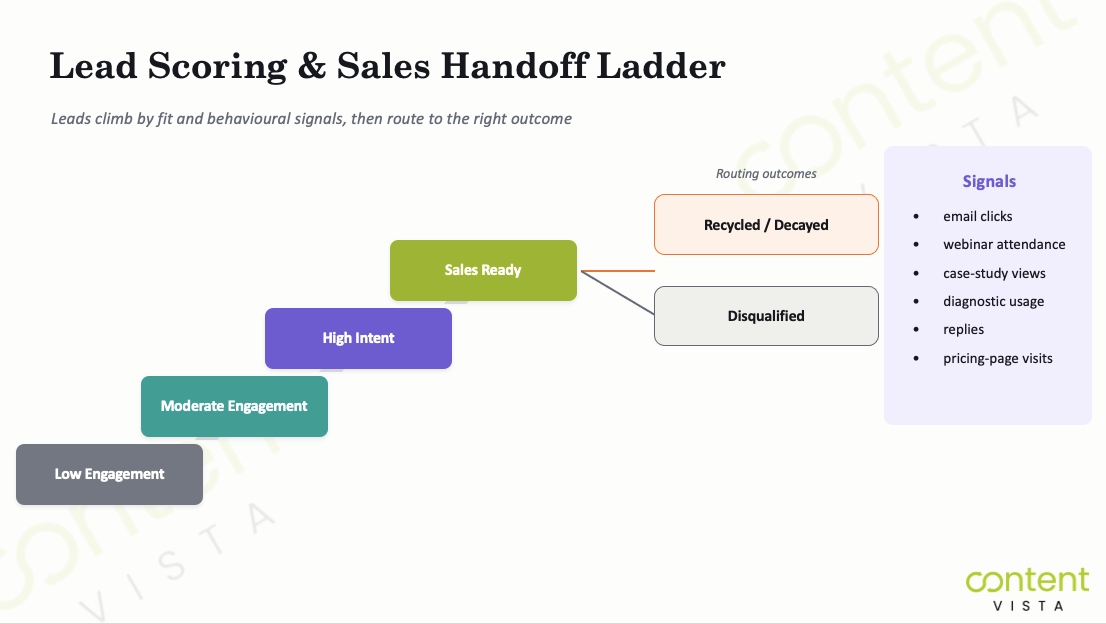
| Level | Behaviour / Signal | Recommended Action | Owner |
|---|---|---|---|
| Low engagement | Opens only, no clicks, low-fit source | Continue light nurture or suppress if inactive | Marketing |
| Moderate engagement | Clicks resources, attends webinar, downloads asset | Continue segmented nurture and update score | Marketing / automation |
| High intent | Uses diagnostic, replies, views service page, clicks case study | Route to sales or founder follow-up | Sales / founder |
| Stale engagement | Previously active but inactive for defined period | Decay score and recycle | Marketing / CRM owner |
| Disqualified or poor fit | Not ICP, wrong need, wrong timing | Suppress, segment or long-term nurture | Marketing / CRM owner |
Lead nurturing becomes far more effective when fit scoring, intent scoring, CRM ownership and recycling rules work together as one progression system.
Metrics That Matter by Sequence Type
Many nurture systems look successful on paper while contributing very little to actual pipeline progression.
Why?
Because the wrong metrics are being tracked.
The wrong metric makes a weak nurture sequence look successful.
A sequence can generate:
high open rates
decent click rates
strong delivery metrics
and still fail to:
qualify leads
create opportunities
support sales conversations
improve conversion timing
move pipeline forward
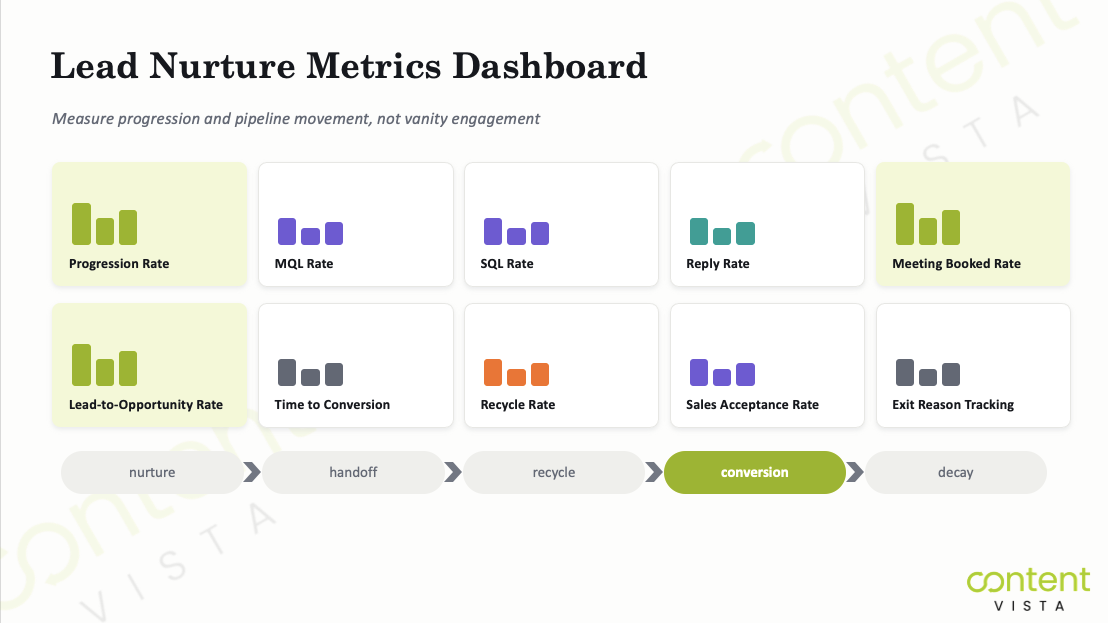
That is why nurture measurement should focus on progression, not just engagement.
Progression is also what makes forecasting possible. It is the same logic behind predictable lead generation: you cannot forecast a pipeline you cannot see moving.
Opens alone are not the outcome.
In fact, many “high-performing” nurture sequences are simply good at generating passive attention without creating movement.
A stronger measurement system evaluates whether the lead:
progressed
qualified
engaged meaningfully
converted
recycled appropriately
reached sales readiness
improved in fit or intent scoring
Different nurture sequences also require different primary metrics.
A webinar no-show sequence should not be judged the same way as a proposal follow-up sequence.
Likewise, a lead magnet nurture flow serves a very different purpose from a dormant-lead reactivation workflow.
That means the success criteria should change too.
| Sequence Type | Primary Metric | Why It Matters |
|---|---|---|
| Lead magnet follow-up | CTA click / second engagement | Shows whether the lead is moving beyond the first download |
| Webinar attendee follow-up | CTA click / meeting request / replay engagement | Shows whether event engagement became pipeline intent |
| No-show follow-up | Replay view / resource click | Shows whether the lead can be re-engaged |
| Booked call follow-up | Reply or rescheduled meeting | Shows whether momentum can be recovered |
| Proposal follow-up | Decision response / objection reply | Shows whether the sequence is helping decision movement |
| Re-engagement sequence | Reactivation rate / opt-down / unsubscribe | Shows whether dormant leads still have usable intent |
| Outbound-to-nurture | Reply, case-study click, or diagnostic use | Shows whether outbound interest can become qualified engagement |
Beyond sequence-specific metrics, several system-level measurements matter across the entire nurture infrastructure.
Progression rate
This is one of the most useful metrics in nurture analysis.
Progression rate measures whether leads are moving meaningfully through stages:
subscriber → engaged lead
engaged lead → MQL
MQL → SQL
SQL → opportunity
opportunity → proposal
proposal → customer
This matters far more than isolated email metrics because it reflects actual funnel movement.
Reply rate
Replies often signal stronger intent than clicks.
A reply usually indicates:
contextual engagement
active thinking
problem awareness
stakeholder involvement
buying curiosity
objection surfacing
This is especially important for:
outbound nurture
proposal follow-up
booked-call recovery
founder-led sales environments
Meeting booked rate
Some nurture sequences exist specifically to create conversations.
In those cases, meeting-booked rate becomes a stronger KPI than general engagement.
For example:
webinar attendee nurture
diagnostic nurture
outbound-to-nurture flows
sales re-engagement sequences
The key question becomes: Did the sequence create a qualified conversation?
Lead-to-opportunity rate
This is one of the strongest indicators of nurture quality.
It measures whether nurture is producing:
usable pipeline
sales-qualified conversations
opportunity-stage movement
instead of simply generating activity.
This metric becomes especially important when evaluating:
segmentation quality
scoring logic
handoff timing
nurture relevance
Time to conversion
Strong nurture systems often reduce friction and accelerate decision movement.
That means measuring:
time from first touch to booked call
time from MQL to SQL
time from proposal to decision
time from engagement to opportunity
This helps reveal whether the nurture system is:
clarifying decisions
improving momentum
reducing confusion
shortening evaluation cycles
Recycle rate
Not every lead converts immediately.
That is normal.
But strong systems track:
how many leads recycle
why they recycle
whether they re-engage later
whether nurture reactivates them successfully
This becomes especially valuable in long sales cycles.
Sales acceptance rate
One of the clearest signs of nurture quality is whether sales actually accept the leads being routed.
If sales repeatedly rejects:
MQLs
demo requests
nurture escalations
automation handoffs
then the scoring or qualification system may be weak.
This metric helps align marketing and sales operationally.
CRM hygiene and exit tracking
This is the layer most nurture systems ignore.
A mature nurture infrastructure should track:
why leads exited
who owns the lead
whether handoffs happened correctly
whether stages remain accurate
whether stale leads are decaying properly
whether recycled leads re-enter correctly
Without this, reporting becomes unreliable very quickly.
The CRM should remain the operational source of truth for:
lead status
engagement history
scoring
ownership
routing
lifecycle stage
nurture progression
Key nurture metrics that matter more than opens:
• CTA click rate — whether the email created an action, not just attention
• Reply rate — the strongest early signal of real intent
• Progression rate — movement between lifecycle stages
• MQL rate and SQL rate — qualification quality, not lead volume
• Meeting-booked rate — whether the sequence creates conversations
• Lead-to-opportunity rate — whether nurture produces usable pipeline
• Time to conversion — whether the sequence is shortening decisions
• Recycle rate — whether dormant leads come back
• Sales acceptance rate — whether sales agrees the lead was ready
• Unsubscribe and spam complaint rate — whether cadence has tipped into noise
• Sequence exit reason — why the lead left, not just that it left
• CRM hygiene and handoff accuracy — whether the data behind all of the above is trustworthy
Strong nurture systems measure progression quality, handoff accuracy and conversion movement, not just email activity.
Where AI Helps and Where It Makes Nurture Worse
AI is changing how nurture systems are built.
But there is an important distinction between:
using AI to improve a strong system
and using AI to automate a weak one faster
AI can make a good nurture system faster. It can also make a bad nurture system louder.
That distinction matters because many teams now have access to tools that can:
generate email sequences instantly
personalise outreach automatically
summarise CRM activity
classify leads
suggest follow-up timing
create content variations at scale
Those capabilities are useful.
But they do not replace strategy, segmentation, qualification or sales judgment.
Where AI helps
Used correctly, AI can significantly improve operational efficiency inside nurture workflows.
One of the most useful applications is segmentation support.
AI systems can help identify:
behavioural patterns
content interests
likely intent categories
engagement clusters
topic relevance
nurture routing paths
That becomes especially useful in larger funnels where manually reviewing engagement data becomes difficult.
AI also works well for:
summarising CRM notes
condensing webinar questions
identifying repeated objections
classifying inbound replies
surfacing behavioural patterns
recommending relevant content
drafting sequence variations
generating testing ideas
For example:
webinar attendee questions can be grouped into common pain points
CRM conversations can be summarised into key objections
nurture paths can adapt based on content engagement
outbound replies can be categorised into timing, pricing, fit or implementation concerns
AI can also help repurpose existing content into nurture assets more efficiently.
A single:
webinar
framework article
sales call insight
implementation guide
can become:
nurture emails
objection-handling snippets
segmentation paths
role-specific variations
replay summaries
follow-up prompts
That can improve consistency and reduce production bottlenecks.
Where AI makes nurture worse
The biggest problem happens when AI is used before the underlying nurture logic is clear.
Many teams automate:
segmentation
personalisation
sequence generation
outreach volume
before they define:
ICP clarity
buyer stages
qualification rules
progression logic
sales handoff thresholds
nurture objectives
That usually creates larger operational problems, not better nurturing.
For example, AI-generated nurture can become dangerously generic when:
every lead receives similar messaging
buyer stage is ignored
timing signals are missing
context is weak
personalisation is fabricated
sequence logic is shallow
This often produces nurture that feels:
repetitive
artificial
over-automated
contextually disconnected
One particularly common issue is invented personalisation.
A lead can usually tell when:
“personalisation” was generated from shallow data
context is inaccurate
role assumptions are wrong
messaging references irrelevant details
That reduces trust quickly.
AI can also increase volume too easily.
A weak nurture system sending:
too many emails
poorly timed follow-ups
repetitive reminders
shallow “check-in” messages
becomes even noisier when AI accelerates production.
The underlying strategy problem still exists.
It is just automated now.
Another important limitation: AI should not fully replace human judgment at sales-ready moments.
Once:
implementation concerns
stakeholder alignment
budget discussions
objections
deal timing
strategic fit
become central to the conversation, human context matters much more.
That is especially true in:
consultative sales
founder-led sales
high-ticket services
multi-stakeholder buying
longer sales cycles
AI can assist those workflows.
But it should not become the entire workflow.
The best AI-enabled nurture systems use automation to improve relevance, timing, segmentation and operational clarity not to replace strategy or human judgment.
This is why AI works best as a layer on top of:
clear ICP definition
structured CRM workflows
strong nurture architecture
accurate scoring systems
defined sales handoffs
useful content systems
Without those foundations, AI usually amplifies existing weaknesses instead of fixing them.
If nurture, CRM, content, outbound and automation need to work together, explore the AI Client Acquisition Stack.
Cost, Time and Effort by Nurture Maturity Level
One of the biggest mistakes in lead nurturing is trying to build an enterprise-level automation system before the underlying process is stable.
Not every business needs:
complex AI workflows
advanced lead scoring
multi-channel orchestration
deep CRM automation
at the beginning.
Many teams first need:
clearer follow-up logic
better segmentation
stronger sales handoffs
cleaner nurture goals
more consistent execution
Automation is not the maturity level. Automation only exposes the maturity level you already have.
That is why nurture systems should usually evolve in stages.
The right maturity level depends on:
lead volume
sales complexity
operational bandwidth
CRM maturity
content capacity
team structure
funnel sophistication
reporting requirements
A founder-led service business with low inbound volume may not need the same infrastructure as a multi-channel demand generation team with SDRs, lifecycle automation and pipeline reporting.
The goal is not maximum automation.
The goal is operational fit.
| Model | Best For | Effort Level | Main Risk | When to Choose It |
|---|---|---|---|---|
| Manual follow-up sequence | Early-stage teams or low volume | Low to medium | Inconsistent follow-up | When quality matters more than automation |
| Basic automated drip | Simple lead magnets or newsletters | Medium | Generic emails with weak routing | When the lead path is simple and low-risk |
| Trigger-based nurture workflow | Multiple sources, segments and stages | Medium to high | Overcomplex automation without clear rules | When leads need different paths by intent |
| CRM-integrated sales enablement system | Teams with handoff and pipeline requirements | High | Poor ownership or messy data | When marketing and sales need shared visibility |
| AI-assisted multi-channel nurture system | Mature teams with content, CRM and automation foundations | High | Scaling weak strategy faster | When foundations are clear and workflows need acceleration |
Manual follow-up sequence
This is often the best starting point for:
founders
consultants
agencies
early-stage B2B teams
lower-volume sales environments
The advantage is quality and contextual relevance.
A human-led follow-up process usually:
adapts faster
personalises naturally
handles objections better
stays flexible
The downside is operational inconsistency.
Without systems, manual follow-up can become:
dependent on memory
difficult to track
hard to scale
inconsistent across leads
Still, for smaller teams, this stage is often completely sufficient.
Basic automated drip
This is usually the first automation layer.
Typical use cases include:
newsletter onboarding
simple lead magnets
downloadable resources
educational sequences
The operational burden is still relatively manageable.
But this is also where many businesses get stuck.
They automate:
generic sequences
weak segmentation
poor timing
low-context messaging
without building:
progression logic
scoring systems
routing rules
lifecycle stages
As a result, the nurture feels automated instead of useful.
Trigger-based nurture workflow
This is where nurture becomes more strategically mature.
Instead of: “Everyone gets the same sequence,”
the workflow adapts based on:
source
trigger
behaviour
stage
engagement
fit
intent
This level usually requires:
better CRM structure
segmentation rules
content mapping
lead scoring logic
clearer ownership
It also requires more operational discipline because complexity increases quickly.
The biggest risk here is overengineering.
Many teams build:
too many branches
too many triggers
too many scoring conditions
too many automation paths
before validating whether the nurture actually improves progression.
CRM-integrated sales enablement system
This is typically where nurture becomes deeply tied to revenue operations.
At this stage:
marketing
sales
CRM workflows
scoring
reporting
lifecycle stages
automation
all need to work together.
This usually involves:
structured handoff rules
sales visibility
pipeline reporting
multi-owner workflows
sequence exit criteria
lead recycling
score decay
operational dashboards
The implementation effort becomes significantly higher because:
process alignment matters
data quality matters
ownership clarity matters
reporting accuracy matters
Without operational discipline, this layer becomes messy very quickly.
AI-assisted multi-channel nurture system
This is the most operationally demanding stage.
At this level, businesses may combine:
CRM workflows
email automation
LinkedIn engagement
outbound systems
AI segmentation
AI-generated variations
conversational AI support
behavioural routing
content recommendation engines
When done correctly, this can improve:
scale
speed
personalisation
operational visibility
nurture responsiveness
But this level only works when the fundamentals already exist.
Otherwise, AI simply amplifies:
weak messaging
bad routing
poor segmentation
incorrect scoring
operational confusion
That is why maturity matters more than automation sophistication alone.
The best nurture systems are not necessarily the most automated. They are the ones where segmentation, timing, ownership, CRM visibility and progression logic are operationally clear.
Another important point: maturity levels are not permanent.
Many businesses evolve through stages:
manual first
then basic automation
then segmentation
then CRM integration
then AI-assisted optimisation
That progression is normal.
The mistake is trying to skip operational maturity and jump directly into advanced automation.
Common Lead Nurturing Sequence Mistakes
Most nurture systems do not fail because email stopped working.
They fail because the underlying logic is weak.
The mistakes are not complicated. But they are exactly why nurture turns into noise.
Many businesses eventually accumulate:
disconnected sequences
bloated CRMs
confused ownership
generic automation
poor handoffs
inaccurate scoring
unclear reporting
And the result is predictable:
low trust
weak conversion
frustrated sales teams
declining engagement
operational confusion
The good news is that most nurture failures are preventable once you know what to look for.
• Sending the same sequence to every lead
Different triggers represent different levels of intent. A checklist download, proposal delay, webinar attendance and outbound reply should not receive identical follow-up.
• Treating downloads as sales-ready intent
A lead magnet usually signals curiosity or problem awareness: not immediate buying readiness.
• Confusing drip campaigns with nurture
Time-based automation alone is not a strategic nurture. Strong nurture adapts to stage, behaviour, fit and progression signals.
• Confusing nurture with sales follow-up
Marketing nurture and sales conversations serve different purposes. Sales-ready leads usually need contextual human follow-up, not endless educational automation.
• Writing emails with no clear job
Each email should have a defined purpose:
educate, qualify, overcome objection, create progression, or route ownership.
• Using too many CTAs
When every email asks the lead to:
book a call,
read three resources,
watch a webinar,
download another guide,
and reply -
the sequence loses focus.
• Ignoring lead source
Inbound, outbound, webinar, referral, LinkedIn, paid acquisition and recycled leads often require different nurture logic.
• Ignoring buyer stage
Early-stage leads need education and clarity. Mid- and late-stage leads usually need proof, decision support or objection handling.
• Not setting exit criteria
Leads should not remain trapped in nurture indefinitely. Every workflow should define:
handoff,
recycle,
suppression,
or progression rules.
• No score decay
Old engagement should not keep stale leads artificially “hot” forever.
• No sales feedback loop
If sales rejects nurture-generated leads repeatedly, the scoring or qualification system is probably weak.
• No CRM visibility
Disconnected spreadsheets, inboxes, and marketing tools create routing confusion and inaccurate reporting.
• No ownership rules
Marketing, sales, founders, and automation systems should have clearly defined responsibilities.
• Automating before content assets exist
Automation does not compensate for weak:
education,
proof,
decision support,
or nurture content.
• Over-personalising with fake AI-generated context
Artificial or inaccurate personalisation reduces trust quickly. Relevance matters more than forced “personalisation.”
• Tracking opens instead of progression
A nurture sequence with high opens but weak progression may still be operationally ineffective.
One of the most common strategic mistakes is overbuilding too early.
Teams often create:
complex branching workflows
advanced AI automation
detailed scoring models
dozens of nurture paths
before clarifying:
ICP definition
sequence goals
sales ownership
stage definitions
conversion logic
That creates automation complexity without operational clarity.
Another major issue is treating nurture as a content problem only.
Nurture is not just:
writing emails
scheduling sequences
sending newsletters
It is a progression system.
That means:
CRM structure matters
handoff timing matters
segmentation matters
routing matters
scoring matters
reporting matters
ownership matters
The strongest nurture systems usually feel simpler externally because the internal logic is clear.
The weakest systems often feel busy:
too many emails
too many automations
too many disconnected workflows
too much noise
without meaningful progression.
A useful diagnostic question is: “Does this sequence help the lead move somewhere specific?”
If the answer is unclear, the nurture probably needs restructuring.
Strong nurture systems are designed around progression, qualification and operational clarity, not just sending more emails more efficiently.
When Not to Automate Nurture Yet
There is a point where automation improves nurture.
And there is another point where automation simply exposes operational problems faster.
Many teams assume: “We need better automation.”
But sometimes the nurture sequence is not the problem. The maturity of the system underneath it is.
If the underlying:
positioning
ICP clarity
sales process
CRM structure
ownership model
content system
qualification logic
are weak, automation usually amplifies the confusion instead of fixing it.
This is why some nurture systems feel:
noisy
generic
disconnected
over-automated
impossible to maintain
The automation itself is not necessarily wrong.
The foundation underneath it is incomplete.
Unclear ICP
If the ideal customer profile is vague, nurture becomes generic very quickly.
You cannot create relevant progression if you do not clearly understand:
who the lead is
what problem they are solving
what stage they are in
how they buy
what triggers intent
what objections matter
Without ICP clarity, sequences usually become:
broad educational drips
generic newsletters
disconnected content pushes
That weakens conversion and relevance simultaneously.
Weak offer
Automation cannot compensate for weak positioning or unclear value.
If the offer itself is confusing, nurture will struggle regardless of:
email quality
personalisation
segmentation
automation sophistication
Many nurture systems underperform because the underlying offer lacks:
differentiation
clarity
urgency
specificity
operational relevance
In those situations, improving:
messaging
positioning
service clarity
value articulation
usually matters more than building additional workflows.
Messy CRM
This is one of the most common operational issues.
If the CRM contains:
duplicate records
unreliable stages
missing ownership
inconsistent fields
broken tags
unclear lead sources
then automation becomes unreliable very quickly.
That affects:
scoring
routing
segmentation
reporting
handoffs
nurture triggers
A weak CRM structure creates weak nurture infrastructure.
No sales alignment
Nurture breaks when marketing and sales disagree about:
lead quality
qualification
handoff timing
ownership
follow-up expectations
Without shared definitions for:
MQL
SQL
SLA
routing rules
progression stages
leads often fall into operational gaps.
For example:
marketing thinks the lead is sales-ready
sales thinks the lead is too early
nurture continues running incorrectly
ownership becomes unclear
That creates friction across the entire funnel.
No useful content assets
A nurture sequence still needs something useful to send.
Many businesses try to automate before building:
guides
proof assets
comparison content
implementation insights
objection-handling resources
decision support materials
case-style examples
Without those assets, the nurture becomes repetitive very quickly. More often than not, that is a content and thought leadership gap long before it is an automation gap.
The system has nothing meaningful to deliver besides:
reminders
check-ins
generic educational emails
No measurement system
If no one can clearly answer:
what counts as progression
when leads become qualified
why leads recycle
which nurture paths work
what sales accepts
what sequences convert
then optimisation becomes guesswork.
Strong nurture requires:
clear metrics
dashboards
reporting visibility
exit criteria
handoff tracking
CRM discipline
Otherwise, teams often continue scaling workflows that are not actually improving conversion.
| Warning Sign | Why It Matters | Better Next Move |
|---|---|---|
| Unclear ICP | The sequence cannot be relevant if the audience is undefined | Fix audience and positioning first |
| Weak offer | Nurture cannot make an unclear offer compelling | Clarify the offer and value proposition |
| Messy CRM | Triggers, scores and handoffs will be unreliable | Clean data and define fields first |
| No sales alignment | Sales-ready leads may not be followed up properly | Define MQL, SQL, SLA and ownership rules |
| No content assets | The sequence has nothing useful to send | Create proof, guides, case studies and decision assets |
| No measurement system | You cannot tell whether nurture is working | Define metrics, dashboards and exit criteria |
Another important reality: some businesses simply need stronger funnel foundations before they need nurture sophistication.
For example:
positioning may still be unclear
acquisition channels may still be unstable
conversion paths may still leak heavily
sales conversations may still be inconsistent
service packaging may still be evolving
In those cases, adding automation too early often creates more operational noise instead of more revenue clarity.
The best nurture systems are usually built on top of strong positioning, clean CRM infrastructure, clear ownership, useful content and aligned sales processes.
If nurture keeps breaking because the foundations are unclear, assess your marketing growth maturity before adding more automation.
Marketing Growth Maturity AssessmentMarketing OS SprintMini Examples: How Nurture Looks in Real Growth Systems
Most nurture systems improve when businesses stop treating follow-up as a disconnected marketing task and start treating it as part of a wider growth system.
Here’s what changes when nurture is treated as a system instead of a sequence of polite reminders.
The biggest shift is usually operational:
clearer routing
stronger context
better handoffs
more useful content
improved CRM visibility
better timing
cleaner progression logic
The examples below focus on system-level implementation patterns rather than vanity metrics or isolated campaign screenshots.
Additional portfolio and implementation examples are worth a look if you want to see how these patterns show up in practice.
Asset-led nurture and content-assisted growth
In several Content Vista implementations, nurture systems are built around educational assets instead of immediate sales pressure.
That usually includes:
lead magnets
frameworks
calculators
implementation guides
strategic diagnostics
comparison-style content
The nurture logic then adapts based on:
source
engagement
stage
repeat interaction
behavioural signals
Instead of treating every download as immediate buying intent, the workflow identifies:
curiosity
evaluation
active research
implementation readiness
sales intent
This type of structure is particularly useful for longer buying cycles where trust and education matter before direct sales conversations.
Founder-led authority nurture
Some growth systems rely heavily on founder expertise and authority-building content.
In those cases, nurture is often designed to:
continue the founder’s thinking
reinforce positioning
deepen trust
surface objections
support evaluation
Rather than relying only on:
generic newsletters
promotional emails
repetitive reminders
the nurture sequence connects:
thought leadership
implementation insights
operational examples
strategic frameworks
sales conversations
This approach is especially relevant in consultative or expertise-led businesses.
Related example: Akshar Business Consulting.
Lead handling and CRM improvement
In some systems, the biggest nurture improvement does not come from writing better emails.
It comes from fixing:
CRM ownership
routing rules
lead scoring
lifecycle stages
recycle logic
sales visibility
A lead may already be engaging with:
webinars
content assets
outbound conversations
proposals
diagnostics
but without:
proper tracking
stage clarity
handoff rules
the progression breaks operationally.
This is where nurture becomes closely tied to:
CRM structure
sales enablement
reporting
lifecycle management
rather than just email automation.
Related example: Confido.
Webinar and lead magnet follow-up
Another common implementation pattern involves webinar and lead magnet segmentation.
Instead of:
sending identical follow-up to everyone
the nurture path changes based on:
attendance
replay engagement
CTA interaction
resource usage
behavioural signals
For example:
engaged attendees may receive decision-support content
no-shows may enter replay nurture
replay viewers may trigger higher-intent workflows
inactive leads may recycle automatically
This creates much cleaner progression visibility across the funnel.
Outbound-to-nurture systems
Outbound systems often perform better when they include structured nurture instead of relying only on repeated sales follow-up.
That may involve:
cold email engagement
LinkedIn interaction
resource clicks
“not now” replies
soft interest signals
Instead of pushing immediately for meetings, the nurture system continues relevance through:
proof assets
strategic content
implementation examples
diagnostic tools
role-specific resources
This helps maintain momentum without creating pressure too early.
Related example: SalesFed.
Sales enablement support
In more mature systems, nurture supports active pipeline movement rather than only early-stage lead generation.
That can include:
proposal follow-up
objection-handling content
stakeholder alignment assets
implementation clarification
decision-support sequences
The goal is not simply: “send more emails.”
The goal is:
reduce friction
improve progression
clarify next steps
support sales conversations
improve operational visibility
Related example: Smart Solutions.
Strong nurture systems usually improve because the underlying routing, CRM logic, segmentation, content relevance and sales coordination improve together.
FAQs About Lead Nurturing Sequence Examples
What is a lead nurturing sequence?
A lead nurturing sequence is a structured series of follow-up messages and actions designed to move a lead toward a more qualified next step. Strong nurture sequences are based on trigger, buyer stage, fit, behaviour and intent: not just a fixed schedule of emails.
How many emails should a lead nurturing sequence have?
There is no universal number.
Some sequences work with:
3-5 emails
a short sales follow-up path
a longer educational nurture flow
The right length depends on:
buyer stage
sales cycle
lead source
complexity of the decision
level of intent
A proposal follow-up sequence may need fewer, more targeted emails than a long-term lead magnet nurture sequence.
What is the difference between a drip campaign and a nurture sequence?
A drip campaign is usually time-based and sends the same content sequence to everyone in that workflow.
A nurture sequence is typically more behaviour-, stage-, or trigger-based. It adapts based on:
engagement
lead source
intent signals
lifecycle stage
qualification
Strong nurture systems focus on progression, not just scheduled delivery.
What should each email in a nurturing sequence do?
Each email should have one clear job.
That may include:
delivering a resource
explaining a problem
building trust
addressing objections
showing proof
creating progression
encouraging a reply
routing the lead to the next stage
Emails with too many competing CTAs usually weaken progression.
When should marketing hand a lead to sales?
Sales handoff should usually happen when:
fit and intent meet agreed thresholds
the lead shows meaningful buying signals
the lead engages with high-intent assets
the lead requests a conversation
repeated engagement suggests evaluation behaviour
Strong systems define:
MQL criteria
SQL criteria
ownership rules
routing logic
response expectations
before automation scales.
What metrics matter most in a nurture sequence?
Useful nurture metrics often include:
progression rate
reply rate
MQL rate
SQL rate
meeting-booked rate
lead-to-opportunity rate
recycle rate
sales acceptance rate
time to conversion
sequence exit reasons
Open rates alone usually provide incomplete insight.
Should nurture sequences be time-based or behaviour-based?
Most mature nurture systems use a mix of both.
Time-based sequencing can help structure delivery cadence, but behaviour-based logic usually improves relevance.
For example:
webinar attendees
replay viewers
proposal-stage leads
repeat visitors
outbound replies
often need different follow-up paths even if they entered the funnel around the same time.
How do you re-engage cold leads without sounding spammy?
The best re-engagement sequences acknowledge context instead of pretending nothing changed.
Useful approaches often include:
sharing a relevant update
offering a useful resource
asking about current priorities
providing a diagnostic tool
allowing the lead to self-segment
Low-pressure relevance usually works better than aggressive follow-up.
Can lead nurturing sequences work for service businesses and consultants?
Yes especially in businesses with:
longer sales cycles
consultative buying
trust-heavy decisions
founder-led sales
high-ticket services
For service businesses, nurture often supports:
authority-building
objection handling
stakeholder education
sales enablement
timing-based follow-up
rather than purely transactional conversion.
When should you stop or recycle an unengaged lead?
A lead should usually recycle or suppress when:
engagement stops for a defined period
fit is weak
timing is not active
multiple nurture paths fail
sales disqualifies the opportunity
score decay thresholds are reached
Strong nurture systems define exit criteria clearly instead of running sequences indefinitely.
Should lead nurturing sequences include sales emails?
Sometimes: depending on stage and intent.
Early-stage nurture may remain mostly educational.
Mid- and late-stage nurture often benefits from:
founder follow-up
sales clarification
objection handling
proposal support
implementation discussions
low-friction check-ins
The key is matching the communication style to buyer readiness.
Can AI write lead nurturing sequences?
AI can help:
draft sequence variations
summarise CRM notes
repurpose content
identify objections
segment leads
recommend content paths
generate testing ideas
But AI works best when the underlying nurture strategy is already clear.
Without:
clear ICP definition
progression logic
CRM structure
scoring rules
sales alignment
AI often scales weak nurture systems instead of improving them.
The strongest lead nurturing sequence examples are built around progression, context, segmentation and operational clarity: not just automated email volume.
Conclusion: Build Nurture Around Progression, Not Templates
Lead nurturing sequence examples are useful: but only when they match the right trigger, buyer stage and intent level.
That is the real difference between:
nurture that creates progression
and
nurture that creates noise.
A lead magnet download, webinar replay view, outbound reply, proposal-stage delay and dormant CRM contact should not enter the same workflow.
Each one signals a different level of:
awareness
urgency
readiness
context
sales fit
That is why strong nurture systems are built around progression logic instead of email templates.
A good nurture sequence should:
increase trust
clarify the problem
surface objections
identify intent
improve routing
support sales readiness
move the lead toward the right next owner
In contrast, generic drip campaigns often continue sending emails long after the lead:
lost interest
changed priorities
became sales-ready
needed a different conversation
required human follow-up instead of automation
The most effective nurture systems usually combine:
trigger-based segmentation
CRM visibility
clear scoring logic
useful content assets
sales alignment
operational ownership
lifecycle rules
without overcomplicating the workflow.
The goal of nurture is not to “stay in touch.” The goal is to help the right lead move toward the right next step with the right level of context and timing.
If your nurture system feels:
inconsistent
generic
over-automated
difficult to maintain
disconnected from sales
weak at progression
the issue may not be the sequence itself.
It may be the maturity of the growth system underneath it.
Related reading: how to build a lead generation system that produces predictable pipeline.
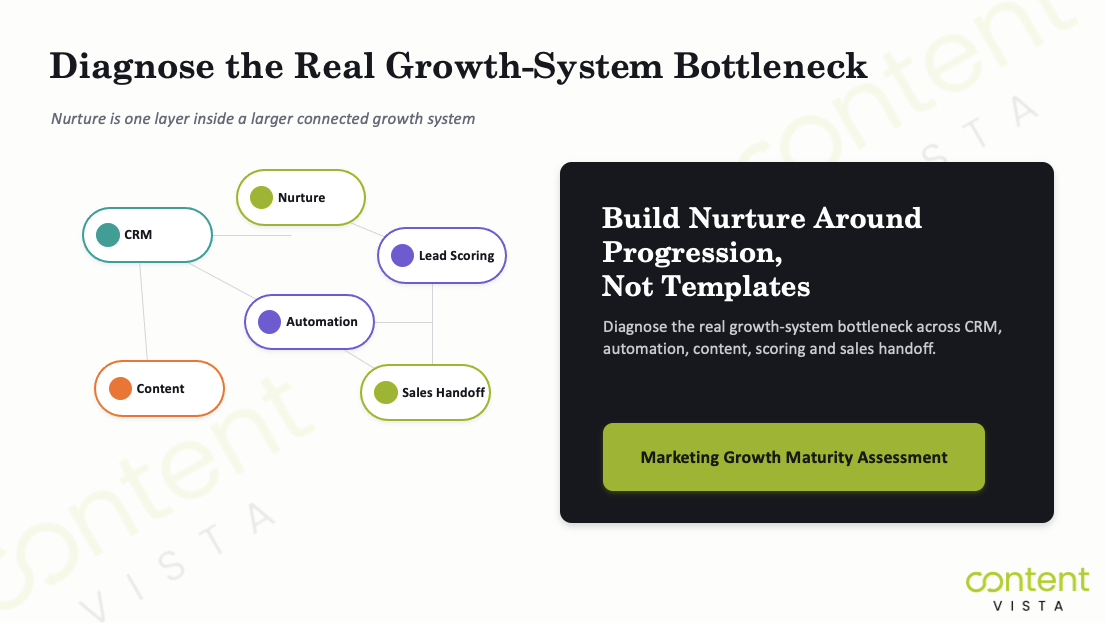
Start with the pipeline maths. The Lead Generation Capacity Calculator shows how many leads your business actually needs each month before you rebuild the sequences feeding it.
Then use the Marketing Growth Maturity Assessment to see whether your nurture gaps are caused by content, CRM, handoff, automation or growth-system maturity.