Quick Summary
- Predictable lead generation does not mean guaranteed leads every day; it means creating a repeatable, measurable system that makes qualified lead flow easier to forecast and improve.
- Most lead generation feels random because businesses rely on uncontrolled variables: referrals, disconnected campaigns, weak follow-up, unclear qualification, and poor CRM visibility.
- The CONTROL Framework helps make lead generation more predictable by clarifying targets, owning one primary channel, standardising operations, tracking leading indicators, removing bottlenecks, optimising one variable at a time, and layering channels only after the first engine works.
Why Lead Generation Feels Random
A lot of businesses are not struggling because they are doing nothing.
They are struggling because they are doing everything.
Content. Outreach. Ads. Networking. Referrals. Social media. Webinars. Newsletters.
The activity is there. The effort is there. But when someone asks:
“How many qualified opportunities are we likely to generate next month?”
There is no confident answer.
That uncertainty creates constant pipeline anxiety.
One month, referrals are flowing. A LinkedIn post performs well. A campaign suddenly creates a spike in inbound interest.
Then the next month, everything slows down without warning.
That is the reality of feast-famine lead flow. The business stays busy, but the pipeline still feels unpredictable.
Here’s the problem:
A lot of lead generation activity creates motion without creating control.
Referrals are a good example. They often convert well, which is why many businesses trust them most. But referrals are difficult to scale intentionally and almost impossible to forecast accurately. They are valuable, but they are not a complete acquisition system on their own.
The same pattern shows up across nearly every channel.
Paid ads can generate clicks without qualified conversations.
Outbound campaigns can generate replies without real buying intent.
Content marketing can create visibility without conversion.
Social media can create engagement without actual pipeline movement.
So what does that mean?
The issue is usually not a lack of tactics.
The issue is a lack of control.
Predictable lead generation is not created by adding more channels. It is created by increasing the number of variables you can control and reducing the number of leaks you ignore.
That is the real difference between random marketing activity and an engineered pipeline.
A predictable lead generation system does not guarantee the exact same number of leads every week. Markets shift. Buyer behaviour changes. Channels fluctuate.
But a strong system gives you something far more valuable:
visibility into what is working, where leads are leaking, and which inputs actually influence pipeline growth.
Without that visibility, most businesses end up reacting instead of operating strategically.
If your pipeline constantly swings between busy months and slow months, you are not alone. Most businesses stuck in the feast-famine cycle are not missing effort.
They are missing a controllable system.
Predictable Lead Generation in Plain English
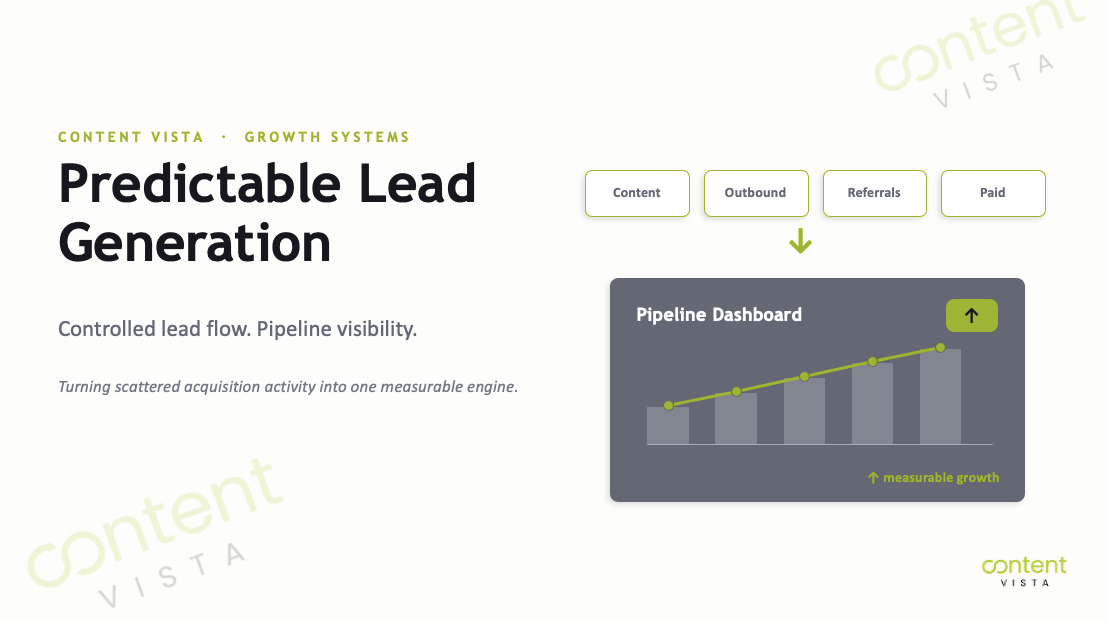
A repeatable system that consistently creates qualified opportunities through clear targeting, focused acquisition channels, standardised capture and follow-up processes, CRM visibility and ongoing optimisation. Predictable does NOT mean guaranteed leads every day. It means reducing randomness so pipeline performance becomes easier to measure, improve, and forecast over time.
What Predictable Lead Generation Actually Means
Predictable lead generation is the process of building a repeatable system that consistently attracts, captures, qualifies and follows up with the right prospects so a business can forecast pipeline more accurately and improve lead flow over time.
One of the biggest misconceptions around lead generation is the idea that “predictable” means guaranteed.
It does not.
No acquisition channel: whether referrals, inbound content, outbound outreach, SEO, events or paid ads can promise perfectly stable lead volume every single week. Markets shift. Buyer timing changes. Conversion rates fluctuate.
Even strong systems experience variance.
So what does predictable actually mean?
Predictable means measurable, repeatable and improvable.
It means your business understands:
where qualified leads are coming from
which channels are creating real opportunities
how quickly leads are being followed up
where prospects are dropping off
how many sales conversations are typically required to create revenue
That visibility changes how decisions get made.
Instead of reacting emotionally to short-term fluctuations, you can identify bottlenecks earlier, improve weak stages faster and forecast pipeline with far more confidence.
Think about it this way:
A predictable pipeline is not one that never changes.
It is one where the underlying system is visible enough to measure and improve intentionally over time.
That distinction matters because many businesses mistake “more activity” for “more predictability.”
In reality, predictability usually comes from tighter systems, clearer qualification, stronger follow-up discipline and better reporting visibility - not simply adding more tactics.
A strong predictable lead generation system connects multiple operational layers together:
lead source
messaging
capture mechanism
qualification criteria
follow-up process
CRM visibility
reporting cadence
optimisation feedback loops
When those layers operate in isolation, lead flow feels random.
When they are connected, standardised, and measurable, pipeline growth becomes far more controllable over time.
That is the shift from reactive marketing to an engineered growth system.
Why Most Lead Generation Stays Unpredictable
Most lead generation problems are not caused by a lack of marketing activity.
They are caused by unstable systems.
A business can publish content consistently, run ads, send outbound campaigns, attend events and still have no reliable way to forecast qualified opportunities.
Here’s why:
Activity alone does not create predictability.
Controlled variables do.
One of the biggest causes of unstable lead flow is overreliance on a single acquisition source. Many businesses depend almost entirely on referrals, one founder-led channel, one paid campaign or one social platform.
It works until it stops working.
The moment buyer behaviour shifts or channel performance drops, the entire pipeline becomes vulnerable.
Another major issue is unclear positioning.
If your ICP, offer, or buying problem is vague, lead generation becomes inconsistent because the market itself is confused.
Here’s where most teams go wrong:
They assume they have a channel problem when they actually have a strategy problem.
That is why many businesses try to “fix” lead generation by adding more tactics instead of improving the underlying system.
Random lead generation usually looks busy but difficult to diagnose. Controlled lead generation creates visibility into where opportunities come from, where conversion breaks down, and which variables actually influence pipeline growth.
Operational inconsistency creates another layer of unpredictability.
For example:
inconsistent publishing or outreach activity
weak landing pages or unclear lead magnets
slow follow-up
no lead qualification rules
no ownership of CRM stages
no reporting cadence
disconnected sales and marketing handoffs
When every lead is handled differently, forecasting becomes almost impossible.
That’s the real issue.
Most businesses do not lack effort. They lack operational consistency.
Another common mistake is tracking lead volume instead of qualified opportunities.
A campaign may generate hundreds of form fills, but if most leads are low-intent, poorly qualified, or never followed up properly, the pipeline still stays weak.
Busy dashboards do not automatically mean healthy pipeline movement.
Then there is optimization chaos.
Teams change targeting, messaging, landing pages, offers, follow-up timing and channels all at once. Results improve or decline, but nobody knows why.
Predictability drops because the system becomes impossible to diagnose.
In short:
The goal is not to create perfect lead generation overnight.
The goal is to build a measurable, controllable lead generation system where lead sources, qualification, capture, follow-up and reporting become stable enough to improve intentionally over time.
That is the difference between random activity and a predictable lead generation system.
| Problem | What Usually Happens |
|---|---|
| Overreliance on one channel | Pipeline fluctuates when that source slows down |
| Unclear ICP or offer | Leads arrive, but conversion quality stays inconsistent |
| Weak capture assets | Traffic exists, but conversion remains low |
| No qualification rules | Sales teams waste time on poor-fit leads |
| Slow follow-up | High-intent leads lose momentum |
| No CRM visibility | Pipeline health becomes difficult to diagnose |
| No reporting cadence | Problems are noticed too late |
| Too many simultaneous changes | Teams cannot identify what is actually working |
Predictable vs Unpredictable Lead Generation
The easiest way to understand predictable lead generation is to compare it with how most businesses actually operate.
Unpredictable lead flow usually depends on bursts of activity, isolated campaigns, referrals or reactive marketing decisions.
A predictable system works differently.
It is built around defined processes, measurable stages, clear ownership and ongoing feedback loops.
That is the real difference.
Not how hard the team works but how much of the pipeline is structured, visible and controllable.
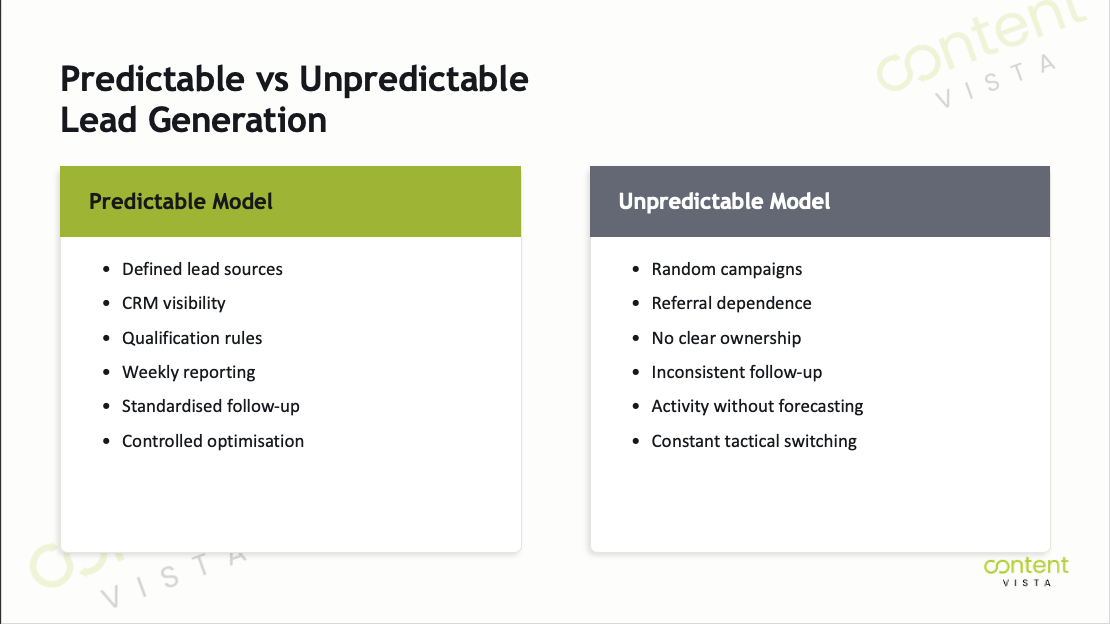
| Trait | Predictable Model | Unpredictable Model | Why It Matters |
|---|---|---|---|
| Lead sources | Defined and intentionally managed | Random or referral-dependent | Stable sources improve forecasting |
| Qualification | Clear lead qualification rules | Every inquiry treated the same | Sales teams focus on better-fit opportunities |
| Follow-up | Standardised response process | Inconsistent or delayed responses | Faster follow-up reduces leakage |
| CRM visibility | Pipeline stages tracked consistently | Leads scattered across tools or inboxes | Visibility improves diagnosis and optimisation |
| Reporting | Weekly metrics and feedback loops | Sporadic reporting or guesswork | Problems are identified earlier |
| Channel strategy | One primary engine owned first | Multiple disconnected tactics | Focus improves control and learning |
| Optimisation | One variable tested at a time | Constant changes across everything | Teams learn what actually improves performance |
| Pipeline planning | Revenue targets linked to lead targets | Activity measured without pipeline context | Better forecasting and resource allocation |
Predictability comes from standardisation and measurement not from constantly adding more channels, campaigns or marketing tools.
Here’s where most teams go wrong:
They try to fix unpredictability with more activity.
But more disconnected activity usually creates more noise, not more control.
Most businesses do not need more random marketing.
They need clearer ownership, tighter qualification, stronger follow-up discipline and better visibility into what consistently creates qualified opportunities over time.
The CONTROL Framework for Predictable Lead Generation
Most lead generation advice focuses on tactics.
Run ads. Publish content. Send cold emails. Improve SEO. Post on LinkedIn.
But tactics alone do not create predictability.
They create activity.
Predictable pipeline growth comes from operational control — understanding which variables influence lead flow, standardising the parts that matter and improving the system without creating unnecessary chaos.
That is where the CONTROL Framework comes in.
Quick note on scope before we get into it. Building a lead generation system and making that system predictable are two different jobs. If you are still assembling the engine itself — channels, capture, CRM, follow-up — start with our full guide to building a lead generation system and its VISTA architecture.
This blog post picks up where that one leaves off.
CONTROL is the operating discipline that runs inside that system. It is what makes lead flow measurable and predictable once the engine is already turning.
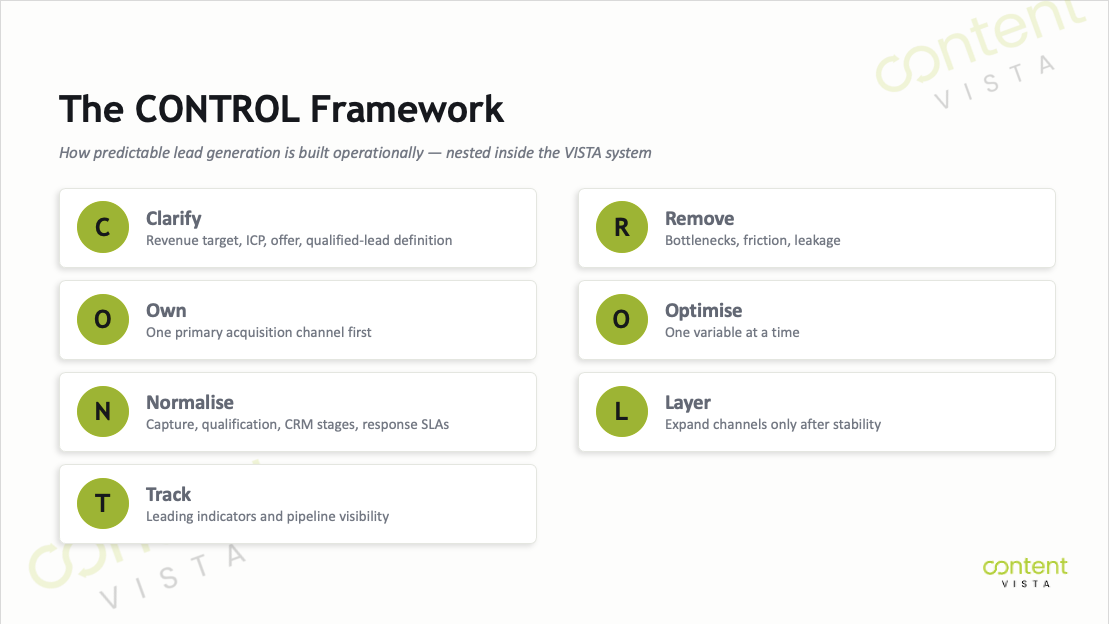
CONTROL Framework for Predictable Lead Generation
C — Clarify the revenue target, ICP, offer and what counts as a qualified lead
O — Own one primary acquisition path before expanding
N — Normalise lead capture, qualification rules, CRM stages, and response SLAs
T — Track leading indicators weekly, not just lagging outcomes monthly
R — Remove bottlenecks, leakage, and stage friction fast
O — Optimise one variable at a time
L — Layer secondary channels only after the first engine works
Clarify
Most unpredictable lead generation starts with unclear inputs.
If your business cannot clearly define:
the revenue target
the ideal customer profile
the offer
what qualifies as a sales-ready lead
then every downstream metric becomes unreliable.
Predictability improves when you work backwards from revenue instead of chasing vague lead volume.
Own
Many businesses spread themselves across too many channels too early.
LinkedIn. SEO. Paid ads. Cold email. Partnerships. Webinars. Newsletters.
Everything starts at once. Nothing gets deep enough to become reliable.
A predictable engine usually starts with one primary acquisition path that the business understands deeply and can improve consistently over time.
Ownership creates cleaner data, stronger optimisation, and clearer operational visibility.
Normalise
Lead generation becomes unstable when every lead is handled differently.
Capture forms, qualification rules, CRM stages, response expectations, and follow-up ownership all need standardisation.
Without operational consistency, pipeline reporting becomes noisy and difficult to improve.
That’s where many businesses quietly lose opportunities.
Track
Most companies review pipeline performance too late.
They look at monthly revenue instead of the leading indicators that influence pipeline quality earlier:
response speed
qualified opportunity rate
stage conversion
pipeline velocity
source-to-opportunity conversion
Predictability improves when you monitor the system continuously instead of reacting after revenue drops.
Remove
Every lead generation system leaks.
Weak landing pages. Slow follow-up. Poor qualification. Disconnected sales handoffs. Weak nurture flows.
These issues quietly reduce pipeline quality over time.
The goal is not perfection.
The goal is faster bottleneck detection and faster correction.
Optimise
Here’s where most teams create chaos:
They change targeting, messaging, landing pages, offers, follow-up timing, and channels all at once.
Then they cannot identify what actually improved performance.
Predictable systems isolate variables and optimise deliberately.
One meaningful change at a time.
Layer
Additional channels should strengthen a stable engine not compensate for a broken one.
A business that cannot reliably manage one acquisition path usually creates more complexity, not more predictability, by adding five more.
Layering works best after the first engine already has:
clear reporting
stable conversion flow
operational ownership
repeatable follow-up discipline
That is how lead generation gradually becomes more measurable, controllable, and scalable over time.
Step 1 - Clarify the Target Before You Build the Engine
Most lead generation systems become unpredictable long before campaigns fail.
They become unpredictable because the inputs were never clearly defined in the first place.
A lot of businesses start with vague goals like:
“We need more leads.”
“We should increase the pipeline.”
“We want more inbound.”
But predictable growth does not start with activity.
It starts with clarity.
If the target itself is unclear, every downstream metric becomes harder to interpret.
That is why strong lead generation systems begin with revenue-backward planning — defining the outcome first, then building the acquisition system around it.
Clarify the Revenue Target
A predictable pipeline starts with a revenue number, not a marketing tactic.
Without a defined revenue target, there is no reliable way to estimate:
how many opportunities are needed
how many qualified leads are required
how much acquisition capacity the business actually needs
which channels are realistic for the current stage
Think about it this way:
A business trying to close five high-ticket consulting clients per quarter needs a very different acquisition model from a business trying to generate hundreds of lower-ticket conversions every month.
Different revenue goals create completely different pipeline requirements.
That is why “more leads” is not a useful strategic target.
Revenue-backward planning creates the missing context.
Instead of asking:
“How do we get more leads?”
the better question becomes:
“What revenue target are we trying to support, and what lead flow is realistically required to support it?”
This is often where businesses realise the issue is not necessarily traffic volume.
It may be:
weak qualification
poor conversion flow
inconsistent follow-up
unclear positioning
pipeline leakage between stages
In many cases, this is where strategic alignment work through a Marketing Strategy & Growth Consulting engagement or a Marketing OS Sprint becomes more valuable than simply launching more campaigns.
Clarify the ICP and Offer
Even strong acquisition channels struggle when the ICP or offer is unclear.
Many businesses assume they have a lead generation problem when the real issue is:
weak positioning
unclear differentiation
broad targeting
mismatched messaging
an offer that does not create urgency
Here’s the problem:
If your business cannot clearly explain:
who the offer is for
what problem it solves
why it matters now
why this solution is different
then pipeline consistency becomes difficult no matter how much marketing activity exists.
That is why predictable lead generation depends heavily on strategic clarity before tactical scaling.
Channels amplify positioning.
They do not fix unclear positioning.
Clarify What Counts as a Qualified Lead
One of the biggest reasons forecasting breaks down is simple:
“Lead” means something different to everyone.
Marketing counts form submissions.
Sales counts booked conversations.
Founders count serious buying intent.
Without a shared definition, reporting becomes misleading very quickly.
A predictable system needs qualification rules before scale happens.
That does not require enterprise-level complexity.
But it does require clarity around questions like:
What makes a lead sales-ready?
Which industries or business types are a fit?
What buying signals matter?
Which inquiries should be nurtured instead of routed directly to sales?
What disqualifies a lead entirely?
Unclear inputs create unreliable outputs. Predictable lead generation becomes possible when revenue targets, ICP definition, offer positioning, and qualification rules are aligned before channels are scaled.
Businesses that skip this foundation often create more lead volume without creating a more qualified pipeline.
Step 2 - Own One Primary Acquisition Path Before Expanding
One of the fastest ways to make lead generation unpredictable is trying to operate too many acquisition channels at the same time.
A business launches LinkedIn content, cold email, SEO, paid ads, webinars, partnerships, newsletters, and outbound sequences simultaneously — then struggles to understand which channel is actually producing qualified opportunities.
The result is usually channel chaos:
fragmented reporting
inconsistent messaging
weak follow-up
scattered ownership
shallow optimisation
low signal clarity
Predictability improves when one acquisition path becomes reliable before the next layer is added.
That does not mean businesses should only use one channel forever.
It means the first engine should become measurable, operationally stable, and consistently improvable before complexity increases.
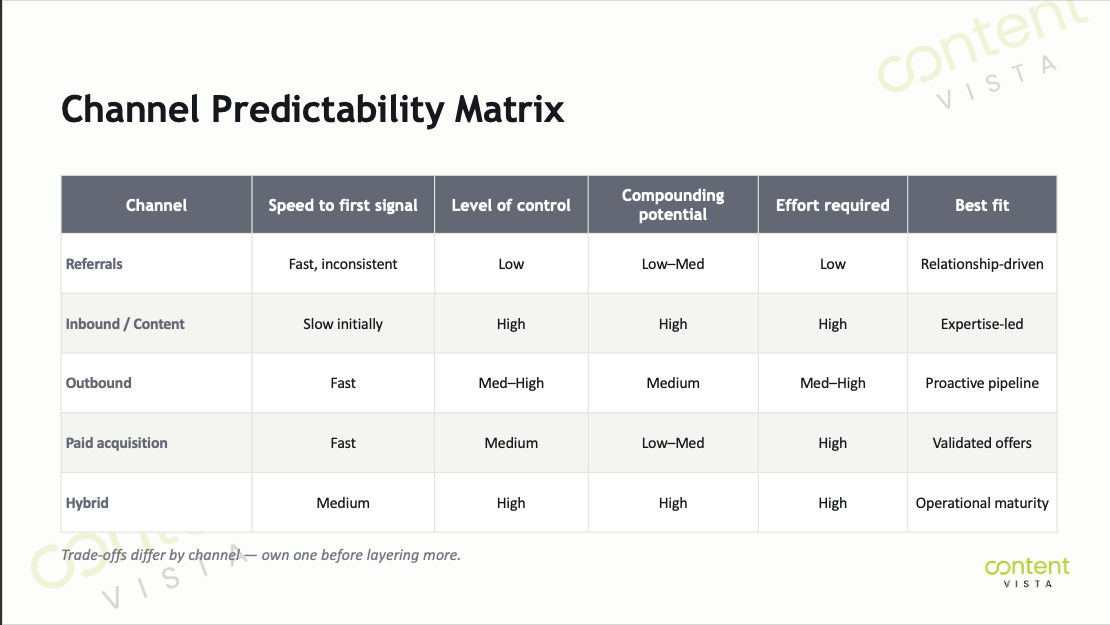
| Channel Type | Speed to First Signal | Level of Control | Compounding Potential | Effort Required | Best Fit |
|---|---|---|---|---|---|
| Referrals | Fast but inconsistent | Low | Low–Medium | Low | Relationship-driven businesses |
| Inbound/content | Slow initially | High | High | High | Expertise-led and trust-based businesses |
| Outbound | Fast | Medium–High | Medium | Medium–High | Businesses needing proactive pipeline creation |
| Paid acquisition | Fast | Medium | Low–Medium | High | Businesses with validated offers and conversion systems |
| Hybrid system | Medium | High | High | High | Businesses with operational maturity and CRM discipline |
Referral-Led Lead Generation
Referrals often create the highest-trust opportunities because credibility is transferred through existing relationships.
The problem is not quality.
The problem is controllability.
Referral-led growth can produce strong short-term pipeline performance, but it is difficult to forecast because your business does not fully control timing, volume, or consistency.
That is why referrals work best as a supporting acquisition source — not the entire growth strategy.
Businesses that rely only on referrals often experience extreme swings between busy periods and pipeline slowdowns.
Inbound/Content-Led Lead Generation
Inbound systems focus on attracting demand through:
content
SEO
newsletters
LinkedIn thought leadership
webinars
lead magnets
educational assets
This model compounds well over time because content assets continue generating visibility and trust long after publication.
But here’s where most teams go wrong:
They expect immediate pipeline movement from channels designed for long-term compounding.
Inbound systems require patience, positioning clarity, and operational consistency.
This model works especially well for expertise-led brands and complex-sale businesses where trust matters before conversion.
Businesses building a content-led pipeline often benefit from a more structured Inbound Magnet System instead of disconnected content activity.
It is also important to distinguish inbound capture from actual demand creation.
Many businesses try to capture demand before they have built enough market attention or positioning authority in the first place.
In those cases, the real issue may be demand generation — not lead capture mechanics alone.
Outbound Lead Generation
Outbound creates a pipeline proactively instead of waiting for inbound interest.
This usually includes:
cold email
outbound LinkedIn outreach
targeted prospecting
account-based outreach
outbound sequences
Outbound often produces faster pipeline signals because your business controls targeting and outreach volume directly.
But predictability depends heavily on:
segmentation quality
messaging clarity
follow-up discipline
deliverability
qualification logic
Poor outbound systems create activity without qualified conversations because teams optimise for sends instead of relevance.
A structured outbound system such as the Cold Email Conversion Lab or a LinkedIn Growth Engine typically performs far better than scattered outreach experiments across multiple tools and channels.
Paid Lead Generation
Paid acquisition creates speed.
But speed amplifies system weaknesses.
If:
qualification is weak
landing pages are unclear
follow-up is slow
CRM routing is inconsistent
then paid traffic often scales inefficiency instead of pipeline quality.
Paid channels work best after:
the offer is validated
conversion flow is stable
qualification logic exists
reporting visibility is clear
Without those foundations, paid acquisition can create expensive noise rather than predictable opportunities.
Hybrid Lead Generation
Hybrid systems combine multiple channels intentionally.
Examples include:
LinkedIn content + outbound follow-up
SEO + newsletter nurture
paid ads + CRM automation
webinars + outbound sales sequences
This is often where the strongest long-term predictability emerges because channels reinforce each other.
But hybrid systems only work well when the business already understands:
attribution
channel ownership
qualification standards
reporting discipline
operational coordination
Otherwise, the business simply creates more moving parts without improving control.
The goal is not to be everywhere. The goal is to own one reliable acquisition engine deeply enough that additional channels improve predictability instead of increasing operational chaos.
That is why mature growth systems usually expand carefully.
One stable engine first.
Then layering.
Step 3 - Normalise Capture, Qualification, CRM Stages and Follow-Up
Many lead generation systems become unpredictable for one simple reason:
Every lead is handled differently.
Some inquiries get immediate follow-up. Others sit untouched for days.
Some leads enter the CRM properly. Others stay buried in inboxes, spreadsheets, or Slack messages.
Some prospects get qualified early. Others move through the pipeline without any clear fit criteria.
That operational inconsistency creates invisible leakage across the entire system.
Predictability improves when lead handling becomes standardised enough to measure, optimise, and improve consistently over time.
Standardise Lead Capture
Lead capture should never feel improvised.
Every acquisition channel needs:
a clear offer
a defined next step
proper routing
consistent data collection
CRM integration
Whether the lead comes through:
LinkedIn
outbound
paid acquisition
webinars
SEO
referrals
newsletters
the capture process should create operational visibility immediately.
Here’s the problem:
Weak capture systems quietly create downstream issues such as:
unclear handoffs
missing lead data
inconsistent qualification
delayed response
broken attribution
The goal is not collecting the maximum number of form submissions.
The goal is creating structured entry points into the pipeline.
This is where stronger Systems, Conversion & Growth Infrastructure becomes critical as acquisition complexity increases.
Standardise Qualification Rules
One of the fastest ways to create sales inefficiency is allowing every team member to define “qualified lead” differently.
Without qualification standards:
sales teams waste time
reporting becomes misleading
forecasting loses accuracy
conversion analysis becomes unreliable
Qualification rules should clarify:
who is a fit
who is not
which signals indicate buying intent
which inquiries require nurture instead of direct sales outreach
The system does not need enterprise-level complexity.
It simply needs enough consistency to improve decision-making.
Standardise CRM Stages
A CRM is not just a contact database.
It is the operational map of your pipeline.
Without standardised stages, businesses lose visibility into:
where leads are entering
where opportunities stall
where conversion drops
how pipeline velocity changes over time
That is why CRM visibility and pipeline tracking matter so much in predictable lead generation.
A predictable system usually defines stages such as:
inquiry
qualified lead
meeting booked
sales opportunity
proposal
closed-won or closed-lost
That structure creates cleaner reporting, clearer ownership, and more reliable forecasting.
Here’s where most teams go wrong:
They try to scale acquisition before they can clearly see what is happening inside the pipeline.
Without visibility, optimisation becomes guesswork.
Standardise Follow-Up Speed and Ownership
Even strong acquisition systems fail when follow-up is inconsistent.
Predictability drops quickly when:
nobody owns lead routing
response timing varies
follow-up sequences are unclear
reminders are missing
handoffs are delayed
This is where response SLAs become valuable.
A response SLA defines:
who responds
how quickly
through which channel
what happens next if the lead does not reply
Even simple standards dramatically improve operational consistency.
Think about it this way:
A business does not need perfect automation to improve predictability.
It needs fewer uncontrolled variables.
Mini Checklist: What Should Be Standardised?
Lead capture forms and routing
Qualification criteria
CRM stages and definitions
Follow-up ownership
Response-time expectations
Lead-source tracking
Pipeline reporting cadence
Opportunity-stage visibility
Predictable lead generation depends on operational consistency. When capture, qualification, CRM tracking, and follow-up become standardised, pipeline visibility improves and leakage becomes much easier to diagnose.
The goal is not rigid bureaucracy.
The goal is creating enough structure that your business can clearly identify:
what is working
where leads are leaking
which stages need improvement
how pipeline quality changes over time
That is how lead generation starts operating like a measurable growth system instead of a collection of disconnected marketing activities.
Step 4 - Track the Metrics That Predict Pipeline
One of the biggest mistakes in lead generation is measuring activity without measuring pipeline quality.
Many businesses track:
website traffic
impressions
clicks
likes
form submissions
But those metrics alone do not tell you whether the system is actually creating qualified opportunities.
That’s the real issue.
Lead volume alone is not enough.
Predictable pipeline growth depends on leading indicators — the operational metrics that show whether lead quality, conversion flow, and sales movement are improving before revenue results appear.
That distinction matters because revenue is a lagging indicator.
By the time revenue drops, the underlying problem usually started weeks or months earlier.
Key Metrics That Predict Pipeline Health
- Response speed
- Lead-to-opportunity rate
- Cost per qualified lead
- Stage conversion rate
- Pipeline velocity
- Source-to-opportunity conversion
- Meeting booked rate
- Show rate
- Qualified opportunity rate
Response Speed
Fast follow-up is one of the clearest indicators of pipeline discipline.
Even strong acquisition channels lose effectiveness when leads wait too long for qualification, routing, or outreach.
Slow response times create hidden leakage inside the system.
Lead-to-Opportunity Rate
This metric measures how many raw leads become legitimate sales opportunities.
A business generating large lead volume with weak conversion into qualified conversations usually has:
poor targeting
weak qualification
unclear messaging
low-intent acquisition sources
This is one of the fastest ways to separate a “busy pipeline” from a healthy one.
Cost Per Qualified Lead
Many teams optimise for cheap leads instead of qualified leads.
But a lower cost per lead is not automatically better if downstream conversion quality is weak.
Cost per qualified lead creates a more realistic picture of acquisition efficiency.
Stage Conversion Rate
Predictable systems track how prospects move between stages.
For example:
inquiry → meeting booked
meeting booked → attended
attended → qualified opportunity
opportunity → proposal
proposal → closed deal
This visibility helps identify where friction, qualification issues, or messaging gaps are slowing momentum.
Pipeline Velocity
Pipeline velocity measures how quickly opportunities move through the system.
Slow-moving pipelines often indicate:
unclear next steps
weak sales process
delayed follow-up
poor qualification
mismatched expectations between marketing and sales
Source-to-Opportunity Conversion
Not all lead sources create the same quality.
A channel generating fewer leads may still outperform another if:
opportunity quality is higher
sales cycles are shorter
conversion rates are stronger
This is why lead volume alone rarely tells the full story.
Meeting Booked Rate, Show Rate and Qualified Opportunity Rate
These metrics reveal whether your acquisition system is creating real buying intent or simply generating inquiries.
A business with:
high meeting-booked rates
strong show rates
consistent qualification quality
usually has stronger targeting and positioning than a business generating large volumes of low-intent leads.
Predictability improves when businesses measure the movement of qualified opportunities through the pipeline — not just the number of leads entering the top of the funnel.
Once these metrics become visible, the next step becomes much clearer:
working backwards from revenue targets to understand how many qualified opportunities and leads the business actually needs.
Step 5 - Work Backwards From Revenue to Lead Targets
Most businesses track lead generation forward.
They ask:
How many leads did we get?
How many clicks did the campaign generate?
How many meetings were booked?
But predictable pipeline planning works in the opposite direction.
It starts with revenue.
That shift matters because “more leads” is not a business target.
Revenue is.
When you work backwards from revenue goals, lead generation becomes measurable instead of emotional.
Start With the Revenue Target
The first step is defining the revenue outcome your pipeline needs to support.
For example:
quarterly revenue goal
annual revenue target
monthly sales target
new client acquisition goal
Without that number, there is no reliable way to estimate whether current lead flow is actually sufficient.
Add Average Deal Size
Next, estimate the average value of a closed deal or client.
This creates the bridge between revenue and sales volume.
A business selling:
high-ticket consulting engagements
recurring retainers
enterprise software
lower-ticket services
productised offers
will require very different lead volumes to hit the same revenue number.
That is why pipeline maths matters.
Calculate Wins Needed
Once revenue and average deal size are clear, calculate the approximate number of closed deals required.
Simple example:
Revenue target: $240,000
Average deal size: $12,000
Required wins: 20 deals
This is often where businesses realise the problem is either much smaller — or much larger — than they originally assumed.
Estimate Opportunities Needed
Closed deals do not come from every opportunity.
If your business typically closes:
20% of qualified opportunities
then:
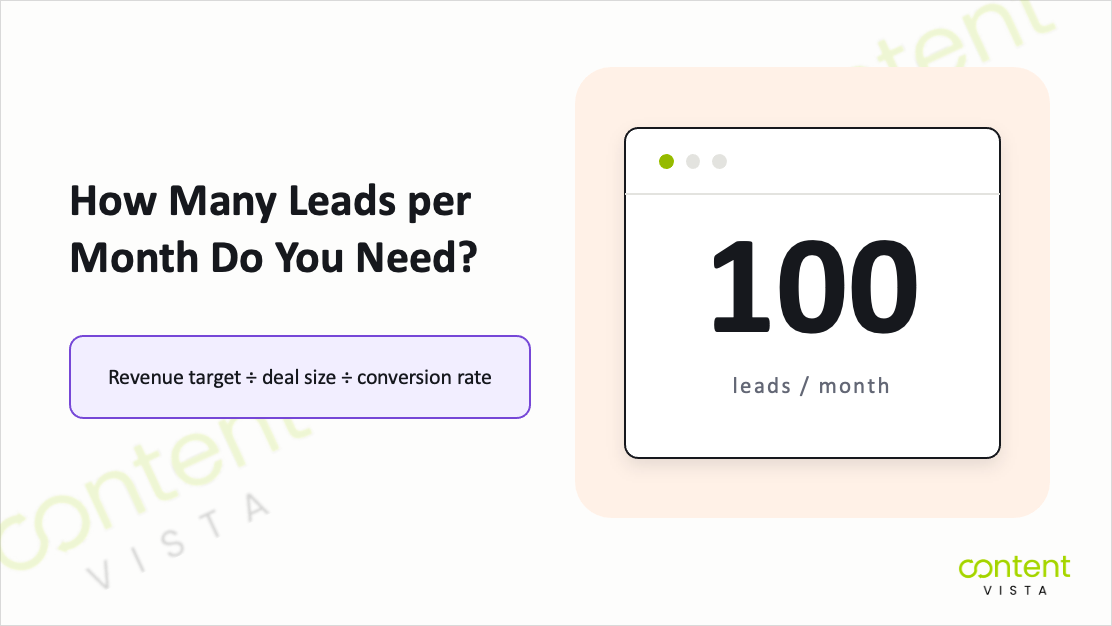
20 closed deals would require roughly 100 qualified opportunities
That is where conversion visibility becomes critical.
Businesses without clear opportunity-stage tracking often underestimate how much pipeline movement is actually required.
Estimate Qualified Leads Needed
The next step is estimating how many qualified leads are required to create those opportunities.
For example:
100 opportunities needed
25% lead-to-opportunity conversion rate
Approximate qualified leads required: 400
Now the planning model becomes much clearer.
Instead of “trying to get more leads,” you can quantify exactly what the pipeline needs to support the revenue target.
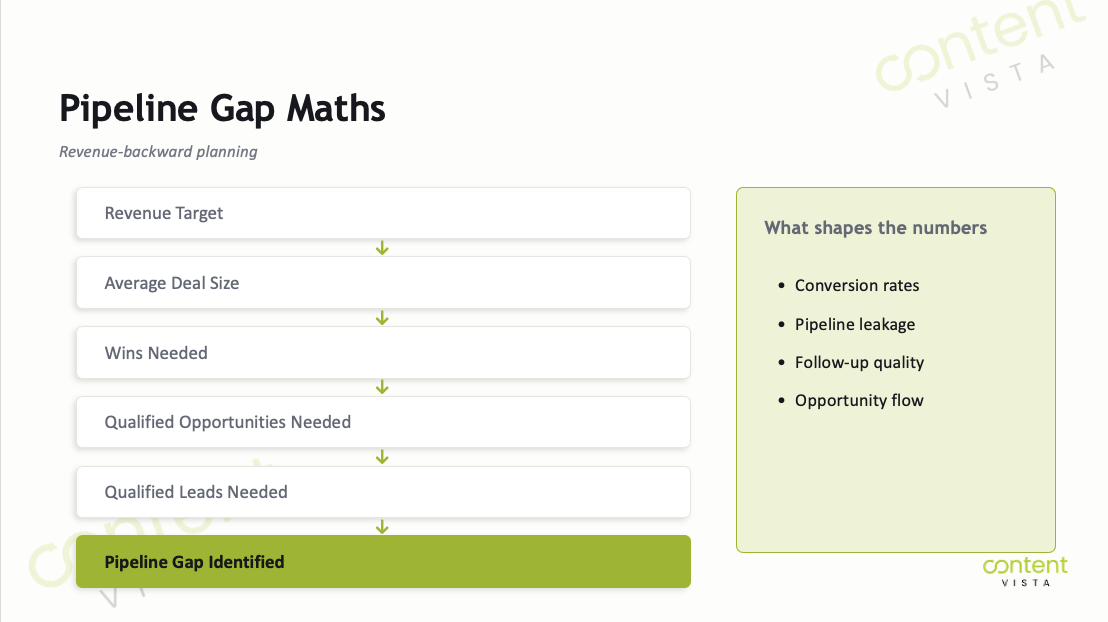
| Revenue Target | Average Deal Size | Wins Needed | Opportunities Needed | Qualified Leads Needed |
|---|---|---|---|---|
| $240,000 | $12,000 | 20 | 100 | 400 |
| $500,000 | $25,000 | 20 | 80 | 320 |
| $120,000 | $6,000 | 20 | 67 | 270 |
| $1,000,000 | $50,000 | 20 | 100 | 500 |
Examples above are illustrative only. Actual pipeline requirements depend on real conversion rates, sales cycles, qualification quality, and channel performance.
Compare Required Lead Flow With Current Lead Flow
This is where the real diagnosis happens.
Once you know:
required qualified leads
required opportunities
current conversion rates
current lead flow
it becomes much easier to identify the actual bottleneck.
Here’s the problem:
The issue may not be traffic.
It may be:
weak qualification
poor conversion rates
slow follow-up
low meeting show rates
weak positioning
pipeline leakage between stages
That is why predictable lead generation depends on pipeline maths, not guesswork.
Most businesses do not have a lead problem in isolation. They have a conversion visibility problem. Revenue-backward planning reveals whether the real gap exists in acquisition, qualification, conversion, or follow-up.
Once those numbers become visible, forecasting becomes far more realistic.
Instead of reacting emotionally to pipeline fluctuations, your business can identify:
how much lead flow is actually required
where opportunities are leaking
which metrics matter most
whether current acquisition systems can realistically support growth targets
Calculate how many qualified leads and opportunities you actually need to hit your revenue target.
Use the Lead Generation Capacity Calculator.
Step 6 - Remove Bottlenecks Before Adding More Channels
One of the most common lead generation mistakes is trying to solve pipeline inconsistency by increasing traffic instead of fixing leakage.
A business sees weak pipeline performance and immediately adds:
another ad campaign
another outbound sequence
another social platform
another lead source
But if the existing system already leaks opportunities, more traffic usually amplifies inefficiency instead of improving predictability.
That is why strong lead generation systems focus heavily on control surfaces — the operational points where conversion quality can be influenced, measured, and improved.
Landing Page Conversion Leaks
Many acquisition channels fail long before the sales conversation happens.
The issue is often the transition between attention and action:
unclear positioning
weak offers
confusing messaging
too many choices
poor mobile experience
unclear next steps
Even small amounts of friction at the capture stage can significantly reduce downstream pipeline quality.
Form Friction and Capture Problems
Businesses frequently collect either:
too little information to qualify leads properly
OR
too much information too early
Both create leakage.
Short forms may increase raw lead volume while reducing qualification quality.
Overly complex forms may discourage legitimate prospects entirely.
The goal is not maximising submissions.
The goal is improving qualified conversion flow.
Slow Response and Weak Follow-Up
Pipeline leakage increases dramatically when leads sit untouched.
This happens more often than most teams realise:
no clear ownership
delayed routing
inconsistent outreach
missed follow-ups
weak sequencing discipline
Even highly interested prospects lose momentum quickly when response systems are weak.
Poor Qualification
A system without qualification logic creates hidden operational waste.
Sales teams spend time on:
poor-fit leads
low-intent inquiries
mismatched buyers
prospects with unrealistic expectations
At the same time, stronger opportunities may not receive enough attention.
That is why predictability depends heavily on qualification discipline, not just acquisition volume.
No Nurture Process
Not every lead is ready immediately.
Businesses that ignore nurture often lose future opportunities simply because the timing was not right during the first interaction.
Simple nurture systems — newsletters, educational sequences, retargeting, or follow-up content — help reduce leakage between initial interest and future buying intent.
Sales Handoff Gaps
Lead generation and sales frequently operate like disconnected systems.
Marketing celebrates lead volume.
Sales complains about quality.
Nobody owns the transition between the two.
That handoff gap quietly damages predictability because opportunities disappear without clear accountability or reporting visibility.
Channel-Message Mismatch
Another overlooked bottleneck appears when channel intent and messaging do not align.
For example:
high-intent outbound messaging paired with weak landing pages
educational content paired with aggressive sales CTAs
paid traffic routed into unclear qualification flows
This creates friction because the buyer experience feels disconnected.
No Attribution Visibility
If your business cannot identify:
which channels create qualified opportunities
which campaigns influence revenue
where leads convert best
then optimisation becomes reactive guesswork.
This is why stronger Lead Generation systems and Systems, Conversion & Growth Infrastructure visibility matter so much as acquisition complexity grows.
Predictable lead generation improves when businesses reduce leakage across the system’s control surfaces : capture, qualification, routing, follow-up, nurture and conversion visibility before adding more channels or campaigns.
In many cases, fixing these operational bottlenecks creates stronger pipeline growth than launching entirely new acquisition efforts.
Step 7 - Optimise One Variable at a Time
Many lead generation systems become harder to improve because teams change too many things simultaneously.
The campaign underperforms, so they:
rewrite the messaging
change the audience
redesign the landing page
shorten the form
switch the CTA
change the follow-up sequence
add another channel
Then results improve — or decline — and nobody knows why.
That creates operational confusion instead of learning.
Predictable lead generation depends heavily on one-variable optimisation: improving one controllable element at a time so your business can clearly identify what influenced performance.
In simple terms, one-variable optimisation means:
keep most of the system stable
change one meaningful input
measure the result
decide whether the change improved pipeline quality
That’s it.
This approach creates cleaner feedback loops and far better decision-making.
Variables Worth Testing
Different stages of the system contain different optimisation opportunities.
Common variables include:
offer positioning
audience targeting
subject lines
call-to-action wording
landing page headlines
form length
follow-up timing
nurture sequence structure
qualification criteria
The important point is not testing everything constantly.
The important point is testing deliberately.
Here’s where most teams go wrong:
They mistake constant change for optimization.
But uncontrolled experimentation usually creates more noise than insight.
A Simple Example
Imagine an outbound campaign generating strong open rates but weak meeting-booked rates.
A lot of teams would immediately rebuild the entire campaign.
But a more predictable approach would isolate one variable first.
For example:
improve the CTA
tighten audience segmentation
shorten the qualification step
change follow-up timing
That creates measurable insight instead of random experimentation.
One-variable optimization reduces noise inside the system. The goal is not constant change. The goal is understanding which changes actually improve qualified pipeline performance.
This becomes even more important as lead generation systems grow more complex.
Businesses operating across:
outbound
inbound
paid acquisition
CRM nurture
LinkedIn content
sales follow-up
can easily create overlapping changes that distort attribution and make optimisation difficult.
Predictability improves when teams slow down enough to identify:
which variables influence conversion
which changes improve opportunity quality
which adjustments reduce leakage
which experiments are actually repeatable
That is how lead generation evolves from reactive marketing into a measurable growth system.
Step 8 - Layer Channels Only After the First Engine Works
Once a business finds an acquisition channel that consistently produces qualified opportunities, the temptation is usually immediate expansion.
Add more platforms.
Add more campaigns.
Add more automation.
Add more channels.
But layering channels is not the same as randomly increasing marketing activity.
Strong lead generation systems expand carefully.
Weak systems expand reactively.
That distinction matters because every additional channel introduces:
more operational complexity
more reporting requirements
more follow-up coordination
more attribution challenges
more opportunities for leakage
That is why layering should happen only after the first acquisition engine becomes operationally stable.
A stable engine usually has:
repeatable lead flow
clear qualification logic
measurable conversion stages
consistent follow-up
reliable reporting visibility
identifiable optimisation patterns
Without those foundations, adding channels often creates more noise than pipeline growth.
Layering Should Strengthen the Existing System
The goal of layering is reinforcement, not distraction.
For example:
a content-led engine may expand into newsletter nurture
a LinkedIn-led engine may add outbound follow-up sequences
a paid acquisition engine may add CRM nurture and retargeting
a webinar funnel may introduce structured sales sequences afterward
Each additional layer should improve:
conversion continuity
buyer movement
qualification visibility
pipeline consistency
—not simply increase activity.
A business running an inbound content engine may eventually add newsletter nurture because the audience already exists and engagement signals are measurable.
A business operating a LinkedIn Growth Engine may later introduce cold outreach because the messaging and audience targeting are already validated.
Likewise, outbound systems often become more effective when paired with:
educational content
case studies
webinars
CRM nurture
retargeting visibility
instead of relying only on direct outreach.
That is also where more integrated systems like an AI Client Acquisition Stack become valuable — not because more tools automatically improve growth, but because coordinated systems create stronger operational visibility and follow-through.
Channel Layering Requires Operational Maturity
Layering works best when your business already understands:
attribution
reporting cadence
qualification standards
ownership responsibilities
CRM discipline
follow-up coordination
Otherwise, expansion creates fragmented execution.
That is how businesses accidentally create channel sprawl:
multiple disconnected tools
overlapping messaging
duplicate outreach
inconsistent reporting
unclear accountability
A second channel should improve the predictability of the first system — not compensate for weaknesses the business has not solved yet.
The strongest acquisition systems eventually become coordinated ecosystems rather than isolated campaigns.
But they get there gradually.
One stable engine first.
Then intelligent layering.
Where AI Helps and Where It Does Not
AI is changing how lead generation systems operate.
But one of the biggest mistakes businesses make is treating AI like a replacement for strategy instead of an execution layer inside a structured system.
AI-assisted workflows can absolutely improve operational efficiency, speed, and visibility.
They can reduce manual work, improve process consistency, and help teams manage pipeline complexity more effectively.
What AI usually cannot do well on its own is create strategic clarity.
That distinction matters.
A weak acquisition system does not suddenly become predictable just because AI tools are added on top of it.
Where AI Helps Most
AI performs best in areas that involve:
repetition
processing speed
pattern organisation
operational support
workflow assistance
This includes:
research
segmentation
contact enrichment
CRM hygiene
reporting summaries
follow-up reminders
first-draft personalisation
content repurposing
basic lead scoring
For example, AI-assisted workflows can help sales and marketing teams:
identify target accounts faster
clean and organise CRM records
summarise lead activity
generate first-draft outbound variations
flag dormant opportunities
repurpose webinar content into nurture assets
support faster reporting cycles
These use cases improve operational control surfaces without replacing strategic decision-making.
Where Human Judgment Still Matters
Lead generation becomes unpredictable when businesses automate decisions that still require context, positioning awareness, or relationship intelligence.
AI should not replace:
ICP judgment
offer strategy
positioning decisions
messaging strategy
objection handling
discovery conversations
sales relationship building
Those areas depend heavily on:
market understanding
emotional nuance
commercial context
buyer psychology
strategic prioritisation
AI can assist those functions.
But it should not own them entirely.
Here’s where most teams go wrong:
They automate before the underlying strategy is clear.
That usually creates faster execution - but not better pipeline quality.
What to Automate vs What to Keep Human
| Function | Best Use of AI | Best Kept Human |
|---|---|---|
| Research | Market summaries, enrichment, data organisation | Strategic interpretation |
| Segmentation | Pattern grouping, filtering | ICP decisions |
| CRM management | Hygiene, tagging, reminders | Pipeline judgment |
| Lead scoring | Initial prioritisation | Final qualification |
| Content creation | Repurposing, first drafts | Positioning and messaging |
| Outreach | Personalisation assistance | Relationship context |
| Follow-up | Automation support | Sales conversations |
| Reporting | Dashboard summaries | Strategic decision-making |
AI-assisted workflows improve predictability when they strengthen operational consistency, reporting visibility, follow-up discipline, and execution speed — not when they attempt to replace strategy, positioning, or human sales judgment.
That is why stronger AI-enabled acquisition systems are usually built around workflow integration instead of isolated AI tools.
Businesses building more advanced infrastructure often move toward coordinated systems where:
CRM automation
outbound sequencing
reporting
nurture workflows
content distribution
follow-up orchestration
operate together inside an AI Client Acquisition Stack.
The important question is not whether AI is involved.
The important question is whether the system itself is becoming more measurable, controllable and operationally reliable over time.
A 90-Day Plan to Build Predictable Lead Generation
Predictable lead generation is not built overnight.
A business does not go from an inconsistent pipeline to perfectly forecastable growth in 90 days.
Markets shift. Conversion rates evolve. Acquisition systems require ongoing optimisation.
But a serious team can build the operational foundation for measurable, repeatable lead flow within 90 days.
That is the purpose of this roadmap.
This is a minimum viable predictability plan not a promise of guaranteed pipeline outcomes.
The goal is operational visibility:
understanding where opportunities come from
identifying leakage
building reporting discipline
creating repeatable acquisition processes
improving control over pipeline movement
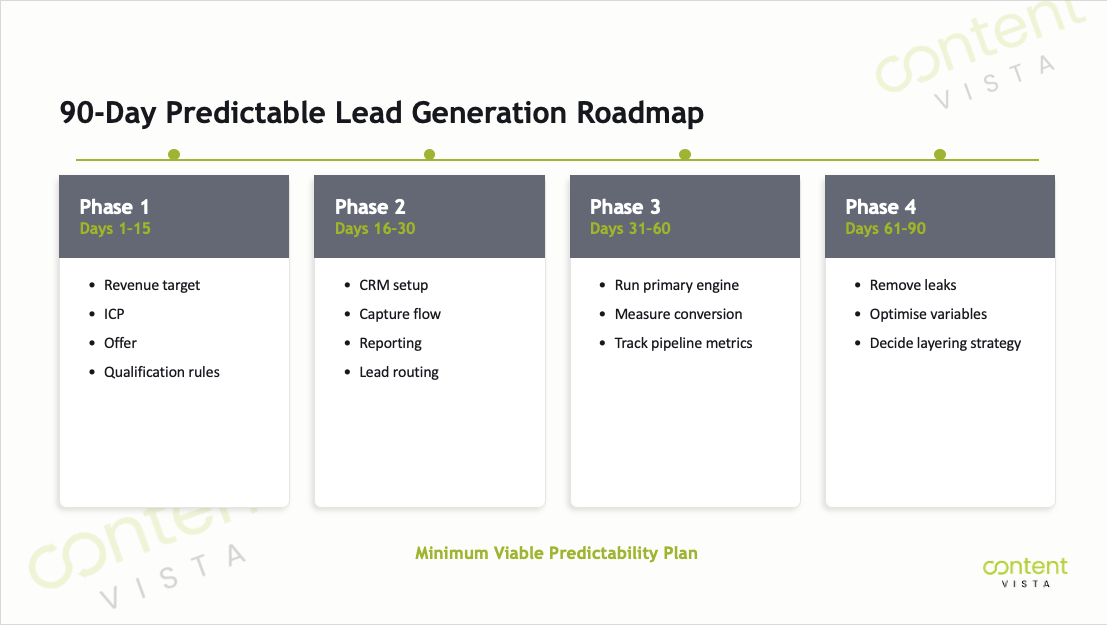
| Phase | Objective | Effort Level | Common Risk | Metric to Watch |
|---|---|---|---|---|
| Days 1–15 | Clarify targets, ICP, qualification rules | Medium | Vague positioning | Qualified lead definition |
| Days 16–30 | Build CRM, capture flow, reporting visibility | Medium–High | Weak operational setup | Response speed |
| Days 31–60 | Run and stabilise the primary acquisition engine | High | Channel inconsistency | Lead-to-opportunity rate |
| Days 61–90 | Optimise bottlenecks and prepare layering decisions | Medium–High | Expanding too early | Qualified opportunity rate |
Days 1-15: Clarify the Target and Define the System
The first phase focuses on strategic clarity.
This includes:
defining the revenue target
identifying the ICP
refining the offer
defining qualification standards
selecting the primary acquisition channel
establishing reporting expectations
Most unpredictability starts here.
If your business cannot clearly define:
who it wants to attract
what counts as a qualified lead
which pipeline metrics matter
which acquisition path will be prioritised
then optimisation becomes much harder later.
This stage should also establish:
ownership responsibilities
reporting cadence
CRM structure
follow-up expectations
The goal is not speed.
The goal is alignment.
Days 16-30: Build the Capture and CRM Foundation
Once the strategy is clear, the operational foundation needs to support it.
This phase usually includes:
landing pages
forms
qualification flows
CRM setup
lead routing
response workflows
meeting-booking infrastructure
basic reporting dashboards
This is also where businesses identify early leakage points:
weak forms
unclear messaging
slow response systems
missing CRM stages
inconsistent ownership
Predictable pipelines require visibility before scale.
Without reliable capture and reporting infrastructure, lead generation becomes difficult to diagnose later.
Days 31-60: Run the Primary Engine
This phase focuses on operational learning.
The business begins actively running the primary acquisition channel:
outbound
LinkedIn
SEO/content
paid acquisition
webinars
partnerships
referral systems
The purpose is not just generating leads.
The purpose is understanding:
conversion patterns
qualification quality
buyer behaviour
pipeline movement
follow-up performance
operational bottlenecks
This is where leading indicators become critical:
response speed
meeting-booked rate
show rate
opportunity conversion
qualification quality
Here’s where most teams go wrong:
They attempt expansion too early.
That usually creates noise before the first engine becomes stable enough to optimise properly.
Days 61–90: Optimise, Remove Leaks and Decide What to Layer Next
By this stage, the business should have enough operational data to identify:
where leads are leaking
which stages create friction
which messaging performs best
which conversion points need improvement
whether the acquisition channel is repeatable enough to scale
This is where one-variable optimization becomes especially important.
Instead of rebuilding everything, the team improves:
targeting
follow-up timing
qualification rules
landing page messaging
CTA structure
nurture flow
The final goal of this phase is not simply “more leads.”
It is understanding whether the first acquisition engine is stable enough to support:
higher volume
operational scaling
secondary channel layering
more advanced automation
multi-channel coordination
A predictable lead generation system is built through operational learning, measurement, and controlled optimization: not by launching as many channels as possible in the shortest amount of time.
After 90 days, most businesses will not have a perfectly predictable pipeline.
But strong teams will have:
clearer pipeline visibility
measurable conversion stages
stronger qualification discipline
more reliable reporting
better operational control
a much clearer understanding of where future growth should come from
Prediction Readiness Scorecard
Most businesses do not need more lead generation advice first.
They need a clearer diagnosis of where predictability is breaking down inside the current system.
This scorecard is a quick self-check designed to help you identify whether your lead engine is operationally ready for predictable pipeline growth.
It is not a full audit.
It is a fast visibility exercise.
Score each category from:
1 = weak or inconsistent
3 = partially structured
5 = highly defined and measurable
| Area | Questions to Ask | Score (1–5) |
|---|---|---|
| Offer Clarity | Is the offer clearly defined, differentiated, and tied to a specific business problem? | [ ] |
| Source Reliability | Does the business have at least one acquisition channel producing opportunities consistently? | [ ] |
| Landing-Page Capture | Are landing pages, forms, and CTAs converting qualified interest effectively? | [ ] |
| Follow-Up Speed | Are leads routed and contacted quickly with clear ownership? | [ ] |
| Lead Qualification | Does the business have shared qualification criteria for sales-ready opportunities? | [ ] |
| CRM Visibility | Can the team clearly track stages, opportunity movement, and pipeline status? | [ ] |
| Conversion Feedback Loop | Are conversion metrics reviewed regularly to improve targeting, messaging, and follow-up? | [ ] |
How to Interpret the Score
30–35 → Strong operational foundation for predictable lead generation
20–29 → Some predictability exists, but leakage and inconsistency are still limiting growth
Below 20 → The business likely has fragmented acquisition activity instead of a measurable lead generation system
Most unpredictable pipelines are not caused by one major failure. They are usually caused by multiple small gaps across targeting, qualification, follow-up, visibility, and optimisation working together.
Think about it this way:
Strong acquisition with weak qualification creates pipeline waste.
Strong lead volume with weak CRM visibility creates forecasting problems.
Strong messaging with slow follow-up creates conversion leakage.
Strong content with weak capture systems reduces opportunity creation.
That is why predictability depends on coordinated systems, not isolated tactics.
This scorecard is intentionally lightweight.
Its purpose is to help you identify whether the operational foundations for measurable pipeline growth actually exist.
The next step is quantifying the real pipeline gap:
how many qualified opportunities are required
how many leads are needed
where conversion bottlenecks exist
whether current lead flow realistically supports revenue goals
Score your current lead engine, then calculate the real pipeline gap.
Use the Lead Generation Capacity Calculator.
Common Mistakes That Make Lead Generation Unpredictable
Most unpredictable lead generation systems do not fail because the business lacks effort.
They fail because small operational mistakes compound over time.
Many of these issues are extremely common, especially in growing businesses trying to scale pipeline quickly without enough process visibility.
Common Mistakes That Reduce Predictability
- Adding too many channels too early
- Treating predictability as certainty
- Relying only on referrals
- Tracking leads instead of qualified opportunities
- Slow follow-up
- Weak CRM discipline
- Vague qualification criteria
- Over-automating before messaging works
- Changing too many variables at once
- Skipping nurture systems
Adding Too Many Channels Too Early
Many businesses try to accelerate growth by launching multiple acquisition channels simultaneously.
The result is usually fragmented execution:
inconsistent messaging
weak reporting
scattered ownership
shallow optimisation
Predictability improves when one engine becomes operationally stable before expansion happens.
Treating Predictability as Certainty
Predictable lead generation does not mean perfectly stable lead volume every week.
Markets fluctuate. Buyer timing changes. Campaign performance shifts.
The goal is not certain. .
The goal is measurable visibility and controllable improvement over time.
Relying Only on Referrals
Referrals can produce excellent opportunities, but they are difficult to forecast consistently.
Businesses that depend entirely on referrals often struggle with feast-famine pipeline cycles because they do not fully control acquisition flow.
Tracking Leads Instead of Qualified Opportunities
Raw lead volume can create false confidence.
A campaign generating many inquiries may still produce weak pipeline quality if:
qualification is poor
follow-up is inconsistent
conversion rates are weak
buyer intent is low
Qualified opportunity flow is usually a much more useful metric than lead count alone.
Slow Follow-Up
Strong acquisition systems still fail when leads sit untouched.
Delayed routing, inconsistent outreach, and unclear ownership quietly reduce conversion quality even when lead generation appears healthy on the surface.
Weak CRM Discipline
Many businesses treat CRM systems like storage tools instead of operational systems.
Missing stages, inconsistent updates, unclear ownership, and incomplete tracking make forecasting difficult because the pipeline itself becomes unreliable.
Vague Qualification Criteria
If sales and marketing define “qualified lead” differently, reporting loses meaning very quickly.
Without qualification clarity:
sales teams waste time
reporting becomes misleading
conversion analysis becomes distorted
pipeline forecasting weakens
Over-Automating Before the Message Works
Automation amplifies systems.
If:
messaging is unclear
targeting is weak
positioning is vague
then automation simply scales inefficiency faster.
Predictability improves when messaging and qualification logic work manually before heavy automation is introduced.
Changing Too Many Variables at Once
Teams often react to weak performance by changing:
the audience
the offer
the landing page
the outreach sequence
the CTA
the follow-up process
all at the same time.
That makes optimisation difficult because nobody knows which change actually influenced results.
Skipping Nurture
Not every qualified prospect converts immediately.
Businesses without nurture systems often lose future opportunities because they stop communication too early instead of maintaining visibility and trust over time.
Most lead generation instability comes from operational inconsistency, weak visibility, and uncontrolled variables: not from a lack of marketing activity.
When Not to Build for Predictability Yet
Not every business is ready to build a predictable lead generation engine immediately.
In some cases, the smartest decision is not scaling acquisition yet.
It is fixing the foundations first.
That distinction matters because predictability amplifies operational structure.
If the underlying system is unclear, scaling channels usually increases noise, inefficiency, and pipeline confusion.
When Not to Build a Predictable Lead Generation Engine Yet
- The offer is unclear
- The ICP is undefined
- There is no consistent sales process
- Follow-up capacity is missing
- The business cannot operationally handle more leads
- The core issue is conversion, not acquisition
- Tracking discipline does not exist
- The expectation is guaranteed certainty instead of managed predictability
Here’s the problem:
Many businesses assume they need:
more ads
more outbound
more content
more traffic
when the real issue is that the market still does not clearly understand:
who the offer is for
why it matters
why it is differentiated
why action should happen now
Likewise, many companies try to scale acquisition before building:
qualification rules
CRM visibility
follow-up ownership
reporting discipline
conversion tracking
That creates pipeline activity without operational clarity.
Another common issue is follow-up capacity.
Generating more leads does not help if:
the sales process is inconsistent
response times are slow
opportunities are not nurtured
ownership is unclear
conversion stages are undefined
In those situations, the bottleneck is operational execution — not acquisition volume.
The same applies when the underlying issue is conversion rather than lead generation itself.
A business may already have:
strong traffic
steady inquiries
booked meetings
but weak:
offer positioning
sales conversations
qualification logic
proposal conversion
follow-up systems
Adding more channels before fixing those gaps usually increases leakage instead of predictability.
It is also important to approach predictability with the right expectations.
Predictable lead generation does not mean guaranteed outcomes or perfectly stable lead volume every month.
It means building systems that improve visibility, control, forecasting accuracy, and operational consistency over time.
Businesses looking for certainty often overreact to short-term fluctuations. Businesses focused on managed predictability build systems that can be measured, improved, and adapted as markets change.
If your foundations are unclear, fix your ICP, offer, funnel strategy, and GTM plan before scaling channels.
Map the real gap first with the Lead Generation Capacity Calculator — or if you need strategic clarity before scaling, explore a Marketing OS Sprint.
Example: Predictable Lead Generation in Practice
Predictable lead generation usually does not come from one campaign.
It comes from multiple connected assets working together:
audience building
trust creation
lead capture
nurture
conversion pathways
operational consistency
A strong example of this is the work done with Akshar Business Consulting.
Instead of relying purely on outbound activity or referral flow, the strategy focused on turning founder expertise into a structured audience and acquisition system.
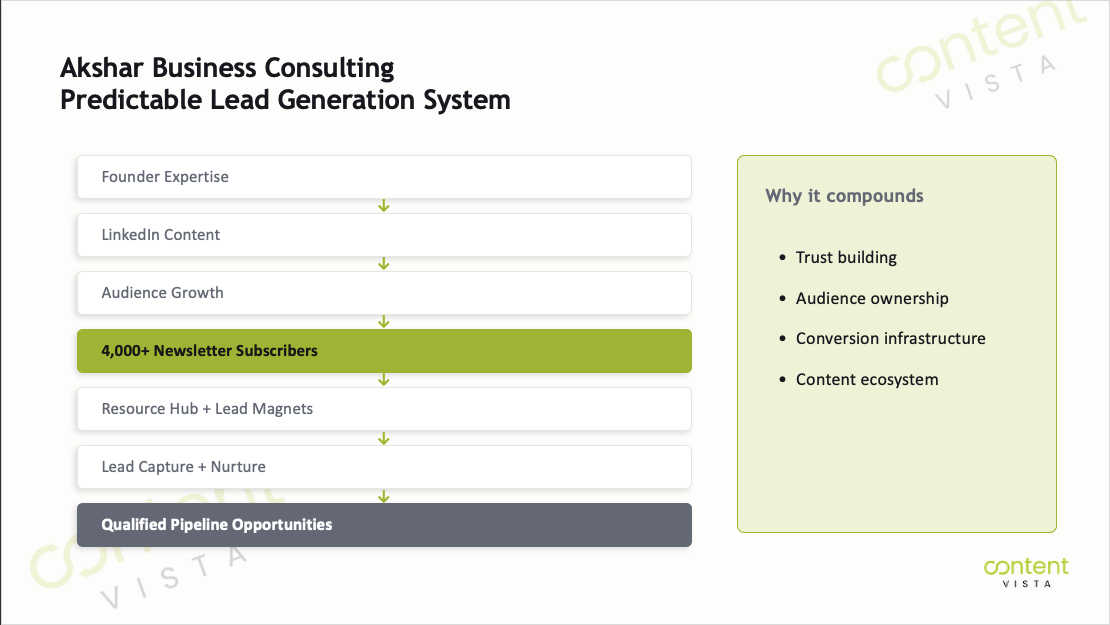
The foundation started with LinkedIn content.
Founder-led insights, perspectives, and educational content helped create consistent visibility and audience engagement around the business’s expertise areas.
Rather than treating LinkedIn as isolated posting activity, the platform became part of a larger lead generation ecosystem.
That audience attention then supported newsletter growth.
Over time, the newsletter grew to more than 4,000 subscribers, creating an owned audience channel that did not depend entirely on platform algorithms or short-term campaign spikes.
The system also included:
resource hubs
lead magnets
educational content assets
structured capture pathways
That mattered because visibility alone does not create predictable lead generation.
The business also needed systems that could:
capture interest
nurture engagement
maintain audience visibility
move prospects toward qualified conversations over time
The important insight is not simply that LinkedIn content “worked.”
The important insight is that multiple layers of the system reinforced each other:
expertise built trust
content built visibility
newsletters built audience continuity
lead magnets supported capture
educational assets supported nurture
conversion infrastructure supported pipeline movement
Predictable lead generation becomes more realistic when audience building, capture systems, nurture assets, and conversion pathways operate as a coordinated system instead of disconnected marketing activities.
This is also why businesses focused only on lead volume often struggle to create long-term predictability.
Sustainable pipeline growth usually comes from connected systems that compound trust, visibility, and conversion readiness over time.
For a deeper breakdown, explore the Akshar Business Consulting case study.
FAQs About Predictable Lead Generation
What is predictable lead generation?
Predictable lead generation is the process of building a repeatable system that consistently creates qualified opportunities through measurable acquisition, capture, qualification, follow-up and optimization processes.
The goal is not guaranteed leads every day.
The goal is improving forecasting accuracy and operational control over pipeline growth.
How is predictable lead generation different from just generating more leads?
Generating more leads focuses on volume.
Predictable lead generation focuses on qualified pipeline movement.
A business can generate large numbers of inquiries and still struggle with:
weak qualification
poor conversion
inconsistent follow-up
low opportunity quality
Predictability comes from visibility, process consistency, and measurable conversion stages — not simply higher lead counts.
How long does it take to build a predictable lead generation engine?
Most businesses can build the operational foundation for a predictable lead generation system within 60–90 days.
But long-term predictability usually develops over a much longer period through optimisation, reporting discipline, and repeated learning cycles.
The timeline depends heavily on:
offer clarity
ICP definition
sales process maturity
acquisition channel complexity
follow-up systems
CRM visibility
Which channel is most predictable: inbound, outbound, or paid?
No single channel is universally “most predictable.”
Each acquisition model has different trade-offs:
outbound creates faster feedback loops
inbound compounds trust and visibility over time
paid acquisition creates speed but requires strong conversion systems
Predictability usually improves when one primary acquisition engine becomes stable before additional channels are layered strategically.
Can referrals be part of a predictable lead-generation model?
Yes.
Referrals can be an important part of a predictable lead generation strategy, especially in relationship-driven industries.
However, referrals alone are difficult to forecast consistently because the business does not fully control timing or volume.
Stronger systems usually combine referrals with owned acquisition channels such as:
content
outbound
newsletters
CRM nurture
SEO
audience-building systems
What metrics matter most?
The most important metrics are the ones that predict pipeline quality before revenue changes appear.
Key metrics often include:
response speed
lead-to-opportunity conversion
qualified opportunity rate
meeting-booked rate
show rate
stage conversion rates
source-to-opportunity conversion
pipeline velocity
cost per qualified lead
Lead volume alone is usually not enough.
How many leads do I need to hit my revenue target?
That depends on:
average deal size
close rate
lead-to-opportunity conversion
qualification quality
sales cycle performance
The most accurate approach is revenue-backward planning:
Start with the revenue target
Calculate required wins
Estimate opportunities needed
Estimate qualified leads required
Compare required lead flow against current performance
This usually reveals whether the real bottleneck exists in acquisition, qualification, conversion, or follow-up.
What should I automate and what should stay human?
AI-assisted workflows work best for:
research
segmentation
enrichment
CRM hygiene
reminders
reporting
content repurposing
first-draft personalisation
Human judgment is still critical for:
ICP decisions
positioning
messaging strategy
objection handling
qualification nuance
sales conversations
relationship building
The strongest systems combine automation with strategic human oversight.
When should I avoid building a multi-channel engine?
Avoid expanding into multiple acquisition channels when:
the offer is unclear
qualification rules are weak
CRM visibility is inconsistent
follow-up discipline is missing
the first acquisition channel is still unstable
the business cannot operationally manage more complexity
Multi-channel systems work best after one engine becomes measurable and repeatable first.
What does a good follow-up process look like?
A strong follow-up process is:
fast
structured
measurable
clearly owned
It usually includes:
defined response SLAs
CRM tracking
qualification steps
nurture pathways
reminder systems
follow-up sequencing
clear next actions for sales conversations
Good follow-up systems reduce pipeline leakage and improve conversion consistency over time.
Conclusion: Predictability Comes from Control, Not More Activity
Predictable lead generation is not about guaranteeing the exact same number of leads every week.
It is about reducing randomness.
Businesses create more reliable pipeline growth when they:
clarify targets
define qualification rules
standardise follow-up
track leading indicators
improve CRM visibility
remove leakage across the system
That is what creates operational control.
More channels alone do not solve unpredictability.
In many cases, they make it worse by adding complexity before the underlying system is stable.
A business with:
unclear positioning
weak qualification
inconsistent follow-up
poor reporting
fragmented acquisition
does not usually need more activity first.
It needs a stronger system.
That is why predictable lead generation is ultimately a systems problem: not just a traffic problem.
The businesses that forecast pipelines more accurately are rarely the ones doing the most marketing.
They are usually the ones controlling more variables inside the acquisition process.
If you want a deeper breakdown of how the full acquisition infrastructure works, explore the lead generation system pillar next.
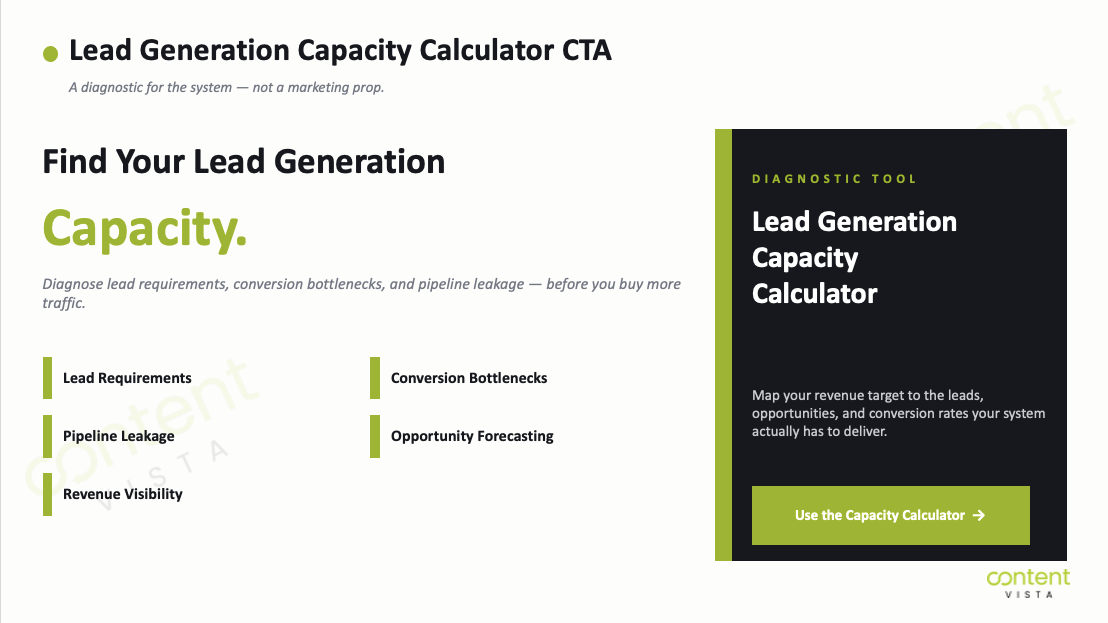
Use the Lead Generation Capacity Calculator to find what your lead engine needs next.
Or explore Lead Generation Services if you want help building a connected acquisition system.