Quick Summary
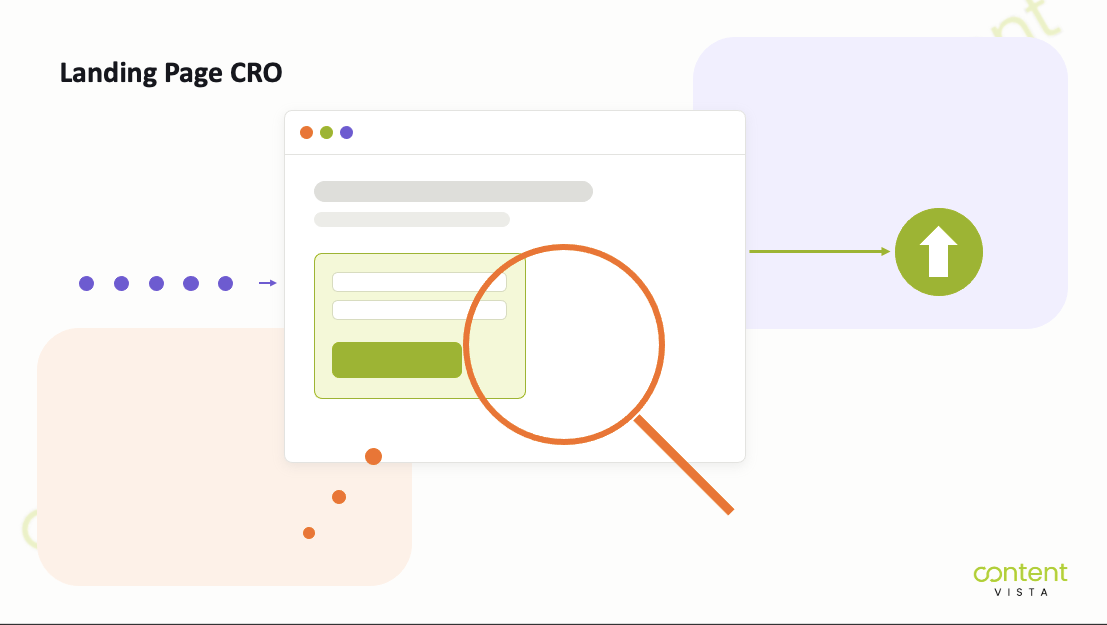
- Landing page conversion rate optimization is the process of improving how effectively a page turns visitors into leads or customers.
- But for lead funnels, a good CRO does more than increase form submissions.
- It diagnoses source intent, message match, page clarity, CTA friction, trust, form flow, thank-you logic, CRM handoff and testing priorities so the page produces more qualified conversions not just more clicks or low-fit leads.
Why Most Landing Page CRO Advice Underperforms
Here's the problem: most landing page CRO advice assumes the page is the problem. But sometimes the page is only where the leak becomes visible.
Test a new headline. Change the button colour. Shorten the form. Swap the hero image. Move the CTA higher. Those things can matter.
But they get treated as isolated fixes instead of part of a wider conversion path — and that is where most landing page optimisation efforts break down.
A landing page can look polished and still underperform because the real problem started before the click or continues after the form submit.
The traffic source may be attracting the wrong audience. The ad or LinkedIn post may promise something the page does not continue. The offer may be unclear.
The CTA may ask for too much commitment too early. The form may create unnecessary friction.
The thank-you page may lead nowhere. The CRM handoff or follow-up process may be weak enough that good leads disappear after conversion.
Here's the reframe that changes everything: when qualified leads are not showing up, this is usually a system problem, not a lead problem.
The landing page is not a standalone asset. It is one step inside a wider click-to-qualified-lead system.
If you treat every conversion problem like a page-design problem, you end up making random changes without understanding where the leak actually exists. Teams test button copy before validating message match.
They redesign pages before checking whether the traffic is relevant. They celebrate higher form submissions without asking whether lead quality improved. That is not optimisation — it is random acts of marketing with a dashboard attached.
The result is usually more activity, not better conversion performance.
This article takes a different approach. Instead of treating CRO like a checklist of disconnected tactics, we will break down how to diagnose the actual leak across source intent, page clarity, trust, friction, post-submit flow and handoff before redesigning the page or running random A/B tests.
That is also why landing page CRO should connect directly to your wider lead generation system rather than sitting off to one side.
What Is Landing Page Conversion Rate Optimization?
Landing page conversion rate optimization is usually explained as the process of improving a page so more visitors complete a desired action. That definition is directionally correct but it is often too narrow for real lead-generation funnels.
Landing page conversion rate optimization is the process of improving a landing page so more visitors take a desired action, such as submitting a form, booking a call, downloading a resource or requesting a demo. In lead funnels, CRO should also improve lead quality, post-submit flow, CRM handoff and pipeline visibility.
In practice, the "desired action" depends on the funnel. For some businesses it is a consultation request or demo booking. For others it is a webinar registration, audit submission, newsletter signup, lead magnet download or direct sales enquiry.
But this is where many CRO conversations become incomplete.
A page can technically convert while the funnel still underperforms. You may get more form submissions, but lower-quality leads. You may increase conversion rate while damaging sales-readiness.
You may improve click-through rates while creating a weak post-submit experience that never moves leads into the pipeline.
That is why landing page CRO should not stop at the form submit.
For lead funnels, the real job of CRO is to improve the entire path between click and qualified opportunity. That includes:
whether the traffic arriving on the page is relevant
whether the offer matches visitor intent
whether the CTA feels appropriate to the buying stage
whether the form creates unnecessary friction
whether the thank-you page guides the next step
whether the CRM handoff and follow-up process are working correctly
whether the business can actually track which conversions become qualified pipeline
In short: CRO is not just about getting more people to click. It is about getting the right people to take the right next step.
Landing pages rarely operate alone. They sit inside a lead generation system that includes traffic acquisition, messaging, qualification, automation, sales follow-up and measurement — because the page is a layer of that system, not an accessory to it.
Look at CRO through that lens and the goal changes. Instead of chasing isolated page metrics, you start diagnosing how effectively the entire click-to-qualified-lead path is working.
What Counts as a Good Landing Page Conversion Rate?
One of the most common questions in landing page CRO is simple:
"What's a good conversion rate?"
The problem is that most benchmark discussions flatten a very contextual question into a single number.
A landing page for a cold social campaign behaves differently from a high-intent Google search page. A webinar registration page behaves differently from a "book a strategy call" page. A low-commitment lead magnet behaves differently from an enterprise demo request.
That is why broad benchmark numbers can be useful for orientation but dangerous when treated like universal targets.
Benchmark ranges vary widely based on traffic source, audience intent, offer type, industry, device behaviour, funnel stage and conversion goal. Use benchmarks as context, not as absolute success metrics.
A page converting at a lower percentage may still outperform a "higher-converting" page if the leads are more qualified, sales-ready or likely to become opportunities.
The reverse is also true.
Some landing pages generate impressive conversion rates because the offer is extremely broad, the form is frictionless or the CTA asks for very little commitment. Then sales discovers that many of those leads were never a good fit to begin with.
That is not strong CRO. It is just an easier conversion.
So the more useful question is not: "Is our conversion rate good?"
It is: "Is this page turning the right traffic into qualified leads?"
That shift changes how you evaluate landing-page performance. Instead of looking only at raw conversion rate, you start evaluating:
lead quality
source relevance
sales acceptance
opportunity creation
post-submit engagement
cost per qualified lead
source-to-pipeline conversion
A page that converts fewer visitors but produces stronger opportunities may create far more business value than a page optimised purely for volume.
| Metric View | What It Tells You | What It Can Hide | Better Question |
|---|---|---|---|
| Raw conversion rate | How many visitors converted | Whether those leads were qualified | Did the page create qualified opportunities? |
| Industry benchmark | How your page compares to broad averages | Differences in traffic, offer and intent | Is this benchmark relevant to your funnel? |
| Cost per lead | How much each lead costs | Lead quality and sales-readiness | What is the cost per qualified lead or opportunity? |
This is why benchmarks create so much confusion.
A business comparing its high-intent consultation page against a broad ecommerce-style benchmark may conclude the page is underperforming when the opposite is true. Another company may celebrate a low-cost lead campaign while ignoring the fact that almost none of those leads progress into revenue.
Good landing page optimisation requires context. You have to evaluate:
where the traffic came from
what the visitor expected
how much intent existed before the click
how much commitment the CTA requires
how much qualification the business actually needs
what happens after the submit
In many cases, improving conversion quality matters more than increasing conversion quantity.
That is especially true for B2B services, consulting, SaaS demos, audits, sales consultations and webinar funnels — higher-consideration journeys where the goal is not maximum submissions. It is qualified pipeline creation.
The MATCH CRO Framework
Most landing page optimisation efforts fail for one reason: teams start changing visible page elements before diagnosing the actual conversion problem.
They test headlines before checking message match. They shorten forms before evaluating lead quality. They redesign layouts before understanding whether the traffic itself is misaligned.
That creates activity, but not better conversion performance.
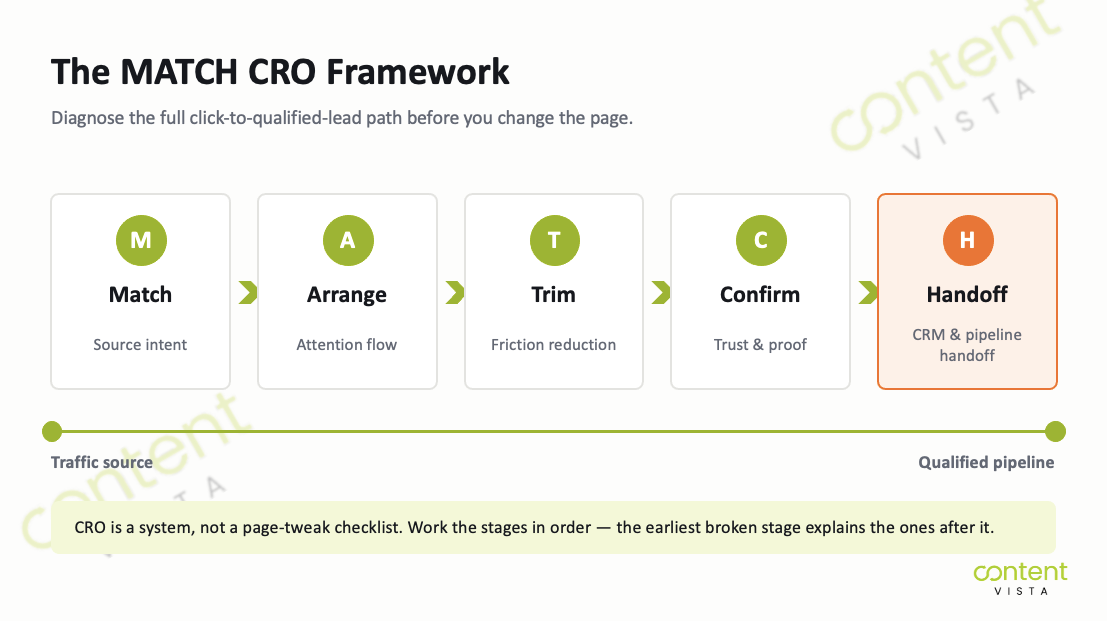
The MATCH CRO Framework solves that by making you evaluate the full click-to-qualified-lead path before making random CRO decisions.
Let's make this practical. Before you change the button, run the page through MATCH.
MATCH stands for:
Match the page to the visitor's source intent
Arrange attention around one next step
Trim friction, technical drag, and form resistance
Confirm trust, proof, and offer clarity
Handoff the conversion into thank-you logic, CRM and testing
The framework matters because landing pages rarely fail for only one reason.
A page may have strong copy but weak source alignment. It may generate submissions while producing poor-fit leads. It may convert well while leaking opportunities after the thank-you page. It may attract attention but overwhelm visitors with competing actions.
MATCH helps diagnose those problems systematically instead of treating CRO like a collection of isolated tricks.
| Stage | What It Means | Main Goal | Main Risk If Ignored |
|---|---|---|---|
| Match | Match the page to the visitor's source intent | Make visitors feel they landed in the right place | Traffic arrives but feels disconnected from the page |
| Arrange | Arrange attention around one clear next step | Reduce distraction and decision overload | Visitors do not know what to do next |
| Trim | Trim friction, technical drag, and form resistance | Make action easier without lowering lead quality | Visitors drop before completing the action |
| Confirm | Confirm trust, proof, and offer clarity | Make the decision feel safe and relevant | Visitors hesitate because credibility is weak |
| Handoff | Handoff the conversion into thank-you logic, CRM and testing | Turn submits into qualified pipeline | Leads disappear after the form submit |
Match the page to source intent
The first job of a landing page is not persuasion. It is continuity.
Visitors should immediately feel that the page matches the promise that brought them there — whether that came from a Google search, LinkedIn post, cold email, webinar invite, ad campaign or referral source. If the source message and page message feel disconnected, conversion resistance begins before the visitor even evaluates the offer.
Arrange attention around one next step
Many landing pages fail because they create too many competing paths.
Multiple CTAs, cluttered layouts, unclear hierarchy and mixed messaging force visitors to decide what matters instead of guiding them naturally toward action.
Strong CRO reduces unnecessary decision load and makes the next step obvious.
Trim friction without damaging lead quality
Not all friction is bad.
Some friction protects lead quality by filtering out low-intent visitors. The goal is not to remove every field, question or qualification step. The goal is to remove unnecessary resistance while keeping the conversion path aligned with buyer intent.
That includes:
form complexity
CTA commitment level
mobile usability
page speed
technical drag
unclear instructions
awkward flow between sections
Confirm trust and offer clarity
Visitors rarely convert because of one persuasive line.
They convert because the page reduces uncertainty. That means confirming:
credibility
relevance
specificity
proof
outcomes
process clarity
safety of the next step
If trust signals appear too late or feel generic, hesitation increases near the conversion point.
Handoff the conversion properly
This is where most CRO discussions stop too early.
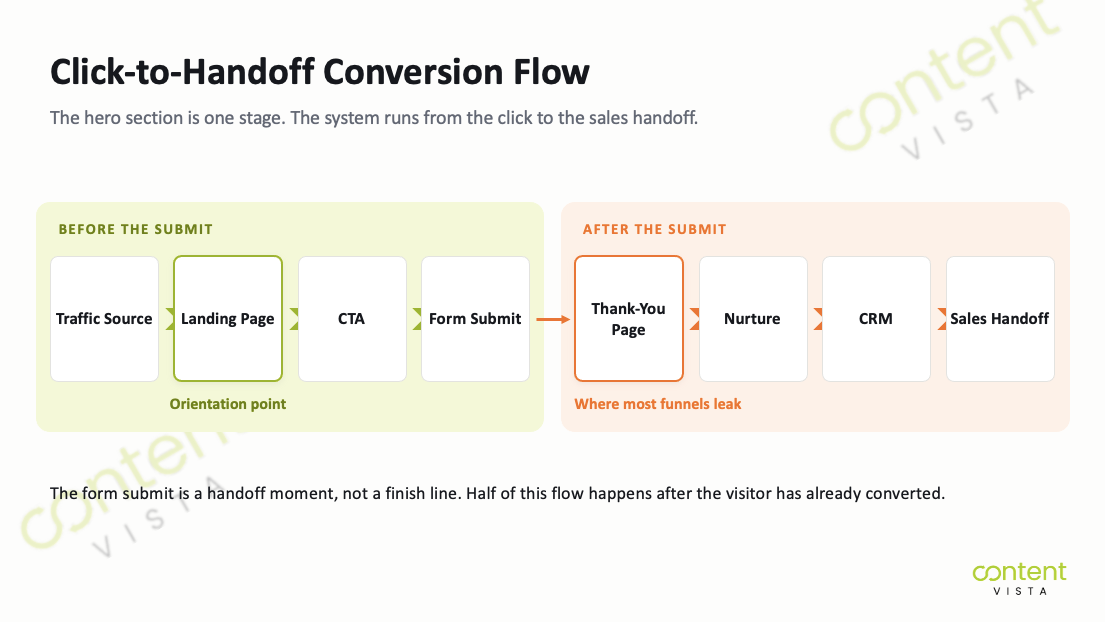
A form submit is not the finish line. It is a handoff moment.
The thank-you page, CRM routing, automation logic, sales assignment, nurture flow and follow-up timing all affect whether conversions actually become qualified pipeline.
That is why MATCH treats post-submit flow as part of conversion optimisation, not as a separate operational problem.
If the page needs more than surface-level tweaks, fix the conversion strategy before redesigning.
Website Strategy & Conversion DesignThe Seven Landing Page Leak Zones
Here's where most teams go wrong: they blame the landing page before they identify the leak.
A page may look like the problem because that is where conversion failure becomes visible. But the actual issue may have started before the click or continued after the form was submitted. That is why isolated CRO fixes so often disappoint.
You can rewrite the headline, shorten the form, redesign the layout or test new CTA copy and still see weak results if the real leak exists somewhere else in the conversion path.
Each of the seven leak zones maps to a stage of MATCH, so you can find the failure point instead of guessing at it.
Instead of asking: "How do we improve this page?"
You start asking: "Where is the conversion path losing qualified visitors?"
That distinction changes everything.
| Leak Zone | MATCH Stage | What Breaks | Common Symptom | What to Fix |
|---|---|---|---|---|
| Source mismatch | Match | The ad, email, search result, or social post promises something the page does not continue | Visitors bounce quickly or feel misled | Align source message, headline, offer and CTA |
| Above-the-fold confusion | Arrange | Visitors cannot quickly understand the offer | They scroll, hesitate or leave | Clarify headline, subhead, visual and primary action |
| Trust gap | Confirm | The page does not prove why the reader should believe you | Visitors hesitate before submitting | Add relevant proof, credibility, specifics and risk reducers |
| CTA friction | Trim | The next step feels unclear, too big, or poorly timed | Visitors want value but avoid the action | Clarify CTA copy, placement and commitment level |
| Form friction | Trim | The form asks too much or feels unsafe | Drop-offs happen near the form | Reduce unnecessary fields or align fields with qualification needs |
| Post-conversion dead end | Handoff | The thank-you page fails to guide the next step | Leads submit but do not progress | Add delivery, expectation-setting, secondary CTA, nurture or routing |
| Measurement blind spot | Handoff | The team tracks submits but not quality or pipeline | CRO decisions are based on partial data | Track lead quality, qualified rate, handoff and opportunity creation |
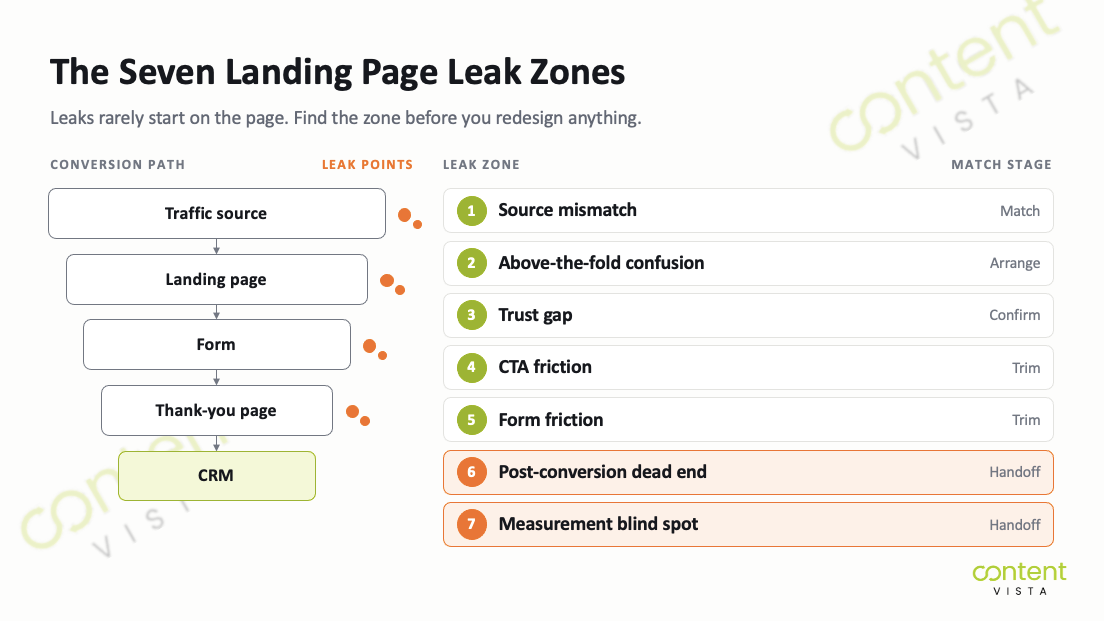
Read that block as a sequence, not a menu. The zones run in the order a visitor experiences them, and the earliest broken zone usually explains the ones after it. If source mismatch is live, a trust gap further down is a symptom — not a separate problem to solve.
Source mismatch
Many conversion problems begin before the landing page even loads.
If an ad, cold email, LinkedIn message, webinar invite or search result creates one expectation while the landing page presents another, visitors immediately feel friction.
This is one of the fastest ways to lose trust.
The visitor may not consciously analyse the mismatch. They simply feel that the page is not what they expected and leave before engaging with the offer.
Above-the-fold confusion
Visitors should understand the offer quickly.
If the hero section is vague, overloaded, overly clever or visually chaotic, people hesitate instead of moving forward.
This is especially common when landing pages try to say too many things at once:
multiple audiences
multiple CTAs
too much copy upfront
unclear outcomes
weak visual hierarchy
Confusion creates silent drop-off.
Trust gap
Even interested visitors need reassurance.
A page may communicate the offer clearly but still underperform because it does not prove:
why the business is credible
why the solution works
why the visitor should trust the next step
what outcome is realistic
what risk is reduced
Generic claims rarely solve this problem. Specific proof usually does.
CTA friction
Sometimes the next step simply feels too big.
A visitor may want the value being offered but hesitate because the CTA feels premature, high-commitment, unclear or badly timed.
For example:
"Book a consultation" may feel too aggressive for cold traffic
"Request a demo" may feel unclear without context
multiple CTA choices may dilute focus
weak CTA copy may fail to explain the value of acting now
The problem is not always the button itself. It is often the psychological weight attached to the next step.
Form friction
This is where many teams overcorrect.
Yes, unnecessary form fields can reduce completion rates. But removing friction blindly can also damage lead quality.
A strong form balances two things:
reducing unnecessary resistance
preserving useful qualification
If visitors hesitate near the form, the issue may be:
too many fields
poor timing
privacy concerns
unclear expectations
mobile usability problems
mismatch between visitor intent and requested commitment
Post-conversion dead end
Many funnels leak immediately after conversion.
The visitor submits the form and lands on a generic thank-you page with no direction, no expectation-setting, no delivery logic and no meaningful next step.
That creates a major missed opportunity.
The thank-you page is one of the highest-intent moments in the funnel. It can:
reinforce trust
guide the next action
segment leads
trigger nurture paths
improve CRM routing
move high-intent visitors further into pipeline
Ignoring this stage weakens the entire system.
Measurement blind spot
Some teams optimise for conversion rate while having no visibility into whether those conversions actually become qualified opportunities.
That creates misleading CRO decisions.
A campaign may look successful at the page level while failing commercially. Another page may appear underwhelming while quietly producing the highest-quality leads in the funnel.
Without visibility into lead quality, sales acceptance, opportunity creation and source-to-pipeline conversion, optimisation becomes guesswork.
Landing page leaks do not always originate on the landing page itself. Some begin before the click. Others appear after the form is submitted. That is why effective CRO starts with diagnosis before redesign.
Find where your landing page is leaking before you redesign or buy more traffic.
Website Conversion Leak AuditFix Message Match Before You Touch the Button
The button is rarely the first problem. The first problem is usually that the visitor expected one thing and the page delivered another.
Teams focus on page-level tweaks before checking whether the visitor is actually experiencing continuity between:
the source they clicked from
the promise they saw before the click
the offer presented after the click
the CTA they are being asked to take
When message match breaks, conversion resistance starts immediately.
Match the source promise to the page promise
Every traffic source creates expectations. A Google search creates one kind of intent. A cold email creates another. A LinkedIn post, webinar invite, referral campaign, paid ad or outbound message each frames the visitor's expectations differently before they reach the page.
The landing page has to continue that conversation.
If someone clicks a LinkedIn post promising a practical framework and lands on a generic services page, the experience feels disconnected. If a Google search visitor expects a solution comparison but lands on a vague brand-awareness page, trust drops immediately.
A visitor should feel: "Yes, this is the page I expected to land on."
Not: "Wait, where am I?"
This is why landing-page strategy has to align with channel strategy. Traffic from inbound and outbound lead generation often requires different message framing, proof and CTA structure than inbound search traffic. The same applies to outbound campaigns such as cold email lead generation, where the landing page must continue the promise established in the outreach sequence instead of resetting the conversation entirely.
Match the audience's awareness level
Not every visitor arrives with the same level of awareness. Some already understand the problem and are actively comparing solutions. Others are still figuring out whether the problem is worth solving at all.
A high-intent search visitor may respond well to:
direct offers
comparison-focused messaging
consultation CTAs
implementation details
pricing or process clarity
A colder visitor from social or outbound traffic may need:
more context
clearer education
stronger trust-building
simpler framing
lower-friction next steps
Here's where many landing pages create accidental friction: the page asks for a high-commitment action before the visitor has enough confidence or context to take it. That mismatch is common in campaigns driven by LinkedIn lead generation, where visitors often engage earlier in the journey than branded search traffic.
The result is not always a bounce. Sometimes visitors stay on the page but hesitate, delay or disengage because the page is asking them to move faster than their intent level supports.
Match the CTA to the visitor's intent
The CTA should feel like a natural continuation of the visitor's journey, not an abrupt escalation.
For example:
a cold visitor may prefer "See the framework" over "Book a consultation"
a research-stage visitor may respond better to "Get the checklist" than "Request a proposal"
a high-intent visitor may want direct access to a demo, audit, or strategy conversation
Strong CRO aligns the commitment level of the CTA with the readiness level of the visitor. That is why changing button text alone rarely fixes deeper conversion problems.
| Question | What to Check | Fix |
|---|---|---|
| Does the headline continue the source promise? | Compare ad, email, search result, or social post to page headline | Align wording and outcome |
| Does the page match the visitor's awareness level? | Check whether visitors know the problem, solution, or provider already | Add education, proof, or direct CTA based on intent |
| Does the CTA match commitment level? | Compare visitor intent with the ask | Use a lower-friction CTA where needed |
Because if the visitor expected one thing and the page delivered another, no CTA optimisation will fully solve the problem.
Clarify the Offer in the First Five Seconds
If someone needs ten seconds to understand the offer, the page is already making them work too hard.
Visitors do not arrive ready to study your page. They arrive trying to answer a few fast questions:
What is this?
Is this relevant to me?
Why should I care?
What happens next?
If the page delays those answers, confusion grows before persuasion even begins.
Make the outcome obvious
The hero section should communicate the outcome quickly. Not the company slogan. Not abstract positioning. Not clever copy that sounds impressive but explains nothing.
Visitors should immediately understand:
what the offer is
what problem it solves
what result it helps create
why the page matters to them
Weak hero sections sound like branding exercises instead of conversion assets — vague transformation language, generic growth claims, unclear product categories, jargon-heavy headlines, benefits disconnected from visitor intent.
That does not mean every headline needs to be literal or boring. It means clarity should win over cleverness when the two conflict.
Show who the page is for
Visitors also need to know whether the offer is meant for them. A page trying to speak to everyone usually weakens conversion because it becomes too broad to feel relevant to anyone.
That specificity may come through:
audience language
industry references
use-case framing
funnel stage
business type
pain-point alignment
qualification cues
The faster visitors recognise themselves in the messaging, the faster they can evaluate whether continuing is worthwhile.
Remove competing messages
Many landing pages unintentionally overload the visitor. Too many sections compete for attention. Multiple offers appear at once. Navigation pulls visitors in different directions. Several CTAs ask for different actions simultaneously.
The goal of the hero section is not to present every possible option. It is to create directional clarity:
one primary offer
one dominant conversion path
one clear next step
one central outcome
Secondary paths can still exist when strategically necessary. But they should not compete visually with the primary conversion goal. Pages with multiple competing CTAs often convert worse not because the CTAs are weak, but because visitors struggle to understand which action actually matters.
Use the hero section to create direction
The hero section should guide attention, not just decorate the page. Headline hierarchy, supporting copy, CTA placement, visual flow, whitespace, mobile readability and scannability all reduce friction — because visitors do not need to "figure out" how to navigate the page mentally. The page itself creates direction.
For businesses struggling with unclear positioning, weak page hierarchy or confusing conversion paths, this usually requires deeper Website Strategy & Conversion Design rather than isolated headline or button tweaks.
Reduce CTA and Form Friction Without Killing Lead Quality
One of the most common CRO recommendations is: "Reduce friction."
That advice is directionally useful but incomplete.
The mistake is simple: teams remove friction without asking whether that friction was filtering the wrong leads or the right ones.
A newsletter signup should not feel like a procurement process. But a high-ticket consultation request probably should not feel frictionless either.
The goal is not maximum submissions. It is the right number of qualified submits.
CTA friction
CTA friction happens when the next step feels:
unclear
too aggressive
too early
too vague
too time-consuming
disconnected from visitor intent
Sometimes the problem is the wording. But more often, the friction comes from what the CTA psychologically implies:
"Book a strategy call" feels higher commitment than "See if this is a fit"
"Request a proposal" feels heavier than "Talk through your goals"
"Get started" may sound unclear without context
"Submit" communicates almost no value at all
Strong CTA copy reduces uncertainty about what happens next, who the offer is for, what the visitor receives and how much commitment is involved. The CTA should feel like a logical continuation of the visitor's current buying stage, not a forced leap forward.
Form friction
Form friction is where CRO advice becomes overly simplistic.
Yes, long forms can reduce completion rates. Yes, unnecessary fields create resistance. But removing every qualification field is not automatically better conversion optimisation.
Different funnel stages require different levels of information. For example:
a downloadable checklist may only require name and email
a webinar registration may justify a few contextual fields
a sales consultation request may need qualification data
a proposal request may require company, budget or timeline information
The key question is not: "How short can we make the form?"
It is: "What information is genuinely necessary at this stage of intent?"
Some friction is useful because it protects:
sales time
routing accuracy
lead quality
segmentation
qualification
follow-up relevance
At the same time, forms often create accidental friction through:
unnecessary fields
poor mobile usability
weak field sequencing
privacy concerns
unclear expectations
intimidating layouts
sensitive questions asked too early
Trust matters here. Visitors are far more likely to share information once the page has established credibility and explained why the information is needed. Asking for high-sensitivity information before sufficient trust exists usually increases hesitation and abandonment.
The lead quality trade-off
This is where many landing-page optimisation efforts quietly fail.
A team removes qualification friction, conversion rate rises and the page appears to improve. But downstream metrics begin to weaken:
sales calls decline in quality
qualification rates drop
no-show rates increase
pipeline quality deteriorates
sales teams lose trust in inbound leads
The page technically converts better while the funnel performs worse.
In many cases, moderate friction improves overall funnel efficiency because it filters out low-fit submissions before they enter sales workflows. The right form depth depends on traffic temperature, offer type, audience awareness, deal complexity, sales process and qualification requirements.
| Funnel Stage | Visitor Intent | Form Depth | CTA Style |
|---|---|---|---|
| Out-of-market / education | Low to medium intent | Minimal fields | Get the guide, see the checklist, audit the leak |
| In-market / evaluation | Medium to high intent | Moderate qualification | Compare options, request audit, see fit |
| Sales-ready | High intent | Qualification fields allowed | Book a consultation, request proposal, talk to an expert |
Friction should be intentional. Good CRO does not blindly reduce effort everywhere — it reduces unnecessary resistance while preserving the qualification signals the business actually needs.
That often requires stronger funnel architecture, not just isolated form edits. For businesses dealing with weak conversion flow, poor lead quality or disconnected funnel experiences, this frequently becomes a broader Landing Pages & Funnel Builds problem rather than a simple CTA rewrite.
Add Proof, Credibility and Visual Hierarchy Where It Matters
A visitor does not convert because the page sounds confident. They convert because the page reduces doubt.
Visitors hesitate when they cannot quickly answer questions like:
Can this company actually deliver?
Has this worked for businesses like mine?
Is the process credible?
Is the outcome realistic?
What proof supports the claim being made?
Proof works best when it answers the doubt the visitor is already feeling. That is the difference between strategic credibility placement and generic "social proof sections" added as decoration.
Place proof near decision points
Many landing pages bury their strongest proof near the bottom of the page where fewer visitors see it.
Trust signals work best when they appear close to moments of hesitation:
near the hero section
before the CTA
beside the form
around pricing or consultation requests
near higher-commitment actions
A consultation CTA may need process clarity and client credibility nearby. A high-ticket service page may need implementation proof before the form. A webinar signup may benefit from speaker expertise or outcome examples. A lead magnet page may need proof that the resource is genuinely useful.
The goal is not to overload the page with proof. It is to place the right proof where visitors naturally experience uncertainty.
Match the proof to the claim
One of the biggest CRO mistakes is using generic testimonials that do not support the actual conversion decision. A vague quote like "Great experience working together" rarely reduces meaningful hesitation.
Specificity creates credibility. Better proof often includes:
specific outcomes
implementation details
before-and-after context
operational improvements
strategic clarity
process screenshots
workflow examples
recognisable client categories
expert positioning
portfolio examples
The proof should reinforce the exact claim being made on the page. If the page claims operational clarity, show operational examples. If it promises funnel improvement, show funnel-related proof. If it positions the business as strategic rather than tactical, the proof should reinforce systems thinking and execution depth.
That is why structured case studies usually outperform isolated testimonials. Examples like Confido or SalesFed support conversion decisions more effectively than generic praise because they help visitors understand how the work was approached and applied. Broader implementation examples from the portfolio can reinforce capability and range when visitors are evaluating fit.
Use visual hierarchy to make proof easy to scan
Proof only helps if visitors actually notice it. Many landing pages visually bury credibility signals inside dense blocks of copy or poorly structured layouts.
Good visual hierarchy helps visitors identify proof quickly without interrupting the reading flow. That may include:
clear spacing
section separation
visual contrast
pull quotes
logo clusters
highlighted outcomes
screenshots
process visuals
short proof summaries
scannable formatting
Proof should support comprehension, not create clutter. A page overloaded with testimonials, badges, logos and claims can feel performative rather than trustworthy.
Build credibility progressively
Trust builds in layers.
A visitor may first need relevance: "This is for businesses like mine."
Then capability: "They understand the problem."
Then credibility: "They have done this before."
Then confidence: "This feels safe enough to take the next step."
Strong landing pages support that progression naturally. The hero section creates relevance. Supporting copy clarifies the problem. Proof elements reduce uncertainty. Process clarity lowers perceived risk. The CTA feels more justified because trust has been established gradually.
This matters most for higher-consideration services where visitors are not making impulse decisions. Pages asking for consultations, audits, proposals or strategic conversations often fail because they ask for commitment before establishing enough credibility to justify the ask. Specific examples such as Akshar Business Consulting can reduce that hesitation when aligned with the visitor's decision stage.
Strong proof does not simply say "Trust us." It helps the visitor conclude: "This looks credible, relevant, and worth continuing."
Optimise the Thank-You Page, Not Just the Form
Most landing-page optimisation stops at the form submit. That is a mistake.
The conversion does not end when someone submits the form. That is where the next leak usually begins.
Many teams treat the thank-you page like a technical confirmation screen: "Thanks. We'll be in touch."
But the visitor has already taken action. Attention is high. Trust is temporarily elevated. Momentum exists. What happens next directly affects:
lead progression
booking rates
nurture engagement
qualification flow
CRM routing
sales readiness
opportunity creation
Deliver what was promised
The first job of the thank-you page is simple: confirm the action worked and deliver the promised value.
If someone requested an audit, downloaded a guide, registered for a webinar or booked a consultation, the page should immediately reinforce:
what they requested
what happens next
where the resource is
how the process works
Visitors should never wonder: "Did the form actually submit?" "Am I supposed to wait?" "Where is the resource?" Post-submit doubt reduces trust very quickly.
Set expectations
Expectation-setting is one of the most underrated conversion elements in lead funnels. A strong thank-you page reduces anxiety by clarifying:
response timing
next actions
onboarding steps
meeting process
delivery sequence
follow-up method
review timelines
A consultation request page can explain when the team responds. A webinar signup page can reinforce attendance instructions. A lead magnet page can explain email delivery timing.
Better expectation-setting also reduces confusion, duplicate submissions, support requests, no-shows and lead drop-off.
Offer the next best step
Most thank-you pages waste momentum. Once someone converts, there is often an opportunity to move higher-intent visitors deeper into the funnel.
That does not mean overwhelming them with upsells. It means offering a logical next action based on intent. Depending on the funnel, the thank-you page may:
offer a secondary CTA
invite calendar booking
present a relevant resource
suggest a case study
trigger segmentation
move visitors toward consultation
reinforce nurture progression
A lead magnet download may lead to a webinar invitation. A webinar registration may offer a strategy checklist. An audit submission may offer calendar scheduling. A consultation request may route to preparation resources.
This is exactly the mechanic a webinar lead generation funnel depends on — the registration is the beginning of the sequence, not the end of it.
Route the lead correctly
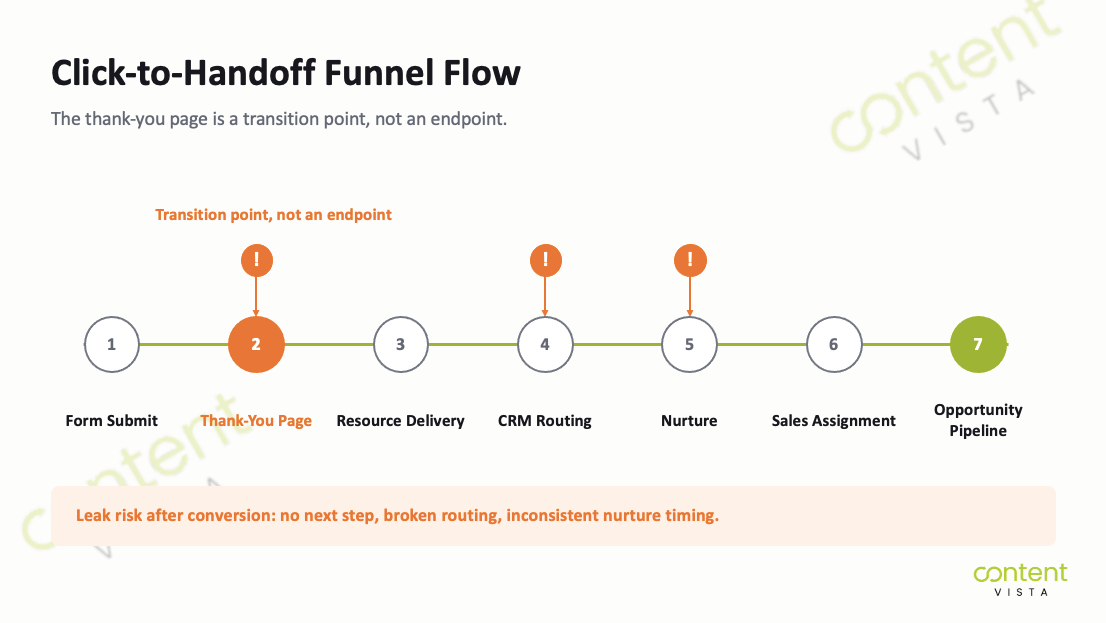
This is where CRO overlaps with systems design. A landing page may generate conversions successfully while the operational handoff behind the scenes remains broken.
For example:
leads may enter the wrong CRM workflow
qualification data may not map correctly
high-intent leads may wait too long for response
sales ownership may be unclear
segmentation may fail
nurture timing may be inconsistent
That creates invisible funnel leaks after the submit.
The thank-you page and post-submit workflow should connect directly into CRM routing, lead scoring, segmentation, automation, notification logic, nurture systems and sales follow-up. This is why landing-page optimisation often becomes a broader Marketing Automation & CRM Systems and Systems, Conversion & Growth Infrastructure problem rather than only a page-design problem.
| Element | Purpose | Example Fix |
|---|---|---|
| Confirmation message | Reassures the lead that the action worked | "Your audit results are on the way. Here's what happens next." |
| Offer delivery | Gives immediate access when relevant | Add download, video, calendar or next-step link |
| Expectation-setting | Clarifies timing and follow-up | Explain when they will hear from you or what to do next |
| Secondary CTA | Moves high-intent leads forward | Add audit, consultation, webinar or relevant resource |
| CRM trigger | Routes the lead into follow-up | Assign segment, score, workflow or owner |
A landing page can improve conversion rate while still leaking pipeline after the submission. Optimising the thank-you flow often improves lead progression even when form conversion rate stays the same.
What to Test First and When Not to A/B Test Yet
A/B testing is powerful. But testing the wrong thing just helps you learn the wrong lesson more slowly.
Many teams jump into testing because it feels measurable and systematic. But experimentation without diagnosis leads to wasted time, weak conclusions and cosmetic improvements that never move the funnel.
Not every landing-page problem needs an A/B test. Sometimes the right move is:
fixing a clear issue directly
redesigning the page structure
improving source alignment
repairing post-submit flow
clarifying the offer
diagnosing lead-quality problems
addressing technical or UX friction
The important question is not: "What can we test?"
It is: "What is most likely causing the conversion resistance?"
Start with the highest-friction, highest-impact issue
Not all page elements deserve equal testing priority. Testing button colours while the offer is unclear is rarely useful. Testing microcopy while traffic-source alignment is broken misses the bigger issue.
High-impact optimisation work usually starts with:
message match
headline clarity
offer positioning
CTA relevance
form depth
trust placement
layout flow
page speed
mobile usability
Cosmetic tweaks matter far less when structural friction still exists.
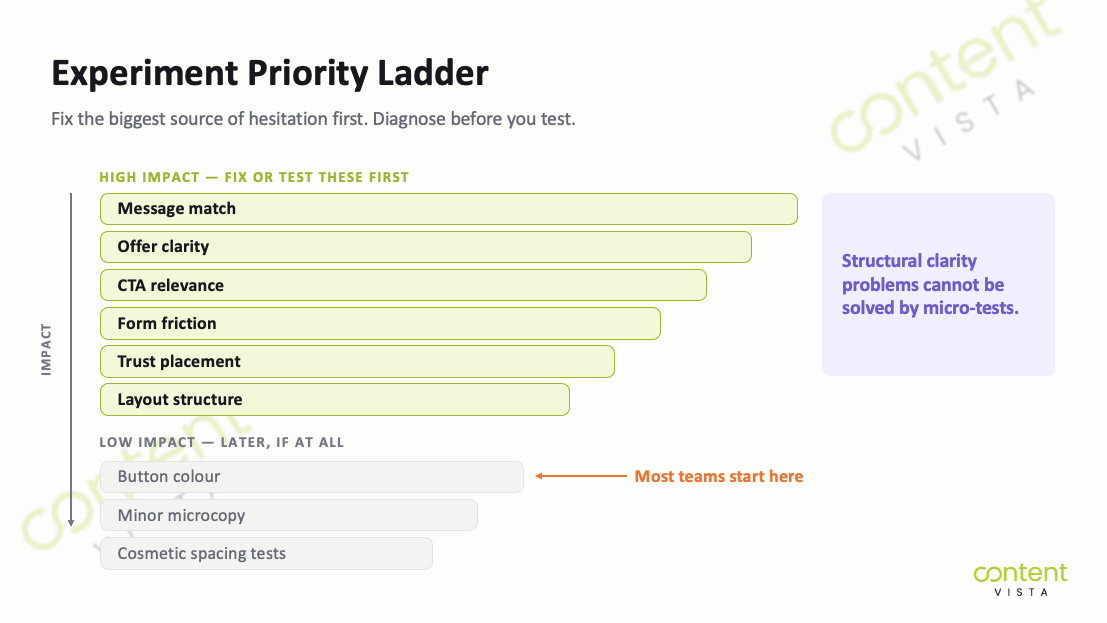
A useful prioritisation rule is: fix the biggest source of hesitation first.
if visitors bounce quickly, investigate message match and clarity
if they scroll but do not act, investigate trust and CTA friction
if they abandon forms, investigate qualification resistance
if conversions happen but leads stall later, investigate post-submit flow and CRM handoff
That sequence produces more meaningful CRO decisions than random testing queues.
Build a hypothesis before running a test
Good experiments begin with a reason.
Weak testing programs run experiments like "Let's test a different button colour" or "Let's move the form" without a clear explanation of:
what friction exists
why the friction exists
what behaviour should change
why the proposed variation should improve it
That creates noisy learning.
A useful CRO hypothesis usually follows a structure like: "We believe visitors hesitate because [problem]. If we change [element], we expect [behaviour change] because [reason]."
The hypothesis matters because it forces the team to diagnose the conversion problem before testing solutions.
Know when you do not have enough traffic
Some pages simply do not receive enough traffic to support reliable A/B testing. This is common in:
niche B2B funnels
high-ticket services
specialised lead-generation campaigns
outbound landing pages
account-based campaigns
consultation funnels
In those situations, qualitative diagnosis often creates more value than premature experimentation. That may include session recordings, heatmaps, user interviews, sales feedback, heuristic review, funnel analysis and form analytics.
So what does that mean in practice? It depends on how much traffic the page actually gets.
| Traffic Level | What It Looks Like | Do This First | Avoid This |
|---|---|---|---|
| Low traffic | Conversions are rare enough that a test would run for months before it told you anything | Diagnose qualitatively — session recordings, sales feedback, heuristic review — then fix obvious clarity problems directly | Waiting on statistical significance that will never arrive |
| Medium traffic | You can see behaviour patterns, but significance builds slowly | Fix structural clarity first, then run one high-impact test at a time on big swings such as offer framing or CTA commitment level | Running several small tests in parallel and splitting an already-thin sample |
| High traffic | Conversion events arrive consistently and reliably | Run structured A/B testing with a written hypothesis and a queue ranked by expected impact on qualified leads | Testing cosmetics while message match or source quality is still broken |
Redesign when the problem is structural
Some pages do not need optimisation. They need rebuilding.
If the page suffers from:
unclear positioning
competing offers
weak hierarchy
poor visual flow
disconnected messaging
confusing structure
fragmented conversion paths
then isolated A/B tests often become a distraction. Micro-tests cannot solve structural confusion.
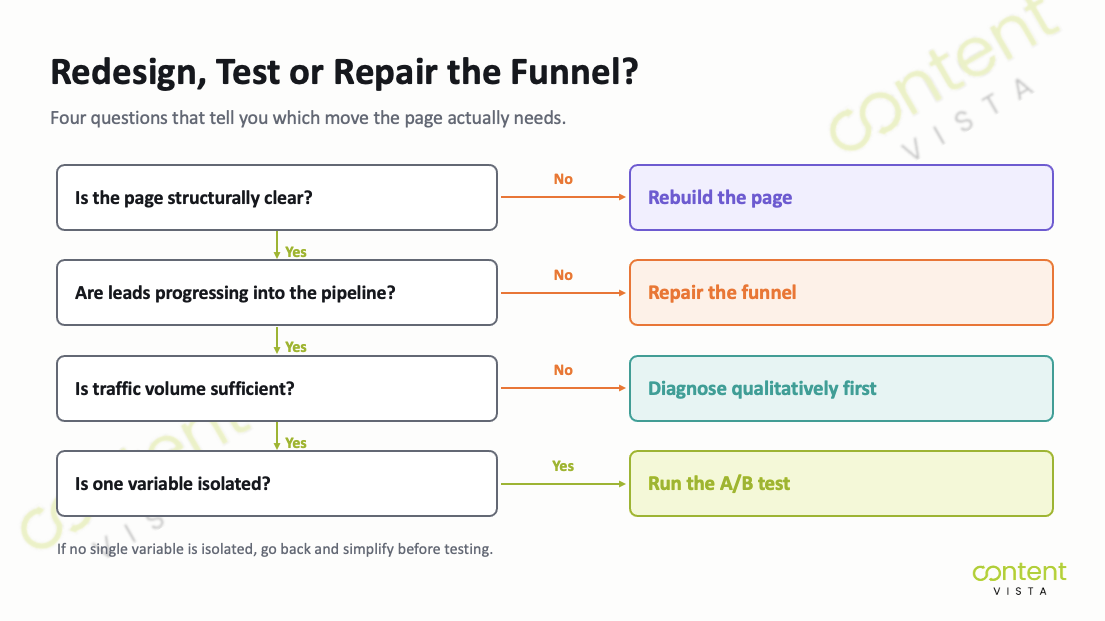
This is where mature CRO differs from "test everything" thinking. Strong optimisation teams recognise the difference between a page with one improvable variable, a page with systemic clarity problems, and a funnel with operational breakdowns after conversion.
| Situation | Best Move | Why | Example |
|---|---|---|---|
| Page has traffic but one unclear element | A/B test | You can isolate the variable | Test headline, CTA or form depth |
| Page is unclear, cluttered or structurally weak | Redesign or rebuild | Micro-tests will not fix a broken page structure | Rebuild hero, offer flow, proof and form path |
| Page converts but leads do not progress | Funnel repair | The leak is after the form submit | Fix thank-you page, nurture, CRM or sales handoff |
| Very low traffic | Diagnose qualitatively first | The sample size may not support reliable testing | Use analytics, session recordings, interviews or expert review |
If the page is fundamentally unclear, testing button copy is usually a distraction. Structural clarity problems should be solved before experimentation becomes the primary optimisation method.
The best CRO programs do not test more randomly. They diagnose more accurately, prioritise more intelligently and test the changes most likely to improve qualified conversion performance.
Speed, Mobile UX and Page Experience Still Matter
Speed will not save a weak offer. But a slow page can stop a strong offer from ever being considered.
Page speed, mobile usability and overall page experience influence how easily visitors can engage. If the experience feels slow, unstable, cluttered or difficult to use, friction begins before the visitor even evaluates the offer.
But technical optimisation should be viewed in context. Some teams blame every conversion problem on performance scores while ignoring message clarity, CTA friction, weak offers or poor source alignment. Others ignore technical drag entirely and wonder why visitors abandon the page.
Strong CRO balances both.
Slow pages create invisible friction
Technical friction often feels subtle from the business side but frustrating from the visitor side. Examples include:
slow-loading hero sections
delayed page interaction
layout shifts
oversized media
heavy scripts
mobile lag
broken form behaviour
difficult scrolling
popups blocking content
Visitors rarely announce: "This page is technically inefficient." They simply leave.
That is why technical drag matters. It interrupts momentum before trust and clarity can even begin working — and it matters most for paid traffic, mobile visitors, colder acquisition channels and high-volume campaigns.
Mobile UX affects conversion behaviour directly
Many landing pages are still designed desktop-first even though a large portion of traffic often arrives on mobile.
Mobile visitors need:
readable headlines
scannable layouts
sufficient spacing
tappable CTAs
short visual blocks
easy form interaction
fast loading
minimal visual clutter
The goal is not to create a stripped-down mobile page. The goal is to reduce interaction effort. Forms should not feel exhausting on mobile. Buttons should not require precision tapping. Key information should appear early without excessive scrolling.
Mobile usability problems often reduce conversion quietly because visitors disengage before reaching the main CTA.
Core Web Vitals matter but they are not the whole strategy
Core Web Vitals and page-experience metrics provide useful technical signals around loading performance, responsiveness and layout stability. They matter because user experience matters.
But they should not become the entire CRO strategy.
A technically fast page with weak positioning still struggles to convert. A perfect performance score does not fix unclear messaging, poor trust placement, weak qualification logic or broken funnel flow. Teams sometimes chase technical perfection while ignoring weak source match, unclear offer structure, poor CTA alignment, low trust and disconnected post-submit flow. The result is a fast page that still underperforms commercially.
Fix obvious friction first
Fix major loading delays, broken mobile experiences, unstable layouts, unusable forms, heavy media problems and intrusive popups.
Then focus on the strategic conversion path itself:
message clarity
offer strength
proof placement
CTA alignment
qualification logic
post-submit progression
Technical performance supports conversion. It does not replace conversion strategy. The strongest landing pages combine fast, usable experiences with clear messaging, relevant offers, strong trust signals and well-structured funnel flow.
Metrics That Matter More Than Conversion Rate Alone
The wrong metric can make a bad page look good or a good page look broken.
Many teams focus almost entirely on conversion rate: "How many visitors submitted the form?" That number matters. But on its own, it creates a very incomplete picture.
A page can generate a high conversion rate while producing weak leads, poor sales acceptance or low pipeline impact. Another may convert at a lower rate while consistently producing stronger opportunities.
The goal is not just measuring conversions. It is measuring whether conversions become qualified business outcomes.
Track metrics across the full funnel
Strong CRO measurement usually operates across four levels:
page-level behaviour
post-submit engagement
lead-quality signals
CRM and pipeline progression
Each layer reveals a different kind of friction. For example:
low conversion rate may indicate weak message match or offer clarity
high form abandonment may indicate friction near submission
low thank-you engagement may indicate weak next-step structure
poor qualified lead rate may indicate low-fit traffic
weak sales acceptance may indicate qualification problems
low lead-to-opportunity conversion may reveal post-submit leaks
A landing page is not performing inside a vacuum. It is operating inside a wider acquisition and qualification system.
Page-level metrics still matter
Basic engagement and conversion metrics remain useful because they reveal where visible friction may exist:
landing page conversion rate
form completion rate
bounce rate
engagement quality
scroll depth
CTA interaction
device behaviour
traffic-source performance
High bounce rates may indicate source mismatch. Shallow engagement may indicate unclear messaging. Strong engagement with weak conversion may indicate CTA friction. Heavy mobile drop-off may indicate usability issues.
The important point is context. No single metric explains the entire funnel.
Post-submit metrics reveal hidden leaks
Many teams stop measurement at the form submit. That creates a major blind spot.
The thank-you page and immediate post-submit experience often determine whether visitors continue moving toward qualification. Useful post-submit metrics may include:
thank-you page CTA click-through
booking completion
webinar attendance
nurture engagement
email interaction
resource consumption
secondary CTA progression
A page generating many submissions but weak post-submit progression usually has a hidden qualification or expectation problem.
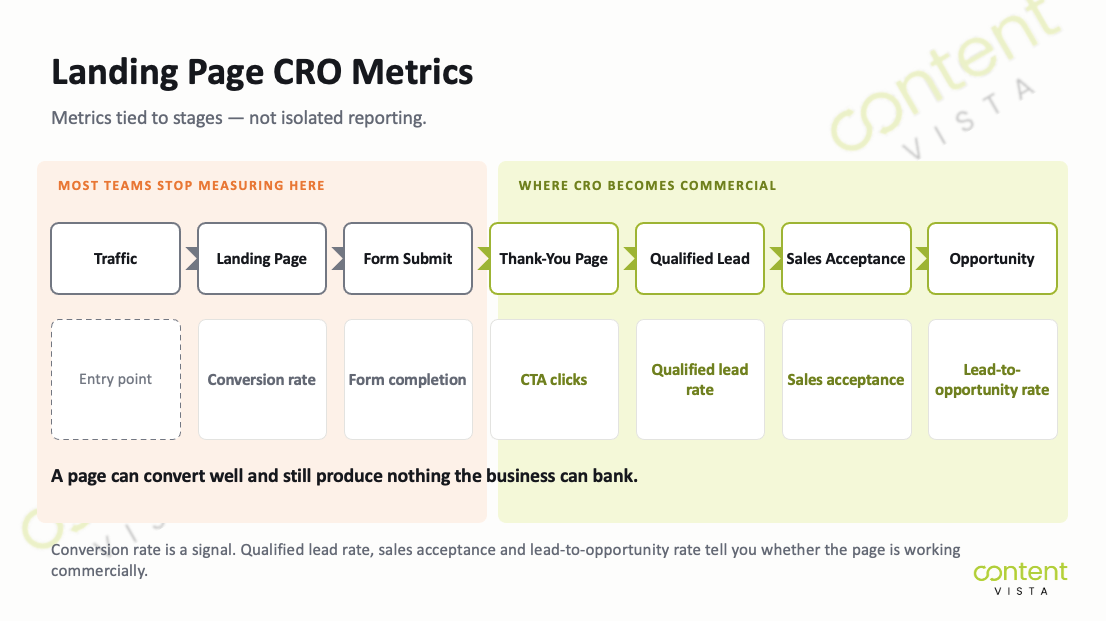
Lead-quality metrics matter more than raw volume
This is where CRO becomes commercially meaningful.
Generating more leads is not useful if those leads do not match the ICP, fail qualification, never respond, never reach sales readiness or never become opportunities.
Important qualification metrics include:
qualified lead rate
sales acceptance rate
lead-to-opportunity rate
source-to-pipeline conversion
opportunity value
deal progression quality
These answer the real CRO question: "Is this landing page contributing to qualified pipeline?"
A lower-volume page with stronger qualification performance may create far more business value than a high-volume page optimised purely for form submissions.
Connect CRO reporting to pipeline visibility
The most mature CRO systems connect landing-page performance directly into CRM and pipeline reporting. That visibility helps teams identify:
which traffic sources create quality pipeline
which offers attract better-fit leads
which pages produce sales-ready opportunities
where leads stall after conversion
where qualification breaks down
Without this connection, optimisation decisions often become distorted by vanity metrics.
| Stage | Metric | Why It Matters |
|---|---|---|
| Page | Conversion rate | Shows how many visitors take the primary action |
| Page | Form completion rate | Shows whether friction blocks submission |
| Post-submit | Thank-you page CTA clicks | Shows whether high-intent leads continue |
| Lead quality | Qualified lead rate | Shows whether conversions match the ICP |
| Sales handoff | Sales acceptance rate | Shows whether sales sees leads as useful |
| Pipeline | Lead-to-opportunity rate | Shows whether CRO creates business outcomes |
Here's the question worth asking before you touch the page: do you actually know how many qualified leads this system should be producing? Without that number, every conversion rate is context-free.
Work out how many qualified leads your system should be generating before you decide the page is the problem.
Lead Generation Capacity CalculatorFor businesses trying to improve acquisition quality rather than just lead volume, this usually becomes a broader Lead Generation and Systems, Conversion & Growth Infrastructure conversation rather than a landing-page optimisation exercise.
Patch, Rebuild or Redesign the Funnel?
Not every landing page needs a redesign. But not every leak can be patched with a headline tweak either.
One of the biggest CRO mistakes is applying the wrong level of intervention to the problem. The goal is not to redesign by default — it is to identify the smallest meaningful change capable of improving qualified conversion performance.
Patch obvious friction first
Sometimes the problem really is simple. The page may already have strong offer positioning, clear structure, relevant traffic, reasonable trust and good intent alignment, but still suffer from one or two obvious leaks:
weak CTA copy
unnecessary form fields
slow mobile performance
poor visual hierarchy
unclear headline wording
missing trust placement
In those situations, targeted fixes often create meaningful improvement quickly. The risk is assuming every performance issue can be solved this way. Quick fixes work best when the overall conversion architecture is already sound.
Test when the variable is isolated
Structured A/B testing becomes useful when:
the page already functions reasonably well
traffic volume is sufficient
one variable may materially influence conversion
the team has a clear hypothesis
That may mean testing headline framing, evaluating CTA commitment level, comparing form depth, changing proof placement or adjusting hero messaging.
But testing only works well when the page is fundamentally understandable already. If the offer, hierarchy, trust flow or CTA structure are weak, testing small elements often produces noisy or misleading outcomes.
Rebuild when the structure itself is weak
Some landing pages are underperforming because the page never creates clarity in the first place. Common signs include:
confusing hero sections
unclear offers
competing CTAs
weak narrative flow
poor proof structure
disconnected sections
scattered messaging
A rebuild makes more sense when the page does not explain the offer clearly, fails to guide attention, lacks persuasive flow, creates decision overload or feels disconnected from visitor intent. This is where broader Landing Pages & Funnel Builds or Website Strategy & Conversion Design work becomes necessary rather than isolated CRO tweaks.
Redesign the funnel when the leak is operational
Sometimes the landing page performs reasonably well while the business still struggles to generate qualified pipeline. That usually means the problem exists after the submission. For example:
thank-you pages create dead ends
nurture systems are weak
CRM routing is inconsistent
follow-up timing is poor
qualification breaks down
sales handoff fails
traffic sources attract low-fit visitors
attribution visibility is incomplete
Redesigning the page alone rarely solves the real issue. The funnel itself needs redesign: restructuring offers, changing qualification logic, redesigning nurture flow, improving CRM automation, fixing source-message alignment, clarifying handoff ownership, improving sales-process integration.
This is where CRO becomes a systems problem rather than a page-design problem.
| Option | Best For | Effort Level | Main Risk | When to Choose It |
|---|---|---|---|---|
| Patch | Obvious copy, CTA, form or speed issues | Low | Treating symptoms only | When the page is mostly sound but has clear friction |
| A/B test | Specific hypothesis with enough traffic | Medium | Testing weak ideas or waiting too long for inconclusive data | When one variable may meaningfully affect conversion |
| Rebuild page | Weak offer flow, confusing structure, or poor proof | Medium to high | Rebuilding without fixing source-message fit | When the page does not explain, persuade or guide action |
| Redesign funnel | Broken thank-you page, nurture, CRM or sales handoff | High | Fixing the page while the funnel still leaks | When leads submit but do not become qualified pipeline |
Choose the right level of intervention for the actual leak. A landing page can look broken when the real issue is upstream traffic quality, downstream handoff failure or a funnel that was never structurally aligned in the first place.
Common Landing Page CRO Mistakes
The mistakes are simple. But they are exactly why teams keep buying more traffic instead of fixing the conversion path.
Most landing-page optimisation problems are not caused by a lack of tools. They come from diagnosing the wrong issue, measuring the wrong thing or treating CRO like isolated page tweaking instead of funnel optimisation.
A few of those deserve unpacking, because they cause the most damage.
Cutting form fields without checking lead quality. Shorter forms improve completion rate. They also remove qualification signals. Teams celebrate increased lead volume while sales acceptance drops, no-show rates rise and pipeline conversion deteriorates. The page appears healthier while the business outcome worsens.
Tracking conversions without tracking qualified leads. Without visibility into lead quality, sales acceptance, opportunity creation and source-to-pipeline performance, teams optimise for the wrong outcome. A page generating fewer but stronger opportunities may be far more valuable than one optimised purely for submission volume.
Redesigning before diagnosing. Sometimes the issue is the page. Sometimes it is poor traffic quality, weak source intent, broken nurture flow, delayed follow-up, CRM routing failure or weak qualification. Fixing the page alone will not solve those problems.
And one more worth naming, because it is newer: relying heavily on AI-generated copy without grounding it in actual buyer insight. AI accelerates production, but generic AI copy often sounds polished while failing to reflect real customer language, actual objections, decision-stage nuance, buying context and qualification psychology. The result is a page that looks "optimised" and feels emotionally disconnected from real buyer intent.
The most effective CRO work is rarely about one tactic. It comes from aligning source intent, messaging, proof, CTA structure, qualification logic, post-submit flow and pipeline visibility into one coherent conversion system.
When Not to Optimise the Page Yet
Sometimes the landing page is not the problem. The foundation underneath the landing page is.
Many businesses start CRO work too early. They optimise headlines before clarifying the offer. They redesign pages before validating audience fit. They run A/B tests before understanding why visitors are arriving in the first place.
Landing page optimisation works best when the underlying acquisition and conversion foundations are already reasonably stable. If those foundations are weak, CRO becomes an expensive way to optimise confusion.
Start with clarity before optimisation
A landing page cannot compensate for an unclear business strategy. If the ICP is vague, the messaging becomes vague too. The page tries to speak to everyone, the offer loses specificity and visitors struggle to recognise whether the solution is meant for them.
The same applies to weak positioning. If the business cannot clearly explain:
what problem it solves
who it solves it for
why the offer matters
why it is differentiated
what action visitors should take
then CRO changes alone rarely fix the problem.
Optimisation amplifies clarity. It does not create clarity from scratch.
Traffic quality matters more than page tweaks
Sometimes the page is fine but the wrong visitors are arriving. This often happens when:
targeting is weak
ads overpromise
keywords attract poor-fit intent
outbound messaging is misaligned
broad social traffic lands on high-intent pages
the offer attracts curiosity instead of qualification
In those situations, improving the landing page may produce only marginal gains because the real issue exists upstream in the acquisition strategy. The page cannot reliably convert visitors who were never a good fit to begin with.
CRO cannot fix a broken sales process
Many teams optimise aggressively for leads while the operational funnel behind the page remains weak. For example:
follow-up is inconsistent
CRM workflows are incomplete
sales ownership is unclear
nurture systems are missing
response times are slow
qualification logic is weak
lead routing fails
the business lacks capacity to handle leads properly
This creates a hidden conversion leak after the submit. The landing page may technically perform well while the actual business outcome remains poor. This is why building predictable lead generation has to come before optimising individual pages inside it.
Sometimes there is simply not enough data yet
Very low-volume pages do not provide enough reliable data for structured testing. In these situations, qualitative diagnosis usually creates more value than endless experimentation. That may include:
reviewing session recordings
analysing source quality
interviewing leads
checking sales feedback
improving offer clarity
simplifying the page structure
refining positioning
The goal is to strengthen the fundamentals before scaling optimisation activity.
| Warning Sign | Why It Matters | Better Next Move |
|---|---|---|
| Unclear ICP | The page cannot convert people it does not understand | Fix audience and positioning first |
| Weak offer | CRO cannot make an unclear offer compelling | Clarify value proposition and offer structure |
| Wrong traffic source | The page may be receiving low-fit visitors | Fix targeting and source-message match |
| Broken follow-up | Leads submit but do not progress | Fix CRM, nurture and sales handoff |
| No reliable data | Tests may be misleading | Use qualitative diagnosis first |
In many cases, the right next step is not another landing-page experiment. It is fixing the broader growth system around the page — which may require deeper Marketing Strategy & Growth Consulting or a structured operational reset such as the Marketing OS Sprint.
Landing page optimisation works best when the business already has a reasonably clear offer, defined audience, functional follow-up process and measurable conversion path. Without those foundations, optimisation often improves the wrong thing.
Mini CRO Repair Examples
Here's what this looks like when you stop treating CRO as a checklist and start treating it as leak repair.
The examples below are hypothetical but based on common landing-page conversion patterns seen across lead-generation funnels.
Example 1 - Source-message mismatch
A company runs a LinkedIn campaign about pipeline leakage, weak qualification and disconnected follow-up. But when visitors click through, they land on a broad generic services page talking vaguely about "growth solutions."
The problem is not the CTA button. The problem is continuity. The visitor expected a focused diagnostic conversation and funnel-specific insight. Instead, the landing page resets the conversation entirely.
The repair:
create a dedicated landing page matching the campaign theme
continue the same language and framing
reinforce the original pain point
focus the CTA around diagnosis instead of generic consultation
align proof and examples with the campaign topic
The key insight: message mismatch creates friction before the visitor evaluates the actual offer.
Example 2 - Form friction vs lead quality
A lead magnet page performs well with out-of-market visitors. The form is extremely short — first name, email. Conversion rate looks strong. But downstream quality is weak: poor-fit leads, low engagement, weak sales-readiness, low follow-through.
The initial instinct is to celebrate the conversion rate. But the leak becomes visible after the submission.
The repair:
clarify who the resource is for
add qualification language to the page
introduce one or two contextual form fields
align the CTA with the intended audience
improve segmentation logic after submission
The result is not necessarily more submissions. It is better-fit submissions.
Example 3 - Thank-you page dead end
A webinar registration page converts consistently. Visitors submit the form successfully, but attendance and post-webinar progression remain weak.
The thank-you page simply says: "Thanks for registering." No calendar links. No reminder expectations. No next step. No nurture transition. The conversion technically happened, but momentum stopped immediately afterward.
The repair:
add calendar-save links
explain what attendees will learn
set reminder expectations
introduce related resources
trigger segmented nurture flow
reinforce credibility before the event
The landing page itself was not the biggest leak. The thank-you experience was.
Example 4 - Testing vs rebuilding decision
A low-traffic B2B landing page underperforms. The team immediately proposes A/B testing button colours, CTA wording and section spacing.
But the page has larger structural issues: unclear positioning, weak headline clarity, scattered messaging, poor hierarchy, insufficient proof, competing CTAs. And traffic volume is too low for reliable testing. Running micro-tests here would produce inconclusive data while delaying more meaningful improvements.
The repair:
diagnose the page qualitatively first
review session recordings and engagement flow
simplify the page structure
rebuild the hero section
clarify the offer
tighten CTA hierarchy
improve proof placement
Only after the page becomes structurally clear does experimentation become useful.
Most landing-page leaks are not isolated design problems. They are conversion-path problems involving source intent, trust, qualification, post-submit flow and funnel structure working together or failing together.
FAQs About Landing Page Conversion Rate Optimization
What is landing page conversion rate optimization?
Landing page conversion rate optimization is the process of improving how effectively a landing page turns visitors into a desired action, such as a form submission, consultation request, demo booking, webinar registration or download. Effective CRO also considers lead quality, post-submit flow, CRM handoff and pipeline impact: not just raw conversion volume.
What is a good landing page conversion rate?
There is no universal "good" conversion rate.
Performance varies based on:
industry
traffic source
audience intent
offer type
device behaviour
conversion goal
lead qualification level
A high conversion rate with low-quality leads may still indicate a weak funnel. A lower conversion rate with strong-fit opportunities may be commercially more valuable.
How do you improve a landing page's conversion rate?
Start by diagnosing where friction exists.
Common CRO improvements include:
improving message match
clarifying the offer
strengthening the headline
reducing CTA friction
improving form usability
adding trust and proof
improving mobile UX
simplifying page structure
fixing post-submit flow
aligning the page with visitor intent
The best optimisation work improves qualified conversions, not just more submissions.
What should I test first on a landing page?
Start with the highest-impact issue first.
That usually means testing or fixing:
message match
headline clarity
offer positioning
CTA structure
form depth
proof placement
page hierarchy
Testing cosmetic details before fixing structural friction usually produces weak results.
Is it better to reduce form fields?
Not always.
Shorter forms can improve completion rates, but removing too many fields may reduce lead quality. The right form depth depends on:
funnel stage
offer type
visitor intent
qualification needs
Low-commitment offers usually need lighter forms. Higher-intent offers may benefit from moderate qualification fields.
When should I redesign a page instead of A/B testing it?
Redesign makes more sense when the page is structurally weak.
Examples include:
unclear offers
confusing hierarchy
poor proof flow
competing CTAs
disconnected messaging
weak mobile usability
A/B testing works best when one variable can be isolated on an otherwise functional page.
Does page speed affect landing page conversions?
Yes but it is not the only factor.
Slow-loading pages, unstable layouts, and poor mobile usability can create friction before visitors evaluate the offer. Core Web Vitals and page experience matter because user experience matters.
But speed alone will not fix weak positioning, poor trust signals, unclear messaging or broken funnel flow.
What is the difference between landing page CRO and funnel optimisation?
Landing page CRO focuses on improving the page experience itself:
messaging
CTA flow
form usability
trust
layout
conversion clarity
Funnel optimisation looks beyond the page into:
traffic quality
nurture flow
CRM routing
qualification logic
sales handoff
pipeline progression
attribution visibility
A landing page can convert well while the wider funnel still leaks pipeline.
Should a thank-you page include another CTA?
Often, yes.
The thank-you page is a high-intent moment in the funnel. Depending on the context, it may include:
calendar booking
webinar reminders
related resources
audit invitations
nurture progression
next-step guidance
The goal is not to overload visitors. It is to continue momentum after the initial conversion.
What metrics matter beyond conversion rate?
Important CRO metrics may include:
qualified lead rate
form completion rate
bounce rate
engagement depth
thank-you page CTA clicks
sales acceptance rate
lead-to-opportunity rate
source-to-pipeline conversion
opportunity value
These metrics help connect landing-page performance to actual business outcomes.
How much traffic do I need for A/B testing?
There is no fixed number that applies universally.
Reliable A/B testing depends on:
traffic volume
conversion volume
expected impact size
test duration
statistical confidence
Very low-traffic pages often benefit more from qualitative diagnosis first, such as:
session recordings
heatmaps
user feedback
heuristic review
funnel analysis
When is the real problem not the landing page at all?
The landing page may not be the real issue when:
the ICP is unclear
the offer is weak
traffic quality is poor
source-message alignment is broken
follow-up is inconsistent
CRM workflows fail
nurture systems are missing
sales handoff is weak
the business lacks operational capacity
the post-submit funnel leaks heavily
In these situations, fixing the broader conversion system often matters more than changing the page itself.
Fix the Leak Before You Buy More Traffic
More traffic will not fix a leaking conversion path.
If the landing page is unclear, the offer is weak, the CTA creates friction, the form attracts poor-fit leads or the funnel breaks after the submit, increasing traffic amplifies the problem instead of solving it.
That is why effective landing page CRO starts with diagnosis.
The goal is not simply to improve form-fill numbers. It is to understand where qualified leads are leaking across the full conversion journey:
source-message match
offer clarity
trust and proof
CTA friction
form flow
thank-you experience
CRM routing
nurture progression
sales handoff
source-to-pipeline visibility
A landing page is not an isolated asset. It is one step inside a wider click-to-qualified-lead system. Which brings us back to where we started: when the leads are not showing up, it is usually a system problem, not a lead problem.
Sometimes the leak starts before the page. Sometimes it happens after the submission. Sometimes the issue is structural rather than visual. The important thing is identifying the actual bottleneck before increasing spend or rebuilding the page.
Fix the leak, and the page stops being a lottery ticket. It becomes one working layer of a lead generation system that produces predictable pipeline instead of feast-and-famine spikes.
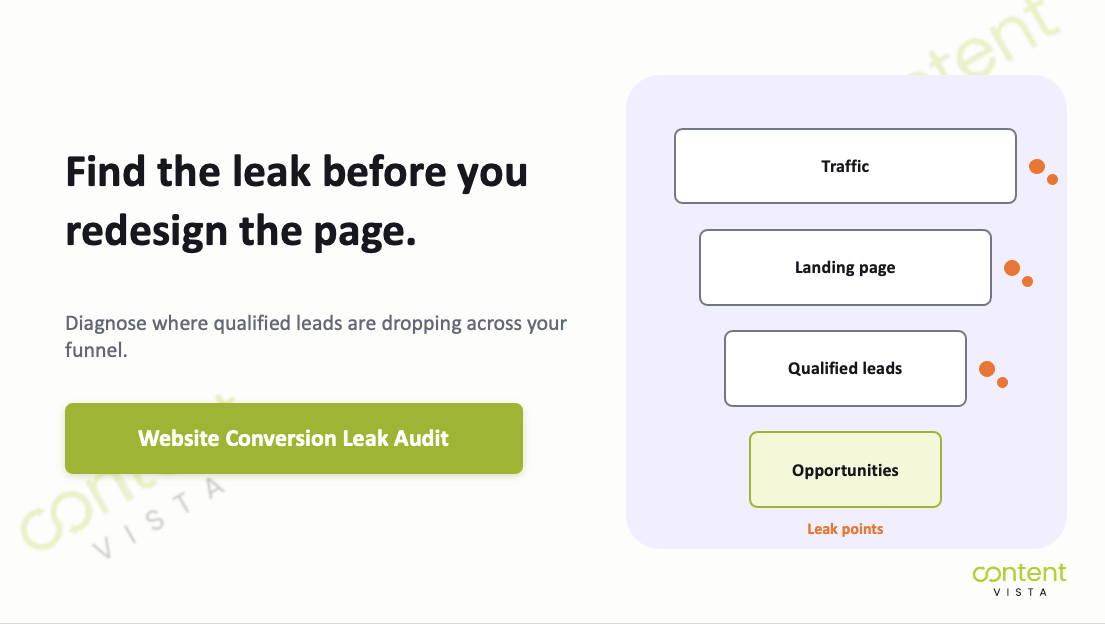
Use the Website Conversion Leak Audit to find where your landing page or funnel is losing qualified leads.
Website Conversion Leak Audit