Quick Summary
- Inbound lead generation vs outbound is not really a winner-vs-loser decision.
- Inbound works best when buyers actively search, compare options and can be educated through content, SEO, thought leadership or lead magnets over time.
- Outbound works best when buyers are identifiable and the business needs qualified conversations faster through targeted outreach.
Why the Inbound vs Outbound Debate Confuses So Many Teams
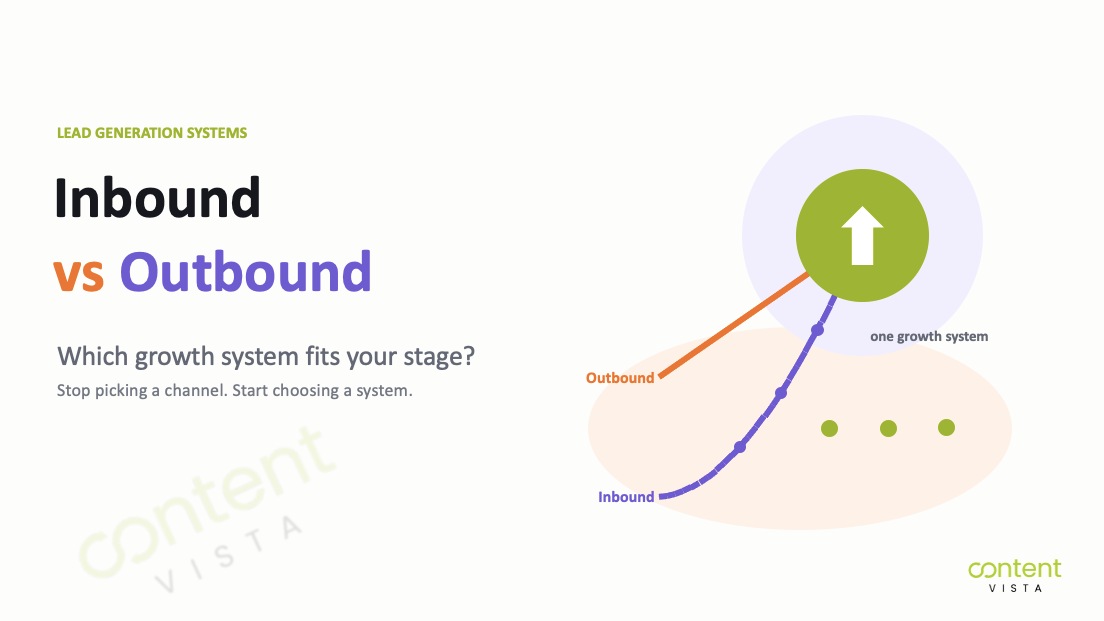
Inbound vs outbound is the wrong debate.
The real question is: which engine should lead your growth right now, which should support it, and what should you sequence next?
Most businesses approach lead generation as a channel argument. One side says inbound lead generation compounds over time through SEO, content, newsletters, thought leadership and trust-building assets. The other side argues that outbound lead generation creates faster conversations through direct outreach, cold email, LinkedIn prospecting, and targeted campaigns.
Both sides are partially right. And that is exactly why so many teams get stuck.
The problem is not usually “inbound vs outbound.” The problem is choosing a growth system without diagnosing the business stage, pipeline urgency, audience behaviour, sales complexity and execution capacity first.
A founder-led consultancy with strong expertise but weak visibility may need an inbound-led engine to build authority and capture demand over time. A business with aggressive pipeline targets and clearly identifiable buyers may need outbound-led outreach first to create conversations faster.
Another company may need a hybrid channel mix where outbound creates immediate opportunities while inbound builds trust and warms future buyers in parallel.
That is where the confusion starts.
Inbound can create compounding demand, but it usually needs time, consistency, conversion assets and enough authority for people to trust the message. Outbound can accelerate feedback and pipeline creation, but only when targeting, positioning, messaging and follow-up are handled properly.
Poor outbound feels like spam. Poor inbound becomes content with no commercial movement behind it.
Hybrid systems can be powerful, but only when CRM, nurture, messaging and execution are connected into one coordinated process instead of random acts of marketing.
That is why this article will not try to crown a winner.
Instead, it will help you decide whether inbound-led, outbound-led, hybrid-led or foundations-first is the smarter move for your current stage and why many businesses should stop asking “Which channel is better?” and start asking “Which system fits how we actually grow?”
Here’s the reframe that changes everything: for most businesses, this is a system problem, not a lead problem. The channel you pick matters far less than whether it plugs into a connected lead generation system underneath it.
Building that system end to end — getting the offer and ICP right, connecting capture and CRM so prospects don't disappear through pipeline leakage, turning engagement into sales-ready conversations — is a bigger subject than one page. This article covers one decision inside it: which engine should lead right now.
If you want the broader framework behind predictable pipeline creation, start with understanding the lead generation system.
What Inbound and Outbound Lead Generation Actually Mean
Before comparing inbound and outbound, it helps to strip away the marketing jargon and look at what these systems are actually designed to do.
Inbound lead generation is built to attract attention over time. The business creates useful assets such as SEO content, thought leadership, newsletters, webinars, lead magnets, educational resources or search-visible pages that help potential buyers discover the company while researching a problem or evaluating solutions.
Outbound lead generation works differently. Instead of waiting to be discovered, the business proactively reaches selected prospects through channels like cold email, LinkedIn outreach, direct messages, calls, paid outreach or account-based campaigns designed to start conversations directly.
Inbound lead generation attracts prospects by creating useful content, search visibility, trust and lead-capture paths that bring buyers toward the business. Outbound lead generation proactively reaches selected prospects through direct outreach, paid campaigns or account-based activity to start conversations before they actively come to you.
In simple terms, inbound is usually pull-based. It earns attention.
Outbound is usually push-based. It initiates attention.
But that distinction alone can be misleading.
A strong inbound system is not just “publishing content.” It requires positioning, clear audience understanding, conversion paths, nurturing and enough authority for buyers to trust what they are reading. Without those pieces, inbound often turns into disconnected content production with little pipeline impact.
The same is true for outbound. Strategic outbound is not mass spam or random cold outreach. Effective outbound depends on targeting precision, messaging relevance, timing, follow-up discipline and CRM visibility. Poor outbound feels intrusive. Well-executed outbound creates focused conversations with the right buyers at the right time.
That is why the real comparison is not “good inbound versus bad outbound” or vice versa. Both models can fail when the underlying growth system is weak.
In short: inbound earns attention. Outbound initiates it. But that still does not tell you which one should lead.
The smarter decision depends on things like pipeline urgency, audience behaviour, sales complexity, authority assets and operational capacity which is why businesses increasingly connect both through broader demand generation and lead generation systems rather than treating them as isolated tactics.
Check out our demand generation and lead generation services.
Inbound vs Outbound Lead Generation at a Glance
Here’s the simplest way to compare them before we get into the real decision.
Inbound and outbound are built for different growth conditions. One is designed to attract and compound attention over time. The other is designed to create direct contact and faster market feedback. Neither is automatically better. The right fit depends on your pipeline urgency, audience behaviour, authority level, sales complexity and execution capacity.
| Comparison Area | Inbound Lead Generation | Outbound Lead Generation | Strategic Reality |
|---|---|---|---|
| Speed to first conversations | Usually slower because content, SEO and trust take time to build | Usually faster because outreach creates direct contact immediately | Businesses with urgent pipeline pressure often lean outbound first |
| Control | Less direct control over timing and discovery | Higher control over targeting, sequencing, and outreach volume | Outbound gives faster testing and feedback loops |
| Compounding value | Strong compounding potential through reusable content and search visibility | Limited compounding if outreach stops completely | Inbound often creates longer-lived assets |
| Trust-building | Strong for authority, education, and credibility | Depends heavily on messaging relevance and proof | Outbound works better when supported by visible authority assets |
| Cost profile | Often front-loaded into content, SEO, systems, and consistency | Often tied to ongoing prospecting, tooling, outreach, and follow-up effort | Poor execution increases cost in both models |
| Team effort | Requires content creation, optimisation, nurture, and conversion systems | Requires prospecting, targeting, messaging, and follow-up discipline | Hybrid systems require operational coordination across both |
| Buyer intent | Captures existing demand from buyers already researching | Creates conversations before buyers actively search | Outbound is often useful in less mature or less searchable markets |
| Targeting precision | Broader discovery through search, content, and audience reach | Highly specific targeting by role, company, industry, or trigger | Outbound works well when the ICP is clearly identifiable |
| Sales involvement | Buyers may self-educate before speaking to sales | Sales involvement usually starts earlier in the process | Complex offers often need both education and direct conversations |
| Best-fit use cases | Thought leadership, SEO-driven demand, educational buying journeys, authority building | Fast pipeline creation, niche targeting, outbound prospecting, account-based outreach | Many businesses eventually combine both into a channel mix |
| Risks | Slow results, low conversion intent, disconnected content, weak capture systems | Spam perception, targeting mistakes, poor follow-up, message fatigue | The real risk is scaling either system before foundations are ready |
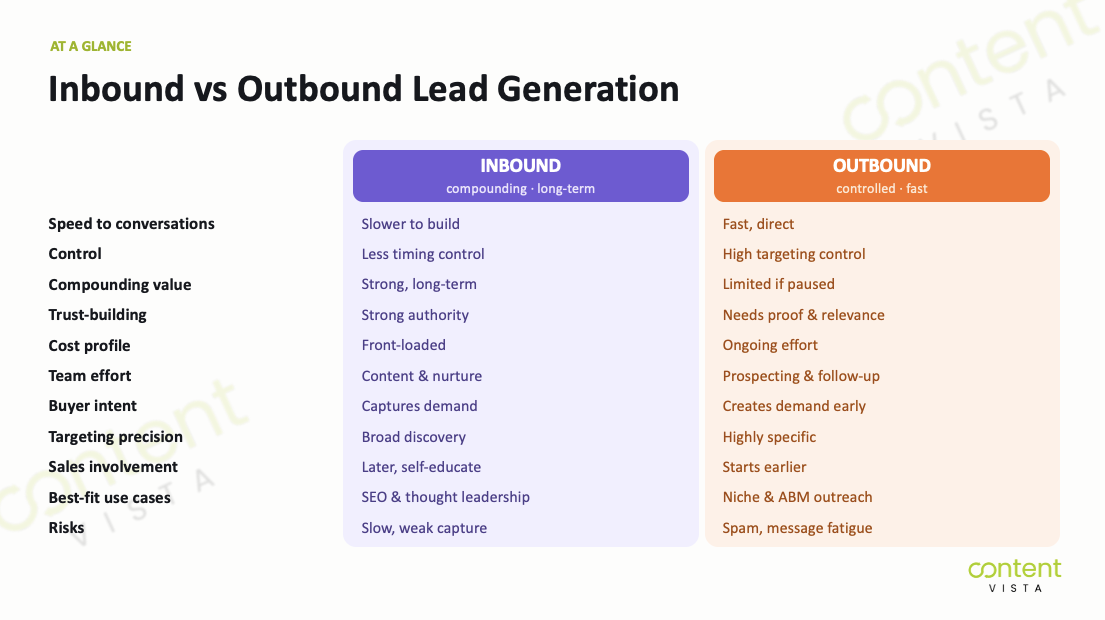
Inbound is usually stronger at building trust and compounding visibility over time. Outbound is usually stronger at creating direct conversations faster. The highest-performing growth systems often combine both but only when messaging, CRM, follow-up and conversion infrastructure are connected properly.
This comparison explains the mechanics. But it still does not answer the more important question: which engine should lead for your business right now and what should support it next?
Why “Which Is Better?” Is the Wrong Question
Here’s where most teams go wrong: they choose a channel before they diagnose the system.
The internet loves turning inbound and outbound into opposing camps. One side treats inbound as the “smart” long-term strategy. The other treats outbound as the only reliable way to create pipelines quickly. But most businesses do not fail because they picked the wrong side in a marketing debate.
They failed because they scaled the wrong engine for their stage.
Inbound and outbound solve different problems.
Inbound is strongest when the business needs trust, discoverability, authority, education and compounding demand over time. It works especially well when buyers actively research solutions, compare vendors, and consume content before speaking to sales.
Outbound solves a different challenge. It creates direct market contact. It helps teams validate positioning faster, reach specific accounts proactively and generate conversations before search demand or brand visibility fully exists.
That is why “Which is better?” is usually the wrong question.
The better questions are:
Which engine should lead right now?
Which channel should support it?
What should we sequence next once traction appears?
A business with strong expertise but no visibility may need inbound-led authority building first. A company under immediate revenue pressure may need outbound-led pipeline generation first. Another business may need outbound to create immediate conversations while inbound builds long-term trust and owned attention in parallel.
And some companies should not scale either one yet.
If the ICP is unclear, the offer is weak, the website does not convert, the CRM process is broken or sales follow-up is inconsistent, adding more inbound or outbound usually magnifies inefficiency instead of fixing it.
Inbound-led, Outbound-led, Hybrid-led or Foundations-first?
* Inbound-led → Best when buyers search, research, compare and need trust before conversion.
* Outbound-led → Best when pipeline urgency is high and buyers can be targeted directly.
* Hybrid-led → Best when the business needs both authority and faster conversations.
* Foundations-first → Best when positioning, offer clarity, funnel structure, CRM or follow-up systems are weak.
So how do you actually make the call? Run your situation through these four questions in order.
Lead / Support / Sequence Checklist
* Lead → Which engine solves your most urgent constraint right now? Choose outbound-led if pipeline urgency is high and buyers are clearly identifiable. Choose inbound-led if buyers already search and trust drives the decision.
* Support → Which engine strengthens the one that leads? Inbound assets make outbound replies warmer and more credible. Outbound conversations sharpen inbound messaging, topics and positioning. The supporting engine runs lighter, not at full scale.
* Sequence → What gets layered next once the leading engine produces signal? Add the next channel deliberately — a social-led or paid-led motion, or a nurture and CRM layer — instead of launching everything at once.
* Foundations-first → Should you scale either engine yet? If the offer, ICP, positioning, CRM or follow-up is weak, stop here. Fix those foundations before you scale any channel — otherwise you are just scaling random acts of marketing.
Hybrid systems are where many businesses eventually land but hybrid does not mean “do everything everywhere.”
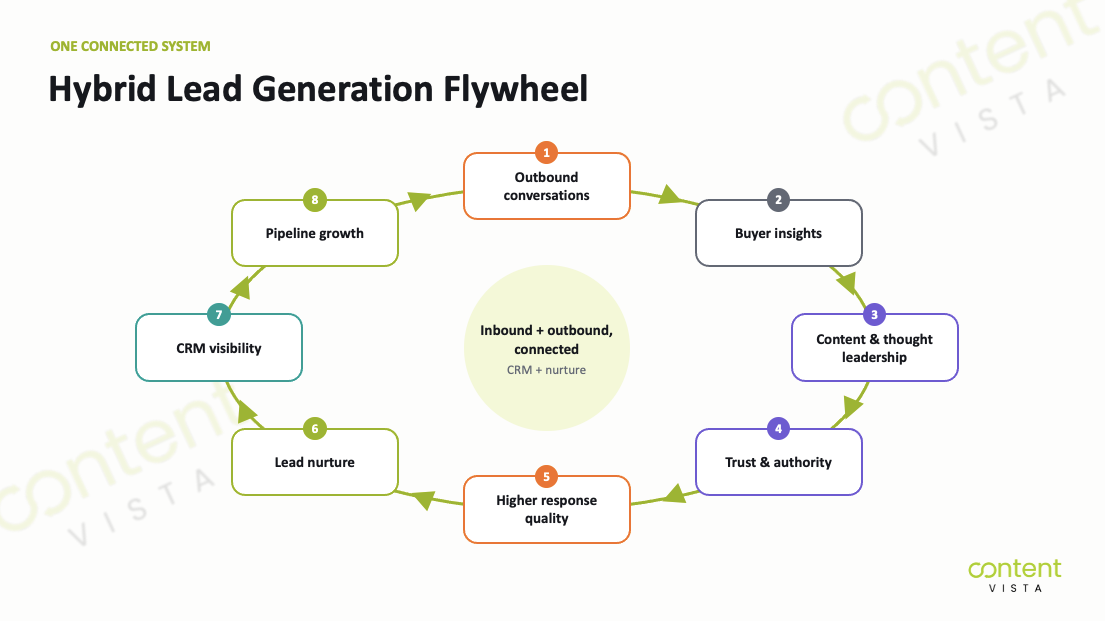
A functional hybrid growth system connects outbound conversations, inbound content, CRM tracking, nurture flows, lead scoring and follow-up into one coordinated engine. Outreach informs content. Content improves outreach credibility. Sales conversations shape future messaging. CRM visibility ties the entire channel mix back to pipeline and revenue outcomes.
That is very different from randomly posting content while simultaneously sending disconnected cold emails.
The real decision is not inbound versus outbound.
It is whether your business currently needs:
compounding demand
faster feedback
targeted conversations
authority-building
conversion infrastructure
or a stronger foundation underneath all of them.
Not sure whether inbound, outbound, hybrid or foundations-first fits your stage? Use the Marketing Growth System Finder.
Marketing Growth System FinderThe PACER Channel-Mix Diagnostic
Let’s make this practical. Before you choose a channel, score these five things.
Most lead generation decisions fail because teams jump straight into tactics:
“We need SEO.”
“We should run cold email.”
“Let’s post more on LinkedIn.”
“We need paid ads.”
But channels only work when they match the business situation underneath them.
That is why Content Vista uses a simple channel-mix diagnostic called PACER to decide whether inbound-led, outbound-led, hybrid or foundations-first is the smarter growth move right now.
PACER Channel-Mix Diagnostic
* P - Pipeline urgency: How quickly do you need qualified conversations?
* A - Audience discoverability: Are buyers actively searching or do you need to reach them directly?
* C - Commercial complexity: Does the offer sell through content alone or does it require direct explanation and follow-up?
* E - Existing authority assets: Do you already have proof, trust, audience, content or conversion assets?
* R - Resourcing and response capacity: Can your team consistently create content, run outreach, follow up and manage CRM handoff?
Let's take these one at a time.
P - Pipeline Urgency
Some businesses can wait for compounding growth. Others cannot.
If revenue pressure is high and the pipeline gap is immediate, outbound often becomes necessary because it creates faster market contact and faster feedback loops. Inbound usually takes longer because trust, search visibility and audience attention need time to build.
High urgency often pushes the channel mix toward outbound-led or hybrid-led execution.
Lower urgency creates more room for inbound-led authority building.
A - Audience Discoverability
This is one of the most overlooked decisions in lead generation.
Are buyers already searching for solutions like yours? Or do they need to be reached proactively before they even start researching?
If search intent already exists, inbound can work extremely well through SEO, thought leadership, educational content, newsletters, webinars and lead magnets.
But some markets do not search clearly. Some buyers only respond when approached directly. In those cases, outbound becomes much more important.
The less discoverable the audience, the more proactive the system usually needs to become.
C - Commercial Complexity
Simple offers can often convert through content and nurture alone.
Complex offers usually cannot.
If the buying process involves stakeholder alignment, education, customisation, trust-building or strategic explanation, direct conversations matter much earlier. Outbound, sales involvement, and consultative follow-up become more important in the channel mix.
That does not eliminate inbound. It changes its role.
Inbound may educate and warm buyers, while outbound helps move decisions forward through human interaction.
E - Existing Authority Assets
Inbound performs very differently depending on existing trust.
A business with case studies, expertise, founder visibility, search traction, testimonials, educational content, newsletters or thought leadership already has authority assets that make inbound more effective.
A business starting from zero often struggles because inbound systems need credibility before they compound.
Outbound can sometimes bridge that gap faster by creating direct conversations while authority assets are still being built.
R - Resourcing and Response Capacity
This is where many strategies quietly break.
Inbound requires consistent publishing, optimisation, nurturing, and conversion tracking. Outbound requires prospecting, targeting, follow-up, CRM discipline and response handling.
Hybrid systems require both.
If the team lacks execution capacity, operational consistency or CRM visibility, scaling channels too early often creates chaos instead of pipeline.
That is when foundations-first becomes the smarter answer.
| PACER Factor | Strong Signal | Likely Best Fit | Strategic Interpretation |
|---|---|---|---|
| Pipeline urgency | Immediate pipeline pressure | Outbound-led or Hybrid-led | Faster conversations and feedback matter more than long-term compounding initially |
| Audience discoverability | Buyers actively search and compare | Inbound-led | Search visibility, thought leadership, and content can capture demand effectively |
| Commercial complexity | Offer needs explanation and consultative selling | Hybrid-led or Outbound-led | Direct conversations become essential earlier in the buyer journey |
| Existing authority assets | Strong proof, visibility, and expertise already exist | Inbound-led or Hybrid-led | Existing trust improves content conversion and discoverability |
| Resourcing and response capacity | Weak systems, inconsistent execution, poor CRM follow-up | Foundations-first | Scaling channels before operational readiness usually increases inefficiency |
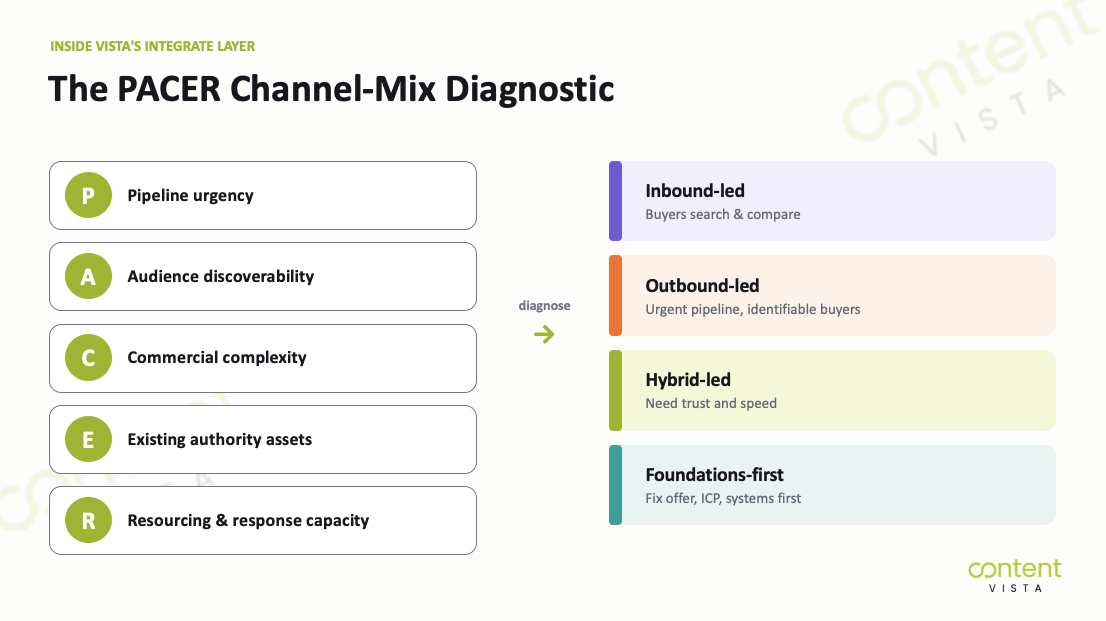
The PACER diagnostic is not designed to force a single answer forever.
A company might begin outbound-led because pipeline urgency is high, then gradually layer inbound once messaging improves and authority assets grow. Another business may start inbound-led, then add outbound later for account-based targeting and faster pipeline acceleration.
The goal is not to choose a side.
The goal is to build the right channel mix for the current stage, then evolve it as the business matures.
Use the Marketing Growth System Finder to turn your PACER diagnosis into the right growth-system recommendation.
Marketing Growth System FinderWhen Inbound Should Lead
Inbound is powerful when people are already looking.
But if no one knows they have the problem yet, content alone may be too slow.
That distinction matters because inbound lead generation works best when demand already exists in some form even if buyers have not chosen a vendor yet. The role of inbound is to capture attention, build trust, educate buyers and convert existing curiosity into a qualified pipeline over time.
When those conditions exist, inbound can become one of the strongest compounding growth systems a business can build.
Your Buyers Are Already Searching
Inbound should usually lead when buyers actively search for:
the problem,
the solution category,
comparisons,
implementation guidance,
or strategic expertise.
This is especially true in research-heavy buying journeys where buyers consume multiple pieces of information before speaking to sales.
For example, someone searching for terms related to SEO lead generation, demand generation, CRM systems, thought leadership, conversion infrastructure or pipeline strategy is already showing intent. They are looking for answers, frameworks, vendors or implementation guidance.
That creates an opportunity for:
search visibility,
educational content,
lead magnets,
newsletters,
webinars,
and thought leadership assets to attract and nurture demand before direct outreach is even necessary.
Inbound performs well here because the buyer is already moving toward the business voluntarily.
Your Offer Needs Education and Trust
Some offers do not convert well from direct outreach alone because the buyer needs context first.
High-trust services, strategic consulting, complex B2B offers, transformation projects or expertise-driven categories often require:
education
authority
credibility
proof
and repeated exposure before conversion happens
Inbound helps create that trust layer before sales interaction begins.
A well-structured content ecosystem can answer objections, explain frameworks, demonstrate expertise and reduce friction before the first conversation ever happens. That is one reason strong demand generation systems often combine SEO, content strategy, newsletters, webinars and lead capture into a connected trust-building engine rather than isolated content campaigns.
Check out our demand generation and content and thought leadership services.
You Have Expertise Worth Turning Into Assets
Inbound becomes much stronger when the business already has:
expertise
experience
proof
a differentiated point of view
or insight buyers genuinely need
That knowledge can be converted into reusable authority assets:
articles
guides
frameworks
newsletters
webinars
SEO pages
diagnostic tools
or educational resources
This is where inbound stops being “content marketing” and starts becoming an owned attention system.
A useful article published today may continue attracting qualified searches months later. A strong webinar can feed lead nurture sequences. A thought leadership post can improve outbound credibility later. A searchable framework can become part of how buyers evaluate the category itself.
That compounding effect is one of inbound’s biggest strengths.
But it only works when the content is connected to:
positioning
lead capture
conversion paths
and sales readiness
Publishing content without those systems underneath it often creates visibility without a pipeline.
Relevant services:
You Can Wait for Compounding Returns
Inbound usually requires patience.
Search visibility compounds over time. Trust compounds over time. Newsletter audiences compound over time. Educational assets compound over time.
That means inbound is often strongest for businesses that:
can invest consistently
do not require immediate pipeline rescue
and are willing to build long-term discoverability instead of relying entirely on direct-response outreach
This is especially valuable for businesses trying to reduce long-term dependence on constantly buying attention or manually creating every conversation from scratch.
Inbound-led growth works best when:
* buyers already search and research
* trust influences conversion
* expertise can be turned into reusable assets
* and the business can invest long enough for authority and discoverability to compound
At the same time, inbound is not magic.
If the ICP is unclear, the messaging is weak, the website does not convert or there is no clear lead-capture path, content alone rarely fixes the problem. Inbound amplifies clarity. It does not create clarity automatically.
If inbound should lead, build a system that turns content, search and authority into captured demand.
Inbound Magnet SystemWhen Outbound Should Lead
Outbound is not the enemy. Bad outbound is.
A lot of businesses dismiss outbound because they associate it with spammy cold emails, generic LinkedIn pitches or aggressive sales tactics. But strategic outbound lead generation is not about blasting messages at random people.
It is about creating focused conversations with the right buyers at the right time.
Outbound should usually lead when pipeline urgency is high, buyers are identifiable and the business needs faster market feedback than inbound alone can realistically provide.
You Need Conversations Faster
Inbound compounds over time. Outbound creates contact now.
That distinction matters when:
revenue pressure is immediate
the sales pipeline is inconsistent
a new offer needs validation
or the business cannot wait months for search visibility and authority to mature
Outbound gives teams more direct control over:
who gets contacted
how quickly campaigns launch
which messaging gets tested
and how fast conversations begin
That speed makes outbound valuable not only for pipeline generation, but also for learning. Strong outbound systems help businesses quickly identify:
which positioning resonates
which objections appear repeatedly
which buyer segments respond
and which messaging creates movement
In many cases, those insights later improve inbound strategy as well.
Relevant reading:
Your Buyers Are Identifiable
Outbound becomes much more effective when the ICP is clear.
If ideal buyers can be identified by:
job title
industry
company size
growth stage
technology stack
hiring patterns
funding activity
or other market signals
then outbound can target them directly instead of waiting for them to discover the business organically
This is especially useful in:
niche B2B markets
account-based sales environments
high-ticket services
specialised consulting
or categories where search demand is limited or fragmented
In these cases, waiting entirely for inbound demand may slow growth unnecessarily.
Outbound allows the business to initiate conversations instead of waiting passively for attention.
That is one reason many modern lead generation systems combine cold email, LinkedIn outreach and account-based targeting into coordinated outbound workflows rather than treating outreach as isolated campaigns.
Relevant reading:
Your Offer Needs Direct Explanation
Some offers are difficult to understand through content alone.
The more strategic, consultative, high-ticket or operationally complex the offer becomes, the more important direct conversations usually become as part of the buying journey.
Outbound can accelerate that process because it creates opportunities for:
qualification
education
objection handling
and contextual discussion much earlier
That does not mean inbound becomes irrelevant
It means outbound often becomes the primary conversation engine while inbound supports trust, authority, and credibility in the background.
For example, a cold email may start the relationship, but the prospect may still review:
articles,
founder content,
case studies,
webinars,
LinkedIn activity,
or educational resources before responding positively.
That is why outbound works best when paired with visible authority assets instead of operating as disconnected outreach.
Relevant services:
You Need Market Feedback Before Scaling Content
One of outbound’s biggest advantages is feedback speed.
Inbound content strategies can take significant time before enough data exists to understand:
which messaging converts
which ICP segments respond
which objections matter most
or which positioning actually creates qualified demand
Outbound compresses that learning cycle.
Direct conversations reveal language patterns, buying triggers, objections, priorities and decision dynamics much faster than waiting for SEO or long-form content to mature.
That makes outbound especially valuable for:
newer offers
repositioning efforts
category creation
niche solutions
or businesses still refining their market message
In many cases, outbound should not be viewed as separate from content strategy. The conversations themselves become inputs for stronger inbound assets later.
That is also where systems like LinkedIn-led outreach and social selling become useful bridges between direct outbound and trust-building visibility.
Relevant system:
Outbound-led growth works best when:
* pipeline urgency is high,
* buyers are clearly identifiable,
* direct conversations improve conversion,
* the market is niche or less searchable,
* and the team can consistently manage targeting, replies, follow-up, and CRM handoff.
Outbound is not inherently aggressive. Poorly executed outbound is.
When targeting is weak, messaging is generic, or follow-up is inconsistent, outreach quickly becomes noise. But when outbound is treated as a controlled growth system instead of random prospecting, it can create some of the fastest learning and pipeline acceleration available to a business.
If outbound should lead, build it as a controlled system — not random cold outreach.
Cold Email Conversion LabWhen a Hybrid Engine Is the Smarter Move
Hybrid does not mean doing everything at once. It means sequencing the right pieces so they make each other stronger.
This is where many modern growth systems are heading.
Inbound and outbound are often treated like competing approaches, but in practice, high-performing businesses increasingly connect them into one coordinated acquisition engine:
outbound creates conversations now,
inbound builds trust and discoverability over time,
CRM tracks movement across both,
and nurture systems convert buyers who are interested but not ready yet.
The key is orchestration.
Without coordination, “hybrid” quickly becomes scattered activity with no clear ownership or measurement. But when messaging, outreach, content, lead capture, nurture, and CRM work together, each engine improves the performance of the other.
How Inbound Supports Outbound
Outbound works better when the prospect already sees signs of expertise and credibility.
A cold email feels very different when the recipient can immediately find:
useful articles,
strong positioning,
thought leadership,
founder insights,
webinars,
educational resources,
or visible proof connected to the business.
Inbound assets reduce friction.
They help prospects validate the company before replying. They answer objections before sales calls. They create familiarity before direct conversations happen.
This is especially important in:
high-ticket services,
B2B consulting,
strategic offers,
long sales cycles,
and trust-sensitive buying decisions.
In many cases, outbound creates the first interaction while inbound content quietly supports the conversion behind the scenes.
A LinkedIn message backed by visible authority performs differently from one backed by nothing.
How Outbound Improves Inbound
The relationship also works in reverse.
Outbound conversations generate real-world market intelligence much faster than waiting for inbound analytics alone.
Sales calls, cold email replies, LinkedIn conversations, and objections reveal:
what buyers care about,
what language resonates,
what confuses the market,
which pain points repeat,
and where positioning breaks down.
That information becomes fuel for stronger inbound content.
A common mistake in inbound strategy is creating content based entirely on keyword tools without enough buyer insight. Hybrid systems solve that problem because outbound conversations continuously sharpen:
content topics,
messaging,
positioning,
lead magnets,
webinar themes,
and nurture sequences.
The result is content grounded in actual buying conversations instead of theoretical search assumptions.
| Hybrid System Layer | What It Does | How It Supports the Other Engine | Strategic Outcome |
|---|---|---|---|
| Outbound outreach | Creates direct conversations and market feedback | Reveals objections, language patterns, and buyer intent for content strategy | Faster learning and faster pipeline creation |
| Inbound content and thought leadership | Builds authority, trust, and discoverability | Improves reply quality and outbound credibility | Higher conversion confidence and stronger positioning |
| Lead magnets and nurture | Captures and educates interested but not-ready buyers | Keeps outbound-generated interest warm over time | Better lead-to-opportunity conversion |
| CRM and automation | Connects source tracking, follow-up, and pipeline visibility | Aligns inbound and outbound activity into one growth system | Clearer attribution and operational coordination |
How CRM and Nurture Connect Both
This is the part many businesses underestimate.
Hybrid systems only work when there is operational infrastructure connecting the channels.
Without CRM visibility:
leads get lost,
follow-up becomes inconsistent,
attribution becomes unclear,
and marketing and sales drift apart again.
CRM is what turns multiple channels into a coordinated growth system instead of disconnected activity.
Nurture systems matter just as much.
Not every prospect converts immediately after:
a webinar,
a cold email
a LinkedIn interaction
or a downloaded resource
Many buyers need repeated exposure over time before they become sales-ready.
That is where nurture flows, newsletters, educational content, and lead scoring help bridge the gap between initial interest and pipeline movement.
A hybrid growth engine works best when:
* outbound creates immediate conversations
* inbound builds authority and trust
* CRM connects visibility across channels
* nurture systems keep prospects engaged
* and both engines continuously improve each other through shared insights
The strongest hybrid systems are not built around “marketing channels.”
They are built around:
buyer movement
trust development
conversation quality
conversion visibility
and operational coordination across the entire acquisition process
If you need inbound, outbound, content, CRM and automation working together, explore the AI Client Acquisition Stack.
AI Client Acquisition StackSpeed, Cost, Effort, and Compounding Trade-Offs
Inbound is not free. Outbound is not automatically expensive. The real cost is usually hidden in time, team capacity and poor execution.
This is where simplistic marketing advice often breaks down.
A lot of content online reduces the decision to:
inbound = cheaper,
outbound = faster.
But real lead generation systems are more complicated than that.
The actual economics depend on:
business stage
offer quality
conversion rates
sales cycle complexity
team capability
operational consistency,
content quality
targeting precision
and CRM infrastructure
A weak inbound system can waste months creating content that never converts. A weak outbound system can burn time, reputation and prospect attention without creating qualified conversations.
That is why the better comparison is not “cheap vs expensive.” It is:
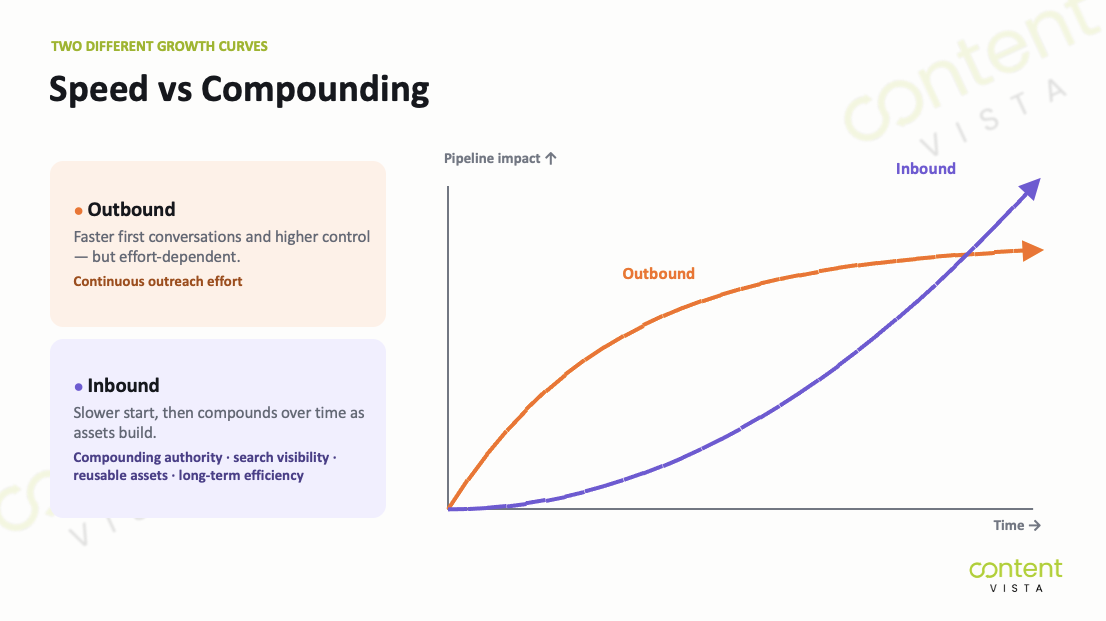
speed vs compounding
control vs patience
and operational effort vs long-term leverage
| Comparison Factor | Inbound-Led | Outbound-Led | Strategic Reality |
|---|---|---|---|
| Time to results | Usually slower because authority, search visibility, and trust take time to build | Usually faster because outreach creates direct conversations immediately | Pipeline urgency often determines which engine leads first |
| Direct cost | Investment often goes into content, SEO, systems, design, strategy, and distribution | Investment often goes into prospecting, outreach tooling, sales effort, and follow-up | Cost varies heavily based on execution quality and conversion efficiency |
| Team effort | Requires consistent content creation, optimisation, nurture, and lead capture management | Requires targeting, prospecting, messaging, follow-up, and CRM discipline | Both systems fail when execution consistency breaks |
| Operational complexity | Search strategy, editorial workflows, lead nurture, conversion paths, analytics | Prospect lists, sequencing, deliverability, outreach operations, reply management | Hybrid systems create even higher coordination requirements |
| Sales involvement | Buyers may self-educate longer before speaking to sales | Sales conversations often begin earlier | Complex offers usually require both education and direct interaction |
| Content requirements | High ongoing requirement for useful, credible, discoverable assets | Lower long-form content dependency initially | Strong outbound still benefits from visible authority assets |
| Outreach requirements | Lower direct prospecting requirement | High requirement for outreach consistency and response handling | Outbound stops quickly when execution stops |
| Compounding value | Strong long-term compounding through searchable assets and owned attention | Limited compounding unless insights feed broader systems | Inbound often becomes more efficient over time |
| Stopping risk | Existing content and search visibility may continue generating demand after publishing slows | Pipeline often drops quickly if outreach pauses | Outbound depends more heavily on continuous operational activity |
| Measurement difficulty | Attribution can become complex across content, nurture, and delayed conversions | Easier to measure direct outreach actions and replies | Both models require CRM visibility for meaningful pipeline analysis |
One of the biggest mistakes businesses make is relying too heavily on broad “cost per lead” claims without context.
You will still see outdated statistics repeated across the internet suggesting inbound is dramatically cheaper than outbound. The most-cited example is HubSpot’s 2012 State of Inbound Marketing report, which put the average cost per lead at $135 for inbound-dominated businesses versus $346 for outbound-dominated ones — a 61% gap. Here’s the catch: that figure comes from a January 2012 survey of 972 marketers under very different market conditions, and it should not be treated as a universal decision rule in 2026.
Inbound can absolutely become more efficient over time because:
strong articles continue attracting search traffic
newsletters build owned audiences
authority compounds
and educational assets continue generating leads after publication
But none of that happens automatically.
Inbound requires:
strategic positioning
editorial consistency
SEO infrastructure
lead capture systems
nurture flows
conversion optimisation
and enough patience for compounding to occur
That is a real operational investment.
Outbound works differently.
It often creates faster learning and faster conversations because teams directly control:
who gets contacted,
when outreach happens,
which messaging gets tested,
and how aggressively pipeline generation is pursued.
But outbound usually requires continuous effort to sustain momentum. Prospecting, outreach management, deliverability, follow-up, CRM updates and response handling do not compound in the same way search visibility does.
That creates a different type of operational burden.
Inbound usually trades speed for compounding value.
Outbound usually trades compounding value for faster control and feedback.
The right choice depends less on generic cost claims and more on:
* pipeline urgency
* buyer behaviour
* operational capacity
* trust requirements
* and how mature the overall growth system already is.
In practice, many businesses eventually combine both:
outbound generates immediate conversations
inbound improves conversion confidence
and long-term authority gradually reduces dependence on constant outbound effort alone.
The goal is not to prove one channel is universally cheaper or faster.
The goal is to understand which trade-offs your business can realistically support right now.
How to Choose Your First 90-Day Channel Mix
You do not need a forever strategy yet. You need the right next 90 days.
That is an important distinction.
A lot of businesses delay execution because they try to design the “perfect” long-term growth system before validating what actually works. But channel strategy becomes much clearer once:
conversations start happening,
buyer behaviour becomes visible,
and real conversion data begins to accumulate.
The goal of the first 90 days is not the maximum scale.
The goal is to establish the right leading engine, create feedback loops, and build enough operational structure to improve intelligently over time.
If Inbound Should Lead
The first 90 days of an inbound-led strategy should focus less on volume and more on relevance and conversion readiness.
Start by clarifying:
who the ICP actually is
what problems they actively search for
what objections influence buying decisions
and what type of expertise the business can uniquely demonstrate
From there:
define core content themes
build a strong lead magnet or educational resource
and create a small number of high-quality search and thought-leadership assets tied directly to buyer intent
The objective is not “publish everywhere.”
It is to create authority assets that:
attract qualified discovery
build trust
and move visitors into lead capture paths
At the same time, inbound infrastructure should be established early:
forms
CRM tracking
newsletter or nurture setup
conversion pathways
and basic attribution visibility
Without those systems, inbound traffic often becomes invisible activity instead of measurable pipeline.
If Outbound Should Lead
Outbound-led systems should focus heavily on precision during the first 90 days.
That means:
defining the ICP clearly
building focused target lists
identifying buying triggers
and refining outreach messaging before trying to scale volume.
The early goal is not mass outreach.
It is message-market validation.
Cold email, LinkedIn outreach and targeted prospecting should be treated as controlled experiments designed to answer questions like:
Which messaging creates replies?
Which buyer segments engage?
Which objections appear repeatedly?
Which positioning creates qualified conversations?
The most valuable outcome in the first 90 days is usually learning clarity not just raw lead count.
That learning should then improve:
future outreach
sales conversations
landing pages
lead magnets
and future inbound content
If Hybrid Should Lead
Hybrid systems should avoid trying to launch every channel simultaneously.
The smarter approach is sequencing.
Start with outbound to generate:
conversations
objections
positioning feedback
and buyer-language insights quickly
Then use those insights to strengthen inbound assets:
articles
lead magnets
newsletters
webinars
FAQ content
and thought leadership
At the same time:
nurture systems should be established
CRM tracking should connect both channels
and attribution visibility should begin early
This is what transforms “multiple marketing activities” into one coordinated growth system.
A prospect might:
receive an outbound message
visit thought leadership content
download a lead magnet
join a nurture sequence
return later through search
and eventually convert after multiple touchpoints
Hybrid systems work because inbound and outbound continuously reinforce each other instead of competing for credit.
If Foundations Should Come First
Some businesses should resist scaling channels entirely during the first 90 days.
If the ICP is vague, the offer is weak, positioning is unclear or follow-up systems are inconsistent, adding more traffic or outreach often increases inefficiency instead of fixing it.
In those situations, the first 90 days should focus on:
clarifying the ICP
sharpening the offer
improving positioning
tightening the sales narrative
building a functional funnel
defining CRM stages
and creating reliable follow-up processes.
This stage is less exciting than launching campaigns, but it often creates the highest long-term leverage because future inbound and outbound systems perform far better once the foundations are stable.
| Channel Strategy | First 30 Days | Days 31–60 | Days 61–90 |
|---|---|---|---|
| Inbound-led | Clarify ICP, define content themes, build lead magnet, establish tracking | Publish search and thought-leadership assets, launch nurture flows | Improve conversion paths, measure traffic-to-lead quality, refine authority positioning |
| Outbound-led | Define target list, refine messaging, launch outreach testing | Optimise reply quality, improve targeting, document objections and insights | Scale winning outreach patterns and use insights to improve inbound assets |
| Hybrid-led | Launch targeted outbound while creating foundational authority content | Convert outreach insights into educational assets and nurture systems | Connect CRM attribution, improve lead scoring, coordinate inbound and outbound workflows |
| Foundations-first | Clarify ICP, sharpen offer, fix positioning and funnel structure | Build CRM stages, follow-up systems, and conversion processes | Prepare for future inbound or outbound scaling with stronger operational foundations |
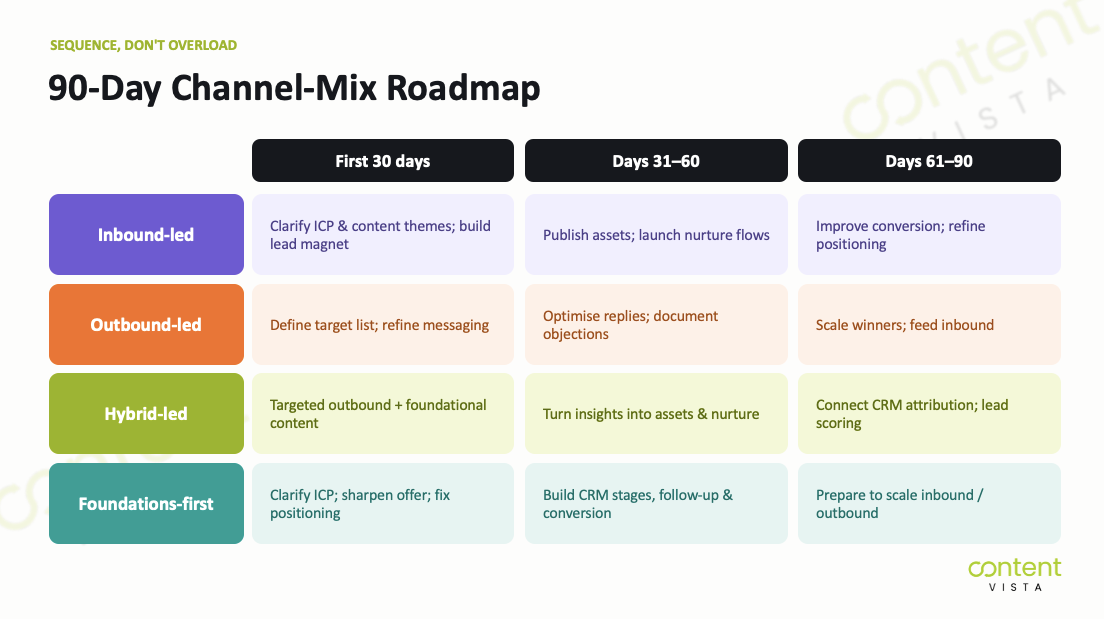
The first 90 days should optimise for:
* clarity,
* feedback,
* conversion visibility,
* and operational consistency.
Not maximum channel volume.
The businesses that scale most effectively are usually not the ones doing the most channels early.
They are the ones building the right sequence first.
Use the Marketing Growth System Finder to identify the best starting point before you build the next 90 days.
Marketing Growth System FinderThe Metrics That Actually Matter
The wrong metric makes the wrong channel look broken.
This happens constantly in lead generation.
A business invests in inbound, then judges success only by short-term lead count. Another launches outbound campaigns and evaluates performance purely on email open rates. A hybrid system gets measured channel-by-channel without tracking how touchpoints influence each other over time.
The result is distorted decision-making.
Inbound, outbound, and hybrid systems should not be measured identically because they solve different parts of the acquisition process. The real objective is not vanity metrics. It is source-to-pipeline visibility and conversion quality across the entire growth system.
What Matters Most in Inbound
Inbound performance is often misunderstood because the conversion path is usually longer and less linear.
Someone may:
discover an article through search,
subscribe to a newsletter,
return weeks later through another content asset,
download a lead magnet,
and only then become sales-ready.
That means traffic alone is not enough.
The more useful inbound metrics usually include:
organic traffic quality
content-assisted leads
lead magnet conversion rates
newsletter or resource signups
lead-to-opportunity conversion
content-assisted pipeline contribution
and time to conversion
A page attracting thousands of irrelevant visits is less valuable than a smaller number of highly qualified visitors who actually enter the pipeline.
This is why inbound measurement should focus on conversion movement, not just visibility.
What Matters Most in Outbound
Outbound metrics are more direct but that does not make them simpler.
A high email volume means very little if:
contact quality is weak
messaging is poorly targeted
or replies never become qualified opportunities
That is why strong outbound measurement focuses on conversation quality rather than raw outreach activity.
Useful outbound metrics usually include:
contact quality
reply rate
positive reply rate
meeting rate
qualified conversation rate
opportunity rate
bounce rate
complaint rate
and source-to-pipeline conversion
These metrics reveal where the actual breakdown occurs:
targeting
messaging
deliverability
qualification
or follow-up execution
Outbound systems should also track learning speed. Sometimes a campaign is valuable not because it closes immediately, but because it rapidly improves positioning clarity and buyer understanding.
What Matters Most in Hybrid Systems
Hybrid systems require a broader view because conversion rarely happens through a single touchpoint.
A prospect may:
receive an outbound email
visit thought leadership content
join a webinar
subscribe to a newsletter,
re-engage through LinkedIn,
and only convert later through a sales conversation
That means channel isolation becomes misleading.
Strong hybrid measurement focuses on:
content-assisted outbound response
outbound-informed content topics
nurture conversion rates
multi-touch attribution
CRM visibility
and revenue influenced by multiple engines together
The goal is not to force every lead into a single-source attribution model.
The goal is to understand how different channels support buyer movement across the full journey.
| Channel Model | Primary Metrics | What They Reveal | Common Measurement Mistake |
|---|---|---|---|
| Inbound-led | Organic traffic quality, content-assisted leads, lead magnet conversion, newsletter signups, lead-to-opportunity conversion | Trust-building effectiveness and long-term demand capture quality | Measuring traffic volume without measuring pipeline quality |
| Outbound-led | Contact quality, reply rate, positive reply rate, meeting rate, opportunity rate, bounce and complaint rates | Messaging relevance, targeting quality, and conversation efficiency | Measuring outreach activity instead of qualified pipeline creation |
| Hybrid-led | Content-assisted outbound response, nurture conversion, multi-touch attribution, CRM visibility, revenue influenced | How channels reinforce each other across the buyer journey | Treating channels as isolated systems instead of connected workflows |
| Foundations-first | Funnel conversion visibility, CRM consistency, follow-up speed, stage progression tracking | Operational readiness before scaling acquisition | Scaling channels before attribution and follow-up systems are reliable |
Key Metrics That Actually Matter
Inbound:
* Content-assisted pipeline
* Lead-to-opportunity conversion
* Time to conversion
* Organic traffic quality
Outbound:
* Positive reply rate
* Qualified conversation rate
* Opportunity rate
* Source-to-pipeline conversion
Hybrid:
* Multi-touch attribution
* CRM visibility
* Nurture conversion
* Revenue influenced across channels
One of the most important lessons in modern lead generation is that attribution is rarely clean anymore.
Buyers move across:
search
newsletters
LinkedIn
outbound conversations
webinars
referrals
and multiple content touchpoints before converting
That is why CRM infrastructure and systems visibility matter so much. Without them, businesses often misjudge which channels are actually creating revenue influence versus superficial activity.
Relevant services:
The objective is not perfect attribution.
It is enough visibility to understand:
where qualified buyers originate
what moves them forward
which channels reinforce each other
and where the acquisition system actually breaks down
Where AI Helps in Inbound, Outbound and Hybrid Systems
AI can speed up a good system. It can also scale confusion if the strategy is weak.
That is the most important thing to understand about AI-assisted workflows in lead generation.
AI is not a replacement for:
positioning
offer clarity
ICP judgment
strategic sequencing
proof
or real human conversations
But when the underlying growth system is already sound, AI can significantly reduce execution friction across inbound, outbound and hybrid workflows.
The key is using AI as an operational layer not as a substitute for strategy.
How AI Helps Inbound Systems
Inbound systems involve a large amount of repetitive research, content preparation, structuring and repurposing work.
AI can accelerate many of those workflows:
topic research
SEO clustering
content brief generation
content repurposing
newsletter drafting
webinar outline creation
FAQ extraction
lead magnet ideation
and content summarisation
For example, sales conversations and CRM notes can be turned into:
article ideas
comparison pages
objection-focused resources
nurture content
or thought-leadership angles much faster than manual workflows alone
AI is particularly useful for:
reducing production bottlenecks
identifying content gaps
and helping teams maintain consistency across larger content ecosystems.
But AI-generated content without expertise, differentiation or strategic direction usually creates generic output that fails to build authority or trust.
The strategy layer still matters more than the drafting layer.
How AI Helps Outbound Systems
Outbound workflows also contain many repetitive operational tasks that AI can streamline.
AI can assist with:
account research
segmentation
buying-signal detection
draft personalisation
follow-up summaries
reply classification
CRM enrichment
and outreach preparation
For example, AI can help identify:
hiring trends
company growth signals
technology changes
leadership movements
or behavioural patterns that improve targeting relevance
It can also help sales and outbound teams prioritise:
warmer accounts,
higher-fit prospects,
or conversations requiring immediate follow-up.
But this is where many teams misuse AI.
Automating low-quality outreach at scale does not improve outbound. It usually makes spam faster and easier to produce.
The strongest AI-assisted outbound systems still rely on:
strong positioning,
precise targeting,
human judgment,
and relevant messaging.
How AI Helps Hybrid Systems
Hybrid systems often benefit the most because they involve the highest operational complexity.
AI can help connect:
inbound content workflows,
outbound activity,
CRM visibility,
nurture systems,
and reporting infrastructure.
Examples include:
CRM summaries,
lead routing,
meeting summaries,
nurture automation,
workflow triggers,
pipeline reporting,
and converting sales conversations into content ideas automatically.
This is especially useful when multiple teams are involved across:
marketing,
outbound,
sales,
customer success,
and operations.
AI can reduce coordination friction and improve information flow between systems that otherwise become disconnected.
AI works best when:
* the ICP is already clear,
* the positioning is already strong,
* the offer already solves a real problem,
* and the business already understands its acquisition strategy.
AI amplifies systems. It does not replace them.
One of the biggest mistakes businesses make is treating AI like a shortcut to avoid strategic thinking.
In reality, AI tends to magnify the quality of the existing system underneath it:
strong systems become more efficient,
weak systems become noisier.
That is why AI-assisted workflows should support:
execution,
coordination,
analysis,
and operational scale: not replace judgment, trust-building or buyer understanding.
If you need AI-assisted inbound, outbound, CRM, and automation working together, explore the AI Client Acquisition Stack.
AI Client Acquisition StackCommon Mistakes That Break the Channel Mix
The mistakes are simple. But they are exactly why teams waste months switching channels instead of fixing the system.
Most lead generation failures are not caused by choosing inbound or outbound incorrectly in theory. They happen because businesses scale tactics before the underlying growth system is ready to support them.
One of the most common mistakes is choosing inbound simply because outbound feels uncomfortable.
A business may avoid outreach because it fears sounding sales-driven or intrusive, so it hides entirely behind content creation instead. The result is often months of publishing with little pipeline movement because there is no clear distribution strategy, conversion path, or buyer validation loop behind the content.
The opposite mistake happens just as often.
Some businesses choose outbound only because inbound feels too slow. They aggressively launch cold outreach before:
positioning is clear,
proof exists,
the offer is refined,
or the ICP is properly defined.
That usually creates low reply quality, poor conversion, and messaging fatigue very quickly.
Another major problem is trying to run inbound and outbound simultaneously without assigning clear roles.
A functional hybrid system requires structure:
Which engine leads?
Which engine supports?
What role does content play?
How are leads nurtured?
What triggers sales involvement?
How does CRM tracking connect everything together?
Without those answers, “hybrid” often becomes scattered marketing activity with no coordinated buyer journey underneath it.
Content strategy breaks down for similar reasons.
Many businesses create:
articles,
newsletters,
thought leadership,
or SEO assets
without building:
lead capture paths,
nurture systems,
qualification processes,
or conversion mechanisms.
Traffic alone is not a pipeline system.
Outbound systems fail in similar ways when businesses run outreach without:
proof,
credibility,
follow-up discipline,
or CRM visibility.
A cold email might generate interest, but without proper handoff, tracking, and nurture, opportunities disappear between marketing and sales workflows.
Measurement mistakes also create serious distortion.
Inbound and outbound should not be judged by identical metrics. Measuring inbound entirely through short-term lead count often undervalues long-term authority and content-assisted conversion. Measuring outbound only through send volume or open rates hides whether qualified conversations are actually being created.
Another issue is relying too heavily on outdated CPL comparisons and generic industry statistics — like the much-repeated 2012 HubSpot figure showing inbound at a 61% lower cost per lead, which is now well over a decade old.
The economics of inbound and outbound vary dramatically depending on:
sales cycle,
offer complexity,
conversion rates,
team quality,
operational maturity,
and execution consistency.
Old “inbound is always cheaper” assumptions can create poor strategic decisions when taken out of context.
AI creates a newer version of the same problem.
Some businesses layer AI onto broken systems before clarifying:
the ICP,
the offer,
the positioning,
or the conversion process.
That rarely fixes anything. It usually accelerates low-quality execution faster.
Common Mistakes That Break the Channel Mix
* Choosing inbound because outbound feels uncomfortable
* Choosing outbound because inbound feels too slow
* Running both channels without defining lead/support roles
* Creating content without conversion paths
* Running outreach without proof or follow-up systems
* Measuring inbound and outbound with identical metrics
* Ignoring CRM handoff and attribution visibility
* Treating hybrid as “do everything everywhere”
* Relying on outdated CPL assumptions and generic statistics
* Using AI before clarifying ICP, positioning, and offer quality
* Scaling channels before messaging consistently converts
The underlying pattern across all these mistakes is the same:
teams try to scale channels before they establish clarity.
But channels amplify systems.
If the positioning is strong, the buyer understanding is clear, the offer is differentiated, and the operational workflows are connected, inbound, outbound, and hybrid systems can all work extremely well.
If those foundations are weak, adding more channels usually magnifies the inefficiency instead of solving it.
When Not to Rely on Either Channel Yet
Sometimes the channel is not the problem. The foundation underneath the channel is.
This is one of the most overlooked realities in lead generation.
Businesses often assume they need:
more SEO,
more content,
more cold outreach,
more LinkedIn activity,
or more automation.
But in many cases, inbound and outbound are both underperforming because the core growth foundation is weak.
Scaling channels on top of unclear positioning or broken conversion systems rarely fixes the problem. It usually increases noise, operational stress, and wasted spend.
That is why some businesses should pause before aggressively scaling either inbound or outbound.
When the ICP Is Still Unclear
If the business cannot clearly define:
who the ideal buyer is,
what problem matters most,
what buying triggers exist,
or which segments convert best,
then both inbound and outbound become inefficient.
Inbound struggles because content lacks relevance and search alignment.
Outbound struggles because targeting and messaging become too broad.
Without ICP clarity, the acquisition system loses precision everywhere.
When the Offer or Positioning Is Weak
A vague offer creates weak conversion across every channel.
If the business cannot explain:
what it does,
who it helps,
why it is differentiated,
or why buyers should care now,
then no amount of traffic or outreach solves the underlying issue.
Inbound content becomes generic.
Outbound messaging feels unclear.
Conversion rates stay inconsistent because the market does not understand the value proposition quickly enough.
This is often a positioning problem disguised as a channel problem.
When the Operational System Cannot Support Growth
Even strong acquisition channels break when:
sales follow-up is inconsistent,
CRM stages are unclear,
leads disappear between teams,
nurture systems are missing,
or the website fails to explain the offer properly.
A business may generate interest successfully while still losing pipeline because the operational infrastructure underneath the acquisition system is unreliable.
This is especially common in growing companies where:
marketing,
sales,
and operations evolve separately instead of as one coordinated system.
When There Is No Proof or Conversion Support
Inbound and outbound both convert more effectively when buyers can quickly validate trust.
That usually requires:
case studies,
proof,
authority assets,
testimonials,
frameworks,
or educational resources that reduce perceived risk.
Without proof:
inbound content may attract attention without conversion,
and outbound outreach may generate curiosity without confidence.
The issue is not necessarily traffic or outreach volume. It is trust readiness.
When not to rely heavily on inbound or outbound yet:
* The ICP is unclear
* The offer is vague
* Positioning is weak
* The value proposition cannot be explained clearly
* Sales follow-up is inconsistent
* CRM visibility is missing or unreliable
* Conversion assets do not exist
* The website fails to explain the offer
* Proof and authority signals are weak
* The team cannot execute consistently
In these situations, the smartest move is usually not “more inbound” or “more outbound.”
It is fixing the growth foundation first:
clarifying positioning,
tightening the offer,
improving conversion flows,
defining operational ownership,
and creating enough strategic clarity for future channels to perform properly.
That is often where structured marketing strategy and growth consulting work creates more leverage than adding another acquisition tactic immediately.
Relevant service:
If your ICP, offer, funnel or follow-up system is unclear, fix the foundations before scaling inbound or outbound.
Marketing Os SprintMini Examples: Inbound-Led, Outbound-Led and Hybrid-Led Systems
Here’s what this looks like when the channel mix changes by business situation.
The goal of these examples is not to prove that one model always wins. It is to show how different businesses often require different lead-generation engines depending on:
audience behaviour,
authority level,
pipeline urgency,
and operational maturity.
Example 1 - Inbound-Led System
An inbound-led approach works especially well when the business has strong expertise that can be transformed into authority assets over time.
The work with Akshar Business Consulting reflects this type of model. The strategy focused heavily on:
founder-led thought leadership,
educational content,
visibility-building,
and authority development designed to attract the right audience through expertise rather than aggressive outbound acquisition.
This kind of inbound-led system is effective when:
buyers research before purchasing,
trust influences conversion,
and long-term discoverability matters strategically.
In these situations, content is not treated as random publishing. It becomes part of a broader authority and demand-generation engine tied to positioning, education, and audience trust.
Relevant case study:
Example 2 - Outbound-Led System
Outbound-led systems become more important when direct pipeline creation and targeted conversations need to happen faster.
The Confido case reflects this style of execution more closely through a stronger emphasis on:
LinkedIn-led outreach,
lead generation workflows,
targeted audience engagement,
and proactive conversation creation.
In outbound-led environments, the growth system depends heavily on:
ICP clarity,
messaging precision,
outreach coordination,
and follow-up discipline.
This model is especially useful when:
buyers are identifiable,
sales cycles involve direct interaction,
or the market is too niche to rely entirely on inbound discovery alone.
Strong outbound systems also tend to create faster market feedback because conversations happen earlier in the process.
Relevant case study:
Example 3 - Hybrid-Led System
Many mature growth systems eventually become hybrid systems.
Instead of relying entirely on inbound or outbound, they connect:
authority-building,
outreach,
CRM visibility,
nurture,
and sales workflows into one coordinated acquisition engine.
SalesFed is a useful example of how sales and lead-generation systems can operate in a more integrated way where outreach, positioning, process structure, and pipeline visibility all influence growth together.
In hybrid-led systems:
outbound creates direct conversations,
inbound improves trust and credibility,
and CRM infrastructure connects the buyer journey across multiple touchpoints.
The key difference is coordination.
The channels are not competing for attribution. They are reinforcing each other operationally.
For example:
outbound conversations may reveal objections,
those objections become content topics,
content improves outreach credibility,
nurture keeps leads warm,
and CRM tracking connects everything back to opportunity creation.
That is very different from running disconnected campaigns across multiple channels simultaneously.
Relevant case study:
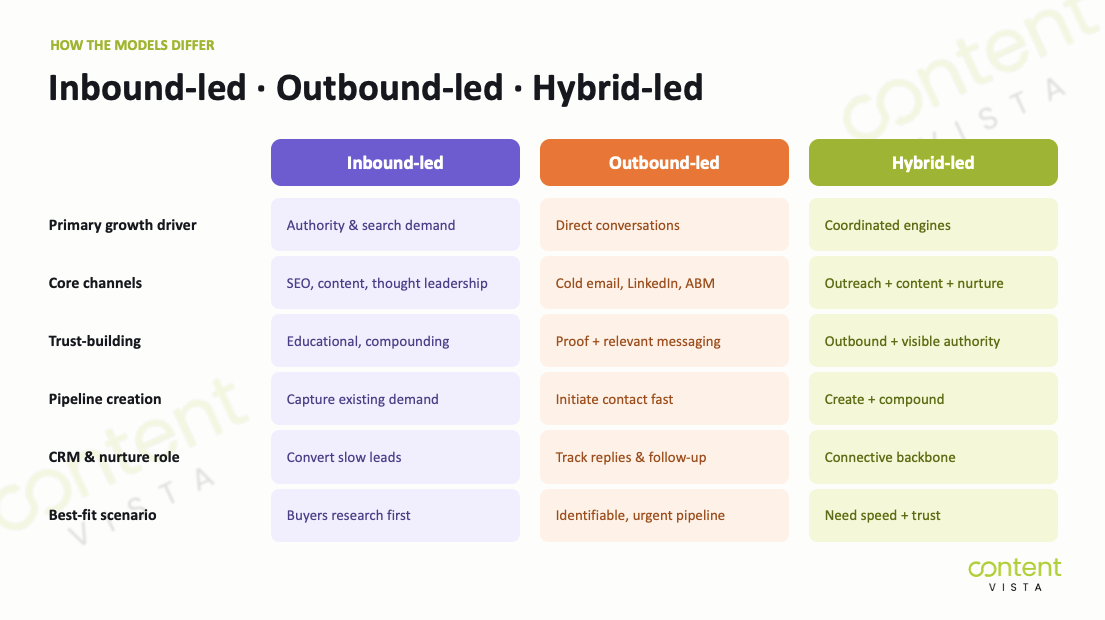
The strongest lead-generation model is usually not the one that follows trends.
It is the one that matches:
* buyer behaviour,
* pipeline urgency,
* authority level,
* operational capacity,
* and how the business actually converts trust into revenue.
These examples also reinforce an important point:
the “right” channel mix often changes as the business evolves.
A company may begin outbound-led to create an immediate pipeline, then gradually invest more heavily in inbound authority. Another may begin inbound-led, then add outbound later for account-based targeting and sales acceleration.
The goal is not choosing a permanent side.
It is building the right growth system for the current stage.
FAQs About Inbound Lead Generation vs Outbound
Which is better for lead generation: inbound or outbound?
Neither is universally better.
Inbound lead generation works well when buyers actively search, research, and compare solutions before converting. Outbound lead generation works well when buyers are identifiable and the business needs faster conversations or direct market access.
The better choice depends on:
pipeline urgency,
buyer behaviour,
offer complexity,
authority level,
and operational capacity.
What is the difference between inbound and outbound lead generation?
Inbound lead generation attracts buyers through:
SEO,
content,
thought leadership,
newsletters,
webinars,
and lead magnets.
Outbound lead generation proactively contacts buyers through:
cold email,
LinkedIn outreach,
calls,
account-based outreach,
and direct prospecting.
Inbound usually earns attention. Outbound usually initiates attention.
Is inbound cheaper than outbound?
Not automatically.
Inbound can become more efficient over time because search visibility, authority, and content assets compound. But inbound still requires:
content production,
SEO infrastructure,
conversion systems,
nurture,
and long-term consistency.
Outbound can create faster results but usually requires continuous prospecting, outreach management, and follow-up effort.
The real cost depends on execution quality and conversion efficiency — not generic industry averages alone.
Does outbound generate leads faster than inbound?
Usually, yes.
Outbound often creates faster conversations because the business proactively reaches buyers instead of waiting for discovery through search or content.
That makes outbound useful when:
pipeline urgency is high,
market feedback is needed quickly,
or the business is targeting specific accounts directly.
However, faster outreach does not automatically mean better pipeline quality.
When should a business start with outbound first?
A business should usually prioritise outbound first when:
pipeline urgency is immediate,
buyers are identifiable,
the market is niche,
the offer requires direct explanation,
or inbound visibility is still weak.
Outbound is especially useful for validating positioning and messaging quickly through real conversations.
When should a business prioritise inbound first?
Inbound should usually lead when:
buyers actively search for solutions,
trust influences conversion,
the business has expertise worth publishing,
and the company can invest in long-term compounding demand.
Inbound is particularly effective for educational buying journeys where content and thought leadership influence decision-making before sales involvement.
Should small businesses use inbound, outbound, or both?
Small businesses can succeed with inbound, outbound, or hybrid systems depending on:
budget,
execution capacity,
sales cycle,
and pipeline urgency.
Many smaller businesses start outbound-led because they need conversations faster. Others use inbound-first because the founder already has strong expertise or audience credibility.
The key is not “doing everything.” It is choosing the right leading engine first.
What does a hybrid inbound and outbound strategy look like?
A hybrid strategy combines:
outbound conversations,
inbound authority-building,
nurture systems,
CRM tracking,
and follow-up workflows into one coordinated growth system.
For example:
outbound creates initial conversations,
content improves trust and credibility,
nurture keeps prospects engaged,
and CRM tracks movement across the buyer journey.
The strongest hybrid systems make inbound and outbound reinforce each other instead of competing.
Which works better for high-ticket services?
High-ticket services often perform best with hybrid systems.
Inbound helps build:
trust,
authority,
expertise visibility,
and educational depth.
Outbound helps create:
direct conversations,
qualification opportunities,
and consultative sales movement earlier in the process.
Complex or high-value offers usually require both education and human interaction before conversion happens.
What metrics matter for inbound vs outbound lead generation?
Inbound metrics often include:
organic traffic quality,
content-assisted leads,
lead-to-opportunity conversion,
newsletter signups,
and content-assisted pipeline.
Outbound metrics often include:
positive reply rate,
meeting rate,
qualified conversation rate,
opportunity rate,
and source-to-pipeline conversion.
Hybrid systems usually require:
CRM visibility,
nurture conversion tracking,
multi-touch attribution,
and revenue influences measurement across channels.
Can AI improve inbound and outbound lead generation?
Yes when the strategy underneath the system is already clear.
AI-assisted workflows can help with:
content research
SEO clustering
outreach preparation
segmentation
CRM summaries
lead routing
and workflow automation.
But AI should not replace:
positioning,
ICP clarity,
offer quality,
strategic judgment,
or human conversations.
AI improves execution efficiency. It does not automatically fix weak strategies.
When should you fix strategy before scaling either channel?
A business should focus on foundations first when:
the ICP is unclear
positioning is weak
the offer is vague
CRM systems are unreliable
follow-up is inconsistent
or conversion assets are missing.
In those situations, scaling inbound or outbound usually magnifies inefficiency instead of solving it.
The smarter move is often:
clarifying the offer
improving positioning
fixing operational workflows
and strengthening conversion infrastructure before scaling acquisition channels.
Conclusion: Choose the Growth System That Fits Your Stage
Inbound and outbound are not enemies.
They solve different growth problems at different stages.
Inbound helps businesses build:
trust,
discoverability,
authority,
and compounding demand over time.
Outbound helps businesses create:
direct conversations,
faster market feedback,
targeted pipeline creation,
and proactive buyer engagement.
Hybrid systems can become extremely powerful when:
inbound and outbound are sequenced intentionally,
CRM visibility connects the buyer journey,
nurture systems support conversion,
and messaging stays consistent across the entire growth process.
And in many situations, the smartest move is not scaling either channel immediately.
If the ICP is unclear, positioning is weak, follow-up is inconsistent, or the offer lacks clarity, foundations-first is often the highest-leverage decision a business can make before investing heavily in acquisition.
That is the central idea behind this entire guide:
the right answer is usually not “inbound vs outbound.”
It is:
which engine should lead now,
which should support it,
and what should be sequenced next as the business evolves.
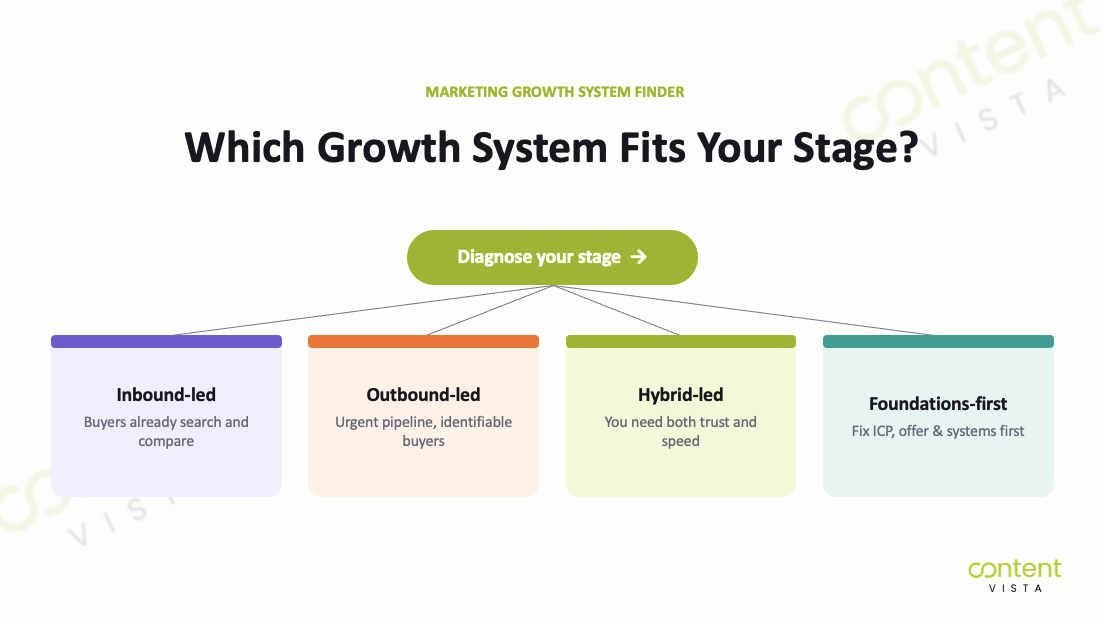
Use the Marketing Growth System Finder to find whether inbound, outbound, hybrid, or foundations-first fits your current growth stage.
Marketing Growth System FinderIf you want the broader system behind predictable acquisition beyond individual channels, explore our guide to building a lead generation system - and the VISTA Lead Generation Framework behind it..