Quick Summary
- A LinkedIn lead gen strategy works best as a connected profile-to-pipeline system, not isolated posting or DM activity.
- The strongest systems combine profile trust, targeting, content, engagement, outreach, follow-up, CRM visibility, and measurement.
- LinkedIn should lead, support, or wait depending on buyer activity, offer clarity, trust requirements, and operational readiness.
Why Most LinkedIn Lead Gen Strategies Fail
Posting more is not a strategy. Sending more DMs is not a strategy either.
Here’s the problem: most LinkedIn activity is disconnected from the system that turns attention into pipeline.
A founder posts consistently for three months but gets no qualified conversations. A sales team sends hundreds of connection requests but struggles to get replies. Someone optimises their profile headline, experiments with thought leadership, even buys Sales Navigator: yet the pipeline still feels unpredictable.
The issue is usually not LinkedIn itself.
The issue is that the activity is fragmented.
One person focuses only on content. Another focuses only on outreach. Another treats LinkedIn like a digital resume instead of a buyer-facing trust layer. The result is disconnected effort instead of a profile-to-pipeline system.
Think about how most LinkedIn lead generation actually happens.
A prospect sees a comment. Then a post. Then your profile. Then a connection request. Then maybe a message. Then silence because there is no follow-up process, no qualification logic and no CRM handoff.
That is not a lead generation system. It is an isolated activity.
Most LinkedIn lead gen strategies fail because visibility, trust, outreach, follow-up and pipeline tracking are treated as separate actions instead of one connected growth system.
Here’s where most teams go wrong:
They post content without a clear buyer strategy.
They send pitch-first DMs before trust exists.
They target broad job-title lists instead of relevant buyer signals.
They optimise for profile views instead of qualified conversations.
They generate engagement without a process for turning conversations into opportunities.
They never calculate whether LinkedIn can realistically support a predictable pipeline.
And that’s the real issue.
LinkedIn works best when profile trust, targeting, content, engagement, outreach, follow-up and measurement operate together. Not as isolated tactics. As a connected lead generation engine.
What Is a LinkedIn Lead Gen Strategy?
In short: LinkedIn lead generation is not one thing. It is a sequence.
A lot of businesses treat LinkedIn as either a content platform or a messaging platform. They focus on posting more consistently, growing connections faster, or sending more outreach.
But none of those actions automatically create pipelines on their own.
A real LinkedIn lead generation strategy is a system designed to create qualified conversations through visibility, trust, targeting, engagement, outreach and follow-up.
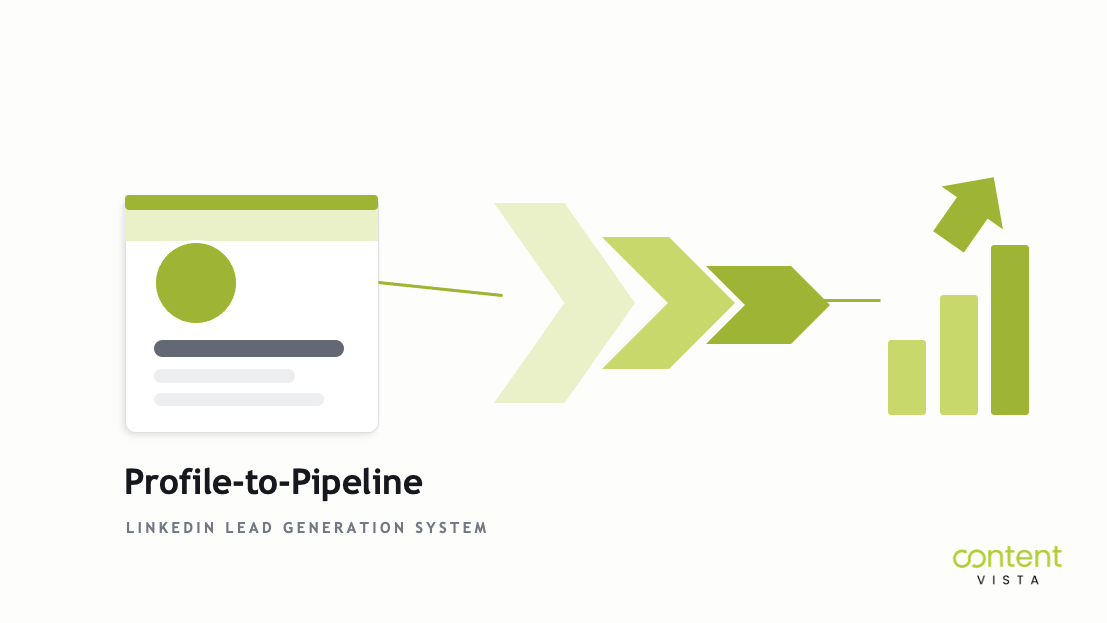
A LinkedIn lead gen strategy is a structured system for turning profile trust, audience targeting, content visibility, engagement, outreach and follow-up into qualified conversations that can become pipeline. It connects what prospects see, how they are approached, and how conversations are tracked after they respond.
Think about how buyers actually experience LinkedIn.
They may first discover someone through a comment, a shared post, a mutual connection, or a thought-leadership post. Then they check the profile. Then they decide whether the person seems credible, relevant or worth responding to. Only after that does outreach become easier.
That is why LinkedIn lead generation is not just “posting content” or “sending DMs.”
It includes:
buyer-facing profile positioning
audience targeting
buyer-signal discovery
content visibility
comment engagement
relationship-led outreach
follow-up systems
CRM handoff and pipeline tracking
The better way to think about it is this:
LinkedIn is one channel inside a broader lead generation system.
And when the profile, targeting, content, outreach and follow-up layers work together, LinkedIn stops feeling random. It starts functioning like a measurable profile-to-pipeline engine.
Why LinkedIn Still Matters for Lead Generation?
LinkedIn still matters because it sits at the intersection of visibility, credibility and access.
For many businesses, especially service firms, consultants, agencies, operators, advisors, founders and B2B teams, it remains one of the few platforms where professional identity, public expertise and direct outreach exist in the same environment.
That combination is important.
A buyer may discover your company through a post, see your comment on someone else’s content, click through to your profile, look at your experience, scan your Featured section, notice mutual connections and only then decide whether to reply to your message.
Very few channels compress that much trust context into one place.
Cold email can create awareness. Ads can create reach. Referrals can create credibility.
But LinkedIn adds something different: visible context before the conversation starts.
A prospect can see:
how you think
what problems you talk about
whether your positioning feels relevant
who engages with your content
how you communicate publicly
whether you look credible before replying
That changes the dynamics of outreach completely.
LinkedIn is not valuable because it gives you access to inboxes. It is valuable because it gives buyers context before the conversation begins.
This is also why thought leadership matters more than many teams realise.
Not because every prospect reads every post.
But because useful content, comments, and visible expertise create familiarity over time: especially among hidden buyers who may never engage publicly but still observe profiles, conversations and positioning before making decisions.
LinkedIn also creates signal visibility that many outbound channels lack.
You can spot:
role changes
hiring activity
company growth
engagement patterns
recent posts
mutual connections
category conversations
buyer interest signals
That makes relationship-led prospecting and signal-based outreach far more contextual than generic cold outreach alone.
But here’s the catch: LinkedIn only works when your profile, content, outreach and follow-up are connected.
Without that system, LinkedIn becomes another place where activity creates noise instead of pipeline.
The platform itself is not the strategy.
The acquisition system behind it is.
When LinkedIn Should Lead and When It Should Support Another Channel
So, should LinkedIn lead your growth system?
It depends.
For some businesses, LinkedIn can become the primary profile-to-pipeline engine. For others, it works better as a credibility and relationship layer supporting outbound, events, partnerships, referrals or inbound demand generation.
And sometimes, LinkedIn is not the right first move at all.
Here’s the simplest way to decide:
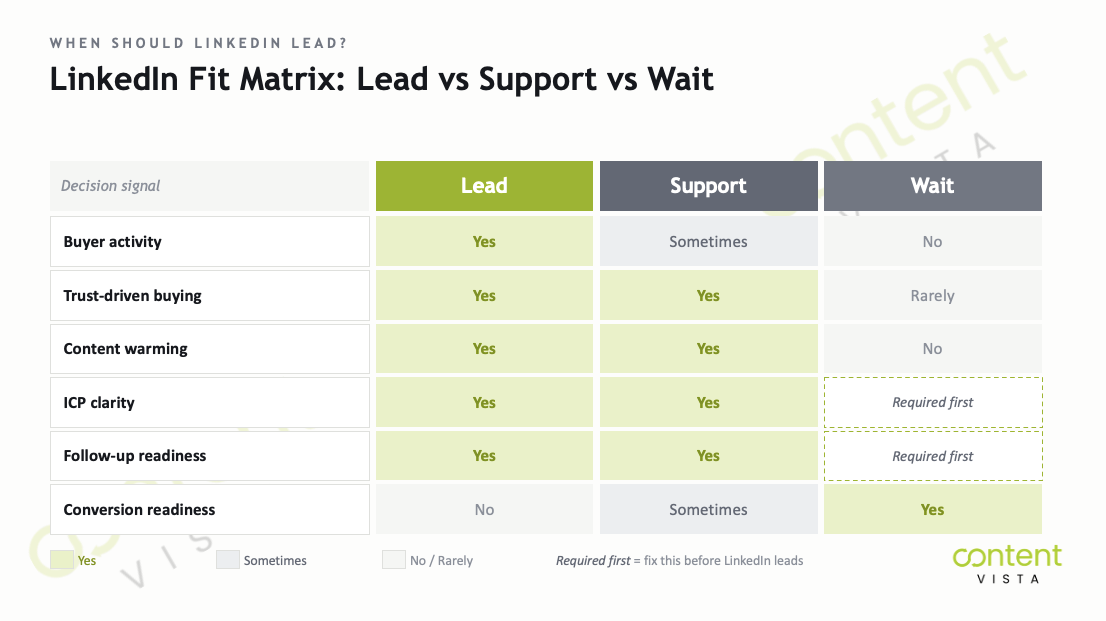
| Scenario | LinkedIn Should Lead | LinkedIn Should Support | LinkedIn Should Wait |
|---|---|---|---|
| Buyers are active on LinkedIn | Yes | Sometimes | No |
| Trust and expertise influence buying | Yes | Yes | Rarely |
| Founder/team has a credible point of view | Yes | Yes | No |
| Cold email is primary outbound motion | Sometimes | Yes | No |
| Offer and ICP are clearly defined | Yes | Yes | Required first |
| Content can warm up conversations | Yes | Yes | No |
| Outreach benefits from buyer signals and context | Yes | Yes | No |
| Follow-up and CRM process exists | Yes | Yes | Required first |
| Positioning or conversion problems still exist | No | Sometimes | Yes |
When LinkedIn should be your primary engine
LinkedIn works best as the main acquisition channel when trust, visibility and relationship-building influence buying decisions.
That is especially true for:
consultants
agencies
professional services
B2B operators
founder-led companies
advisory firms
niche expertise businesses
In these cases, buyers often research people before responding.
They look at profiles. They read posts. They evaluate credibility long before a call is booked.
That means the profile itself becomes part of the conversion journey.
LinkedIn should lead when your team can consistently demonstrate expertise, publish useful thinking, participate in industry conversations, and use context-rich outreach instead of volume-led prospecting.
It is particularly effective when content can warm up conversations before outreach begins. That is where demand generation and thought leadership become strategically important instead of “just marketing content.”
When LinkedIn should support another channel
Not every acquisition system needs LinkedIn to be the primary driver.
Sometimes it works better as a support layer.
For example, a company running outbound cold email may use LinkedIn to:
research accounts
validate positioning
identify buyer signals
build familiarity before outreach
strengthen credibility after email contact
continue conversations publicly
That is why many strong acquisition systems combine LinkedIn plus cold email instead of treating them as competing channels.
The same applies to businesses already generating attention through webinars, partnerships, newsletters, SEO, podcasts or events. LinkedIn can amplify those channels by making expertise more visible and creating follow-up touchpoints around existing demand.
LinkedIn becomes more effective when it supports a connected acquisition system instead of carrying the entire growth burden alone.
When LinkedIn should wait
This is the part most “LinkedIn growth” advice ignores.
Sometimes LinkedIn is not the bottleneck.
If the ICP is unclear, the offer is vague, the positioning is weak or there is no follow-up process, posting more content and sending more messages will not solve the real issue.
LinkedIn should probably wait if:
buyers are not active or researchable there
the sales process cannot handle conversations properly
there is no CRM visibility
the team lacks capacity for follow-up
there is no clear point of view
the business still needs offer clarity or conversion fixes first
In those situations, scaling outreach too early usually creates noise instead of pipeline.
The better move is to fix the acquisition foundations before increasing activity.
Not sure whether LinkedIn should be your main channel, a support channel, or part of a bigger acquisition system?
Marketing Growth System FinderThe LINKS Framework for LinkedIn Lead Generation
Let’s make this practical.
If LinkedIn is going to create a pipeline, five things need to work together.
Not just content. Not just outreach. Not just profile optimization.
The businesses that consistently generate qualified conversations from LinkedIn usually operate with a connected profile-to-pipeline model — whether they realise it or not.
Here’s the important part: LinkedIn is not a separate growth system. It is one channel inside the broader lead generation system — and this blog post is only about making that one channel work. Building the whole system is a bigger job.
That is the purpose of the LINKS Framework.
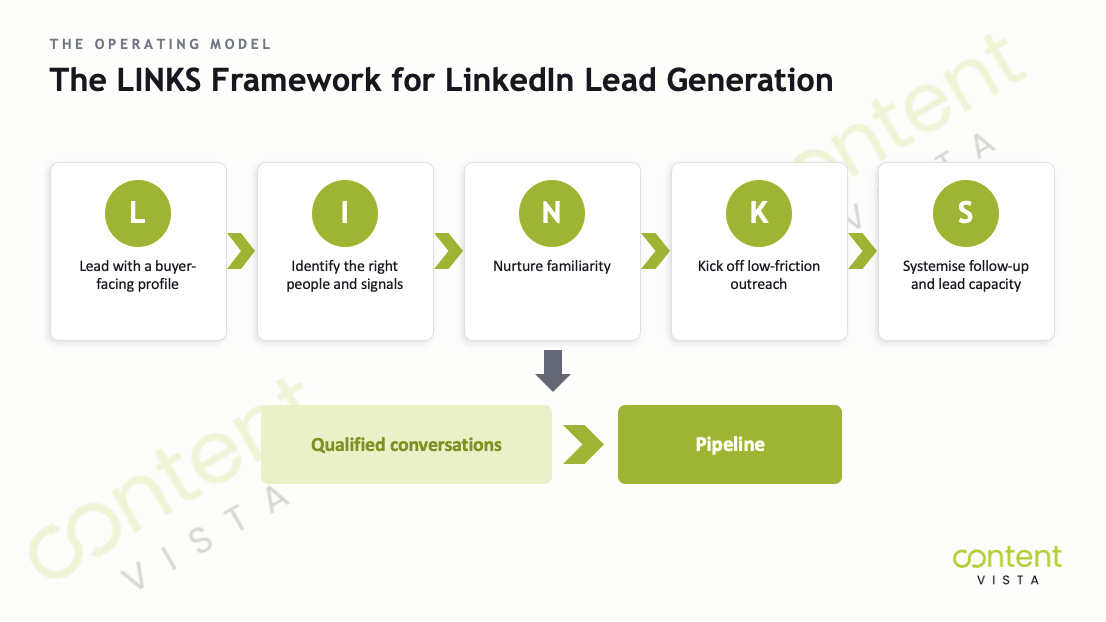
The LINKS Framework
L — Lead with a buyer-facing profile
I — Identify the right people and signals
N — Nurture familiarity with content and comments
K — Kick off low-friction outreach
S — Systemise follow-up, CRM handoff, and lead capacity
This framework matters because most LinkedIn lead generation advice is fragmented.
One expert talks about personal branding. Another talks about Sales Navigator. Another focuses only on DMs. Another pushes automation.
But buyers do not experience your LinkedIn presence in fragments.
They experience it as a sequence.
They see your profile. They notice your content. They observe your positioning. They encounter your comments. They receive outreach. They decide whether you seem credible. Then the conversation either moves forward or disappears.
That means LinkedIn lead generation is not really about “growth hacks.”
It is about reducing friction across the entire buyer journey.
Lead with a buyer-facing profile
Before someone replies to outreach, they often evaluate the profile behind the message.
A weak, vague, or résumé-style profile creates doubt. A buyer-facing profile creates trust and relevance before the conversation even starts.
Identify the right people and signals
Good outreach sent to the wrong audience still fails.
The strongest LinkedIn strategies use buyer signals, timing, role relevance, company context and engagement patterns to decide who to approach and why now matters.
Nurture familiarity with content and comments
LinkedIn is different from most outbound channels because public familiarity can exist before direct outreach.
Content, comments, and thought leadership help prospects recognise your expertise before the first message arrives.
Kick off low-friction outreach
The best LinkedIn outreach does not jump immediately into a pitch.
It starts with context, relevance, and low-pressure conversation entry points designed to earn the next reply instead of forcing a conversion too early.
Systemise follow-up, CRM handoff and lead capacity
Most LinkedIn systems break after the reply arrives.
Without tagging, qualification, follow-up rules, CRM visibility, and pipeline tracking, conversations stay trapped inside inboxes instead of becoming measurable opportunities.
The LINKS Framework is not a content tactic or outreach playbook. It is a repeatable operating model for turning LinkedIn activity into qualified conversations and pipeline visibility.
Use the Marketing Growth System Finder to find whether LinkedIn Growth Engine, Inbound Magnet System, Cold Email Conversion Lab, Marketing OS Sprint or AI Client Acquisition Stack fits your current stage.
Marketing Growth System FinderStep 1 - Lead With a Buyer-Facing Profile
Before someone replies to your message, they often check your profile.
And that’s where the first conversion either happens or dies.
A weak LinkedIn profile creates friction before the conversation even begins. If the profile feels vague, self-focused, outdated, or résumé-driven, outreach has to work much harder to earn trust.
That is why the buyer-facing profile sits at the front of the entire profile-to-pipeline system.
The goal is simple: When a prospect lands on your profile, they should quickly think:
“This person understands my problem.”
Not: “What exactly do they do?”
Make the headline buyer-facing
Most LinkedIn headlines waste the highest-visibility space on the platform.
They say things like:
Founder at [Company]
Growth Consultant
CEO | Speaker | Advisor
Helping businesses grow
None of that tells the buyer:
who you help
what problem you solve
what outcome you support
why they should care
A buyer-facing profile headline should position relevance before status.
Instead of writing for ego, write for recognition.
For example:
Helping B2B service firms turn LinkedIn activity into qualified conversations
Building profile-to-pipeline systems for founder-led growth teams
Helping consulting firms improve outbound conversion and pipeline visibility
The better your headline communicates buyer relevance, the less your outreach feels like a cold interruption.
Use the About section to clarify who you help
Most About sections read like career summaries.
That is a mistake.
The About section should function more like a positioning layer:
who you help
what problems you solve
how you think
how you approach the problem
what makes your approach different
what someone should do next
The strongest buyer-facing profiles sound specific and useful, not corporate.
Avoid generic phrases like:
passionate leader
growth-driven professional
results-oriented entrepreneur
helping companies scale
Those phrases create almost no trust because they could describe anyone.
Instead, focus on operational clarity and buyer understanding.
A good About section often makes the prospect feel: “They understand the exact bottleneck we’re dealing with.”
Add proof, assets, and next steps
Credibility rarely comes from one sentence.
It comes from layered proof.
That means your buyer-facing profile should support your positioning with:
case-study references
Featured-section assets
useful content
testimonials or recommendations
process explanations
examples of thinking
lead magnets or resources
visible expertise
The Featured section is especially underused.
Many profiles leave it empty or fill it with random links. But strategically, it can reinforce the exact promise your outreach or content is making.
For example:
a framework breakdown
a case study
a useful article
a workshop replay
a diagnostic tool
a lead-generation resource
The goal is consistency between what your outreach says and what your profile proves.
Your LinkedIn profile should reduce uncertainty before the conversation starts. The stronger the profile trust layer, the easier it becomes to create qualified conversations.
Make your profile easy to trust before outreach
A buyer-facing profile should feel coherent.
That means:
the banner supports the positioning
the headline matches the offer
the About section reinforces the audience focus
the experience section shows relevant credibility
the content aligns with the outreach narrative
the CTA gives a logical next step
Here’s the key idea:
Your outreach does not exist separately from your profile.
If your message promises expertise but the profile feels generic, the buyer notices the mismatch immediately.
That is why LinkedIn lead generation is not just a messaging strategy. It is trust architecture.
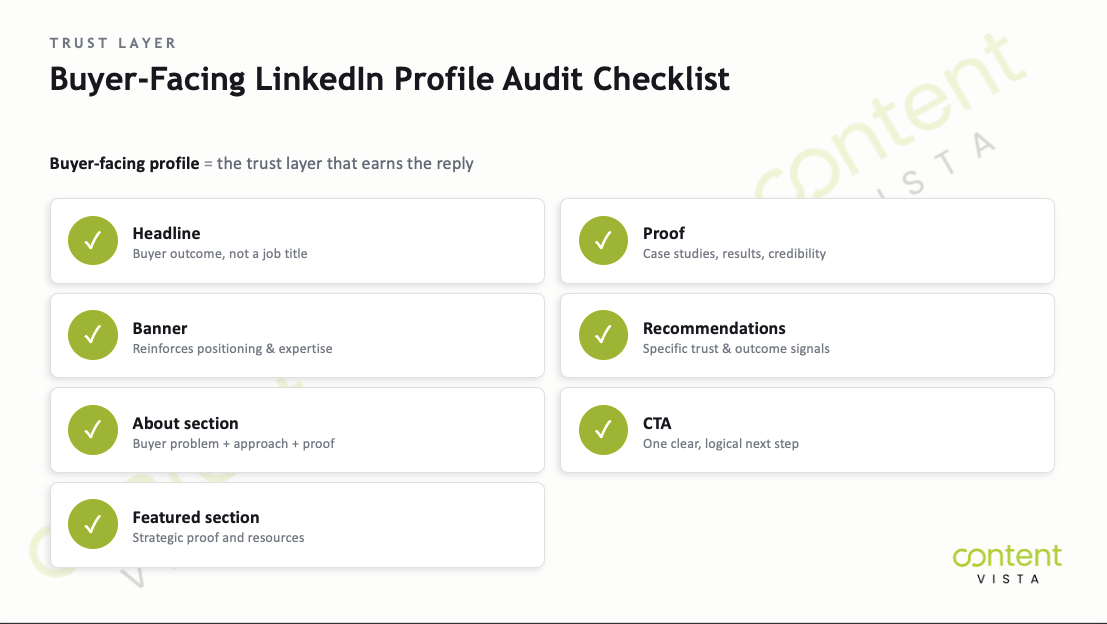
Profile Trust Audit Table
| Profile Element | Weak Version | Buyer-Facing Version |
|---|---|---|
| Headline | Job title only | Clear buyer outcome or problem focus |
| Banner | Generic branding | Reinforces positioning or expertise |
| About section | Career history | Buyer problem + approach + credibility |
| Featured section | Empty or random | Strategic proof and resources |
| Experience | Internal responsibilities | Relevant transformation or expertise context |
| Recommendations | Generic praise | Specific trust and outcome signals |
| CTA | No next step | Clear logical continuation |
A strong buyer-facing profile does not guarantee replies.
But it dramatically improves the odds that outreach, content, comments, and conversations feel credible instead of transactional.
And that is what turns LinkedIn from “activity” into a functioning acquisition system.
If you want help building a more connected buyer-facing profile and outreach system, explore the LinkedIn Growth Engine.
Step 2 - Identify the Right People and Signals
A lot of LinkedIn outreach fails before the first message is even sent.
Not because the copy is bad. Not because the profile is weak.
Because the targeting is wrong.
Many teams still approach LinkedIn targeting like a spreadsheet exercise: job title + industry + company size.
But modern LinkedIn lead generation works far better when targeting includes timing, context and buyer signals : not just demographics.
The title tells you who someone is. The signal tells you why now might be the right time to reach out.
Define the buyer segment
Strong targeting starts with clarity around the buyer segment itself.
That means understanding:
who experiences the problem
who influences the buying decision
who feels the urgency
who is easiest to reach
who is most likely to respond to your positioning
This is where many teams become too broad.
For example: “Founders” is usually too wide. “Marketing leaders” is usually too vague.
A better approach is to narrow around:
business model
growth stage
operational bottleneck
acquisition maturity
market category
urgency triggers
The more precisely the buyer-facing profile, outreach and content align with a specific problem environment, the easier it becomes to create qualified conversations.
That is also why LinkedIn should sit inside a broader lead generation system, not operate as disconnected outreach activity.
Use signals, not just titles
Signals are what make LinkedIn strategically powerful.
Instead of only filtering for static attributes, look for signs that indicate:
change
urgency
growth
friction
attention
momentum
Useful buyer signals can include:
role changes
company expansion
hiring activity
funding announcements
technology adoption
public complaints or pain indicators
category discussions
recent posts
engagement with relevant content
leadership hires
market repositioning
For example: A founder posting about pipeline inconsistency is a stronger signal than simply “CEO at SaaS company.”
A company hiring multiple SDRs may indicate outbound expansion.
A consulting firm discussing demand generation problems publicly may already be problem-aware before outreach begins.
That context changes how conversations start.
Good targeting increases relevance before outreach begins. Bad targeting forces outreach to work too hard to create interest.
Build lists around timing and relevance
The strongest LinkedIn prospecting systems are dynamic, not static.
Instead of building one giant lead list and blasting messages, build smaller lists around:
timing
intent
market changes
recent activity
visible priorities
That allows outreach to feel contextual instead of random.
For example:
recently promoted operators
founders discussing hiring
agencies expanding outbound
consultants posting about lead quality
companies entering new markets
businesses increasing content activity
This becomes even more effective when LinkedIn supports multi-channel outreach instead of functioning in isolation.
A prospect may:
see your content first
receive an email later
check your profile afterward
respond through whichever channel feels most natural
That is usually more effective than relying on one channel alone.
Where Sales Navigator fits
Sales Navigator can support this process well.
But it is important to frame it correctly: Sales Navigator is not the strategy.
It is one tool inside the targeting and signal-discovery layer.
Used properly, it can help with:
advanced filtering
saved searches
account monitoring
buyer alerts
signal tracking
relationship mapping
What it cannot do is fix:
weak positioning
poor targeting logic
irrelevant offers
low-trust profiles
bad outreach
That distinction matters because many teams buy tools before building the underlying acquisition logic.
The better approach is the opposite: first define the buyer, the signals and the conversation strategy: then use tools to support execution.
Because in LinkedIn lead generation, relevance beats volume almost every time.
Step 3 - Nurture Familiarity Before the DM
Here’s where most LinkedIn outreach goes wrong: it asks for trust before it has created any familiarity.
That is the fundamental difference between LinkedIn and most cold outbound channels.
On LinkedIn, prospects often experience your presence before they experience your message.
They may:
see your content
notice your comments
check your profile
observe mutual engagement
read your About section
scan your Featured resources
recognise your name from previous interactions
That public context changes how conversations start.
And strategically, it means content and engagement are not separate from outreach. They are what make outreach feel warmer, safer and more relevant.
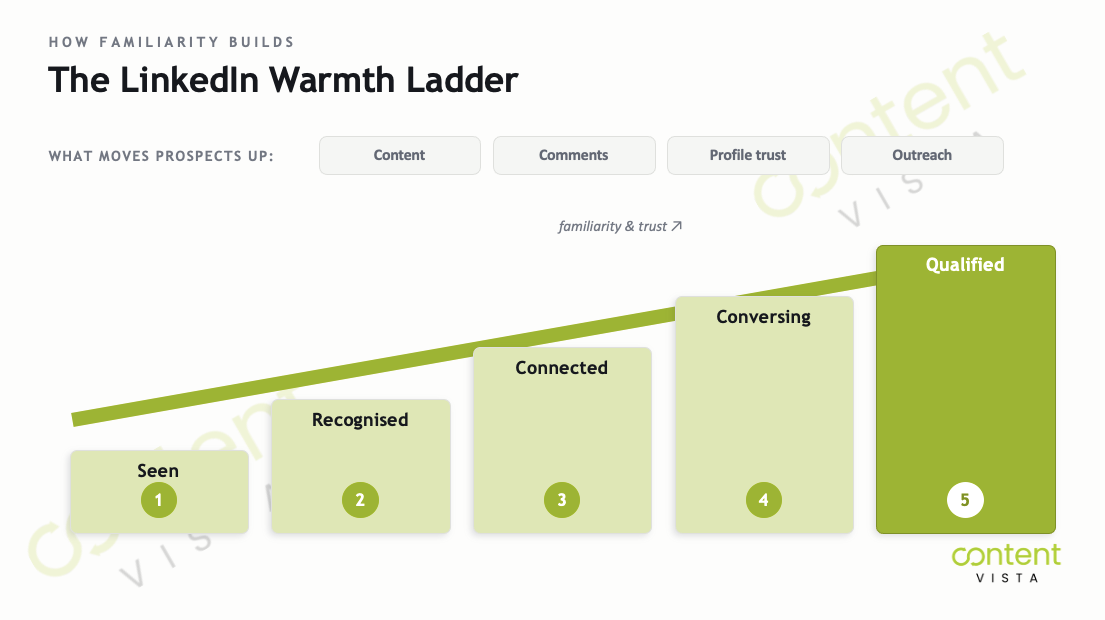
The LinkedIn Warmth Ladder
Seen → Recognised → Connected → Conversing → Qualified
The goal is not viral visibility.
The goal is movement through that sequence.
Use content to create recognition
Most LinkedIn content fails because it tries too hard to impress instead of helping buyers think more clearly.
A better approach is to create content around:
buyer problems
operational mistakes
decision frameworks
implementation gaps
misconceptions
category insights
trade-offs
process breakdowns
lessons from execution
That kind of content creates recognition.
A prospect should read the post and think: “This is exactly the problem we’re dealing with.”
Not: “This person is trying to sound smart.”
Relationship-led prospecting works better when prospects already recognise your thinking before the first message arrives.
That is why strong LinkedIn content is less about personal branding performance and more about trust transfer.
Use comments to build context
Comments are one of the most underused parts of LinkedIn lead generation.
Most people either:
ignore comments completely
leave generic responses like “Great post”
use comments for visibility bait
But useful comments can quietly build familiarity long before outreach begins.
Good comments:
add perspective
clarify an idea
extend the conversation
challenge assumptions respectfully
introduce useful examples
reinforce expertise naturally
And importantly, comments place your thinking inside conversations your buyers are already paying attention to.
That creates contextual visibility.
A prospect may never engage directly with your content but still become familiar with your name, positioning, and expertise through repeated exposure in relevant discussions.
That familiarity lowers friction later when outreach happens.
Comments are not just engagement tactics. They are trust-building micro-interactions that make future conversations feel less cold.
Turn thought leadership into conversation starters
Thought leadership is often misunderstood.
It is not a motivational posting. It is not generic inspiration. And it is not constant self-promotion.
In a LinkedIn lead generation system, thought leadership exists to:
shape perception
clarify expertise
build category authority
create familiarity
attract the right conversations
The strongest thought leadership usually does one of three things:
explains a problem more clearly
reframes a common assumption
introduces a useful operating model or framework
That is why practical frameworks, implementation lessons and operational insights often outperform vague “mindset” content for B2B lead generation.
And this matters even for outbound-heavy systems.
Because when prospects see thoughtful content before or after outreach, the message no longer feels like it came from a stranger. It feels connected to a visible point of view.
That is where thought leadership that creates demand becomes strategically valuable.
Instead of relying entirely on cold outreach, content starts warming the environment around the outreach itself.
The result is not just more visibility.
It is more contextual, qualified conversations.
If content and thought leadership need to warm up your audience first, build demand before outreach.
Demand GenerationStep 4 - Kick Off Low-Friction Outreach
Most LinkedIn outreach fails because it tries to compress the entire sales process into one message.
Connection request. Pitch. Calendar link. Follow-up pressure.
All within minutes of connecting.
That approach usually creates resistance instead of conversations.
The better approach is lower friction, more context, and gradual progression.
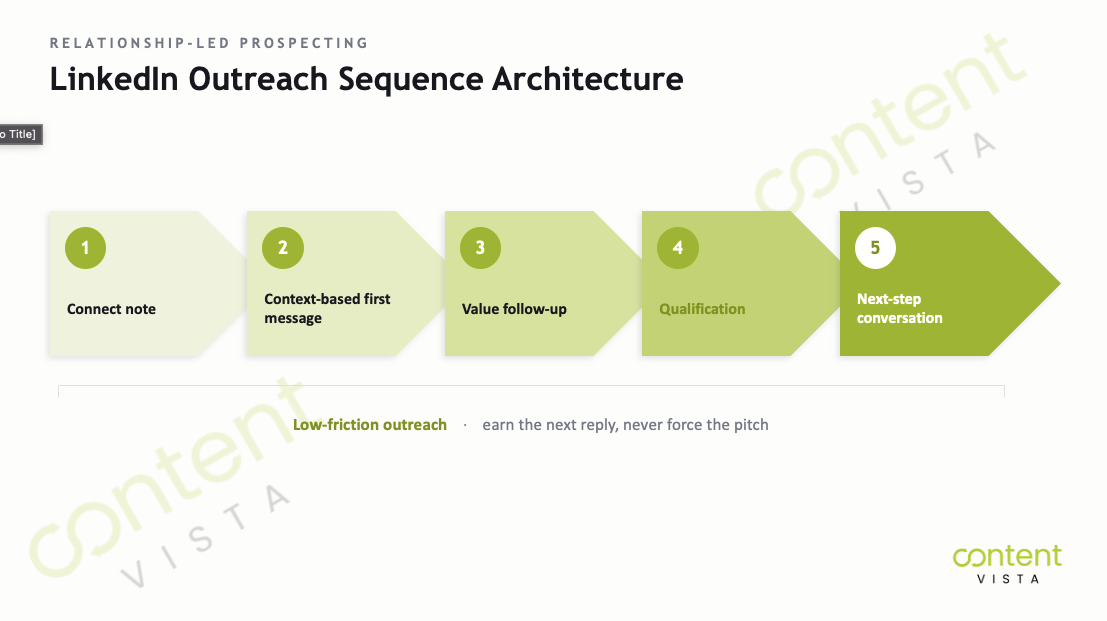
The goal of the first message is not to close the deal. It is to earn the next reply.
Personalise the connection request
The connection request is not the place for a full sales pitch.
It is simply the first interaction layer.
A good request usually feels:
relevant
contextual
low-pressure
human
That context might come from:
a shared topic
a recent post
a mutual connection
a hiring announcement
a podcast appearance
a category discussion
a signal you observed
The point is not “personalisation theatre.”
It is showing the prospect there is an actual reason for the connection beyond list-building.
For example:
referencing a recent insight they shared
mentioning a category challenge they discussed publicly
connecting around a relevant operational topic
That feels very different from: “Would love to connect and explore synergies.”
Or worse: an immediate pitch disguised as a connection note.
Start with context, not a pitch
The first message after connecting should continue the conversation : not abruptly change the dynamic.
This is where many LinkedIn sequences break.
They move directly from: “Thanks for connecting” to: “Here’s what we sell.”
That transition feels transactional because no familiarity or relevance has been built yet.
A stronger approach is to continue from visible context:
a post they wrote
a hiring trend
a market challenge
a growth initiative
an observation relevant to their role
The best outreach often sounds curious rather than persuasive.
For example:
asking a thoughtful operational question
sharing a short relevant observation
mentioning a pattern you are seeing across similar companies
referencing a challenge connected to their visible activity
That creates room for dialogue instead of forcing a sales interaction immediately.
Low-friction outreach reduces pressure while increasing relevance. The conversation should feel like a continuation of context : not an interruption demanding attention.
Move from conversation to qualification
A lot of LinkedIn outreach advice focuses only on getting replies.
But replies are not the real goal.
Qualified conversations are.
That means outreach needs progression logic.
A conversation usually moves through stages:
connection
context
interaction
relevance discovery
qualification
next-step discussion
Trying to skip those stages creates friction.
A more effective approach is gradual qualification:
understanding whether the problem exists
identifying urgency
checking whether timing makes sense
seeing if the prospect is actively exploring solutions
Follow-ups should support this process by adding:
additional insight
useful context
relevant examples
clarifying questions
helpful resources
Not repetitive pressure.
That distinction matters.
Persistent follow-up can be useful. Aggressive follow-up usually damages trust.
Avoid aggressive automation
Automation is one of the most misunderstood parts of LinkedIn lead generation.
Used carefully, automation can support workflow efficiency:
reminders
CRM updates
list management
scheduling
enrichment
lightweight sequencing
But aggressive automation often creates the exact opposite of what LinkedIn outreach is supposed to achieve: trust and contextual relevance.
Problems usually start when teams:
mass-send generic messages
fake personalisation
automate comments badly
scale outreach without targeting discipline
prioritise volume over conversation quality
rely on scripts that ignore buyer context
That creates both trust risk and platform risk.
It also weakens positioning because the outreach starts sounding interchangeable.
The stronger approach is human-guided, context-aware execution supported by systems : not black-hat scaling tactics.
Outreach Sequence Architecture Table
| Stage | Goal | Example Approach |
|---|---|---|
| Connection request | Create relevance | Shared topic, signal, or context |
| First message | Start conversation | Observation or thoughtful question |
| Follow-up | Add value | Useful insight, example, or resource |
| Qualification | Explore fit | Discuss problem, urgency, or priorities |
| Next step | Move conversation forward | Suggest deeper discussion only when relevant |
The important shift is this:
LinkedIn outreach works best when it feels like relationship-led prospecting, not inbox extraction.
That means:
better targeting
stronger context
more relevant conversations
lower friction
more qualified pipeline opportunities
And when that process becomes repeatable, LinkedIn stops behaving like random outbound activity and starts functioning like a scalable profile-to-pipeline system.
If you want LinkedIn to become a consistent profile-to-pipeline system, explore the LinkedIn Growth Engine.
Linkedin Growth EngineStep 5 - Systemise Reply Handling, Follow-Up and CRM Handoff
Getting a reply is not the finish line.
It is where the system either starts working or starts leaking.
This is one of the biggest weaknesses in most LinkedIn lead generation strategies. Teams spend enormous effort on content, prospecting and outreach, but once replies arrive, there is no structured process behind them.
Messages stay trapped in inboxes. Follow-ups become inconsistent. Context gets lost. Qualified opportunities disappear.
That breaks the entire profile-to-pipeline model.
Because LinkedIn lead generation is not just about starting conversations. It is about operationalising what happens after the conversation starts.
Tag conversations by intent
Not every reply means the same thing.
That is why conversations should be categorised early instead of handled randomly.
Common response categories include:
interested
not now
referral
objection
wrong person
unqualified
This matters because every category requires a different next step.
For example:
“Interested” may trigger qualification and scheduling.
“Not now” may require long-term follow-up.
“Referral” may open a new contact path.
“Wrong person” may reveal the correct stakeholder.
“Objection” may signal positioning friction.
“Unqualified” may indicate targeting issues upstream.
Without categorisation, teams treat every reply manually, inconsistently and emotionally.
A structured approach creates clarity around what should happen next.
Create follow-up rules
Most pipeline leakage happens in follow-up.
Not because people intentionally ignore leads: but because there are no rules governing:
timing
ownership
reminders
escalation
re-engagement
nurturing
Good LinkedIn systems define:
when to follow up
what type of follow-up makes sense
when to pause outreach
when to move conversations into nurture
when to disqualify
Importantly, follow-up should remain contextual.
A strong follow-up adds:
relevance
insight
useful information
timing awareness
continuity
Not repetitive pressure.
A reply without a follow-up system creates hidden pipeline leakage. The goal is not just conversation volume. It is a conversation continuity.
Move qualified conversations into CRM
One of the most common operational mistakes is allowing qualified conversations to live only inside LinkedIn inboxes.
That creates:
poor visibility
fragmented ownership
inconsistent qualification
lost context
weak reporting
unreliable forecasting
A functioning profile-to-pipeline system moves qualified conversations into CRM once intent becomes meaningful.
That allows teams to track:
source-to-opportunity conversion
outreach performance
response quality
pipeline progression
revenue attribution
follow-up status
This is where LinkedIn stops being a “social selling activity” and becomes part of a measurable lead generation system.
Keep LinkedIn from becoming an invisible pipeline
Invisible pipelines are dangerous because they create false confidence.
Conversations appear active. Messages are happening. Engagement looks healthy.
But leadership still cannot answer:
how many qualified conversations exist
which outreach paths convert best
where leads drop off
how LinkedIn contributes to revenue
which follow-ups actually create opportunities
That visibility gap is usually a systems problem, not a LinkedIn problem.
The solution is operational infrastructure:
CRM integration
conversation tracking
qualification logic
ownership clarity
follow-up workflows
reporting visibility
That is where systems, conversion and growth infrastructure become strategically important.
Because ultimately, LinkedIn lead generation only becomes scalable when conversations move beyond inbox management and into measurable pipeline operations.
Measure Lead Generation Capacity, Not Just Profile Views
Profile views are nice.
But they do not tell you whether LinkedIn can actually support your pipeline target.
That is one of the biggest measurement mistakes in LinkedIn lead generation.
Teams celebrate:
impressions
likes
comments
follower growth
Social Selling Index (SSI)
Meanwhile, leadership is still asking: “How many qualified opportunities is this actually creating?”
Those are very different questions.
A profile-to-pipeline system should measure business movement, not just platform activity.
Metrics That Matter More Than Profile Views
| Metric | Why It Matters |
|---|---|
| Target prospects added | Measures whether the right audience is entering the system |
| Connection acceptance rate | Indicates relevance and profile trust |
| Conversation start rate | Shows whether outreach creates engagement |
| Reply quality | Reveals whether targeting and messaging align |
| Qualified conversations | Measures real sales relevance |
| Booked calls | Tracks progression toward pipeline |
| Opportunity creation | Connects outreach to revenue potential |
| Source-to-pipeline conversion | Measures actual acquisition efficiency |
| Follow-up completion | Prevents hidden pipeline leakage |
The important shift is this:
Instead of asking: “How much visibility are we getting?”
Ask: “How many qualified conversations are we creating consistently?”
That changes how LinkedIn gets managed operationally.
Why vanity metrics create false confidence
A post with high engagement may create no pipeline.
A post with low engagement may quietly influence decision-makers who later respond to outreach, book calls or refer opportunities.
That is why platform metrics alone are incomplete.
Visibility matters. Recognition matters. Familiarity matters.
But ultimately, the acquisition system has to connect activity to:
conversations
qualification
opportunities
pipeline movement
Otherwise LinkedIn becomes difficult to evaluate strategically.
The goal is not maximum visibility. The goal is enough qualified conversations to support pipeline targets predictably.
Estimate lead generation capacity, not just engagement
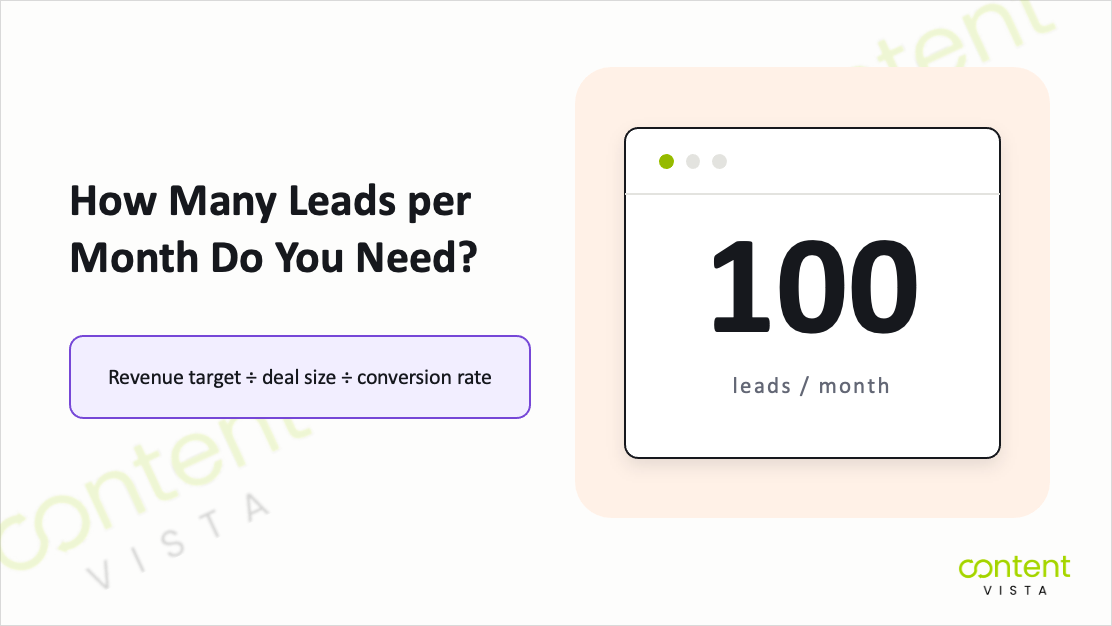
This is where lead generation capacity becomes useful.
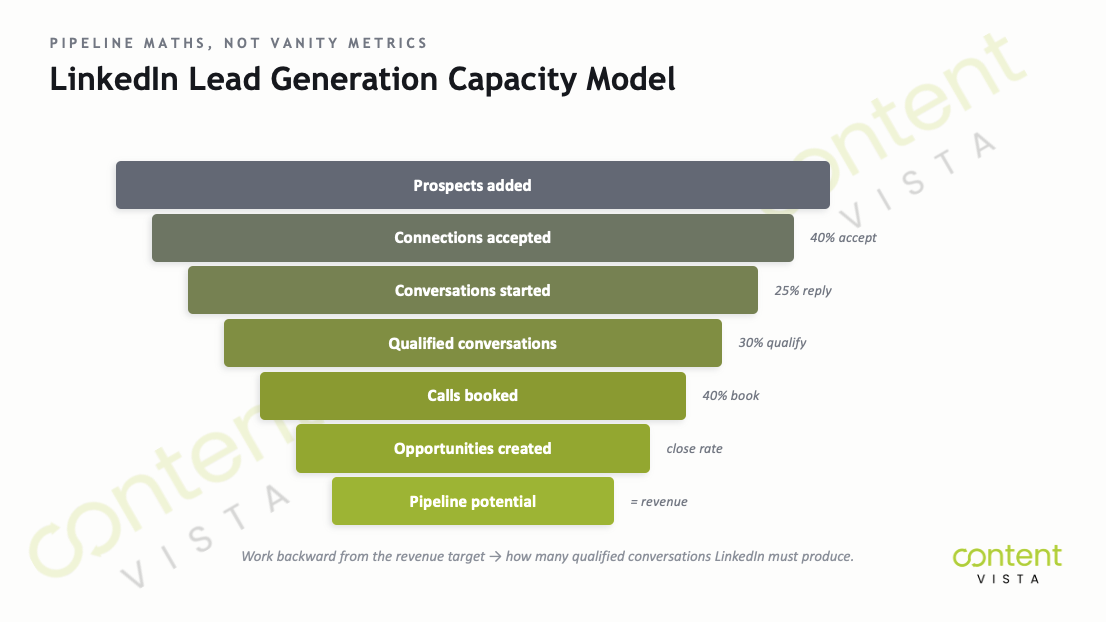
Instead of measuring isolated metrics, estimate whether LinkedIn can realistically produce enough pipeline activity for the business.
For example:
If:
100 relevant prospects are added monthly
40% accept connection requests
25% enter conversations
30% of conversations become qualified
40% of qualified conversations book calls
Then the business can roughly estimate:
conversation volume
qualified opportunities
pipeline potential
operational workload
follow-up requirements
The exact numbers vary by:
industry
positioning
trust level
targeting quality
offer strength
outbound maturity
audience warmth
But the principle remains the same: LinkedIn should be measured as a pipeline input system, not just a visibility platform.
Optional: SSI vs Business KPI Comparison
| Platform Metric | Business KPI Equivalent |
|---|---|
| SSI score | Qualified conversations |
| Profile views | Relevant buyer interest |
| Post impressions | Audience visibility |
| Engagement rate | Conversation potential |
| Follower growth | Target audience expansion |
| Connection count | Relationship quality and relevance |
| Likes/comments | Pipeline movement |
SSI and engagement metrics are not useless.
They simply become more valuable when interpreted inside the broader acquisition system.
A rising SSI with no qualified conversations is not success.
A modest engagement profile producing consistent pipeline opportunities often matters far more commercially.
Build measurement around operational reality
The best LinkedIn systems measure:
outreach efficiency
targeting quality
conversation progression
qualification rates
follow-up discipline
pipeline contribution
That creates strategic visibility into whether LinkedIn is:
scalable
sustainable
resource-efficient
commercially viable
And importantly, it helps teams decide:
whether LinkedIn should remain primary
whether another channel should support it
whether the current execution model is strong enough to scale
Calculate whether LinkedIn can realistically generate enough qualified conversations for your pipeline target.
Lead Generation Capacity CalculatorWhere AI Helps and Where It Hurts LinkedIn Strategy
AI can make a good LinkedIn system faster.
It can also make a bad one noisier.
That distinction matters because a lot of AI-driven LinkedIn advice focuses almost entirely on speed:
faster content
faster outreach
faster prospecting
faster automation
But LinkedIn lead generation still depends heavily on:
trust
positioning
judgment
timing
relevance
conversation quality
AI-assisted workflows can support those systems.
They cannot replace them.
What AI can support
Used carefully, AI can reduce operational workload across the profile-to-pipeline process.
For example, AI-assisted workflows can help with:
account research
signal discovery
lead list enrichment
first-draft outreach messages
content idea generation
CRM notes
conversation tagging
follow-up reminders
reporting summaries
That support is useful because LinkedIn systems often involve repetitive operational work:
tracking conversations
monitoring accounts
identifying signals
summarising interactions
organising pipeline activity
AI can accelerate those tasks significantly.
It can also help teams maintain consistency across larger outreach and content operations without manually handling every administrative step.
But support is an important word.
Strategic thinking still matters more than tooling.
What AI should not replace
AI struggles when the work requires:
nuance
emotional judgment
positioning clarity
genuine expertise
contextual understanding
relationship-building
This is where many LinkedIn systems become weaker after adding AI.
Common problems include:
comments that sound generic
outreach that feels mass-produced
fake personalisation
profile content losing personality
irrelevant targeting
invented context or hallucinated details
automated engagement that feels unnatural
And once prospects sense that interactions are synthetic, trust drops quickly.
That is especially dangerous on LinkedIn because the platform is built around visible professional identity.
AI should support trust-building systems : not imitate human credibility badly.
There is also platform risk.
Aggressive automation, scraping, spam sequencing, or black-hat engagement tactics can create:
account restrictions
deliverability issues
damaged brand perception
lower response quality
long-term trust erosion
The problem is not AI itself.
The problem is using AI to scale weak strategies.
How to use AI without sounding robotic
The strongest AI-assisted workflows usually follow a simple principle:
Use AI for preparation and operational support. Use humans for judgment and conversation quality.
For example:
let AI surface relevant signals
let AI organise research
let AI draft message structures
let AI summarise CRM activity
But human review should still shape:
tone
positioning
context
prioritisation
outreach logic
relationship handling
That balance matters because buyers can usually tell the difference between:
contextual communication
and
synthetic volume production
The goal is not maximum automation.
The goal is more relevant, scalable execution without losing trust quality.
That is where an integrated AI-assisted client acquisition system becomes strategically useful : especially when LinkedIn, content, CRM, outbound and follow-up systems need to work together operationally.
If you need LinkedIn, cold email, content, CRM and automation working together, explore the integrated acquisition stack.
AI Client Acquisition StackWhat LinkedIn Lead Gen Costs in Time and Effort
There is no free version of LinkedIn lead generation.
You either pay with:
time
team capacity
systems
operational complexity
outsourced execution
That is important to understand because many businesses underestimate how much coordination a functioning profile-to-pipeline system actually requires.
The visible part is usually content and outreach.
The invisible part is:
targeting
signal monitoring
conversation handling
follow-up
CRM updates
reporting
qualification
consistency
That workload changes depending on the execution model.
Cost / Time / Effort Comparison Table
| Model | Time Required | Content Effort | Outreach Effort | CRM / Process Complexity | Risk Level | Best Fit |
|---|---|---|---|---|---|---|
| Founder-led manual execution | High founder involvement | High | Medium to high | Low to medium | Burnout and inconsistency risk | Early-stage founder-led businesses |
| Internal operator-supported execution | Medium | Medium | Medium | Medium to high | Process dependency risk | Teams building repeatable outbound systems |
| Done-for-you LinkedIn engine | Lower internal workload | Shared or external support | Managed externally or collaboratively | Medium | Misalignment if positioning is weak | Businesses wanting structured execution support |
| Integrated acquisition stack | Higher setup complexity | Coordinated multi-channel content | Multi-channel outreach | High | Operational complexity if unmanaged | Growth-stage businesses scaling pipeline systems |
Founder-led manual execution
This is how most businesses start.
The founder:
writes content
sends connection requests
handles outreach
follows up manually
manages conversations directly
That can work well early because founder expertise often creates strong trust signals.
But it is also difficult to sustain consistently.
The biggest risks are:
inconsistent execution
outreach fatigue
poor follow-up discipline
limited scalability
pipeline visibility gaps
Eventually, many founder-led systems hit a capacity ceiling.
Internal operator-supported execution
This model introduces support from:
SDRs
growth operators
marketing coordinators
outbound specialists
RevOps support
The advantage is operational consistency.
Targeting, outreach management, CRM updates, reporting, and follow-up become more structured instead of depending entirely on founder bandwidth.
But this also increases process complexity.
Without clear positioning, qualification rules, and messaging systems, internal execution can quickly become noisy or disconnected.
That is why many teams eventually formalise the process into a dedicated LinkedIn Growth Engine instead of treating LinkedIn as an ad hoc activity.
Done-for-you LinkedIn engine
Some businesses choose outsourced or hybrid execution models.
This can reduce internal operational pressure while improving consistency across:
content
prospecting
messaging
follow-up systems
reporting
The main benefit is systemisation.
The main risk is strategic misalignment.
If the positioning, audience clarity, or trust layer is weak, outsourcing execution alone usually does not solve the underlying acquisition problem.
A done-for-you system works best when:
the offer is already validated
the buyer is defined
the messaging is reasonably clear
the organisation can still participate strategically
Integrated acquisition stack
As businesses scale, LinkedIn often stops operating alone.
It becomes part of a broader acquisition environment involving:
cold email
content
CRM systems
nurture flows
AI-assisted workflows
reporting infrastructure
qualification systems
That is where integrated systems become more useful than isolated channel management.
An AI Client Acquisition Stack can help coordinate these moving parts into one operational growth system instead of disconnected campaigns.
The key idea is this:
LinkedIn lead generation is rarely “just posting content” or “just sending DMs.”
It is an operational system with real execution costs: whether those costs are paid through time, people, infrastructure, or external support.
Common Mistakes That Break LinkedIn Lead Generation
The mistakes are not complicated.
But they are expensive.
Most LinkedIn lead generation systems do not fail because the platform stopped working. They fail because small strategic and operational gaps compound over time.
A weak profile lowers trust. Bad targeting lowers relevance. Poor follow-up leaks conversations. Over-automation damages credibility.
And eventually, teams conclude: “LinkedIn doesn’t work for us.”
In reality, the system underneath the activity was never fully connected.
Common LinkedIn Lead Generation Mistakes
* Incomplete or résumé-style profile
* Vague positioning
* Broad targeting
* Content with no buyer relevance
* Pitch-first outreach
* No engagement before messaging
* No follow-up rhythm
* Over-automation
* Vanity-metric obsession
* No CRM visibility
* No lead-capacity planning
* Scaling LinkedIn before offer clarity
Incomplete or resume-like profile
A LinkedIn profile is not just a career summary.
When the profile lacks:
buyer relevance
positioning clarity
proof
useful context
credibility signals
prospects hesitate before replying.
If outreach promises expertise but the profile feels generic, trust drops immediately.
Vague positioning
Many profiles and messages try to appeal to everyone.
That usually creates weak relevance.
Statements like:
“helping businesses grow”
“growth consultant”
“marketing expert”
are often too broad to trigger buyer recognition.
Specificity creates trust faster than generality.
Broad targeting
A common mistake is building large lists based only on:
job title
industry
company size
without considering timing, urgency, or buyer signals.
The result is low-context outreach sent to people with no clear reason to respond now.
Content with no buyer relevance
Posting consistently is not enough.
If the content does not help buyers:
understand problems
evaluate decisions
avoid mistakes
recognise operational gaps
it may create visibility without creating pipeline movement.
Content should support conversations, not just activity.
Pitch-first DMs
One of the fastest ways to damage trust is jumping directly from: “Nice to connect” to: “Book a call.”
LinkedIn outreach works better when it earns progression gradually through context and relevance.
The first message should create conversation, not force conversion.
No engagement before outreach
Prospects often notice:
comments
profile visits
content interactions
shared discussions
before replying.
Ignoring the public familiarity layer makes outreach colder than it needs to be.
No follow-up rhythm
Many teams either:
never follow up
or
follow up aggressively without adding value
Both approaches hurt conversion.
Good follow-up systems create continuity, not pressure.
Over-automation
Automation becomes dangerous when it replaces judgment.
Generic comments, fake personalisation, mass messaging, and robotic sequencing make the outreach feel synthetic very quickly.
AI-assisted workflows should support execution: not imitate authenticity badly.
Treating SSI and profile views as success
Visibility metrics can be useful indicators.
But they are not the same as:
qualified conversations
opportunities
pipeline contribution
A high SSI with no measurable business movement is not meaningful growth.
No CRM visibility
When conversations stay trapped inside LinkedIn inboxes:
ownership becomes unclear
follow-up becomes inconsistent
reporting becomes unreliable
pipeline visibility disappears
That breaks the profile-to-pipeline system operationally.
No capacity planning
Some businesses generate more conversations than they can realistically handle.
Others never calculate whether LinkedIn can support pipeline targets in the first place.
Without lead-capacity planning, execution becomes reactive instead of strategic.
Trying to use LinkedIn before offer clarity
This may be the biggest mistake of all.
If the:
ICP is unclear
offer is weak
positioning is vague
conversion system is broken
LinkedIn activity usually amplifies confusion rather than solving it.
The platform cannot compensate for foundational acquisition problems.
When Not to Use LinkedIn as Your Primary Lead Gen Channel Yet
Sometimes LinkedIn is not the problem.
The foundation underneath LinkedIn is.
That distinction matters because many businesses try to fix weak acquisition systems by increasing activity:
more posting
more outreach
more automation
more content
But if the underlying strategy is unclear, LinkedIn often amplifies the confusion instead of solving it.
Not every business should make LinkedIn its primary lead generation channel immediately.
And in some cases, waiting is the smarter strategic decision.
Do not make LinkedIn your primary lead generation channel yet if:
* the offer is unclear
* the ICP is undefined
* buyers are not active or researchable on LinkedIn
* there is no visible proof or point of view
* there is no follow-up capacity
* the sales process cannot handle conversations consistently
* the business needs conversion or positioning fixes first
* the expectation is instant results without sustained execution
One of the biggest warning signs is vague positioning.
If the business cannot clearly explain:
who it helps
what problem it solves
why buyers should care
what differentiates the offer
then LinkedIn outreach becomes difficult very quickly.
The same applies to ICP clarity.
Broad targeting usually creates:
weak relevance
low response quality
inconsistent conversations
confused messaging
And that is not a LinkedIn problem. It is a strategic clarity problem.
Another important consideration is buyer behaviour.
Some audiences simply are not highly active or researchable on LinkedIn. In those cases, forcing LinkedIn into the primary acquisition role can create unnecessary friction compared to:
referrals
partnerships
search-driven acquisition
industry communities
events
outbound email
channel relationships
There is also an operational reality many teams underestimate: LinkedIn lead generation creates conversation volume that needs handling.
Without:
qualification logic
follow-up systems
CRM visibility
ownership clarity
scheduling capacity
The pipeline starts leaking immediately after replies arrive.
LinkedIn works best when the acquisition foundations already exist. It accelerates clarity and trust. It does not magically create them from nothing.
This is especially important for teams expecting instant results.
LinkedIn is usually a compounding channel:
trust builds gradually
familiarity develops over time
positioning strengthens through repetition
conversations improve as targeting improves
That means consistency matters more than short bursts of activity.
In many cases, the better first step is strengthening:
offer clarity
ICP definition
conversion systems
positioning
messaging
overall growth strategy
before scaling LinkedIn execution aggressively.
If your offer, ICP, or funnel is unclear, fix the foundations before scaling LinkedIn.
Marketing Os SprintExample: What a LinkedIn-Led Growth System Looks Like
This is what changes when LinkedIn is not treated as a posting habit or DM channel, but as part of a connected growth system.
The strongest LinkedIn-led acquisition systems usually combine:
expertise visibility
content distribution
audience capture
relationship-building
outreach
qualification
CRM visibility
conversion infrastructure
Not isolated tactics.
Akshar Business Consulting
The Akshar Business Consulting case study is a useful example of how LinkedIn can support a wider demand-generation and lead-capture ecosystem.
Instead of relying only on outbound messaging, the system connected:
founder expertise
LinkedIn content
newsletter growth
educational resources
lead magnets
audience capture infrastructure
The founder’s industry insights became visible content assets that helped create familiarity and trust with the target audience over time.
That visibility did not operate in isolation.
Content directed attention toward:
newsletters
educational resources
lead magnets
broader audience engagement systems
This created a more connected profile-to-pipeline environment where LinkedIn visibility supported ongoing audience capture and nurturing instead of functioning only as a DM channel.
The important takeaway is structural: LinkedIn worked because it connected into a broader demand and lead-generation system.
Not because of “posting frequency” alone.
Confido
The Confido case study shows another important variation of the model.
In this case, LinkedIn and outbound execution worked together to support qualified lead generation.
Instead of treating outreach as disconnected activity, the system combined:
prospect targeting
outreach coordination
conversation generation
lead qualification
operational follow-up
inside a wider acquisition process.
That made it easier to connect conversations back into measurable pipeline activity instead of leaving them fragmented across inboxes and disconnected outreach workflows.
The key principle across both examples is the same:
LinkedIn becomes far more effective when it operates as one layer inside a connected acquisition system involving content, outreach, audience capture, follow-up and pipeline visibility.
That is the difference between:
random activity
and
a repeatable LinkedIn-led growth engine.
LinkedIn Lead Capacity Scorecard
Most LinkedIn lead generation systems do not fail because of one catastrophic mistake.
They fail because several weak layers quietly compound:
weak positioning
inconsistent content
poor targeting
no follow-up discipline
invisible pipeline tracking
That is why a quick operational self-audit is useful before scaling activity further.
This scorecard is designed to help you assess whether your current LinkedIn engine is capable of generating qualified conversations consistently or whether the bottleneck sits somewhere else in the system.
LinkedIn Lead Capacity Scorecard
Score each area from:
1 \= weak or inconsistent
3 \= partially working
5 \= strong and repeatable
| Area | Questions to Ask | Score (1–5) |
|---|---|---|
| Profile trust | Does the buyer-facing profile clearly communicate relevance, expertise, proof, and next steps? | ___ |
| Targeting quality | Are outreach lists built around real buyer signals and timing instead of broad titles alone? | ___ |
| Content consistency | Is content consistently reinforcing expertise, buyer problems, and trust-building? | ___ |
| Outreach quality | Does outreach feel contextual, low-friction, and conversation-led instead of pitch-heavy? | ___ |
| Conversation rate | Are conversations starting consistently from outreach and engagement activity? | ___ |
| CRM visibility | Are qualified conversations tracked properly beyond LinkedIn inboxes? | ___ |
| Follow-up discipline | Is there a repeatable follow-up process with ownership and reminders? | ___ |
| Lead capacity | Can the current system realistically generate enough qualified conversations for pipeline goals? | ___ |
How to interpret the score
32-40: Strong operational foundation. The system is likely scalable with optimisation and capacity planning.
24-31: Functional but inconsistent. One or two weak layers are probably limiting pipeline growth.
16-23: Major operational gaps exist. LinkedIn activity may be generating noise more than predictable pipeline.
Below 16: The problem is likely strategic, not tactical. Offer clarity, positioning, targeting or process foundations may need work first.
The important thing is not the score itself.
It is identifying where the system breaks:
trust
targeting
outreach
follow-up
operational visibility
capacity constraints
Because LinkedIn performance is usually cumulative.
One weak layer affects everything downstream.
A functioning LinkedIn engine is not built from one tactic. It is built from connected systems that support trust, conversations, qualification and pipeline movement together.
If lead volume or operational capacity feels unclear, use the Lead Generation Capacity Calculator to estimate whether LinkedIn can realistically support your pipeline goals.
Score your LinkedIn engine, then use the Marketing Growth System Finder to find the growth system that fits your current stage.
Marketing Growth System FinderFAQs About LinkedIn Lead Gen Strategy
What is a LinkedIn lead gen strategy?
A LinkedIn lead gen strategy is a structured system for turning profile trust, targeting, content, engagement, outreach and follow-up into qualified conversations. The goal is not just visibility or profile views. It is pipeline creation through a connected profile-to-pipeline process.
Is LinkedIn still effective for lead generation in 2026?
Yes: especially for B2B services, consulting, agencies, operators, founders, and expertise-led businesses where trust and credibility influence buying decisions. However, LinkedIn works best when it operates as part of a broader acquisition system instead of isolated posting or messaging activity.
Do I need Sales Navigator for LinkedIn lead gen?
Not always.
Sales Navigator can improve:
targeting
signal discovery
saved searches
account monitoring
prospect filtering
But it is a support tool, not the strategy itself. Weak positioning, poor targeting logic or bad outreach will still underperform even with advanced tools.
What should I optimise on my profile first?
Start with the buyer-facing profile fundamentals:
headline clarity
audience relevance
About section positioning
proof and credibility
Featured section assets
logical next steps
The profile should help prospects quickly understand:
who you help
what problems you solve
why your perspective matters
Should I post content or send DMs first?
Usually both should support each other.
Content helps create familiarity and trust before outreach happens. Outreach helps convert visibility into conversations. The strongest LinkedIn lead generation systems combine:
content
comments
outreach
follow-up
CRM tracking
instead of relying entirely on one tactic.
How do I avoid sounding spammy on LinkedIn?
Avoid:
pitch-first messages
fake personalisation
generic comments
aggressive automation
irrelevant targeting
Good outreach usually feels contextual, low-pressure and conversation-oriented. The first goal is to earn a reply, not force a sales call immediately.
What should I say in a connection request?
Keep connection requests short, relevant, and contextual.
For example:
reference a recent post
mention a shared topic
connect around an industry challenge
acknowledge a relevant signal
The goal is not to sell in the connection request. It is to create a natural reason for the connection.
How many follow-ups should a LinkedIn sequence include?
There is no perfect number because timing, audience and conversation quality vary.
The better question is: “Does each follow-up add relevance or pressure?”
Strong follow-up sequences usually:
add useful context
continue the conversation naturally
reference timing or signals
introduce helpful insight
Weak sequences repeat the same pitch without adding value.
What metrics matter more than profile views?
Important LinkedIn lead generation metrics include:
connection acceptance rate
conversation start rate
reply quality
qualified conversations
booked calls
source-to-pipeline conversion
follow-up completion
opportunity creation
These metrics reveal whether LinkedIn activity is contributing to measurable pipeline outcomes.
Is SSI an important KPI?
SSI can be a useful directional indicator, but it should not be treated as the primary business KPI.
A strong SSI with no qualified conversations does not necessarily indicate effective lead generation. Pipeline contribution, conversation quality and opportunity creation matter far more commercially.
When is LinkedIn the wrong primary lead-gen channel?
LinkedIn may not be the right primary channel yet if:
the ICP is unclear
the offer is weak
buyers are not active there
there is no proof or visible expertise
follow-up systems are missing
the sales process cannot handle conversations properly
In those situations, foundational strategy and conversion issues usually need fixing first.
Should I automate LinkedIn outreach?
Automation should support operations, not replace judgment.
AI-assisted workflows can help with:
research
tagging
reminders
CRM updates
list enrichment
But aggressive automation often creates:
robotic messaging
weak trust
poor targeting quality
account risk
lower conversation quality
The strongest LinkedIn systems combine operational efficiency with human context and strategic judgment.
Conclusion: LinkedIn Lead Generation Is a System, Not a Messaging Hack
LinkedIn lead generation works when the system connects.
Not just the content. Not just the outreach. Not just the profile.
The businesses that generate consistent pipeline from LinkedIn usually connect:
buyer-facing positioning
audience targeting
signal discovery
thought leadership
relationship-led outreach
follow-up discipline
CRM visibility
lead-capacity planning
into one operational flow.
That is the difference between random activity and a functioning lead generation system.
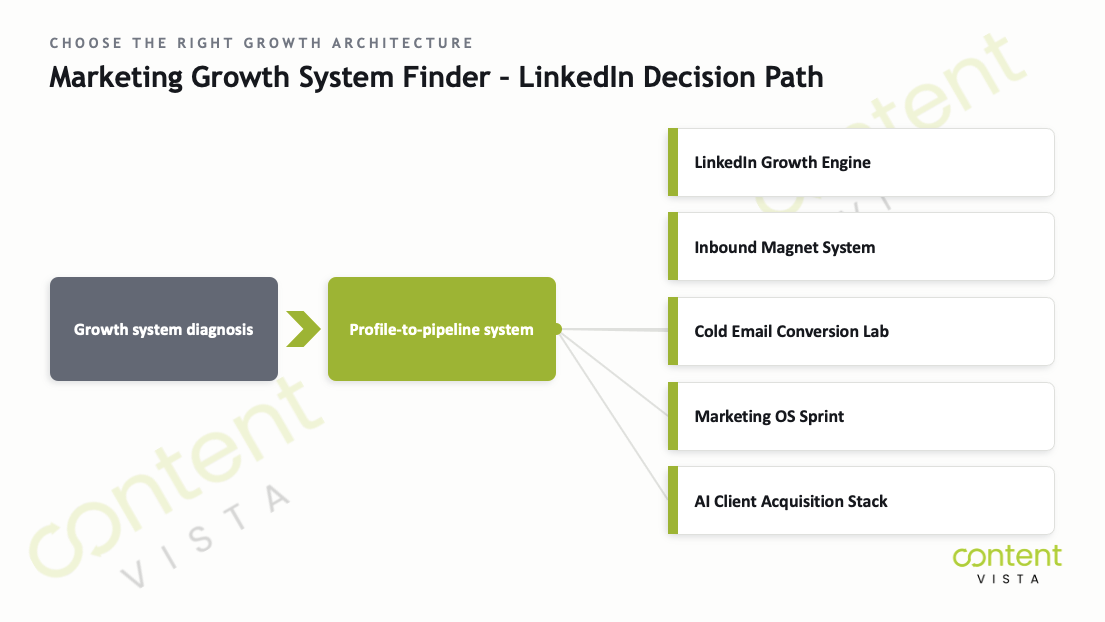
LinkedIn works best when it operates as a profile-to-pipeline system connected to a broader acquisition strategy: not as isolated posting, messaging or automation activity.
For some businesses, LinkedIn should lead the acquisition engine.
For others, it should support:
outbound email
content marketing
demand generation
partnerships
CRM-driven nurture
wider multi-channel systems
And in some cases, the right next step is not “more LinkedIn.”
It is fixing:
positioning
offer clarity
ICP definition
follow-up systems
conversion infrastructure
before scaling outreach further.
That is why diagnosis matters more than blindly increasing activity.
Use the Lead Generation Capacity Calculator to see how many qualified conversations LinkedIn actually needs to produce — and whether it can realistically support your pipeline target.
Lead Generation Capacity CalculatorOr use the Marketing Growth System Finder to find whether LinkedIn should be your main engine, a support channel or part of a larger acquisition stack.