Quick Summary
- A lead generation system is the connected process that attracts prospects, captures interest, qualifies fit, nurtures engagement, routes leads into sales conversations, and tracks pipeline impact.
- Most businesses do not have a “lead problem”; they have a system problem caused by disconnected channels, weak follow-up, poor qualification, and limited CRM visibility.
- Predictable pipeline comes from aligning acquisition, conversion assets, CRM workflows, nurture, sales handoff, and measurement into one coordinated growth system.
Why Lead Generation Fails Without a System
Most businesses do not actually have a lead problem.
They have a system problem.
On the surface, it looks like the issue is low lead volume. So the response becomes predictable: more outreach, more ads, more LinkedIn activity, more webinars, more content, more tools.
But here’s the problem:
More activity does not automatically create more pipeline.
In many businesses, traffic already exists. Outreach already happens. Content is already getting published. Referrals are already coming in.
The real issue is that none of it connects.
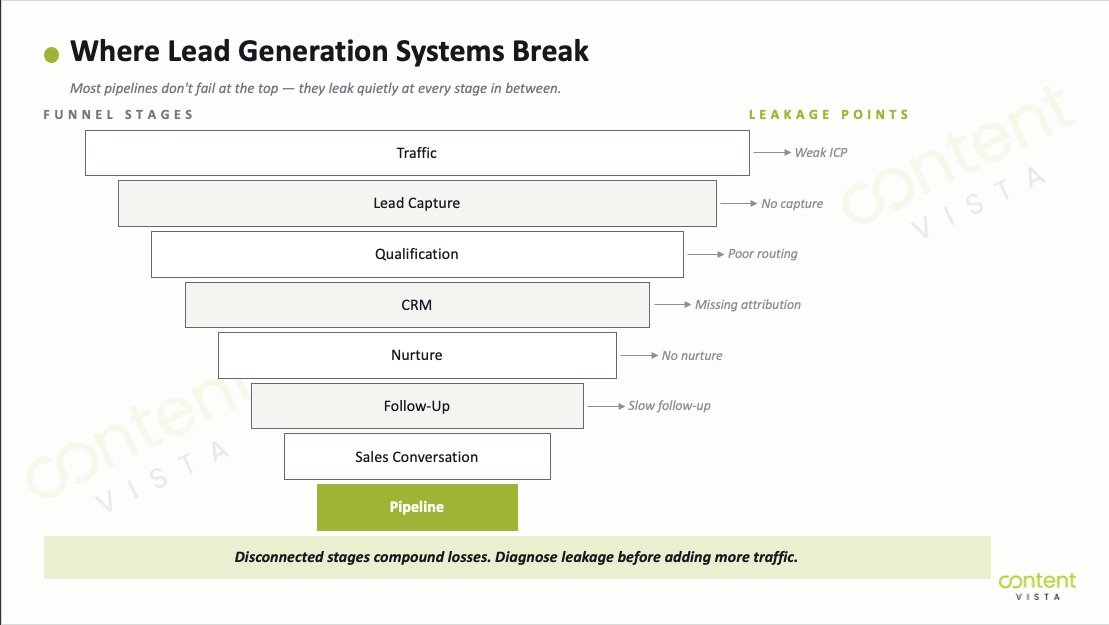
Traffic comes in, but there is no clear capture path. Outreach happens, but qualification criteria are weak. Leads enter the CRM, but follow-up is inconsistent. Content generates attention, but there is no structured nurture process moving prospects toward sales conversations.
So what happens?
Leads fall through gaps between marketing, CRM, nurture, qualification, and sales follow-up.
And the result is the cycle most founders and growth teams know too well: a few strong months, followed by silence, panic, reactive marketing, and another sprint to “generate more leads.”
That feast-famine pattern is usually not caused by one failing tactic.
It is caused by the absence of a connected lead generation system.
Predictable pipeline does not come from doing more marketing activity. It comes from building a system that connects attention, capture, qualification, nurture, follow-up, and pipeline visibility.
Here’s where most teams go wrong:
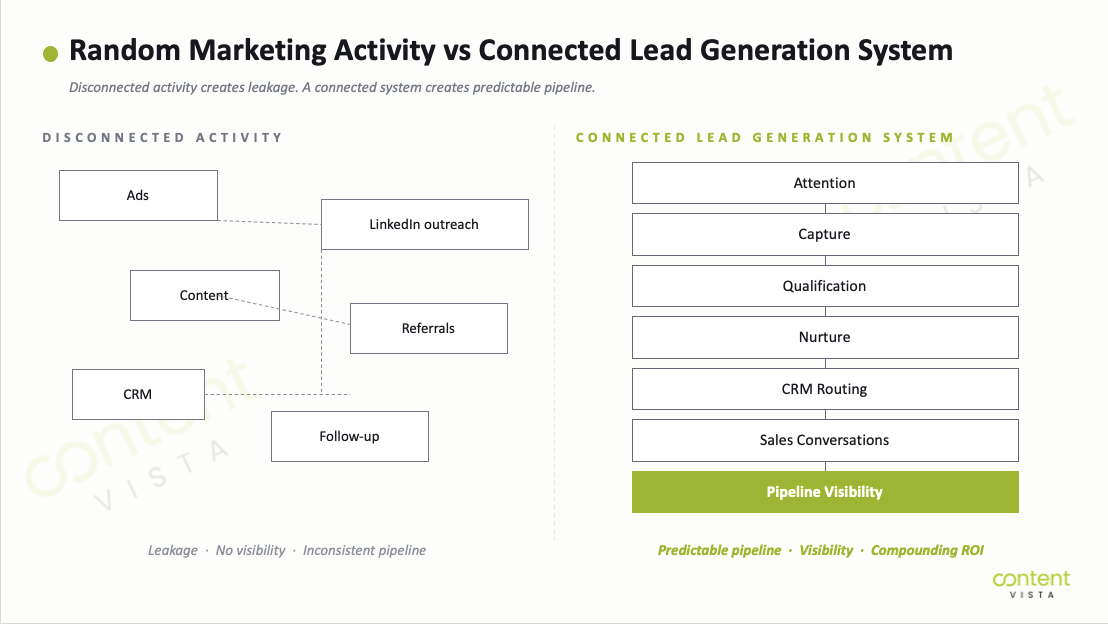
They rely on what can best be described as “random acts of marketing.”
A webinar launches without a nurture sequence. Paid traffic gets sent to weak landing pages. LinkedIn outreach happens outside the CRM. Referrals come in, but nobody tracks what converts. Marketing generates leads that sales never follows up on properly.
Individually, none of these activities are bad.
The problem is that they operate in isolation instead of functioning as one coordinated growth system.
That’s the real issue.
More traffic poured into a disconnected system usually creates more leakage, not more revenue.
A real lead generation system works differently. It creates architecture around the buyer journey so that attention turns into qualified opportunities instead of scattered activity.
If your business feels stuck between inconsistent lead flow and reactive marketing, the solution is usually not another tactic.
It is building the system behind the tactics.
What Is a Lead Generation System?
A lead generation system is the connected process that attracts potential buyers, captures their interest, qualifies fit, nurtures engagement, routes leads into the right sales conversations, and tracks how those leads turn into pipeline and revenue.
Unlike isolated marketing tactics, a real lead generation system connects channels, CRM workflows, follow-up, qualification, and conversion infrastructure into one coordinated growth system designed to create a predictable pipeline - not just more leads.
A strong lead generation system does not depend on one channel, one campaign, or one burst of activity.
It creates a repeatable path from attention to qualified opportunity by aligning acquisition, capture, qualification, nurture, routing and measurement into one connected growth system.
Most people think of lead generation as a tactic.
They think about LinkedIn outreach, paid ads, SEO, webinars, cold email, lead magnets, or landing pages.
But here’s the mistake:
None of those things are a lead generation system on their own.
They are individual components inside a larger growth architecture.
A real lead generation system connects the entire path from attention to opportunity. It makes sure the right people enter the system, move through a structured conversion journey, receive the right follow-up at the right time, and eventually become qualified pipeline instead of disconnected contacts sitting inside a CRM.
That distinction matters more than most businesses realize.
Because many teams mistake activity for infrastructure.
For example:
Running ads without qualification criteria is not a system.
Publishing content without lead capture is not a system.
Generating leads without nurture or routing is not a system.
Using a CRM without lifecycle stages or ownership rules is not a system.
Think about it this way:
A lead generation system is not one campaign. It is the operational framework connecting acquisition, capture, qualification, CRM workflows, nurture, follow-up, and reporting into one coordinated growth process.
That process usually includes:
attraction channels
conversion assets
lead capture mechanisms
qualification logic
CRM and routing infrastructure
nurture sequences
follow-up workflows
pipeline reporting and attribution
In short:
The goal is not simply to generate more leads.
The goal is to consistently turn attention into qualified opportunities and a predictable pipeline.
Why Most Lead Generation Efforts Fail
Most lead generation efforts fail for a simple reason:
Businesses optimize isolated activities instead of fixing the system connecting them.
That’s the real issue.
A company can have:
website traffic but weak conversion
outbound activity but poor reply quality
lead forms but inconsistent follow-up
CRM data but no pipeline visibility
content engagement but very few qualified opportunities
On the surface, it looks like a lead problem.
But in most cases, the path from attention to opportunity is broken.
Here’s where many teams go wrong:
They treat channels like separate departments instead of parts of one connected acquisition system.
The content team publishes articles. Sales runs LinkedIn outreach. Paid campaigns drive traffic to landing pages. Referrals arrive through WhatsApp or email.
But none of it connects into one shared workflow.
As a result:
leads get duplicated
ownership becomes unclear
qualification standards vary
attribution disappears
pipeline forecasting becomes unreliable
The business stays busy. The system stays weak.
Weak ICP clarity creates another major problem.
Many businesses generate “leads” before defining what a qualified lead actually looks like.
For example:
a consultant gets discovery calls from the wrong market segment
a local service business attracts price-sensitive inquiries that never convert
a SaaS company optimizes signups even though activation quality is poor
Without clear ICP and qualification criteria, lead generation becomes volume-driven instead of opportunity-driven.
And that usually creates more noise, not more revenue.
Traffic without capture is another common failure point.
Businesses invest heavily in visibility while underinvesting in conversion infrastructure.
Examples include:
content without lead magnets
webinars without nurture sequences
ads driving traffic to generic homepages
social engagement without a clear next step
Attention alone does not create a pipeline.
There has to be a structured path from interest to action.
Then comes follow-up.
A surprising number of leads disappear because nobody owns the next step.
Slow responses, weak nurture, missing routing logic, and unclear sales handoffs quietly kill momentum inside the funnel.
A prospect who downloads a resource today may become sales-ready two weeks later.
But without nurture and tracking, that opportunity often disappears silently inside the CRM.
More traffic or more outreach will not fix a broken lead generation system. If qualification, routing, nurture, follow-up, and attribution are weak, increasing activity usually increases leakage instead of pipeline.
One of the biggest mistakes businesses make is tracking lead volume while ignoring opportunity quality.
Because a smaller number of qualified, sales-ready opportunities is almost always more valuable than a large database of unqualified contacts.
In short:
Predictable pipeline comes from system design, not marketing activity alone.
Lead Generation System vs Tactic vs Tool
One of the biggest reasons businesses struggle with lead generation is simple:
They confuse tactics and tools with systems.
And when that happens, they keep adding more activity without fixing the underlying workflow.
Here’s the distinction that matters:
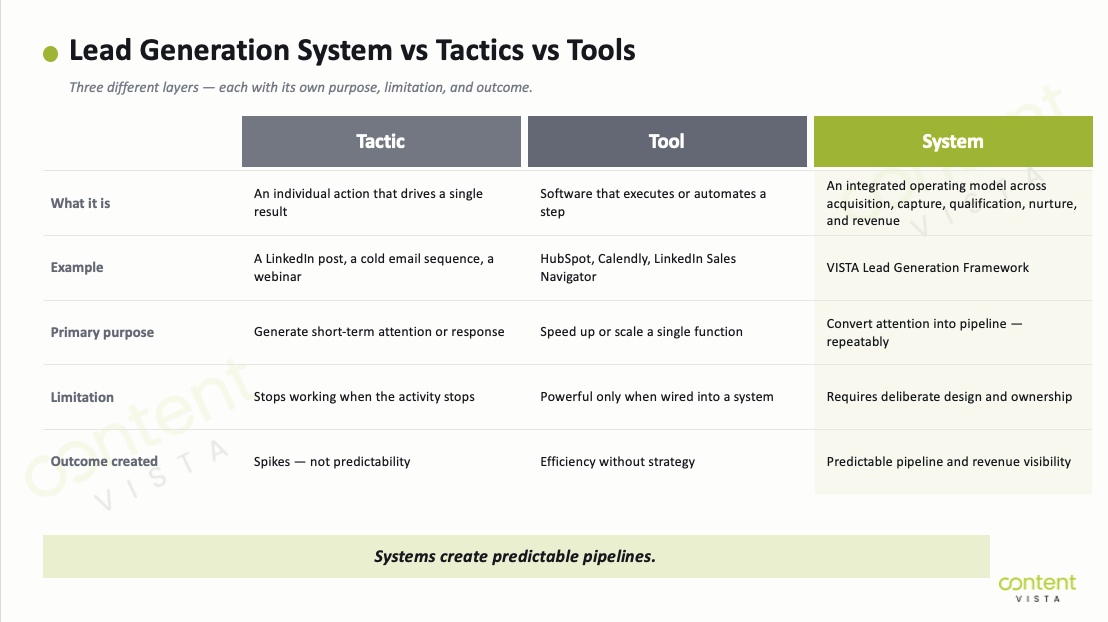
A tactic is an action. A tool helps execute that action. A system connects everything around outcomes.
Think about it this way:
A tactic might help you generate attention. A tool might help you manage execution. But only a system connects acquisition, qualification, routing, follow-up, nurture, reporting, and sales conversations into one coordinated growth process.
That’s the layer most businesses are missing.
For example:
LinkedIn outreach is a tactic.
A CRM is a tool.
A lead generation system defines how outreach, qualification, routing, follow-up, nurture, reporting, and sales conversations work together.
Without the system layer, tactics stay disconnected and tools become expensive databases instead of pipeline infrastructure.
| Concept | Definition | Example | What It Solves | What It Cannot Solve Alone |
|---|---|---|---|---|
| Lead Generation Tactic | A specific activity used to attract or engage prospects | Cold email outreach, webinars, SEO content, LinkedIn prospecting | Creates attention or engagement | Does not create qualification, routing, nurture, or pipeline visibility by itself |
| Lead Generation Tool | Software that supports execution or tracking | CRM, email automation platform, scheduling software, enrichment tools | Improves execution efficiency and organization | Cannot fix weak messaging, poor qualification, or disconnected workflows |
| Lead Generation System | The connected architecture linking acquisition, capture, qualification, CRM, nurture, routing, follow-up, and reporting | An integrated workflow moving leads from attention to sales-ready opportunity | Creates predictable pipeline and operational visibility | Still requires strategy, execution discipline, and ongoing optimization |
A tactic creates activity. A tool improves execution. A lead generation system connects people, processes, channels, tools, handoffs, and metrics into one coordinated path from attention to revenue.
That’s why businesses can own sophisticated software stacks and still struggle with pipeline consistency.
The missing piece is rarely “another tool.”
It is the system connecting the tools.
The VISTA Lead Generation Framework
Most lead generation advice focuses on isolated tactics.
Post more content. Run more ads. Send more outreach.
But here’s the problem:
Businesses rarely fail because they “didn’t do enough marketing.”
They fail because the acquisition system itself is incomplete.
That’s why Content Vista approaches lead generation differently.
Instead of treating lead generation as a collection of disconnected activities, we treat it as a connected operating model designed to create predictable pipeline.
That operating model is the VISTA Lead Generation Framework.
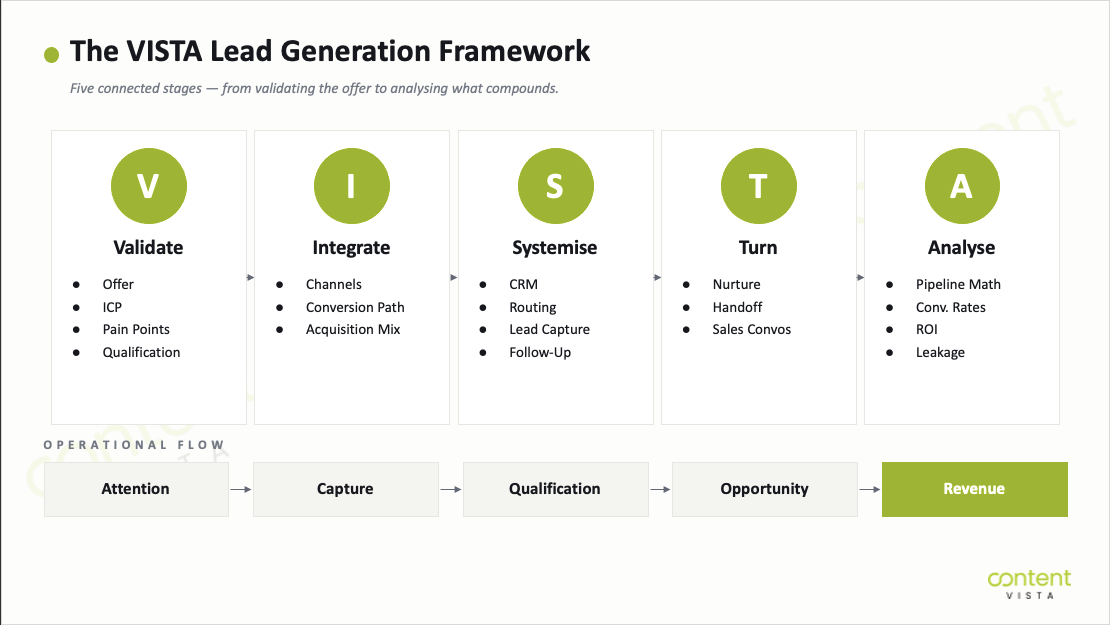
The framework is built around five connected layers that move prospects from attention to qualified opportunity while improving visibility across the entire system.
The VISTA Lead Generation Framework
V — Validate the offer, ICP, pain points, and qualification criteria
I — Integrate the right channels around one clear conversion path
S — Systemise capture, CRM, scoring, routing, and follow-up
T — Turn engagement into sales conversations through nurture and handoff
A — Analyse pipeline math, conversion rates, leakage points, and ROI
Here’s why this matters:
Most businesses try to scale acquisition before fixing qualification, workflows, routing, or conversion infrastructure.
The result?
More activity enters the system, but the pipeline stays inconsistent because the architecture underneath it is weak.
The VISTA framework solves that by organizing lead generation as a complete growth system instead of a channel strategy.
Let’s make this practical:
Validate
Before scaling acquisition, you need clarity on:
who you want to attract
what pain points trigger buying intent
what qualifies someone as a good-fit lead
whether the offer itself is strong enough to scale
Without this layer, businesses often generate lead volume without generating real opportunities.
Integrate
Next comes channel alignment.
That could include:
inbound content
LinkedIn outreach
webinars
referrals
partnerships
paid campaigns
email sequences
The goal is not using every channel.
It is connecting the right channels around one clear conversion path instead of creating disconnected marketing activity.
Systemise
This is where lead generation becomes operational infrastructure.
It includes:
lead capture
CRM setup
lifecycle stages
lead scoring
routing logic
nurture automation
follow-up ownership
Here’s where most teams go wrong:
They focus heavily on acquisition while ignoring the systems layer underneath it.
And that is where pipeline leakage usually happens.
Turn
Generating engagement is not enough.
The system also needs to turn engagement into qualified sales conversations through:
nurture sequences
timing
handoff rules
sales-ready criteria
response workflows
This is where the pipeline actually gets created.
Analyse
Finally, strong systems create visibility.
That means tracking:
pipeline math
conversion rates
lead-source quality
leakage points
attribution
ROI
Without this layer, businesses often make growth decisions based on activity instead of outcomes.
In short:
The rest of this article uses the VISTA framework as the blueprint for building a lead generation system that produces predictable pipeline instead of fragmented marketing activity.
Step 1 - Validate the Offer, ICP and Qualification Criteria
Most lead generation systems fail before the first campaign even launches.
Not because the channels are wrong.
But because the foundation underneath the channels is unclear.
Here’s the problem:
Many businesses try to scale acquisition before validating:
who they actually want to attract
what problem they solve best
what buying triggers matter
what makes someone a qualified opportunity
That usually creates expensive noise instead of predictable pipeline.
A lead generation system should not begin with tools or traffic sources.
It should begin with clarity.
Define Who Should Enter the System
Every lead generation system attracts a certain type of buyer — whether intentionally or accidentally.
That means the first step is defining:
your ideal customer profile (ICP)
business stage
urgency level
budget alignment
decision-maker type
buying intent signals
pain-point severity
Think about it this way:
A founder-led consultancy does not need the same acquisition system as a local service business or a complex B2B company.
For example:
a founder-led consultancy may need authority-led inbound and relationship-driven buyers
a local service brand may need high-intent geographic demand capture
a complex-sale B2B company may need longer nurture cycles and multiple stakeholders
a coaching or education business may rely heavily on trust-building before conversion
Without ICP clarity, businesses often attract large numbers of low-fit inquiries that consume sales time without creating a real pipeline.
That’s why strong lead generation systems optimize for qualified opportunities, not raw lead volume.
If the business still lacks positioning clarity, offer-market fit, or ICP definition, the right first step is usually growth architecture before scaling acquisition. That is where Content Vista’s Marketing Strategy & Growth Consulting becomes more valuable than simply adding more campaigns.
Define What Makes a Lead Qualified
Not every interested prospect should enter the same workflow.
A strong lead generation system defines:
what counts as a qualified lead
when someone becomes sales-ready
what disqualifies poor-fit opportunities
which signals indicate buying intent
Qualification can include:
company size
urgency
geography
budget range
engagement level
problem awareness
service fit
authority to buy
For example:
downloading one lead magnet may trigger nurture
requesting pricing may trigger immediate follow-up
attending a webinar may increase lead score
repeat engagement across multiple touchpoints may indicate higher intent
Without qualification logic, businesses often overwhelm sales teams with low-intent leads while high-potential opportunities receive inconsistent follow-up.
Validate the Offer Before Scaling Acquisition
One of the most expensive mistakes businesses make is scaling lead generation around an offer that is still unclear, weak, or unvalidated.
More traffic does not fix:
weak positioning
unclear differentiation
poor messaging
low conversion rates
offer-market mismatch
It usually amplifies those problems.
Do not overbuild too early. A complex lead generation system cannot compensate for an unclear offer, weak positioning, or undefined buyer fit. Validate the fundamentals before scaling acquisition activity.
That’s the real issue:
Many businesses spend months optimizing channels when the real bottleneck is strategic clarity.
In most cases, a simpler system with a validated offer will outperform a sophisticated acquisition engine built on weak foundations.
That is why the VISTA framework starts with validation first.
Because a predictable pipeline starts with attracting the right buyers into the right system.
Step 2 - Integrate the Right Channels
Once the offer, ICP and qualification criteria are clear, the next step is choosing the right acquisition model.
This is where many businesses make another costly mistake:
They copy channels from competitors instead of choosing channels that fit their sales cycle, buyer behavior, trust requirements and internal capacity.
A lead generation system should not be built around “every possible channel.”
It should be built around the right channel mix connected to one clear conversion path.
That path might begin with:
content
outbound outreach
referrals
paid traffic
webinars
partnerships
social engagement
But here’s the key question:
Which acquisition model best fits how your business creates trust and converts buyers?
Inbound-led Systems
Inbound-led systems attract prospects through:
content
SEO
newsletters
lead magnets
webinars
educational resources
These systems work especially well when:
trust-building matters
buyers research before purchasing
expertise influences buying decisions
sales cycles are medium to long
The biggest advantage is intent quality.
Prospects often arrive already problem-aware and partially educated.
The trade-off is time. Inbound systems usually compound gradually rather than creating an immediate pipeline.
Businesses focused on authority-building and long-term demand creation often benefit from an Inbound Magnet System approach.
Outbound-led Systems
Outbound-led systems proactively create conversations through:
cold email
outbound prospecting
direct outreach
account-based sequences
strategic follow-up
These systems work best when:
the ICP is clearly identifiable
deal values justify manual outreach
pipeline needs to accelerate faster
relationships matter more than search intent
Here’s where most teams go wrong:
They treat volume as strategy.
Without positioning, personalization, qualification logic, and follow-up structure, outbound quickly becomes noise.
Social-led Systems
Social-led systems use platforms like LinkedIn, Instagram, YouTube or X to build visibility and start conversations.
These systems often combine:
authority-building
content distribution
audience trust
direct engagement
outbound conversation starters
This model works especially well for:
consultants
agencies
founder-led businesses
coaches
high-trust service brands
expertise-driven companies
A LinkedIn Growth Engine is particularly effective when buyers evaluate expertise before booking conversations.
The strength of social-led systems is relational trust.
The risk is inconsistency if content, outreach, and nurture are not connected into one repeatable workflow.
Paid-led Systems
Paid-led systems use:
search ads
Meta ads
YouTube ads
sponsored placements
retargeting campaigns
These systems can accelerate lead flow quickly, especially when:
the offer is already validated
conversion infrastructure is strong
attribution is clear
follow-up speed is high
The mistake is simple:
Many businesses scale spend before fixing conversion leakage.
If landing pages, qualification logic, nurture, or sales follow-up are weak, paid acquisition usually amplifies inefficiency instead of pipeline.
Hybrid Systems
Most mature businesses eventually move toward hybrid systems.
For example:
inbound content creates demand
LinkedIn builds trust
outbound accelerates conversations
webinars educate buyers
paid traffic retargets engaged prospects
email nurture maintains momentum
Hybrid systems are powerful because they reduce dependence on one acquisition source.
But they also require stronger coordination across:
CRM infrastructure
attribution
lifecycle stages
messaging consistency
follow-up ownership
That’s why integration matters more than channel quantity.
| System Model | Best For | Required Assets | Sales Cycle Fit | Main Risk | Best Next Step |
|---|---|---|---|---|---|
| Inbound-led | Authority-driven businesses | Content, SEO, lead magnets, nurture | Medium to long | Slow early momentum | Build trust and capture systems |
| Outbound-led | High-ticket or targeted outreach | ICP clarity, messaging, CRM workflows | Short to medium | Low-quality outreach volume | Improve personalization and qualification |
| Social-led | Founder-led and trust-based brands | Consistent content and engagement | Medium | Inconsistent execution | Build structured nurture and follow-up |
| Paid-led | Validated offers needing scale | Landing pages, tracking, follow-up | Short to medium | Expensive leakage | Strengthen conversion infrastructure |
| Hybrid | Businesses seeking predictable pipeline | Multi-channel coordination | Medium to long | Operational complexity | Improve attribution and system integration |
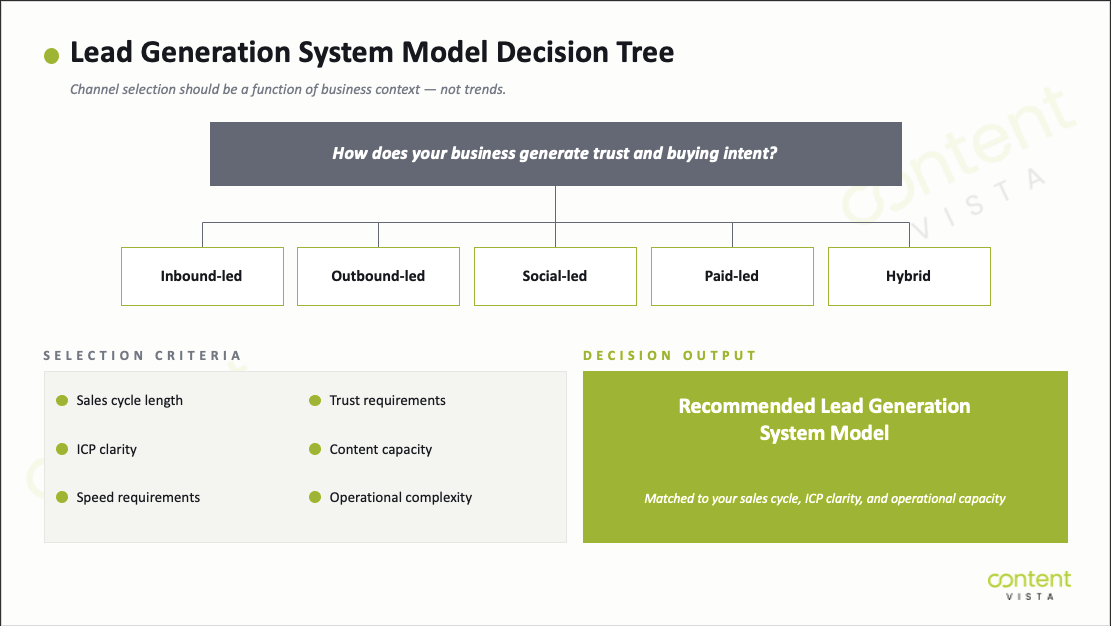
The best lead generation system is not the one using the most channels. It is the one where the right channels work together around one coordinated path from attention to qualified opportunity.
If the business primarily needs awareness and trust before capture, the smarter starting point may be a demand generation system rather than aggressive lead acquisition.
Step 3 - Systemise Capture, CRM, Scoring and Routing
This is the stage where lead generation stops being “marketing activity” and starts becoming operational infrastructure.
Most businesses spend the majority of their energy on acquisition:
more traffic
more outreach
more content
more campaigns
But a predictable pipeline is usually created or lost in the systems layer that comes after acquisition.
That layer includes:
how leads get captured
where they get routed
how qualification is tracked
who owns follow-up
what triggers nurture
how pipeline visibility is maintained
Without this infrastructure, even strong acquisition channels eventually create chaos.
That’s why lead generation is not only about acquiring attention.
It is also about building the operational infrastructure that captures, qualifies, routes, nurtures, tracks, and converts that attention into pipeline.
Build Clear Conversion Paths
Every lead generation system needs intentional conversion points.
That can include:
landing pages
lead magnets
webinar registrations
demo requests
booking forms
newsletter signups
consultation applications
The goal is not to capture every visitor.
The goal is to move the right prospects into the right workflow.
For example:
a high-intent buyer may go directly into a sales booking flow
an early-stage prospect may enter nurture through a lead magnet
a referral inquiry may bypass top-of-funnel education entirely
Strong systems reduce friction while improving qualification quality.
Weak systems create ambiguity.
Here’s where many teams go wrong:
They send traffic into generic workflows with no qualification logic, no segmentation, and no clear next step.
Examples of weak conversion infrastructure include:
generic “Contact Us” forms
no qualification questions
unclear next steps
disconnected booking tools
no CRM tagging
duplicate lead records
Structure the CRM Around Lifecycle Stages
A CRM should not function as a passive contact database.
It should function as pipeline infrastructure.
That means defining:
lifecycle stages
qualification status
lead source tracking
ownership rules
opportunity stages
follow-up history
engagement visibility
Without lifecycle structure, businesses lose visibility into where leads actually sit inside the buyer journey.
A strong CRM setup usually includes stages such as:
new lead
engaged lead
marketing-qualified lead
sales-qualified lead
opportunity
proposal
customer
nurture / inactive
The exact structure varies by business model.
But the principle stays the same:
Every lead should have a visible status and a clear next action.
Businesses trying to improve conversion infrastructure often discover that pipeline problems are actually CRM visibility problems.
Use Lead Scoring and Routing Logic
Not all leads deserve the same response speed or workflow.
That is where scoring and routing become essential.
Lead scoring helps prioritize based on:
buying intent
engagement level
ICP fit
behavioral signals
source quality
urgency
For example:
repeat website visits may increase lead score
webinar attendance may trigger sales follow-up
pricing-page engagement may indicate higher purchase intent
low-fit submissions may move directly into nurture instead of sales outreach
Routing logic then determines:
who owns follow-up
how quickly outreach happens
whether the lead enters nurture or sales
which workflow gets triggered next
Without routing rules, leads often sit untouched inside the CRM while teams assume someone else is handling follow-up.
Automate Repetition, Not Judgment
Automation is useful when it removes operational friction.
That includes:
form submissions
lead assignment
reminders
nurture sequences
CRM updates
meeting confirmations
lead scoring updates
follow-up triggers
But here’s the mistake:
Many businesses over-automate communication before fixing strategy and qualification.
The result is usually:
robotic outreach
irrelevant nurture
poor timing
spam-like follow-up
weak buyer experience
The strongest lead generation systems automate repetitive operational tasks while keeping qualification, messaging, and relationship-building intentionally human.
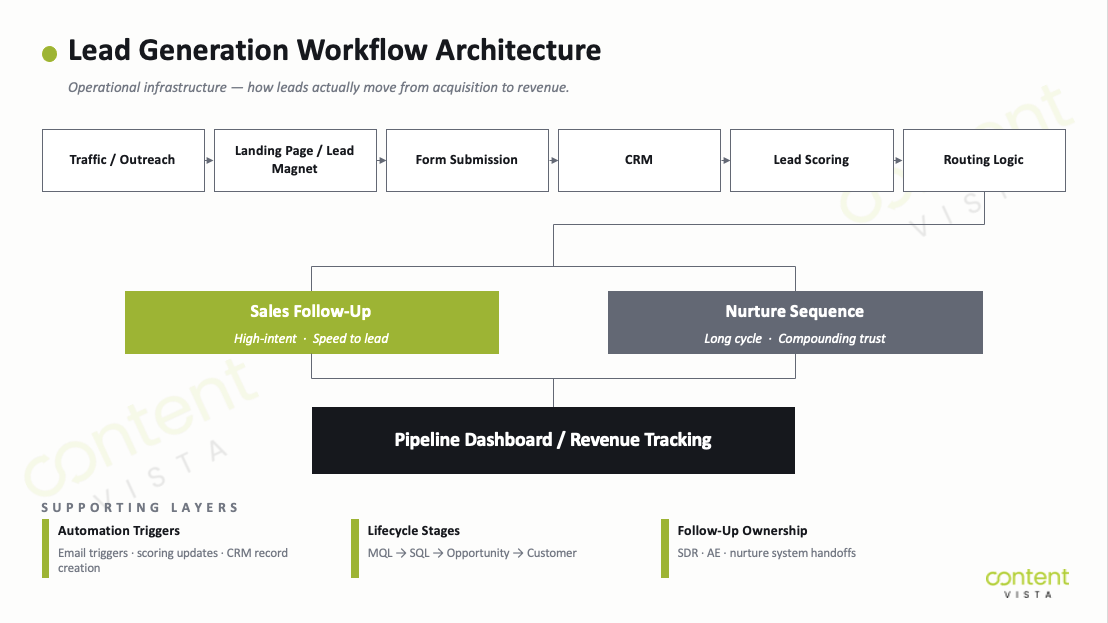
Lead generation is not only about acquiring attention. It is also about building the operational infrastructure that captures, qualifies, routes, nurtures, tracks and converts that attention into pipeline.
This is why businesses with modest traffic but strong systems often outperform businesses generating far more activity with weak infrastructure underneath it.
If the current acquisition process feels fragmented, disconnected, or difficult to scale, the problem is often infrastructure: not activity volume. That is where Systems, Conversion & Growth Infrastructure becomes critical.
Step 4 - Turn Engagement Into Sales Conversations
Generating attention is not the same as generating pipeline.
A lead generation system only becomes commercially effective when it can consistently turn engagement into qualified sales conversations.
That transition usually depends on:
nurture quality
timing
qualification logic
follow-up consistency
sales handoff structure
buyer intent visibility
This is the stage where many businesses quietly lose opportunities without realizing it.
Leads engage with content, attend webinars, download resources, or reply to outreach- but nothing structured happens next.
The result is stalled momentum instead of a sales-ready pipeline.
What Makes a Lead Sales-Ready?
A sales-ready lead is not simply someone who entered the CRM.
It is someone showing enough fit and intent to justify direct sales engagement.
That can include signals such as:
repeated content engagement
webinar attendance
pricing-page visits
direct inquiries
booking requests
strong ICP alignment
urgency indicators
multiple high-intent actions
For example:
downloading one educational guide may not justify immediate sales outreach
requesting a proposal usually does
engaging with multiple trust-building assets over time may indicate rising intent
The goal is to avoid two common mistakes:
pushing cold leads into sales too early
delaying outreach to highly qualified opportunities
Strong systems define clear sales-ready criteria so teams know when nurture should transition into conversation.
How Nurture Should Change by Intent Level
Not every lead needs the same type of follow-up.
A low-intent lead may need:
educational content
case studies
newsletters
trust-building resources
objection-handling content
A high-intent lead may need:
faster response times
direct outreach
booking prompts
consultation invitations
qualification conversations
That’s why strong nurture systems combine soft CTAs and hard CTAs strategically.
Soft CTAs help maintain engagement:
download a guide
watch a webinar
join a newsletter
explore a framework
Hard CTAs invite direct action:
book a strategy call
request pricing
schedule a demo
apply for consultation
Let’s make this practical:
A founder discovers an educational article through search.
They download a lead magnet.
Over the next two weeks, they receive:
practical nurture emails
case-study content
LinkedIn touchpoints
webinar invitations
After engaging repeatedly with conversion-focused content, they click through to a booking page and request a strategy conversation.
The system then routes them into a qualified sales workflow instead of treating them like a cold inbound lead.
That is what a connected multi-channel lead generation system is designed to do.
Why Handoff Rules Matter
One of the most overlooked parts of lead generation is sales handoff structure.
Without clear rules:
follow-up becomes inconsistent
leads sit untouched
sales assumes marketing owns the lead
marketing assumes sales is handling it
pipeline visibility breaks down
Strong systems define:
who owns follow-up
how quickly outreach happens
when nurture pauses
when sales engagement begins
what happens if the lead goes cold
Response speed matters especially for high-intent leads.
A prospect actively searching for solutions today may disappear entirely if follow-up happens days later instead of hours later.
Lead generation systems fail when engagement is treated as the finish line. Engagement only becomes pipeline when nurture, timing, qualification and follow-up are coordinated into one structured conversion process.
That is why turning engagement into conversation is not a “sales task” alone.
It is a system design responsibility shared across marketing, CRM infrastructure, automation, and sales workflows.
Businesses looking to improve this transition layer often discover that the biggest issue is not acquisition volume - it is conversion coordination. Explore Lead Generation Services if the goal is building a connected system that consistently turns engagement into a qualified pipeline.
Step 5 - Analyse Pipeline Math and Leakage
Most businesses measure lead generation backwards.
They start with: “How do we get more leads?”
But predictable pipeline usually starts with a different question:
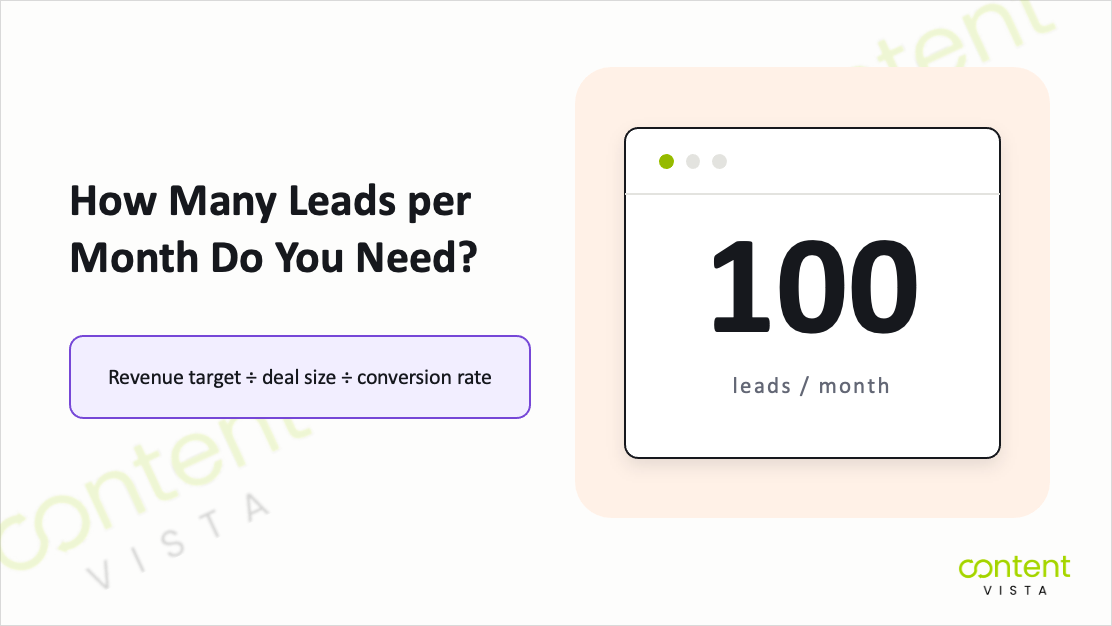
“How many qualified opportunities do we actually need to hit our revenue target?”
That one shift changes how the entire lead generation system gets designed.
Instead of chasing activity metrics, you start working backward from:
revenue goals
average deal size
close rates
conversion performance
pipeline capacity
That’s where real pipeline visibility begins.
Start With Revenue Targets, Not Lead Volume
A strong lead generation system connects marketing activity directly to pipeline math.
That means understanding:
revenue target
average deal size
opportunity-to-close rate
lead-to-opportunity conversion rate
required pipeline volume
expected acquisition capacity
Let’s make this practical:
Imagine a business wants to generate $50,000 in monthly revenue.
If:
average deal size = $5,000
close rate = 25%
lead-to-opportunity conversion = 20%
…the system math changes dramatically.
| Revenue Target | Average Deal Size | Deals Needed | Close Rate | Opportunities Needed | Lead-to-Opportunity Rate | Leads Needed |
|---|---|---|---|---|---|---|
| $50,000/month | $5,000 | 10 deals | 25% | 40 opportunities | 20% | 200 leads |
Think about what that means:
The business may think it has a “traffic problem” when the real issue is actually:
poor qualification
weak nurture
low conversion rates
slow follow-up
pipeline leakage
More leads are not always the answer.
In many cases, improving conversion efficiency creates more pipeline than increasing acquisition volume.
Identify Where Pipeline Leakage Happens
Most lead generation systems leak opportunities silently.
That’s the real issue.
The system looks active on the surface, but opportunities disappear between stages.
Examples include:
traffic reaches the site but does not convert
forms get submitted but nobody follows up
sales conversations happen but qualification is weak
nurture stops too early
CRM stages are inconsistent
attribution disappears after first touch
high-intent leads receive delayed responses
Without visibility, businesses often keep scaling the wrong part of the system.
For example:
increasing ad spend while landing-page conversion stays weak
adding outreach volume while lead quality declines
producing more content without improving capture
generating MQLs that never become opportunities
The goal is not simply to generate activity.
It is to reduce leakage between stages.
Track Sources by Revenue, Not Just Leads
One of the most misleading metrics in lead generation is raw lead volume.
A channel generating 500 low-quality leads may perform worse than one generating 25 highly qualified opportunities.
That’s why mature lead generation systems track:
source-to-opportunity conversion
source-to-revenue attribution
pipeline contribution
sales-qualified lead rates
average sales cycle by source
cost per qualified opportunity
For example:
SEO content may generate fewer but higher-intent leads
outbound may create faster conversations but lower close rates
referrals may convert at a higher rate despite lower volume
webinars may generate slower but more educated buyers
Without source-level visibility, businesses often optimize for vanity metrics instead of commercial outcomes.
Key Metrics Every Lead Generation System Should Track
- Revenue target
- Average deal size
- Lead-to-opportunity conversion
- Opportunity-to-close rate
- Pipeline value
- Response speed
- Lead-source quality
- Cost per qualified opportunity
- Pipeline leakage points
- Source-to-revenue attribution
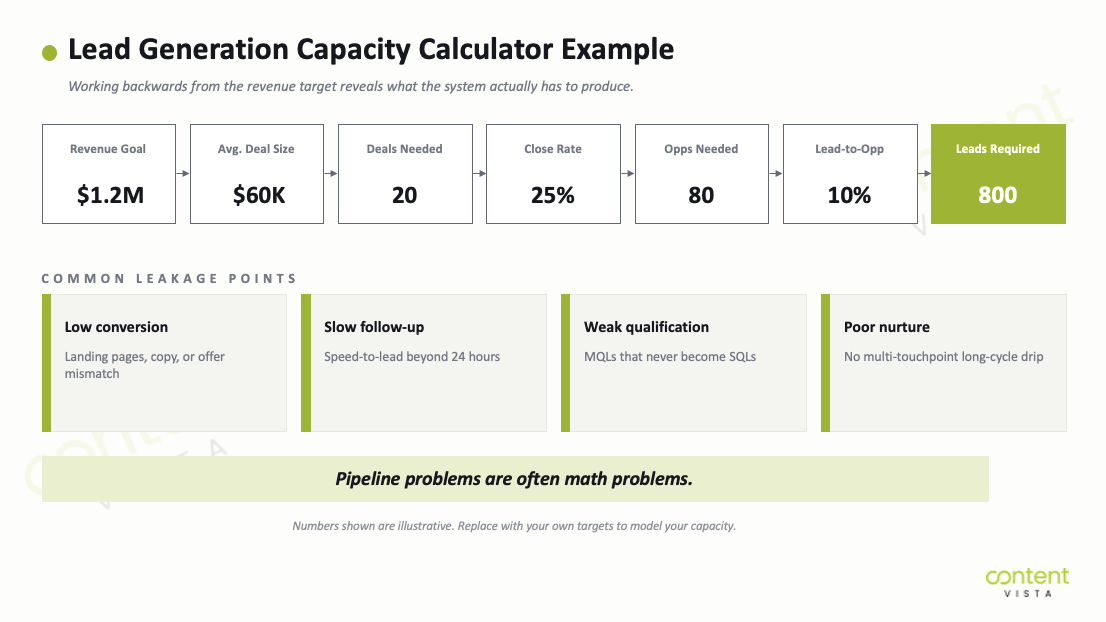
The most important insight here is simple:
Pipeline problems are usually math problems before they are marketing problems.
If the numbers do not work operationally, adding more tactics rarely fixes the underlying issue.
That’s why strong lead generation systems focus heavily on:
conversion visibility
stage-by-stage performance
qualification efficiency
bottleneck diagnosis
pipeline forecasting
Not sure where your pipeline is breaking?
Use the Lead Generation Capacity Calculator to calculate:
- how many qualified leads you actually need
- where your current funnel is leaking
- which conversion stage is limiting growth
- what your system needs next
The Pipeline Gap Scorecard
Most businesses already know something in their lead generation system feels inconsistent.
The challenge is identifying where the real bottleneck actually exists.
This quick scorecard is designed to help you diagnose whether your biggest issue is:
acquisition
conversion
follow-up
qualification
CRM visibility
channel integration
Score each category from 1–5:
1 = weak or inconsistent
3 = partially working
5 = strong and predictable
Score Your Lead Generation System
| Category | Questions to Ask | Score (1–5) |
|---|---|---|
| Acquisition Consistency | Do qualified leads enter the system consistently every month, or does pipeline fluctuate unpredictably? | ___ |
| Conversion Strength | Do landing pages, lead magnets, outreach, and nurture convert attention into qualified opportunities effectively? | ___ |
| Follow-Up Speed | Are high-intent leads contacted quickly with clear ownership and structured workflows? | ___ |
| Qualification Clarity | Does the business clearly define what makes a lead qualified or sales-ready? | ___ |
| CRM Visibility | Can the team clearly track lifecycle stages, opportunity status, source attribution, and pipeline movement? | ___ |
| Channel Integration | Do content, outreach, CRM, nurture, and sales workflows operate as one connected system? | ___ |
How to Interpret Your Score
24–30: Your lead generation system likely has strong infrastructure and visibility. The biggest opportunities may involve optimization, scale, or channel expansion.
16–23: Parts of the system are working, but there are likely operational bottlenecks, leakage points, or inconsistent workflows limiting pipeline predictability.
6–15: The business probably has fragmented acquisition activity rather than a fully connected lead generation system.
This scorecard is designed as a quick self-check — not a full diagnosis. Most pipeline problems are caused by multiple connected bottlenecks rather than one isolated issue.
For example:
weak qualification often creates poor conversion downstream
slow follow-up reduces opportunity creation
disconnected channels create attribution gaps
missing nurture workflows lower sales readiness
poor CRM visibility hides leakage until revenue slows
That’s why businesses frequently misdiagnose the real problem.
They assume they need:
more traffic
more leads
more outreach
more content
When the real issue is usually system coordination and conversion efficiency.
Want a more useful diagnosis than a self-score?
Use the Lead Generation Capacity Calculator to calculate:
- your actual lead requirements
- conversion-stage bottlenecks
- pipeline leakage points
- opportunity gaps
- growth constraints based on your numbers
Where AI Fits in a Lead Generation System
AI is changing how lead generation systems operate.
But not in the way most marketing headlines suggest.
The biggest misconception is that AI replaces strategy.
In reality, AI works best as an execution layer inside a well-designed system.
It can improve speed, consistency, analysis, and operational efficiency.
But it cannot compensate for:
weak positioning
unclear offers
poor ICP definition
broken qualification logic
disconnected workflows
weak human communication
That distinction matters because many businesses are now adding AI tools into lead generation systems that are already structurally weak.
The result is usually faster inefficiency instead of better pipeline.
Where AI-Assisted Workflows Help Most
AI is especially useful for repetitive, operational, and data-heavy workflows.
That includes:
prospect research
lead enrichment
segmentation
CRM updates
lead scoring
routing logic
follow-up reminders
reporting summaries
content repurposing
personalization drafts
For example:
AI can summarize account research before outreach
scoring models can prioritize high-intent behavior
workflows can trigger nurture sequences automatically
CRM records can be cleaned and categorized faster
webinar transcripts can become nurture content
sales reps can receive follow-up reminders automatically
These AI-assisted workflows reduce manual friction and improve operational consistency.
That is where AI creates the most practical value inside lead generation systems.
Businesses looking for deeper orchestration across acquisition, automation, CRM workflows and reporting often move toward an AI Client Acquisition Stack approach.
What AI Should Not Replace
AI should support strategic thinking - not replace it.
The highest-leverage parts of lead generation still require human judgment.
That includes:
positioning decisions
offer strategy
ICP definition
messaging strategy
objection handling
qualification conversations
relationship-building
sales calls
Think about it this way:
AI can help you execute faster.
But it still cannot replace commercial judgment, trust, or nuanced buyer understanding.
For example:
AI can draft outreach personalization
humans still need to decide what message actually resonates
AI can summarize objections
humans still need to handle nuance, trust and persuasion
AI can identify engagement patterns
humans still need to interpret commercial context
This matters even more in high-trust sales environments where buying decisions depend on credibility, expertise and relationship quality.
Here’s where most teams go wrong:
They over-automate communication before fixing positioning and messaging.
The result is usually:
robotic outreach
poor timing
generic nurture
irrelevant follow-up
trust erosion
The strongest lead generation systems combine AI efficiency with human strategic oversight.
| System Area | AI Can Help With | Human Judgment Required | Risk if Over-Automated |
|---|---|---|---|
| Prospect Research | Data gathering and enrichment | ICP interpretation and targeting decisions | Poor-fit outreach |
| Segmentation & Scoring | Pattern detection and prioritization | Qualification logic and commercial nuance | Misclassified leads |
| Routing & Automation | Workflow triggers and assignment | Pipeline oversight and escalation decisions | Leads falling through gaps |
| Personalization Drafts | Drafting outreach variations | Messaging strategy and tone | Robotic communication |
| CRM Hygiene | Updating records and summaries | Lifecycle strategy and reporting interpretation | Inaccurate pipeline assumptions |
| Reporting | Trend summaries and dashboards | Strategic decisions and optimization priorities | Activity-driven decision making |
| Content Repurposing | Turning assets into multiple formats | Positioning and editorial direction | Generic low-trust content |
AI works best when it accelerates execution inside a strong lead generation system. It does not replace positioning, strategic judgment or human trust-building.
In short:
The businesses seeing the strongest results with AI are usually not the ones automating everything.
They are the ones using AI-assisted workflows to remove operational friction while keeping strategy, qualification and relationship-building intentionally human.
What a Lead Generation System Costs in Time and Effort
One of the biggest misconceptions about lead generation systems is that they are “set-and-forget” assets.
They are not.
A strong system requires:
strategic clarity
operational setup
ongoing optimization
CRM discipline
content or outreach execution
reporting visibility
continuous refinement
The real question is not only: “How much does it cost?”
It is also:
how much internal capacity exists
how quickly pipeline is needed
how complex the buyer journey is
how many moving parts need coordination
A lean founder-led business does not need the same system depth as a company running multi-channel acquisition at scale.
That’s why lead generation systems are usually implemented in stages.
DIY Systems
A DIY approach works best when:
the business is early-stage
the founder understands the audience deeply
sales volume is still manageable manually
the offer is still evolving
Typical DIY systems include:
simple landing pages
basic CRM setup
manual outreach
lightweight nurture
newsletter or content workflows
basic automation
The advantage is lower cost and faster experimentation.
The trade-off is time, operational inconsistency, and slower optimization.
Many businesses eventually hit a ceiling where founder-led execution becomes difficult to scale.
Guided or Done-With-You Builds
This model combines internal ownership with external strategic or technical support.
It often includes:
strategy workshops
CRM architecture
conversion infrastructure
messaging refinement
workflow design
automation setup
reporting support
This approach works well for businesses that:
already have some traction
want to avoid costly mistakes
need structure without fully outsourcing execution
have an internal marketing or sales function
In many cases, this stage creates the highest leverage because it improves the underlying system before aggressively increasing acquisition volume.
Done-for-You Implementation
A done-for-you model typically includes end-to-end execution:
acquisition systems
content or outreach operations
CRM workflows
automation
nurture sequences
reporting
pipeline optimization
This is often appropriate when:
the business lacks internal execution capacity
sales cycles are complex
pipeline consistency matters commercially
multiple acquisition channels must operate together
The challenge is not simply “running campaigns.”
It is coordinating all the moving parts into one operational system.
Full-Stack Client Acquisition Systems
More advanced systems combine:
inbound acquisition
outbound workflows
CRM infrastructure
automation
nurture
attribution
reporting
AI-assisted workflows
conversion optimization
These systems require significantly more coordination, but they also create stronger pipeline visibility and scalability when executed well.
| Model | Best For | Time Investment | Complexity | Cost Level | Risk | When to Choose It |
|---|---|---|---|---|---|---|
| DIY System | Early-stage businesses | High internal time | Low to medium | Lower | Inconsistency and slow optimization | When validating offers and learning the market |
| Guided / Done-With-You | Growing teams with some internal capacity | Shared responsibility | Medium | Medium | Partial execution gaps | When improving infrastructure and workflows |
| Done-for-You | Businesses needing execution support | Lower internal workload | Medium to high | Higher | Dependency on execution partner | When pipeline consistency becomes critical |
| Full-Stack Client Acquisition System | Businesses requiring integrated multi-channel growth | Strategic oversight required | High | Higher | Operational complexity | When scaling predictable pipeline across channels |
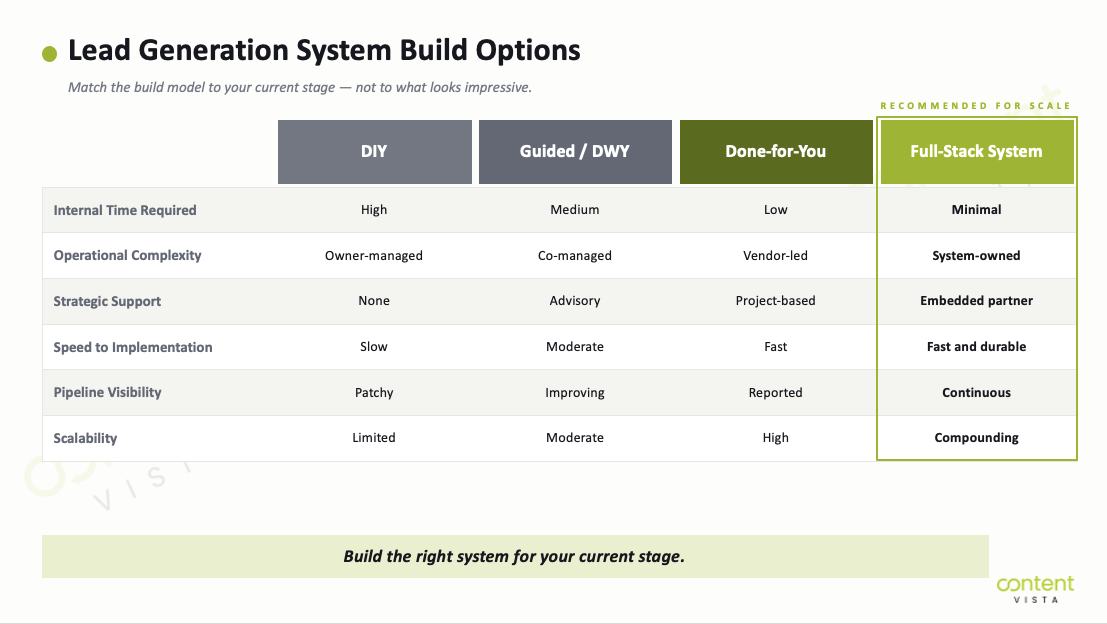
The right lead generation system is not the most complex one. It is the one that matches the business’s current stage, operational capacity and pipeline requirements without creating unnecessary complexity too early.
The most effective systems usually evolve over time.
Businesses rarely need every workflow, automation, and acquisition channel immediately.
In many cases, the smarter move is building a smaller connected system first - then expanding once qualification, conversion, and pipeline visibility are already working.
Common Mistakes When Building a Lead Generation System
Most lead generation systems do not fail because businesses lack effort.
They fail because the system gets built in the wrong order.
A company can invest heavily in ads, outreach, automation, software, and AI tools and still struggle with inconsistent pipelines because the underlying architecture is weak.
The mistakes below are especially common when businesses try to scale acquisition before building operational clarity.
Common Lead Generation System Mistakes
- Choosing tools before strategy
- Over-automating outreach
- Generating leads before defining qualification
- Sending traffic to weak landing pages
- Not integrating CRM workflows
- Tracking leads instead of opportunities
- Relying on one acquisition channel
- Neglecting nurture sequences
- Operating without sales handoff rules
- Treating AI as the strategy
Choosing Tools Before Strategy
Many businesses start by buying software.
CRM platforms, automation tools, enrichment systems, outbound tools, AI tools — all before defining:
ICP
positioning
qualification criteria
conversion flow
pipeline goals
Here’s the problem:
Tools can improve execution, but they cannot create strategy.
A disconnected process running through expensive software is still a disconnected process.
Over-Automating Outreach
Automation becomes a problem when it removes relevance and timing.
Examples include:
generic cold outreach
robotic LinkedIn messaging
irrelevant nurture emails
AI-generated personalization that feels artificial
Automation should reduce operational friction — not remove human judgment.
Generating Leads Before Defining Qualification
One of the fastest ways to waste sales capacity is generating lead volume without qualification logic.
Without clear definitions for:
ICP fit
urgency
budget
intent
problem awareness
…the system starts optimizing for activity instead of opportunities.
That usually creates overloaded pipelines filled with low-fit leads.
Sending Traffic to Weak Landing Pages
Many businesses invest heavily in traffic acquisition while underinvesting in conversion infrastructure.
Common issues include:
unclear positioning
weak offers
poor CTA structure
confusing forms
no trust-building elements
disconnected booking flows
More traffic rarely fixes poor conversion architecture.
It usually amplifies inefficiency.
Not Integrating CRM Workflows
A CRM should function as operational infrastructure - not a passive contact database.
Without:
lifecycle stages
routing logic
ownership rules
follow-up tracking
source attribution
…the system loses visibility quickly.
This is where many pipeline leaks become invisible.
Tracking Leads Instead of Opportunities
High lead volume can create a false sense of growth.
But pipeline quality matters far more than contact quantity.
A smaller number of qualified opportunities often creates more revenue than a large database of unqualified leads.
Strong systems track:
opportunity creation
sales-qualified leads
close rates
pipeline value
source-to-revenue contribution
—not just form submissions.
Relying on One Channel
Many businesses become overly dependent on:
one ad platform
one outbound tactic
one referral source
one social platform
That creates fragility.
If channel performance changes, pipeline becomes unstable quickly.
More resilient lead generation systems gradually diversify acquisition while maintaining operational consistency.
Neglecting Nurture Sequences
Not every prospect is ready to buy immediately.
Without nurture:
leads go cold
trust decays
objections stay unresolved
intent signals disappear
Nurture is what helps transform early interest into sales readiness over time.
Operating Without Sales Handoff Rules
Many businesses assume “someone will follow up.”
That assumption creates:
delayed outreach
missed opportunities
inconsistent buyer experiences
internal confusion
Clear ownership and response expectations are essential for pipeline reliability.
Treating AI as the Strategy
AI can improve workflows, reporting, personalization drafts, and operational speed.
But AI is not a substitute for:
positioning
strategic clarity
buyer understanding
messaging
relationship-building
The businesses struggling most with AI in lead generation are often trying to automate weak systems instead of improving the system itself.
Most lead generation problems are not caused by lack of activity. They are caused by weak system design, unclear qualification, disconnected workflows, and operational leakage between stages.
When Not to Build a Full Lead Generation System Yet
Not every business should immediately build a complex lead generation system.
In some cases, doing so too early creates more operational complexity without solving the real bottleneck.
This is especially common when businesses try to scale acquisition before validating the fundamentals underneath it.
When NOT to Build a Full Lead Generation System Yet
- The offer is still unclear or unvalidated
- ICP definition is weak or inconsistent
- Messaging does not resonate with buyers
- There is no repeatable sales process
- The business lacks follow-up capacity
- Existing leads are not converting well
- The operational issue is conversion, not acquisition
- Pipeline visibility is already weak at low volume
Think about it this way:
If the business cannot consistently close current opportunities, more leads may simply create more noise.
If follow-up is inconsistent now, increasing acquisition volume usually increases leakage.
If positioning is unclear, scaling traffic often amplifies poor-fit inquiries.
And if the offer itself is weak, no amount of automation fixes conversion problems.
That’s one of the biggest mistakes businesses make when building growth systems:
They try to scale before the foundation is commercially stable.
Acquisition Does Not Fix Weak Conversion
Many businesses assume lead generation is the solution whenever the pipeline slows down.
But sometimes the real issue is:
low close rates
unclear offers
poor qualification
weak messaging
broken sales workflows
inconsistent nurture
poor buyer trust
In those situations, adding more traffic or outreach can actually make the system less efficient.
The smarter move is often:
refining positioning
improving qualification
strengthening nurture
tightening the sales process
improving conversion infrastructure first
That’s why a strong lead generation strategy starts with diagnosis not channel selection.
Build in Stages, Not All at Once
A smaller connected system is often more effective than an overbuilt acquisition machine.
For example:
a founder-led consultancy may only need authority content, LinkedIn nurture, a strong CRM workflow, and a clear booking process
a growing B2B company may need lifecycle automation, lead scoring, multi-channel attribution, outbound coordination, and pipeline reporting
The right system depends on:
business stage
operational maturity
internal capacity
sales complexity
conversion readiness
A lead generation system should amplify a validated business model — not compensate for weak positioning, unclear offers, or broken sales processes.
If the business is unsure whether the problem is acquisition, conversion, qualification, or follow-up, a diagnostic approach usually creates more leverage than immediately adding more channels.
Not sure whether your business actually needs more leads?
Use the Lead Generation Capacity Calculator to identify whether the real bottleneck is:
- traffic
- conversion
- qualification
- follow-up
- pipeline leakage
- opportunity generation
Or explore Marketing Strategy & Growth Consulting if the business needs strategic clarity before scaling acquisition.
Example: What a Lead Generation System Looks Like in Practice
A strong lead generation system does not depend on one viral post, one ad campaign, or one isolated channel.
It connects expertise, audience growth, lead capture, nurture, and conversion into one coordinated workflow.
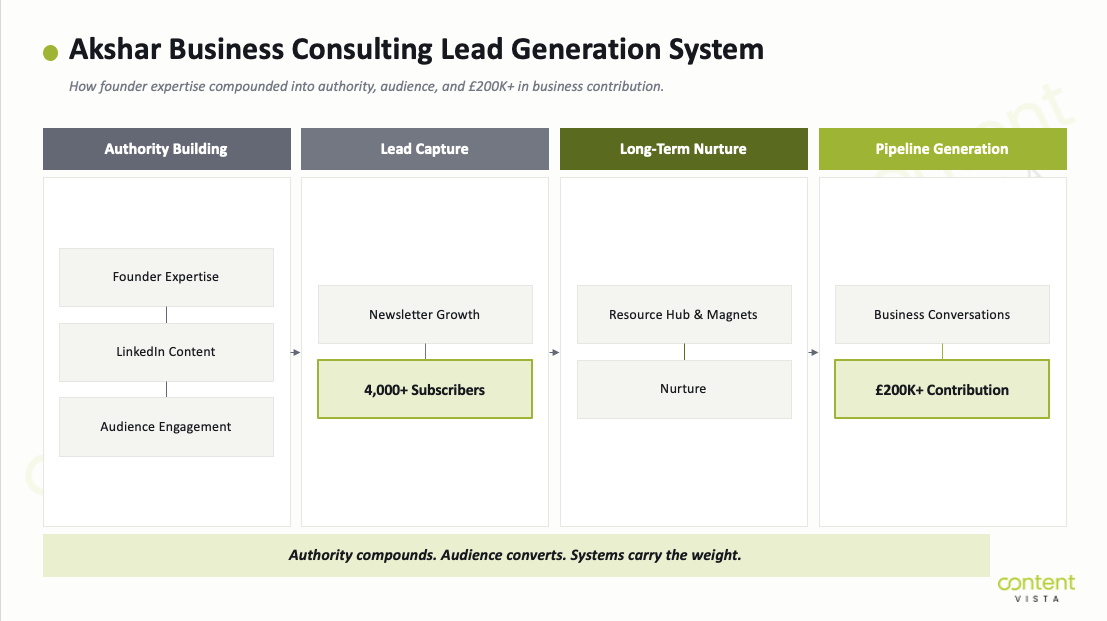
A practical example of this was the system built for Akshar Business Consulting.
Instead of treating content as disconnected “social media activity,” the strategy focused on turning founder expertise into a structured acquisition engine.
The workflow looked roughly like this:
founder expertise became LinkedIn content
LinkedIn content drove audience trust and visibility
content engagement supported newsletter growth
newsletter subscribers entered a longer-term nurture environment
resource hubs and lead magnets created lead capture opportunities
the system connected content, nurture, and inbound interest into business conversations
Over time, that ecosystem contributed to:
4,000+ newsletter subscribers
£200K+ in business generated through the system
Importantly, the growth did not come from simply “posting more.”
That’s the real difference.
The system connected:
authority-building
audience growth
lead capture
nurture
conversion pathways
…into one operational lead generation system.
This is what many businesses miss when trying to improve lead generation.
They focus on individual channels in isolation:
LinkedIn
SEO
newsletters
webinars
outbound
lead magnets
But pipeline usually improves when those channels reinforce each other instead of operating independently.
In the Akshar example:
LinkedIn created attention
newsletter growth created retention
resource hubs improved capture
nurture increased trust over time
inbound conversations emerged from accumulated engagement
That is a very different model from transactional “lead generation campaigns.”
It is a connected acquisition ecosystem designed around long-term pipeline creation.
For the full breakdown, explore the Akshar Business Consulting case study.
The strongest lead generation systems are usually not built around one tactic. They are built around connected trust-building, capture, nurture and conversion workflows that compound over time.
Lead Generation System Checklist
A lead generation system becomes much easier to improve once you can clearly identify:
what already exists
what feels inconsistent
what is missing entirely
Use this checklist as a practical self-audit.
If multiple areas below feel unclear, disconnected, or inconsistent, the issue is usually not “more leads.”
It is system maturity.
Lead Generation System Self-Audit
| Area | Questions to Ask | Status |
|---|---|---|
| ICP Clarity | Is the ideal customer profile clearly defined, including buying triggers, urgency, and qualification signals? | ☐ |
| Offer Clarity | Does the offer solve a clear problem with strong positioning and differentiated messaging? | ☐ |
| Channel Strategy | Are acquisition channels intentionally selected based on buyer behavior and conversion path? | ☐ |
| Capture Mechanism | Do landing pages, lead magnets, forms, or booking flows capture intent effectively? | ☐ |
| Qualification Criteria | Is there a clear definition of what makes a lead qualified or sales-ready? | ☐ |
| CRM Setup | Are lifecycle stages, ownership, source tracking, and opportunity visibility properly structured? | ☐ |
| Nurture Process | Do leads receive consistent follow-up, education, trust-building, and objection handling? | ☐ |
| Follow-Up Speed | Are high-intent leads contacted quickly with clear response expectations? | ☐ |
| Attribution | Can the business track which channels and campaigns contribute to qualified opportunities and revenue? | ☐ |
| Pipeline Reporting | Is there visibility into conversion rates, leakage points, pipeline value, and forecasting? | ☐ |
A strong lead generation system does not require perfection across every category.
But major gaps in:
qualification
CRM visibility
nurture
follow-up
attribution
conversion infrastructure
…usually create inconsistent pipeline over time.
Most businesses do not need more marketing activity first. They need better visibility into where their current system is breaking, leaking, or underperforming.
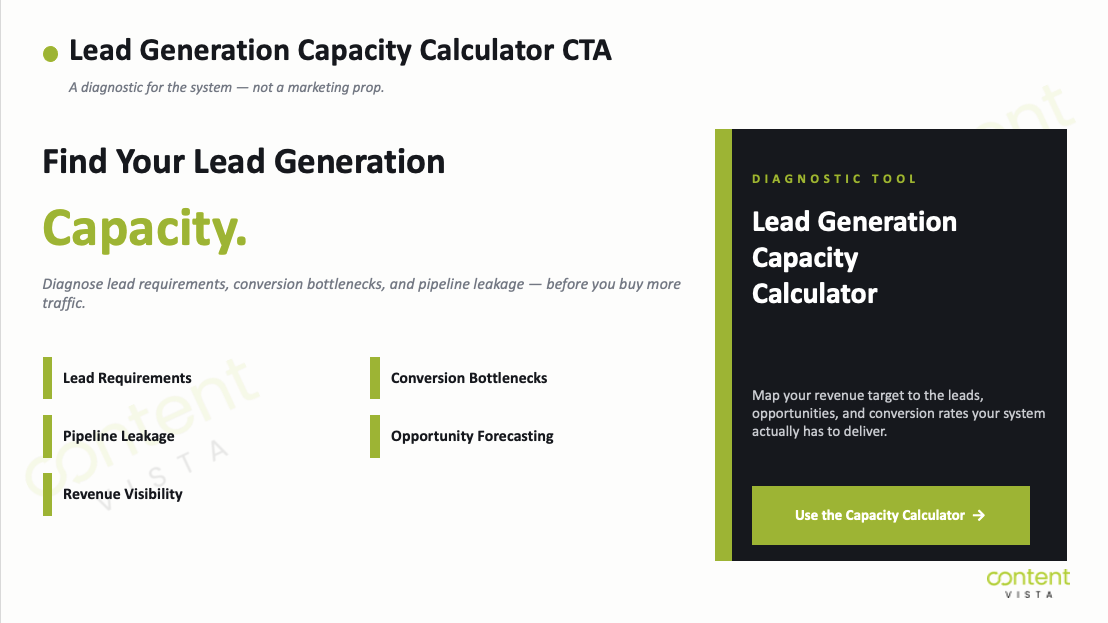
Want a clearer diagnosis than a checklist?
Use the Lead Generation Capacity Calculator to identify:
- how many qualified leads you actually need
- where pipeline leakage is happening
- which conversion stage is limiting growth
- whether the problem is acquisition, qualification, follow-up, or conversion
FAQs About Lead Generation Systems
What is a lead generation system?
A lead generation system is the connected process that attracts prospects, captures interest, qualifies fit, nurtures engagement, routes leads into sales conversations and tracks how those leads become pipeline and revenue.
Unlike isolated tactics, a lead generation system connects acquisition, CRM workflows, follow-up and conversion infrastructure into one coordinated workflow.
How is a lead generation system different from a lead gen tactic?
A lead generation tactic is a single activity such as SEO, LinkedIn outreach, webinars, or paid ads.
A lead generation system is the larger framework connecting:
tactics
tools
qualification
nurture
CRM workflows
follow-up
reporting
pipeline visibility
In short:
Tactics create activity. Systems create predictable pipeline.
What are the core parts of a lead generation system?
Most lead generation systems include:
ICP and offer definition
acquisition channels
landing pages or lead capture
CRM infrastructure
qualification criteria
lead scoring
nurture workflows
sales handoff processes
reporting and attribution
The exact structure depends on the business model and sales complexity.
What is the difference between inbound, outbound and hybrid lead generation systems?
Inbound systems attract leads through content, SEO, newsletters and educational assets.
Outbound systems proactively create conversations through outreach and prospecting.
Hybrid systems combine both approaches into one connected acquisition workflow.
Hybrid systems are often more resilient because they reduce dependence on a single lead source.
How long does it take to build a working lead generation system?
That depends on:
business complexity
offer maturity
acquisition channels
CRM setup
internal capacity
sales cycle length
A simple founder-led system can often be implemented relatively quickly, while a multi-channel lead generation system with automation, attribution and nurture workflows usually takes longer to refine operationally.
Most systems improve iteratively rather than becoming “finished” immediately.
Do I need a CRM before building a lead generation system?
Not always at the earliest stage, but eventually yes.
Without a CRM, it becomes difficult to:
track leads
manage follow-up
maintain pipeline visibility
assign ownership
measure conversion rates
track attribution
Even lightweight lead generation systems benefit from basic CRM structure once lead volume starts increasing.
What should I automate in a lead generation system?
Automation works best for repetitive operational tasks such as:
lead capture
routing
reminders
nurture sequences
CRM updates
reporting summaries
follow-up triggers
Automation should support the workflow not replace strategic thinking or human communication.
Over-automating outreach and nurture often reduces trust and response quality.
What metrics matter most in a lead generation system?
The most important metrics usually include:
revenue target
average deal size
lead-to-opportunity conversion
opportunity-to-close rate
pipeline value
source-to-revenue attribution
follow-up speed
lead quality
cost per qualified opportunity
pipeline leakage between stages
Strong systems focus on opportunity quality and revenue contribution — not just lead volume.
When should I avoid building a complex lead generation system?
Avoid overbuilding when:
the offer is not validated
ICP clarity is weak
messaging is inconsistent
the sales process is unclear
the business cannot handle more leads operationally
the real issue is conversion rather than acquisition
In many cases, simplifying the workflow and improving conversion fundamentals creates more leverage than adding complexity.
Should small businesses build a lead generation system or outsource it?
That depends on:
internal capacity
budget
growth stage
operational complexity
sales volume
Some small businesses succeed with lean DIY systems initially.
Others benefit from guided implementation or outsourced support once acquisition, CRM workflows, nurture, and reporting become difficult to manage internally.
The right choice depends on whether the business needs strategic guidance, operational support, or full execution.
How many leads do I actually need to hit my revenue target?
That depends on:
average deal size
close rate
lead-to-opportunity conversion
revenue goals
For example:
lower close rates require more opportunities
lower lead quality requires more leads
higher-value offers may require fewer opportunities overall
That is why pipeline math matters more than raw lead volume.
The most reliable way to estimate this is through a pipeline model or calculator rather than guessing based on traffic alone.
What makes a lead sales-ready?
A sales-ready lead typically shows both:
qualification fit
buying intent
Signals can include:
repeated engagement
pricing-page visits
demo requests
webinar participation
high ICP alignment
urgency indicators
multiple conversion actions
Strong lead generation systems define clear sales-ready criteria so teams know when nurture should transition into direct sales engagement.
Conclusion: More Leads Are Not the Goal - Predictable Pipeline Is
Most businesses do not struggle because they lack marketing activity.
They struggle because activity is disconnected from qualification, nurture, follow-up, and pipeline visibility.
That’s why more leads do not automatically create more revenue.
More traffic, more outreach, or more campaigns poured into a weak system usually create more operational noise — not more qualified opportunities.
A strong lead generation system works differently.
It connects:
acquisition
conversion
CRM infrastructure
qualification
nurture
sales handoff
reporting
…into one coordinated workflow designed to turn attention into predictable pipeline.
The businesses that scale sustainably are usually not the ones doing the most marketing.
They are the ones with the clearest system architecture and the strongest visibility into where a pipeline is actually created or lost.
Predictable pipeline does not come from isolated tactics. It comes from building a connected lead generation system that aligns acquisition, qualification, conversion, and operational visibility.
Before increasing spend, adding channels or scaling outreach, diagnose the system first.
That is usually where the highest-leverage improvements exist.
Calculate the real gap between your current pipeline and your revenue goals.
Use the Lead Generation Capacity Calculator to identify:
- how many qualified leads you actually need
- where your funnel is leaking
- which conversion stage is limiting growth
- whether the problem is acquisition, qualification, nurture, or follow-up
Or explore Lead Generation Services if you need help building a connected acquisition system.