Quick Summary
- Cold email lead generation still works but not as a volume-first numbers game.
- The campaigns most likely to create a qualified pipeline today are usually built around narrow targeting, signal-based relevance, deliverability discipline, thoughtful follow-up, and reply-quality measurement.
- The goal is not to maximise opens or blast more inboxes. It is to start relevant commercial conversations with people who are realistically a fit.
Why Cold Email Has a Spam Problem
Cold email has a bad reputation for a reason.
Most of it is irrelevant, lazy, and impossible to distinguish from spam.
That does not mean cold email lead generation is dead. It means the old volume-first version of it is.
Here’s the problem: too many teams still treat outbound like a numbers game. They buy a giant list, throw AI-generated copies into a sequence, add fake “personalisation,” and hope a tiny percentage replies.
The result is predictable: ignored emails, spam complaints, weak reply quality, damaged sender reputation, and outreach that creates activity without creating a pipeline.
And buyers are far less tolerant of that now.
Inbox providers are stricter. Spam filtering is smarter. Decision-makers are overwhelmed with low-effort outreach. A generic “Hey {{FirstName}}, noticed your company is growing…” email is no longer enough to earn attention because everyone is doing it.
That’s the real issue.
Cold email does not fail because email stopped working. It fails because the message does not deserve a reply.
The better way to think about cold outreach is this:
Cold email is not a mass-blast tactic. It is a controlled outbound system.
That system includes:
narrow targeting
clear offer positioning
signal-based relevance
deliverability discipline
measured follow-up
reply handling
CRM visibility
pipeline tracking
In short: cold email works best when it behaves like one channel inside a broader lead generation system, not as an isolated “send more emails” activity.
That distinction matters because the goal is not more.
It is a more qualified conversation.
And the companies still generating pipeline from cold outreach in 2026 are usually the ones treating relevance, infrastructure and measurement as part of the same system, not separate problems.
What Cold Email Lead Generation Actually Means
A lot of confusion around cold email comes from the fact that people use the same term to describe completely different behaviours.
A targeted outbound email to a relevant decision-maker is not the same thing as blasting thousands of generic messages to scraped lists.
That distinction matters.
Cold email lead generation is the process of sending relevant, targeted outbound emails to people who have not opted in, with the goal of starting qualified commercial conversations that can become pipeline without relying on bulk-blast tactics that damage trust or deliverability.
The key idea is not “cold.”
It is relevant.
The purpose of cold email is not to force attention from strangers. It is to start a commercial conversation that has a legitimate reason to exist.
That means the outreach should be:
targeted to a defined segment
connected to a real problem, trigger, or business context
personalised beyond merge fields
measured against reply quality and pipeline contribution
handled responsibly from a deliverability and compliance perspective
In short: cold email is not the same as blasting a list. Done properly, it is a controlled outbound system.
That is why strong outbound teams usually think about cold email as one channel inside a broader lead generation system, not as an isolated growth hack.
The difference shows up quickly in execution.
Spammy outreach usually optimises for sending volume.
Effective cold outreach optimises for relevance, qualified replies and downstream opportunities.
One approach creates inbox fatigue.
The other creates conversations that can realistically turn into pipeline.
Cold Email vs Spam vs Email Marketing
One reason cold email gets misunderstood is that people often group three very different things together:
cold outreach
spam
email marketing
But they are not the same.
Here’s the simplest way to separate the three.
| Factor | Cold Email | Spam | Email Marketing |
|---|---|---|---|
| Audience relationship | No prior relationship, but outreach is targeted and relevant | Usually no relationship and little relevance | Existing subscriber, customer or opted-in contact |
| Intent | Start a relevant commercial conversation | Push volume regardless of fit | Nurture, educate, promote or retain |
| Targeting | Narrow and intentional | Broad and indiscriminate | Based on subscriber lists or audience segments |
| Personalisation | Contextual and signal-based | Generic or misleading | Often segmented and behaviour-based |
| Permission status | Usually non-opt-in outreach | Often ignores consent expectations | Typically opt-in |
| Messaging style | Direct, relevant, low-friction | Aggressive, deceptive, repetitive, or manipulative | Campaign-style newsletters, promotions, updates |
| Success metrics | Qualified replies, meetings, pipeline contribution | Send volume or vanity metrics | Engagement, conversions, retention, revenue |
| Deliverability impact | Can remain healthy with good practices | Often damages sender reputation | Usually safer when list hygiene is maintained |
| Compliance expectations | Must respect applicable outreach and data-use rules | Often ignores compliance requirements | Generally structured around subscriber consent |
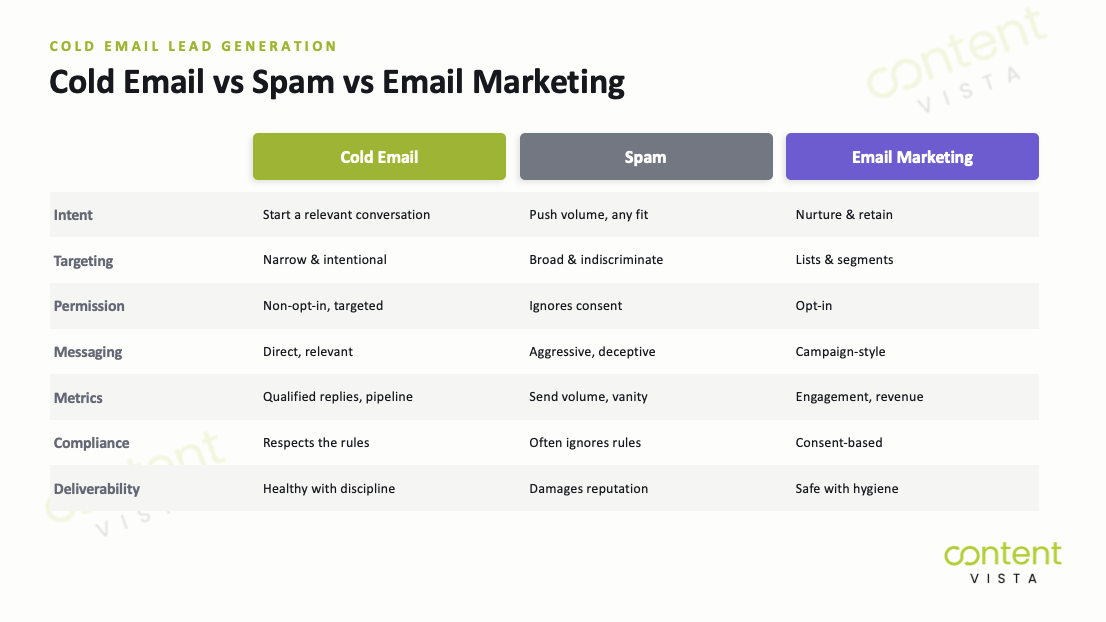
The important distinction is relevance and intent.
Cold email is not automatically spam simply because the recipient did not subscribe to a newsletter.
A relevant message sent to a narrowly targeted prospect with a legitimate business reason behind it is very different from blasting thousands of generic emails with misleading subject lines or fake personalisation.
That said, cold outreach still carries responsibility.
Inbox providers, regulators, and buyers increasingly expect senders to respect deliverability standards, unsubscribe requests, data usage rules, and complaint risk. Depending on the location, audience, and business context, frameworks such as FTC / CAN-SPAM guidance in the US and ICO / PECR / UK GDPR guidance in the UK and Europe may apply differently. This article is not legal advice, and businesses should confirm applicable requirements for their own market and outreach practices.
In practice, the line between cold email and spam is usually simple:
If the outreach is irrelevant, deceptive, untargeted or impossible to opt out from, recipients will treat it like spam even if the sender calls it lead generation.
Is Cold Email Still Effective in 2026?
So, does cold email still work?
Yes.
But only if you stop treating it like a volume game.
Cold email is no longer a channel where generic sequences and massive send counts reliably create opportunities. Inbox providers are stricter, buyers are harder to impress, and AI-generated outreach has made low-effort messaging even easier to ignore.
That is why many outbound campaigns now produce mediocre results despite sending huge volumes of email.
The mistake is assuming that more outreach automatically creates more pipeline.
In reality, cold email performance is heavily shaped by:
targeting quality
offer relevance
sender reputation
deliverability setup
list hygiene
follow-up discipline
timing
messaging context
When those pieces are weak, cold email becomes expensive noise.
When they work together, cold outreach can still generate qualified conversations at a predictable enough level to matter.
It is important to keep expectations realistic, though.
Average cold email reply rates are often in the low single digits, especially across broader or less relevant outreach. (Instantly 2026 Cold Email Benchmark Report) More targeted campaigns with stronger segmentation, clearer signals, and tighter offer alignment can perform significantly better but there are no guaranteed benchmarks because industry, market sophistication, pricing, trust requirements and execution quality all change the outcome.
That is why serious outbound teams do not obsess over vanity metrics anymore.
Open rates, in particular, have become less dependable because privacy protections and inbox behaviour can distort tracking data. A campaign can show inflated opens while generating weak commercial outcomes.
Think about it this way:
A high open rate with no meaningful replies is not a win.
A high reply rate from bad-fit prospects is not a win either.
The real goal is qualified pipeline contribution.
That means measuring whether cold outreach is creating relevant conversations, sales-ready opportunities and downstream revenue potential: not just email activity.
We will break down the exact metrics that matter later in this guide, because this is where many cold email strategies quietly fail: they measure visibility instead of business impact.
When Cold Email Is the Right Channel and When It Is Not
Here’s where most teams go wrong: they ask whether cold email works before asking whether cold email fits.
Cold email is not automatically the best acquisition channel for every business, market or growth stage.
In some situations, it can create highly efficient conversations with the right buyers.
In others, it simply amplifies weak positioning, vague targeting or low trust.
That distinction matters because cold email works best when the business underneath it is already reasonably clear.
Cold email is a good fit when…
Cold email tends to perform better when buyers are identifiable and the outreach can be tied to a specific problem, trigger or business context.
That usually means:
you know who the decision-makers are
the offer is considered, high-value, or outcome-driven
the audience can be segmented narrowly
the pain point is specific enough to create relevance
the team can respond to replies quickly
CRM tracking and follow-up processes exist or can be built
This is why cold email often works well for:
agencies
consultants
B2B services
niche operators
software companies with defined ICPs
high-ticket or specialised offers
outbound-led sales teams
The common pattern is simple: The narrower the relevance, the more likely the outreach feels legitimate instead of intrusive.
Cold email is a poor fit when…
Cold email becomes much harder when the business itself is still unclear.
For example:
the offer is vague
the ICP keeps changing
the market definition is too broad
the pricing is too low to justify manual relevance
the sales process is weak
the team cannot handle responses consistently
the service or product is not operationally ready for growth
It also struggles in markets where trust usually needs to exist before direct outreach works.
Some businesses first need visibility, authority, referrals, education or audience trust before outbound becomes effective.
In those situations, aggressive cold outreach often creates resistance instead of demand.
That is why many companies should first build demand before capture rather than immediately scaling outbound sends.
What to use instead if cold email is not the first move
If cold email is not the right first channel, that does not mean lead generation is impossible.
It usually means another growth constraint needs to be solved first.
| Situation | Better First Move |
|---|---|
| Offer positioning is unclear | Clarify messaging, ICP, and growth strategy first |
| The market is too broad | Narrow the audience and segment by pain/problem |
| Buyers require trust before responding | Build authority through content, referrals, or [demand generation](https://contentvista.com/services/demand-generation) |
| No follow-up or CRM process exists | Build operational sales infrastructure before scaling outreach |
| The team cannot handle replies | Improve internal sales capacity first |
| The product/service is still unstable | Fix delivery and conversion foundations before pipeline expansion |
| The offer is low-ticket and volume-dependent | Explore Inbound-led or Paid-led systems, partnerships, or lifecycle marketing instead |
Cold email is strongest when relevance can outweigh interruption.
If the business cannot yet explain who the outreach is for, why it matters or what happens after replies arrive, scaling outbound usually creates noise faster than pipeline.
The important takeaway is this:
Cold email should be treated like a precision channel, not a universal growth shortcut.
When targeting, relevance, follow-up and operational capacity are aligned, it can become a valuable outbound engine.
When they are not, more sends usually make the underlying problems more obvious.
If cold email is a fit, build it as a conversion system: not a spam campaign.
Explore the Cold Email Conversion Lab or the broader lead generation service.
The Cold Email Readiness Checklist
Before you scale sends, run a quick readiness check.
Cold email rewards preparation, not urgency. The CLEAN system you’ll see next only works when the operational basics are already in place — so treat this as the gate before scaling, not the clean-up after.
Cold Email Readiness Checklist
You are ready to run cold email when you can tick all of these:
* A narrow, clearly defined segment — not “anyone who could buy”
* A credible, specific offer tied to a real problem
* Verified contact data and basic list hygiene
* Compliant data sourcing and usage for your market
* Authenticated sending domains (SPF, DKIM, DMARC)
* A reply-handling process with clear ownership
* CRM visibility for routing and stage tracking
* Follow-up capacity to handle responses consistently
* A way to measure source-to-pipeline contribution
Can’t tick one? Fix that gap first. A weak link here is usually a system problem, not a lead problem — and scaling outbound on top of it just creates noise faster than pipeline.
Once those basics hold, the question shifts from “should we?” to “how?” — and that is exactly what the next section is built around.
The CLEAN Cold Email Framework
Let’s make this practical.
If cold email is going to generate a pipeline without damaging trust, five things need to work together.
Most outbound problems do not come from one bad email.
They come from disconnected systems:
weak targeting
fake personalisation
poor deliverability
aggressive asks
no reply process
no measurement beyond opens
That is exactly what the CLEAN framework is designed to prevent.
CLEAN is a relevance-first outbound framework built around one core principle:
Cold email should feel intentional, contextual and operationally controlled — not like mass-produced spam.
The CLEAN Cold Email Framework
C — Choose a narrow segment and one clear offer
L — Link the email to a real signal, problem, or trigger
E — Engineer deliverability and compliance before scaling
A — Ask for one low-friction next step
N — Nurture with measured follow-up, reply handling and CRM handoff
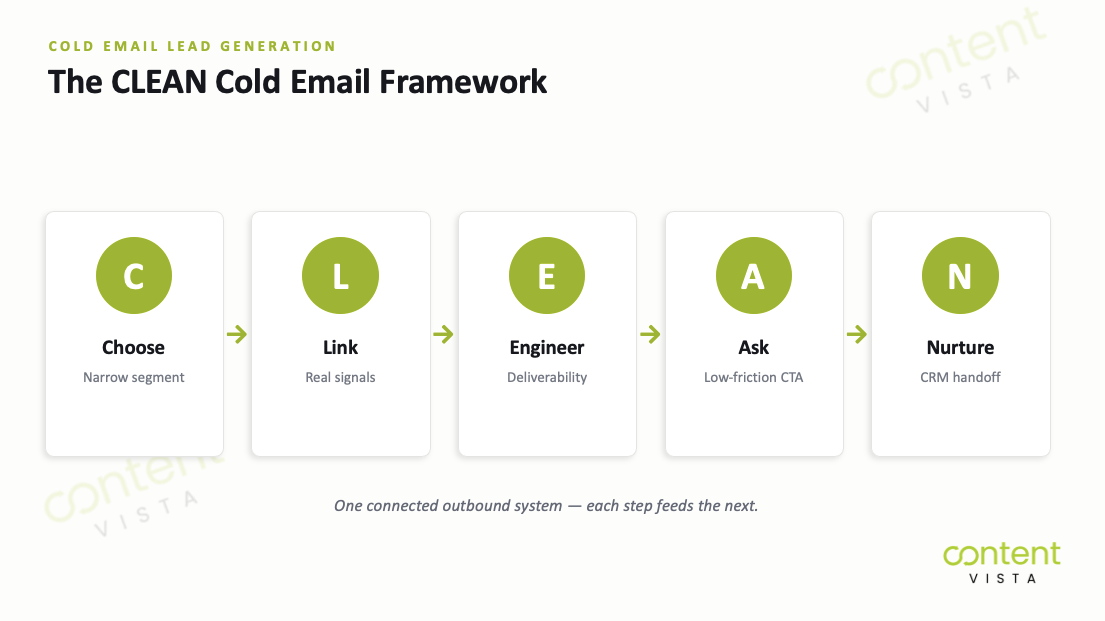
But before we break CLEAN down, one thing has to be clear: CLEAN is not a competing model. It is the cold-email-specific execution layer of the broader lead generation system — what Content Vista calls the VISTA Lead Generation Framework (Validate → Integrate → Systemise → Turn → Analyse).
Cold email sits inside that system as one Outbound-led System within the Integrate layer. CLEAN simply applies VISTA’s logic to that single channel:
C — Choose maps to Validate: confirm the segment, offer and fit before you scale sends.
L — Link maps to Integrate: connect each message to a real signal so outbound fits one coordinated acquisition path.
E — Engineer maps to Systemise: build deliverability, compliance, CRM and routing infrastructure underneath the outreach.
A — Ask maps to Turn: turn attention into a qualified conversation with one low-friction next step.
N — Nurture maps to Turn and Systemise: handle replies, route them into CRM, and move sales-ready conversations forward.
The fifth VISTA layer, Analyse, shows up later in this guide when we measure the metrics that actually create pipeline. Same system — just applied to one channel instead of the whole engine.
Each part matters because cold email failures are usually connected.
For example, broad targeting creates vague messaging.
Vague messaging lowers replies.
Lower replies push teams toward higher send volume.
Higher volume increases complaint risk and deliverability pressure.
And once sender reputation weakens, even relevant emails become harder to land in inboxes.
That is why treating cold email like a copywriting problem alone usually fails.
The better way is to think of outbound as a controlled system.
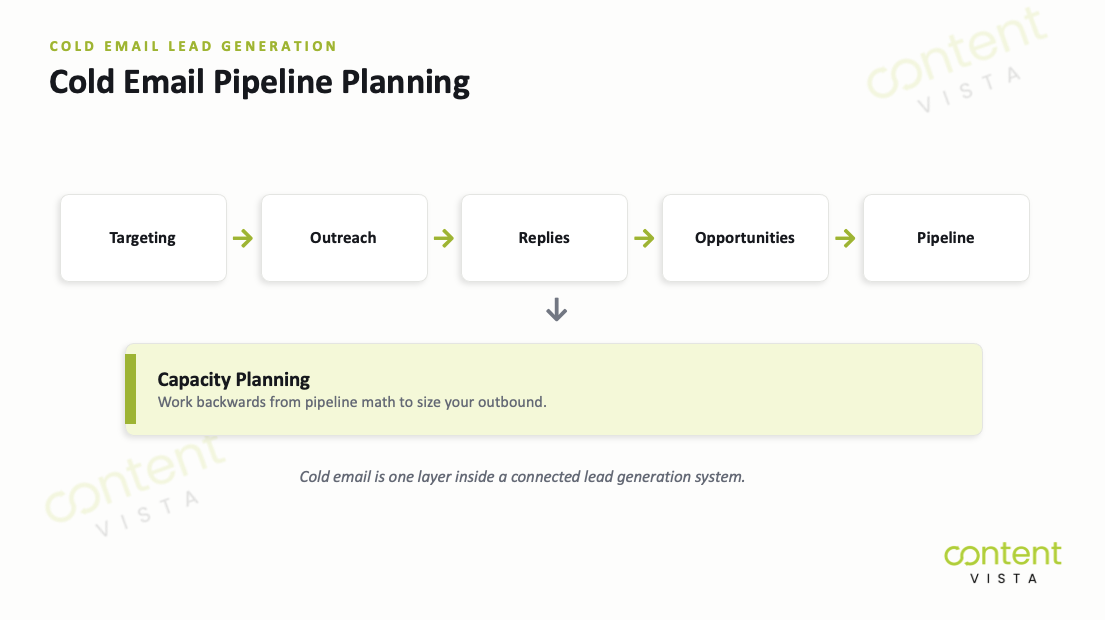
Use the Lead Generation Capacity Calculator to see how many qualified opportunities your outbound engine needs to create.