Quick Summary
- Most local lead generation fails as a system, not an activity.
- Nearby searchers are sent to a generic homepage, responses arrive too slowly and enquiries disappear into shared inboxes without reaching the right location.
- Even when leads arrive, many businesses cannot see which location or channel produced the customer.
You’re generating local interest - then losing it
You’re running local ads. Publishing posts. Asking for reviews. Updating your Google Business Profiles.
Maybe traffic is even increasing.
But the leads are still thin.
One location gets enquiries while another stays quiet. Calls come in, but nobody knows which campaign drove them.
Form submissions sit in a shared inbox. Prospects wait too long for a reply, then contact the next business in the local results.
Here’s the problem:
You may not need more local lead generation activity. You may need to stop losing the demand you already create.
For multi-location businesses, the biggest failures often happen between the click and the customer.
A nearby searcher lands on a generic homepage instead of the right location page. A form asks for too much information.
A lead reaches the wrong team. A call goes untracked.
Marketing reports another lead, but nobody knows whether it became revenue.
That is why more traffic alone rarely fixes an unpredictable pipeline.
Local lead generation works when your pages, forms, response process, location routing and tracking operate as one connected system.
This article will help you find the points where local leads are leaking and show you what to fix before spending more on traffic.
What is local lead generation?
Local lead generation is the process of attracting nearby people who are actively looking for a product or service and turning that interest into calls, enquiries, bookings, store visits or sales for a specific business location. For multi-location businesses, it also means connecting each lead to the right location and tracking what happens next.
That usually involves channels such as Google Business Profile, local SEO, paid search, Local Services Ads, reviews, location pages and call or form enquiries.
But here’s the important distinction:
Some people use the phrase “local lead generation business” to describe the rank-and-rent model. That is where someone builds local websites and sells or rents the leads to another company.
That is not what this article covers.
Here, local lead generation means generating and converting demand for the locations your business already operates.
The goal is not simply to create more visibility. It is to make sure nearby searchers reach the right page, contact the right team and become customers you can trace back to the correct location and channel.
Running a single-location service business? Start with our guide to local lead generation for service businesses for the fundamentals.
This article focuses on what changes when you operate several locations.
Why most local lead generation underperforms (it's not what you think)
You may be paying for clicks, earning local visibility and generating enquiries, yet still seeing an unpredictable pipeline.
Here’s the part nobody tells you:
The problem often is not a lack of traffic. It is what happens after that traffic arrives.
A nearby searcher clicks an ad and lands on a generic homepage. A form submission waits overnight.
A call reaches the wrong location. A lead gets counted in a report but never connected to a booked job or sale.
That is pipeline leakage.
And for a multi-location business, even a small leak becomes expensive when it repeats across every branch, campaign and enquiry source.
Key local lead generation metrics
Contacting a lead within 5 minutes rather than 30 minutes made qualification about 21 times more likely in the MIT/InsideSales Lead Response Management Study (2007). That research predates modern forms and texting, so read it alongside newer evidence, not on its own.
A 2024 RevenueHero test of 1,000 B2B SaaS companies found that 63.5% never responded to a demo request. Those that did took just over 29 hours on average.
Local intent moves quickly.
When your response, page experience, routing and tracking do not move with it, spending more on ads or SEO simply sends more demand into the same leaks.
That is why local lead generation is a system problem, not an activity problem.
The connected system behind local leads that convert
So how do you stop the leaks?
Here’s the map:
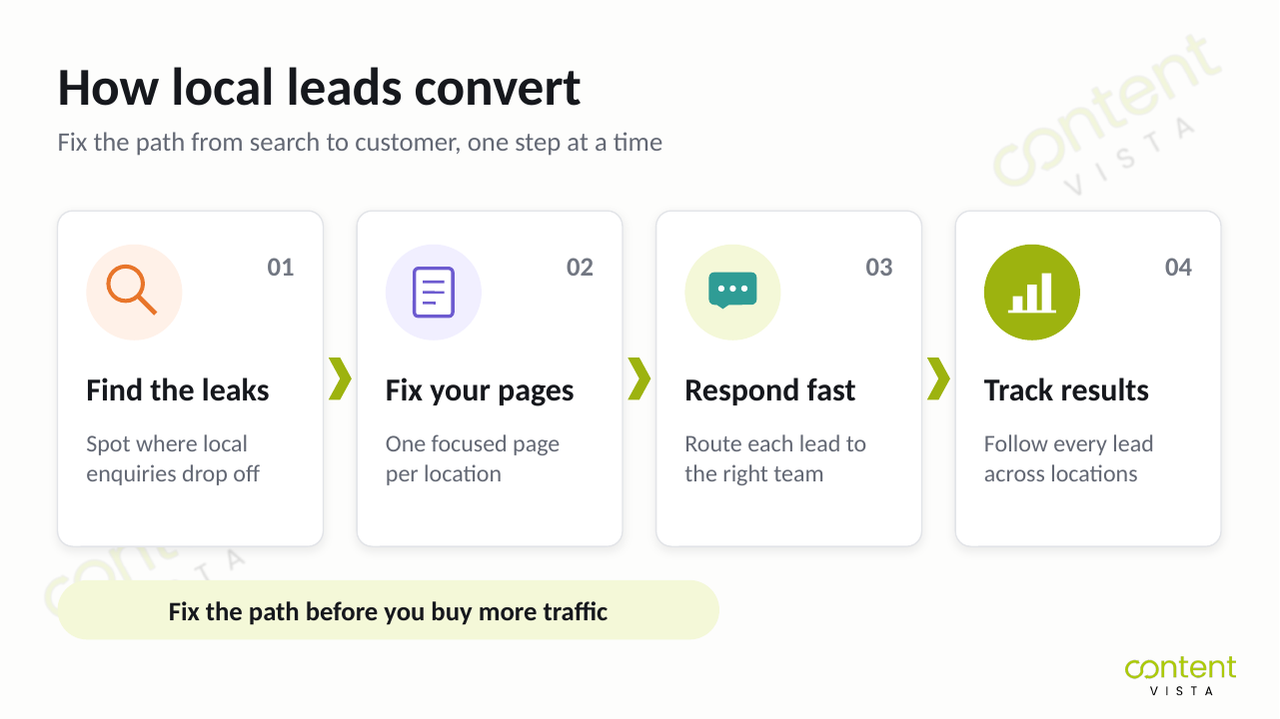
First, send each nearby searcher to a useful page built for the location they are considering, not a generic homepage that forces them to search again.
Then make it easy to act. Clear offers, focused forms, visible phone numbers and strong next steps should turn local intent into an enquiry without unnecessary friction.
Once the lead arrives, speed and ownership matter. Every call or form submission should reach the correct location quickly, with a clear person responsible for responding.
Finally, connect the enquiry to what happens next. You need to know which page, channel, campaign and location produced the lead, and whether that lead became a customer.
That is what conversion and growth infrastructure does. It connects the work you are already doing so fewer opportunities disappear between steps.
The full end-to-end approach is covered in our guide to building a connected revenue system.
The sections ahead walk through each leak so you can see where your process breaks and what to fix first.
Find the four places your local leads leak
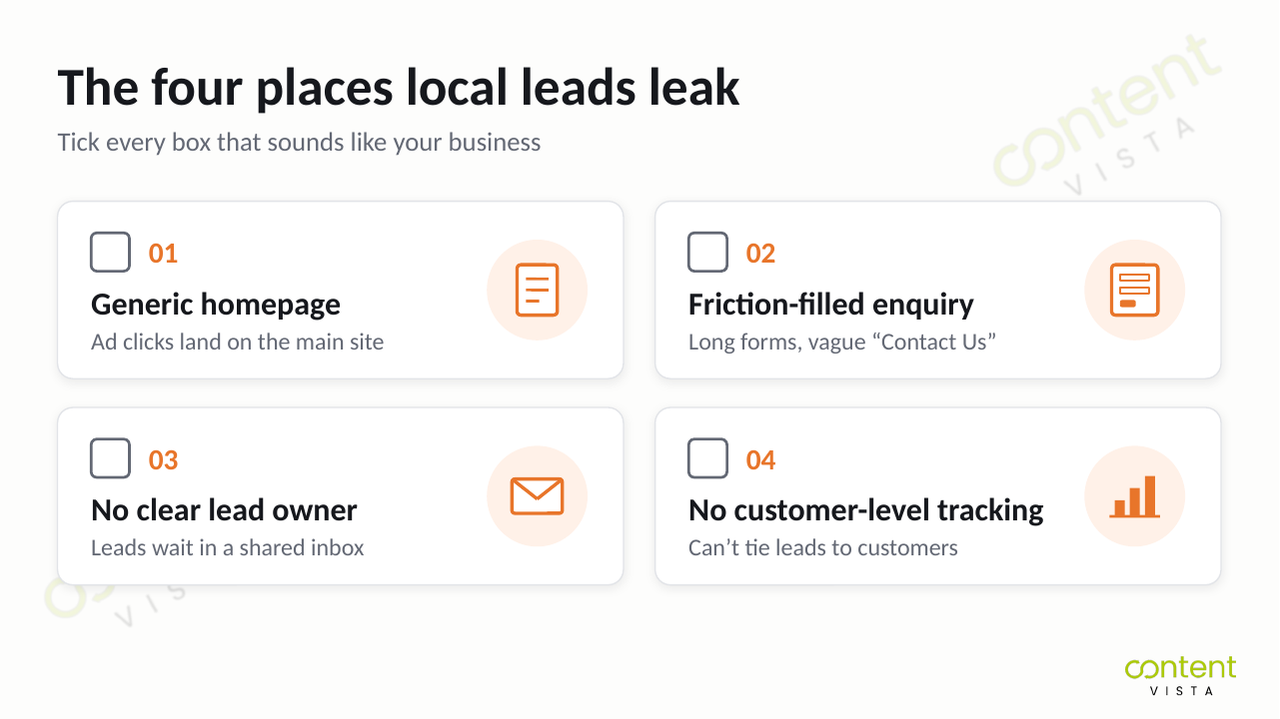
Be honest: which of these is happening in your business?
Run this checklist against your website, enquiry process and location reporting. Tick every statement that is true.
Each one points to a place where local demand may be disappearing before it becomes revenue.
Local lead leak checklist
☐ Nearby searchers land on a generic homepage.
Someone searches for a service in a specific area, but your ad, listing or search result sends them to the main website. They must then find the right location, confirm that it serves them and work out what to do next.
☐ Your enquiry path creates friction.
The main action is a vague “Contact Us” button or the form asks for more information than your team needs to begin the conversation. The visitor has local intent, but no clear reason to act now.
☐ New leads have no clear owner.
Calls and forms arrive in a shared inbox, spreadsheet or general phone queue. Nobody is immediately responsible for routing the enquiry to the correct location or providing a fast response.
☐ You cannot connect leads to customers.
You can see clicks, calls or form submissions, but you cannot reliably identify which location, campaign, page or channel produced the customer. That makes it difficult to protect what works or fix what does not.
If you ticked even one box, more traffic may amplify the problem rather than solve it.
Use the Website Conversion Leak Audit to pinpoint where your current journey is losing enquiries and which issue to address first. It takes about two minutes.
Fix your location pages and forms so they convert
So what does that mean for your pages?
Start by stopping the homepage dump.
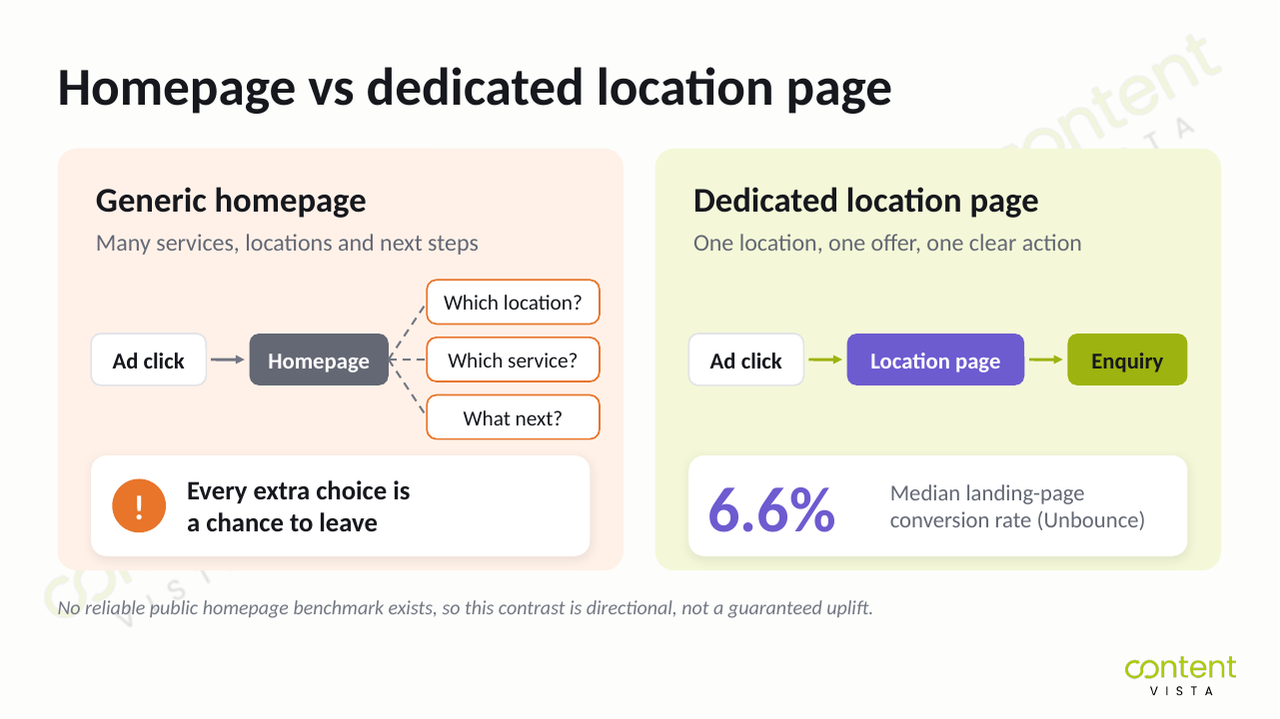
When someone clicks an ad for a service in a specific city, sending them to your homepage forces them to find the relevant location, confirm that you serve their area and locate the right next step.
Every extra decision creates another opportunity to leave.
A focused destination removes those decisions. Unbounce’s benchmark data puts the median dedicated landing page at a 6.6% conversion rate.
There is no equally reliable public benchmark for homepages, so don’t treat that figure as a guaranteed uplift.
But the direction is clear: a page built for one location and one action gives local traffic a clearer path than a page built for everyone.
Build genuinely useful location landing pages for each market. Do not simply duplicate one template and swap the city name.
Each page should reflect that location’s services, coverage area, contact details, proof, common customer needs and next step.
That relevance helps visitors recognise that they are in the right place.
Then inspect the form.
Ask only for the information required to start the conversation.
In one illustrative Imagescape case study, cutting a contact form from 11 fields to four lifted its conversion rate by about 120%.
That is not a universal outcome, but it shows how unnecessary fields can suppress response.
Replace vague “Contact Us” dead ends with a specific action: request an estimate, schedule a consultation, check availability or speak with the local team.
Strong website and conversion design removes uncertainty at the moment intent is highest.
For a deeper breakdown, see our guide to landing page conversion rate optimization.
Respond faster and get every lead to the right location
Here’s the uncomfortable math:
A local lead is rarely waiting for your team alone.
They have just searched for a nearby provider, opened several results and started contacting the businesses that look credible.
When your response takes hours, they do not pause their search. They call the next result.
That makes speed-to-lead one of the highest-impact improvements available to a local business.
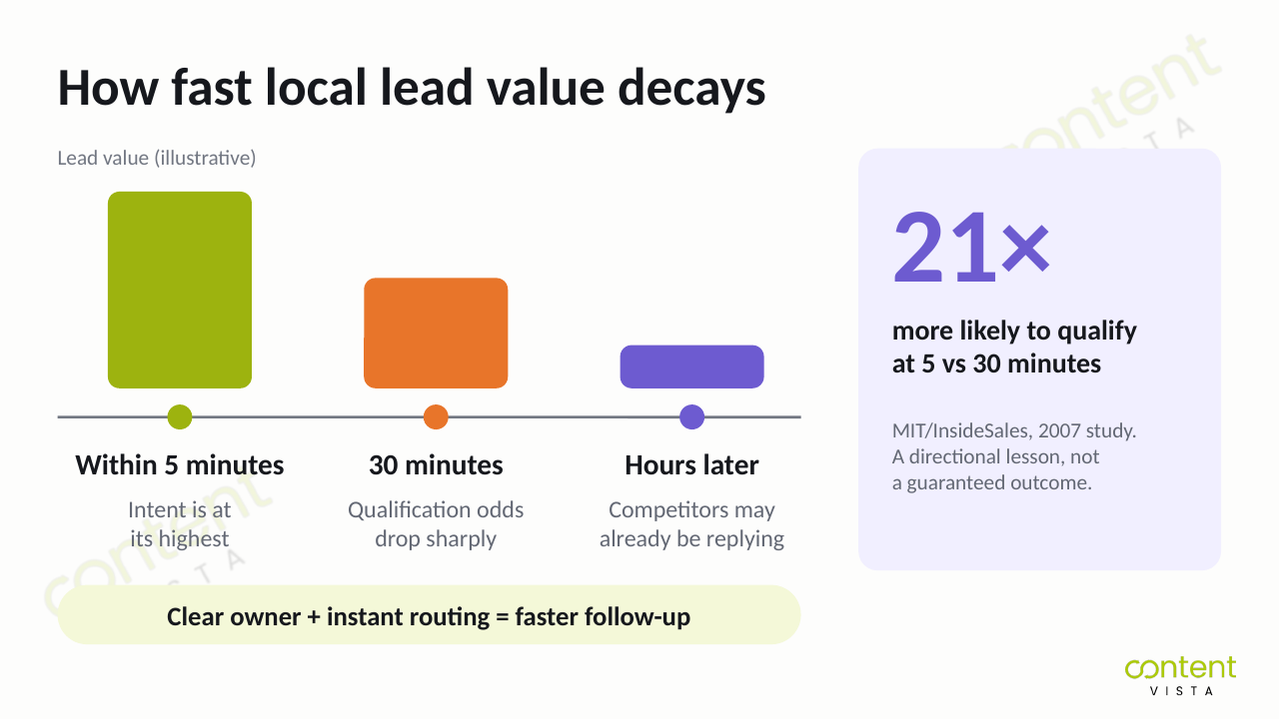
The MIT/InsideSales study found that contacting a lead within five minutes rather than 30 made qualification about 21 times more likely.
The study dates to 2007, so don’t treat the exact multiplier as a modern universal benchmark. But its practical lesson still holds: lead value decays quickly when intent is immediate.
Speed alone is not enough, though. The lead must also reach the right person.
Every form submission and call should have clear ownership the moment it enters your business.
Route enquiries using location, service area, requested service or campaign source, not whichever employee notices the shared inbox first.
Strong CRM and lead routing should automatically assign the lead, alert the responsible team, record the source and escalate it when nobody responds.
That matters even more across multiple locations. Without consistent routing, one branch may follow up immediately while another quietly loses demand.
And before increasing spend, ask a more basic question: how many qualified leads does each location actually need to reach its target?
Use the Lead Generation Capacity Calculator to work backwards from your required customers and conversion rates.
Respond fast. Assign ownership immediately. Measure it by location.
Otherwise, you are paying to create opportunities your process cannot reliably capture.
Know which location and channel actually earned the customer
Let’s make this practical:
Imagine several location pages use nearly identical copy, every branch shares the same phone number and all form enquiries enter one general inbox.
Your reports may show that leads are coming in, but not where they truly came from.
That creates a serious blind spot.
You cannot tell whether the customer found the business through local search, a paid campaign, a location page, a review profile or a referral.
You may not even know which branch ultimately handled and closed the enquiry.
Closed-loop tracking fixes that by connecting the full journey: the first click or call, the location selected, the enquiry source, the follow-up activity and the final customer outcome.
Each lead should carry that information into your CRM or reporting process, so you can compare performance by both location and channel.
Once that data flows, our guide to marketing attribution models explains how to decide which touchpoints get the credit.
That changes the question you ask.
Instead of “How many leads did this location generate?” ask:
“How many of those leads became customers, and which source produced them?”
Lead count alone can reward volume without quality.
One location may generate fewer enquiries but convert more of them into revenue. Another may report high lead volume while losing most enquiries through poor routing or slow follow-up.
The right scoreboard is not traffic, clicks, calls or form fills in isolation.
It is the number and quality of customers each location earns from the demand you create.
Where to start if you can only fix one thing
Start with the biggest leak, not the easiest task.
First, measure how quickly each location responds to a new enquiry.
If leads are waiting in a shared inbox or sitting unassigned, fix ownership, routing and response alerts before increasing traffic.
Next, check where your local ads, listings and search results send people.
If high-intent visitors land on a generic homepage, direct them to a focused page for the relevant location and service.
Then simplify the enquiry path. Remove unnecessary form fields, replace vague “Contact Us” buttons and make the next step obvious.
Finally, connect each lead to its source, location and customer outcome.
The priority is simple: fix whatever is losing the most ready-to-buy demand today.
For many multi-location businesses, that means response speed first and page destination second.
The local channels - reframed as feeders into your system
These all matter. But here’s the catch:
None of them fixes local lead generation on its own.
Each channel creates or captures demand. Your pages, response process, routing and tracking determine whether that demand becomes a customer.
Google Business Profile
An accurate, active profile helps nearby searchers find the right location, understand what it offers and take the next step.
Keep services, opening hours, photos, contact details and location-specific information current. Then make sure clicks and calls flow into a process that records the source and routes the enquiry correctly.
Local SEO and “near me” searches
Strong local SEO helps each location appear for relevant searches in its service area, including the local pack and organic results.
The goal is not visibility alone. Searchers should reach a genuinely useful location page that confirms relevance and gives them one clear action.
Google Ads and Local Services Ads
Location targeting lets you capture high-intent searches in selected markets, while Local Services Ads can generate calls and messages directly from local results.
Effective local paid ads should send each prospect to the right destination, preserve campaign and location data and trigger immediate follow-up.
Reviews and reputation
Reviews reduce uncertainty when customers compare nearby providers. They can strengthen your profile, build trust and help one location stand out from another.
But reviews still need a conversion path: a clear page, a useful offer and a responsive local team.
The channels are feeders. They bring people into the system.
If the destination is generic, the form creates friction, the response is slow or the source disappears from your reporting, the channel gets blamed for a problem it did not create.
Judge each channel by the customers it helps produce, not just impressions, rankings, clicks, calls or form submissions.
Activity-led vs system-led: the difference in one view
Activity-led local lead generation focuses on producing more visibility, clicks, calls and form submissions.
A system-led approach asks a harder question: what happens to that demand after it arrives?
That distinction changes where you invest.
Instead of automatically increasing ad spend or publishing more content, you improve the destination, shorten response time, assign every enquiry to the right location and track which leads become customers.
The channels still matter. The difference is that they no longer operate as disconnected tactics.
Use the comparison below to assess your current setup.
If most of your process resembles the activity-led column, the next improvement may not be another campaign. It may be fixing the points where existing demand is already leaking.
| Dimension | Activity-led approach | System-led (connected infrastructure) |
|---|---|---|
| Core belief | “We need more traffic and more leads” | “We need to stop leaking the leads we already get” |
| Where ad traffic lands | The homepage | A dedicated page for that location |
| Lead response | Whenever someone gets to it | Within minutes, routed to the right location |
| Measurement | Lead count per channel | Closed-loop, lead-to-customer, per location |
| Result | Unpredictable and hard to attribute | Predictable, measurable pipeline |
The most common local lead generation mistakes
Sending local traffic to the homepage. Nearby searchers must find the right location, service and next step themselves, adding friction when intent is highest.
Responding slowly or not at all. A local prospect can contact several providers in minutes. Delayed follow-up gives the next result the advantage.
Publishing near-duplicate location pages. Swapping only the city name creates weak local relevance and gives visitors little reason to trust that the page serves their specific market.
Failing to track calls. Phone enquiries often become invisible once they reach a shared number, making it difficult to connect the customer to a location or channel.
Treating cost per lead as the only metric. A low CPL means little if the leads are poorly routed, rarely contacted or never become customers. Track lead-to-customer performance by location instead.
When you don't need the full system (yet)
Not every local business needs a sophisticated CRM, attribution setup and automated routing from day one.
If you operate from one location, receive only a small number of enquiries and can personally see where each lead came from, a full infrastructure build may add more complexity than value.
Start with the basics instead.
Create one strong location page that clearly explains who you serve, what you offer and how to take the next step.
Then make sure every enquiry reaches a named person and receives a fast response.
Track leads in a simple, consistent way until the volume becomes difficult to manage manually.
Build more infrastructure when the business grows beyond clear ownership and reliable visibility, not simply because the tools exist.
What this looks like in practice
Housewright Handyman shows what can happen when local lead generation is treated as a connected process rather than a collection of separate tactics.
For this local service business we helped, Content Vista’s work generated 270+ leads at roughly $15-$25 per lead, alongside 450% growth in SEO impressions on key local service pages.
That 450% figure reflects increased search visibility, not revenue growth.
The leads came from Meta Ads campaigns, so the cost per lead is one channel’s result for one client. It is not a benchmark or a guaranteed outcome.
The useful lesson is how the pieces connected.
Dedicated service and location pages gave nearby searchers somewhere relevant to land. A rebuilt website put lead capture front and centre.
And service-specific ad campaigns sent traffic into that setup, rather than into a generic page.
Traffic mattered. But traffic alone was not the result.
The result came from improving how local demand was captured and converted, so more of the visibility being earned had a clear path toward becoming a lead.
Local lead generation FAQs
What is local lead generation?
Local lead generation is the process of attracting nearby people who need your product or service and turning that interest into calls, enquiries, bookings, visits or sales for a specific business location.
Is local lead generation the same as the “rank-and-rent” business model?
No. Rank-and-rent involves building local websites and selling the leads to another business; this article focuses on generating customers for locations your business already operates.
How fast should you respond to a new local lead?
Respond within minutes wherever possible. Local prospects often contact several providers at once, so delayed follow-up gives competitors time to reply first.
Every lead should also have a clear owner immediately.
What’s a good cost per lead for a local business?
There is no useful universal CPL benchmark. A $20 lead that never converts is expensive, while a $100 lead that becomes a profitable customer may be efficient.
Published averages still give you a rough reference point:
| Channel | Average cost per lead | Source |
|---|---|---|
| Google Ads, all industries | $66.69 | WordStream/LocaliQ 2026 benchmarks |
| Google Ads, home and home improvement | $90.92 | WordStream/LocaliQ 2026 benchmarks |
| Local Services Ads, home services | $53 | SearchLight, February 2026 |
These are US averages, and they vary widely by market and trade. Judge CPL alongside lead quality, close rate, customer value, location and channel.
Should I send Google Ads traffic to my homepage or a landing page?
Use a focused landing page for the relevant location and service. A homepage usually introduces too many choices, while a dedicated page can confirm local relevance and present one clear next step.
How do multi-location businesses track leads across locations?
Capture the lead source, campaign, page, call and location, then carry that information into the CRM through to the final customer outcome.
Use location-specific routing and trackable phone numbers where appropriate.
How many location pages should I have, and how do I avoid duplicate content?
Create one useful page for each genuine location or distinct service area.
Avoid duplication by including location-specific services, proof, contact details, coverage information, customer needs and calls to action.
Which channel is best for local leads: SEO, Google Ads or Local Services Ads?
The best channel depends on search demand, competition, urgency, budget and service type.
Often, the strongest approach combines channels and measures which one produces customers, not merely clicks or leads.
Stop buying more traffic until you fix the leaks
More local visibility will not solve a broken path from searcher to customer.
If nearby prospects land on the wrong page, wait too long for a reply, reach the wrong location or disappear from your reporting, additional traffic simply feeds the same leaks.
The stronger move is to connect the journey from first click to closed customer and fix the point where demand is being lost.
The Website Conversion Leak Audit helps you identify where your website and lead journey are losing potential customers, so you can prioritise the fixes that matter most.
Start the Website Conversion Leak Audit.