Quick Summary
- Marketing strategy decides where you will play, who you will target, what position you will own, what offer you will lead with and how your funnel should convert attention into revenue.
- Marketing tactics are the actions you use to execute that strategy: SEO, ads, email, LinkedIn, webinars, outreach, content and campaigns.
- Strategy gives tactics direction. Tactics give strategy motion.
Marketing Strategy vs Tactics: The Difference That Decides Whether Your Marketing Compounds
You’re posting regularly, running ads, sending emails, publishing blogs and testing landing pages. And you’re still wondering why revenue is not compounding.
Here’s the problem: strategy is the system of choices your marketing runs on; tactics are the interchangeable actions inside it.
When you confuse the two, budgets leak. Every activity starts acting like a separate bet instead of part of a connected growth plan.
Most businesses don’t have a tactic problem first. They have a diagnosis problem.
They assume the answer is “post more,” “run better ads,” “try cold email,” or “start doing SEO.”
But if the audience is unclear, the offer is weak, the positioning is generic, or the funnel has no logical next step, more tactics only create more noise.
That’s why this distinction matters. A tactic can create short-term movement. A strategy determines whether that movement builds on itself.
By the end of this guide, you’ll be able to tell whether your growth problem is strategic or tactical.
You’ll also see where your marketing plan is leaking and what a real strategy needs to include before tactics can compound.
What Is a Marketing Strategy (and What Is a Marketing Tactic)?
So what’s the actual difference?
In simpler terms: your strategy decides the logic. Your tactics deliver the movement.
Say your strategy is: “We need to become the trusted choice for growth-stage companies that have tried scattered marketing but now need a connected revenue system.”
Then your tactics might include founder-led content, a diagnostic tool, comparison articles, LinkedIn distribution, webinars and email nurture.
But those tactics only make sense because the strategic choice came first.
Without that choice, the same activities become random output. You may still be “doing marketing,” but the pieces do not reinforce one another.
Tactics are components of a strategy, not a substitute for one.
Strategy vs Tactics at a Glance
The easiest way to separate marketing strategy from marketing tactics is to ask what each one controls.
Strategy controls the direction of growth: who you are trying to reach, what position you want to own, what promise you want the market to believe and how your marketing should convert attention into revenue.
Tactics control execution: the channels, campaigns, formats and actions used to move that strategy forward.
Both matter. But they do different jobs.
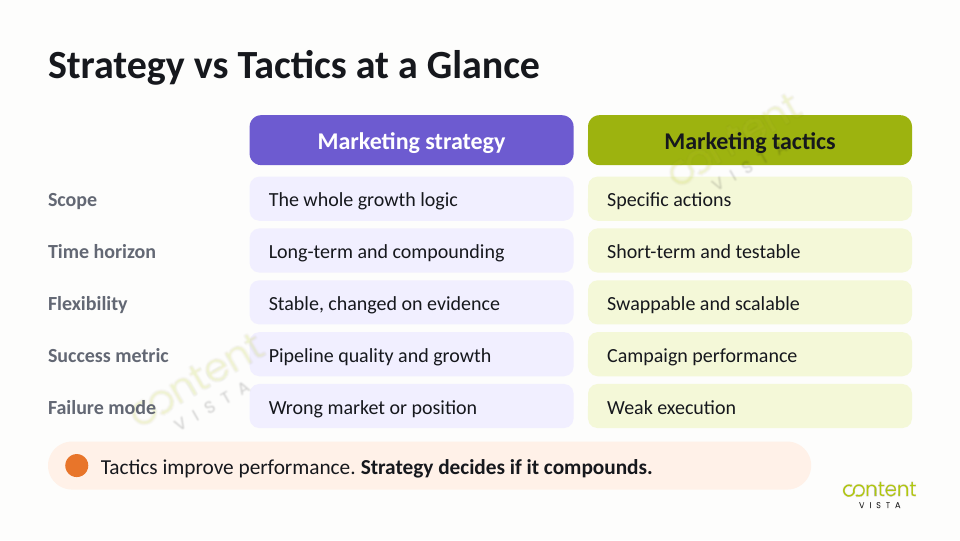
| Dimension | Marketing Strategy | Marketing Tactics | What Happens When This Is Missing |
|---|---|---|---|
| Scope | Defines the overall growth logic, audience, positioning, offer, funnel and channel priorities. | Executes specific actions such as ads, SEO, email, webinars, outreach and content. | Marketing becomes busy but disconnected. |
| Time horizon | Longer-term; designed to compound learning, trust, pipeline and revenue. | Shorter-term; designed to test, reach, convert, nurture or activate a specific audience. | Every campaign starts from zero. |
| Flexibility | Stable enough to guide decisions, but adjustable when market evidence changes. | More flexible; tactics can be changed, paused, replaced or scaled. | Teams keep changing actions without fixing the real problem. |
| Success metric | Better positioning, stronger pipeline quality, clearer conversion paths and compounding growth. | Campaign performance, traffic, leads, engagement, conversion rates, replies or booked calls. | Metrics improve in pockets but revenue does not compound. |
| Failure mode | Wrong market, weak positioning, unclear offer, poor channel fit or disconnected funnel logic. | Weak creative, poor targeting, low-quality execution, inconsistent cadence or bad follow-up. | The team misdiagnoses a strategic problem as a tactical one. |
In short: tactics can improve performance, but strategy decides whether that performance adds up to a growth system.
Why Confusing Tactics for Strategy Drains Your Budget
Here’s the problem: most marketing teams do not waste budget because they picked the “wrong” tactic.
They waste the budget because the tactic is operating without a strategic job.
A company runs ads to generate leads. Then it posts on LinkedIn to build visibility. Then it starts SEO because competitors are ranking. Then it launches an email programme because someone said nurture matters.
Each action may be reasonable on its own.
But if these actions are not connected by audience clarity, positioning, offer logic, funnel design and measurement, they become random acts of marketing.
That is expensive because B2B buying does not work like a vending machine.
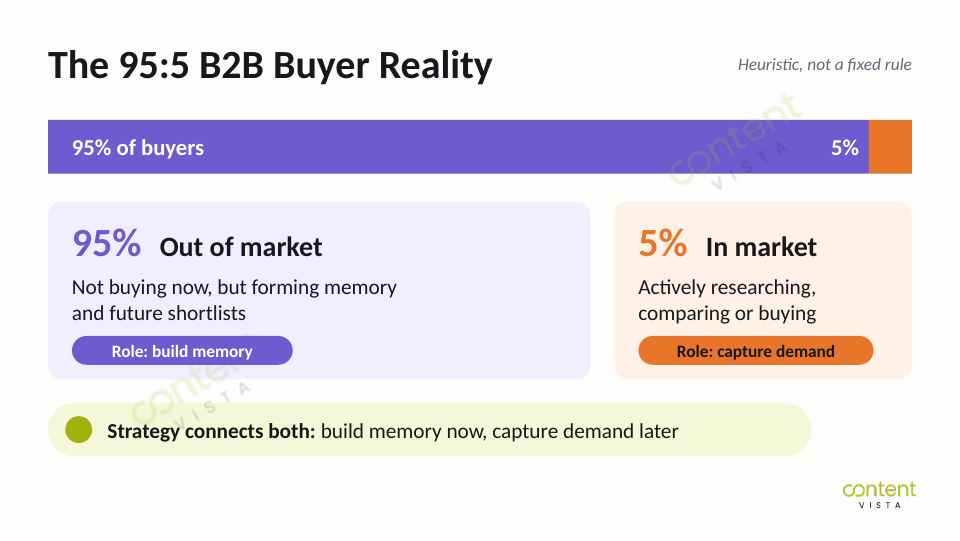
John Dawes of the Ehrenberg-Bass Institute introduced the 95:5 idea in his 2021 Ehrenberg-Bass paper for LinkedIn’s B2B Institute.
The idea: at any given time, roughly 95% of B2B buyers are out-of-market, while about 5% are actively buying.
This should be treated as a heuristic, not a law. Dawes himself says the 95% figure is not meant to be a precise rule. It’s a way to communicate that most businesses are not in-market in a given period.
So what does that actually mean for your budget?
If your marketing is tactics-only, it usually fights over the small in-market group.
Every campaign is built around “convert now,” “book now,” “buy now,” or “talk to sales now.”
That may capture some active demand. But it does very little to influence the much larger group that will enter the market later.
Strategy changes the job of marketing.
Instead of asking, “Which tactic should we run next?” it asks, “How do we become the brand this buyer remembers, trusts and shortlists when the problem becomes urgent?”
That is where compounding starts.
Content, ads, email, events, search, founder visibility and sales enablement stop acting like separate pushes.
They start building the same memory structure in the buyer’s mind: who you help, what problem you solve, why your point of view is credible and when to consider you.
If you are creating activity but revenue is not following, diagnose where the gap is happening between marketing motion and business outcome. Use the Revenue Milestone Gap Calculator to see how far your current pipeline is from the revenue you’re aiming for.
Without strategy, each tactic has to work alone. With strategy, every tactic strengthens the next one.
Is a Marketing Strategy the Same as a Marketing Plan?
Let’s clear this up: no, a marketing strategy is not the same as a marketing plan.
A marketing plan is downstream of strategy. It turns strategic choices into timelines, campaigns, owners, deliverables, budgets and execution milestones.
It answers: What are we doing this quarter? What goes live when? Who owns it? Which channels are we using?
A marketing strategy answers the harder questions first: Who are we trying to win with? What position do we want to own? Why should this audience choose us? What market problem are we solving? Which growth path gives us the best chance of winning?
Roger Martin’s Playing to Win frames strategy as a set of interrelated and reinforcing choices that position a business to win, not as a long planning document.
That distinction matters because a plan can look impressive even when the underlying choices are weak.
You can have a 90-day content calendar, a campaign roadmap, a paid media plan and a weekly posting schedule and still have no real strategy.
Michael Porter makes a related point in “What Is Strategy?”, his 1996 Harvard Business Review article: operational effectiveness is not strategy.
Doing the same activities better than rivals is not the same as choosing a different, defensible position.
In marketing terms, that means “posting more consistently,” “optimising ads” or “sending better emails” may improve execution. But those improvements do not automatically create a stronger market position.
Here’s the practical difference.
A plan says: “Publish two LinkedIn posts per week, run one webinar, launch three email campaigns and test two landing pages.”
A strategy says: “We need to become the most trusted growth partner for companies that have tried disconnected marketing and now need a connected revenue system. Every channel must reinforce that position, diagnose the buyer’s growth bottleneck and move them toward a strategic audit.”
If all you have is a list of tactics on a calendar, you have a plan. Useful, yes. But not a strategy.
How Do You Know If Your Problem Is Strategic or Tactical?
Let’s make this practical: before you change your channel mix, increase spend, hire another freelancer or launch another campaign, run the Strategy-or-Tactics Test.
The goal is simple. You want to know whether your marketing problem is upstream or downstream.
An upstream problem is strategic: unclear positioning, weak ICP definition, fuzzy offer, poor GTM logic or disconnected channels.
A downstream problem is tactical: the strategy is sound, but the execution quality, cadence, creative, targeting or follow-up needs work.
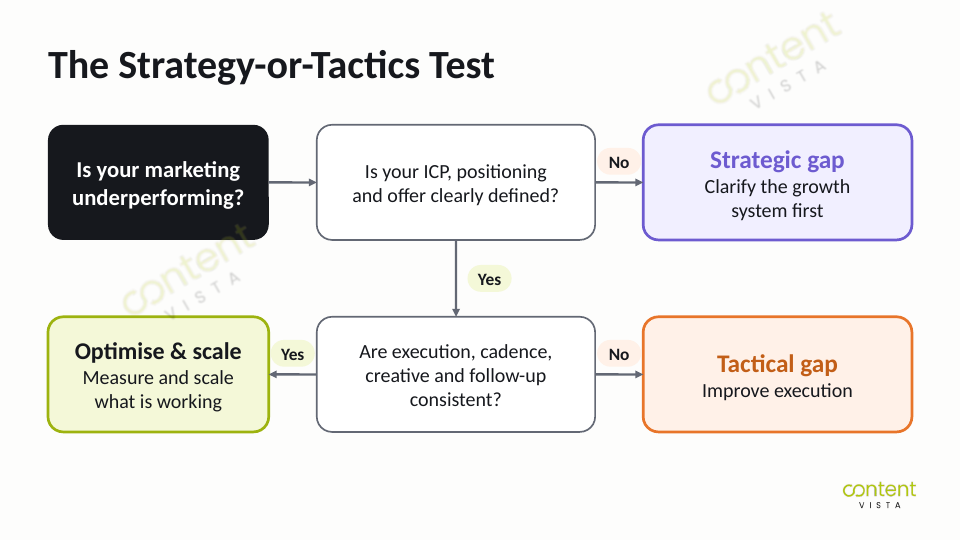
The Strategy-or-Tactics Test
Answer each question with yes or no:
Can you state who you are for and who you are not for in one sentence?
Can you explain why your ideal customer should choose you over the obvious alternatives?
Do your channels ladder up to one clear positioning or do they run independently?
Does every major tactic support a defined buyer journey stage?
If you doubled spend on your best-performing tactic, would revenue compound or just rise temporarily?
Do you measure qualified pipeline, sales conversations, or revenue movement: not just activity?
Can your team explain what each tactic is supposed to prove, improve or convert?
When a campaign underperforms, do you know whether the issue is audience, offer, message, channel or execution?
Do your content, ads, email, landing pages, and sales follow-up reinforce the same growth narrative?
Is there a clear next step for buyers who are interested but not ready to buy yet?
If you answered “no” to several questions about ICP, positioning, offer, GTM logic or channel alignment, you likely have a strategic gap.
Adding more tactics will only create more activity around an unclear growth system.
What to do next: pause the tactic-chasing. Clarify who you are targeting, what position you want to own, what buying problem you solve and how your marketing should move people from awareness to trust to revenue.
If you answered “yes” to the strategic questions but “no” to consistency, creative quality, follow-up, measurement or cadence, you likely have a tactical gap.
What to do next: improve execution. Tighten the campaign, sharpen the landing page, improve the follow-up sequence, test better creative or fix the measurement layer.
A strategic gap means the system is unclear. A tactical gap means the system exists, but the execution needs improvement.
Diagnosed a strategic gap? Pressure-test your GTM foundation before you spend more on tactics. Use the GTM Readiness & Positioning Clarity Audit to identify whether your growth issue is positioning, ICP clarity, offer strategy or go-to-market execution.
What Does a Real Marketing Strategy Look Like?
Here’s what that looks like in practice: a real marketing strategy is not a list of channels.
It’s a connected operating system that tells every channel what job it has to do.
That system does four jobs. And it runs as a loop, not a one-off exercise.
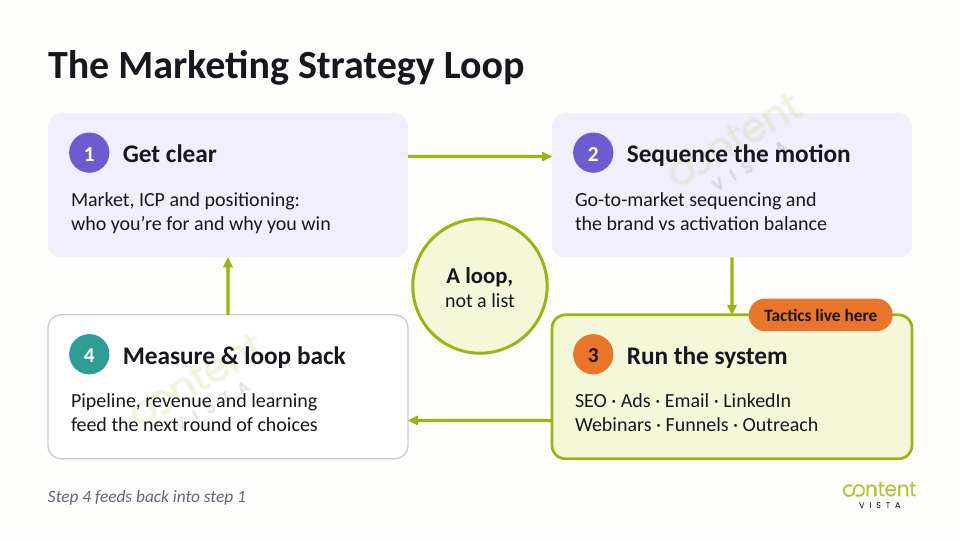
1. Get clear on who you’re for and why you win
This is where strategy starts. It defines the market, ICP, positioning, category context, buyer problem and commercial focus.
Before choosing tactics, you need to know who you are for and who you are not for.
You also need to know what problem you want to be known for solving and what makes your point of view credible.
This is where brand and market positioning and market research and competitive intelligence matter.
It’s the kind of work behind our Alirrium case study, where research-driven positioning contributed to acquisition interest from Baker Tilly.
Skip this step and tactics become guesswork.
2. Sequence your go-to-market motion
This step turns strategic clarity into a go-to-market motion.
It’s where you decide the channel sequence, campaign logic, brand-vs-activation balance, offer path and buyer journey.
For example, a company with low market awareness may need more demand creation before it pushes conversion-heavy campaigns.
A company with active demand but weak conversion may need a sharper capture and funnel system.
That is a go-to-market strategy decision, not a channel preference.
3. Run the system (this is where tactics live)
This is where the system gets built and operated.
SEO, paid ads, email, LinkedIn, webinars, landing pages, nurture sequences, sales enablement, founder content and outreach all sit here.
They are not the strategy. They are the execution layer of the strategy.
Tactics also need infrastructure: landing pages, CRM handoff, automation, attribution, nurture paths and conversion logic. That’s why marketing systems and funnel design become critical at this point.
Founder authority belongs here too, as a demand channel.
Turning a founder’s or executive’s expertise into trust, visibility, audience and demand is the job of founder and executive positioning.
4. Measure, learn and loop back
This step closes the loop.
It’s where you measure what is actually moving: pipeline quality, conversion paths, sales conversations, revenue influence, channel efficiency and strategic learning.
The point is not just to report performance. The point is to learn what needs to change.
If the market response shows that the ICP is too broad, you go back and tighten who you’re for.
If the channel mix is wrong, you rework your go-to-market sequence.
If execution is inconsistent, you fix how the system runs.
Tactics live in step three. They execute your strategy. They are not the strategy itself.
That’s the difference between isolated marketing activity and a revenue-driven marketing strategy.
Brand vs Lead Generation: Where Strategy Decides How Tactics Get Weighted
Strategy does not just decide which tactics you use. It decides how heavily each tactic should be weighted.
That matters because not every marketing activity has the same job.
Some tactics are built for brand-building: creating memory, trust, familiarity and future consideration among buyers who are not ready to buy yet.
Others are built for sales activation: capturing the people already searching, comparing, enquiring or shortlisting vendors.
Here’s where it gets debated: Binet and Field’s The Long and the Short of It is often summarised as recommending a roughly 60:40 split between brand-building and sales activation.
But whenever that 60:40 ratio is used, it needs context.
Byron Sharp of the Ehrenberg-Bass Institute has publicly criticised the ratio as resting on unsound awards data, so it should not be treated as a universal law.
For B2B specifically, Binet and Field’s own analysis for LinkedIn’s B2B Institute, The 5 Principles of Growth in B2B Marketing, found efficiency peaked at around 46% brand and 54% activation.
That’s close to an even split. And the authors themselves describe it as a guiding principle, not a ratio to follow precisely.
| Heuristic | What it suggests | How to use it |
|---|---|---|
| 95:5 buyer-market heuristic | Most B2B buyers are usually out-of-market, while a much smaller group is actively buying. | Use brand-building to reach and prime future buyers, while using activation to capture current demand. |
| 60:40 brand-to-activation split | A commonly cited Binet & Field guideline for balancing long-term brand effects with short-term activation. | Treat it as a directional heuristic, not settled law; Byron Sharp has criticised the evidence base behind the ratio. |
| B2B 46:54 balance | Binet and Field’s B2B analysis found efficiency peaked at roughly 46% brand to 54% activation, close to an even split. | Use it as a starting point, then adjust based on category maturity, sales cycle, budget, funnel health and revenue goals. |
So how do you know whether your weighting is actually working? Watch the metrics that reflect strategy, not just activity.
| Metric | What it tells you |
|---|---|
| Qualified pipeline | Whether marketing is producing revenue-ready demand, not just activity. |
| CAC (customer acquisition cost) | Whether the system acquires customers efficiently as you scale. |
| Share of voice and mental availability | Whether you’re building memory with the out-of-market buyers who will decide future shortlists. |
If you are unsure whether your current mix is building profitable growth or just buying short-term activity, use the True CAC & Marketing ROI Calculator to compare what your marketing actually costs against the revenue it creates.
The real point is not whether your split is exactly 60:40, 50:50 or something else. The point is that the weighting itself is a strategy decision.
A company entering a crowded category may need more brand-building because buyers do not yet know why it should be remembered.
A company with strong awareness but weak conversion may need better activation, sharper offers, improved landing pages or stronger follow-up.
A company selling into long buying cycles may need both: brand to build future shortlists, activation to convert the active few.
That is why “Should we run ads, publish thought leadership, build SEO, launch webinars or increase outbound?” is not a tactical question first.
It is a strategic weighting question.
When Tactics Are Actually the Right Thing to Focus On
But let’s be fair: not every marketing problem is strategic.
Sometimes the strategy is clear, and the real issue is that the tactics are not being executed well enough.
In that case, pausing everything for another positioning workshop may be the wrong move.
You may need sharper creative, better targeting, cleaner landing pages, stronger follow-up, more consistent publishing or tighter campaign operations.
You are likely dealing with a tactical gap when the foundation is already clear.
You know exactly who you are for. Your ICP is specific. Your positioning is differentiated. Your offer makes sense.
Your channels ladder up to one strategy. Your team knows what each tactic is supposed to achieve. But the execution is weak, inconsistent, or under-optimised.
For example, if your LinkedIn strategy is sound but the posts are generic, the issue is tactical.
If your paid campaign is aimed at the right audience with the right offer but the landing page is unclear, the issue is tactical.
If your email nurture fits the buyer journey but the copy is flat or the cadence is irregular, the issue is tactical.
The rule of thumb is simple: fix strategy first if the foundation is unclear; sharpen tactics first if the foundation is solid but execution is sloppy.
That is why the Strategy-or-Tactics Test matters. It prevents you from overcorrecting in the wrong direction.
A strategic gap needs clearer choices. A tactical gap needs better execution against choices you have already made.
Common Marketing Strategy vs Tactics Mistakes (and Quick Fixes)
Quick gut check: if your marketing feels busy but revenue is not compounding, one of these mistakes is usually hiding underneath the activity.
| Common mistake | Quick fix |
|---|---|
| Buying tactics before clarifying positioning | Before choosing channels, define who you serve, what problem you solve, why your offer is different and what position you want to own. |
| Confusing activity for progress | Stop measuring only posts, campaigns, clicks, impressions or email sends. Tie activity to qualified pipeline, sales conversations, conversion movement and strategic learning. |
| Treating a content calendar as a strategy | Use the calendar as an execution tool, not the source of strategic direction. Every content piece should support a clear audience, message, offer, funnel stage or demand objective. |
| Chasing only the in-market 5% | Balance activation with memory-building. Capture buyers who are ready now, but also build familiarity and trust with buyers who will enter the market later. |
| Copying competitors’ tactics without understanding their strategy | Do not copy the visible output. Reverse-engineer the strategic logic first: audience, positioning, offer, funnel, budget, sales model and timing. |
The pattern is simple: tactics fail when they are asked to solve upstream problems they were never designed to solve.
A paid ad cannot fix unclear positioning. A content calendar cannot fix a weak point of view.
A webinar cannot fix the wrong audience. An email sequence cannot fix an offer nobody understands.
Fix the strategic choice first. Then improve the tactic.
How to Turn Strategy and Tactics Into a Growth Plan That Compounds
So where do you start?
Start by putting each layer in the right place.
Your strategy is the system your marketing runs on. It decides who you’re for, how you go to market, how the system runs and how the learning feeds back into your next decisions.
Your tactics sit inside that system. SEO, ads, email, LinkedIn, webinars, landing pages, nurture sequences, founder content and outreach are execution components.
They matter, but they are not the system itself.
Your plan is how you sequence the system over time.
That means a real growth plan should not start with “What should we post this month?” It should start with:
Who are we trying to win with?
What position do we want to own?
What buying problem are we solving?
What channels best fit this buyer journey?
What tactics belong in the first 90 days?
What will we measure to know whether the system is compounding?
For the end-to-end strategy layer, go deeper with our guide to building a revenue-driven marketing strategy. It walks through Content Vista’s CORE Growth System™ step by step.
If your team needs help clarifying the strategic foundation, the next logical step is marketing strategy and growth consulting.
Before you add another tactic, pressure-test whether your GTM foundation is ready to support growth. Use the GTM Readiness & Positioning Clarity Audit to identify whether your gap is positioning, ICP clarity, offer strategy or go-to-market execution.
The simplest reframe is this: tactics are interchangeable. The system is the moat.
When the system is clear, tactics compound. When the system is unclear, tactics compete for budget, attention and patience.
Marketing Strategy vs Tactics: FAQs
Is marketing a strategy or a tactic?
Marketing is neither only a strategy nor only a tactic. It includes both: the strategic choices that define who you serve, how you are positioned and how you win, plus the tactics used to execute those choices.
Strategy gives marketing direction; tactics create movement.
What comes first: strategy or tactics?
Strategy should come first. You need to clarify the audience, positioning, offer, buyer journey and growth goal before choosing tactics.
Otherwise, you may end up running ads, publishing content or sending emails without knowing what each activity is supposed to build or prove.
What are examples of marketing strategy vs marketing tactics?
A marketing strategy might be: “Become the trusted growth partner for companies with scattered marketing that need a connected revenue system.”
Tactics could include SEO, LinkedIn content, webinars, paid campaigns, email nurture, landing pages and founder-led thought leadership used to support that strategy.
Can you have tactics without a strategy, and what happens if you do?
Yes, you can have tactics without a strategy, but they usually become disconnected activities.
You may generate clicks, posts, leads or campaigns, but the learning does not compound because the actions are not reinforcing one clear position, funnel or growth system.
Is a marketing strategy the same as a marketing plan?
No. A marketing strategy is the set of choices that guide growth. A marketing plan is the calendar, roadmap, budget and execution sequence that turns those choices into action.
If you only have a list of campaigns and dates, you have a plan, not a strategy.
How do I know if my marketing problem is strategic or tactical?
Use the Strategy-or-Tactics Test. If your ICP, positioning, offer, channel logic or GTM direction is unclear, the problem is strategic.
If those choices are clear but creative, consistency, targeting, landing pages, follow-up or measurement are weak, the problem is tactical.
How much budget should go to brand vs lead generation?
There is no universal split. The right balance depends on category maturity, sales cycle, existing demand, conversion strength and revenue goals.
Binet and Field’s 60:40 brand-to-activation idea (which Byron Sharp has criticised for relying on awards data) and their roughly even B2B split are useful heuristics, not laws.