Quick Summary
- Build the marketing system first, then run campaigns inside it.
- Campaigns create temporary bursts of attention, leads or sales, and their impact usually slows once the activity stops.
- A marketing system connects positioning, content, acquisition, conversion, follow-up, sales handoffs and measurement so each campaign strengthens what comes next.
This guide is for founders, marketing leaders and revenue teams deciding whether to invest in another campaign or fix the underlying structure first.
It will help you see what your business needs right now, where campaigns fit within a growth system, and how to stop funding short-term activity that never builds a reliable path from attention to revenue.
Why Your Marketing Keeps Going Quiet
A campaign goes live.
Attention rises. Leads come in. The team feels momentum.
Then the launch ends.
And everything goes quiet again.
This is the feast-or-famine trap: short bursts of activity followed by long stretches of uncertainty.
One month, the pipeline looks healthy. The next, the team is scrambling for the next idea, channel, offer or campaign to restart demand.
I have seen this pattern often. A business launches a webinar, runs ads, posts heavily on LinkedIn or pushes a new offer.
The activity works. For a while.
But because the campaign isn't connected to an ongoing content rhythm, follow-up process, nurture sequence, sales handoff or measurement loop, the results have nowhere to compound.
So the team starts over.
New campaign. New message. New urgency.
These are often called "random acts of marketing." They're disconnected activities that may perform individually but never add up to a reliable growth engine.
And that raises the real question:
Is your marketing underperforming because the strategy is wrong?
Or because there is no system carrying the strategy forward once the campaign ends?
Marketing System vs Marketing Campaign: The Real Difference
A marketing campaign is a time-boxed push designed to achieve a specific goal, such as generating leads, launching an offer or promoting an event. A marketing system is the always-on operating structure that connects positioning, content, channels, conversion, follow-up, sales handoffs and measurement so marketing can run consistently.
A campaign is an activity with a start date, an end date and a defined outcome.
It may include paid ads, a webinar, a product launch, a LinkedIn push, an email sequence or a limited-time offer.
A system is what makes those activities work together.
It determines who you're targeting, what message reaches them, how attention becomes interest, how interest becomes a lead, how that lead is nurtured and how the team learns from the result.
In plain English:
A campaign creates a spike.
A system creates continuity.
Both can be strategic. The real difference is durability.
A campaign delivers a result within a window. A system creates the conditions for every future campaign to become more efficient, more consistent and more connected over time.
Systems vs Campaigns, Side by Side
Campaigns and systems operate at different levels.
A campaign creates focused movement. A system makes that movement repeatable, connected and measurable.
| Dimension | Marketing Campaign | Marketing System |
|---|---|---|
| Purpose | Achieves one defined goal, such as promoting a launch, event, offer or lead-generation push. | Creates a repeatable path from positioning and attention to conversion, follow-up, measurement and improvement. |
| Time horizon | Runs within a fixed period and ends when the planned activity is complete. | Operates continuously and supports multiple campaigns over time. |
| Structure | Uses a selected message, audience, channel mix, assets and offer for one initiative. | Connects strategy, content, channels, funnels, CRM workflows, sales handoffs and reporting. |
| Results pattern | Often produces a temporary spike in reach, leads or sales activity. | Builds a steadier operating rhythm and allows learning to carry into future activity. |
| Measurement | Measures performance against one campaign goal and timeframe. | Tracks how the full journey performs and where attention, leads or opportunities are being lost. |
| Value after activity stops | Momentum usually slows unless another activity replaces it. | Retains processes, assets, audience insight, data and feedback loops that improve the next campaign. |
The practical takeaway is simple.
Use campaigns to create concentrated action. Use a system to make sure each campaign contributes to something larger than its immediate result.
Strategy, Plan, Campaign and Where the System Fits
Here's the thing most people get backwards: they start with campaigns, call the activity a plan and assume the plan is the strategy.
These are four distinct layers.
Strategy is the why. It defines the market you want to win, the audience you need to influence, the position you want to occupy and the business outcome marketing must support.
A revenue-driven marketing strategy provides the direction for every decision that follows.
The marketing plan is the how. It translates that strategic direction into priorities, channels, resources, responsibilities, timelines and sequences.
A plan is downstream of strategy. The two terms shouldn't be used interchangeably, because a detailed plan without a clear strategic choice can simply organise the wrong activity more efficiently.
For a deeper look at how strategy differs from the activity beneath it, see our guide to marketing strategy vs tactics.
Campaigns are the what. They're the specific, time-bound initiatives executed within the plan: a webinar, product launch, paid acquisition push, account-based outreach sequence, research report or event promotion.
The marketing system is the operating layer beneath them all. It connects the plan to repeatable execution through workflows, content processes, channel rhythms, conversion paths, lead management, sales handoffs, measurement and feedback loops.
In other words, the system isn't another campaign or a replacement for strategy.
It is the system your marketing runs on.
It's the structure that lets each campaign reuse what already exists, generate useful learning and strengthen the next round of activity, so the team never has to rebuild from zero.
Why One-Off Campaigns Don't Work in B2B
B2B buying journeys are structurally too long, crowded and non-linear for a short campaign to carry them alone.
Start with the 95-5 rule.
Professor John Dawes, writing for the LinkedIn B2B Institute in 2021, estimated that only about 5% of potential B2B buyers are actively in-market at any given time. You can read more in the Ehrenberg-Bass Institute's work on the 95-5 rule.
But Dawes is clear that 95-5 is a directional heuristic, and the exact figure won't hold for every sector.
The point is that most buyers who encounter your marketing aren't ready to purchase immediately.
Here's where it gets interesting:
"Out of market" doesn't mean "not paying attention." In 6sense's 2026 B2B Buyer Experience Report, 96% of buyers said they keep up with their category between evaluations, and most of their vendor opinions shift during that time.
So the brands that stay visible between buying cycles are the ones shaping the shortlist before it even exists.
| Buying reality | Research signal | Marketing implication |
|---|---|---|
| Most buyers are out of market | Roughly 5% may be actively buying at a given time (Ehrenberg-Bass / John Dawes, 2021); the figure is a heuristic, not a fixed law. | Marketing must build memory and relevance before demand becomes active. |
| Decisions involve a group | Gartner describes complex buying groups of 6–10 decision-makers; Forrester's State of Business Buying, 2026 puts the typical decision at 13 internal stakeholders plus nine external influencers. | Content must answer different priorities and help the group reach internal agreement. |
| Buyers spend limited time with suppliers | Gartner's survey of 750 B2B buyers found they spend only about 17% of their purchase journey meeting potential suppliers. | Your content and digital experience must do substantial work without direct sales involvement. |
| Purchases frequently stall | Forrester's State of Business Buying, 2024 reported that 86% of B2B purchases stall during the buying process. | Marketing must reduce uncertainty, clarify value and support consensus, which a lead alone can't do. |
| Buying cycles last months | 6sense's vendor-produced 2026 Buyer Experience Report puts the average cycle at 10.3 months, with buyers first contacting sellers about 59% of the way through. | A few weeks of campaign activity can't cover the full decision period. |
| The favourite usually wins | In the same 6sense study, the vendor buyers favoured before first seller contact won 82% of the time. | Preference is built long before a sales conversation, so marketing has to be present early and often. |
The Gartner and Forrester findings on business buying show why a lead isn't the same as a decision: multiple people must research, compare, justify and agree.
The 6sense figures are first-party vendor research, so treat them as directional rather than universal benchmarks.
In fact, 6sense's own conclusion lines up with this article's argument. It advises revenue teams to manage category reputation "as a continuous operating discipline, not a campaign."
A short campaign may trigger attention.
It can't stay useful across a roughly ten-month journey involving six to thirteen people (and often more).
That requires an always-on demand generation strategy that keeps educating buyers, reinforcing positioning, capturing intent, nurturing interest and supporting internal consensus long after the original campaign ends.
The Compounding Effect (And Why Campaigns Fade)
Here's the craziest part: the work that feels slowest at the beginning can become the most valuable later.
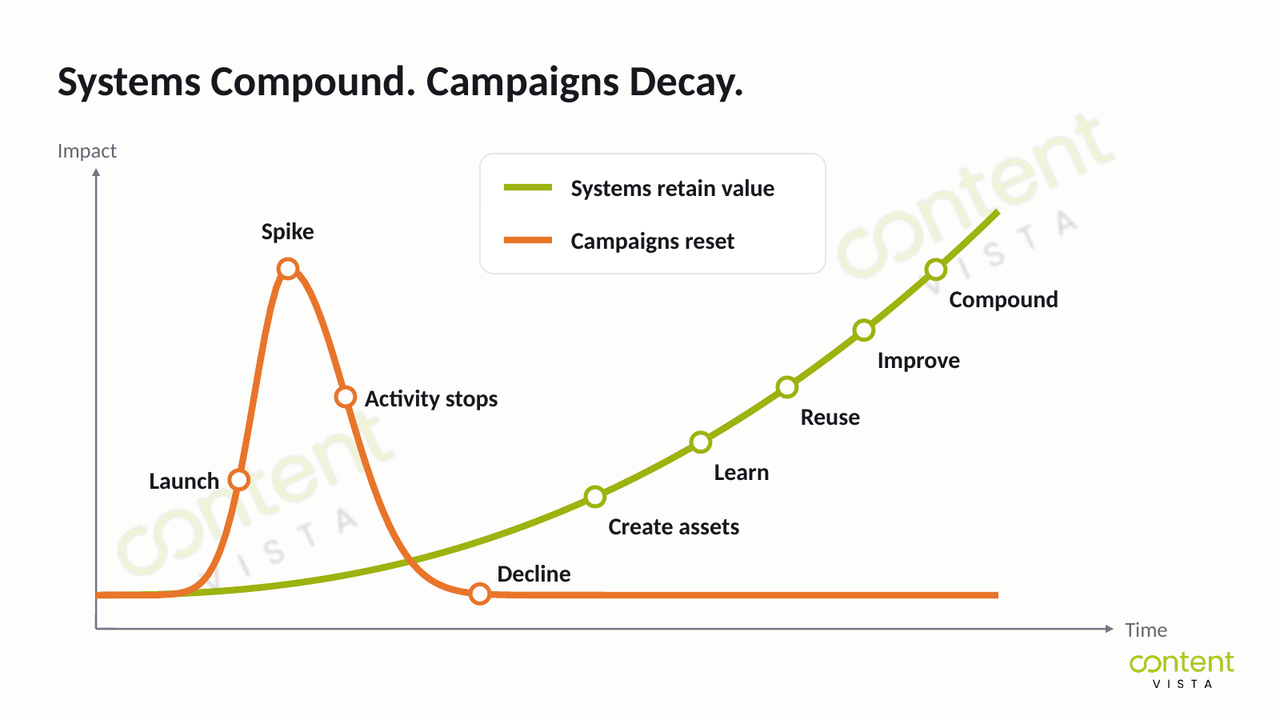
A campaign usually produces a curve that rises, peaks and declines.
Once the ads stop, the launch ends or the outreach sequence closes, the activity stops creating new momentum unless another campaign replaces it.
A marketing system behaves differently.
An article keeps attracting buyers. A newsletter builds an owned audience. A nurture sequence keeps educating leads.
Search visibility, customer insight, reusable creative, CRM data and sales feedback all strengthen the next cycle. Each asset becomes an input into future marketing, instead of a one-time output.
Venture capitalist Tomasz Tunguz has described content as one of the few forms of marketing with a compounding return: consistent publishing builds a growing body of assets that keep producing value over time.
HubSpot's own first-party analysis points the same way. In its historical optimisation work, HubSpot found that 76% of its monthly blog views and 92% of its monthly blog leads came from posts published in earlier months.
The reverse is also true.
When the activity stops, results fade. The Ehrenberg-Bass Institute's study of brands that stopped advertising, published in the Journal of Advertising Research in 2021, found that sales fell by 16% on average after one year without advertising, 25% after two years and 36% after three.
That research tracked Australian consumer goods brands, so the exact numbers won't transfer neatly to B2B. But the direction is hard to ignore: presence decays when you stop showing up.
That is the lightbulb:
Campaigns rent momentum for a defined period.
Systems retain assets, learning, audience access and operating capacity. So the next campaign starts ahead of the last one, instead of back at zero.
How Should You Split the Budget?
Now, here's where smart people disagree.
One of the most cited rules in marketing is the 60:40 split proposed by Les Binet and Peter Field in their IPA research: roughly 60% of budget toward long-term brand building and 40% toward short-term activation.
The idea is simple. Brand activity creates future demand, while activation converts demand that already exists.
For B2B, Binet and Field later suggested a different balance: approximately 46% brand building and 54% activation, in The 5 Principles of Growth in B2B Marketing, published with the LinkedIn B2B Institute in 2019.
That split reflects the stronger role of lead generation and sales activation in many B2B markets.
But the B2B dataset was relatively small, so treat the ratio as directional guidance, not a universal formula.
And there is another important caveat.
Professor Byron Sharp of the Ehrenberg-Bass Institute has publicly criticised the evidence behind the 60:40 rule. Speaking at a B2B marketing summit in 2022, he called it "very misleading," arguing that the underlying dataset of award submissions is skewed.
So the honest answer is: there is no fixed budget ratio that works for every business.
The right split depends on your category, growth stage, sales cycle, existing brand awareness, pipeline pressure and how much marketing infrastructure already exists.
An established brand with reliable demand capture may invest differently from a lesser-known company still building recognition and trust.
Treat 60:40 or 46:54 as starting hypotheses rather than budgeting commandments.
The more useful question is whether your spend balances immediate pipeline needs with the long-term system required to create future demand.
What Disconnected Campaigns Actually Cost You
Let's put a number on it.
In an EMARKETER survey created with Demandbase, 58% of B2B marketers said ad waste is a significant issue, and more than half estimated that 16% to 45% of their ad spend is lost on irrelevant accounts.
That's vendor-sponsored survey data, but it matches what most marketing leaders feel in their gut.
And the financial loss is only one part of the cost.
Disconnected campaigns also consume:
Team time: repeated briefing, production, approvals, setup and reporting.
Creative effort: new assets are built from scratch instead of being reused and improved.
Media budget: traffic is bought before positioning, targeting or conversion paths are ready.
Sales capacity: poorly qualified leads create follow-up work without enough buying intent.
Learning: campaign insights stay trapped in reports instead of improving the wider marketing system.
Here's the problem:
It's rarely that a single campaign fails.
It's that every campaign is treated as a separate event, with a new message, new workflow, new audience and new measurement. So the business keeps paying the setup cost without keeping much of the value.
A connected system changes the economics.
It lets each campaign reuse proven foundations, add new insight and make the next investment better informed than the last.
So, Which Should You Build First?
The sequencing logic is straightforward.
Most potential B2B buyers aren't actively in-market when they first encounter your brand.
Even when interest exists, the purchase may involve several stakeholders, competing priorities, internal approvals and months of evaluation. A short campaign can't support that entire journey on its own.
A system can.
Start by putting the essential operating structure in place:
Clear positioning and a defined ideal customer
A consistent message linked to a meaningful business problem
A reliable route for creating and capturing demand
A conversion path with an appropriate next step
Follow-up and nurture beyond the first interaction
Sales handoffs and a feedback loop
Measurement that improves future decisions
Then run campaigns through that structure.
A webinar, launch, report, event, paid push or outbound sequence can create concentrated momentum. The system makes sure the attention, leads, data, assets and learning keep working afterward.
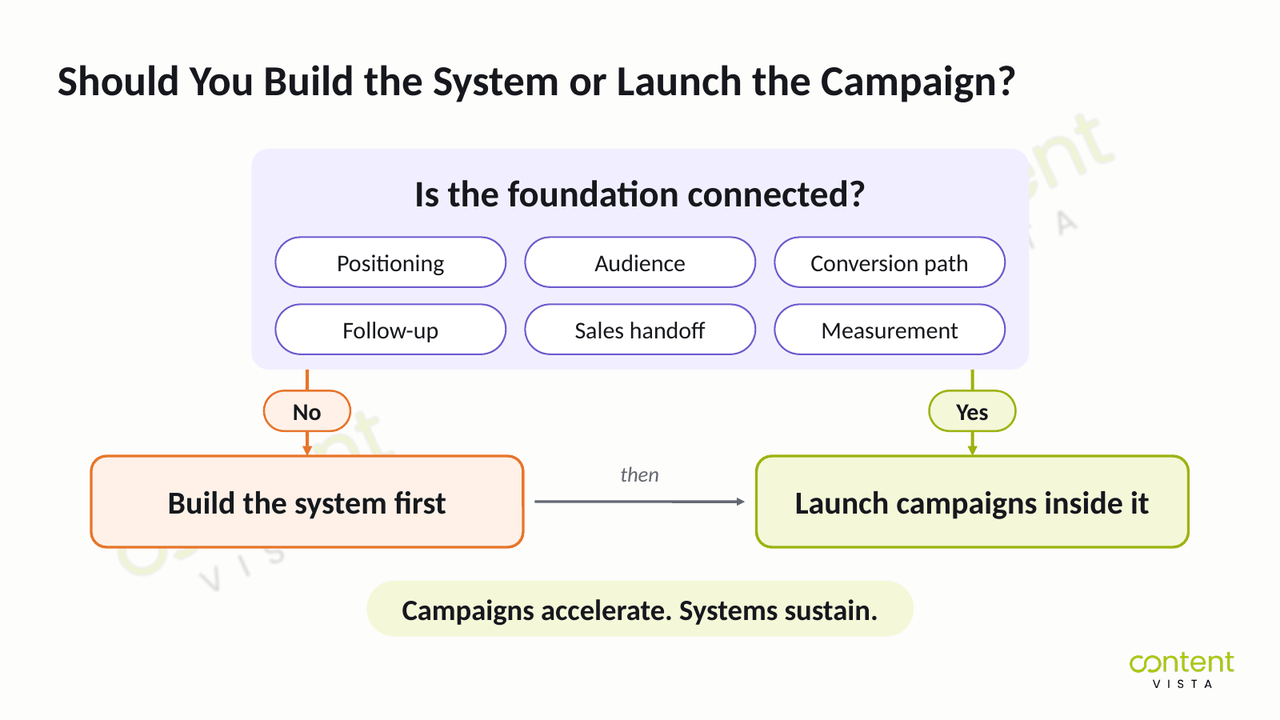
The decision rule is simple:
If each new campaign forces you to recreate the audience, message, funnel, follow-up and reporting, build the system first.
Before investing in another campaign, use the GTM Readiness & Positioning Clarity Audit to identify gaps in your positioning, go-to-market logic and growth foundation.
What a Marketing System Actually Looks Like
A working marketing system is a continuous loop. It connects strategic clarity, go-to-market design, execution and revenue learning.
It gives marketing a structure that campaigns can run inside, so the team doesn't have to rebuild its foundations every time.
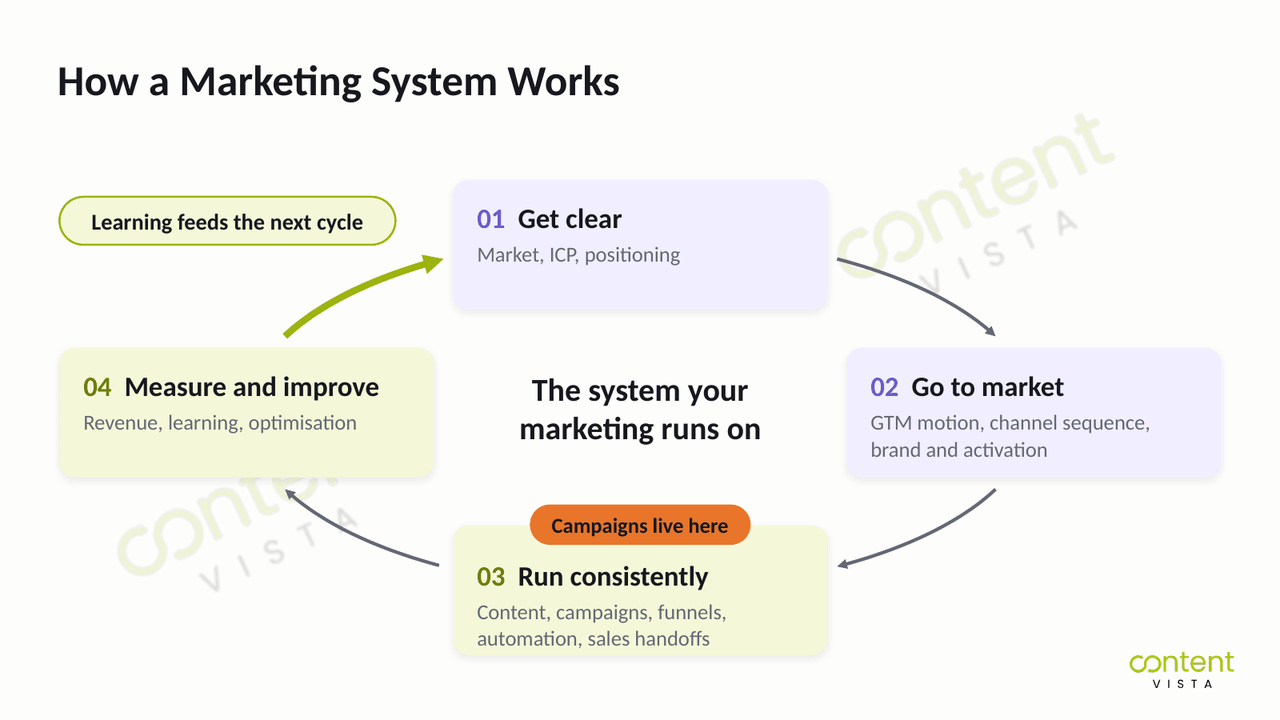
How a marketing system gets built
Get clear on your market, audience and position. Define the market problem, ideal customer profile, buying context, competitive alternatives and the position your brand should occupy. This is the foundation of effective marketing strategy and growth consulting and brand and market positioning.
Decide how you'll go to market. Work out how the business will create, capture and convert demand. This includes channel sequencing, audience journeys, sales alignment and the balance between long-term brand building and short-term activation. A strong go-to-market strategy turns strategic choices into a coordinated route to market.
Run the system consistently. Build and operate the content, outreach, campaigns, landing pages, automation, nurture sequences, sales handoffs and reporting rhythms. This is where campaigns actually live: as focused initiatives inside the system.
Measure what moved revenue, then improve. Track what created attention, qualified interest, pipeline movement and revenue, beyond surface-level activity. Then feed those findings back into your positioning and planning so the next cycle starts with better audience insight and sharper execution.
That feedback loop is the point.
What you learn in one cycle sharpens the next, which is how good marketing systems and funnel design improves over time.
Campaigns end. The system learns, retains value and compounds.
At Content Vista, we run this loop as the CORE Growth System™. If you want the full breakdown, our guide to revenue-driven marketing strategy walks through it end to end.
Where Campaigns Fit Once You Have a System
To be clear: campaigns aren't the enemy here.
Once the system exists, campaigns become accelerants inside its execution layer.
A launch can concentrate attention. An event can create urgency. A seasonal push can activate a timely need. A focused outbound sequence can open conversations with a defined group of accounts.
The difference is what happens next.
Inside a system, the campaign feeds reusable assets, audience insight, CRM data, nurture journeys, sales follow-up and performance learning. Its value carries forward.
Outside a system, much of that momentum disappears when the activity stops.
So the answer isn't "systems instead of campaigns."
It's systems first whenever possible, campaigns inside them and deliberate learning after every run.
That's how a short-term push stops being a one-off expense and becomes part of a compounding growth engine.
Are You Running Campaigns or a System? (Quick Self-Check)
Let's make this practical. Tick the ones that sound like you:
Signs you are running disconnected campaigns
- Every campaign starts with a new audience, message or offer.
- Leads arrive, but follow-up depends on manual effort.
- Marketing activity drops sharply between launches.
- Campaign data is reported, then rarely used again.
- Sales and marketing use different definitions of a qualified lead.
- Content, ads, email and outreach operate as separate activities.
- The team can't clearly explain how attention becomes revenue.
- A failed campaign triggers a channel change instead of a system diagnosis.
Signs you are running a marketing system
- Campaigns share the same positioning and audience logic.
- Every lead enters a defined conversion and nurture path.
- Content and campaigns keep supporting buyers between active pushes.
- Sales feedback improves future targeting, messaging and execution.
- Assets, data and learning are reused rather than discarded.
- The team measures the full journey, beyond campaign-level activity.
If most of your ticks sit in the first list, the problem may not be campaign performance.
It may be that your campaigns have no connected operating structure underneath them.
Use the Marketing Growth System Finder to identify which part of your growth system needs attention first.
What This Looks Like in Practice
A system-first approach doesn't always begin with more channels or a bigger campaign calendar.
Sometimes the highest-leverage move is clarifying what the business should be known for, then building authority around that position consistently.
That was the work behind Alirrium, an RPA and intelligent automation consultancy serving financial institutions.
Content Vista designed an original industry survey and turned the findings into the "State of RPA in Financial Institutions 2024" report.
Here's what made it more than a one-off push:
The report didn't stop at launch. It was repurposed into LinkedIn content, distributed through targeted email outreach, and used by Alirrium's team as a research-led conversation opener with prospects.
One asset kept working across several channels and touchpoints.
The authority that work built contributed to Baker Tilly's acquisition interest in Alirrium.
That distinction matters.
A campaign can promote what a company already says about itself. A system strengthens the underlying position, makes sure the market encounters it repeatedly, and gives each piece of thought leadership a larger strategic role.
The Alirrium example shows what compounding marketing can look like in practice: research creates clarity, clarity shapes positioning, positioning guides execution, and consistent execution builds durable authority.
Frequently Asked Questions
What's the difference between a marketing system and a marketing campaign?
A marketing campaign is a time-bound initiative built around one goal, while a marketing system is the ongoing structure that supports repeated growth. Campaigns create focused activity. Systems connect positioning, content, channels, conversion, follow-up, sales handoffs and measurement so that activity keeps creating value after the campaign ends.
Should I build a marketing system or run campaigns first?
Build the minimum viable marketing system first, then run campaigns inside it. Clarify your audience, positioning, conversion path, follow-up process and measurement before increasing activity. A genuinely time-sensitive launch or event may justify starting with a campaign, provided you capture the learning and build the system immediately afterward.
What are the components of a marketing system?
A marketing system includes strategic clarity, go-to-market design, repeatable execution and performance measurement. Together, these connect audience insight, positioning, channels, campaigns, funnels, automation, sales handoffs and revenue feedback in one operating loop, so each cycle improves on the last.
Is a marketing campaign part of a marketing system?
Yes, a campaign should operate as part of a marketing system. It belongs within the system's execution layer, where launches, events, advertising, outreach and seasonal pushes accelerate a defined objective. The surrounding system makes sure the campaign's data, assets, leads and lessons strengthen future activity instead of disappearing.
What's the difference between marketing strategy, a marketing plan, and a campaign?
Marketing strategy defines why the business will compete, whom it must influence and what position it should occupy. The marketing plan explains how that strategy will be executed through priorities, channels, resources and timelines. A campaign is one specific, time-bound initiative delivered within that plan.
What is systems thinking in marketing?
Systems thinking means treating marketing as a connected set of inputs, workflows, handoffs and feedback loops rather than isolated activities. It looks at how positioning affects messaging, how campaigns feed nurture, how sales feedback improves targeting and how measurement informs the next cycle of strategic and operational decisions.
Can a small team build a marketing system, or is that only for big companies?
A small team can build a marketing system by starting with a simple, repeatable foundation. It doesn't require a large technology stack or many channels. One defined audience, a clear message, a reliable acquisition path, consistent follow-up and a basic review rhythm are enough to begin.
How long before a marketing system starts working?
A marketing system starts working once its core processes are connected and repeated consistently, but the time to meaningful commercial results varies. It depends on existing demand, brand awareness, buying-cycle length, execution quality and sales follow-up. Measure early operational improvements before expecting fully compounded revenue impact.
Build the System. Then Light the Campaigns.
Campaigns still matter.
But they work best when they run inside a system built to carry their value forward.
Start with clear positioning, a defined audience, connected conversion paths, follow-up, sales handoffs and measurement. Then use campaigns to create focused momentum without forcing the team to rebuild the foundation each time.
That's the difference between isolated marketing activity and a growth engine.
Content Vista operates as a Growth Systems Company, helping businesses connect strategy, execution, infrastructure and learning so marketing becomes more consistent, more accountable and more capable of compounding over time.
Before you launch the next campaign, check whether the foundation is ready to support it. Use the GTM Readiness & Positioning Clarity Audit to identify gaps in your positioning, go-to-market logic and growth system.