Quick Summary
- A demand generation strategy is not a campaign calendar. It is a connected system for building a predictable pipeline.
- The strongest demand engines do the following four things well.
- Create demand among buyers who are not ready yet.
What Is a Demand Generation Strategy? (Intro + Definition)
Your marketing is busy.
Content is going out. Ads are running. Leads are trickling in. But the pipeline still feels unpredictable.
Here's the problem:
Most teams treat demand generation like a list of tactics. Publish more content. Run more campaigns. Add another channel. Push harder.
But demand generation strategy is not about doing more marketing activity. It is about engineering a connected demand engine where every channel has a role, every message supports the buyer journey and every effort moves the business closer to a qualified pipeline.
A demand generation strategy is a structured marketing system designed to create awareness and trust, capture existing buyer intent, convert interest into qualified pipeline and compound results over time through measurement, optimisation and reinvestment across connected channels.
That distinction matters because lead volume alone does not build growth. Pipeline does.
The real question is not, "How do we get more leads?"
It is:
"How do we build a system that creates, captures, converts and compounds demand consistently?"
Demand Generation vs. Lead Generation (and Demand Creation vs. Capture)
Most teams confuse demand generation with lead generation.
That confusion is expensive.
Demand generation is the broader system. It creates awareness, trust, interest and preference across the market, including people who are not ready to buy today.
Lead generation is narrower. It captures and converts people who have already shown some level of interest.
In simple terms:
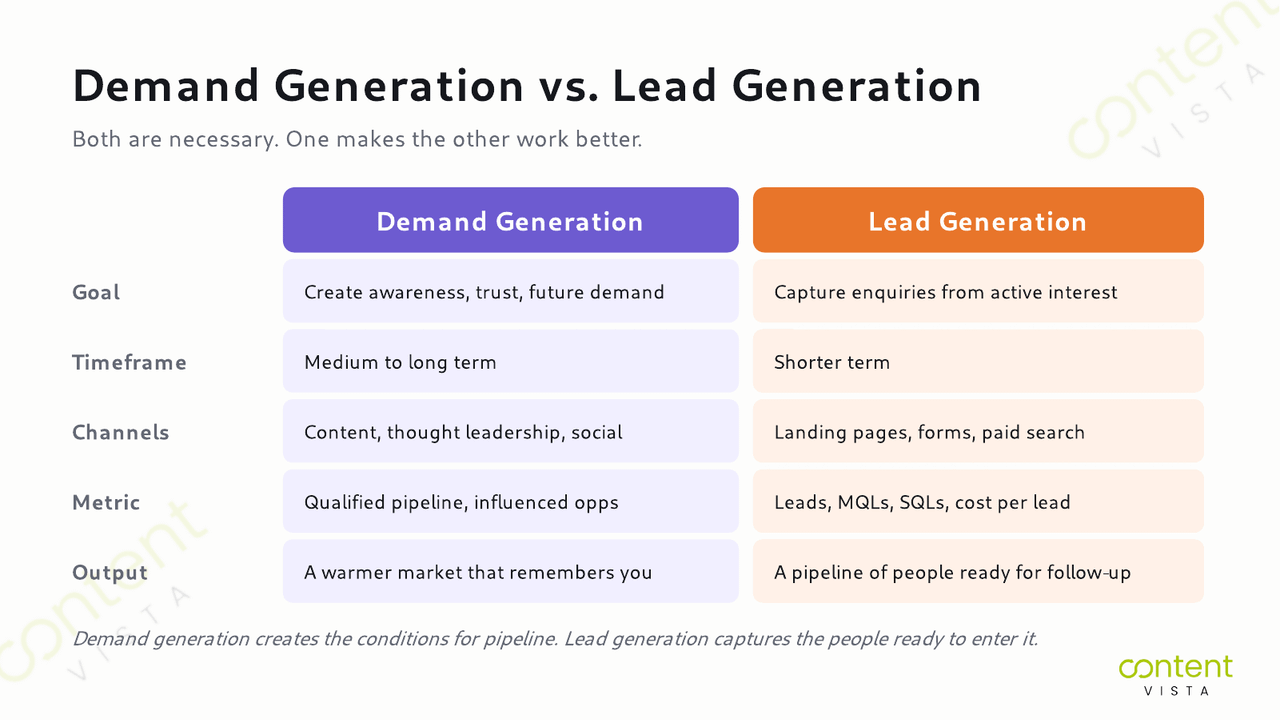
Demand generation creates the conditions for the pipeline. Lead generation captures the people who are ready to enter it.
| Dimension | Demand Generation | Lead Generation |
|---|---|---|
| Goal | Create awareness, trust, preference, and future demand across the market | Capture contact details or enquiries from people showing active interest |
| Timeframe | Medium to long term, because it builds market familiarity before buyers are ready | Shorter term, because it focuses on converting existing interest into leads |
| Typical channels | Content, thought leadership, social, PR, community, events, founder-led authority | Landing pages, forms, lead magnets, paid search, outbound, webinars, nurture flows |
| Key metric | Qualified pipeline, account engagement, brand demand, influenced opportunities | Leads, MQLs, SQLs, conversion rate, cost per lead |
| Output | A warmer market that knows, trusts and remembers you | A database or pipeline of people ready for follow-up |
If you already have enough market demand, strong lead generation systems can help capture it.
But if nobody knows you, trusts you, searches for you, or understands why your category matters, lead generation alone becomes a pressure game.
You keep asking cold audiences to convert before they are ready.
If you want the ground-level version first, start with what demand generation actually means and then come back here for the system.
Demand creation vs. demand capture - the split that changes everything
This is the sharper distinction.
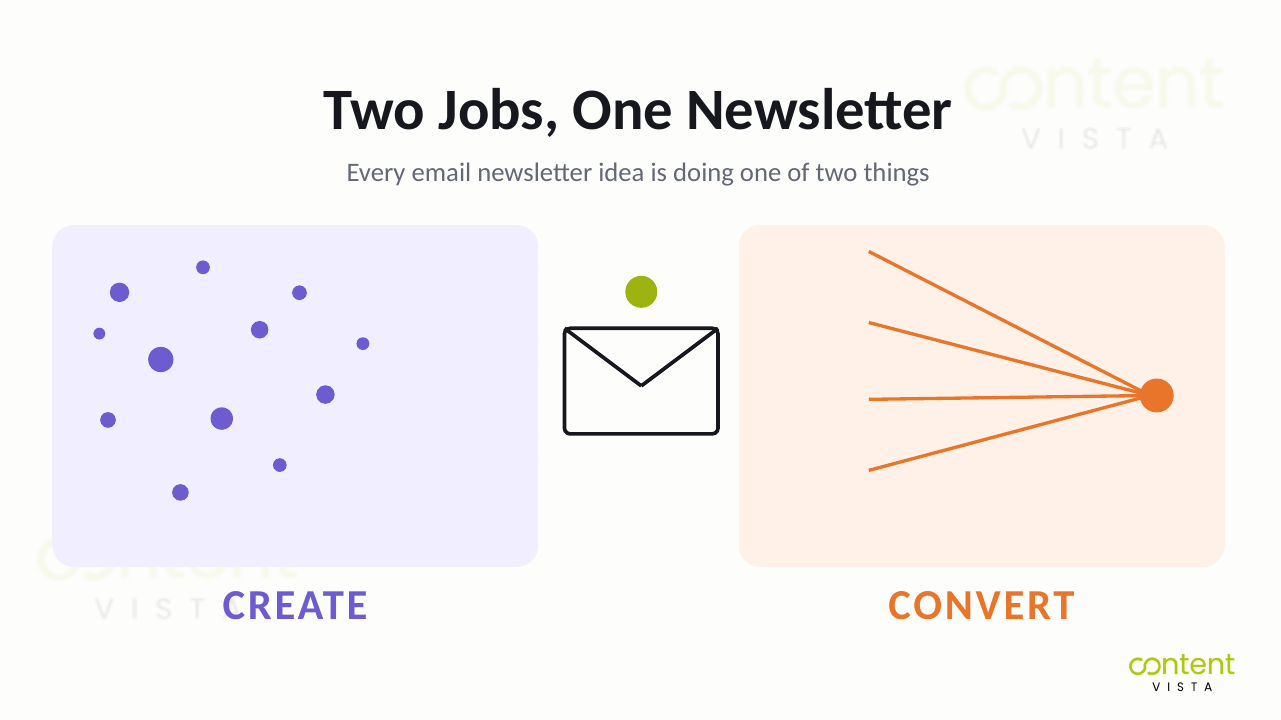
Demand creation is about educating, shaping, and influencing people before they are actively buying. For example: publishing a strong point-of-view article, running founder-led content, building category conversations or creating a useful benchmark that makes buyers rethink their current approach.
Demand capture is about meeting existing intent. For example: ranking for buyer keywords, running paid search on high-intent terms, creating comparison pages or retargeting people who have already engaged.
You need both.
Create demand so the market warms up before the buying window opens. Capture demand so you are present when the buyer is finally ready to move.
Why Most Demand Generation Fails: Tactics Without a System
Here's the problem:
Most demand generation does not fail because the team chose the wrong channel. It fails because the channels do not work together.
The content team publishes useful posts, but sales does not know how to use them. Paid campaigns generate clicks, but the landing page speaks to a different problem. Webinars create interest, but there is no nurture system after registration. SEO brings traffic, but the conversion path is weak.
Everything is active.
Nothing is compounding.
That is the difference between marketing activity and a demand engine.
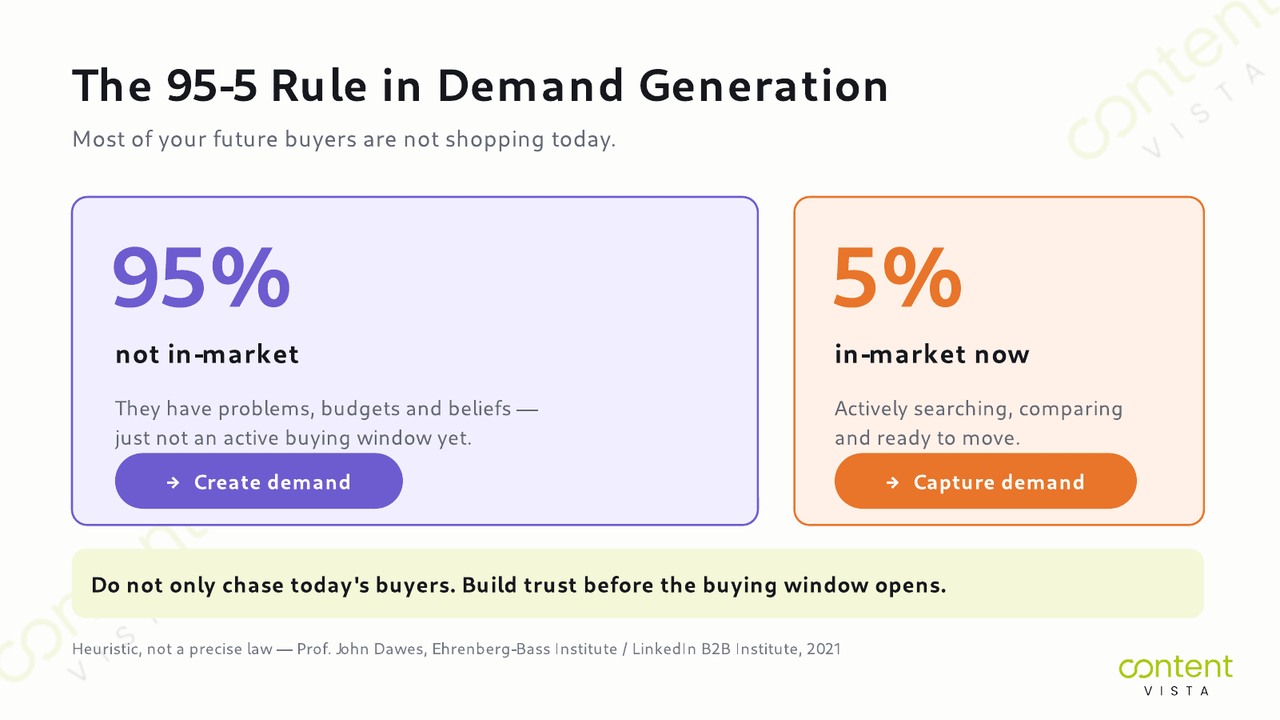
The 95-5 rule, introduced by Professor John Dawes of the Ehrenberg-Bass Institute in a 2021 paper for the LinkedIn B2B Institute, says that at any given moment, roughly 95% of B2B buyers are not actively in-market, while around 5% are ready to buy. Dawes is clear that this is a heuristic rather than a precise law - the figure comes from typical category purchase cycles and will vary by market, so treat it directionally.
So what does that mean?
If your entire strategy is built around capturing leads from the 5%, you are fighting over the smallest part of the market. You may get some short-term pipeline, but you are not building memory, trust, preference or category demand with the 95% who will buy later.
That is where lead-volume thinking caps growth.
It pushes teams to ask, "How many leads did we get this month?"
A stronger demand generation strategy asks a better question:
"Are we creating demand before buyers enter the market, capturing demand when they show intent, converting it into pipeline, and learning what to improve next?"
That is the real issue: without a system, every campaign resets from zero.
The Demand Engine: Create → Capture → Convert → Compound
Let's make this practical:
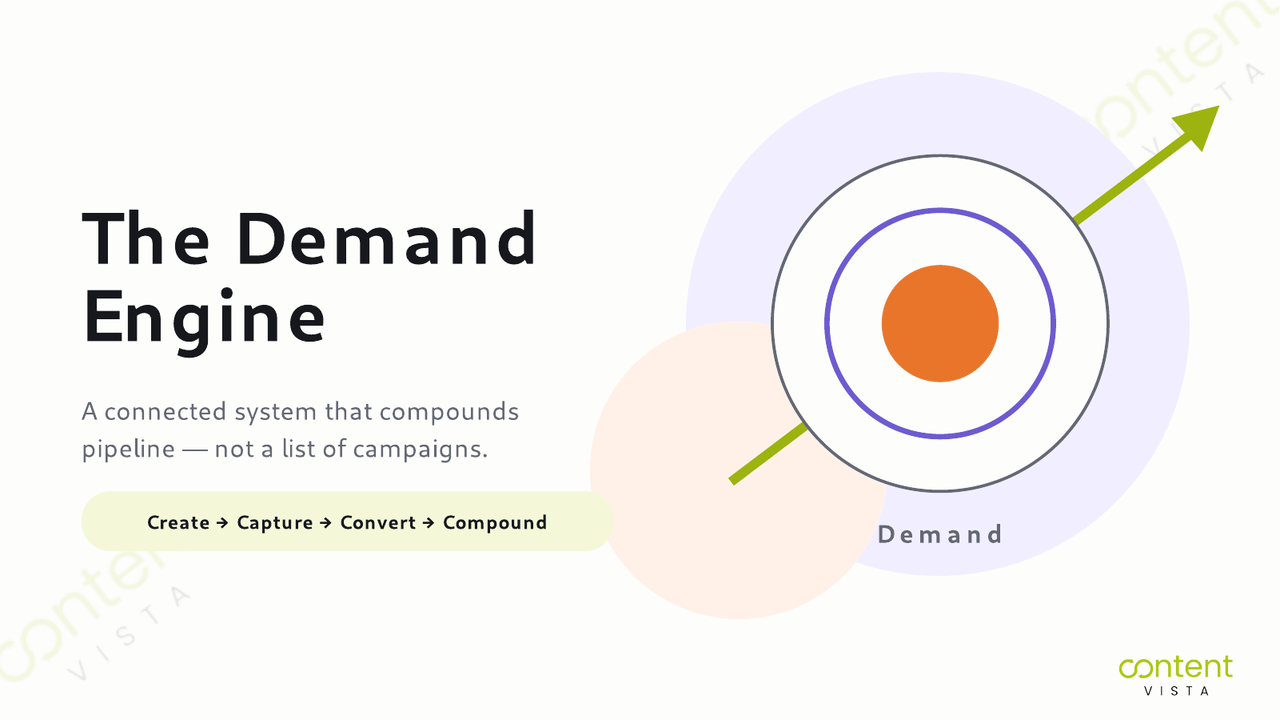
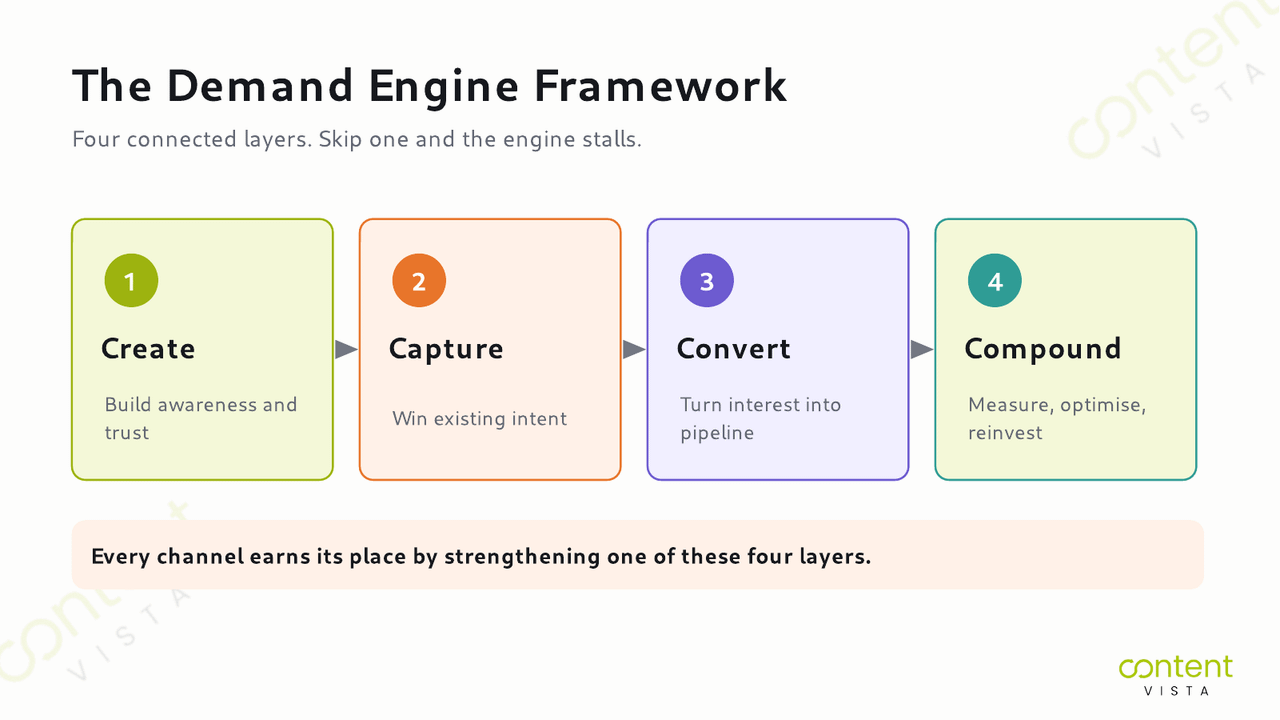
A demand generation strategy only works when it operates as one connected engine. At Content Vista, we call this the 4C Demand Engine: Create → Capture → Convert → Compound.
It is one part of the wider growth system that carries a business from first attention through to closed revenue.
Create is where you build awareness, trust, and preference before buyers are ready. This is the long-term layer: content, thought leadership, social, PR, founder authority and category education.
Capture is where you meet active intent. This includes SEO, paid search, retargeting, comparison content and bottom-funnel assets that help ready buyers find you when they start looking.
Convert is where interest becomes qualified pipeline. This is where landing pages, offers, nurture flows, qualification, CRM handoffs and sales alignment matter.
Compound is where the system improves. You measure what creates pipeline, identify the weakest layer, fix it and reinvest so growth builds instead of resetting every campaign.
Step-by-step process:
1. Create demand before buyers are ready.
2. Capture demand when buyers show intent.
3. Convert demand into qualified pipeline.
4. Compound results through measurement, optimisation, and reinvestment.
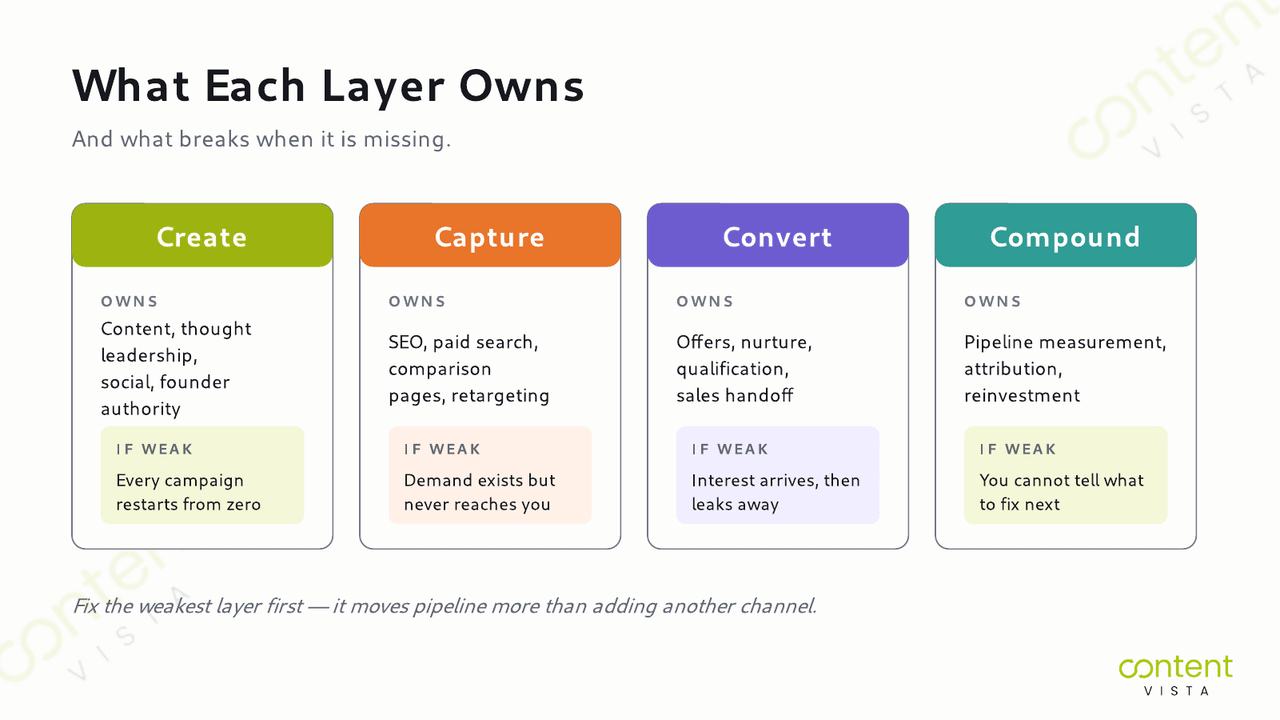
Skip one layer and the engine stalls. Creating without capture wastes attention. Capture without creating dries up. Convert without alignment leaks pipeline. Compounding without measurement becomes guesswork.
Layer 1 - Create Demand (Winning the 95%)
Creating demand means building awareness, trust and category preference before someone is ready to buy.
This is the layer that works on the future market.
The people who are not searching yet. Not comparing vendors yet. Not filling forms yet. But they do have problems, ambitions, frustrations and beliefs that can be shaped long before the buying window opens.
Here's where most teams go wrong:
They underfund this layer because it does not always produce instant leads.
So they keep pushing capture channels harder. More ads. More landing pages. More lead magnets. More outbound. But if the market does not know you, trust you or understand why your approach matters, capture gets expensive and conversion gets harder.
Demand creation is where you make the market warmer before it becomes active.
The core channels usually include:
Educational content that helps buyers understand the problem better
Content and thought leadership that gives the brand a clear point of view
Social distribution that keeps the brand visible between buying cycles
Founder-led content that builds trust through a human voice
PR, partnerships, and community presence that increase credibility
An inbound demand engine that turns useful content into sustained discovery
Good demand creation does not sound like "please buy from us."
It sounds like:
"Here is the problem you are underestimating. Here is why the old way is breaking. Here is a better way to think about it."
That is why thought leadership matters. The 2024 Edelman-LinkedIn B2B Thought Leadership Impact Report, which surveyed around 3,500 management-level professionals across seven countries, found that roughly nine in ten decision-makers and C-suite executives say they would be more receptive to outreach from a company that consistently produces high-quality thought leadership. Nearly three-quarters said thought leadership is a more trustworthy basis for judging a company's capabilities than its marketing materials. These are self-reported attitudes rather than measured behaviour, so read them as direction, not guarantee.
Founder-led demand works for the same reason. People trust clear thinking before they trust a sales pitch.
Wondering if your founder content is actually building authority and pipeline? Benchmark it with the Founder Authority & Audience Engine Benchmark.
Create demand first and the rest of the engine has something warmer to capture.
Layer 2 - Capture Demand (Winning the 5%)
Capturing demand means showing up when buyers are already looking.
This is the in-market layer.
These are the people searching for solutions, comparing options, reading alternatives, clicking ads, revisiting your website or asking, "Who can help us fix this?"
Your job here is not to educate the entire market from scratch. Your job is to meet existing intent with the right page, offer, proof and next step.
That usually includes:
SEO for buyer-intent keywords
Paid search for high-intent queries
Comparison pages and bottom-funnel content
Retargeting for people who have already engaged
Landing pages built around specific pain points or use cases
Case studies that help buyers reduce perceived risk
One important shift: capture is no longer only about search engines. G2's April 2026 Answer Economy report, based on a March 2026 survey of 1,076 B2B software buyers, found that 51% now start their research with an AI chatbot more often than with Google, up from 29% a year earlier. In the same study, 69% said AI guidance led them to choose a different vendor than they had originally planned.
The sample is software buyers specifically, so treat it as a strong signal rather than a universal figure - but the direction is hard to ignore. If your content is not clear, structured and quotable enough for an answer engine to cite, part of your capture layer is invisible.
This layer matters because demand creation without capture can waste attention.
If someone remembers your point of view, searches for your category, lands on your website and still cannot understand what you do or why they should take the next step, the engine leaks.
But there is a warning here:
Capture without creation eventually dries up.
You can only harvest existing demand for so long. If the market does not already know you, trust you or associate you with the problem you solve, capture channels become more competitive, more expensive and more dependent on short-term spend.
So the goal is not to choose between creation and capture.
The goal is to connect them.
Create demand so the market warms up before the buying window opens. Capture demand so that when buyers finally move, your brand is visible, relevant and easy to act on.
Layer 3 - Convert Demand Into Pipeline
Creating demand makes the market warmer.
Capturing demand brings interested people closer.
But conversion is where the system either turns that interest into qualified pipeline or lets it leak.
Think about it this way:
A buyer may read your content, click your ad, visit your service page, download a resource or attend a webinar. But none of that matters commercially unless there is a clear path from interest to action.
That path usually includes:
A relevant landing page or conversion point
A clear offer or next step
Lead capture that does not create unnecessary friction
Nurture that matches the buyer's stage
Qualification criteria that separate fit from noise
Sales handoff that preserves context
Follow-up that speaks to the actual problem, not just the form fill
Here's where most "conversion" problems are actually alignment problems.
Marketing celebrates the lead. Sales questions the quality. The buyer gets a generic follow-up. The nurture sequence says one thing, the sales call says another, and the CRM does not capture enough context to make the next conversation useful.
That is not a traffic problem.
That is a system problem.
And in complex buying journeys, the issue gets sharper. Gartner's research on the B2B buying journey describes a typical buying group for a complex solution as six to ten decision-makers, each arriving with information they gathered independently.
Forrester's The State Of Business Buying, 2024 puts the average higher, at 13 people involved in the buying decision, with 89% of purchases involving two or more departments. The two figures measure slightly different things, so the honest read is a range - but either way, the number is not one.
So you are rarely converting one person.
You are helping a group build confidence.
That means your conversion layer must do more than collect leads. It must create clarity, reduce risk, preserve context, and move the right opportunities into the pipeline.
Layer 4 - Compound (Measurement, Attribution & What to Fix Next)
Compounding is where a demand generation strategy becomes a growth system.
This layer is not about asking, "How many leads did we get?"
It is about asking:
"What created qualified pipeline, what helped opportunities move forward, and what should we fix next?"
That shift matters because lead volume can hide weak performance. A campaign may produce many form fills, but if those leads do not match your ICP, do not convert into sales conversations or do not influence revenue, the engine is not getting stronger.
You need to measure demand generation on pipeline and revenue quality, not activity alone.
Here is the honest part:
Attribution will never be perfect.
A buyer may first hear about you through a founder's LinkedIn post, later read three blog posts, ask a peer about you, search your brand, click a retargeting ad and finally fill out a form after visiting a service page. Last-touch software may credit the final form fill, but it often under-credits the demand creation that made the buyer trust you in the first place.
Practitioners who work on this problem daily - Chris Walker and the team at Refine Labs among the most vocal - argue that this gap is systematic, and that self-reported attribution ("how did you hear about us?") should sit alongside software rather than behind it. That is an informed operator view built on agency data, not peer-reviewed research, so weigh it accordingly.
But the practical lesson is useful:
Do not rely only on last-touch attribution to judge demand creation.
Use a mixed view instead: pipeline quality, sales conversations, self-reported attribution, direct traffic, branded search movement, content-assisted opportunities, CRM notes and closed-won patterns.
Then compound.
Find the weakest layer.
If people know you but do not convert, fix capture and conversion. If you get leads but poor-fit opportunities, fix messaging and qualification. If every campaign starts from zero, fix demand creation. If you cannot tell what is working, fix measurement.
Optimise the weakest layer, reinvest what works and repeat.
That is how demand compounds instead of resetting every month.
Demand Generation Channels Compared (Cost, Time & Effort)
Let's make this practical:
Not every demand generation channel behaves the same way.
Some channels create demand slowly but compound. Some capture intent quickly but stop the moment the budget stops. Some need heavy strategy and content. Others need tight targeting, fast testing and strong follow-up.
The mistake is treating all channels as interchangeable. The clearest starting split is inbound vs outbound marketing, because each one feeds a different layer of the engine.
Use the comparison below as a planning guide, not a universal benchmark. Exact CAC or CPL ranges vary by industry, ACV, audience maturity, geography, offer strength and sales cycle.
| Channel | Typical Cost/CAC | Time to Results | Effort/Notes |
|---|---|---|---|
| SEO/Content | Lower long-term CAC once authority builds; upfront strategy and production costs required | Medium to long term, usually slower at the start but compounding over time | Strong for demand creation and capture when content maps to the full buyer journey |
| Paid Search | Higher ongoing CAC in competitive categories; cost depends heavily on keyword intent and competition | Fast, often useful for immediate demand capture | Works best when landing pages, offer and sales follow-up are tightly aligned |
| Often higher cost per lead or engagement in B2B, especially for senior audiences | Medium term for authority; faster for targeted promotion | Useful for thought leadership, founder-led demand, retargeting and account-level visibility | |
| Can be efficient when the list is relevant; poor targeting damages performance and trust | Fast for existing audiences; slower if list quality or positioning is weak | Best used for nurture, education, reactivation, and sales support, not only cold conversion | |
| Webinars | Moderate to high cost depending on production, promotion, speakers, and follow-up | Medium term, especially when tied to nurture and sales enablement | Strong for complex offers where buyers need education before they are ready to speak |
| ABM | Higher cost per account, but potentially stronger fit when ACV justifies focus | Medium to long term, depending on account complexity and sales cycle | Best for defined high-value accounts, not broad market education |
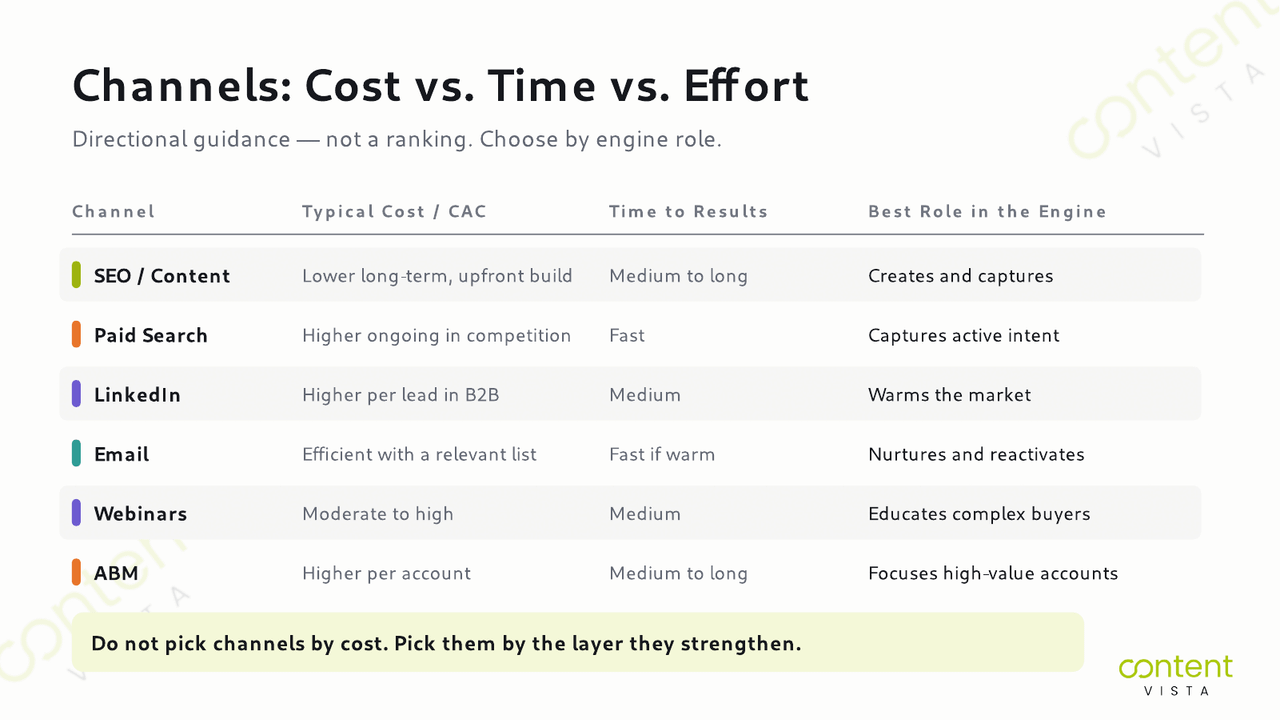
In short: do not pick channels only by cost.
Pick them by role.
SEO and content may build the long-term engine. Paid search may capture active buyers. LinkedIn and founder-led content may warm the market. Email and webinars may nurture. ABM may focus effort on high-value accounts.
The strategy is not "Which channel is best?"
The better question is:
"Which layer of the demand engine does this channel strengthen?"
How to Sequence and Weight Your Strategy (by Company Stage)
So which one are you?
That is the question most demand generation advice skips.
A company that is still proving product-market fit should not build the same demand engine as a mature business with clear ICP, strong proof and a long sales cycle. The right strategy depends on your stage, your market size, your deal value and how much demand already exists.
Early teams usually need sharper learning. Scaling teams need connected systems. Mature teams need efficiency, segmentation and compounding.
| Stage | Weight Create vs Capture | Lead Channels | Watch-outs |
|---|---|---|---|
| Early/Pre-scale | Weight toward learning, positioning and selective capture. Create demand carefully, but do not overbuild a broad content engine before the ICP and offer are clear. | Founder-led content, direct outreach, customer conversations, niche SEO, small paid tests, targeted landing pages | Do not mistake visibility for validation. If product-market fit is still unclear, demand generation may create noise before it creates pipeline. |
| Scaling | Balance create and capture. Build market trust while improving the paths that turn existing intent into qualified pipeline. | SEO/content, paid search, LinkedIn, webinars, nurture, retargeting, case studies, bottom-funnel pages | Watch for channel silos. This is where teams often grow activity faster than the system that connects it. |
| Mature | Weight toward compounding, segmentation, and efficiency. Create demand by category, audience and account tier; capture with precision. | ABM, thought leadership, executive content, partner campaigns, category reports, high-intent SEO, lifecycle nurture | Do not let legacy campaigns keep running because "they always have." Mature engines need sharper measurement and pruning. |
The decision logic is simple:
If your ICP is unclear, prioritise learning before scale.
If your ICP is clear but demand is inconsistent, build both creation and capture.
If your market is narrow and high-value, weigh more toward ABM and direct relationship-building.
If your market is broader, build an inbound engine that can compound across search, content, social and nurture.
The point is not to do every channel.
The point is to sequence the right layers in the right order, so each one strengthens the next.
Demand Generation Metrics & Benchmarks You Can Trust
Benchmarks are useful only when you treat them as ranges, not rules.
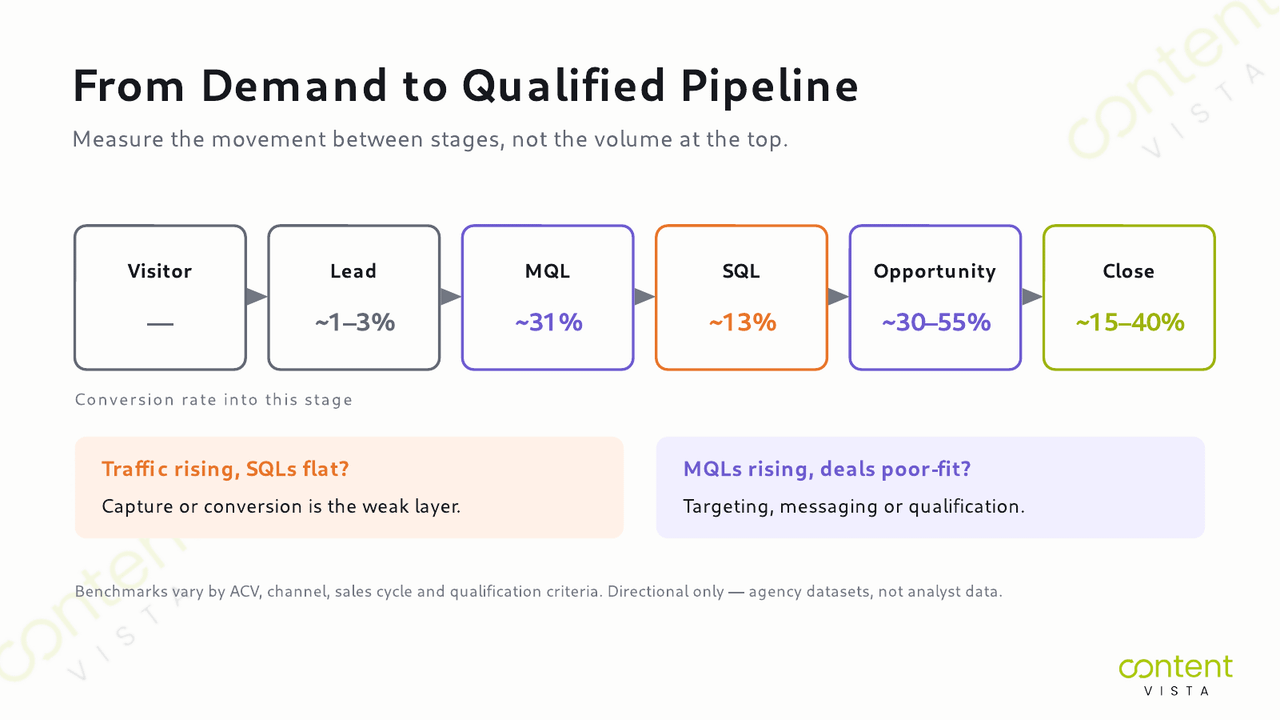
Your conversion rates will change based on your ACV, sales cycle, ICP clarity, channel mix, offer strength, and how strictly your team defines MQL, SQL and opportunity.
Here's where most benchmark articles mislead you: two companies in the same industry can report 13% and 40% for the same funnel stage, and both can be accurate, because they are measuring different definitions. The figures below come largely from agency datasets rather than analyst firms, so use them as reference points, not universal targets.
| Funnel Stage | Benchmark Range | Source / Year |
|---|---|---|
| Visitor to Lead | Around 1-3% for most B2B, lower for enterprise | First Page Sage; Ruler Analytics (2025-2026, agency/platform data) |
| Lead to MQL | Around 31% cross-industry | First Page Sage, 30-industry dataset (2025) |
| MQL to SQL | Around 13% cross-industry; materially higher in B2B SaaS | First Page Sage, client data 2019-2025 |
| SQL to Opportunity | Around 30-55%, depending on channel and definition | First Page Sage (2025-2026, agency data) |
| Opportunity to Close | Around 15-40%, with SMB typically higher than enterprise | First Page Sage (2025-2026, agency data) |
| Metric | Source / Year |
|---|---|
| Marketing budgets have plateaued at roughly 7.7-7.8% of company revenue | Gartner CMO Spend Survey, 2025 and 2026 |
| 46% of CMOs say their most urgent 2026 question is how to prioritise the initiatives most likely to drive growth | Gartner survey of 174 senior marketing leaders, September 2025 |
| Around 95% of B2B buyers are not in-market at any given moment (heuristic, not a precise law) | Professor John Dawes, Ehrenberg-Bass Institute / LinkedIn B2B Institute, 2021 |
| A typical complex B2B buying group runs from 6-10 decision-makers up to an average of 13 | Gartner; Forrester State of Business Buying, 2024 |
| 51% of B2B software buyers now start research with an AI chatbot more often than Google | G2, The Answer Economy, April 2026 (n=1,076) |
The budget number is worth sitting with. Gartner's CMO Spend Survey has shown marketing budgets flat at roughly 7.7-7.8% of company revenue for several years running, well below pre-pandemic levels. Meanwhile, Gartner's survey of 174 senior marketing leaders found that 46% named prioritising growth-driving initiatives as their most urgent question for 2026.
Read those together and the message is clear: nobody is getting more money. The teams that win are the ones that spend the same budget on a connected system instead of scattered activity.
The real takeaway is not "hit this exact number."
It is this:
Measure the movement from demand to qualified pipeline, not just the volume at the top. If traffic is rising but SQLs are flat, your capture or conversion layer is weak. If MQLs are rising but opportunities are poor-fit, your targeting, messaging, or qualification needs work.
Good demand generation metrics tell you what to fix next. For the full measurement picture, see our guide to demand generation frameworks and metrics.
When Demand Generation Is NOT Your Priority
The mistake is simple:
Teams hear "demand generation" and assume they need a full content engine, paid funnel, thought leadership motion, nurture system and attribution setup immediately.
Sometimes, they do not.
If you are still pre-product-market-fit, your priority is not broad demand creation. It is customer learning. Talk to real buyers, sharpen the problem, validate the offer and find repeatable proof before scaling visibility.
If your total addressable market is tiny or highly niche, broad demand generation may create wasted reach. You may be better served by direct relationship-building, founder-led outreach, partnerships and account-specific education.
If your motion is pure ABM and you are targeting a handful of named accounts, mass-market demand creation is not the first lever. Your priority is account intelligence, stakeholder mapping, tailored content and high-trust sales conversations.
Is demand gen your priority right now?
Yes, if your ICP is clear and you need a more predictable pipeline.
Yes, if buyers understand the problem, but do not yet associate your brand with the solution.
Yes, if you have proof, but your channels are disconnected.
No, if your offer is still unclear.
No, if you cannot define your best-fit buyer.
No, if your market is so narrow that direct account strategy will outperform broad demand creation.
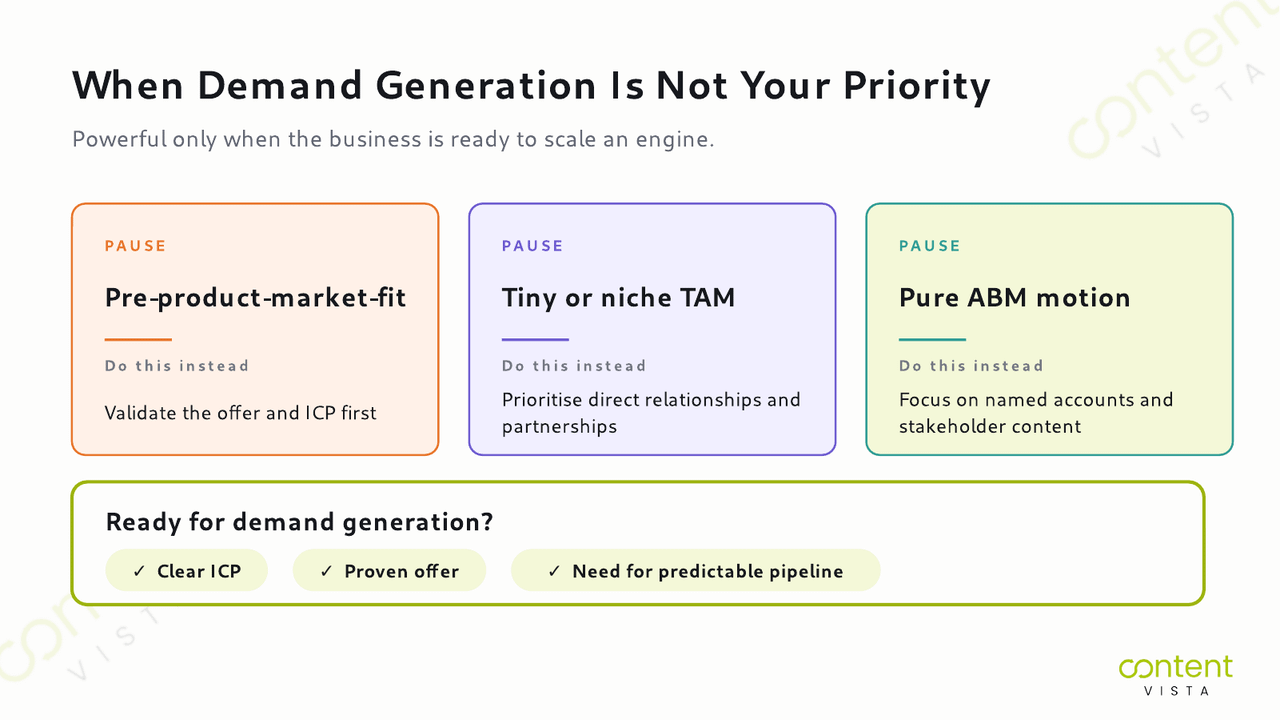
A good strategy is not doing demand generation because everyone says you should.
It is knowing when the engine is ready to scale.
Common Demand Generation Mistakes (and How to Fix Them)
Here's where most teams go wrong:
They do not fail because they are doing nothing.
They fail because they are doing too many disconnected things without a system underneath.
Mistake 1: All capture, no create.
The team spends everything on paid search, landing pages, retargeting and outbound, but does not build awareness or trust with future buyers.
Fix: Invest consistently in demand creation so the market is warmer before people start searching.
Mistake 2: Chasing MQL volume.
More leads look good in a dashboard, but they mean very little if they do not turn into qualified pipeline.
Fix: Measure quality, fit, sales conversations, opportunity creation and revenue movement, not form fills alone.
Mistake 3: Running channels in silos.
Content, paid, social, SEO, email and sales all operate separately, so the buyer experience feels fragmented.
Fix: Give every channel a defined role in creating, capturing, converting or compounding demand - and make sure each one hands off to the next.
Mistake 4: Treating nurture as an afterthought.
Someone shows interest, receives a generic email sequence, and then disappears.
Fix: Build nurture around buyer stage, pain point, proof and next logical action.
Mistake 5: Underfunding brand and thought leadership.
The team wants an immediate pipeline but avoids the work that creates trust before the buying window opens.
Fix: Use clear points of view, founder-led content, proof and category education to create memory before demand becomes active.
Mistake 6: Measuring activity instead of learning.
Campaigns are reported, but the team does not know what to improve next.
Fix: Review the weakest layer every month and reinvest in what is actually moving the pipeline.
What Good Looks Like (Real Examples)
Good demand generation is not one brilliant campaign.
It is a connected system where the right strategy, channels, content, capture points and follow-up work together.
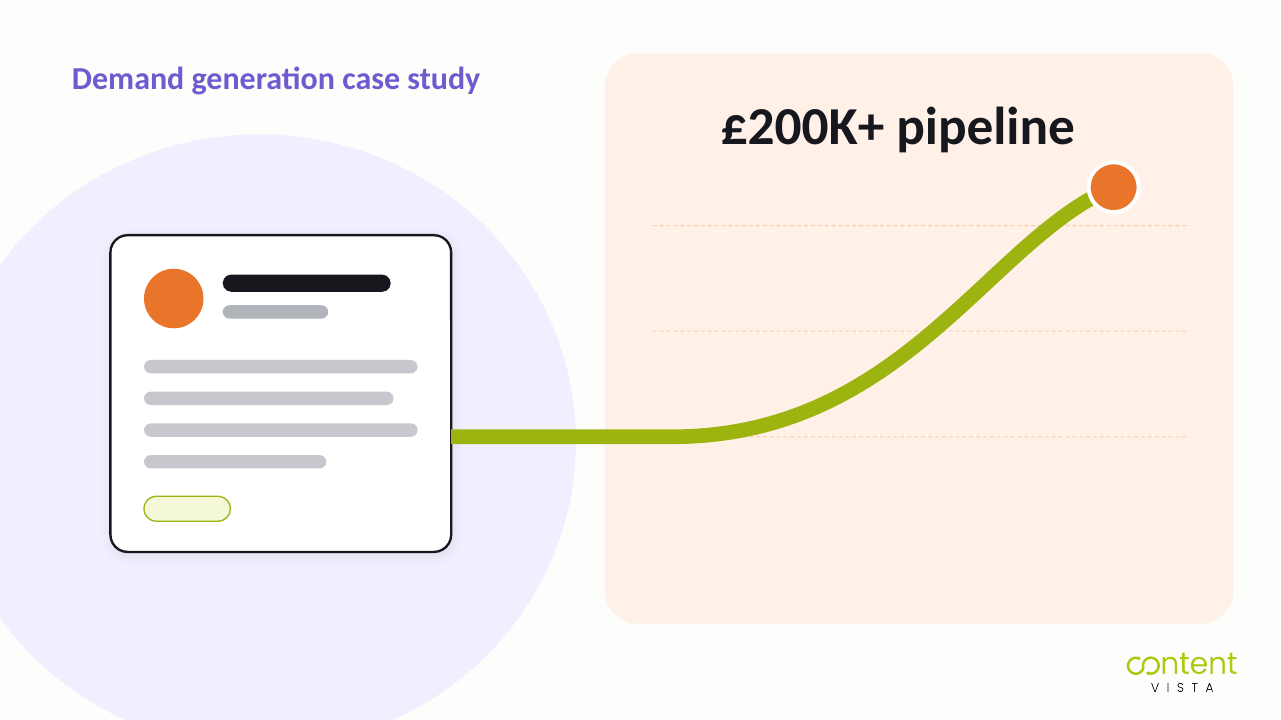
For Akshar Business Consulting, a content-led demand engine built around founder authority, a fortnightly LinkedIn newsletter and a rebuilt resource hub produced 4,000+ newsletter subscribers, a +35 point lift in LinkedIn SSI and £200K+ in estimated pipeline. That is the Create layer doing its job first, with capture and conversion built to catch what it warmed up.
For Personam, the work started from zero brand presence in a sceptical enterprise cybersecurity market. Founder personal branding plus a structured content and newsletter programme produced a 41.8% newsletter open rate and 1,000+ LinkedIn followers from a standing start. Demand creation is what makes a market notice an unknown company at all.
Two shorter examples show the other layers at work. SalesFed built brand, LinkedIn, webinar and outreach into one end-to-end engine and generated $400K in qualified pipeline. Housewright is a capture-layer story: search demand already existed, and connecting website, SEO and conversion pages turned it into 270+ leads and 450% SEO growth.
That is what good looks like:
Not scattered marketing wins.
A demand engine where every layer supports the next.
Where to Start: Diagnose Your Weakest Layer
By now, the pattern should be clear:
A demand engine is only as strong as its weakest layer.
You may have strong content but poor capture. Strong traffic but weak conversion. Good leads but poor qualification. Or plenty of campaign activity, but no real compounding because measurement is unclear.
That is why the smartest first move is not to launch another campaign.
It is to diagnose the system.
Start by asking: Where is demand leaking right now? In our experience, it is almost always one of four gaps.
The discovery gap. Buyers are not finding you early enough. Your name does not come up when someone in your category starts thinking about the problem. Symptoms: low branded search, no inbound that you did not chase, every deal sourced by outbound.
The credibility gap. Buyers see you but do not trust your perspective yet. You get traffic and impressions, but not conversations. Symptoms: good reach, weak reply rates, prospects who "have heard of you" but cannot say what you stand for.
The capture gap. Demand exists, but the path from interest to enquiry is broken. Symptoms: rising traffic, flat enquiries, pages that inform but never invite the next step.
The routing gap. Intent shows up, then dies in the handoff. Symptoms: enquiries that go cold, sales asking "where did this come from?", CRM records with no context.
Most teams have one dominant gap, not four. Fixing the dominant one usually moves the pipeline more than adding another channel.
If the issue is strategic sequencing, your growth strategy may need work. If the issue is execution across creation, capture and conversion, your demand generation services layer may need to be rebuilt as a connected engine.
Not sure which gap is yours? Diagnose it in minutes with the Marketing Growth Maturity Assessment.
Frequently Asked Questions
What is a demand generation strategy?
A demand generation strategy is a connected marketing system designed to create awareness, capture buyer intent, convert interest into qualified pipeline and compound results over time. The goal is not simply to get more leads. The goal is to build predictable demand that supports revenue.
What's the difference between demand generation and lead generation?
Demand generation is the broader discipline. It builds awareness, trust, preference and market demand before buyers are ready. Lead generation focuses on capturing and converting people who have already shown interest.
What are the 4 pillars of demand generation?
At Content Vista, we define the 4 pillars of demand generation as audience/ICP, content and distribution, capture and nurture and measurement and alignment. In simple terms: know who you are creating demand for, reach them with useful content, convert interest into pipeline and measure what actually moves revenue.
How do you build a demand generation strategy?
Start with your ICP, positioning, and pipeline goal. Then build the engine: create demand through content and authority, capture demand through SEO and high-intent channels, convert demand through funnels and nurture, and compound results through measurement and optimisation.
What is the 95-5 rule in B2B marketing?
The 95-5 rule says that most B2B buyers are not actively in-market at any given time, while a much smaller share are ready to buy. It comes from Professor John Dawes at the Ehrenberg-Bass Institute and is a heuristic rather than an exact measurement. The practical lesson is clear: do not only chase today's buyers. Build trust with future buyers before they enter the market.
Demand generation vs. ABM - what's the difference?
Demand generation builds demand across a broader market or category. ABM focuses on a defined set of high-value target accounts. The two can work together: demand generation warms the market, while ABM concentrates effort on the accounts that matter most.
How much should I budget for demand generation?
There is no universal budget because it depends on your stage, ACV, market size, sales cycle, channels and internal capacity. For context, Gartner's CMO Spend Survey has found overall marketing budgets sitting at roughly 7.7-7.8% of company revenue in recent years. A scaling company may need a balanced mix of content, SEO, paid search, social, nurture and sales enablement, while a narrow ABM motion may spend more on account-specific strategy.
How do you measure demand generation ROI?
Measure demand generation ROI by looking at qualified pipeline, opportunity quality, revenue influenced, CAC, sales cycle movement and conversion across the funnel. Do not rely only on lead volume or last-touch attribution. A good measurement system helps you identify which layer to fix next.
Build a Demand Engine That Compounds
In short:
Stop running disconnected tactics and start building a system.
A strong demand generation strategy does not depend on one campaign, one channel, or one lucky spike. It creates demand before buyers are ready, captures demand when they show intent, converts that interest into qualified pipeline and compounds through measurement, optimisation and reinvestment.
That is the Create → Capture → Convert → Compound engine.
When these layers work together, marketing stops resetting every month. It starts building memory, trust, pipeline and momentum.
Not sure which layer of your demand engine is weakest? Diagnose it in minutes with the Marketing Growth Maturity Assessment.