Quick Summary
- Demand generation is the process of creating, capturing, converting and compounding market interest before and during the buying journey.
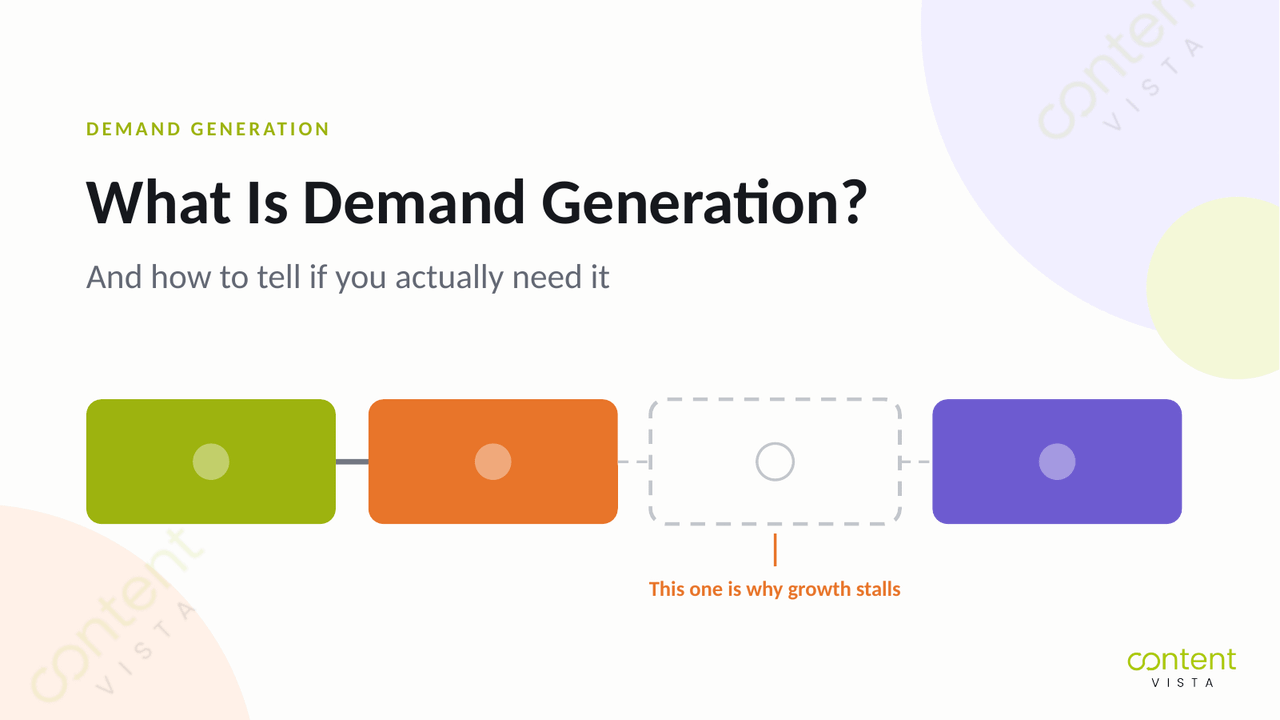
- In this article, we'll break down what a working demand engine actually does, then help you diagnose the Four Demand Gaps: discovery gaps, credibility gaps, capture gaps and routing gaps.
- The key point: demand generation is not always the fix.
Why "Demand Generation" Is Such a Confusing Term Right Now
You've probably read ten definitions of demand generation and still feel a little fuzzy about what it actually means.
That's not your fault. The term has been stretched in too many directions.
SaaS vendors use "demand generation" to describe software workflows. Agencies often use it as a bigger-sounding label for content marketing, paid ads, SEO or lead generation.
LinkedIn influencers use it to talk about brand, audience building, founder-led content or thought leadership. Sales teams sometimes use it as a synonym for "more leads this month."
So when a business owner or marketing leader asks, "What is demand generation?", they are usually not asking for a textbook definition. They are trying to understand something more practical:
"Do we need this right now or do we just need better lead generation, better conversion, better positioning or a cleaner marketing system?"
That is the real question.
In this article, we'll define demand generation clearly, separate it from nearby concepts like lead generation and demand capture and give you a practical way to decide whether demand generation should actually be your next marketing priority.
Demand generation is not just "getting attention." It only matters when attention can be turned into trust, pipeline and eventually revenue.
What Demand Generation Actually Means
Here's the cleanest way to say it:
Demand generation is the system of creating awareness and capturing buying intent before prospects speak to sales, especially because modern B2B buyers often research anonymously. Unlike lead generation, it does not only collect forms; it builds demand and captures the intent that already exists.
Demand generation is not the same as filling forms. A form fill is only one possible output of demand generation. If people download an ebook but do not understand the problem, trust the brand or move closer to a buying decision, you have captured contact details, not necessarily created demand.
It is also not the same as pipeline management. Pipeline management begins once opportunities are being qualified, moved, forecasted and closed. Demand generation sits earlier. It creates the conditions that make the pipeline possible.
The practical distinction is this: demand generation works across both sides of the market.
It helps create demand among the larger group of people who are not actively looking to buy yet, often described through the 95% out-of-market framing.
It also helps capture demand from the smaller group who are already searching, comparing, asking for recommendations or evaluating vendors.
So demand generation should not be treated as a standalone campaign. It is one layer inside a connected growth system.
It builds awareness, trust, recall, search intent, direct traffic, qualified conversations and eventually revenue momentum when the rest of the system is strong enough to convert that interest.
Why Demand Generation Matters Now (More Than It Used To)
Demand generation matters more now because buyers are harder to interrupt, harder to track and often much further into their research before they ever speak to a vendor.
The 95-5 rule is the simplest way to frame this. In Professor John Dawes' original paper for the Ehrenberg-Bass Institute, written for LinkedIn's B2B Institute in 2021, the argument is that up to 95% of business buyers are not in the market for a given product or service at any one time — because most B2B categories only get repurchased once every few years.
Worth noting: Dawes is explicit that 95% is a heuristic, not a precise rule. If you know how often your category actually gets bought, you can calculate your own split. Directionally, though, the implication holds. Most of the people who will eventually buy from you are not shopping today.
That changes the job of marketing.
Old-school lead generation often assumes the buyer is already interested. Put an offer in front of them, collect the form fill and pass the lead to sales. That still has a place, but it is not enough when much of the buyer journey happens before a form fill.
6sense describes this invisible research period as the "Dark Funnel," where buyers research anonymously before they identify themselves.
Its 2025 B2B Buyer Experience Report found that buyers now complete roughly 60% of their journey independently before contacting any vendor — earlier than the 70% mark it had tracked in previous years — and the vendor they already favour at that first contact goes on to win around 80% of the time.
Read that again: most of the deciding happens before you know the buyer exists.
AI is also changing discovery. G2's Answer Economy report, based on a March 2026 survey of 1,076 B2B software buyers, found that 51% now start their research in an AI chatbot more often than in Google, up from 29% a year earlier.
That is software-buyer data, so treat the exact number as directional for other categories. The direction itself is hard to argue with. AI Overviews and AI chatbots now influence what buyers see, shortlist, compare and trust before they land on your website.
At the same time, marketing teams have less room for disconnected tactics.
Gartner's 2025 CMO Spend Survey of 402 marketing leaders found budgets flat at 7.7% of company revenue for the second year running, with 59% of CMOs saying that budget is not enough to execute their strategy.
Flat budget. Harder-to-reach buyers. A discovery layer you do not control. That combination is why a connected demand generation strategy matters.
It helps you reach future buyers early, capture active intent when it appears and avoid wasting budget on isolated campaigns that cannot compound.
Demand Generation vs Lead Generation vs Demand Capture
Here's where most people get this wrong: demand generation, lead generation and demand capture are connected, but they are not the same job.
Lead generation focuses on identifying people who are willing to share contact information. Demand capture focuses on converting people who are already searching, comparing or ready to speak to a vendor.
Demand generation is broader. It includes the work that makes people aware of the problem, trust your point of view, remember your brand and eventually move into active buying intent.
That distinction matters because a business can have "leads" without real demand. It can also capture existing demand for a while through search ads, retargeting or comparison pages, but struggle later because it is not creating future demand.
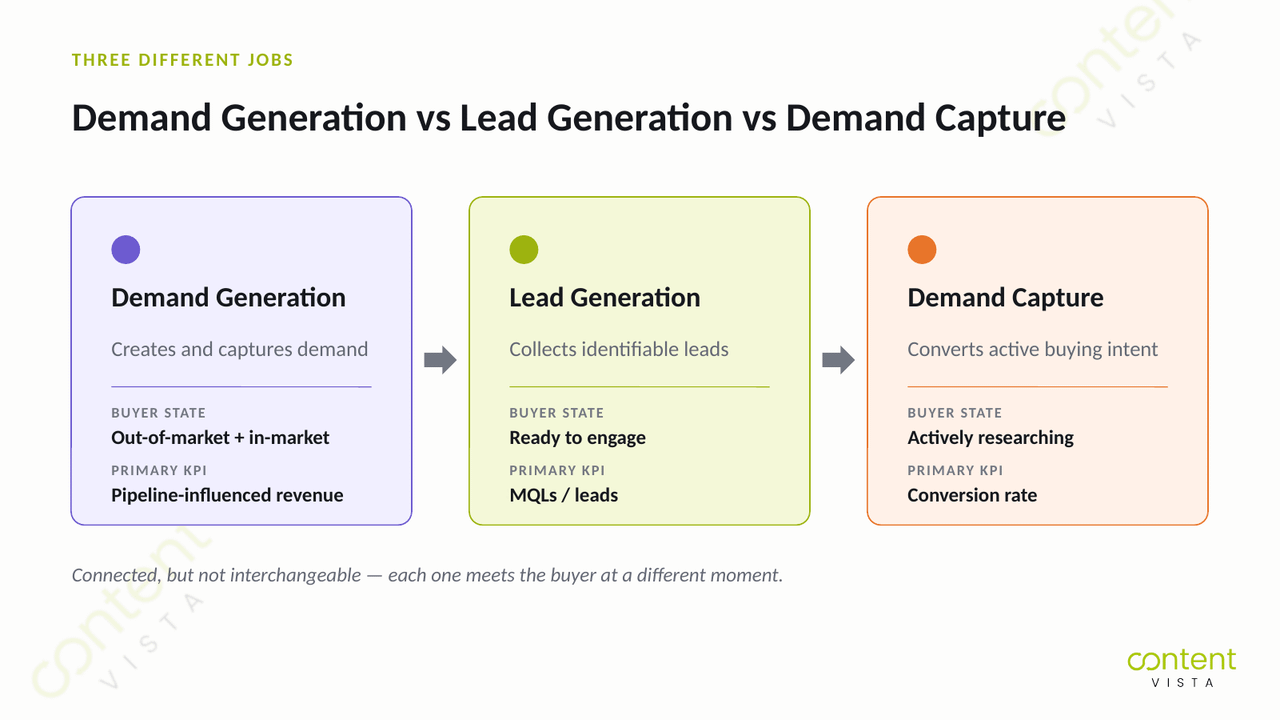
| Dimension | Demand Generation | Lead Generation | Demand Capture |
|---|---|---|---|
| What it does | Creates AND captures demand across the buyer journey | Collects identifiable contact info from prospects | Harvests existing in-market intent |
| Buyer state | Includes out-of-market and in-market | Mostly in-market, ready to engage | Strictly in-market, actively researching |
| Primary KPI | Pipeline-influenced revenue | MQLs / leads | Conversion rate, captured-intent volume |
| Time horizon | Long-term + short-term | Short-term | Short-term |
| Example channels | Thought leadership, founder content, podcasts, SEO, paid, ABM | Lead magnets, forms, gated content, sales outreach | BOFU SEO, paid search, comparison content, retargeting |
A simple way to think about it:
Demand generation builds the market's interest.
Lead generation identifies who is willing to engage.
Demand capture converts people who are already showing intent.
If your business already has strong awareness and trust, you may need a better lead generation system. If people are actively searching for your category but not choosing you, you may need better demand capture.
But if the market does not understand the problem, does not trust your brand yet or only remembers competitors when it is time to buy, you likely need demand generation.
How Demand Generation Actually Works as a System
Demand generation becomes easier to understand when you stop seeing it as a campaign type and start seeing it as a system.
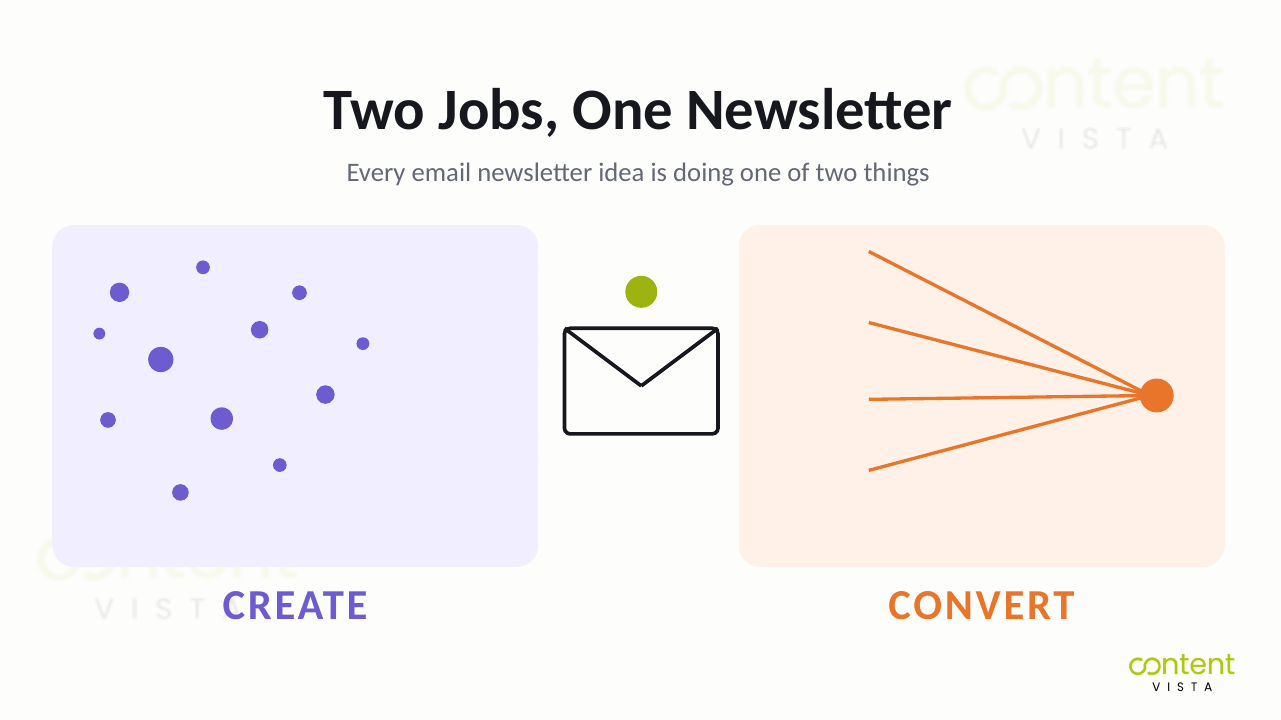
A working demand engine does four jobs. Not four campaigns, not four departments — four jobs that have to connect. Separating them is what lets you diagnose where growth is actually breaking instead of simply adding more activity.
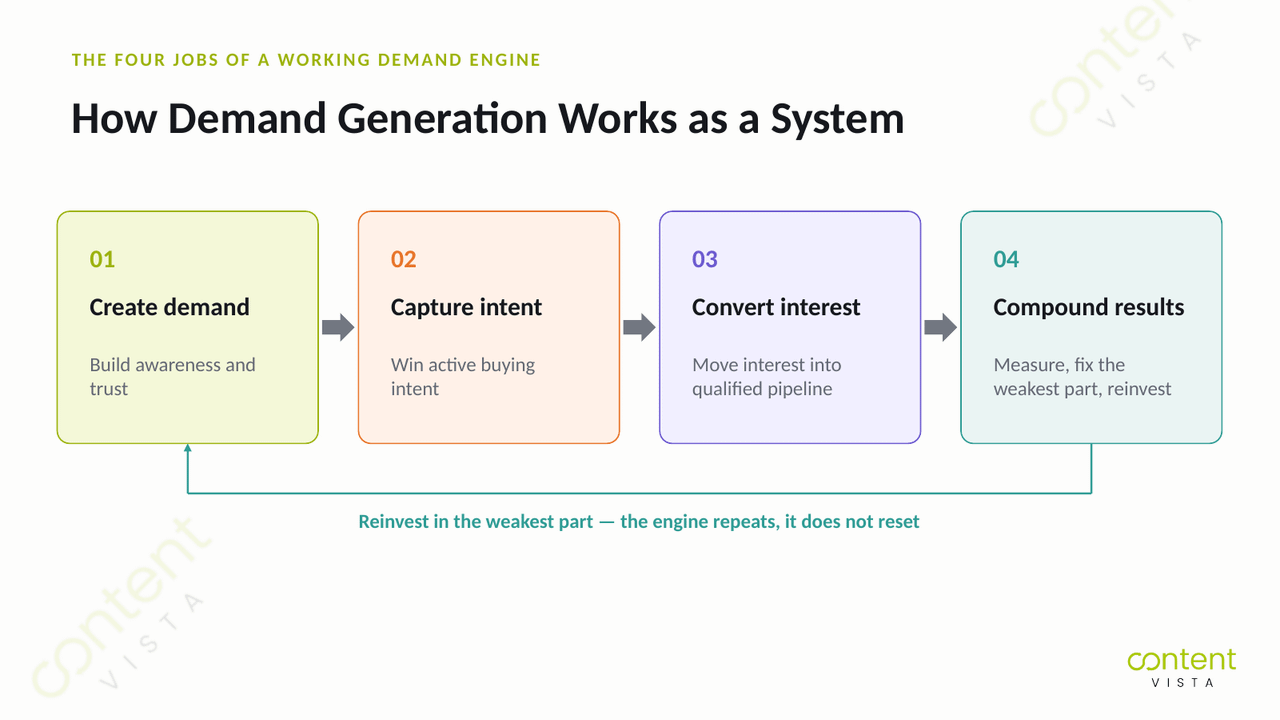
| Job | What it does | Example activities |
|---|---|---|
| Create demand | Generate awareness, trust, and category demand among the ~95% out-of-market | Thought leadership, founder content, brand, social, PR, podcast guesting |
| Capture intent | Harvest existing in-market intent from the ~5% | SEO on buyer keywords, paid search, comparison content, retargeting |
| Convert interest | Move captured interest into qualified pipeline | Funnels, lead capture, nurture, sales alignment, qualification |
| Compound results | Measure on pipeline/revenue, fix the weakest part, reinvest | Pipeline-influenced revenue tracking, attribution, system optimisation |
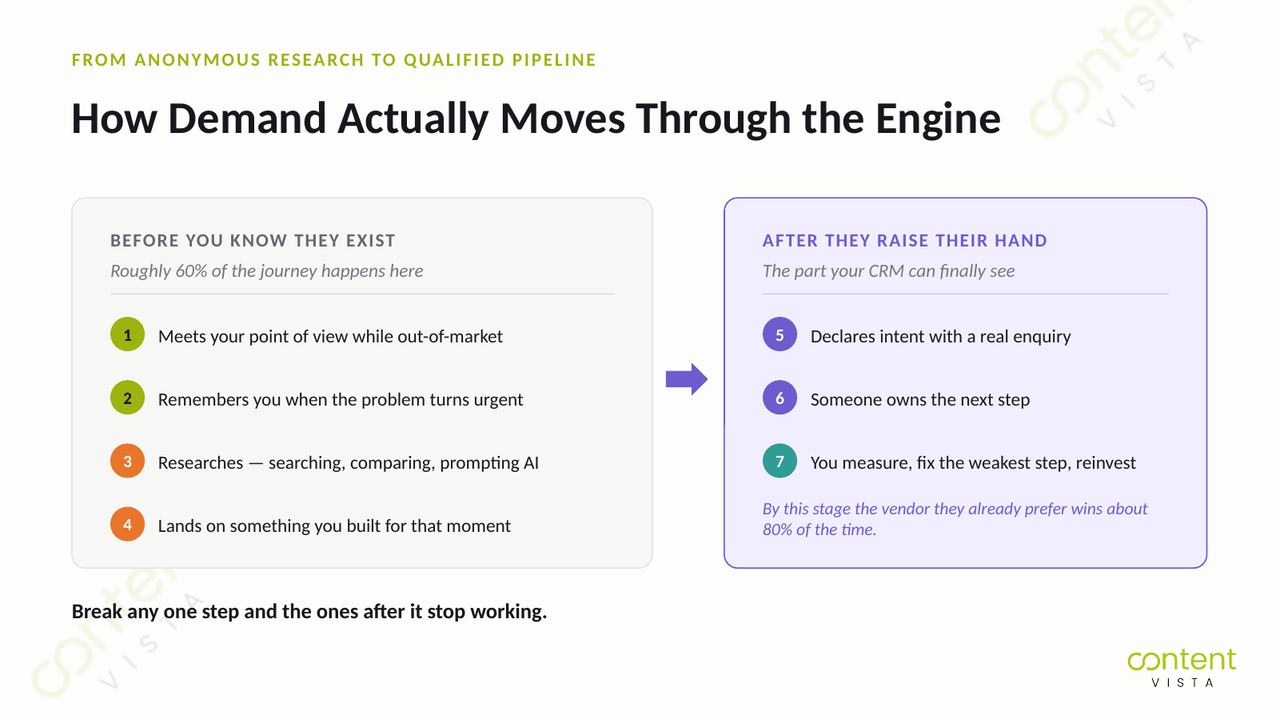
So what does that look like in motion? Here's how demand actually moves through a working engine, start to finish:
A future buyer meets your point of view while they are still out-of-market — through a founder post, a podcast, an article, a peer recommendation or an AI answer.
They remember you when the problem becomes urgent. This is the part you cannot buy later.
They start researching — searching, comparing, asking peers, prompting an AI chatbot. Mostly anonymously.
They land on something of yours built for that moment — a buyer-intent page, a comparison, a diagnostic tool, a service page.
They declare intent by enquiring, booking, or asking a real question.
Someone owns the next step — qualification, follow-up, nurture, sales handoff.
You measure which of those steps produced qualified pipeline, fix the weakest one, and reinvest there.
Break any one of those seven steps and the ones after it stop working. That is the whole argument for treating demand generation as a system rather than a campaign.
Creating demand
This is the job most companies under-invest in, because it does not always produce instant leads.
But if the 95-5 rule is directionally right, most of your future buyers are not actively shopping today. They may not be searching for vendors, requesting proposals, or comparing options yet. That does not mean they are irrelevant. It means they are in the education, awareness or problem-recognition stage.
Creating demand means shaping how those people understand the problem before they enter the market. In practice, this can look like founder-led content, point-of-view articles, category education, social media narratives, expert commentary, podcasts, PR and consistent content and thought leadership.
Here's why this matters: if buyers only discover you when they are already comparing vendors, you are entering the conversation late.
It also works from a standing start. Personam, an AI threat-detection platform, launched with no brand identity, no website, no content and no social presence.
A 26-competitor market study, a rebuild of the brand and a consistent content engine took it from zero to 1,000+ LinkedIn followers and a 41.8% newsletter open rate — visibility built before buyers were shopping, in a category where nobody had heard of them.
If you want a read on how much authority you are actually building, the Founder Authority & Audience Engine Benchmark gives you a baseline.
Capturing intent
Creating demand and capturing demand are different jobs.
Creating demand is about reaching people before they are ready to buy. Capturing it is about being visible when they are already showing intent.
A buyer searching for "best demand generation agency," "demand generation strategy," "lead generation vs demand generation," or "B2B marketing funnel help" is no longer casually browsing. They are actively trying to solve something.
That is where SEO, paid search, retargeting, comparison content, bottom-funnel landing pages and category-specific service pages matter.
The mistake is choosing one side and ignoring the other. If you only create demand, you may educate the market but fail to capture people when they are ready. If you only capture demand, you may compete for the same small in-market pool as everyone else.
A stronger demand generation strategy connects both.
Converting interest into pipeline
Captured interest is not the same as pipeline.
Someone can visit a page, click an ad, download a guide, attend a webinar or reply to a post and still not be ready for a sales conversation. This is where many demand generation programs leak. They create awareness, capture attention and then send people into a vague next step.
Conversion means building the path from interest to qualification. That includes clear landing pages, relevant CTAs, lead magnets, diagnostic tools, nurture sequences, qualification criteria, CRM hygiene and sales alignment.
Let's make this concrete: if your SEO brings in the right visitors but your page offers only a generic "Contact Us," you may not have a traffic problem. You may have a conversion problem.
Demand generation does not end when someone becomes identifiable. It must help move the right people toward the right next action.
Compounding what works
The final job is what turns demand generation from a set of activities into a growth system.
Compounding starts when you measure what each part of the engine is doing and improve the weakest one. Not vanity metrics alone. Not just impressions, likes, clicks or lead volume. The real question is: what is stopping demand from becoming revenue?
If awareness is weak, invest in creating demand. If intent exists but competitors capture it, improve your capture path. If traffic and leads exist but opportunities do not, fix conversion. If campaigns work once but never get better, you are not compounding.
If you want the full build — the whole engine, laid out layer by layer — that lives in our demand generation strategy guide, where we call it the 4C Demand Engine. This page stays on what demand generation is and whether you actually need it.
The goal of demand generation is not "more activity." The goal is to identify the weakest part of your demand engine, improve it and reinvest what works.
The Four Demand Gaps — Where Your Engine Is Probably Broken
Here's the useful part. Knowing what a working demand engine looks like is one thing. Knowing which part of yours is broken is another.
This matters because most teams misdiagnose the problem. They think they need "more demand generation" when they may actually have a credibility problem, a capture problem or a routing problem.
The result is predictable: more content, more campaigns, more leads, but no meaningful improvement in pipeline.
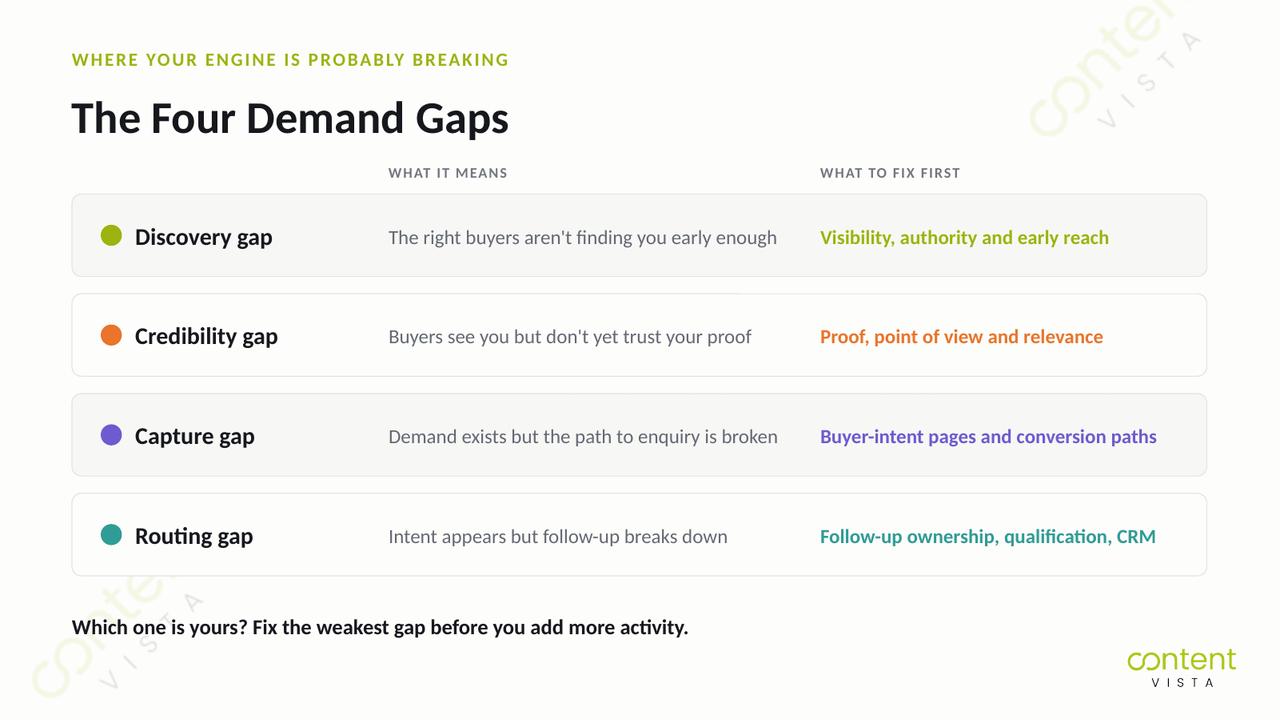
| Gap | What it means | Symptoms you'd see | What to fix first |
|---|---|---|---|
| Discovery gap | The right buyers aren't finding you early enough | Low brand searches, low share of voice, founder posts get no traction | How you create demand — visibility, authority and early reach |
| Credibility gap | Buyers see you but don't yet trust your perspective, proof, or relevance | Traffic but no enquiries, ICP doesn't engage, no proof points | Proof, point of view and the relevance of what buyers land on |
| Capture gap | Demand exists but the path from interest to enquiry is broken | Branded search traffic that doesn't convert, BOFU pages with no clear next step | Your buyer-intent pages and the path from interest to enquiry |
| Routing gap | Intent appears but handoff, CRM or follow-up breaks down | Leads come in but sales doesn't act, no nurture sequence, CRM is a graveyard | Follow-up ownership, qualification, CRM hygiene and sales handoff |
Discovery gap
You have a discovery gap when your ideal buyers are not finding you before they enter buying mode. They may know the problem exists, but they do not associate your brand with the solution. Look for weak brand search, low direct traffic, poor organic visibility and content that gets published but never enters the market conversation.
Credibility gap
You have a credibility gap when people see you, but do not yet trust you enough to engage. This usually shows up as traffic without enquiries, social visibility without meaningful conversations or content that explains the topic but does not prove your authority. The issue is not reach. It is belief.
Capture gap
You have a capture gap when demand exists, but your website, content or offer does not give active buyers a clear next step. People may visit your service pages, read bottom-funnel content, or search your brand, but leave without converting. In this case, more awareness will not fix a broken capture path.
Routing gap
You have a routing gap when enquiries come in, but the system after that point is weak. Leads are not qualified, followed up with, nurtured or handed to sales properly. This is where marketing activity creates motion, but not revenue momentum. The problem is not demand. It is operational follow-through.
Not sure which gap you have? The Marketing Growth Maturity Assessment walks you through it in about ten minutes and gives you a prioritised fix list.
Which Channels Create Demand vs Which Channels Capture It
Here's where teams get this wrong: they treat every channel as if it can do the same job.
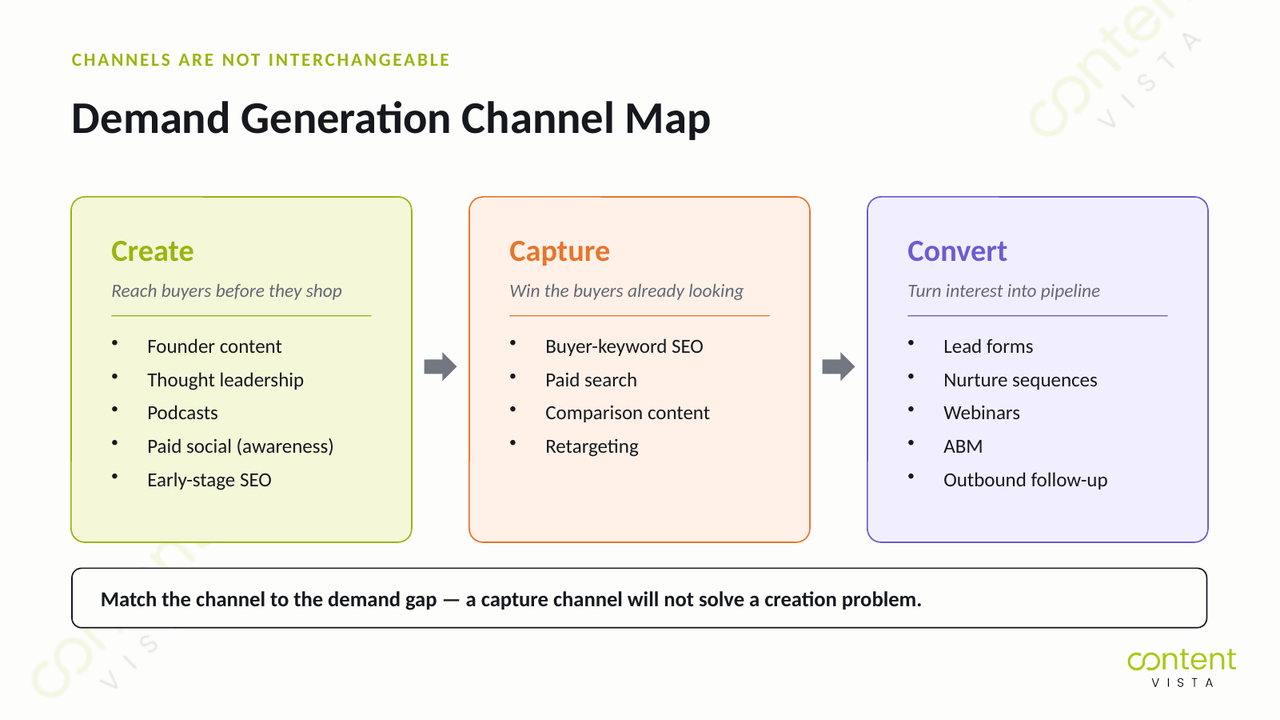
But channels are not interchangeable. A founder's LinkedIn post, a bottom-funnel SEO page, a paid search ad, a webinar and a cold email sequence may all support growth, but they do not influence the buyer in the same way.
Some channels are better at creating demand among people who are not ready to buy yet. Some are better at capturing demand from people already searching. Some help convert interest into pipeline.
A strong demand generation system does not ask, "Which channel should we use?" It asks, "Which part of the engine is weak, and which channel fixes it?"
| Channel | Primary role | Notes |
|---|---|---|
| Founder content / thought leadership | Create | Best long-term Create channel for service businesses and B2B |
| Branded podcast / podcast guesting | Create | Reaches out-of-market buyers; builds category authority |
| LinkedIn organic | Create + some Capture | Strong for both, especially for service-business operators |
| SEO (early-stage/educational) | Create | Reaches search intent for buyers still learning |
| SEO (buyer keywords) | Capture | Captures in-market intent |
| Paid search | Capture | Strong Capture; weak Create |
| Paid social (awareness) | Create | Works at scale; needs strong creative |
| Paid social (lead-form) | Capture / Convert | Treat as capture, not create |
| Events / webinars | Create + Convert | Strong for both depending on format |
| ABM | Capture + Convert | High-fit accounts already on your radar |
| Cold outreach | Convert | Not demand gen — it's outbound prospecting |
The practical mistake is using a capture channel to solve a creation problem.
For example, if your audience does not understand the problem yet, paid search may not save you because people are not searching with the right intent. If they know the problem but do not trust your brand, more lead forms may only produce low-quality enquiries.
If you already have strong interest but poor follow-up, the answer is not more content. It is better conversion and routing.
A channel is only useful when it matches the demand gap you are trying to fix.
What a Minimum Viable Demand Engine Looks Like (by Company Stage)
Not every business needs a mid-market SaaS-style demand generation machine.
That is where a lot of advice becomes unhelpful. A solo consultant does not need ABM workflows, advanced attribution, paid social experiments and five nurture tracks.
A growing service business may not need a branded podcast yet. A mature B2B team probably does need stronger systems, because manual follow-up and scattered content will eventually break.
A minimum viable demand engine is the smallest connected version of creating, capturing and converting demand that your business can actually execute consistently.
| Stage | What creating demand looks like | What capturing intent looks like | What converting looks like | What to skip for now |
|---|---|---|---|---|
| Solo expert or consultant | Founder content on LinkedIn, 1 podcast/month, 1 long-form piece/month | A simple services page that ranks for 2-3 buyer keywords | A clear contact path + nurture email sequence | ABM, paid, complex CRM workflows |
| Growing service business | LinkedIn founder + company, 1-2 long-form pieces/month, podcast guesting | Topic-grouped SEO on 5-10 buyer keywords, paid search on top 3 | Lead magnet, light nurture, manual lead routing | Heavy automation, ABM, advanced attribution |
| Mature B2B team | Multi-channel content, branded podcast, founder + employee advocacy | Full SEO architecture, paid search + paid social capture, ABM, buyer-intent content library | Full nurture, sales alignment, CRM automation, multi-persona routing | Vanity activity that doesn't connect to pipeline |
The point is not to do everything. The point is to make sure the pieces you do choose are connected.
For a solo expert, one strong point of view, one clear service page, and one reliable enquiry path may be enough to start.
For a growing service business, the engine needs more surface area: consistent authority content, buyer-intent SEO and a simple follow-up system.
For a mature B2B team, the problem is usually not activity. It is integration. Content, paid media, SEO, CRM, sales follow-up and reporting must operate as one revenue system.
The right demand engine is not the most advanced one. It is the one your current stage can sustain, measure, and improve.
When Demand Generation Is NOT Your First Investment
Here's the part most agencies won't tell you: demand generation is not always the right first move.
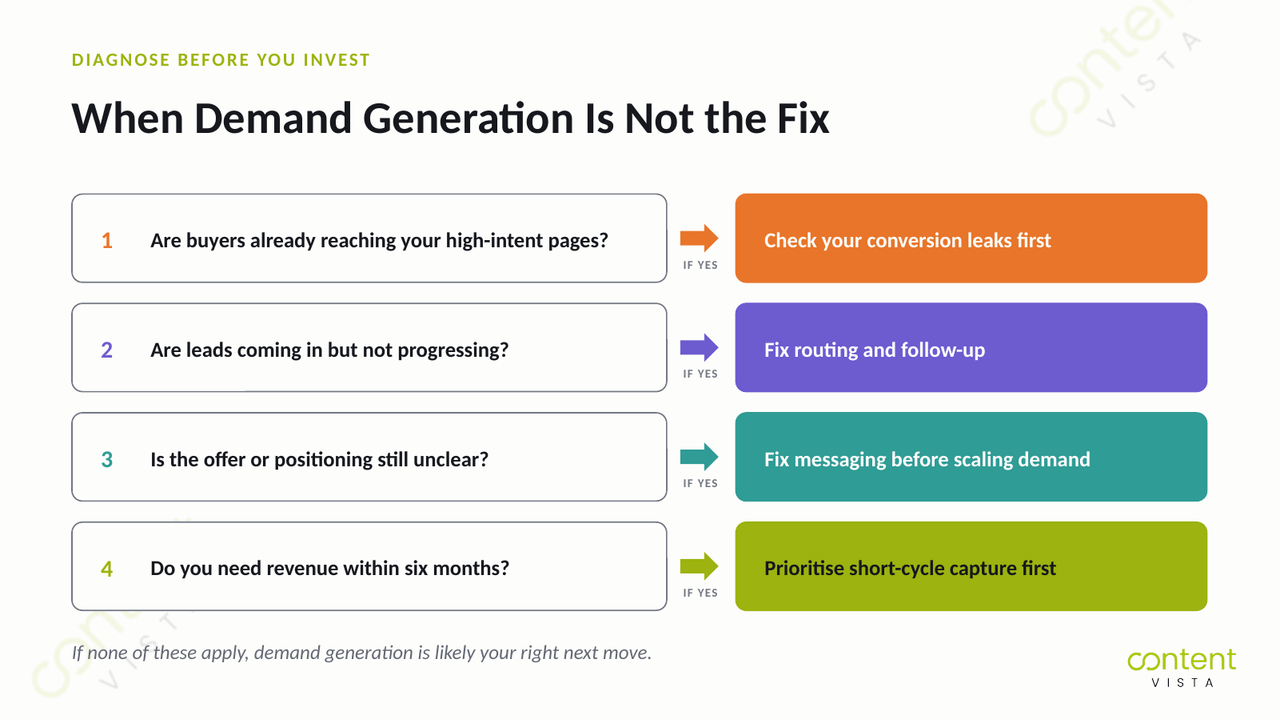
If your growth system is leaking after people already show intent, adding more awareness can make the problem worse.
You may drive more visitors, more clicks and more leads into a broken path, then conclude that "demand generation doesn't work." In reality, the issue may be conversion, routing, positioning or sales readiness.
| Situation | Real problem | Fix this first |
|---|---|---|
| Buyers reach your high-intent pages but don't convert | Conversion problem | Run a website conversion audit before adding more top-of-funnel |
| Leads come in but sales doesn't act on them | Routing and follow-up problem | Fix lead routing, sales alignment and follow-up sequences first |
| You don't have product-market fit yet | Positioning problem | Fix positioning and messaging before scaling demand |
| You have an extremely small TAM (under ~100 ideal-fit accounts) | ABM-shaped problem, not demand gen | Run targeted ABM/outbound; demand gen scales poorly here |
| Cash runway is under 6 months | Wrong time horizon | Demand gen compounds slowly; you need short-cycle capture or sales-led acquisition |
Demand generation works best when the business is ready to turn attention into trust, intent, pipeline, and revenue. If the offer is unclear, the service page is weak, the CTA is vague or the follow-up process is inconsistent, more visibility will not solve the underlying issue.
The same applies when leads are coming in but nobody owns the next step. That is not a demand problem. That is a routing problem. Fix the CRM, follow-up sequence, qualification process and sales handoff before spending more effort on awareness.
Buyers already reaching your high-intent pages but not converting? Audit your conversion leaks before adding more top-of-funnel activity with the Website Conversion Leak Audit.
Demand generation should amplify a working growth system. It should not be used to hide unclear positioning, weak conversion paths or poor follow-up.
How to Measure Demand Generation Without Hiding Behind MQL Volume
MQL volume is not the answer. It is often the hiding place.
A team can generate more form fills, more downloads, and more "leads" while still failing to create a meaningful pipeline. That happens when measurement rewards activity instead of buyer movement.
Demand generation should not be judged only by how many people entered a database. It should be judged by whether the right buyers are becoming more aware, more trusting, more likely to engage and eventually more likely to become revenue.
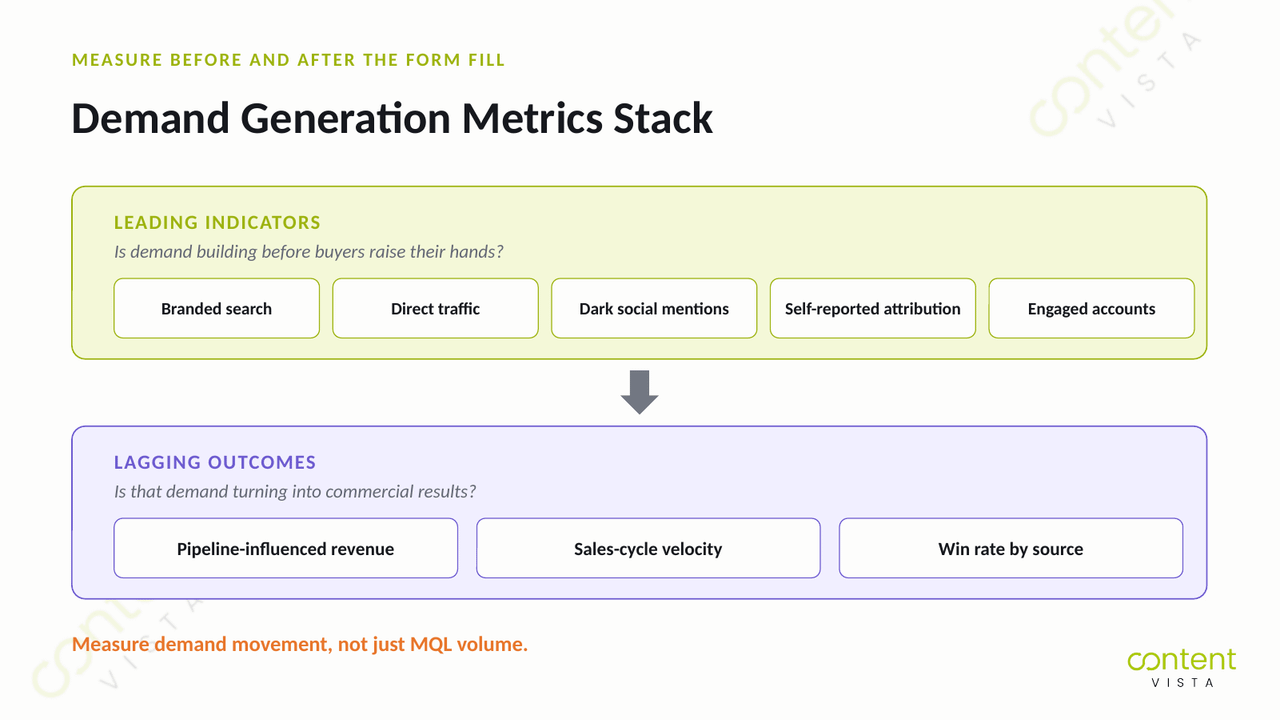
The better measurement model separates leading indicators from lagging outcomes.
Leading metrics tell you whether demand is building before buyers raise their hands. Lagging metrics tell you whether that demand is turning into commercial results.
| Type | Metric | What it tells you |
|---|---|---|
| Leading | Branded search volume | Whether demand creation is working (early signal) |
| Leading | Direct traffic + dark social mentions | Anonymous research happening before form-fill |
| Leading | Self-reported attribution on enquiry forms ("How did you hear about us?") | What ACTUALLY drove the enquiry vs last-touch |
| Leading | Engaged accounts (multi-persona, multi-visit) | Buying group activity inside the dark funnel |
| Lagging | Pipeline-influenced revenue | The metric that matters |
| Lagging | Sales-cycle velocity | Whether better-informed buyers close faster |
| Lagging | Win rate by source | Which demand-creation motion produces winnable deals |
The practical shift is this: do not ask only, "How many leads did this create?" Ask, "Did this create better awareness, better intent, better conversations or better pipeline?"
Self-reported attribution helps because buyers often discover you through content, referrals, podcasts, LinkedIn, search and repeat exposure before the CRM ever sees them.
Last-touch attribution may record the final click, but it often misses the reason the buyer trusted you enough to enquire.
For revenue-side clarity, connect demand metrics to actual funnel economics using tools like our True CAC & Marketing ROI Calculator. Otherwise, you may optimise for cheap leads while missing expensive pipeline leakage.
Good demand generation measurement does not replace revenue accountability. It connects early demand signals to pipeline, sales velocity and win quality.
Common Demand Generation Mistakes
Here are the mistakes we see most often:
Treating demand generation as a campaign category instead of a system. Demand generation is not "a LinkedIn campaign," "a webinar" or "a paid awareness push." Those are activities. Demand generation only works when creating demand, capturing intent, converting it into pipeline and improving what works are connected to each other.
Over-investing in capture while creation is empty. Paid search, buyer-intent SEO and comparison pages can capture existing intent, but they cannot create a market that does not know or trust you yet. If the pipeline is flat, the problem may be that not enough future buyers know why you matter.
Gating all content behind forms. If every useful idea is locked behind a form, you weaken your ability to create demand at all. Out-of-market buyers need frictionless education, not an immediate demand to "download now."
Measuring MQL volume instead of pipeline-influenced revenue. A high lead count can hide poor-fit enquiries, weak intent and stalled sales conversations. Demand generation should be judged by whether it influences qualified pipeline and revenue, not just database growth.
Confusing thought leadership with promotional posts. "Here's what we do" is not thought leadership. Strong thought leadership teaches the market how to think differently about the problem, the cost of inaction and the criteria for choosing a solution.
Skipping sales alignment. If sales does not know where leads came from, what they consumed, what problem they are likely trying to solve or how quickly to follow up, demand leaks at the conversion stage.
Trying to do everything at once. More channels do not automatically mean more growth. Fix the weakest part of your engine first, then expand.
Treating AI Overviews as a separate channel. AI visibility is not a standalone tactic. It is usually the output of strong demand-creation and capture work: clear explanations, credible authority, structured content and useful answers.
Mini Scenarios — Demand Problem, Capture Problem or Routing Problem?
Scenario 1: The solo consultant nobody finds
A consultant has strong expertise, a clear service, and happy past clients, but most opportunities still come through referrals. Their website exists, but few ideal buyers discover them through search, LinkedIn, podcasts or category conversations.
This is not mainly a lead generation problem. It is a Discovery gap. The fix is a focused founder content engine: consistent point-of-view posts, one strong long-form piece per month and selective podcast guesting to make the right buyers aware before they need help.
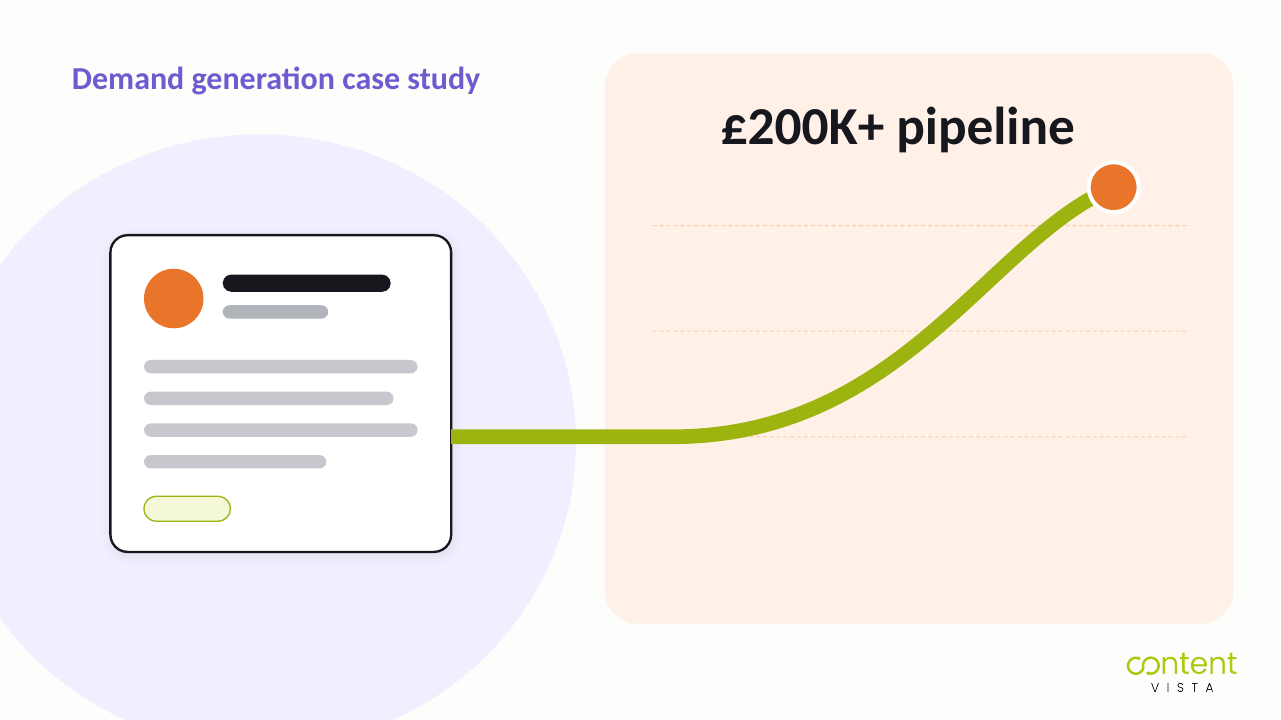
That is close to what we built with Akshar Business Consulting, a London-based financial transformation consultancy with deep FP&A expertise and no consistent content presence. A LinkedIn-led content engine grew the newsletter past 4,000 subscribers and contributed to an estimated £200K+ in pipeline.
Scenario 2: The growing service business with traffic but no enquiries
A service business is getting steady website traffic, but the enquiries are weak or inconsistent. People visit the homepage, read service pages, maybe browse a few blogs, then leave.
This usually points to a Credibility + Capture gap. The market is finding them, but not getting enough proof, relevance or next-step clarity.
The fix is not just more traffic. They need stronger proof points, sharper buyer-intent pages, clearer CTAs, comparison content and conversion paths that match buyer intent.
Scenario 3: The mature B2B team with leads but no movement
A mature B2B team has campaigns running, content going out, and leads entering the CRM. But sales says the leads are unclear, follow-up is inconsistent, nurture is weak and pipeline movement is slow. This is a Routing gap.
More demand generation will not fix it. The immediate fix is sales alignment, CRM hygiene, lead qualification rules, follow-up ownership and nurture sequences that move interest toward a real buying conversation.
These are the kinds of gaps a proper Demand Generation services engagement should diagnose before adding more activity.
Where AI Fits in Demand Generation (AI Overviews, AEO and the New Buyer Journey)
Here's what's real and what isn't: AI is changing how buyers discover, compare and shortlist options, but it does not turn demand generation into a separate "AI channel."
Whether the buyer starts in Google, ChatGPT, Perplexity, Gemini, LinkedIn or a peer conversation, the underlying challenge is the same: will your brand, point of view, proof and solution show up clearly when the buyer is trying to understand the problem?
That is where AI Overviews and answer engines matter. They tend to reward content that is easy to extract: clean definitions, clear frameworks, comparison blocks, decision criteria, FAQs, and practical explanations.
AEO — Answer Engine Optimisation — should not be treated as a completely new discipline. At its best, it is well-structured content with real expertise, clear language, named models and useful answers.
AI can speed up parts of the demand engine: workflow automation, content personalisation at scale, intent-signal analysis, repurposing, research support and content velocity for the work of creating demand.
But it does not replace positioning, brand voice, original point of view, lived expertise, proof or strategic judgment.
Want to map where AI can speed up your demand engine specifically? The AI Workflow & Pipeline Opportunity Map walks you through it.
Frequently Asked Questions
Is demand generation the same as lead generation?
No. Lead generation focuses on collecting identifiable contact information from prospects. Demand generation is broader. It creates awareness, trust and category interest before buyers are ready, then helps capture that intent when they start researching. Lead generation can be one part of demand generation, but it is not the whole system.
What is the difference between demand creation and demand capture?
Demand creation reaches buyers before they are actively shopping. It includes education, thought leadership, category content, founder content and trust-building. Demand capture targets buyers who are already showing intent through search, comparison, referrals, retargeting or direct website visits. A strong demand engine needs both.
Does demand generation work for service businesses and consultants, or only for SaaS?
Demand generation works for service businesses, consultants, agencies, B2B teams and SaaS companies, but the engine should match the business stage. A consultant may need founder content, a clear service page and a simple enquiry path. A larger B2B team may need SEO architecture, nurture, CRM and sales alignment.
Which channels count as demand generation?
Demand generation can include thought leadership, founder content, SEO, podcasts, webinars, paid social, paid search, PR, community, events, retargeting, comparison content and nurture. The channel matters less than the role it plays. Some channels create demand, some capture demand and some help convert interest into pipeline.
How long does demand generation take to work?
Demand generation usually works on two timelines. Capture channels like paid search, buyer-intent SEO and retargeting can create faster signals if intent already exists. Demand-creation channels like thought leadership, organic content and category education compound more slowly. The right expectation depends on your market, offer, budget and existing authority.
What metrics should you actually track for demand generation?
Do not rely only on MQL volume. Track leading indicators such as branded search, direct traffic, self-reported attribution, dark social mentions, engaged accounts and repeat visits. Then connect those signals to lagging outcomes like pipeline-influenced revenue, sales-cycle velocity, win rate and revenue by source.
When should you fix conversion or CRM before investing in demand generation?
Fix conversion first when buyers already reach high-intent pages but do not enquire. Fix CRM and routing first when leads come in but sales follow-up is slow, unclear or inconsistent. In both cases, more demand generation may only push more people into a broken system.
Should demand-generation content be gated or ungated?
Most demand-creation content should be ungated because the goal is reach, trust and education. Gated content can still work for deeper tools, templates, diagnostics or high-intent resources. The mistake is gating every useful idea, because that reduces visibility before buyers are ready to engage.
How does AI search change demand generation in 2026?
AI search makes structured, credible, answer-ready content more important. Definition blocks, comparison sections, clear frameworks, FAQs and decision criteria are easier for AI systems to extract and reference. But AI does not replace positioning, original point of view, proof, brand authority or a connected demand engine.
Demand Generation Works Best When It's Connected to the Rest of Your Growth System
Demand generation works best when it is not treated as a campaign, a channel or a monthly activity bucket.
It is one connected layer inside your larger growth system. Create demand, capture the intent that already exists, convert that interest into qualified pipeline, and compound what works. The Four Demand Gaps help you diagnose where that system is breaking before you invest in more content, more paid media, more outreach or more automation.
That diagnosis matters. If you are not creating enough demand, you need visibility and authority. If you are not capturing it, you need better buyer-intent pages and conversion paths. If you are not converting it, you need sales alignment, nurture and routing. A strong demand generation strategy starts by finding the weakest part first.
For businesses that need this built as a system, Content Vista's Demand Generation services are designed around that connected approach.
Not sure which part of your demand engine is weakest? The Marketing Growth Maturity Assessment walks you through the diagnostic in ten minutes and gives you a prioritised fix list.