Quick Summary
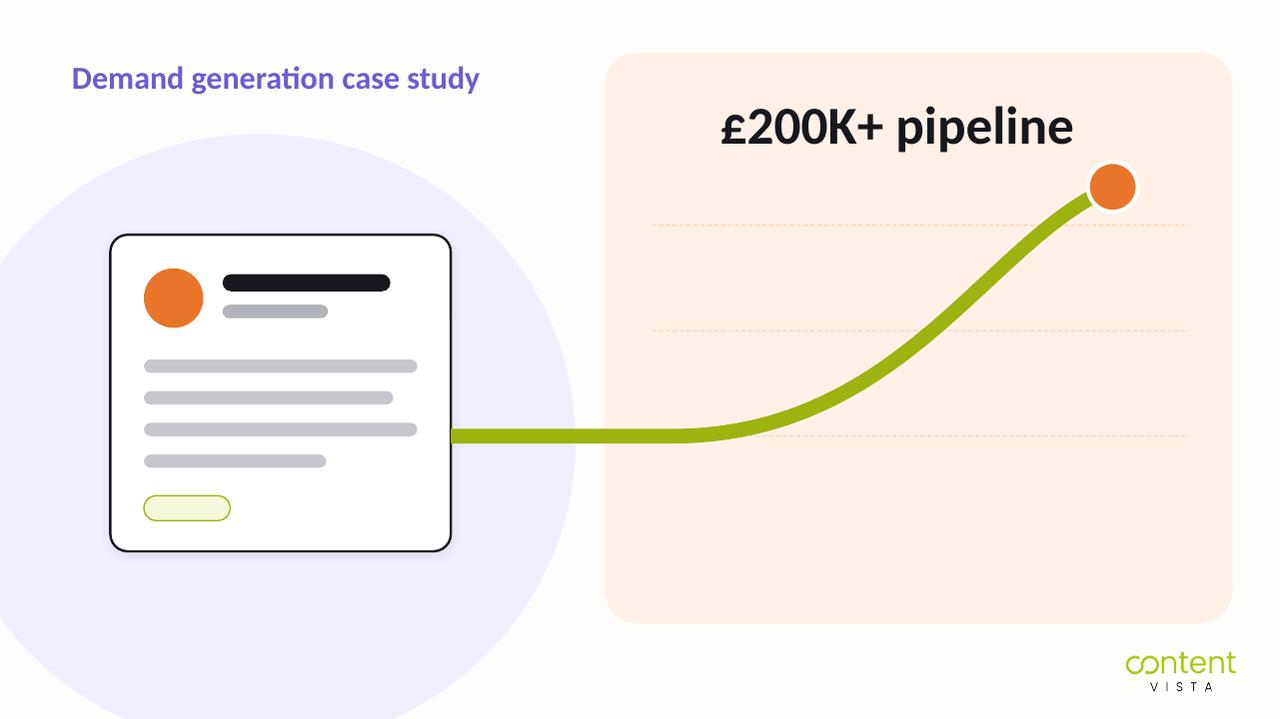
- This demand generation case study shows how Akshar Business Consulting, a London FP&A consultancy, went from no content engine to £200K+ in estimated pipeline and 4,000+ newsletter subscribers.
- LinkedIn thought leadership got the founder discovered.
- A fortnightly newsletter and lead magnets captured that attention.
You're publishing content. So why isn't it creating demand?
Here's the problem:
Most demand generation case studies show you the shiny number, then skip the part that actually matters: the system behind it.
They say "we generated pipeline" or "we grew inbound."
But they rarely explain what changed operationally. Was it better content? Better positioning? Better distribution? Better nurture? Better conversion infrastructure?
Or just a lucky campaign?
This case study is different.
It looks at how a content-led demand engine helped build £200K+ in estimated pipeline for a consultancy.
It did that by turning expertise into visibility, visibility into an owned audience, and that audience into business conversations.
If you want the full model behind this approach, our demand generation strategy guide walks through Content Vista's 4C Demand Engine in detail.
Here, we'll stay practical and follow one client's engine from the ground up.
Instead of treating content as a publishing calendar, you'll see how content became part of a connected growth system: one designed to build trust before the sales conversation ever started.
What a demand generation case study should actually prove
A useful demand generation case study should not just say, "Here is the result."
It should answer the harder question: what system created that result?
Because that is where most case studies fall short.
They show a number, a campaign, a channel or a before-and-after snapshot.
But they do not show how the business moved from scattered activity to a repeatable engine that could create trust, capture attention, nurture interest and turn that interest into revenue.
So what does that mean?
What is a demand generation case study?
A demand generation case study shows how a business created qualified demand through a repeatable system, not a one-off campaign. It should connect strategy, channels, audience capture, conversion paths and pipeline or revenue outcomes, so readers can understand what worked, why it worked and what can be adapted.
That distinction matters.
If a case study only reports MQL volume, it may prove that people filled out forms.
It does not necessarily prove that the marketing system created sales-ready demand, influenced the pipeline or helped revenue conversations move forward.
A stronger case study should show the connected engine behind the result.
What was created. How attention was captured. How trust was converted into conversations. And how those assets kept compounding over time.
That is the standard this case study uses.
The £200K+ outcome matters, but the more useful lesson is the engine behind it.
Meet the client: a consultancy with deep expertise and zero demand engine
This was not a SaaS company with a large marketing team, a paid acquisition budget and a complex tech stack.
At the centre of this Akshar Business Consulting case study was Akshar Business Consulting, a London-based financial transformation consultancy led by founder Tejas Parikh.
The expertise was already there.
Akshar specialises in budgeting, reporting, CPM, Power BI and broader FP&A transformation: the kind of decision-making support growing companies need.
The problem was not capability.
It was that the market had no consistent way to discover, trust and engage with that capability before a sales conversation.
Maybe this sounds familiar:
You know your work creates real value. Your clients trust you once they experience it.
You have strong opinions, useful insights and hard-earned expertise.
But online, that expertise is either invisible, inconsistent or scattered across one-off posts and ad hoc marketing efforts.
That was the demand problem.
There was no clear LinkedIn strategy turning founder expertise into authority.
There was no newsletter to capture and nurture attention.
There were no lead magnets or resource assets giving potential buyers a reason to move closer.
And there was no connected content engine designed to compound trust over time.
On top of that, Tejas was spending too much of his own time on marketing instead of running the consultancy.
So the starting point was simple: Akshar did not need "more content" in the generic sense.
They needed a system that could turn expertise into demand.
The diagnosis: which demand gaps were costing them pipeline?
Here's where most teams go wrong:
They start prescribing channels before diagnosing the demand gap.
Should we post more on LinkedIn? Start a newsletter? Create a lead magnet? Run ads? Build a webinar funnel?
The answer depends on where demand is currently breaking.
For Akshar, the issue was not a lack of expertise. It was a system gap.
Buyers who could benefit from the consultancy were not consistently discovering Tejas Parikh's expertise early enough.
And when interest did exist, there was no clear path to capture it and move it closer to an enquiry.
So the starting diagnosis was mainly two gaps: a Discovery gap and a Capture gap.
Here's how to read all four gaps, and how each one showed up for Akshar.
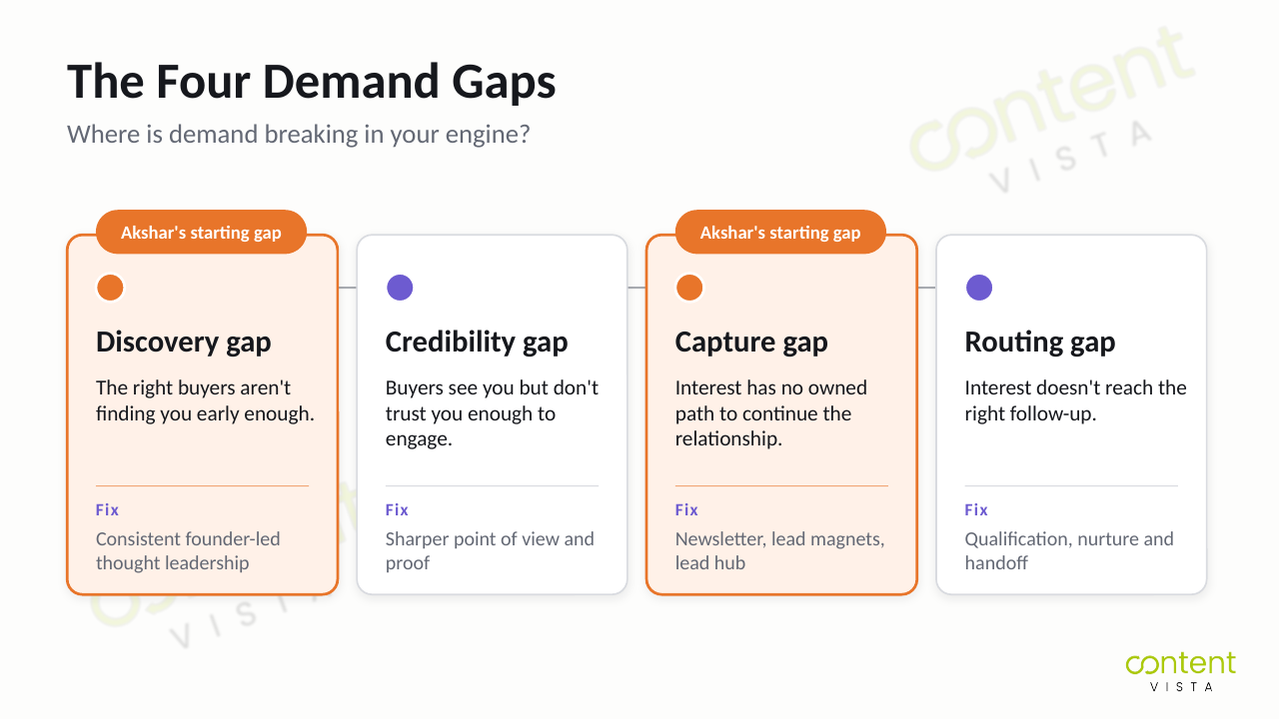
| Demand gap | What breaks | What it meant for Akshar | What usually fixes it |
|---|---|---|---|
| Discovery gap | The right buyers are not finding the expertise early enough. | Founder expertise existed, but there was no consistent LinkedIn strategy turning it into visible authority. | Consistent thought leadership, founder content and clearer positioning. |
| Credibility gap | Buyers see the brand but do not yet trust it enough to engage. | The expertise was strong, but it needed to be shown repeatedly through useful, specific, point-of-view-led content. | Sharper point of view, proof, case studies and deeper authority assets. |
| Capture gap | Interest is created, but there is no owned path to continue the relationship. | There was no newsletter, lead magnet or resource pathway to turn attention into a warmer audience. | A newsletter, lead magnets and a website built to capture declared intent. |
| Routing gap | Captured interest does not move into the right follow-up, nurture or sales conversation. | This became important once visibility and capture improved, because demand still needed a path into enquiry. | Tighter qualification, follow-up, nurture and sales handoff. |
This diagnosis changed the work.
Instead of treating content as a calendar, the focus became engine design: building the missing pieces in the right order, starting with visibility.
For Akshar, the first job was not to "do more marketing."
It was to build the missing demand layers in the right order.
Before you publish more content, diagnose whether your marketing system is mature enough to turn attention into pipeline. Use the Marketing Growth Maturity Assessment to identify the weakest layer in your growth engine.
The build: how the demand engine came together
Once the diagnosis was clear, the work was not to "create more content."
The work was to build an engine.
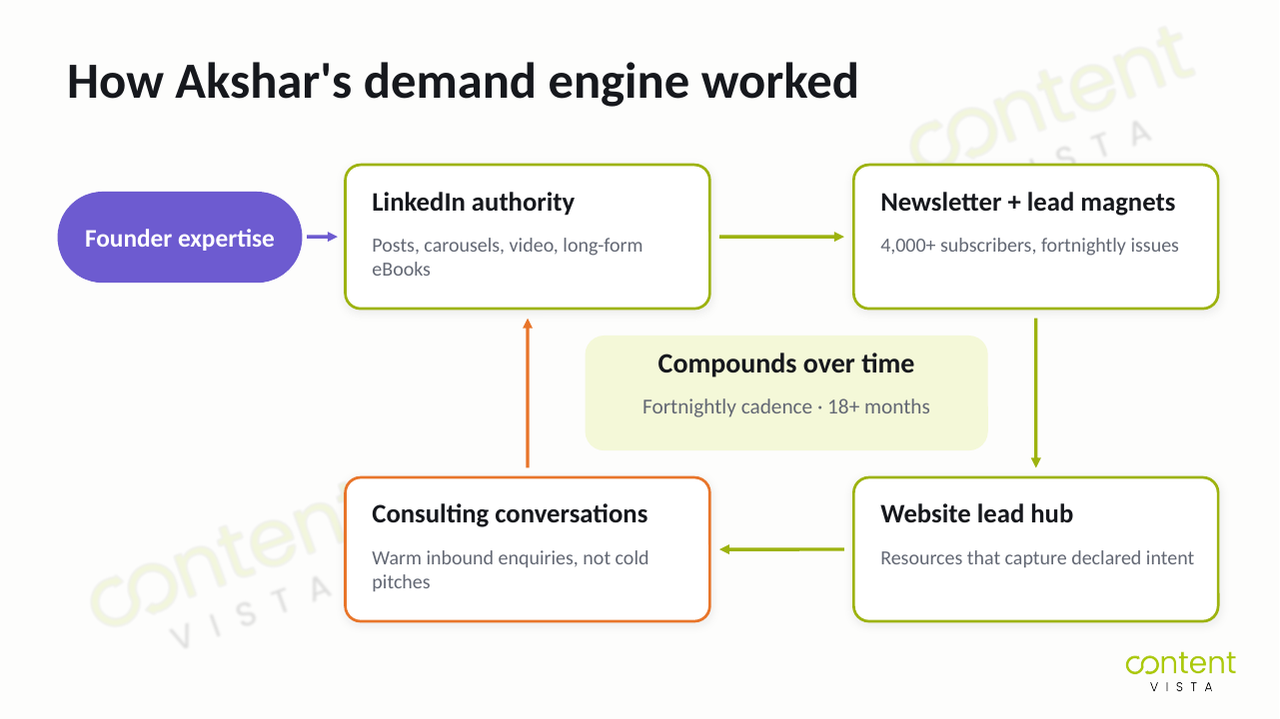
For Akshar, that meant connecting demand creation and demand capture into one system.
LinkedIn content could create visibility, but visibility alone was not enough.
A newsletter could capture attention, but capture alone was not enough.
Lead magnets could create intent, but intent still needed a path into business conversations.
Here's how each piece was built, and the job it did.
Making the expertise visible
The first job was demand creation.
Akshar had deep FP&A expertise, but expertise does not create demand until the market can see it, understand it and remember it.
So this work focused on LinkedIn-led thought leadership, founder narrative and long-form authority assets.
Through regular interviews and discussions, Tejas shared his thinking, curated research and domain expertise.
That raw material was turned into useful, visible, repeatable content (posts, carousels, newsletters and explainer videos) around the problems Akshar's buyers cared about.
This is where the 95-5 rule helps, as long as you treat it as a heuristic.
Professor John Dawes of the Ehrenberg-Bass Institute estimated that only around 5% of B2B buyers are in-market at any given time, and he is explicit that the 95% figure is not meant to be a precise rule.
The exact split varies by category and by how often buyers purchase.
But the direction holds: many potential buyers are not ready to buy at the moment they first see you.
That does not make them irrelevant.
It means demand generation has to build memory, trust and category association before the buying window opens.
For Akshar, LinkedIn was not treated as a posting channel. It became an authority channel.
The content was designed to make the founder's expertise visible to out-of-market buyers before they were actively searching for an FP&A consultancy.
Alongside this, 20,000+ word eBooks created deeper proof of expertise.
Not as lightweight lead bait, but as assets that showed Akshar had a serious point of view.
This is the role of content and thought leadership: not just to publish, but to make expertise easier to discover, trust and associate with a specific business problem.
If you want to build this piece for your own business, our guide to building a content-led demand engine goes deeper.
Giving attention somewhere to go
The second job was demand capture.
This is where many content-led strategies break.
They create attention, but they do not give that attention anywhere to go.
Akshar needed a path from "I saw your content" to "I want to stay connected" to "I am ready to explore this further."
The LinkedIn newsletter became that capture layer.
Each fortnightly issue was a researched, roughly 1,000-word piece written for finance professionals.
Over time, it grew to 4,000+ subscribers, giving Akshar an owned audience that was not dependent on one post, one algorithm or one moment of attention.
Lead magnets and long-form resources supported the same job.
They turned casual interest into declared intent.
Someone reading a LinkedIn post may be only loosely aware of the problem.
Someone choosing to subscribe, download or explore a resource is signalling a stronger level of interest.
The website's resources section was also rebuilt into a structured lead hub, so the system did not stop at content visibility.
It gave potential buyers a clearer place to understand Akshar's expertise, explore resources and move closer to an enquiry.
That is the difference between content activity and a demand engine.
Demand creation makes the right people aware. Demand capture gives that awareness a path to continue.
For more on running a newsletter as a capture and nurture channel, see our guide to email newsletters and lead nurturing.
Turning trust into consulting conversations
The third job was conversion.
But in a content-led demand engine, conversion does not mean forcing every reader into a sales pitch.
It means giving warmed-up interest a sensible route into a business conversation.
For Akshar, conversion was built around turning inbound enquiries into consulting conversations.
The content did not have to close the deal on its own. Its job was to prepare the conversation before it happened.
By the time someone reached out, they were not encountering Akshar cold.
They had likely seen the founder's thinking, engaged with useful content, subscribed to the newsletter, explored resources or visited the website.
That changes the quality of the conversation.
The enquiry becomes less about "Who are you?" and more about "Can you help us with this?"
This matches what B2B buyers report more broadly.
6sense's 2025 Buyer Experience Report found that buyers first engage sellers around 61% of the way through their buying journey.
And the vendor they favoured before that first contact still wins roughly four out of five deals.
In other words, most of the persuading happens before you are in the room.
That is the strategic value of founder and executive positioning.
When the founder's expertise is visible before the sales call, trust starts earlier.
The sales conversation does not need to carry the full weight of credibility-building.
Keeping the engine running long enough to compound
The last piece was time.
This is what made the system durable.
Akshar's demand engine was not built through one campaign burst.
It was built through a fortnightly newsletter rhythm, steady LinkedIn publishing and a partnership of more than 18 months that allowed the assets, audience, trust and conversion paths to strengthen over time.
Each piece made the next one more valuable.
LinkedIn content created visibility. The newsletter captured repeat attention.
Lead magnets and eBooks deepened trust. The website gave the system a clearer conversion hub.
Inbound enquiries created consulting conversations.
The cadence kept the engine alive long enough for the effects to compound.
That is why the £200K+ result is not just a content outcome. It is a system's outcome.
The real lesson is not "post on LinkedIn" or "start a newsletter."
The lesson is that demand generation works better when every asset has a clear job, and every job hands off to the next.
The results: what the engine delivered
The numbers tell the story:
Akshar's content-led demand engine did not just create visibility. It created business momentum.
The headline outcome was £200K+ in estimated pipeline.
That included two yearly consulting contracts worth £60,000 each (£120K in total), a speaking engagement with Adobe's CFO and senior finance speakers, and a business growth partnership with KGRN, one of the largest UAE-based accounting firms.
Alongside that, the engine built a LinkedIn newsletter audience of 4,000+ subscribers.
It improved Tejas Parikh's LinkedIn Social Selling Index (SSI), LinkedIn's score for how well someone builds a professional brand and relationships on the platform, by 35 points.
And it helped create 30+ small consulting gigs in the pipeline.
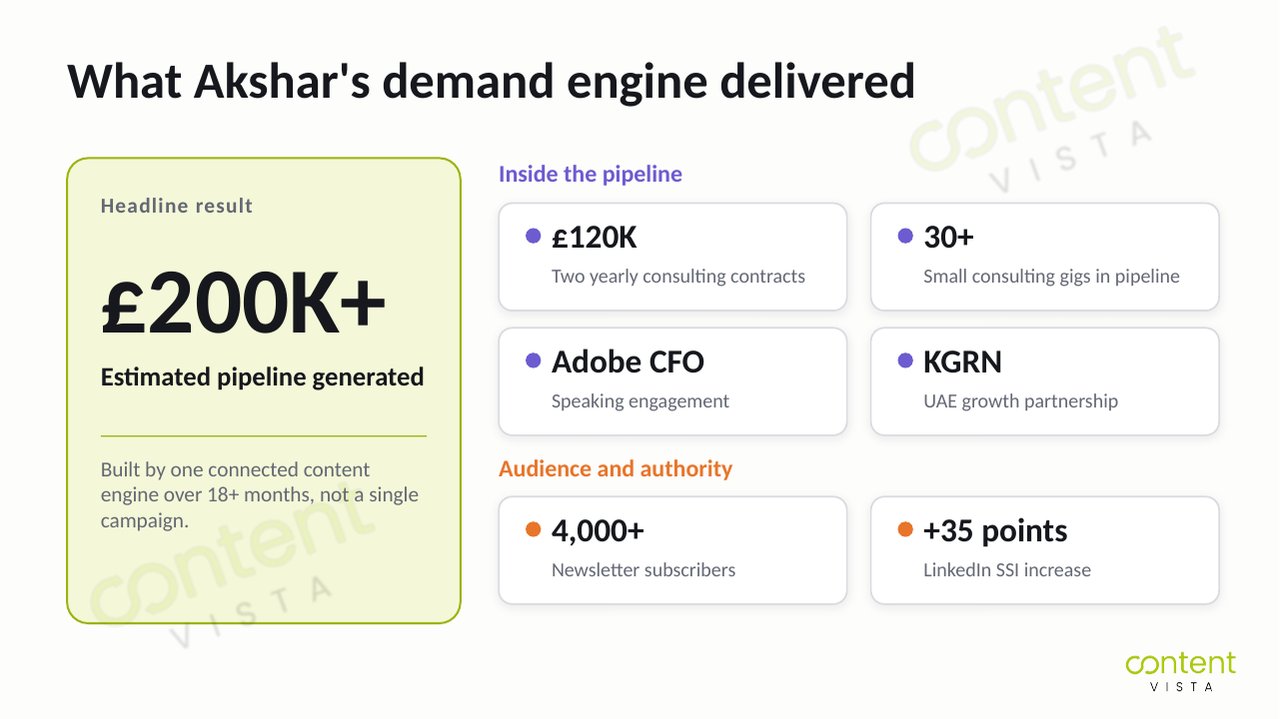
| Result | What it showed |
|---|---|
| £200K+ in estimated pipeline | The content-led demand engine influenced real commercial outcomes, not just awareness. |
| £120K in consulting contracts (two yearly contracts of £60,000 each) | Trust and visibility moved into high-value consulting opportunities. |
| Speaking engagement with Adobe's CFO and senior finance speakers | Founder authority created opportunities beyond direct lead capture. |
| UAE business growth partnership (KGRN) | The engine helped expand opportunity beyond the immediate local market. |
| 4,000+ LinkedIn newsletter subscribers | Attention was converted into an owned audience that could be nurtured over time. |
| +35 point SSI increase | Tejas Parikh's LinkedIn presence became stronger and more visible in the market. |
| 30+ small consulting gigs in pipeline | The system created a wider base of active and potential opportunities. |
The important point is not that one LinkedIn post produced one deal.
The result came from layers working together.
Thought leadership created discovery. The newsletter captured attention.
Lead magnets and the website created stronger intent signals. Inbound enquiries opened consulting conversations.
Consistent execution allowed the system to compound.
That is why this is a demand generation case study, not just a content marketing success story.
A second proof point: founder authority in a different market
Different market, same engine:
The same demand generation logic also showed up in the Personam case study.
Personam is an AI-based cybersecurity threat detection platform, not an FP&A consultancy.
The audience, buying context and category were different.
After an ownership change, it had a working product but almost no market presence: no brand identity, no website, no content and no go-to-market strategy.
But the growth problem was similar: expertise needed to become visible, credible and useful before prospects were ready to engage.
The engine again started with authority.
Instead of chasing short-term campaign volume, the focus was on shaping the company's market point of view, building founder visibility on LinkedIn and creating assets that made the company's thinking easier to trust.
The results were different in form, but similar in pattern.
LinkedIn followers grew from zero to 1,000+.
The newsletter's first issue achieved a 41.8% open rate and a 21.2% click-through rate.
And a 26-competitor market study strengthened credibility in a technical market.
The lesson is simple.
A content-led demand engine is not limited to one sector.
Whether the business is an FP&A consultancy or an AI cybersecurity company, the system still depends on the same things: authority built early, an owned audience to hold attention, and enough consistency for trust to build.
What was hard and what we'd watch
Let's be honest about the hard part:
A content-led demand engine is not difficult because publishing is difficult.
It is difficult because consistency, clarity and judgement have to survive over time.
For Akshar, one constraint was translation.
FP&A is technical, nuanced and high-stakes.
If the content became too simple, it could lose the depth senior finance audiences expect.
If it stayed too technical, it could become inaccessible to the broader decision-makers who influence business conversations.
That meant every content asset had to do two jobs at once.
It had to preserve the seriousness of the expertise, and make the idea easy enough for the right buyer to understand, remember and act on.
The second constraint was cadence.
A fortnightly rhythm sounds simple on paper.
In practice, it requires a steady pipeline of ideas, founder input, editorial judgement, resource creation, distribution and follow-through.
The engine only compounds if the system keeps moving after the initial excitement fades.
The third constraint was patience.
Content-led demand often feels slow before it starts looking obvious.
In the early months, the signals may be softer: better conversations, more profile visits, more saves, more replies, more newsletter subscribers, more people saying they have "seen your posts around."
Those signals matter, but they are not the same as pipeline yet.
What we would watch closely is whether the engine keeps improving across the whole system.
That means more relevant visibility, stronger capture, better-quality enquiries and a growing body of assets that keeps working after each post is published.
That is where the compounding actually happens.
How to apply this to your own demand engine
Let's make this practical:
Before you decide whether you need more content, better ads, a newsletter, outbound, SEO or a new website, diagnose where demand is actually breaking.
Most businesses do not have a single "marketing problem."
They have a weak layer in the engine.
Use the Four Demand Gaps as a quick self-check:
Discovery gap: Are the right buyers finding you before they are actively looking for a vendor? If not, your problem is visibility. You may need stronger thought leadership, clearer positioning, more consistent distribution or a better demand generation system.
Credibility gap: Are people seeing you but not trusting you enough to engage? If yes, the issue may be proof, specificity, authority, founder visibility, case studies or point-of-view depth.
Capture gap: Are you getting attention but losing it because there is no next step? This usually means there is no newsletter, lead magnet, resource hub, diagnostic or owned audience path to turn interest into declared intent.
Routing gap: Are enquiries, subscribers or leads entering the system but not moving into the right follow-up? This is where nurture, qualification, sales handoff and conversion infrastructure matter.
The mistake is assuming the answer is always "more leads."
Sometimes the real issue is that your market does not know you yet.
Sometimes they know you but do not trust you.
Sometimes they trust you but have no reason to raise their hand.
Sometimes they raise their hand, but the system does not route them properly.
If you are unsure whether your next move should be demand creation, demand capture, inbound, outbound or conversion infrastructure, start by clarifying the gap.
This is also where comparing inbound vs outbound marketing can help you choose the right channel mix instead of copying someone else's playbook.
When a content-led engine isn't the right first move
To be fair, this approach is not always the answer.
Think twice before leading with it if:
You need pipeline in the next month or two. A content-led engine compounds. It rarely rescues a quarter on its own, so pair it with demand capture or outbound while it builds.
Nobody with real expertise can give regular input. Akshar's engine ran on consistent founder interviews. Without that raw material, content drifts into generic advice buyers have already read.
Your real leak is the Routing gap. If enquiries already arrive but go cold, fix follow-up and qualification first. More content just pours more demand into a leaky system.
Not sure which growth system fits your current bottleneck? Use the Marketing Growth System Finder to identify the system that matches where your business is right now.
FAQ
What is a demand generation case study?
A demand generation case study shows how a business created qualified demand through a repeatable system, not a one-off campaign.
A good one explains the strategy, channels, capture paths, nurture process and pipeline or revenue outcomes behind the result.
For a broader definition, see our guide on what is demand generation.
How long does demand generation take to produce pipeline?
Demand generation usually compounds over time rather than producing instant pipeline from the first campaign.
The early phase often builds visibility, trust, audience and engagement signals before those signals turn into enquiries.
The timeline depends on the buying cycle, complexity, audience trust and how connected the content, capture and conversion pieces are.
Demand generation vs lead generation: what's the difference?
Demand generation creates awareness, trust and preference before someone is ready to buy.
Lead generation captures people who are closer to taking action, usually through forms, calls, downloads, events or enquiries.
The strongest growth systems use both: demand generation warms the market and lead generation gives ready buyers a path to engage.
What metrics actually prove demand generation worked?
Useful demand generation metrics go beyond impressions, likes or MQL volume.
Stronger proof includes qualified inbound enquiries, sales conversations, pipeline influenced, revenue generated, newsletter growth, repeat engagement, branded search growth and opportunities created from content-led trust.
Asking new enquiries how they first heard about you (self-reported attribution) also helps, because much of demand creation happens where tracking software cannot see it.
The point is not just whether people saw the content, but whether the system moved the right people closer to revenue. Our guide to demand generation metrics covers which numbers to track.
Does demand generation work for service businesses and consultancies, not just SaaS?
Yes, demand generation can work especially well for service businesses and consultancies because expertise is often the product.
When buyers are choosing a consultant, advisor or specialist firm, trust matters before the sales conversation begins.
A content-led demand engine helps make that expertise visible, credible and easier to engage with.
What should a good demand generation case study include?
A good demand generation case study should show five things: the starting point (what was missing), the system that was built (channels, assets and cadence), the timeline, the results stated precisely, and what was hard.
Be clear about whether a figure is pipeline or closed revenue, because readers will judge the whole case study on that distinction.
Build the engine before you scale the activity
Here's the bottom line:
Demand generation is not a campaign you switch on. It is a connected, compounding engine.
The Akshar case worked because content was not treated as isolated output.
Founder expertise was turned into visibility. Visibility was captured through owned audiences and resources.
Trust moved into enquiries. Consistent execution allowed the system to compound into real business outcomes.
That is the lesson to take from this demand generation case study.
Before you publish more content, start with the system.
Find out where your marketing engine is strongest, weakest and most likely to leak demand. Take the Marketing Growth Maturity Assessment to diagnose your next growth priority.