Quick Summary
- Most "email newsletter ideas" lists hand you fifty topics and no way to choose between them. This guide does the opposite.
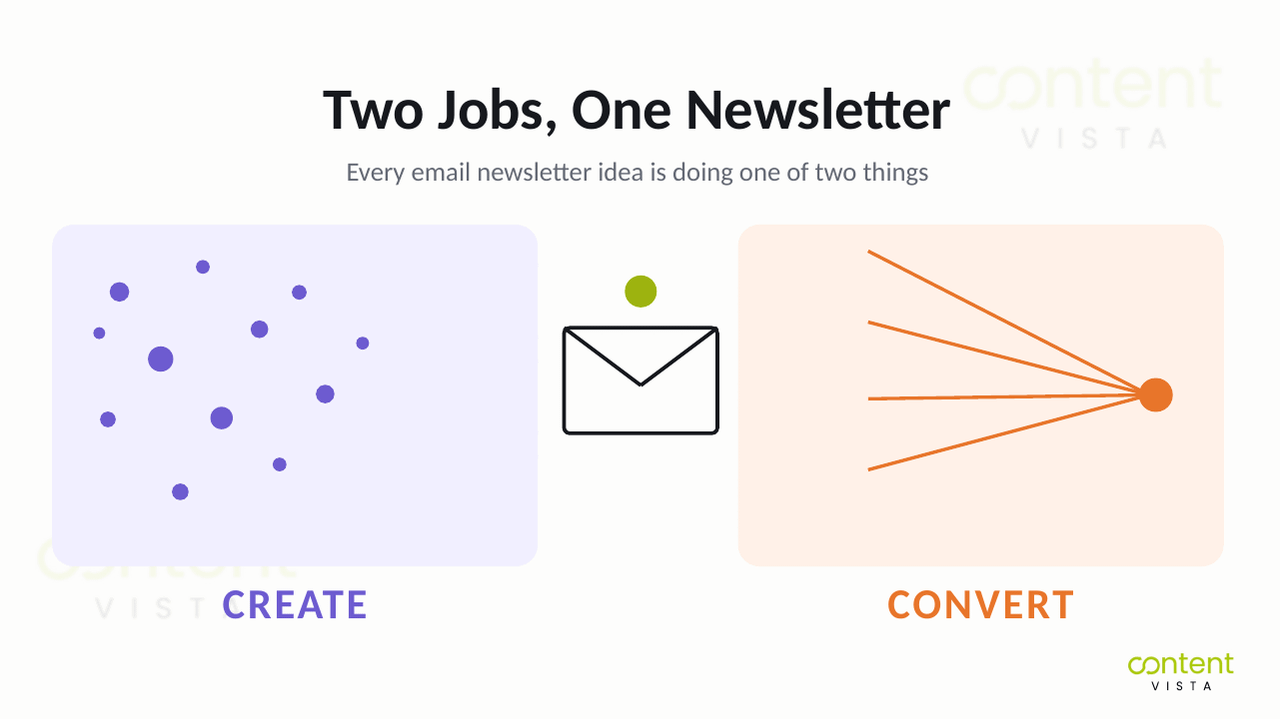
- Every newsletter idea does one of two jobs. It either creates demand among buyers who aren't ready yet, or it converts demand among buyers who already are. Sort your ideas that way and the blank page problem disappears.
- Inside: 26 Create ideas, 25 Convert ideas, how to sequence them without burning your list, a three-tier measurement framework that goes beyond open rates, and an honest look at when a newsletter isn't the fix at all.
You don't have a newsletter idea problem
Every Monday starts the same way.
Someone opens a blank document, stares at the cursor and asks:
"What should we send this week?"
Maybe you pull up last month's newsletters. Maybe you scroll LinkedIn for inspiration. Maybe you ask AI for ten newsletter ideas and hope one feels usable.
Then the email goes out.
A few openings. A few clicks. No meaningful conversations. No clear signal that demand moved forward.
And next week, you're back at the same blank page.
Here's the contrarian truth: most marketing teams don't have a newsletter idea problem.
They have a newsletter system problem.
Ideas are not scarce. There are thousands of newsletter ideas available online. You can generate fifty more in thirty seconds.
The real challenge is knowing which idea to use, when to use it and what job that idea is supposed to do inside your marketing system.
Should this week's email build awareness?
Create trust?
Handle a buying objection?
Revive inactive prospects?
Generate conversations with sales-ready leads?
Without that context, even good ideas become random acts of marketing.
That's why the most effective newsletters aren't built around creativity alone. They're built around intent.
Every edition has a purpose. Every topic serves a role. Every email moves the reader one step closer to a business outcome.
In this guide, you'll get more than 40 email newsletter ideas for marketing.
But instead of dumping them into one giant list, we'll organize them by the job they perform inside a demand generation system and show you how to tell whether each type of newsletter is actually working.
So before the idea bank, one question:
If your newsletter disappeared tomorrow, what part of your marketing engine would stop working?
What your newsletter is actually for
Most newsletter advice starts with content.
What should you write about?
How often should you send?
What subject lines get opened?
Those questions matter. But they come after a more important one:
What job is the newsletter supposed to do inside your growth system?
In our work with B2B teams, a newsletter earns its place by doing two jobs, not one.
It creates demand among people who aren't ready to buy.
And it converts demand among people who already are.
Everything else; cadence, design, subject lines - sits downstream of those two jobs.
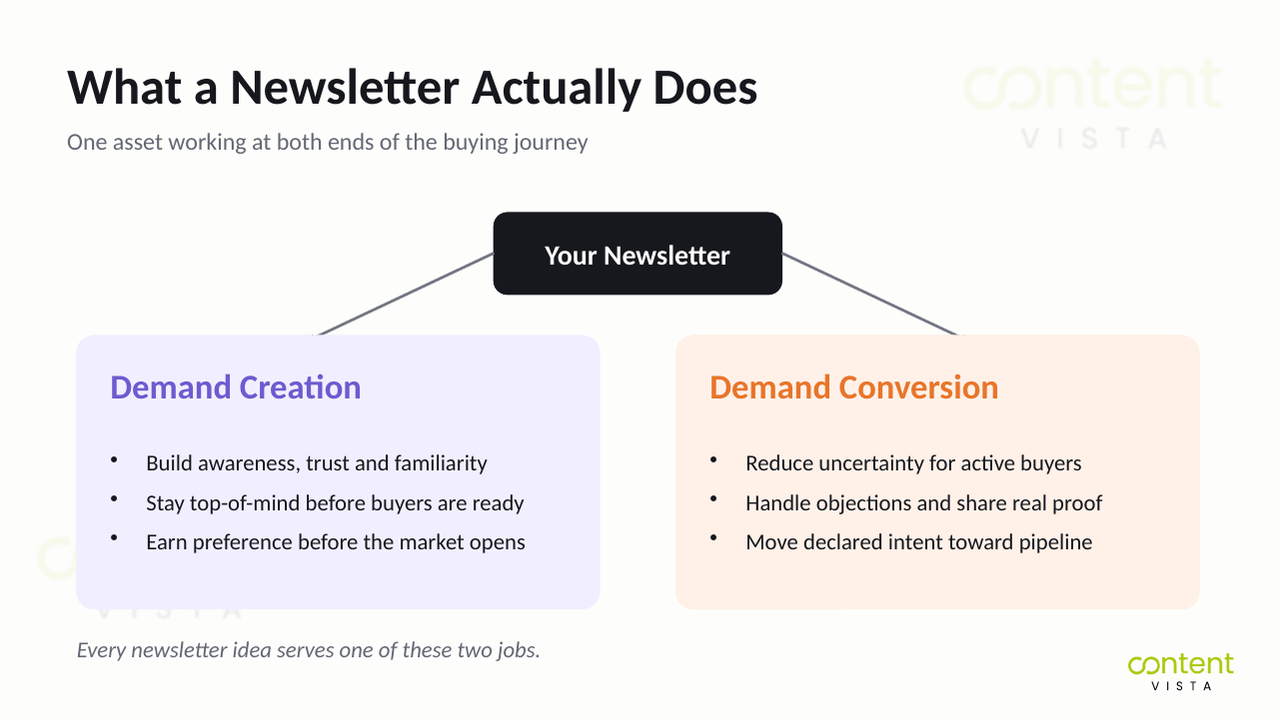
A newsletter is one of the few marketing assets that can work at both ends of the buying journey at the same time.
Demand creation: staying top-of-mind before buyers are ready
Demand creation is the process of building familiarity, trust and preference with people who are not actively looking to buy today.
This is where most newsletters create their greatest long-term value.
A founder reads your email.
A marketing leader forwards it to a colleague.
A prospect sees your perspective repeatedly over six months.
Nothing happens immediately.
No demo request.
No sales call.
No form submission.
But when the problem becomes urgent later, your company is already mentally shortlisted.
Demand conversion: nurturing declared intent
The second job is demand conversion.
This happens after someone has shown interest.
Maybe they downloaded a resource. Maybe they attended a webinar. Maybe they joined your list because they are actively researching solutions.
Now the newsletter becomes a nurturing mechanism.
Instead of simply staying visible, it helps prospects move from curiosity to confidence by answering questions, handling objections, sharing proof and reinforcing why a particular approach makes sense.
This distinction matters because most buyers do not wake up one morning and immediately purchase.
A useful heuristic here is the 95-5 rule. Professor John Dawes of the Ehrenberg-Bass Institute observed that up to 95% of firms are not in the market for many goods and services at any one time.
Dawes is careful about this, and so are we. He frames it as a mental model rather than a precise law, and the exact ratio varies by category and purchase cycle.
But the implication holds: most of the people who could eventually buy from you are not buying this quarter.
Most of the buying journey also happens quietly, inside what marketers call the dark funnel: private conversations, internal discussions, peer recommendations, independent research and mental shortlisting long before anyone speaks to sales.
6sense's research into B2B buyer behaviour found that roughly the first 70% of the buying journey happens during this anonymous selection phase, before buyers contact any vendor.
Their 2025 update shows buyers reaching out slightly earlier, at around 61% of the journey, largely to validate AI-related claims. The window moved. It didn't close.
That's why newsletters remain such a powerful component of a modern demand generation strategy.
They help you stay present during the invisible part of the buying journey, while also helping interested prospects move closer to action.
If you're still getting your bearings on the wider discipline, our guide on what demand generation is covers the fundamentals.
And once you understand those two jobs, choosing newsletter ideas becomes much easier.
The simplest way to sort every newsletter idea
At this point, most articles would jump straight into a giant list of newsletter ideas.
We're going to do the opposite.
Because once you understand why a newsletter exists, choosing the right idea becomes dramatically easier.
Here's the simplest way to think about it:
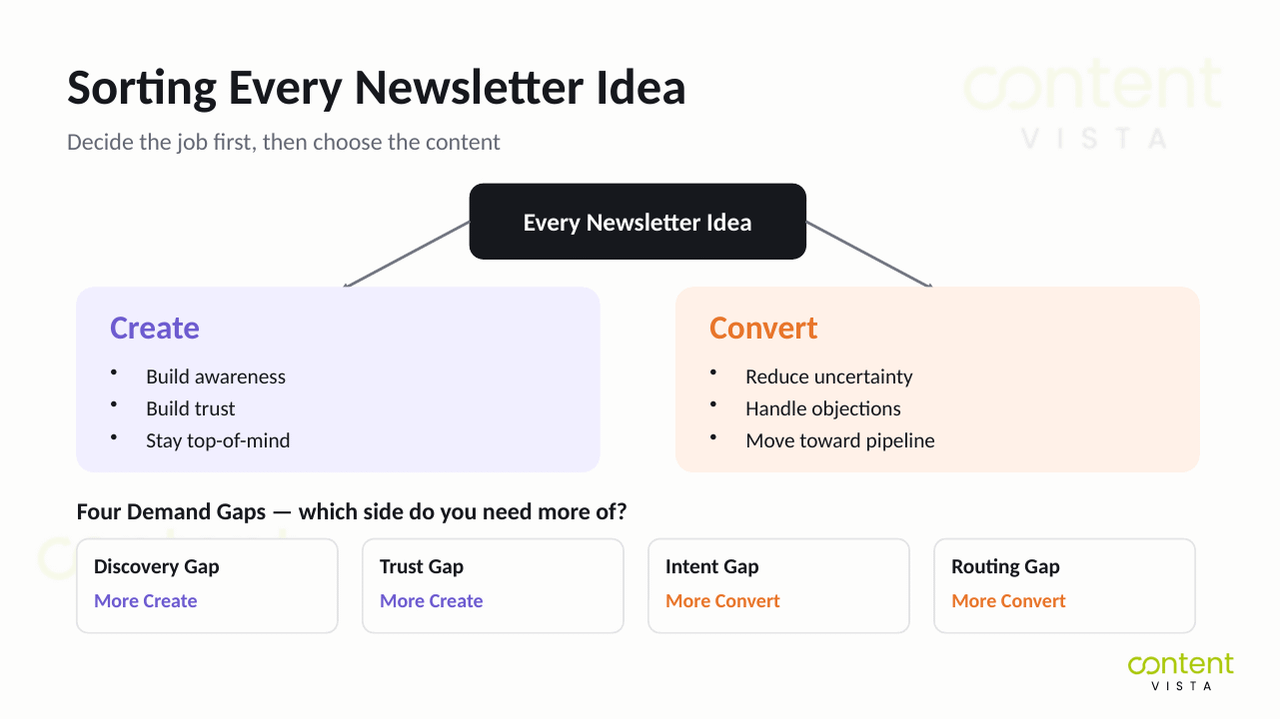
Every newsletter idea falls into one of two categories:
Create ideas
Convert ideas
We call this the Create/Convert Newsletter Sorter. It's less a framework than a habit: before you write anything, decide which of the two jobs this email is doing.
Create ideas build future demand
Create newsletters are designed for people who are not actively buying right now.
Their job is to educate, challenge assumptions, share insights, build familiarity and strengthen mental availability.
Think industry perspectives, trend analysis, founder insights, customer lessons and thought leadership.
The goal isn't immediate conversion.
The goal is becoming the company buyers remember later.
Convert ideas move existing intent forward
Convert newsletters are designed for people who have already shown some level of interest.
Their job is to reduce uncertainty.
These emails answer questions, address objections, explain processes, share proof, compare options and help prospects make decisions.
The goal isn't awareness.
The goal is movement toward the pipeline.
Use the Four Demand Gaps as a quick self-check
If you're unsure which type of newsletter you need more of, start by diagnosing the problem.
| Demand Gap | What It Looks Like | What It Usually Means | Newsletter Priority |
|---|---|---|---|
| Discovery Gap | Few new people entering the audience | Not enough awareness or demand creation | More Create newsletters |
| Trust Gap | Audience exists but engagement is weak | Buyers do not yet see enough authority or relevance | More Create newsletters |
| Intent Gap | Interest exists but few buying signals appear | Prospects are not progressing toward evaluation | More Convert newsletters |
| Routing Gap | Buying intent appears but pipeline stalls | Prospects are not moving efficiently toward sales conversations | More Convert newsletters |
Most newsletter programs don't fail because they lack ideas. They fail because they overinvest in one side of the system and neglect the other.
The good news is that once you know whether you're solving a Create problem or a Convert problem, the content choices become much more obvious.
And because a newsletter is only one part of how demand gets built, it helps to understand how mature the rest of that system is as well.
Not sure whether your growth challenge is a newsletter problem, a demand problem or a pipeline problem?
Take the Marketing Growth Maturity Assessment to identify the gaps limiting growth across your entire marketing engine.
Now let's get practical.
We'll start with newsletter ideas designed to create demand long before buyers are ready to talk.
Newsletter ideas that CREATE demand (for the 95% who aren't ready yet)
Create-layer newsletters are designed for people who are not actively evaluating vendors today.
Their purpose is not lead capture. It is not pipeline acceleration.
Their job is to build familiarity, credibility and mental availability so that when a problem becomes urgent, your company is already on the shortlist.
If you're building a content-led demand engine, these are the newsletter formats that keep your brand present during the long periods between buying decisions.
Point of view and contrarian thinking
The industry belief we disagree with - Why it works: strong opinions create memorability.
The hidden cost nobody talks about - Why it works: reframes familiar problems.
What most companies get wrong about [topic] - Why it works: challenges assumptions.
The advice we stopped following - Why it works: demonstrates experience over theory.
Industry intelligence and market analysis
What changed this month in the market - Why it works: helps buyers stay informed.
Three trends we're watching closely - Why it works: positions you as a signal filter.
What we're reading this week - Why it works: curates value without creating everything yourself.
The most important industry report nobody read - Why it works: surfaces overlooked insights.
The executive summary of a major industry development - Why it works: saves time for economic buyers.
Founder thinking and operator lessons
A lesson learned from a recent project - Why it works: turns experience into education.
A decision we got wrong and what it taught us - Why it works: builds trust through transparency.
How our thinking has evolved in the last year - Why it works: shows intellectual growth.
The question we're asking every client right now - Why it works: reveals strategic priorities.
A founder memo on where the market is heading - Why it works: creates a consistent leadership voice.
If founder expertise is a major part of how you create demand, it's worth checking how effectively that authority is translating into audience growth.
The Founder Authority & Audience Engine Benchmark will show you where it's compounding and where it's leaking.
Category education and awareness building
A beginner's guide to an emerging concept - Why it works: expands category understanding.
The glossary email - Why it works: removes jargon barriers for new entrants.
The five mistakes first-time buyers make - Why it works: educate without selling.
The maturity curve of the category - Why it works: helps buyers self-identify where they are.
Frameworks and mental models
A framework we use internally - Why it works: makes expertise tangible.
The decision-making model behind successful outcomes - Why it works: teaches process, not tactics.
The scorecard buyers should use before making a decision - Why it works: shapes evaluation criteria early.
A visual breakdown of how the system works - Why it works: simplifies complexity.
Myth-busting and future-focused content
A common myth and the reality behind it - Why it works: creates information gain.
A prediction for the next 12 months - Why it works: attracts attention and discussion.
What surprised us this quarter - Why it works: offers fresh observations.
What we're changing internally and why - Why it works: demonstrates active adaptation.
The best Create newsletters are not trying to generate immediate demand. They're trying to earn future preference. When buyers finally enter the market, they should already know who you are, what you believe and why your perspective is worth considering.
Notice the pattern: none of these ideas require a promotion, product announcement or sales pitch.
They create demand by helping people think better, understand the market more clearly or see familiar problems differently.
This is also where newsletters do work that inbound and outbound channels struggle to do on their own, and where they pair naturally with social media for demand generation.
If you want this layer built properly, our content and thought leadership work exists for exactly this.
The next set of newsletter ideas serves a different purpose entirely: converting existing interest into buying momentum.
Newsletter ideas that CONVERT demand (for buyers showing declared intent)
Create newsletters build future preference.
Convert newsletters help buyers act on existing interest.
These are the newsletter ideas you use when someone is already evaluating solutions, researching approaches, comparing vendors or trying to build internal confidence around a decision.
Their job is simple: reduce uncertainty and increase buying momentum.
Customer outcomes and proof
The customer story breakdown - Why it works: helps buyers see themselves in a similar situation.
Before-and-after transformation stories - Why it works: makes outcomes tangible.
The lessons from a successful implementation - Why it works: reduces perceived risk.
What surprised the customer most - Why it works: provides authentic proof points.
The ROI story behind a project - Why it works: resonates with economic buyers focused on business impact.
Comparison and buying-guide content
Option A vs Option B comparisons - Why it works: helps buyers navigate choices.
How to evaluate vendors in this category - Why it works: shapes evaluation criteria.
The buyer's checklist - Why it works: gives prospects a practical decision framework.
When not to choose our approach - Why it works: builds credibility through honesty.
The hidden trade-offs buyers should understand - Why it works: addresses concerns proactively.
Product-in-context content
The problem this solution was built to solve - Why it works: focuses on outcomes, not features.
A day-in-the-life workflow walkthrough - Why it works: helps prospects visualize adoption.
How teams use the solution in practice - Why it works: bridges the gap between interest and implementation.
The most valuable use case we're seeing right now - Why it works: connects relevance to current challenges.
Objection-handling newsletters
The most common objection we hear - Why it works: addresses friction directly.
Questions buyers ask before getting started - Why it works: reduces uncertainty.
What needs to be true for this to work? - Why it works: sets realistic expectations.
The implementation concerns most buyers overestimate - Why it works: removes unnecessary fear.
The cost of waiting six months - Why it works: highlights the opportunity cost of inaction.
Activation and next-step newsletters
How customers like you got started - Why it works: provides a low-friction path forward.
Segment-specific recommendations - Why it works: increases relevance by audience type.
Workshop, webinar, or demo invitations - Why it works: creates meaningful engagement opportunities.
What to do next if you're evaluating solutions - Why it works: helps buyers progress naturally.
The implementation roadmap - Why it works: shows the path beyond the purchase decision.
Frequently asked questions from active buyers - Why it works: consolidates key decision information in one place.
Newsletter versus nurture sequence
One common point of confusion:
A newsletter is not the same thing as a nurture sequence.
Newsletters operate on a broadcast rhythm. Everyone on the list receives them according to a regular publishing cadence.
Nurture sequences are triggered by declared intent.
Someone downloads a guide. Registers for a webinar. Requests information. Visits a key page repeatedly.
Those actions can trigger targeted follow-up journeys designed to move a prospect toward a specific outcome.
In practice, the strongest systems combine both.
The newsletter maintains ongoing visibility while structured nurture programs help convert active interest into pipeline through dedicated lead nurturing systems.
| Dimension | Create Ideas | Convert Ideas | Primary Outcome |
|---|---|---|---|
| Audience State | Not actively buying | Actively researching or evaluating | Match content to buyer readiness |
| Content Examples | Thought leadership, trends, frameworks, insights | Case studies, comparisons, ROI, objections | Relevant information at the right stage |
| Core Goal | Build awareness and preference | Build confidence and momentum | Stronger demand generation system |
| Success Signal | Engagement, recall, audience growth | Meetings, opportunities, pipeline movement | Commercial impact |
How to sequence Create and Convert without burning your list
Let's make this practical.
Most newsletter programs don't fail because they lack content ideas.
They fail because they become predictable sales broadcasts.
The moment every email feels like a promotion, readers stop treating your newsletter as a source of value and start treating it as something to ignore.
That's why most B2B newsletter sends should lean toward Create content with Convert content woven in strategically.
Lead with value, not offers
A useful rule of thumb is this:
Create content earns attention.
Convert content spends it.
If every email asks readers to book a call, attend a demo or evaluate a solution, you'll eventually exhaust the trust you're trying to build.
Instead, use Create newsletters to establish expertise and maintain visibility, then introduce Convert-focused emails when buyers show signs of active interest.
The goal is balance, not strict ratios.
Consistency beats frequency
Many teams obsess over how often they should send.
In reality, consistency matters more than frequency.
A newsletter sent every two weeks for twelve months will usually outperform an ambitious daily or weekly schedule that collapses after six weeks.
For most B2B companies, somewhere between weekly and monthly is the practical operating range.
The exact cadence matters less than the ability to sustain it.
Readers can adapt to your rhythm.
They cannot adapt to unpredictability.
Segment before you sell
Not everyone on your list is at the same stage.
Someone who subscribed yesterday is different from someone who attended a product webinar, downloaded multiple resources and visited your pricing page.
That's where segmentation becomes valuable.
Send Create-heavy content broadly across your audience.
Reserve Convert-heavy content for readers who have demonstrated engagement or declared intent.
This approach keeps your wider audience engaged while delivering more relevant buying-stage content to prospects who are actually evaluating options.
A quick note on personalization
Personalization can improve engagement.
But meaningful personalization comes from context, not tokens.
Using a first name in the subject line is easy.
Sending content that reflects a reader's industry, role, interests or stage in the buying journey is useful.
The second creates value.
The first simply creates the appearance of personalization.
The healthiest newsletter programs are not Create-only or Convert-only. They use Create content to build trust at scale, then deploy Convert content selectively when buyers signal readiness to move forward.
How to know if your newsletter is actually working
This is where most newsletter advice falls apart.
You'll often see success reduced to one metric: open rate.
The problem is that open rates have become increasingly unreliable.
Apple's Mail Privacy Protection downloads remote content in the background when a message arrives, rather than when someone actually reads it. That inflates reported opens and makes year-on-year comparisons shaky.
That doesn't mean measurement is impossible.
It means you need a better framework.
Think about newsletter performance across three layers.
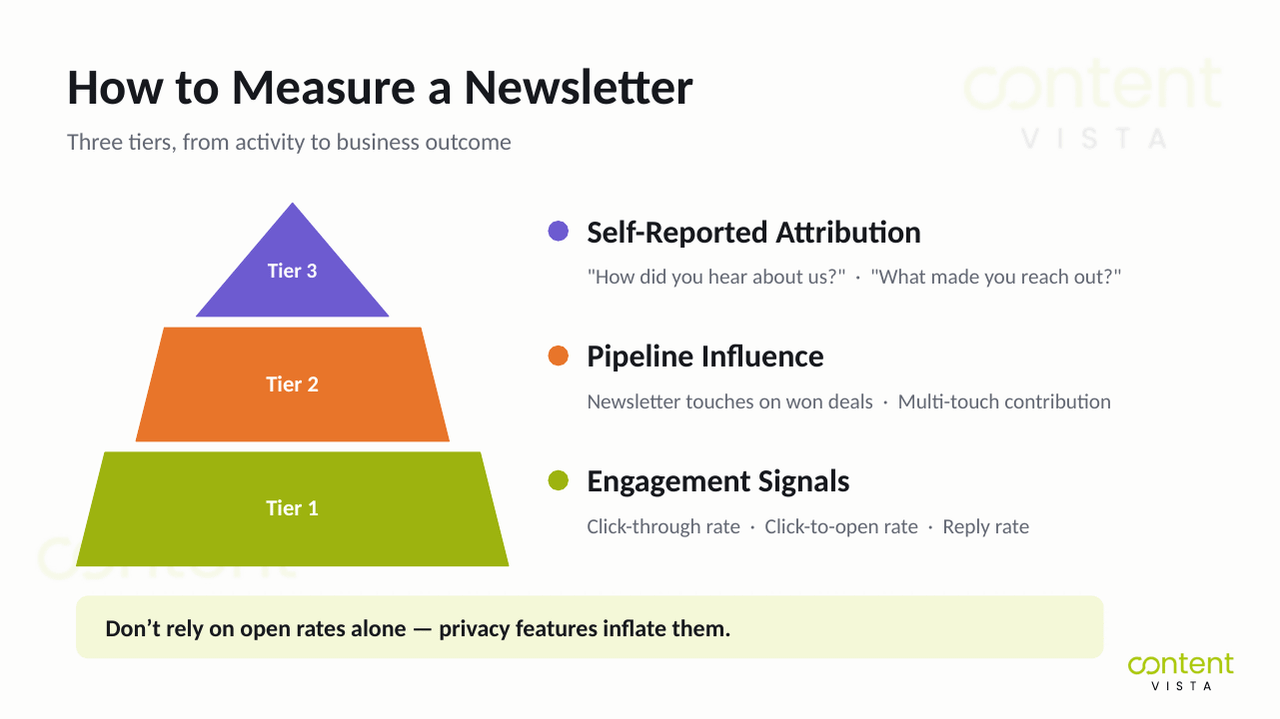
Tier 1: Engagement signals
This is the operational layer.
The question here is simple:
Are people interacting with the content?
The most useful metrics include:
Click-through rate (CTR)
Click-to-open rate (CTOR)
Reply rate
Forwarding or sharing behaviour where measurable
These metrics help you understand whether your content is earning attention.
Open rate can still be monitored, but it should not be treated as the primary success metric.
Tier 2: Pipeline influence
This is where newsletter measurement becomes more meaningful.
Instead of asking whether someone clicked, ask:
Did newsletter engagement appear anywhere in the customer journey?
A useful analysis is to review won opportunities and determine what percentage had at least one newsletter interaction before conversion.
This is not theoretical. Dreamdata's B2B email benchmarks, drawn from 200 active accounts, found that almost 30% of won deals are attributed to email under a data-driven attribution model, while only 3% of leads have an email click as their last touch.
Read those two numbers together and the point becomes obvious.
Email is doing far more work than last-click reporting gives it credit for.
Tier 3: Self-reported attribution
The third layer is surprisingly simple.
Ask prospects:
"How did you hear about us?"
or
"What made you reach out?"
It isn't perfect attribution.
People forget. Memory is imperfect. Attribution is messy.
But as a practitioner method, self-reported attribution often reveals patterns that analytics platforms miss.
Treat it as directional evidence, not definitive truth.
| Measurement Tier | What to Measure | Primary Purpose |
|---|---|---|
| Tier 1 - Engagement | CTR, CTOR, reply rate | Content resonance |
| Tier 2 - Pipeline Influence | Newsletter touches across opportunity journeys | Revenue contribution |
| Tier 3 - Self-Reported Attribution | Buyer feedback and source questions | Qualitative validation |
The biggest takeaway?
Last-touch attribution systematically under-credits newsletter nurture.
A prospect may read your newsletter for six months, consume ten issues, forward two emails internally and then finally convert through a direct website visit.
The analytics platform often credits the website visit.
The buyer credits the newsletter.
The truth usually lives somewhere in between.
That's why the strongest teams combine engagement metrics, pipeline influence analysis and self-reported attribution rather than relying on a single number.
Here are the numbers worth keeping in view while you build that picture.
| Metric | Figure | Source |
|---|---|---|
| Buyers not in-market at any given time | Up to 95% (a heuristic, not a law) | John Dawes, Ehrenberg-Bass Institute |
| Buying journey completed before contacting a vendor | Around 70% (2024), around 61% (2025) | 6sense Buyer Experience Report |
| Won deals attributed to email (data-driven model) | Almost 30% | Dreamdata B2B Email Benchmarks |
| Leads with an email click as last touch | 3% | Dreamdata B2B Email Benchmarks |
| B2B marketers using email newsletters | 71% | Content Marketing Institute |
One note on that last figure. The Content Marketing Institute's B2B research found that 71% of B2B marketers use email newsletters to distribute content, making it one of the most widely used channels in B2B.
Widely used is not the same as well used.
Litmus's State of Email research points at the difference: the highest-ROI email programs most commonly send newsletters and onboarding emails, not promotional blasts.
For a deeper look at how marketing performance should be measured across the entire growth engine, see our guide to demand generation metrics.
When you should NOT start a newsletter
Here's where most teams go wrong:
They treat a newsletter as the solution when it's actually just one component of a larger demand system.
And sometimes, it's not the thing that needs fixing.
If you can't commit to consistency
A newsletter is a trust-building asset.
Trust compounds through repetition.
If you're going to send three emails, disappear for four months, then restart the program again, don't start.
A monthly newsletter that runs consistently for two years will create more value than an ambitious weekly schedule that collapses after eight weeks.
Consistency is the strategy.
Frequency is just a delivery mechanism.
If your real problem sits elsewhere
Earlier, we introduced the Four Demand Gaps.
Not all growth problems are Create problems.
Not all growth problems are Convert problems.
If people are discovering your content but never becoming identifiable leads, you may be looking at an Intent Gap rather than a content shortage.
If buying intent exists but opportunities are not progressing toward pipeline, you likely have a Routing Gap.
In both cases, adding more newsletter content will not solve the underlying issue.
The bottleneck exists elsewhere in the system.
If you don't have a point of view yet
Many companies start a newsletter because they feel they should have one.
That's usually the wrong reason.
If you don't yet have a clear perspective on your market, your customers, or the problems you solve, the issue is not newsletter execution.
It's positioning.
Newsletters amplify thinking.
They do not create it.
A newsletter is most effective when it amplifies an existing point of view, supports a functioning demand engine, and operates consistently over time. If those foundations are missing, fix them first.
The good news is that once those foundations are in place, newsletters become one of the most effective ways to compound trust, demand, and buyer familiarity over the long term.
Two B2B newsletters that did a real job
The easiest way to understand the Create/Convert Newsletter Sorter is to see it in action.
Neither of the examples below succeeded because they sent more emails.
They succeeded because the newsletter had a clear job to do.
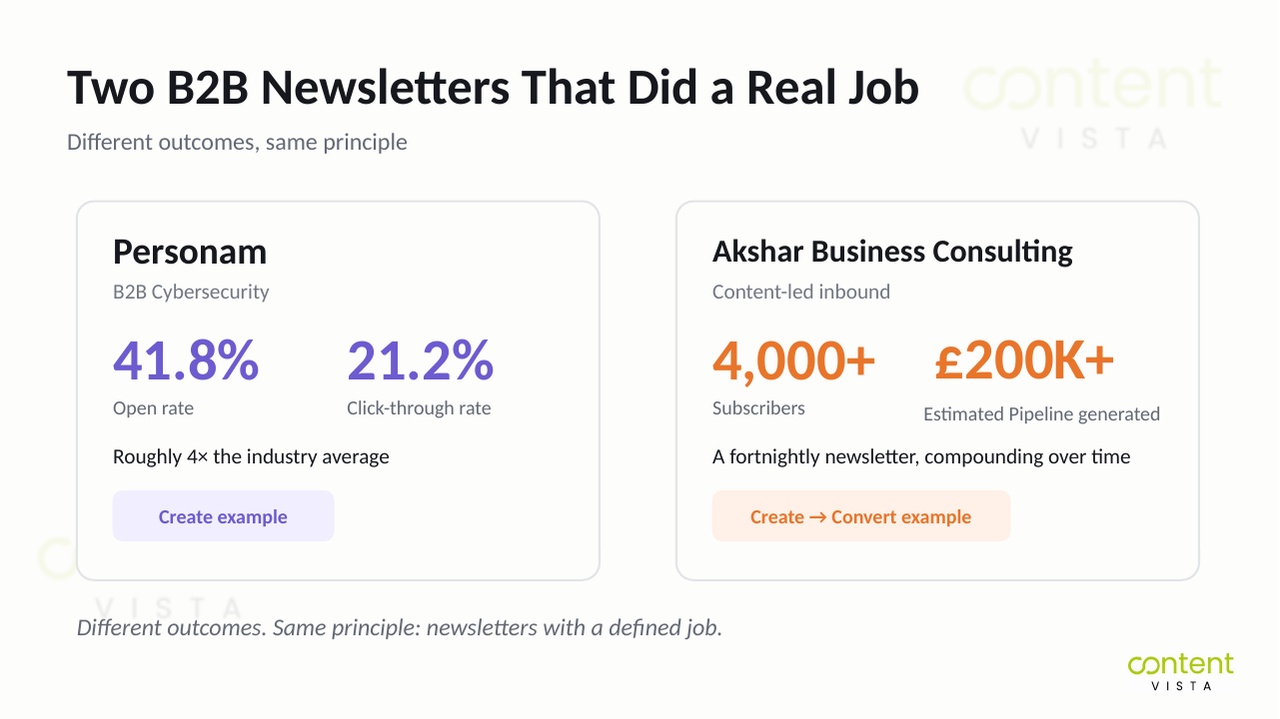
Personam: a Create-first newsletter
Personam, a B2B cybersecurity company, launched a monthly newsletter focused on audience-relevant insights and education.
The first issue generated:
41.8% open rate
21.2% click-through rate
Those results were described as roughly 4x the industry average.
What's important here is not the newsletter frequency or format.
It's the alignment.
The content was designed to create demand by delivering useful information to the right audience at the right level of relevance.
This is a Create example: building attention, trust and ongoing engagement long before a buying conversation occurs.
Akshar Business Consulting: a compounding Create-to-Convert engine
Akshar Business Consulting took a different path.
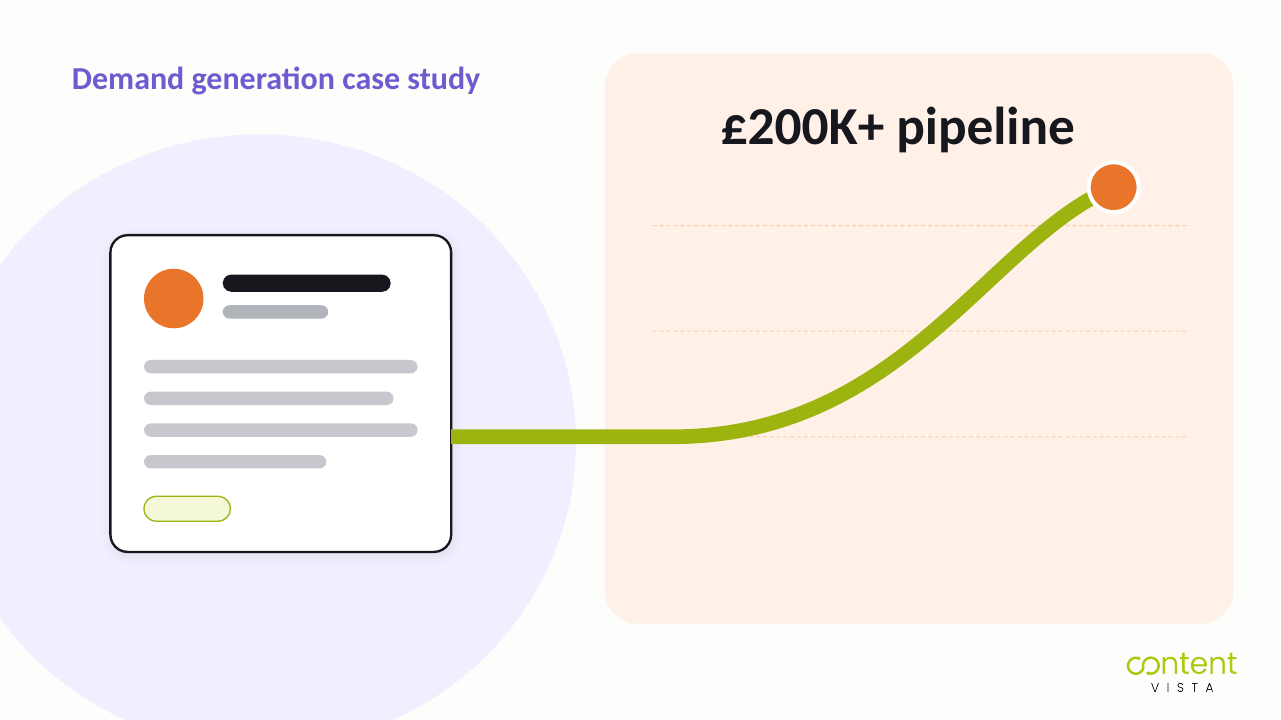
Its fortnightly newsletter grew to 4,000+ subscribers and contributed £200K+ in estimated pipeline through content-led inbound.
The newsletter itself was not acting as a direct sales mechanism.
Instead, it became part of a larger system that continuously educated prospects, reinforced expertise and nurtured interest over time.
This is where the distinction between Create and Convert becomes useful.
The newsletter created familiarity and trust. That trust then fed future conversion opportunities, helping prospects move into conversations when they were ready.
What both examples have in common
At first glance, these examples look different.
One demonstrates strong early engagement. The other demonstrates long-term business impact.
But both follow the same pattern.
Each used the newsletter to build familiarity first, then let that familiarity feed conversion later.
Neither treated the newsletter as a standalone channel.
That's the real lesson.
The best newsletters are not built around publishing frequency.
They're built around a clear job and a consistent point of view that compounds over time.
For organizations building founder-led visibility and audience growth, this often sits alongside broader founder and executive positioning work, where newsletters become one channel within a larger authority-building strategy.
Where to go from here
If you take one thing from this guide, make it this:
Stop asking "what should we send this week?"
Start asking "what job does this email need to do?"
Create, or Convert.
Once that question comes first, the ideas sort themselves.
The blank page stops being a creative problem and becomes a strategic one, which is a far easier problem to solve.
Then measure accordingly.
Not opens. Clicks, replies, pipeline influence and what buyers tell you directly.
And remember that a newsletter rarely fixes a growth problem on its own. It amplifies a system that already works.
If you want that system built rather than assembled piece by piece, that's what our demand generation work is for.
Before you plan your next twelve newsletters, find out what's actually limiting growth.
The Marketing Growth Maturity Assessment shows you where your marketing engine is strong, where it's leaking, and what to fix first.
Email newsletter ideas for marketing - FAQs
What should I put in a marketing newsletter?
The best marketing newsletters contain content that serves a specific job. Use Create content to build awareness, trust and mental availability through insights, trends, frameworks and education. Use Convert content to move active buyers forward through case studies, comparisons, ROI discussions, objection handling and decision-support content.
What's the difference between a newsletter that builds demand and one that converts it?
A demand-building newsletter helps people remember you before they are ready to buy. A demand-converting newsletter helps interested prospects make progress toward a decision. The first focuses on awareness and trust. The second focuses on confidence, clarity and reducing buying friction.
How often should a B2B company send a newsletter?
Most B2B companies should prioritize consistency over frequency. Weekly, fortnightly and monthly cadences can all work. The best schedule is the one you can maintain for the long term while consistently delivering useful content. A reliable monthly newsletter is usually more effective than an inconsistent weekly one.
How do I measure if my newsletter is actually working?
Measure newsletters across three levels. First, track engagement signals such as click-through rate, click-to-open rate and reply rate. Second, evaluate pipeline influence by reviewing newsletter touches across opportunity journeys. Third, use self-reported attribution questions to understand whether newsletters are influencing awareness and buying decisions. Avoid treating open rate as the headline metric, since privacy features inflate it.
Are email newsletters still effective for B2B in 2026?
Yes. Newsletters remain one of the few channels that allow direct, permission-based communication with an audience, and 71% of B2B marketers use them to distribute content. They are particularly effective when used as part of a broader demand-generation system that combines demand creation, nurturing and conversion rather than treating the newsletter as a standalone marketing tactic.
How is a newsletter different from a nurture sequence?
A newsletter follows a regular publishing rhythm and is sent broadly to subscribers. A nurture sequence is triggered by a specific action, such as downloading a resource, attending a webinar or requesting information. Newsletters maintain ongoing visibility, while nurture sequences are designed to move declared intent toward a specific outcome.
When should I NOT start a newsletter?
Do not start a newsletter if you cannot commit to consistent publishing, if your primary bottleneck exists elsewhere in the demand engine or if you lack a clear point of view. A newsletter amplifies positioning and demand-generation efforts that already exist. It rarely solves foundational strategy problems on its own.