Quick Summary
- Inbound and outbound marketing are not enemies. Inbound helps you create demand by building trust, visibility and preference before buyers are ready.
- Outbound helps you capture and convert demand by reaching specific accounts or buyers more directly.
- The right investment split depends on how much in-market demand already exists in your category and how mature your growth system is.
Stop asking which one wins. That is the wrong fight.
Most "inbound vs outbound marketing" advice starts with a scoreboard.
Inbound is cheaper.
Outbound is faster.
Inbound compounds.
Outbound gives control.
So which one should you choose?
Here's the problem: inbound and outbound are not rival camps. They are different layers of one demand engine.
Inbound is strongest when you need to create demand with people who are not ready to buy yet. Outbound is strongest when you need to capture and convert demand from specific buyers who are closer to action.
The real question is not "Which is better?" It is:
Where should you invest right now, based on your buyer-state mix, growth stage and revenue pressure?
By the end, you will know when to lean inbound, when to lean outbound and how to combine both inside one connected growth system.
What's the difference between inbound and outbound marketing?
Inbound marketing is a pull motion. You earn attention by creating useful, discoverable, trust-building assets so buyers find you when they are researching, learning, comparing or ready to act.
Outbound marketing is a push motion. You initiate attention by reaching specific people or accounts through channels like cold email, cold calling, paid campaigns, direct outreach or account-based marketing.
Inbound marketing attracts buyers toward you through content, SEO, thought leadership, social proof and educational assets. Outbound marketing reaches buyers directly through targeted outreach, paid placement or sales-led contact. In simple terms: inbound helps buyers find you; outbound helps you go find buyers.
That is the basic difference.
But the investment decision is not solved by the definition alone. The better question is how each motion behaves inside your demand engine: which one helps you create demand, which one helps you capture demand and which one your business needs more of right now.
Inbound vs outbound marketing: the honest comparison
Before we reframe the question, let's give the standard comparison its due.
Inbound and outbound do behave differently. One usually compounds over time. The other can create faster contact with a defined audience. One is better at earning attention. The other is better at initiating attention.
Here is the honest side-by-side.
| Factor | Inbound | Outbound |
|---|---|---|
| Cost over time | Often heavier upfront because you invest in content, SEO, authority and assets before results compound. Over time, strong inbound assets can keep producing demand without restarting from zero each month. | Often more direct and controllable at the start because you pay for outreach, ads, tools, lists or sales effort. But if the campaign stops, the flow usually slows quickly. |
| Time to first results | Slower at the beginning. It needs trust, visibility, search traction, and repeated exposure before it becomes predictable. | Faster to activate. You can launch outreach, paid campaigns, or account-based plays quickly if the ICP, offer and message are clear. |
| Targeting / control | Less direct control over exactly who discovers you, though strong SEO, thought leadership and distribution can shape the audience over time. | More direct control. You choose the accounts, segments, job titles, geographies or buyer lists you want to reach. |
| Measurability | Harder to measure cleanly because buyers may discover you through content, search, referrals, AI assistants, social or the dark funnel before they ever convert. | Easier to attribute at the campaign level because touches, replies, clicks and booked calls are usually more visible. |
| Longevity | Compounds when built well. A strong article, search page, founder post, newsletter or trust asset can keep influencing buyers long after publishing. | Resets more often. Outbound can work very well, but it usually needs fresh lists, fresh messaging and ongoing campaign effort to keep producing. |
Useful? Yes.
Enough to make the investment decision? Not really.
So what does that mean? It means picking a winner from this table is the wrong move. The table tells you how each motion behaves. It does not tell you which layer of your demand engine is weak, which buyers you are trying to reach or whether your market already has enough declared intent to capture.
That is where the real decision starts.
Why "inbound vs outbound" is the wrong question
The real issue is not whether inbound or outbound is "better."
The real issue is buyer-state.
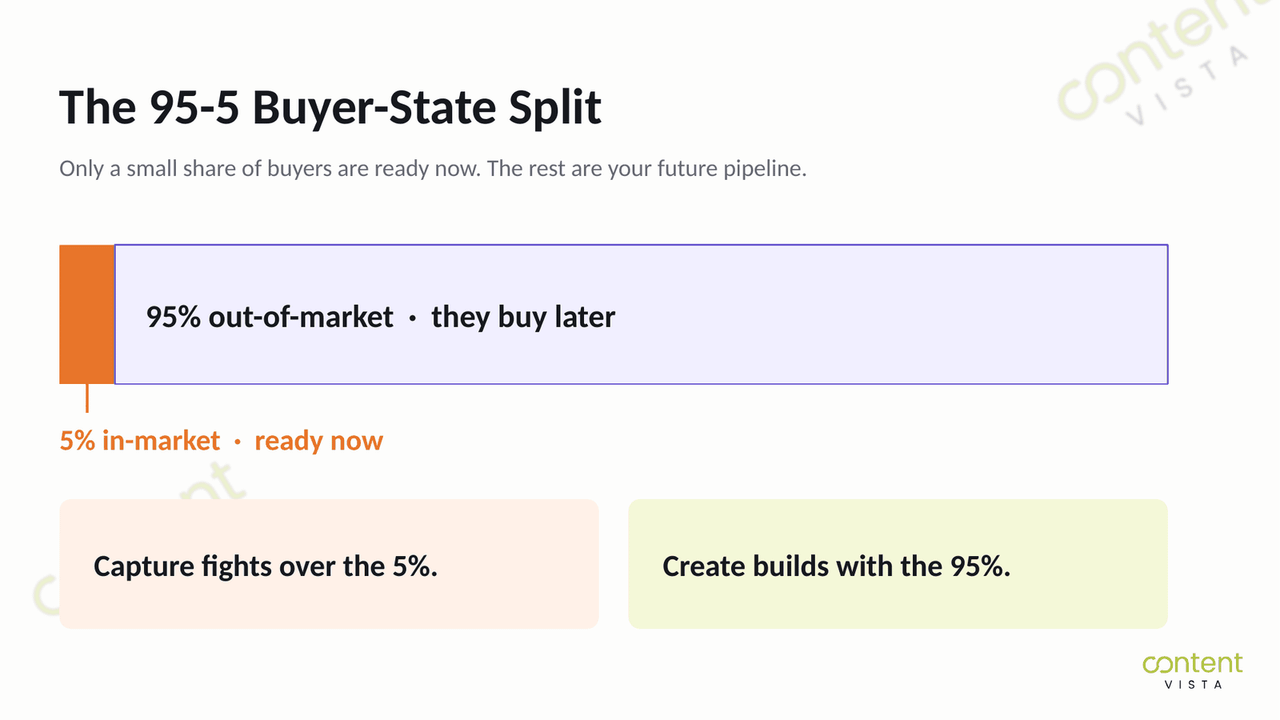
The 95-5 rule says that, at any given time, only about 5% of B2B buyers are actively in-market, while roughly 95% are out-of-market. It comes from Professor John Dawes of the Ehrenberg-Bass Institute, who wrote it up for the LinkedIn B2B Institute in 2021.
Dawes derived it from how often businesses actually re-buy: if companies change providers roughly every five years, only about 20% are in-market across a whole year, and something like 5% in any given quarter. He is clear that it is a mental model rather than a precise law, and that you can run the same calculation for your own category. But the implication is hard to ignore.
So what does that mean?
If your entire growth motion is built around outbound, paid search, retargeting, comparison pages, and other demand capture tactics, you are mostly competing for the same small in-market slice. That does not make outbound wrong. It makes it limited if it is the only thing you fund.
Inbound, when done properly, helps you build memory, trust, and category relevance with the larger out-of-market audience before they start actively looking. That way, when buyers eventually move into-market, you are not a stranger fighting for attention at the last minute. As the Ehrenberg-Bass Institute puts it, the brand that gets remembered is the brand that gets bought.
There is another practical problem: buyers do not spend most of their journey with your sales team, and increasingly they do not want to. A Gartner survey of 646 B2B buyers run in August and September 2025 found that 67% prefer a sales rep-free experience.
And the people you never speak to still shape the decision. Forrester's The State Of Business Buying, 2026 reports that a typical buying decision now involves 13 internal stakeholders plus nine external influencers, and that generative AI searches are where buyers start. Most of that happens somewhere you cannot see, cannot attribute, and certainly cannot cold-email your way into.
In plain language: you cannot rely on direct contact alone to carry the deal.
Outbound can open doors. Inbound can make the market more ready to open them.
That is why "which one wins?" is the wrong question. The better question is: how much demand do you need to create before your capture efforts can work efficiently?
Inbound and outbound are two halves of one demand engine
Here is the cleaner way to think about this.
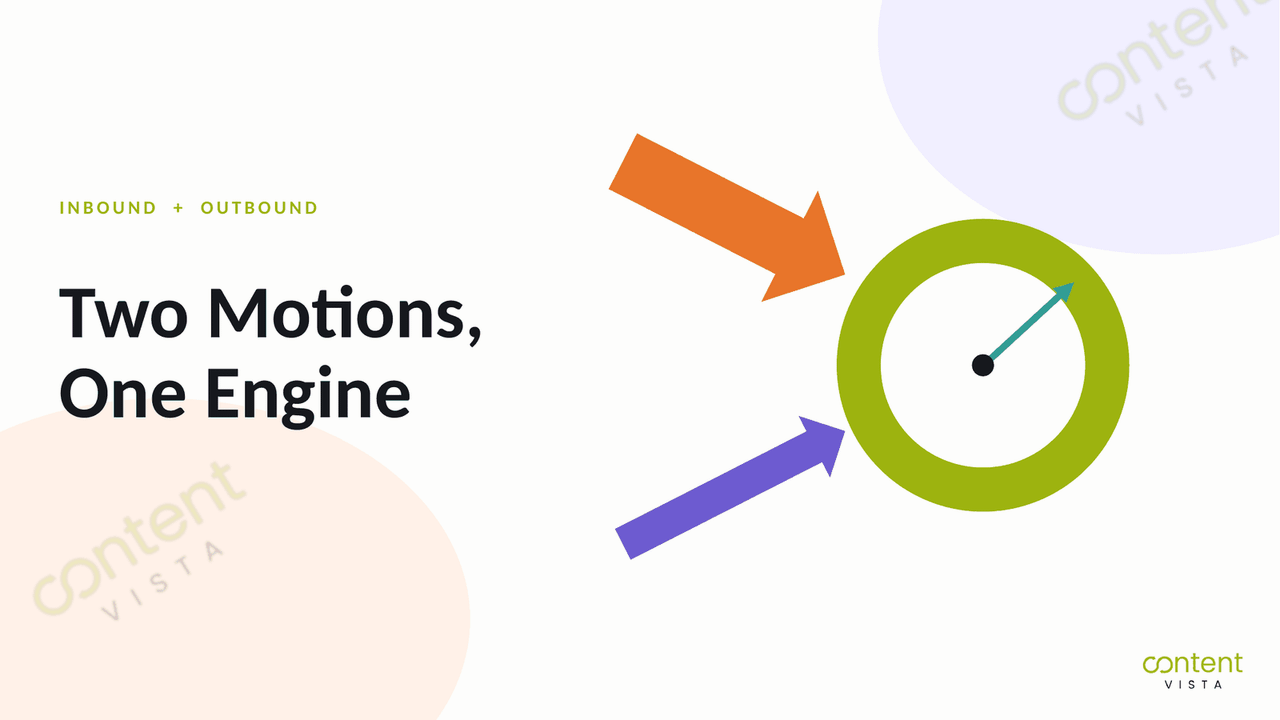
Inbound and outbound are not two separate strategies fighting for budget. They are different motions inside one demand engine.
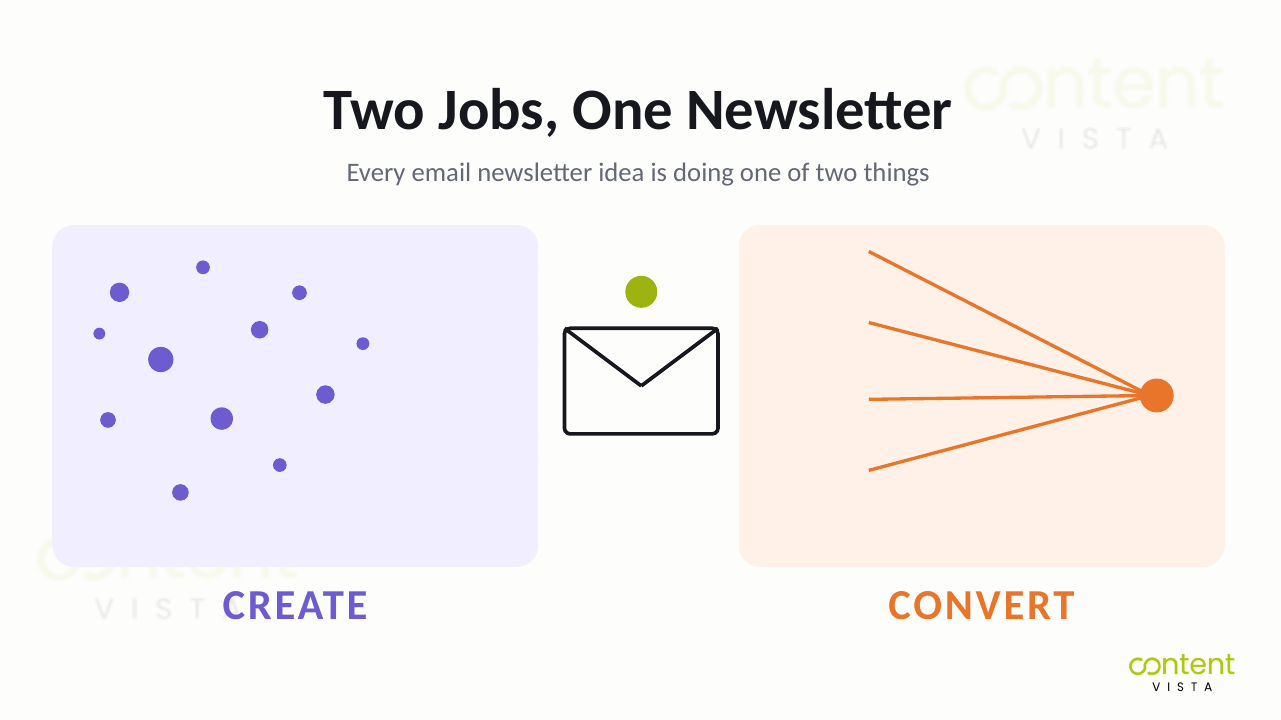
Demand work splits into two jobs. The first is demand creation: making the right buyers aware of you, and building enough trust and category relevance that you are remembered later.
The second is demand capture: harvesting the intent that already exists, from buyers who are searching, comparing or otherwise showing declared intent right now.
Everything after that is plumbing. You still have to convert captured interest into qualified pipeline, and you still have to measure what worked and reinvest so demand compounds instead of resetting every quarter.
This is also why a strong demand generation strategy cannot be built only around one channel or one campaign type.
Inbound usually does the creating, with a strong supporting role in capture. Think SEO, thought leadership, social proof, founder content, newsletters, case studies and buyer-intent content.
Outbound usually does the capturing and converting. Think cold email, targeted outreach, account-based marketing, sales-led follow-up, and direct contact with specific accounts.
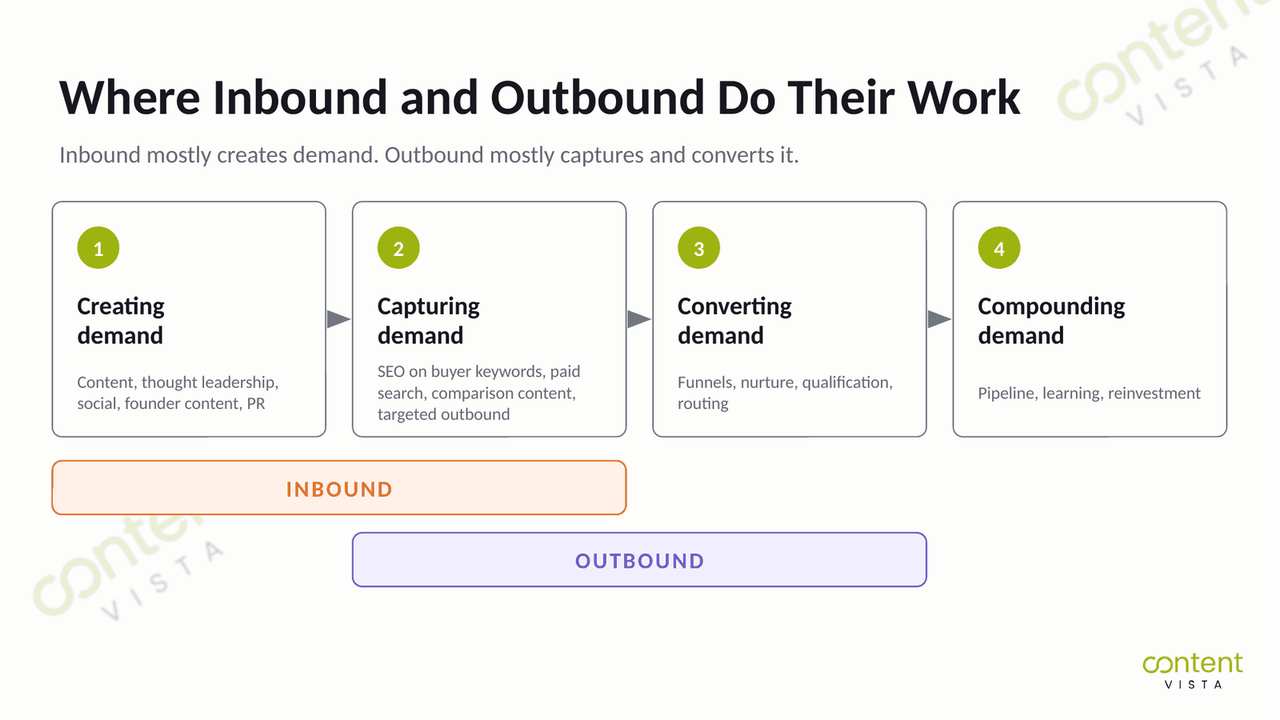
| Stage of demand work | What this stage does | Inbound's role | Outbound's role |
|---|---|---|---|
| Creating demand | Builds awareness, trust, category relevance, and preference before buyers are ready to act. | Strong role. Content, SEO, thought leadership, social, founder content, PR, and educational assets help buyers discover and remember you. | Limited role. Outbound can create awareness, but it is usually less effective when the audience has no problem awareness or buying context yet. |
| Capturing demand | Harvests existing in-market demand from buyers who are already searching, comparing, or showing declared intent. | Strong supporting role. Buyer-intent SEO pages, comparison content, service pages, and case studies help capture active demand. | Strong role. Targeted outreach, ABM, paid search, retargeting, and direct campaigns can reach specific in-market segments quickly. |
| Converting demand | Turns captured interest into qualified pipeline through the right offer, funnel, nurture, routing, and sales alignment. | Supporting role. Inbound assets educate and de-risk the decision, but they still need a conversion path. | Strong role. Outbound often creates the first direct conversation and helps move named accounts toward action. |
| Compounding demand | Measures what creates pipeline-influenced revenue, fixes weak layers, and reinvests so growth does not reset every quarter. | Strong long-term role. Inbound assets can keep building visibility, trust, and demand over time. | Supporting role. Outbound learns from replies, objections, and account data, but it needs system feedback to improve. |
That is the reframe.
Inbound is not "better." Outbound is not "dead." They are different layers of one connected growth system. The mistake is treating them like rival camps instead of asking which layer your business needs to strengthen first.
What inbound marketing does well (and where it fits)
Inbound marketing works best when your market needs trust before it needs a sales conversation.
That is why inbound is not just "posting content." Content is one channel inside demand creation, but inbound also includes SEO on buyer keywords, thought leadership, founder content, social proof, newsletters, case studies, educational assets and useful comparison pages.
The job is simple: make the right buyers aware of you, trust you and remember you before they are ready to buy.
Inbound is usually the right lead investment when you want demand to compound over time. It is slower to build, but strong inbound assets can keep working after the initial effort is done. A well-positioned SEO page, a credible founder post, a useful guide or a strong case study can influence future buyers repeatedly.
That is also why inbound can support lower CAC over time when the system is built properly. First Page Sage's comparison of SEO and PPC conversion rates, drawn from 124 clients between August 2022 and July 2024, puts SEO at around 2.4% against PPC at around 1.3% — a useful reminder that buyer intent and channel economics matter.
A practical example: Akshar Business Consulting generated £200K+ through content-led inbound and built a 4,000+ subscriber base. That is inbound doing what it should do: create demand, build trust and turn attention into future pipeline.
If inbound is the lead motion you need to strengthen, Content Vista's Inbound Magnet System is built around that exact create-to-capture path.
What outbound marketing does well (and where it fits)
Outbound marketing works best when you already know who you need to reach.
That is its strength.
Cold email, cold calling, paid campaigns, targeted outreach to in-market accounts, and account-based marketing give you more control over who sees the message and when. You are not waiting for buyers to discover you. You are choosing the segment, account, role, or trigger and initiating the conversation.
Outbound is the right call when you have a high-ACV offer, a tight ICP, a named-account motion, or a revenue target that needs action now. It is especially useful when your market is small, your buyer list is identifiable, and a single converted account can justify the effort.
But outbound is a precision tool, not a volume engine.
Here's where most teams go wrong: they expect outbound to convert the 95% who are not in-market yet. It rarely does. Outbound can reach anyone. What it struggles to do is manufacture buying context. If someone has no problem awareness, no timing pressure, no trust, and no reason to care yet, a cold message has to do too much work in a single touch.
That is why the reply rates should not surprise anyone. Instantly's 2026 cold email benchmark report, based on billions of cold email interactions, puts the platform-wide average reply rate at 3.43%, with top performers clearing 10%. Outbound can still work well — but only when the targeting, timing, offer, and relevance are sharp.
When outbound is the right call, this is the build: the Cold Email Conversion Lab.
Inbound vs Outbound: where should you actually invest?
Let's make this practical.
Your investment split depends on two things: your buyer-state mix and your growth maturity.
Buyer-state mix means how much active demand already exists in your category. Are people already searching, comparing, and asking for a solution like yours? Or do they first need education, trust, and problem awareness?
Growth maturity means where your business is right now. Are you early-stage and under pressure to create a pipeline quickly? Are you scaling but still invisible in the market? Or are you established and trying to reduce dependency on paid or outbound-heavy acquisition?
Use this matrix as a starting point.
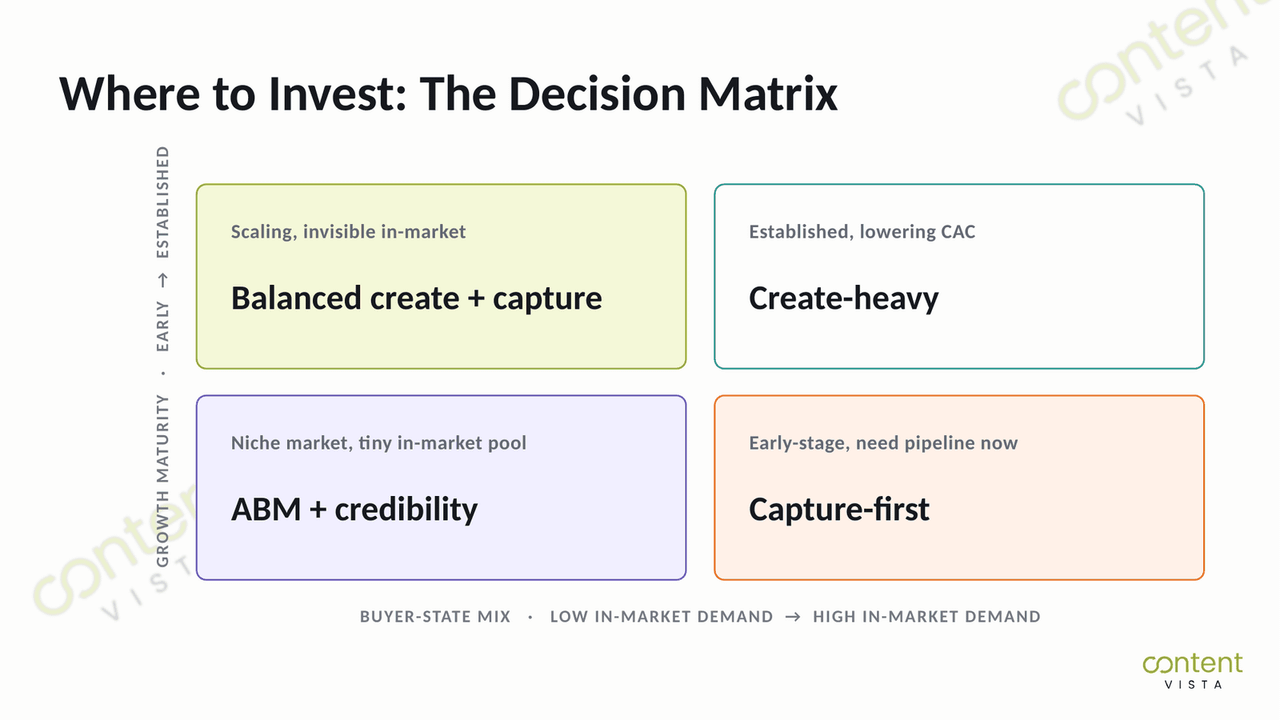
| Your situation | Buyer-state mix | Growth maturity | Recommended tilt |
|---|---|---|---|
| Early-stage, need pipeline now | Some in-market demand exists, but you do not yet have enough visibility or trust. | Early-stage | Tilt toward capture first. Use outbound, paid, partnerships, and buyer-intent pages to create conversations now, while building a basic demand creation layer in parallel. |
| Scaling, demand exists but you're invisible | Buyers are already researching the category, but they do not think of you yet. | Scaling | Balance creation and capture. Invest in SEO, content, thought leadership, case studies, and targeted outbound so buyers can both discover you and hear from you. |
| Established, want to lower CAC | The category has clear demand, but acquisition is becoming expensive or over-dependent on paid/outbound. | Leader or mature scaling brand | Tilt more toward creation. Build brand memory, organic visibility, founder authority, and trust assets that make future capture more efficient. |
| Niche market, tiny in-market pool | Very few buyers are actively searching at any given time, and the account universe is narrow. | Any stage, but especially specialist or high-ACV businesses | Use a sharp mix. Outbound and ABM help you reach named accounts, while demand creation builds credibility before and between direct touches. |
The point is not to copy a generic split.
Place yourself honestly. If you need cash flow now, capture matters. If your market does not know or trust you yet, creation matters. If you only fund one side, the system becomes fragile.
It is also worth being honest about what capture can do when the demand is genuinely there. Housewright is a straightforward example: a market with real, active search demand, 450% SEO growth and 270+ leads from getting the capture layer right.
Once you have placed yourself on the matrix, use the Marketing Growth System Finder to match your situation to the right growth system.
How to split your budget between inbound and outbound
If you want a practical starting point, translate the classic brand/activation split into demand creation and demand capture.
Binet and Field's B2B research for the LinkedIn B2B Institute points to an approximate 46% brand-building and 54% activation split as an optimum starting point. In our language, that means roughly 46% toward creating demand and 54% toward capturing it. Worth noting: the report itself says this ratio should be treated as a guiding principle rather than followed precisely.
But this is not fixed.
The same research suggests the split changes by maturity. Marketing Week's write-up of the study puts brand-building at just 35% of budget for businesses in their first year, rising toward 72% for leader brands. That makes sense. Early-stage companies often need pipelines now. Leader brands can afford to invest more heavily in memory, trust, and long-term demand creation.
Also, treat the popular 60:40 rule as a heuristic, not gospel. The critique is sharper than most people realise: Professor Byron Sharp of the Ehrenberg-Bass Institute has called it "terrible, very misleading", on the grounds that it rests on awards-submission data rather than clean experimental evidence. You do not have to pick a side in that argument to take the practical lesson from it: use the numbers as a starting point, then let your split follow your stage, market, and revenue pressure.
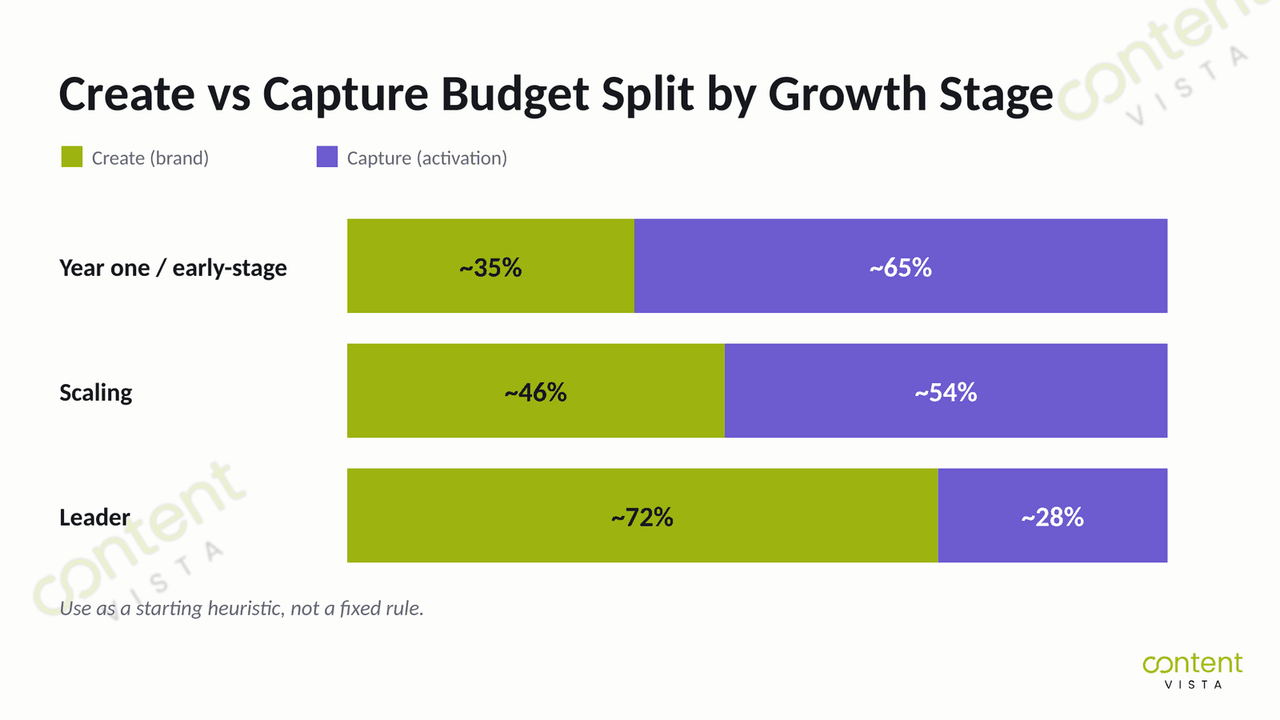
| Growth stage | Create (brand) | Capture (activation) |
|---|---|---|
| Year one / early-stage | ~35% Create | ~65% Capture |
| Scaling | ~46% Create | ~54% Capture |
| Leader | ~72% Create | ~28% Capture |
Use this as a starting allocation, not a permanent rule.
If you are early-stage, outbound, paid search, partnerships, and buyer-intent pages may deserve more weight because you need conversations now. If you are scaling, balance creation and capture so demand does not depend on one channel. If you are already established, a heavier investment in creating demand can improve future capture efficiency.
Not sure which stage you're in? The Marketing Growth Maturity Assessment will help you identify it before you lock your inbound vs outbound split.
How to measure inbound and outbound (without fooling yourself)
Here's where most teams misread the whole inbound vs outbound decision.
They measure what is easiest to see, not what actually influences revenue.
Outbound often looks cleaner in attribution because the touchpoints are visible: email sent, reply received, call booked, deal opened. Inbound is messier. A buyer may read your article, see your founder content, ask peers about you, compare you through AI assistants, visit your site three times and only then fill a form.
That invisible research layer is the dark funnel. If your measurement system ignores it, you will under-credit demand creation and over-credit the final capture touch.
So what does that mean?
Do not make MQL volume your headline metric. Track pipeline-influenced revenue. Look at CAC. Add self-reported attribution, especially a simple "How did you hear about us?" field, so buyers can tell you what analytics missed.
Key metrics to track:
Pipeline-influenced revenue: Which inbound and outbound touches helped create a real pipeline?
CAC: Is your acquisition cost improving as demand creation and capture work together?
Self-reported attribution: What do buyers say actually influenced them before they converted?
This is why connected systems outperform isolated campaigns. In the SalesFed case study, $400K in pipeline came through integrated search and content systems, not one disconnected tactic.
Capture-biased attribution makes teams over-invest in what is visible and starve what creates future demand. That is how companies end up with lots of activity, but no compounding demand engine.
When NOT to lead with inbound or outbound
The honest answer is not "always do both equally."
Sometimes inbound should not lead. Sometimes outbound should not lead. The mistake is choosing based on preference instead of diagnosing the weak layer.
Do not lead with inbound if you need revenue this quarter, your audience is extremely narrow, or you do not yet have the capacity to create useful assets consistently. Inbound compounds, but it needs time, positioning, distribution, and patience. If the business needs conversations now, capture may need to come first.
Do not lead with outbound if your ACV is too low, your market is broad, your ICP is unclear, or your offer has no urgency. Outbound without precision becomes noise. It can create activity, but not necessarily a qualified pipeline.
A simple way to pressure-test the decision is to ask four questions in order. Do enough of the right people know you exist? If not, that is a visibility problem, and more outreach will not fix it. Do they know you but not trust you enough to shortlist you? That is a credibility problem.
Is there demand you are visibly failing to catch — searches, comparisons, enquiries going elsewhere? That is a capture problem. Or are leads arriving and then dying between the form fill and the sales conversation? That is a routing problem, and no amount of new demand will fix it.
Common mistakes:
1. Running inbound and outbound as disconnected random acts.
2. Judging success mainly on MQL volume instead of pipeline-influenced revenue.
3. Copying a competitor's budget split without checking your own buyer-state mix.
4. Using outbound to compensate for weak positioning.
5. Expecting inbound to fix urgent pipeline pressure overnight.
If you want a second pair of eyes on the split, that is exactly where Marketing Strategy & Growth Consulting can help.
Stop choosing. Start building the engine.
Inbound and outbound are not competing religions. They are demand creation and demand capture motions inside one connected growth system.
Inbound helps you build trust, visibility, and future demand before buyers are ready. Outbound helps you reach specific buyers, accounts or segments when speed and precision matter. The win is not choosing a camp. The win is building the architecture that lets both motions support the same demand engine.
In short: your job is not to pick a side. Your job is to balance how much demand you create against how much you capture, based on your buyer-state mix, growth maturity and revenue pressure — and then to keep measuring and reinvesting so the engine compounds.
That is how Content Vista approaches growth: not as disconnected campaigns, but as a Growth Systems Company focused on building demand generation engines that can diagnose, adapt, and compound.
Not sure which growth stage you're in? Find out in minutes with the Marketing Growth Maturity Assessment — then come back and read the matrix again.
Inbound vs outbound marketing: FAQs
What's the difference between inbound and outbound marketing?
Inbound marketing attracts buyers toward you; outbound marketing reaches buyers directly. Inbound is a pull motion built around SEO, content, thought leadership, social proof, and trust-building assets. Outbound is a push motion built around cold email, cold calling, paid campaigns, ABM and targeted outreach.
Which is better, inbound or outbound marketing?
Neither is universally better. Inbound is stronger for creating long-term demand and trust. Outbound is stronger for reaching specific buyers faster. The better question is which part of your demand engine needs more investment right now: creating demand with buyers who are not ready yet, or capturing and converting the demand that already exists.
Is SEO inbound or outbound?
SEO is usually inbound because buyers find you through search. But SEO can also do capture work when it targets buyer-intent keywords such as service, comparison, pricing, or problem-aware searches.
Is inbound marketing cheaper than outbound?
Inbound can become more cost-efficient over time because strong assets can compound. But it is not "cheap" at the start. It needs strategy, content, distribution, SEO, and consistency before the economics improve.
What are examples of inbound and outbound marketing?
Inbound examples include SEO, blogs, guides, case studies, newsletters, social proof, founder content, and educational webinars. Outbound examples include cold email, cold calling, paid ads, direct outreach, retargeting, and account-based marketing.
What's the difference between inbound and outbound sales vs marketing?
Inbound and outbound marketing focus on generating attention and demand. Inbound and outbound sales focus on converting that demand into conversations and revenue. Marketing creates and captures interest; sales qualifies, handles objections, and moves buyers toward a decision.
How should I split my budget between inbound and outbound?
Split your budget based on your growth stage and buyer-state mix. Early-stage businesses often need more capture. Scaling businesses need balance. Mature brands can invest more heavily in creating demand to lower dependence on paid and outbound-heavy acquisition.
How long does inbound take to work vs outbound?
Outbound can create conversations faster if your ICP, offer, and timing are strong. Inbound usually takes longer because it builds trust, search visibility, and demand over time. But once inbound starts working, it can compound instead of resetting every campaign cycle.