Quick Summary
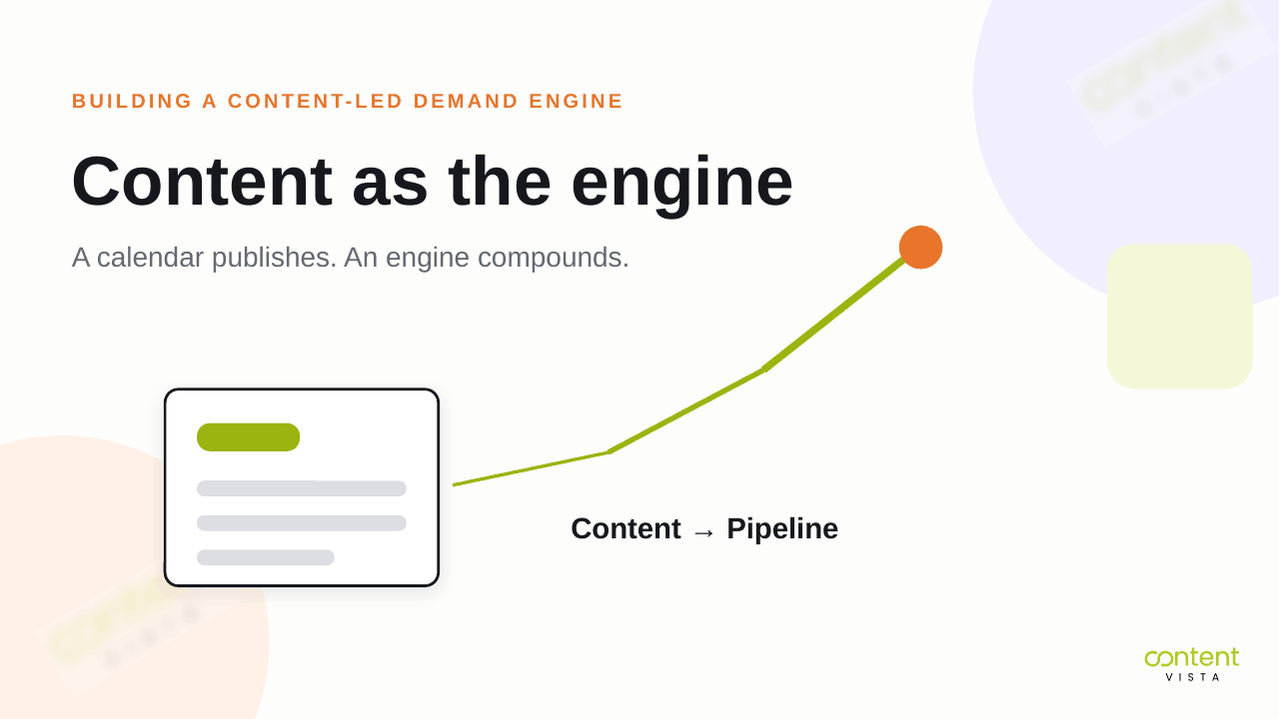
- A content calendar is not a demand strategy.
- Content's biggest job is creating demand: building awareness, trust and mental availability with the roughly 95% of buyers who are not in the market yet.
- But creating demand only turns into pipeline when it connects to the rest of the system; capturing the intent that already exists, converting interest into qualified opportunities, and compounding what works.
You're publishing content. So why isn't it producing pipeline?
You have a blog.
Maybe a newsletter.
You post on LinkedIn when the team has bandwidth. You turn ideas into carousels, send the occasional email, publish a few SEO articles and keep the content calendar moving.
But your pipeline is still flat.
Here's the problem: that's usually not a content problem. It's a system problem.
Most teams don't have a demand generation strategy. They have random acts of marketing: one blog here, one founder post there, one newsletter when there's time, one campaign when revenue feels urgent.
Each asset may be "good" on its own, but it is not connected to how buyers discover you, trust you, remember you, declare intent and eventually become qualified opportunities.
A content-led demand engine works differently.
It does not treat content as a publishing task. It treats content as the engine that creates demand before buyers are ready to speak to sales, then connects that attention to capture, conversion and compounding revenue.
That distinction matters because content rarely fails only because the writing is weak. It fails because the system around it is weak.
The right people are not discovering it. The message is not building enough credibility.
The content is not connected to capture paths. Or the interest it creates is not routed into a sales-ready conversation.
By the end of this guide, you'll know how to build a content-led demand engine and how to diagnose where your own content effort is leaking.
What is a content-led demand engine?
A content-led demand engine is a connected growth system where content powers demand creation among out-of-market buyers, then feeds demand capture, conversion and compounding revenue. Unlike a disconnected publishing calendar, it links what you publish to how buyers discover you, trust you, declare intent and become qualified opportunities.
It is not "posting more." It is not filling a monthly calendar with blogs, newsletters and LinkedIn posts because the brand needs to stay active.
A content-led demand engine gives every content asset a job inside the wider system: create demand, capture existing intent, support conversion or compound what is already working.
Why a content calendar isn't a strategy
Here's where most teams go wrong: they call it a content marketing strategy, but what they really have is a publishing schedule.
Monday: LinkedIn post
Wednesday: blog
Friday: newsletter
Next month: repeat
That may keep the brand visible, but visibility alone does not create demand.
A calendar tells you when to publish. It does not tell you which buyer state you are serving, what belief you are trying to shift, what demand you are creating or how the content connects to capture and conversion.
The mistake is simple: most content calendars are built for people who are ready to buy now.
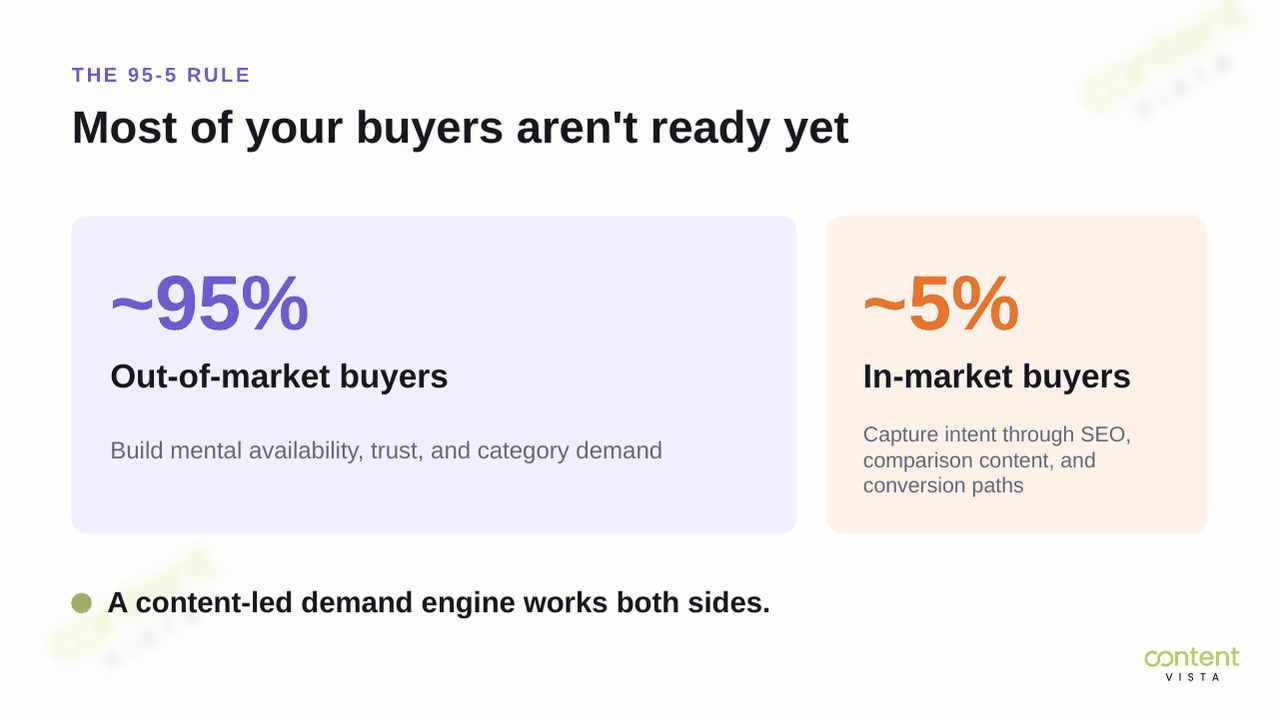
But according to the 95-5 rule, published by Professor John Dawes of the Ehrenberg-Bass Institute for the LinkedIn B2B Institute, only around 5% of B2B buyers are in-market at any given time. The other roughly 95% are out-of-market.
Dawes is explicit that 95% is a heuristic rather than a fixed mathematical constant; the true split depends on how often your category actually buys; but the point holds.
If your content only speaks to the in-market 5%, you are fighting everyone else for the same small pool of buyers.
These are the people searching comparison terms, pricing pages, service providers, implementation options, and "best X for Y" queries.
That demand matters, and you should capture it. But if that is the only audience your content serves, your growth becomes reactive.
You wait until buyers are already looking.
Then you compete with everyone else who waited too.
A content-led demand engine works earlier. It builds mental availability with the out-of-market 95% before they are ready to buy.
It helps them understand the problem differently. It gives language to pain they have not fully named.
It builds trust before the sales conversation exists.
So what does that mean in practice?
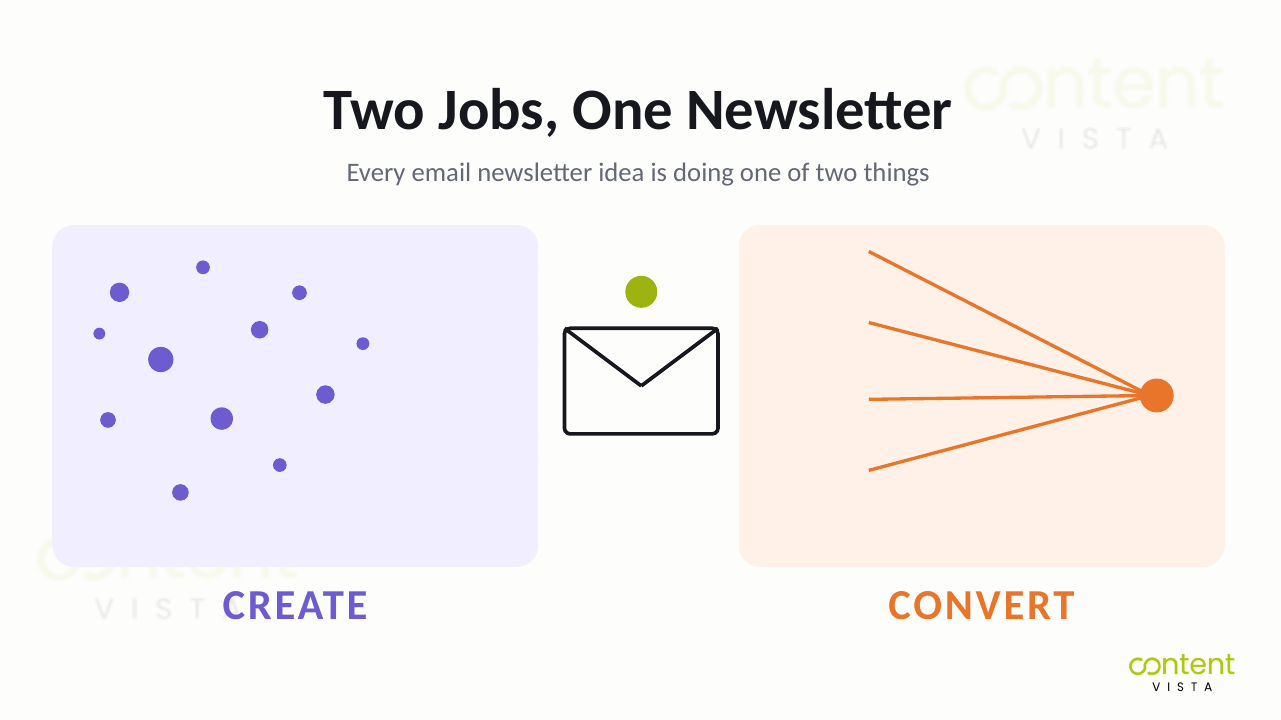
Your content has two jobs.
It must support demand creation with the people who are not ready yet. And it must support demand capture with the people who are already searching, comparing and evaluating.
A calendar can help you stay consistent. But it cannot decide that strategy for you.
That is the difference between publishing content and building a content-led demand engine.
Where content actually fits in a demand engine
A content-led demand engine is not built by asking, "What should we post this week?"
It starts with a better question: "What job should content do inside the demand system?"
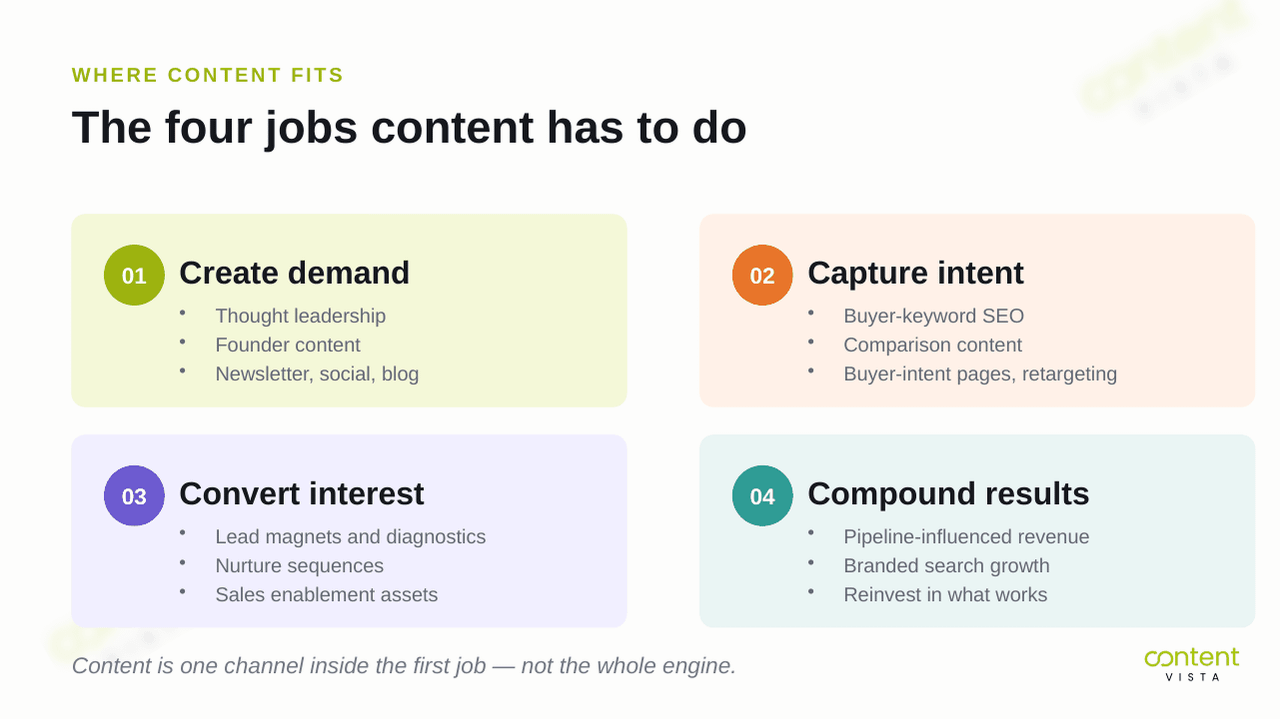
There are four answers, and content has a role in each one: create demand, capture intent, convert interest, and compound what works.
(We call the full model the 4C Demand Engine, and our demand generation strategy guide walks through the whole thing.)
Let's make this practical.
In the Create layer, content builds awareness, trust, and category demand among out-of-market buyers.
This is where thought leadership, founder content, newsletters, blogs, social posts, podcasts and point-of-view content do their strongest work.
The goal is not immediate conversion. The goal is mental availability: when the buyer finally feels the pain strongly enough to act, your name is already associated with the problem and the solution.
But this is where teams often confuse the model.
Content is one channel inside Create. It is not the whole Create layer. And it is definitely not the whole demand engine.
In the Capture layer, content helps harvest existing in-market intent.
This includes buyer-keyword SEO, comparison content, service pages, problem-aware articles, retargeting assets and bottom-of-market content that helps someone already evaluating options find and choose you.
How much you lean on this versus proactive outreach is the real question sitting underneath inbound versus outbound marketing.
In the Convert layer, content turns attention into qualified opportunities.
This is where lead magnets, diagnostic tools, nurture sequences, sales-enablement decks, case studies, objection-handling assets and follow-up content matter.
Without this layer, your best content may create interest that never becomes a sales conversation.
In the Compound layer, content stops being measured as "did this post get leads this week?" and starts being measured as part of the growth system.
You look at pipeline-influenced revenue, declared intent, branded search, qualified opportunities and which layer is weakest. Then you reinvest in what works.
| Dimension | Random acts of marketing | Content-led demand engine |
|---|---|---|
| Goal | Publish consistently, stay visible, and keep the calendar active | Build demand, capture intent, support conversion and compound revenue over time |
| Who it targets | Mostly people already searching, comparing or ready to buy | Both out-of-market buyers who need trust and in-market buyers who need a clear path forward |
| How it's measured | Traffic, impressions, engagement, form fills or short-term lead counts | Pipeline-influenced revenue, qualified opportunities, branded search, declared intent and conversion movement |
| What happens over time | Activity increases, but learning stays scattered and demand does not compound | Strong ideas become reusable assets, stronger positioning, better conversion paths and a more efficient demand engine |
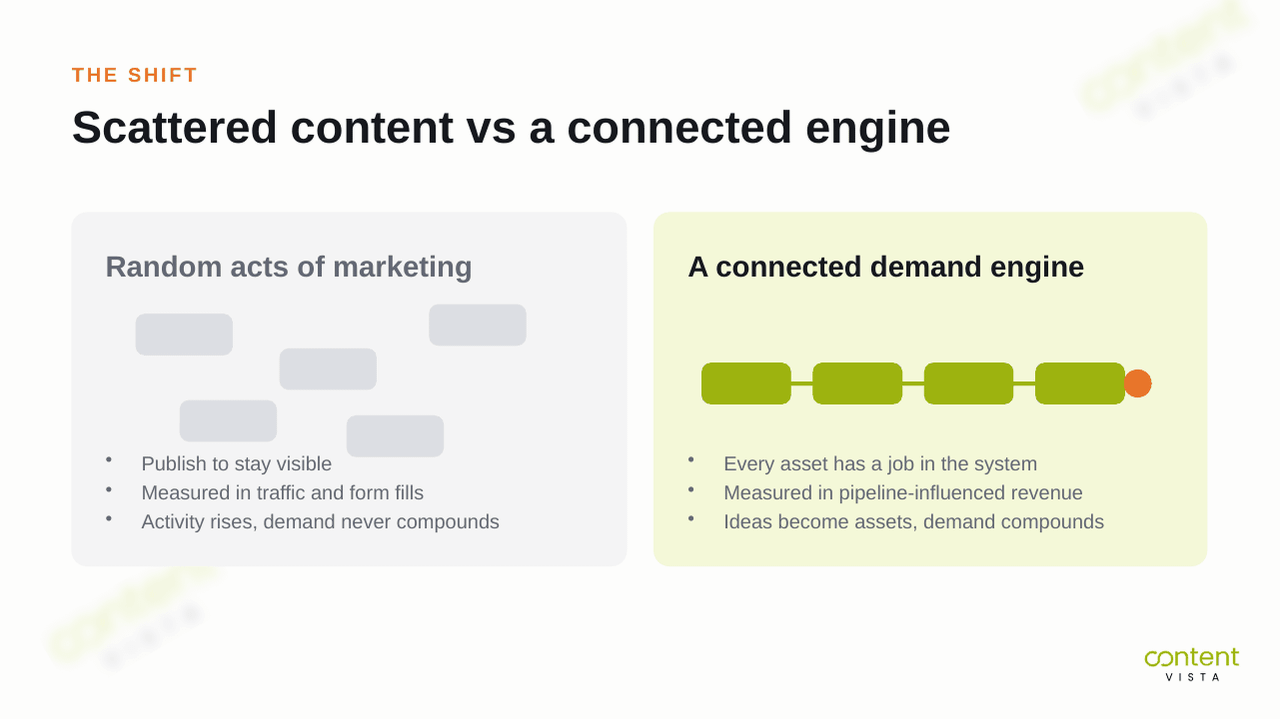
This is the strategic shift: content should not sit in a separate "content bucket." It should move across the engine.
A founder post can create demand.
A comparison article can capture intent.
A diagnostic tool can convert interest.
A case study can compound trust.
That is where content actually fits: not as a calendar, not as a campaign, but as connected infrastructure inside the demand engine.
Before you publish anything: is content even your bottleneck?
Before you plan the next blog, newsletter, founder post or campaign, ask the uncomfortable question first:
Is content actually the thing that is broken?
Because sometimes it is. But often, it is not.
That's the real issue: teams keep adding more content to a system that is leaking somewhere else.
More posts will not fix weak positioning. More blogs will not fix poor capture paths. More newsletters will not fix slow follow-up or unclear routing.
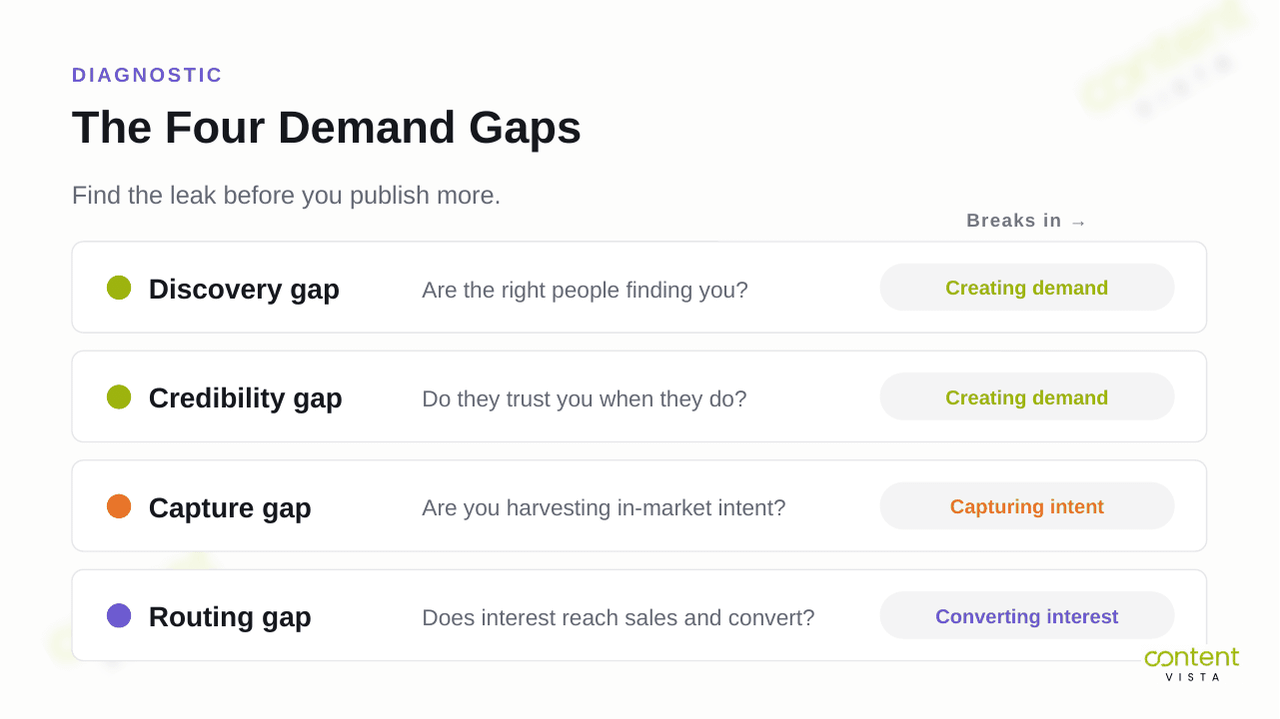
There are four gaps where demand usually leaks. Use them as a diagnostic to find the actual constraint before you create more activity.
The Four Demand Gaps
The first is the Discovery gap. Are the right people even finding you?
If your best buyers do not see your ideas, your Create layer is weak. This is where content, thought leadership, distribution, founder visibility and category education matter.
The second is the Credibility gap. When people do find you, do they trust you?
This is still a Create problem, but it is not solved by volume. It is solved by stronger points of view, sharper positioning, proof, founder authority and content that says something worth remembering.
The third is the Capture gap. Are you harvesting the in-market intent that already exists?
If someone is actively searching, comparing or evaluating, can they find the right content, page, offer or next step? This belongs to Capture.
The fourth is the Routing gap. When interest appears, does it reach the right sales path quickly and clearly? This belongs to Convert.
A buyer may be interested, but if the next step is vague, buried, slow or generic, the demand leaks.
Quick self-check:
Discovery gap: Are the right buyers consistently encountering your ideas before they are ready to buy?
Credibility gap: When they encounter your content, does it make them trust your expertise more?
Capture gap: When buyers are in-market, do you have content and pages that capture that intent?
Routing gap: When someone shows interest, is there a clear path from content to qualified opportunity?
When content is NOT your bottleneck
Here is the blunt truth: sometimes publishing more content is the wrong fix.
If the real problem is Capture, you do not need more thought leadership first. You may need better SEO pages, comparison content, lead magnets, retargeting or buyer-intent assets.
If the real problem is Routing, more visibility will only create more leakage. You may need clearer CTAs, better nurture, tighter sales handoff or stronger follow-up.
And if the real problem is Credibility, volume will not save you. Safe, generic content just creates more noise.
A content-led demand engine starts by finding the weakest layer. Then it creates the right kind of content for that specific leak.
Not sure which layer of your demand engine is weakest? Find your growth maturity level.
Marketing Growth Maturity AssessmentBuilding the Create layer: from publishing to authority
Creation is not about volume.
It is about trust at scale.
This is where many content teams get stuck. They assume the answer is more frequency: more blogs, more posts, more emails, more campaigns.
But the Create layer does not work because you publish often. It works because the right buyers repeatedly encounter ideas that make them trust your judgment before they are ready to buy.
That is how content earns mental availability.
Your goal is not just to be seen. Your goal is to become associated with the problem, the category and the way forward.
Why thought leadership is your highest-trust content
Thought leadership matters because it closes the Credibility gap.
According to the 2024 Edelman-LinkedIn B2B Thought Leadership Impact Report, 73% of decision-makers find an organisation's thought leadership a more trustworthy basis for judging it than its marketing materials.
The same report found that 75% said thought leadership prompted them to research something they were not already considering, and 60% said it made them more willing to pay a premium.
So what does that mean?
High-quality thought leadership does not just "educate." It changes what buyers notice, what they believe and which companies they trust before they are in-market.
The problem is that most thought leadership is not actually thoughtful.
The same report found that only about 15% of decision-makers rate the thought leadership they read as very good or excellent. That is the opening.
Differentiated, data-backed, founder-authored content wins because the bar is low and buyer skepticism is high.
This is why Content & Thought Leadership should not be treated as a content production function.
Done well, it becomes a Create system: Ideas → Authority → Audience → Pipeline.
Founder-led vs company-led content
Company content can build consistency. Founder-led content builds trust faster.
A founder or executive voice carries context, conviction and lived experience that brand channels often flatten.
It can say what the company page cannot say as sharply. It can take a position. It can explain trade-offs.
It can make the market feel like there is a real practitioner behind the point of view.
This matters even more because LinkedIn is now the #1-cited domain for professional queries across major AI platforms, based on Profound's analysis of 1.4 million AI-search citations and corroborated by SEMrush.
Founder content is not just a Create channel anymore. It is also an AI-citation asset.
You can see this in Content Vista's published work.
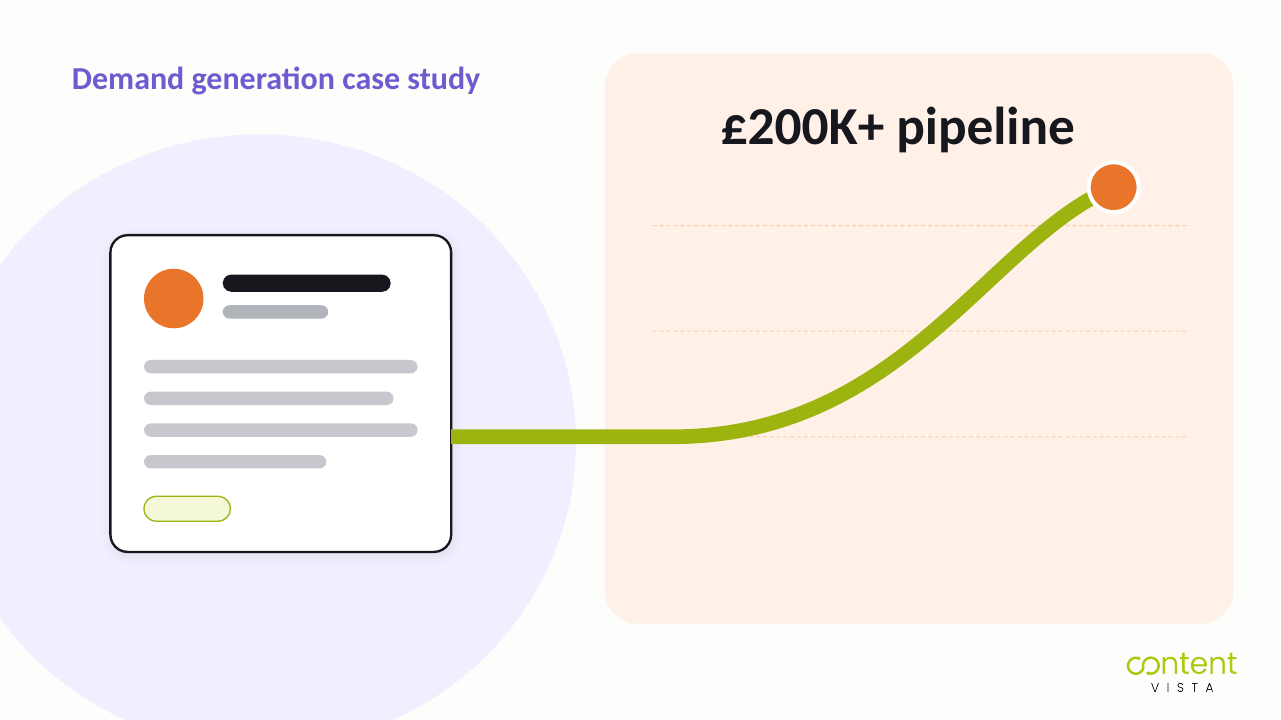
Akshar Business Consulting generated £200K+ in estimated pipeline through content-led inbound and built 4,000+ newsletter subscribers.
Personam reached a 41.8% newsletter open rate through founder personal branding in cybersecurity.
Alirrium used thought leadership and authority positioning in a way that attracted Baker Tilly acquisition interest.
The pattern is clear: when the Create layer works, content stops being output. It becomes an authority infrastructure.
Want to know how strong your founder authority and audience engine really are? Benchmark it here.
For brands where the founder or leadership team needs to become a visible trust asset, Founder & Executive Positioning is not separate from demand creation.
It is often the fastest way to make the Create layer credible.
Stop letting content dead-end: connecting Create to Capture and Convert
Here's where most teams go wrong: they create strong content, earn attention and then leave the buyer with nowhere useful to go.
A founder post creates trust.
A newsletter explains the problem beautifully.
A blog brings in qualified readers.
A webinar gets people thinking differently.
And then what?
If there is no capture path, no relevant next step, no diagnostic, no comparison asset, no nurture sequence and no clean route to sales, that attention leaks out of the system.
The content may be working, but the engine around it is not.
This is especially important because a large part of the buying journey happens before a buyer ever fills a form or speaks to sales.
6sense's research on anonymous buyer behaviour has tracked a consistent pattern for years: buyers completed roughly 70% of their evaluation independently before first contacting a vendor, and only about 3% of website visitors self-identify through a form.
Their 2025 data shows first contact moving slightly earlier, to around 60% of the journey, as buyers engage sooner to validate AI claims.
Because 6sense sells solutions tied to this view, treat it as a well-supported industry perspective rather than gospel. But the practical lesson holds either way.
You cannot measure content only by form fills.
Many buyers are reading, comparing, discussing internally, following your founder, sharing your ideas in private channels and forming a preference long before they declare intent. That is the dark funnel.
And if your system only counts people once they complete a contact form, you will undercount the value of Create and overreact by killing the very content that built trust.
So what does that mean?
You need low-friction ways for interested buyers to move forward when they are ready.
That could mean a useful assessment, a diagnostic tool, a comparison article, a service page, a case study, a buyer guide, a newsletter reply path or a clear "talk to us" route for declared intent.
Creating earns attention.
Capture gives that attention somewhere to go.
Convert turns that interest into qualified opportunities.
This is where Systems, Conversion & Growth Infrastructure becomes critical.
Without the right infrastructure, content stays trapped as visibility. With the right infrastructure, content becomes a pathway from trust to pipeline.
How to measure a content-led demand engine (without lying to yourself)
The mistake is simple: most teams measure content too early, too narrowly, and too close to the form fill.
If a blog does not generate leads this quarter, it is called a failure.
If a founder post does not create demo requests, it is treated as "brand."
If a newsletter builds trust but does not show direct attribution, it gets deprioritised.
That is how good content gets killed before it has a chance to compound.
A content-led demand engine should be measured on pipeline-influenced revenue, not lead counts.
Lead counts can tell you who filled a form.
They cannot tell you who trusted your point of view for six months, shared your post internally, searched your brand later, compared your service page and finally declared intent when the timing was right.
This is the attribution problem.
CMI and MarketingProfs' B2B Content Marketing Benchmarks, Budgets, and Trends: Outlook for 2025 found that 56% of B2B marketers cannot attribute ROI to content and only 29% of those with a documented strategy call it very effective.
That gap is exactly what random acts of marketing create: content activity without a clear system for learning what influenced demand.
So what should you track instead?
Use a combination of direct and directional signals.
Pipeline-influenced revenue is the headline metric. Declared intent shows when buyers raise their hands.
Branded search growth helps show whether mental availability is increasing.
Self-reported attribution, often associated with Chris Walker and Refine Labs' practitioner POV, gives buyers a way to tell you what actually influenced them: "I saw your founder on LinkedIn," "I read your newsletter," "Your article explained the problem better."
None of these is perfect alone. Together, they tell a more honest story.
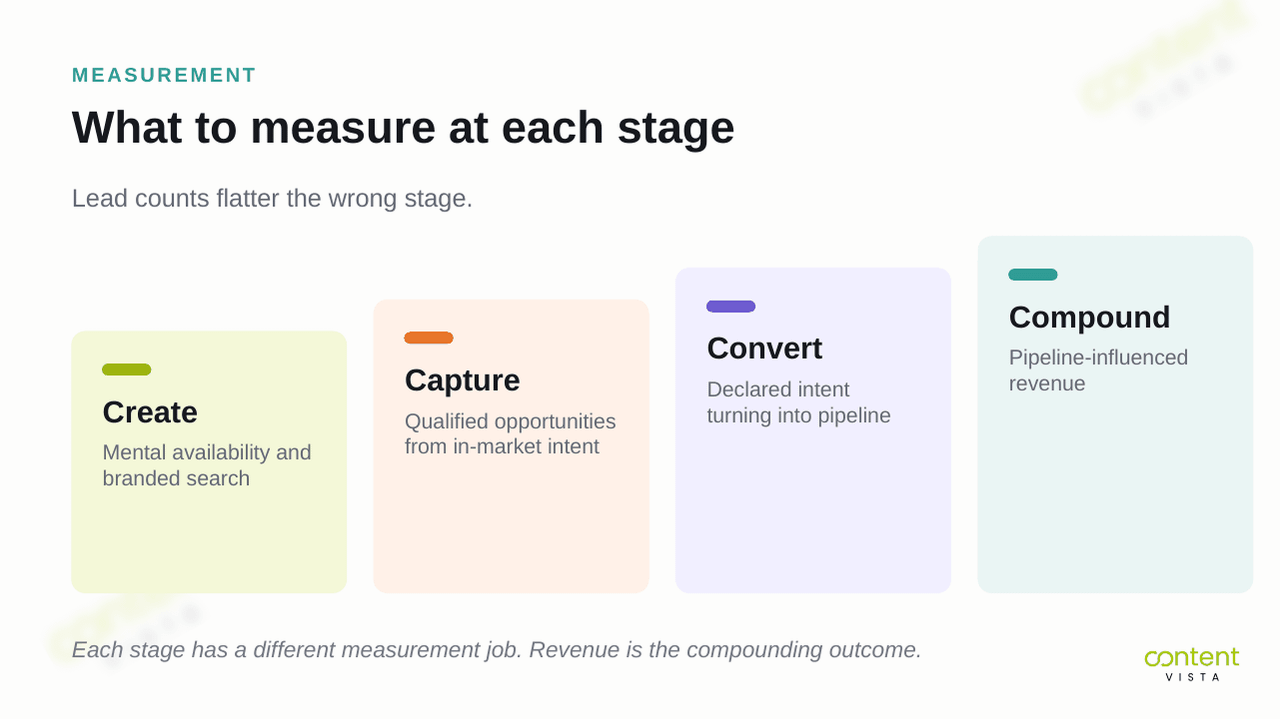
| Stage | Metric that actually matters |
|---|---|
| Create | Mental availability / branded search |
| Capture | Qualified opportunities from in-market intent |
| Convert | Declared intent → pipeline |
| Compound | Pipeline-influenced revenue |
Content compounds. It is slow early because trust, recall and authority take time to build.
Then it accelerates as ideas become familiar, distribution improves, buyers start remembering you and the system gets sharper.
Measure it only by this quarter's lead count and you will cut it too soon. Measure it as part of the demand engine and you can see what is actually working.
What AI search changes about your content strategy
AI search does not make content less important. It makes generic content less useful.
AI Overviews and answer engines are changing how buyers consume information. Instead of clicking through ten similar articles, they may get a summary directly inside the search experience.
Pew Research found in July 2025 that people click far less often when an AI summary appears, although Google disputes Pew's methodology, so this should be treated as a well-evidenced trend rather than a settled final truth.
Ahrefs also found in December 2025 that AI Overviews correlate with roughly 58% lower click-through rates for the #1 organic result.
So what does that mean?
If your content is just another version of what already exists, it becomes easier to summarise and easier to ignore.
A generic "how to build a content marketing strategy" article that repeats goals, personas, calendars, channels and KPIs does not give buyers or answer engines much reason to remember you.
What gets cited and trusted is different.
Original data.
Sharp expertise.
Clear frameworks.
Structured answers.
Founder authority.
Useful comparisons.
Specific implementation insight.
Content that shows experience, not just explanation.
That is why answer engine optimization should not be treated as a formatting trick.
Yes, definitions, FAQs, comparison blocks and direct answers help. But structure only works when the substance is worth extracting.
Think about it this way: AI can summarise common advice. It cannot replace a trusted point of view buyers already associate with your brand.
This is why a content-led demand engine becomes more valuable in an AI-search world, not less.
Even if fewer people click every generic search result, buyers still remember the companies that shape how they think.
They still follow founders who explain problems clearly. They still search branded terms when a need becomes urgent.
They still ask peers, compare options and look for proof.
The goal is no longer just to win the click.
The goal is to become the source buyers and AI systems both recognise as useful, credible and worth returning to.
5 ways content fails to produce demand (and how to fix each)
Mistake 1: Treating the content calendar as the strategy
A calendar tells you when something goes live.
It does not tell you what demand you are creating, which buyer state you are serving or how the asset moves someone through the engine.
Fix: Start with the demand system first. Decide what each asset must do: create demand, capture intent, support conversion or compound what is working.
Mistake 2: Only chasing the in-market 5%
If every article targets people already searching for a solution, you are competing for the smallest, most crowded part of the market.
You may capture some existing demand, but you are not creating future demand.
Fix: Build content for out-of-market buyers too. Teach the problem, shape the category, build mental availability and become memorable before the buyer is ready.
Mistake 3: Measuring content on lead counts
When content is judged only by this quarter's leads, good Create work gets cut too early.
Thought leadership, founder content, newsletters and category-building assets often influence the pipeline before they show up in attribution software.
Fix: Measure pipeline-influenced revenue, branded search, declared intent, qualified opportunities and self-reported attribution alongside direct conversions.
Mistake 4: Publishing safe, undifferentiated content
Generic content may be consistent, but it rarely builds trust.
If your article could be published by any competitor with the logo changed, it will not close the Credibility gap.
Fix: Add a clear point of view, real implementation insight, proof, examples, trade-offs and founder or expert perspective.
Mistake 5: Letting Create content dead-end
Attention is not enough. If a buyer trusts your content but has no useful next step, the demand leaks.
The problem is not the post. It is the missing capture and routing path.
Fix: Connect Create assets to diagnostics, lead magnets, service pages, comparison content, nurture sequences, case studies and a clear route to sales.
How Content Vista builds content-led demand engines
Content Vista is a Growth Systems Company.
We do not treat content as isolated output and we do not build fragmented calendars that sit separately from revenue.
We engineer connected growth systems where content powers the Create layer, then feeds Capture, Convert and Compound so demand can move from attention to qualified opportunities.
That is the reframe this entire guide is built on:
"That's not a strategy problem. It's a system problem."
If your content is not producing pipeline, the answer is not always "publish more."
Sometimes the real leak is weak positioning. Sometimes it is poor demand capture.
Sometimes it is missing conversion infrastructure. Sometimes the content is working, but the path from trust to declared intent is broken.
That is why Content Vista's Demand Generation work connects content, positioning, capture paths, conversion assets, and measurement into one operating system.
And why our Content & Thought Leadership work is built around Ideas → Authority → Audience → Pipeline, not just monthly content output.
The proof is in the pattern: SalesFed generated $400K in pipeline, while Akshar Business Consulting generated £200K+ in estimated pipeline through content-led inbound.
Different contexts, same principle: content works when it is connected to the engine around it.
See where your growth system stands - take the Marketing Growth Maturity Assessment.
Marketing Growth Maturity AssessmentFrequently asked questions
What is a content-led demand engine?
A content-led demand engine is a connected growth system where content creates demand, captures existing intent, supports conversion and compounds revenue over time.
It is not just a publishing calendar. Content powers the Create layer, but it must connect to Capture, Convert and Compound to influence the pipeline.
What's the difference between a content marketing strategy and a content calendar?
A content calendar tells you when to publish.
A content marketing strategy explains why you are publishing, who the content is for, what buyer state it serves, how it supports demand creation or demand capture and how it connects to qualified opportunities.
A calendar is scheduled. Strategy is system design.
How is thought leadership different from content marketing?
Thought leadership is a specific type of content designed to build trust, authority and mental availability.
Content marketing can include blogs, newsletters, social posts, guides, case studies and campaigns. Thought leadership goes further by giving the market a clear point of view, not just information.
How do you measure content marketing ROI in B2B?
Measure content marketing ROI by looking beyond direct form fills.
Track pipeline-influenced revenue, qualified opportunities, declared intent, branded search growth, self-reported attribution and movement through the demand engine.
Lead counts alone understate content's role, especially when buyers research anonymously before contacting sales.
How long does content take to generate pipeline?
Content usually takes months, not weeks, to show up meaningfully in the pipeline.
It compounds slowly at first because trust, recall, distribution and authority take time to build.
The mistake is judging content only on short-term lead counts before the Create layer has had time to influence buyer preference.
Should content be published under the founder or the company?
Both can work, but founder-led content often builds trust faster because it carries a clearer voice, stronger perspective and visible expertise.
Company channels help with consistency and brand presence.
The strongest systems often use both: founder authority for credibility and company content for structure, proof and scale.
Is content marketing still worth it with AI Overviews?
Yes, but generic content is less valuable.
AI Overviews and answer engines reduce clicks to repetitive content, but they increase the value of original data, strong expertise, structured answers, founder authority and memorable points of view.
A content-led demand engine helps buyers remember and trust you even when they do not click immediately.