Quick Summary
- A B2B influencer marketing strategy is not about buying attention from creators.
- It is about using trusted experts, partners, founders, customers and industry voices to create demand before buyers are actively in-market.
- Done properly, influencer and partnership campaigns build awareness, trust, shortlist entry and pipeline-influenced momentum that direct-response campaigns usually cannot create on their own.
Influencer Marketing Without the Hype (A B2B Reframe)
Here's the problem:
Most influencer marketing advice is built for consumer brands selling to individuals. It talks about creators, posts, promo codes, follower counts, and campaign reach.
That is not how B2B buying works.
In B2B, you are not trying to convince one person to buy a product on impulse. You are trying to build trust with a buying committee, often long before that committee is ready to speak to a vendor.
That is why influencer and partnership campaigns should not be treated as a social-media tactic.
For B2B teams, they are a demand-creation engine.
The real question is not, "Which influencer should we pay?"
It is:
Who already has the trust of the market we want to reach — and how do we turn that trust into awareness, credibility, conversation and eventually pipeline?
This playbook will break that down practically. Why influence works. Where it fits in a connected growth system. How to build the strategy.
And how to measure it honestly, without pretending every valuable touchpoint will show up neatly in attribution software.
What an Influencer Marketing Strategy Actually Means in B2B
Let's clear this up:
In B2B, an influencer marketing strategy is not a plan to pay creators for posts. That is the consumer-brand version.
An influencer marketing strategy is a plan for using trusted industry voices to build awareness, credibility and demand with the right buyers before they are ready to buy. In B2B, those voices may include experts, analysts, founders, customers, operators, employees, niche creators and partner brands.
The distinction matters because "influence" gets confused with three different motions.
Influencer marketing is about borrowed credibility and reach. You work with a person your market already listens to, so your message enters the conversation with more trust than it would from your brand account alone.
Affiliate marketing is more performance-driven. The relationship is usually tied to commissions, referral fees, codes or tracked conversions.
That can work, but it is not the same as building category trust or shaping market belief.
Partnership marketing, or co-marketing, is different again. Here, two businesses combine audiences, credibility, expertise or distribution for mutual gain.
Think joint webinars, co-authored reports, ecosystem campaigns, partner newsletters, expert panels or community collaborations.
That is why B2B influencer marketing rarely looks like the Instagram/TikTok creator playbook.
The "influencer" may be a cybersecurity founder with a respected LinkedIn audience. A niche analyst. A consultant your buyers already trust.
It may be a customer willing to publicly explain the problem you solve. An employee with deep domain expertise. Or a complementary business already serving the exact audience you want to reach.
In short: B2B influence is less about popularity and more about market trust.
Why Influence Works on Buyers Who Aren't Ready to Buy
Think about it this way:
Most of your future buyers are not actively shopping right now.
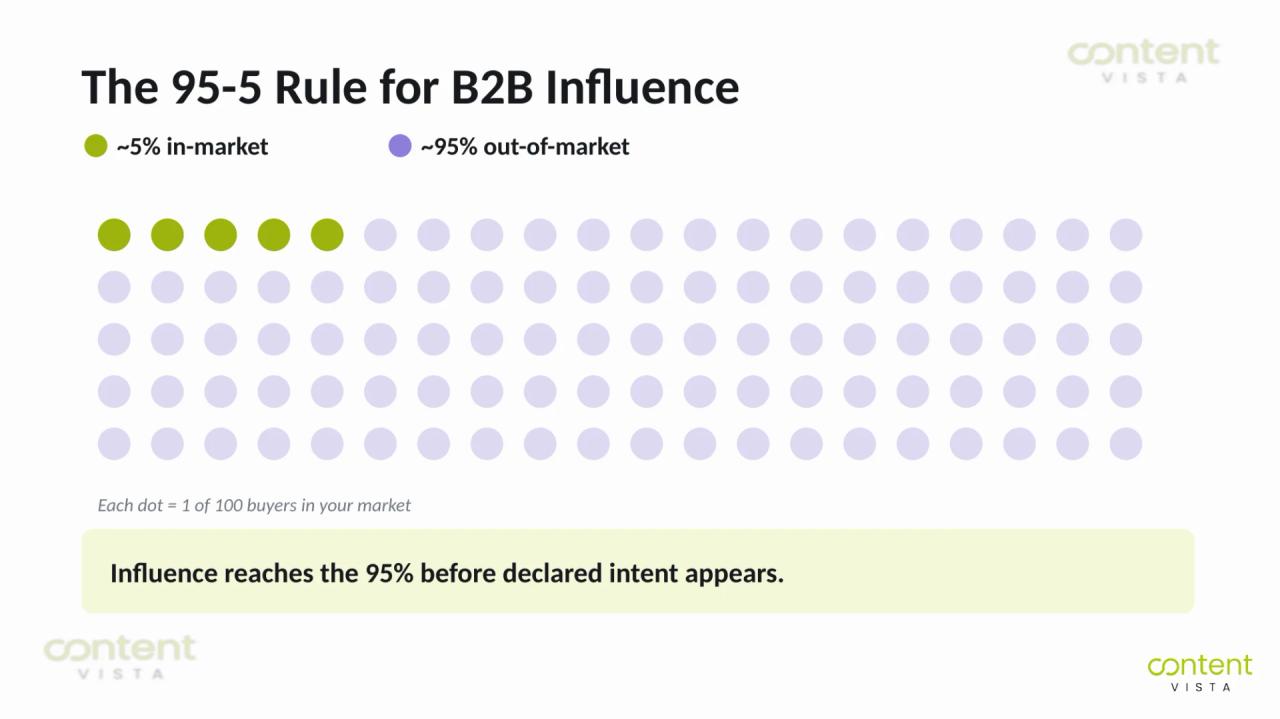
Professor John Dawes of the Ehrenberg-Bass Institute, writing for the LinkedIn B2B Institute, put a number on it: roughly 5% of B2B buyers are in-market at any given time, while about 95% are out-of-market. That is the 95-5 rule.
Worth noting: Dawes offers this as a mental model rather than a precise law. The exact split varies by category, and he encourages you to work it out from how often buyers in your market actually re-purchase. But whatever your number is, the implication holds — most of your market isn't buying today.
So what does that mean?
It means most of the people who will eventually buy from you are not searching for vendors today. They are not filling out forms. They are not comparing proposals.
They are not ready to be "captured" by a sales campaign.
But they are still forming opinions.
They are reading expert posts. Watching founder conversations. Attending webinars. Listening to peers.
They are noticing which companies show up with a clear point of view before the buying process starts.
That is where B2B influence works.
Influencer and partnership campaigns help you reach the 95% who cannot be captured yet. They create demand by building familiarity, trust and mental availability before declared intent appears.
The trust layer matters just as much.
The 2024 Edelman-LinkedIn B2B Thought Leadership Impact Report found that more than 75% of decision-makers say a piece of thought leadership led them to research a product or service they were not previously considering.
It also found that 73% say thought leadership is a more trustworthy basis for judging a company's capability than its marketing materials and product sheets.
That is the real B2B influence play.
You are not only buying reach. You are borrowing credibility from voices your market already trusts.
And in complex B2B buying, that matters because purchase decisions are rarely made by one person.
Gartner's research on the B2B buying journey found that the typical buying group for a complex solution involves six to ten decision-makers, each arriving with four or five pieces of information they gathered independently. The same research found buyers spend only about 17% of their total buying time meeting with potential suppliers.
Here's what makes that harder: a good portion of that committee never appears in your CRM at all.
The 2025 edition of the Edelman-LinkedIn research calls them "hidden buyers" — the finance, procurement and technical stakeholders who shape the decision without ever taking a sales meeting. The report found they actively seek out and evaluate thought leadership, just like the buyers you can see.
You cannot book a meeting with someone who will never accept one. But you can reach them through a voice they already follow.
So if your brand only shows up when someone is booking calls with vendors, you are late.
Influence works because it reaches the market before the form fill, before the shortlist and before the sales conversation.
Curious how much authority your founder voice actually carries in your market? Benchmark it with the Founder Authority & Audience Engine Benchmark.
Where Influence Fits in a Connected Demand Engine
Here's where most teams go wrong:
They treat influencer and partnership campaigns as separate activities.
One webinar here. One LinkedIn collaboration there. One expert quote. One partner newsletter. One founder podcast.
Then they wonder why the activity created attention but did not create momentum.
The missing piece is the system around it.
Demand creation and demand capture are two halves of the same engine. Creation builds awareness and trust with people who are not looking yet. Capture harvests intent from the small group who are.
Run either one alone and it underperforms. Run them as a connected loop and each one makes the other work harder. We call that loop the 4C Demand Engine, and if you want the full build, start with our guide to demand generation strategy.
Influencer and partnership campaigns are mostly demand-creation work.
They help the right buyers discover you before they are actively searching. They build familiarity, category association and credibility with people who are not ready to buy yet.
But good influence also feeds demand capture.
When buyers later begin researching, they are more likely to search for your brand, recognise your point of view, remember a partner conversation or place you on their shortlist.
That matters more than most teams realise, because the shortlist forms early.
6sense's 2025 B2B Buyer Experience Report found that 94% of buying groups rank their preferred vendors before contacting sales — and the vendor they contact first wins around 80% of the time. The same research found buyers had prior personal experience with at least one shortlisted vendor 97% of the time.
TrustRadius found much the same pattern: 78% of buyers building a shortlist selected products they had already heard of before starting their research. For enterprise buyers, that rose to 86%.
Read that again. By the time the "buying process" officially starts, the race is mostly decided.
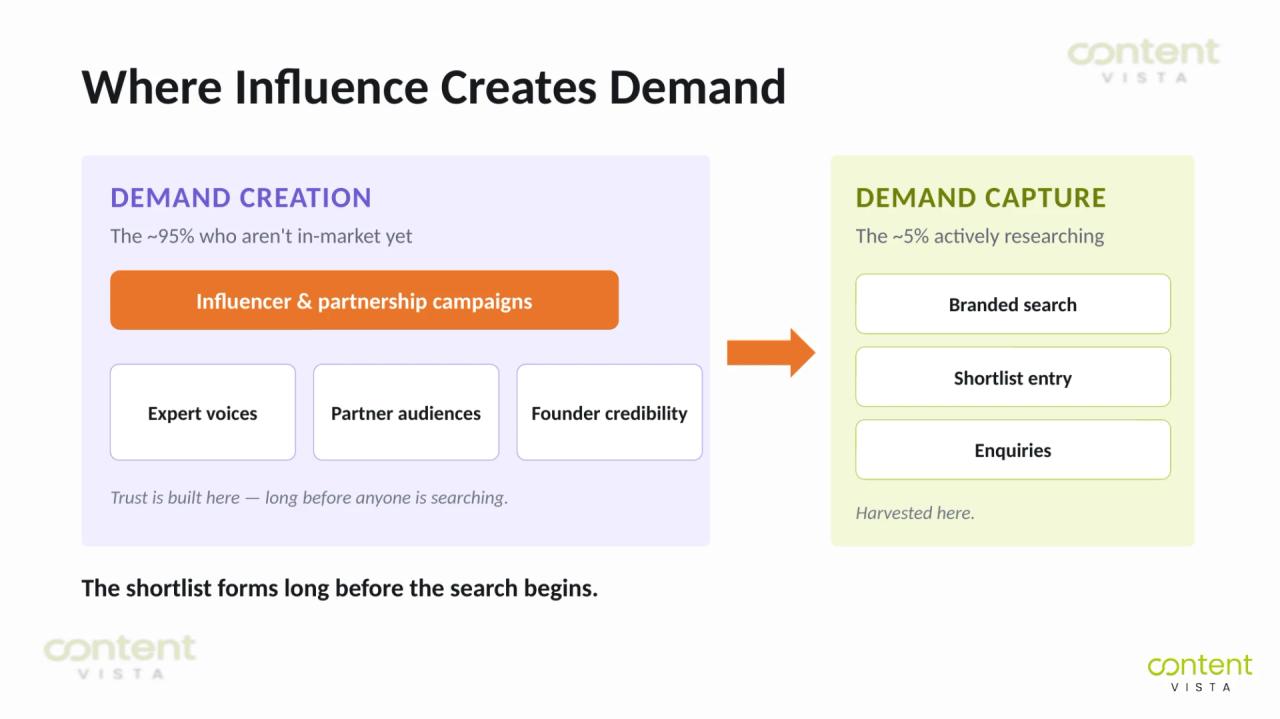
That is why an influencer marketing strategy should not be judged only as a post-level performance activity. It should be judged by whether it puts you on the shortlist before the shortlist exists.
There are two problems this work is especially good at fixing.
The first is a discovery problem: the right buyers are not finding you early enough. Influencer and partnership campaigns help you enter conversations they already trust.
The second is a credibility problem: buyers see you, but still do not trust your perspective. Expert-led content, founder authority, customer voices and partner-led campaigns can close that trust gap.
If you want to go deeper on the content side of this, see building a content-led demand engine.
But the key is this: influence works best when it is wired into the rest of the engine, not left floating as disconnected campaign activity.
Influencer vs. Partnership Campaigns — Two Motions, One Layer
Let's make this practical:
Influencer campaigns and partnership campaigns both help you enter trusted conversations before buyers are actively searching.
But they are not the same motion.
An influencer campaign borrows credibility from an individual. That person may be an expert, founder, analyst, consultant, customer, employee or niche operator your market already trusts.
The value comes from the relationship between that individual and the audience.
A partnership campaign borrows and shares credibility between businesses. This could look like a co-hosted webinar, joint research report, partner newsletter, bundled event, ecosystem campaign or co-marketing series.
The value comes from aligned audiences and mutual trust transfer.
The difference matters because the execution, measurement, and expectations are different.
| Dimension | Influencer Campaigns | Partnership / Co-Marketing |
|---|---|---|
| What it is | Borrowing an individual's credibility and audience | Two businesses combining audiences and credibility |
| Best for | Fast credibility and reach into a defined niche | Sustained access to an aligned buyer base |
| Typical formats | Expert posts, podcast guesting, co-created content, founder collaborations, event speaking | Joint webinars, co-authored reports, partner newsletters, bundled events, ecosystem campaigns |
| What it costs you | Fees or equity of attention, plus relationship management time | Shared effort and audience access, plus coordination overhead |
| How it's measured | Branded-search lift, self-reported attribution, EMV | Partner-sourced and partner-influenced pipeline, co-marketing reach |
Partnerships are especially underused in B2B because teams often think too narrowly about "influencers."
They look for people with audiences, but ignore companies that already serve the same buyer.
That is a missed opportunity.
Crossbeam's analysis of thousands of companies on its network found that involving partners in deals lifted win rates by an average of 11.7% — and the lift generally grew as the connected partner ecosystem got larger.
Microsoft is the flagship example at scale. In an Official Microsoft Blog post, then-corporate vice president Gavriella Schuster wrote that partners influence more than 95% of Microsoft's commercial revenue, either directly or in partnership with Microsoft.
So the smarter question is not "Should we do influencers or partnerships?"
It is: which trusted route gets us into the right market conversation faster?
Should This Be a One-Off Campaign or Always-On?
Here's the thing:
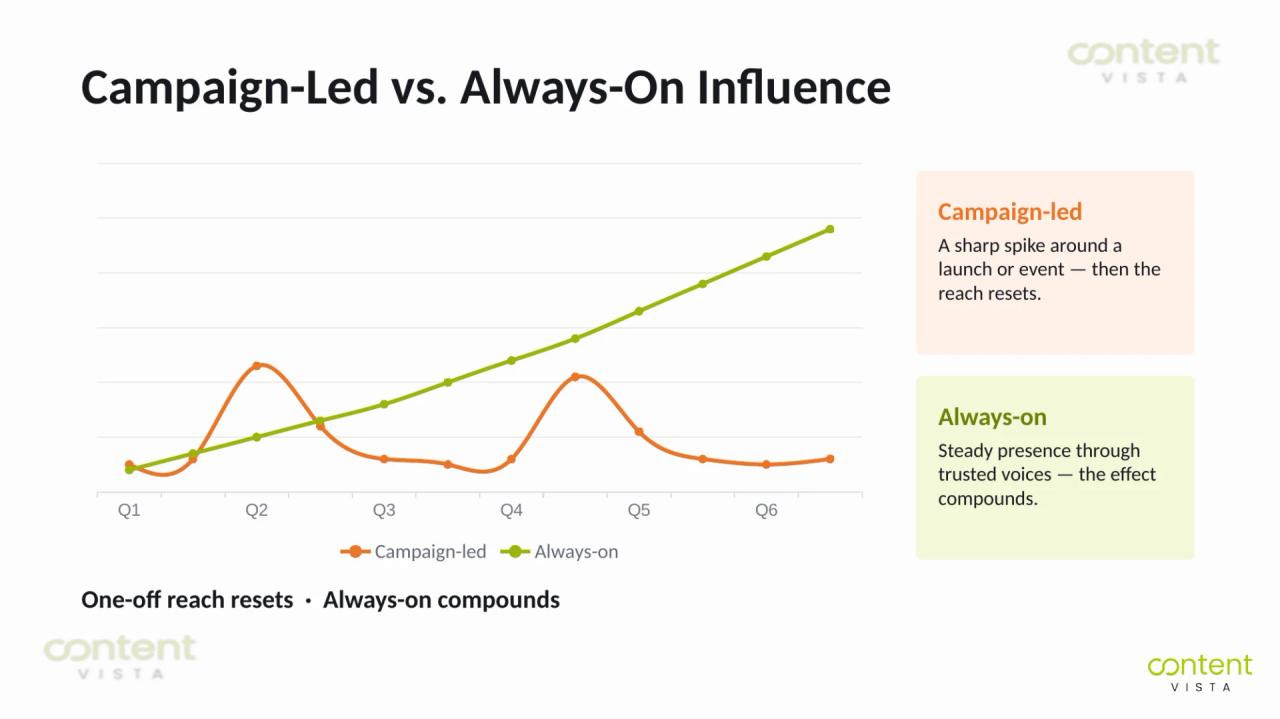
A one-off campaign can create a useful spike. It can help around a product launch, event, report release, webinar or major announcement.
You borrow attention for a defined moment, concentrate reach and try to create visibility quickly.
But once the campaign ends, the reach usually resets.
Always-on influence works differently. Instead of treating influence as a burst of activity, you build repeated market presence through experts, partners, founders, customers and trusted voices over time.
That is what compounds.
The data backs this up.
TopRank Marketing's 2025 B2B Influencer Marketing Report — a survey of 404 B2B marketing professionals at US companies with 100 or more employees — found that 82% of marketers reporting the most success use an always-on approach, compared with just 39% of everyone else.
More bluntly: marketers who are not always-on are 17x more likely to report their program is ineffective.
That does not mean campaigns are useless.
It means campaigns should serve the larger system.
A launch campaign may create the spike. But an always-on influence motion creates the memory, credibility and repeated exposure that makes the spike matter.
This is especially important in B2B, where buyers may notice you months before they are ready to speak to anyone.
And this is no longer a fringe approach. Ogilvy's Influencing Business study — based on 550 CMOs across 11 markets — found that 75% of B2B marketers were already using influencer marketing, and 93% of those planned to increase it.
So the question is no longer whether B2B influence is becoming normal.
The question is whether you are using it as a short-term activity or building it into your demand engine.
| Approach | Reach Pattern | Cost / Effort | Best Outcome | When to Use |
|---|---|---|---|---|
| Campaign-led (spike) | Sharp spike, then resets | Concentrated, time-boxed | Short-term awareness around a launch/event | Product launch, event or a specific moment |
| Always-on | Compounds over time | Steady, ongoing | Durable mental availability with the 95% out-of-market | Default for B2B; the highest-performing teams run this |
How to Build a B2B Influencer & Partnership Strategy
Step one: decide what the strategy is meant to create.
If the goal is demand creation, you are trying to build awareness, trust and mental availability with buyers who are not ready yet.
If the goal is shortlist entry, you are trying to make sure the buyer remembers you when active research begins.
Those are different goals, so they need different measurement plans.
Set the goal before choosing the influencer or partner. Do not start with "Who has a big audience?" Start with the business outcome. Are you trying to create category awareness? Build founder credibility? Reach a new buying committee? Support a launch? Enter a partner ecosystem? Decide this first, then define how you will measure it: branded-search lift, self-reported attribution, partner-sourced pipeline, content engagement or influenced opportunities.
Map the buying committee, not just one persona. In B2B, one person may discover you, another may evaluate you, another may approve the budget and another may block the deal. So your influence map should include the full buying committee: founders, operators, marketing heads, finance leaders, technical evaluators, consultants and end users where relevant. Remember that several of them will never take your call.
Identify the right influencers and partners. Look for trust density, not just audience size. The right voices may include industry experts, analysts, consultants, customers, employees, operators, community leaders or complementary businesses. This is often the hardest part — TopRank's research found that identifying and connecting with the right influencers is the single most-cited challenge in B2B influencer programmes, with nearly half of marketers still struggling with it.
Choose the motion: campaign-led or always-on. Use campaign-led influence when you have a specific moment to amplify: a launch, event, webinar, report or announcement. Use always-on influence when the goal is sustained market presence. For most B2B teams, always-on should be the default, with campaigns layered on top when there is a meaningful moment.
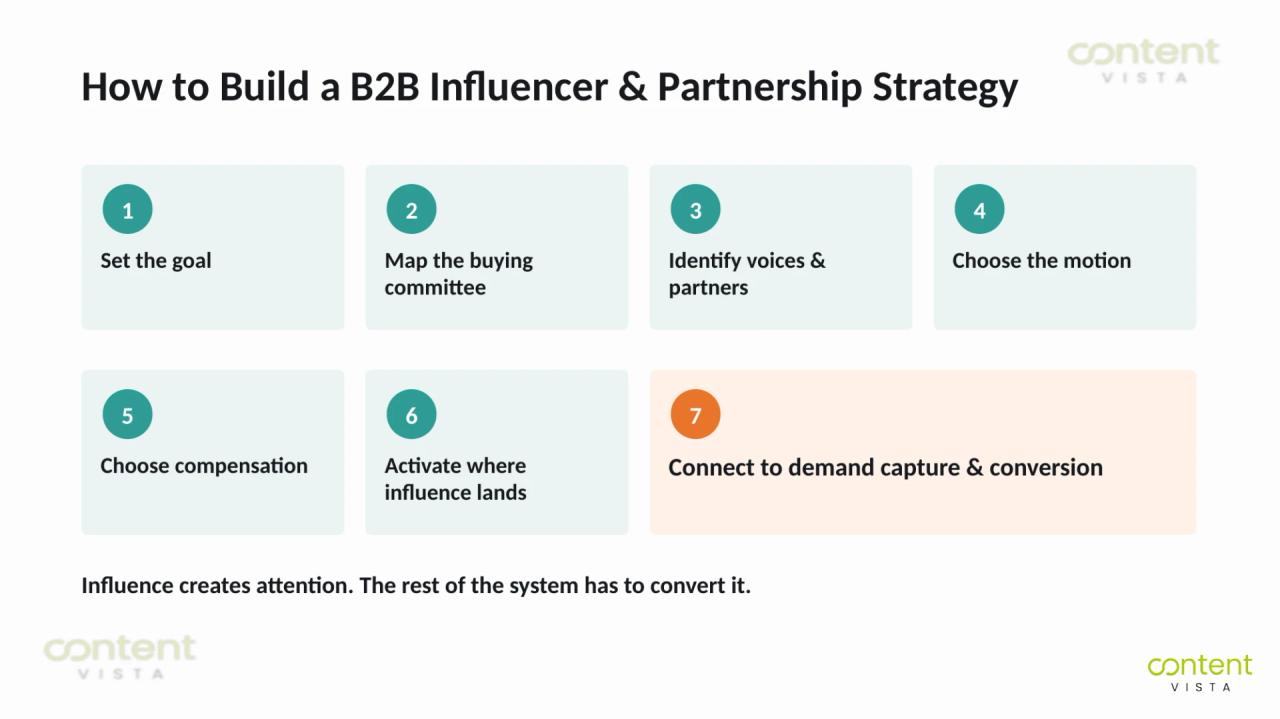
Choose the compensation model. You can use a flat fee, affiliate or commission model, gifted or earned collaboration, or a hybrid. For expert-led B2B work, flat fees and strategic partnerships often make more sense than pure commission, because the value is not always immediate or last-click measurable. Agree usage and ad rights upfront — the right to re-use a collaboration in paid and owned channels is often worth more than the collaboration itself.
Activate where B2B influence actually lands. For many B2B companies, this means LinkedIn, newsletters, webinars, podcasts, private communities, partner databases, industry events and expert-led content. If LinkedIn is central to the motion, connect the campaign to a broader LinkedIn Growth Engine instead of treating every post as an isolated activity. The same logic applies to social media and community work.
Connect it to demand capture and conversion. This is where many campaigns leak. If someone hears about you from a partner webinar, then searches your brand, visits your site and reads your point of view, your system should capture that signal. Influence creates attention — but your website, content, CRM, sales process and follow-up journey have to convert it.
What this looks like in practice: for COYU, we ran eight influencer collaborations across two hyperlocal Delhi NCR markets, securing ad rights so the collaboration content could keep working after the campaign window closed.
On the founder side, our work with Personam built a cybersecurity founder's audience from zero to 1,000+ LinkedIn followers, with a 41.8% newsletter open rate — a reminder that in B2B, the most credible "influencer" available to you is often already on your payroll.
How to Measure Influence Without Lying to Yourself
Here's the uncomfortable truth:
Influence is valuable, but it is not always cleanly attributable.
Demand-creation work often happens before someone fills a form, books a call or appears in your CRM.
A buyer may see a founder post, attend a partner webinar, hear your name in a community, read an expert's recommendation — and then search for you weeks later.
Standard attribution software will usually miss most of that.
The Gartner finding from earlier is the clearest way to see the problem. If buyers spend only about 17% of their buying time with suppliers, then roughly four-fifths of the journey happens somewhere your tracking cannot follow.
This is not a theory problem, and it is not just you. TopRank's research found measuring and reporting results is one of the two biggest challenges in B2B influencer marketing, with nearly half of marketers struggling with it.
The 2024 Edelman-LinkedIn report shows the same gap in thought leadership: only 29% of organisations can link sales leads back to specific pieces, and 42% have no process for measuring effectiveness at all.
So the answer is not to pretend every touchpoint can be tracked perfectly.
The answer is to measure influence honestly.
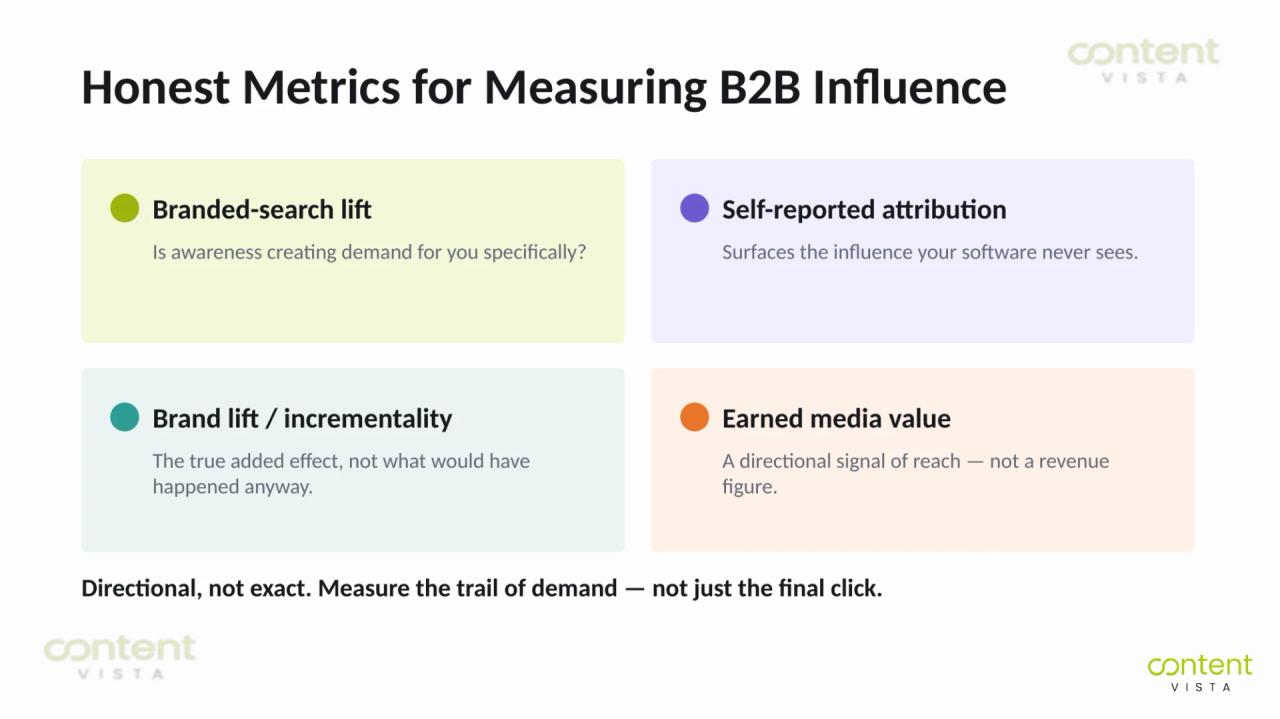
| Metric | What It Tells You |
|---|---|
| Self-reported attribution ("how did you hear about us?") | Surfaces influence the attribution software misses |
| Branded-search lift | Whether awareness work is creating demand for YOU specifically |
| Brand lift / incrementality | The true incremental effect vs. what would've happened anyway |
| Partner-sourced and partner-influenced pipeline | Whether partnership activity is producing real opportunities, not just reach |
| Earned media value (EMV) | A directional signal of reach value - not a hard revenue figure |
Now, about ROI expectations.
You will see confident multiples quoted everywhere — most commonly around $5.20 returned for every $1 spent, a blended figure from Influencer Marketing Hub's benchmark research.
Treat that number with care. It is dominated by consumer and e-commerce campaigns with short purchase cycles and clean last-click tracking. Your six-month B2B buying cycle with a ten-person committee is a different animal entirely.
Here's the honest position: there is no reliable published ROI benchmark for B2B influencer and partnership campaigns, and anyone quoting you one with confidence is borrowing a consumer number.
So set your own baseline instead. Measure branded search, self-reported attribution and influenced pipeline before you start, run the motion for at least two to three quarters, and compare against your own starting point.
In short: measure the trail of demand, not just the final click.
When Influencer & Partnership Campaigns Are the Wrong Move
Let's be honest:
Influencer and partnership campaigns are not magic. They amplify a working growth system. They do not fix a broken one.
If your demand capture is weak, more awareness may simply create more leakage.
People may hear about you, search for you, land on your website and leave — because the offer is unclear, the proof is thin or the next step is confusing.
If your conversion path is weak, the problem is different. You may create interest, but your follow-up, sales narrative, nurture system or buying journey may fail to turn that interest into qualified pipeline.
This is why influence should not be your first move in every situation.
It makes sense when the right buyers are not finding you early enough.
It also makes sense when buyers see you, but do not yet trust your perspective, authority or point of view.
But if your real issue is that you already have attention and still cannot convert it, influencer and partnership campaigns may only make the problem more visible.
Influence is powerful when the market does not know you yet, or does not trust you enough. But if your funnel, offer, proof or follow-up system is broken, fix that before you spend money creating more attention.
Before running a B2B influencer or partnership campaign, ask:
Do we have a clear offer?
Do we have a strong point of view?
Can we capture demand when it appears?
Can we convert interest into a real next step?
Do we know which problem this campaign is meant to solve?
If you are not sure what demand generation should be doing in the first place, start with what demand generation actually is.
Not sure your demand engine is ready for this? Find out where your growth actually stands with the Marketing Growth Maturity Assessment.
The Mistakes That Quietly Kill B2B Influence Campaigns
The mistake is simple:
Most teams run influence like a media buy, then judge it like a last-click ad campaign.
That is how good programs get killed too early.
Mistake 1: Treating it as one post. One expert post, one webinar or one partner mention can create a spike. But B2B trust is built through repeated exposure. If there is no always-on layer, the market forgets you quickly.
Mistake 2: Chasing follower counts. A large audience means very little if it does not map to your buying committee. A niche expert followed by 2,000 of the right operators may be more valuable than a creator with 200,000 irrelevant followers.
Mistake 3: Borrowing B2C playbooks. Consumer creator tactics rarely translate cleanly into B2B. Your buyer is not impulse-buying after watching a reel. They are comparing risk, proof, category expertise and internal consensus.
Mistake 4: Promising last-click ROI. If you tell leadership every influencer activity will show up neatly in attribution software, you are setting the program up to fail. Influence often creates trust long before declared intent appears.
Mistake 5: Ignoring usage and ad rights. A strong collaboration that you cannot legally re-use in paid, email or owned channels is worth a fraction of what it could be. Sort this out in the agreement, not afterwards.
Mistake 6: Running influence outside the demand engine. If there is no clear offer, no strong point of view, no capture path, no nurture system and no conversion journey, the attention leaks.
B2B influence does not fail only because the wrong person was chosen. It often fails because the campaign was never connected to the rest of the growth system.
Influence as a System, Not a Spike
Influencer and partnership campaigns work best when they are treated as part of a connected growth system.
They are not there to replace your offer, your website, your proof, your nurture, or your sales process.
They are there to strengthen the demand-creation side of your engine: helping the right buyers discover you, trust you, remember you and eventually place you in the consideration set.
That is why the real value is not "one creator post" or "one partner webinar."
The real value is the system around it.
At Content Vista, we look at influence through that lens — as one layer of a connected growth system, not as isolated campaign activity.
The goal is to connect expert credibility, partner distribution, founder and executive positioning, content and thought leadership, landing pages, measurement and follow-up — so the attention created does not disappear.
If you are exploring this as a serious growth motion, the next step is not simply finding influencers.
It is deciding where influence fits inside your broader demand generation system, and whether your business needs influencer and campaign-led demand generation built around a real engine, not a spike.
Not sure whether your demand engine is ready for influencer or partnership campaigns? Start with the Marketing Growth Maturity Assessment.
Frequently Asked Questions
What is an influencer marketing strategy?
An influencer marketing strategy is a plan for using trusted voices to build awareness, credibility and demand with a specific audience. In B2B, those voices are often experts, founders, analysts, consultants, customers, employees or partner brands rather than consumer creators.
Does influencer marketing work for B2B?
Yes, influencer marketing can work for B2B when it is used to build trust with the right buying committee. It works best as demand creation, not as a one-off social post expected to produce immediate last-click revenue.
What's the difference between influencer marketing and affiliate marketing?
Influencer marketing is mainly about borrowed credibility, trust and market reach. Affiliate marketing is usually performance-based, where a person or partner earns commission for tracked referrals, sales, signups or conversions.
What's the difference between influencer and partnership marketing?
Influencer marketing uses an individual's credibility and audience. Partnership marketing uses a business relationship, where two companies combine audiences, expertise, distribution or trust through co-marketing, events, reports, campaigns or ecosystem activity.
How do you measure influencer marketing ROI for B2B?
Measure B2B influencer ROI through a mix of self-reported attribution, branded-search lift, partner-sourced or influenced pipeline, brand lift, earned media value and eventual pipeline-influenced revenue. Do not rely only on last-click attribution.
What's a realistic ROI for B2B influencer campaigns?
There is no dependable published B2B benchmark — the widely quoted figures (around $5.20 per $1 spent) are blended, consumer-weighted numbers from Influencer Marketing Hub's benchmark research and do not transfer cleanly to long B2B buying cycles. Set your own baseline instead: measure branded search, self-reported attribution and influenced pipeline before you start, then compare over two to three quarters.
Should influencer campaigns be one-off or always-on?
For B2B, always-on influence is usually stronger because trust compounds over time. TopRank's 2025 research found 82% of the most successful B2B programmes run always-on. One-off campaigns can support launches, events, reports or webinars, but they work best when connected to a broader always-on demand engine.
How much do B2B influencer/partnership campaigns cost?
Costs vary based on the expert, partner, audience size, format, scope and compensation model. A campaign may involve flat fees, affiliate commissions, earned collaborations, partner swaps, co-marketing budgets or hybrid arrangements. Budget for usage and ad rights separately — they are often negotiated on top of the base fee.