Quick Summary
- Social media is a demand-creation engine first and a lead-capture channel second.
- If you treat it only as a place to collect forms, clicks or DMs, you miss its real job: creating recognition, trust, relevance and buying intent before people are ready to enquire.
- This guide shows what social media is actually doing at each stage of the buying journey, and how to work out which part of your system is broken.
You searched for "social media for lead generation." Fair.
Here's the problem: when social media is not producing leads, the issue is usually not the post, the platform or the CTA.
It is usually something upstream of capture.
What is social media for lead generation, really?
Social media for lead generation means using platforms like LinkedIn, Instagram, YouTube, X or communities to attract the right audience, build trust, start conversations and move interested people toward a clear next step, such as a form, call, diagnostic, webinar, download or direct inquiry.
But that definition is incomplete unless you separate demand creation from demand capture.
Demand creation is what happens before someone is actively looking to buy. It is the work of shaping awareness, belief, urgency, trust and recall.
Social media is especially strong here because people do not usually open a social app thinking, "I want to become a lead today."
They notice patterns, save useful ideas, follow consistent voices, ask small questions and slowly decide who feels credible.
Demand capture is different. It is the part where existing intent is harvested: someone clicks the CTA, fills a form, books a call, replies to a DM, downloads a guide or signs up for a webinar.
The problem is that "social media for lead generation" usually gets treated as capture only.
Brands judge every post by clicks, enquiries or immediate conversions. That quietly limits results because it ignores the upstream work social media is supposed to do first.
Social media can capture leads, but only after it has created enough relevance and trust for someone to take the next step.
Why doesn't social media generate leads the way you expect?
Most social-media lead-gen advice assumes your audience is already ready to act. Post better hooks. Add stronger CTAs. Run a lead magnet. Push people to a webinar. Improve the landing page.
Those things matter, but they miss the bigger issue.
Here's where most teams go wrong: they use social media only for demand capture, while most of their audience is still out-of-market.
The 95-5 rule holds that at any given moment, only around 5% of B2B buyers are in-market, while roughly 95% are out-of-market. The finding comes from Professor John Dawes at the Ehrenberg-Bass Institute, whose work for the LinkedIn B2B Institute popularised it.
Treat it as a directional rule rather than a precise law. The exact split depends on how often companies in your category actually buy.
But the direction is what matters. Most of the people who could eventually buy from you are not actively looking, comparing vendors or filling forms today.
So if your entire social media strategy is built around "book a call," "download this" or "talk to sales," you are mostly fishing in the small share of your market that already has intent.
That is a very small pond.
The larger opportunity is everyone else: people who are noticing problems, forming opinions, learning from peers, saving useful posts, joining conversations and slowly building a mental shortlist of who they trust.
They may not show up in your CRM yet. But social is already shaping whether they remember you when the buying window opens.
That is why social media often looks like it is "not generating leads" when it may actually be influencing demand earlier than your tracking can see.
The mistake is expecting every post to capture intent.
A stronger approach uses social media to create demand with the out-of-market audience, then gives the in-market audience clear paths to convert when they are ready.
So where does social media actually fit?
Social media becomes useful for lead generation only when it is part of a connected growth system rather than a standalone posting calendar.
Think about it this way: demand work has four jobs. Creating demand. Capturing it. Converting it. Compounding it. We call that loop the 4C Demand Engine, and our full demand generation strategy guide covers how to build one.
For this page, the useful part is simpler. Social media does most of its work in the first job, and it touches all four.
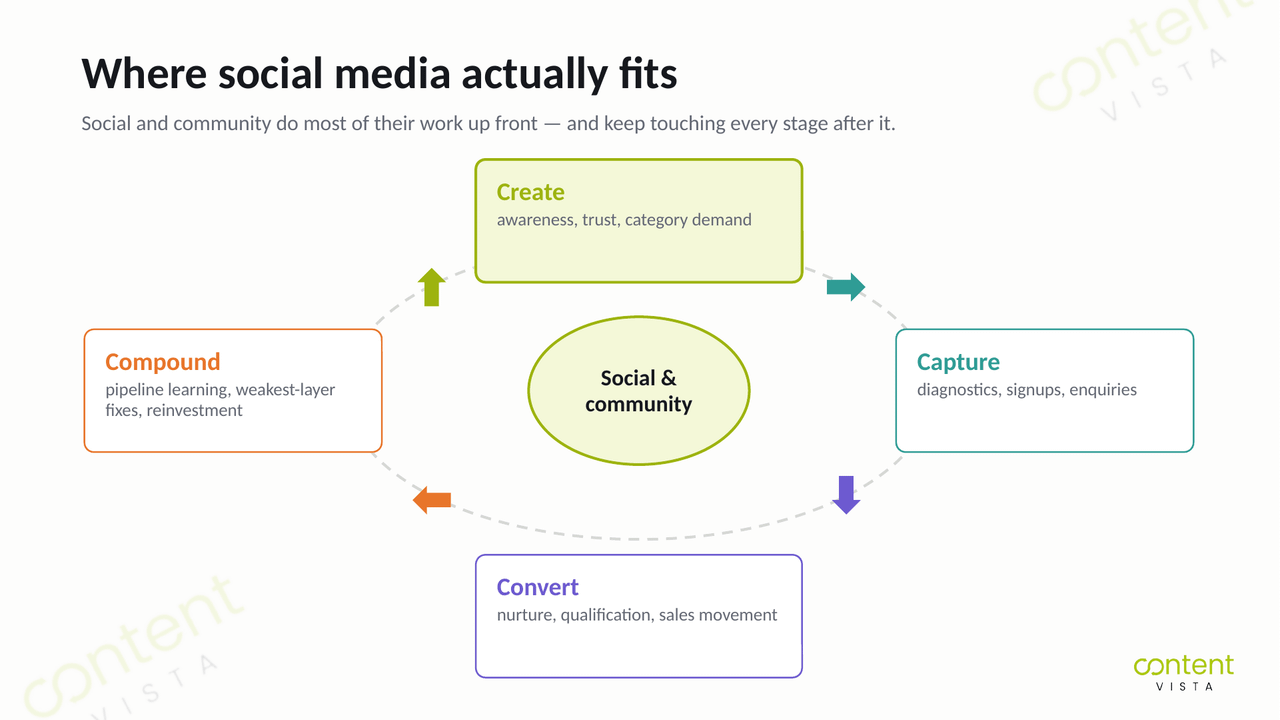
Social media and community mostly create demand. This is where your content, conversations, founder voice, community presence and point of view build awareness, trust, category demand and problem recognition among the people who are not in-market yet.
But social media does not stop there.
It captures demand when attention turns into a measurable next step: a diagnostic, newsletter signup, webinar registration, lead magnet download, DM, form fill, or enquiry. This is where you harvest the in-market intent that already exists.
It supports conversion when the people who engage with your content begin moving toward qualified opportunities. This may happen through follow-up, nurture sequences, sales conversations, retargeting, community interactions or repeated proof that makes the buyer more confident.
Then it has to compound. This is where you measure social media against pipeline-influenced revenue, not just likes or impressions.
You look at what created meaningful conversations, what influenced enquiries, where people dropped off, which part is weakest and what should be reinvested into the next cycle.
So a strong demand strategy does not ask, "Did this post generate a lead today?"
It asks, "Which part of the system did this strengthen, and where is it leaking?"
How do you use social media to create demand?
To create demand, social media has to do more than publish updates.
It has to make the right people repeatedly notice the same problem, believe it matters, trust your point of view and remember you when the buying window opens.
The goal is not to force every viewer into a lead flow immediately. The goal is to build mental availability: when the problem becomes urgent, your brand is already associated with the solution.
This is not a soft claim. Edelman and LinkedIn's research on reaching out-of-market buyers found that 75% of global B2B buyers and C-suite leaders say a particular piece of thought leadership led them to research a product or service they were not previously considering.
Read that again. Content did not capture demand that already existed. It created demand that did not exist yet.
The strongest demand-creating social content usually does three things.
First, it teaches the market how to think. This is where content and thought leadership matters.
Strong point-of-view content does not just explain tactics. It names broken patterns, reframes common assumptions, shows trade-offs and gives the audience language for a problem they were already feeling but had not clearly articulated.
Second, it builds category demand. For example, a company selling growth systems should not only post "book a call" content.
It should consistently explain why disconnected campaigns fail, why lead volume alone is not enough, why nurture matters and why marketing needs to be measured as a system.
That creates demand for the category before it creates demand for the vendor.
Third, it distributes trust through real people. Founder and employee content often travels differently from brand-page content because people tend to engage with recognisable human voices, specific opinions and lived experience.
This does not mean every founder needs to become an influencer. It means the company's best ideas should not stay trapped inside decks, sales calls or internal strategy documents.
Creating demand is not "post more content." It is the work of making your market more aware of the problem, more convinced it matters and more likely to remember you when intent appears.
Content is one channel inside that work, not the whole of it.
Community conversations, comments, founder presence, employee advocacy, events, partnerships, podcasts and dark social all contribute to demand creation when they reinforce the same strategic point of view.
That is why demand generation starts before capture. If your market does not understand the problem or trust your angle, your lead-gen CTAs will always feel heavier than they should.
How do you capture the buyers who are ready on social media?
Once social media has created enough trust and relevance, some buyers will show declared intent.
They comment on a problem, click through to a resource, reply to a story, register for a webinar, ask a question in a DM or engage repeatedly with high-intent content.
That is where demand capture begins.
The mistake is treating every social interaction as equal. A like on a broad awareness post is not the same as someone saving a pricing comparison, asking about implementation or filling a native lead form.
Capture is about spotting the people who are already in-market and giving them a low-friction next step.
Which platform is best for B2B lead capture?
For B2B, LinkedIn is usually the primary social platform because it gives you access to professional identities, role-based targeting, company context, founder-led distribution and buying-committee visibility.
The marketer data backs this up. In Content Marketing Institute and MarketingProfs' survey of 1,015 B2B marketers, LinkedIn was named the most effective channel for distributing thought leadership by 76% of respondents, well ahead of email newsletters (54%) and speaking events or webinars (52%).
That does not mean every B2B company should only use LinkedIn.
But if your buyers are founders, executives, marketers, sales leaders, HR leaders, consultants, agency owners or decision-makers inside companies, LinkedIn is usually the first platform to take seriously.
This is also where a structured social media and community growth system matters. The platform alone does not create a pipeline. The system behind it does.
Are LinkedIn lead-gen forms worth it?
LinkedIn lead-gen forms can be useful when the offer matches the intent level.
They work best for clear, specific next steps such as event registrations, diagnostic requests, benchmark downloads, webinar signups or high-value resources.
They are weaker when the offer is vague. "Book a call" may work for someone already in-market, but it is often too heavy for someone who is only problem-aware.
A better capture path might be: useful post → diagnostic → email nurture → call invite.
Use native forms when friction needs to be low. Use landing pages when the buyer needs more explanation, proof or context before converting.
What role does retargeting play?
Retargeting helps you stay visible to people who have shown intent but have not acted yet. This could include website visitors, video viewers, tool users, event registrants or people who engaged with specific content.
The key is to retarget based on behaviour, not just vanity engagement.
Someone who read a demand-generation guide, visited a service page or started a diagnostic is more meaningful than someone who casually liked a broad post.
What about other social media platforms?
Instagram can work for visual, founder-led, lifestyle, service, local, education or consumer-facing brands, but it usually needs a strong content narrative and a clear DM or link-in-bio path.
YouTube is stronger for education, trust-building, search-led discovery and long-form authority. It often supports demand creation and conversion more than immediate capture.
X can be useful in founder, tech, startup, investing, SaaS and creator-led ecosystems, but it depends heavily on sharp POV and consistent participation.
Communities, Slack groups, WhatsApp groups, Discord and niche forums can generate high-trust opportunities, but they require contribution before promotion.
Should you use organic or paid social media for capture?
Organic social media is best for trust, POV, conversations, community signals, founder visibility and repeated familiarity.
Paid social media is best for controlled distribution, retargeting, testing offers, promoting high-intent resources and scaling what organic has already proven.
The strongest capture system usually uses both: organic to create trust and signal what the market cares about, paid to bring the right in-market audience back to the next step.
How does social interest become a qualified opportunity?
A social media lead does not become valuable at the moment someone fills a form.
It becomes valuable when the interest is understood, routed, nurtured and moved toward a real business conversation.
This is where many social-media lead-gen systems break. They get the inquiry, but then the lead sits in a spreadsheet, receives a generic follow-up, gets passed to the wrong person or hears from sales before the context is clear.
That creates pipeline leakage: interest was created and captured, but not converted into a qualified opportunity.
To convert properly, you need three things.
First, the next step should match the intent level. Someone who downloaded a broad guide may need nurture.
Someone who completed a diagnostic or asked about implementation may need faster human follow-up. Someone who engaged with multiple high-intent posts may need a softer conversation starter, not a hard sales pitch.
Second, social proof should appear before and after the handoff. Case studies, testimonials, examples, founder posts, objection-handling content and implementation breakdowns help people feel safer moving forward.
The buyer should not feel like they jumped from useful education into a disconnected sales process.
Third, routing should be clean. Every captured signal needs a clear path: who receives it, how fast they respond, what context they see, what message goes out and what qualifies the opportunity.
Without that, teams celebrate raw lead volume while the real opportunities quietly disappear.
The unit that matters is not raw lead volume. It is qualified opportunities: people or companies with enough fit, need, timing and intent to justify real sales attention.
Social media can create interest. Capture can collect that interest. But conversion is where the system proves whether the interest is commercially useful.
How do you measure social media's real contribution?
If you measure social media only by last-click conversions, you will almost always undercount it.
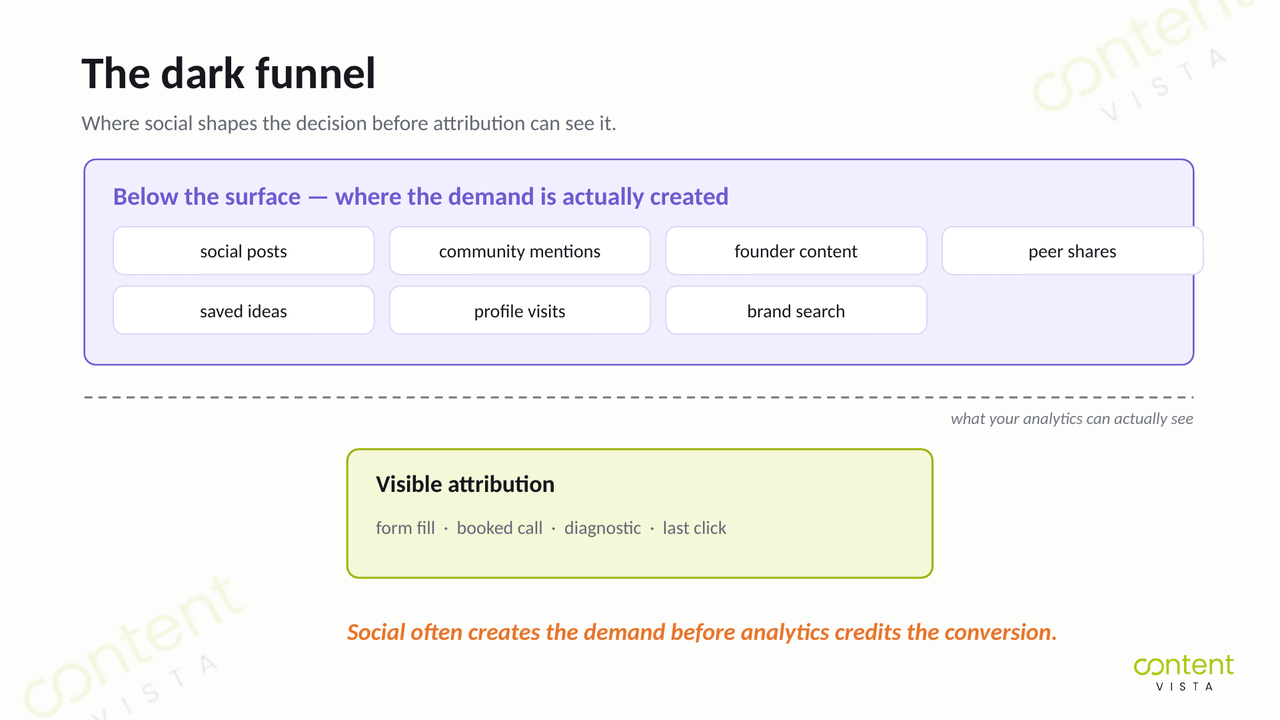
That is because much of social media's value happens inside the dark funnel: the places where buyers notice you, learn from you, compare you, ask peers about you, save your ideas, read silently and build trust before analytics software can clearly attribute the journey.
And that anonymous phase is where the decision is largely made. 6sense's 2025 B2B Buyer Experience Report found that 94% of buying groups had already ranked their preferred vendors before making first contact with a seller, and ended up buying from that preliminary favourite 77% of the time.
So what does that mean? By the time someone fills in your form, the shortlist is usually already written.
Think about how this plays out. A buyer may see your founder's post, hear your idea repeated in a community, watch a short video, check your profile, read a case study later, search your brand name and only then fill out a form.
Last-click attribution may credit the branded search, direct visit or landing page. But social helped create the demand.
This is why last-click reporting can quietly defund the channels that shape the pipeline.
If leadership only funds what gets the final click, social media gets judged like a direct-response channel even when its bigger role is market education, trust-building and shortlist creation.
Most teams know this and still do not fix it. In the same CMI research, 80% of B2B marketers measured thought leadership by audience engagement such as views, downloads and shares, while only 63% measured business impact like leads and pipeline influence.
The fix is to change the question. Instead of asking, "Which post got the lead?" ask, "How is social media influencing the qualified pipeline over time?"
| Vanity metric | Better signal | What it tells you |
|---|---|---|
| Likes and impressions | Saves, shares, profile visits, repeat engagement | Whether the content is creating relevance, recall or deeper interest |
| Follower count | Audience quality and engagement from target accounts or buyer profiles | Whether the right market is paying attention |
| Raw leads | Qualified opportunities | Whether social interest is turning into commercially useful conversations |
| Last-click conversions | Self-reported attribution and assisted journey notes | Whether buyers remember social media, community, content or founder presence as part of the journey |
| Post-by-post performance | Pipeline-influenced revenue over time | Whether social media is contributing to real revenue movement, not just engagement |
Let's make this practical.
Use self-reported attribution wherever possible. Add a simple field such as "How did you hear about us?" to forms, diagnostics and booking flows.
The answers will not be perfect, but they often reveal what analytics misses: "I've been following your posts," "I saw your founder on LinkedIn," "Someone shared your content" or "I heard about you in a community."
Then compare that with CRM notes, source data, assisted conversions, sales conversations and pipeline-influenced revenue.
The goal is not perfect attribution. The goal is better decision-making.
Where does community fit into all of this?
Community is where social media becomes more durable.
A social media audience can notice you, follow you and engage with your ideas.
But a community can do something deeper. It can turn those ideas into shared language, peer discussion, repeated trust and word-of-mouth that does not depend only on your own posting schedule.
That matters because buyers rarely make decisions from one brand touchpoint. They ask peers. They observe who others respect. They notice which ideas keep showing up in credible conversations.
The research supports this. In a Gartner survey of 771 B2B buyers conducted in late 2022, buyers reported valuing third-party interactions — things like customer references, reviews and consultations with independent experts — 1.4 times more than digital interactions with the supplier itself.
In short: what other people say about you can carry more weight than what you say about yourself.
Community helps in four practical ways.
It makes the problem believable. A founder post can introduce an idea, but a useful thread, roundtable, comment section, Slack group, WhatsApp group, webinar chat or niche forum can help that idea become credible because other people add context.
It creates warmer paths to action. Someone who has seen repeated conversations around a problem may be more willing to join a webinar, complete a diagnostic, reply to a DM or ask for help.
It reduces perceived risk. When prospects see useful answers, peer validation, consistent expertise and real conversations around the problem, they need less convincing from a sales pitch.
It teaches you what to say next. Questions, objections, repeated frustrations and language patterns from the audience can feed better content, sharper offers, clearer positioning and stronger follow-up.
Community is not just an engagement layer. It is a demand-compounding layer, because it turns brand claims into peer-validated belief.
This is why social media and community growth should not be treated as separate from demand generation. Community helps demand become trusted, remembered and repeatedly reinforced.
Should the founder post or the company page?
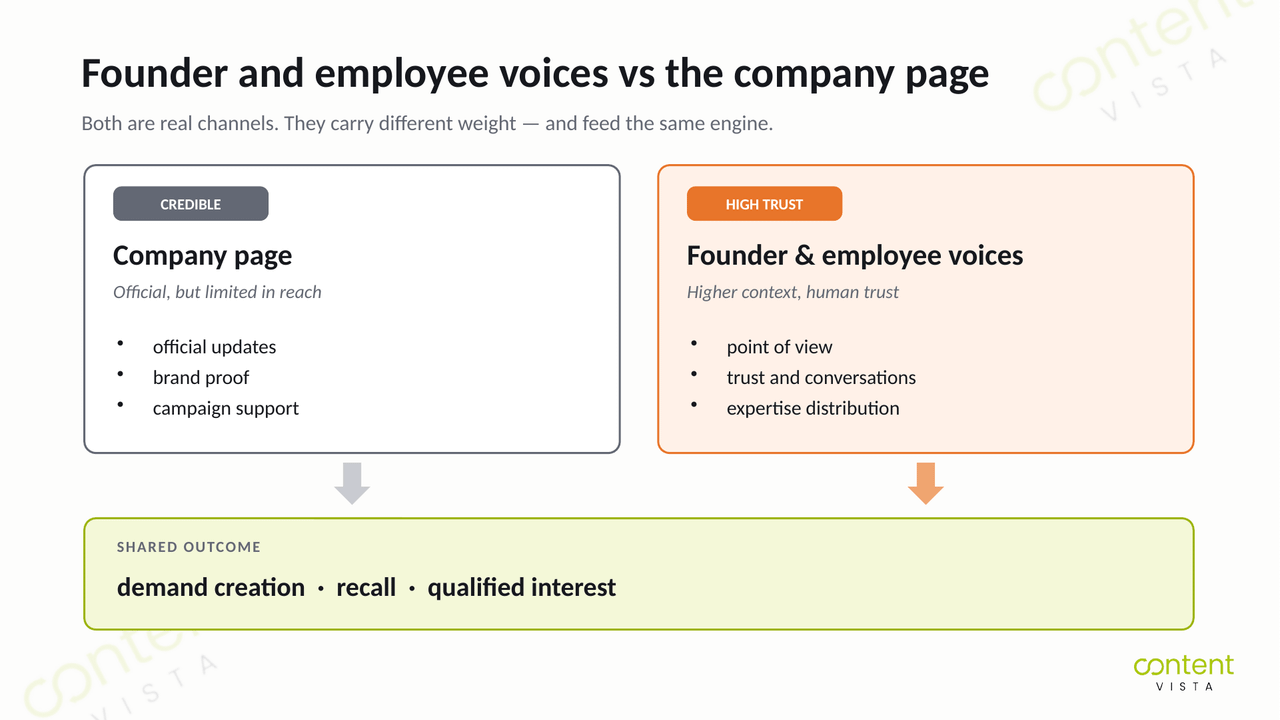
The company page matters. It gives the brand a home, publishes official updates, supports paid campaigns and creates a reference point for people checking credibility.
But on social media, people usually trust and engage with people before they trust and engage with logos.
That is why founder and employee authority can become a real demand lever.
A company page can say, "We help businesses grow." A founder or senior team member can say, "Here is the mistake we keep seeing in broken growth systems, here is why it happens and here is how to fix it."
The second version carries more context, more personality and more trust.
Here's the opportunity: almost nobody actually does this well. CMI's research found that while 96% of B2B organisations create thought leadership content, 37% reported that fewer than 5% of the employees with genuine expertise actively contribute to it.
So the expertise exists inside most companies. It just never reaches the market.
The practical point is not that every founder should post daily or turn personal branding into performance theatre.
The point is that expertise needs distribution. If your strongest insights only appear inside proposals, meetings, sales calls or internal strategy documents, the market never gets to build familiarity with how you think.
A founder or employee audience engine works when it has three parts: a clear point of view, a repeatable content system and a path back into the company's demand engine.
That could mean posts that explain category problems, comments that create useful conversations, short videos that simplify hard ideas or employee-led content that shows implementation nuance.
This is where founder and executive positioning connects directly to demand generation.
The goal is not visibility for its own sake. The goal is to make the company's expertise easier to notice, trust, remember and act on.
Want to know whether your founder or leadership voice is strong enough to support demand creation? Use the Founder Authority & Audience Engine Benchmark to assess what is missing from your audience engine.
Founder Authority & Audience Engine BenchmarkWhich part of your demand engine is actually broken?
If social media is not producing meaningful enquiries, the answer is rarely "post more."
The better question is: which part of the system is weak?
In practice, it is almost always one of four gaps. Each one looks like a social media problem from the outside, but each needs a completely different fix.
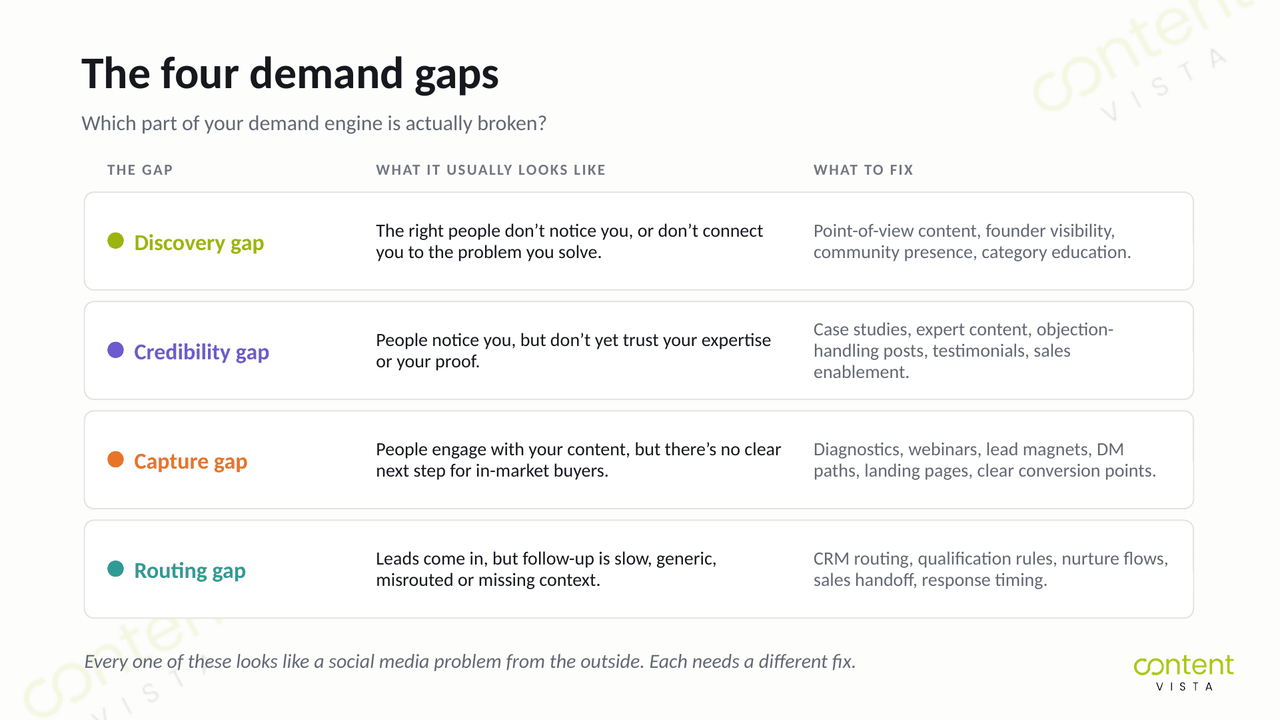
| Demand gap | What it usually looks like | What to fix |
|---|---|---|
| Discovery gap | The right people do not notice you, remember you or associate you with the problem you solve. | Strengthen point-of-view content, founder visibility, community presence, category education and consistent demand creation. |
| Credibility gap | People notice you, but they do not yet trust your expertise, proof, or ability to solve the problem. | Add sharper proof, case studies, expert content, objection-handling posts, testimonials, examples and stronger sales enablement. |
| Capture gap | People engage with your content, but there is no clear next step for in-market buyers. | Add relevant diagnostics, webinars, lead magnets, DM paths, landing pages, forms and clear conversion points. |
| Routing gap | Leads come in, but follow-up is slow, generic, misrouted or disconnected from the original context. | Fix CRM routing, qualification rules, nurture flows, sales handoff, response timing and context transfer. |
That's the real issue with most "social media isn't working" conversations. The symptom is the same, but the cause is not.
Low enquiries may mean the market does not understand or remember you yet.
Weak conversion may mean people see you but do not trust you enough.
Good engagement with few leads usually means there is no clear next step.
And leads that never become pipeline usually means the handoff is broken, not the content.
Not sure which part of your growth system is actually holding back results? Use the Marketing Growth Maturity Assessment to diagnose your weakest layer.
Common mistakes (and when social media is the wrong place to chase leads)
Most social-media lead generation fails because teams confuse activity with demand.
The mistakes are predictable:
Treating social media as a capture-only channel
Measuring success by vanity metrics
Expecting immediate in-market results from out-of-market activity
Posting only from the company page instead of real people
Sending every interested person to the same heavy CTA
Chasing leads before the market understands why the problem matters
That last one does the most damage. If there is no clear point of view, no repeated category education, no proof and no trusted voice, the CTA has to do too much work.
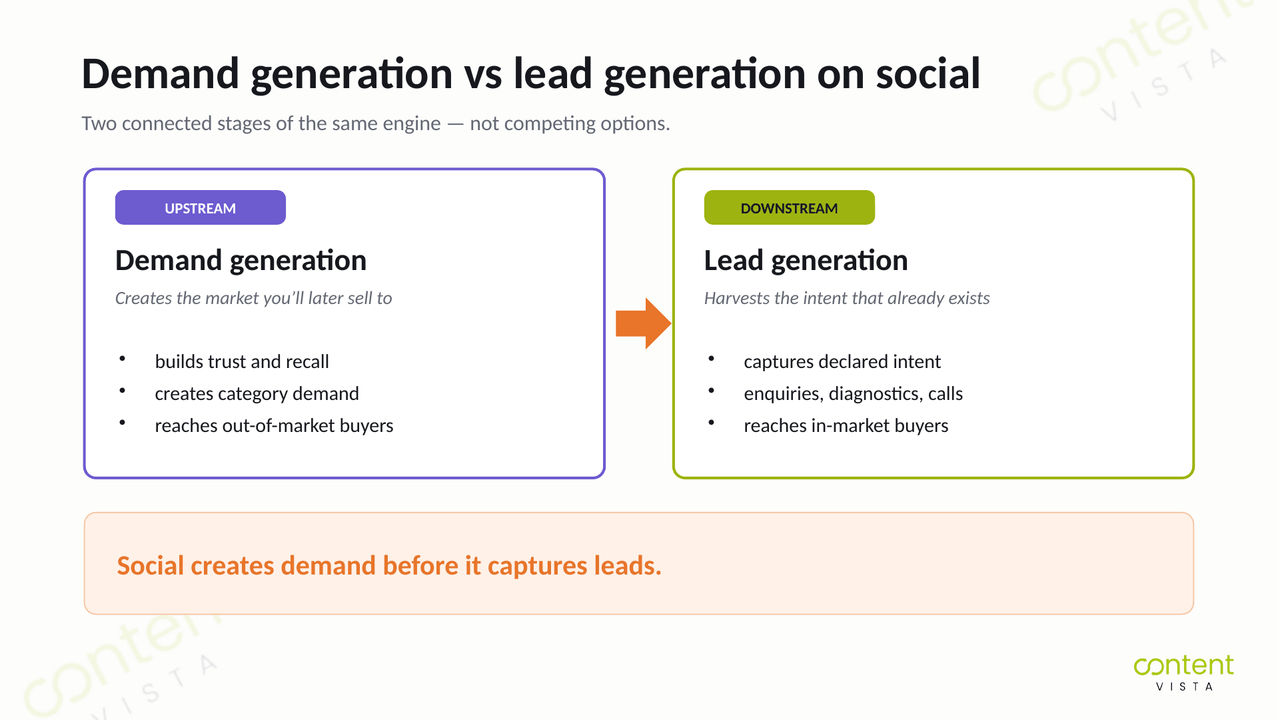
| Dimension | Demand generation | Lead generation | What this means on social media |
|---|---|---|---|
| Primary job | Create awareness, trust, problem recognition and category demand. | Capture people who are already showing interest or intent. | Do not expect every social media post to produce an enquiry. Some posts build future demand. |
| Audience focus | Mostly out-of-market buyers who may buy later. | Mostly in-market buyers who are ready to take the next step. | Social media should serve both, but the message and CTA should not be the same. |
| Best content type | Point-of-view posts, founder insights, community conversations, education, proof and category reframes. | Webinars, diagnostics, lead magnets, demos, consultations, forms and high-intent offers. | Create demand first, then give ready buyers a clear capture path. |
| Success signal | Recall, trust, engagement quality, community discussion, branded search and pipeline influence. | Enquiries, form fills, booked calls, qualified opportunities and sales movement. | Measure social media across the whole journey, not only by last-click leads. |
Social media is also not always the right place to chase lead capture.
If you have created almost no demand yet, pushing hard lead-gen CTAs may underperform because the audience does not know, trust or care enough.
In that case, use social media first to create demand: clarify the problem, sharpen the point of view, build proof and earn attention.
Social media may also be the wrong primary capture channel for a tiny, highly transactional niche where buyers search only when they need an immediate solution.
In that case, direct search, outbound, partnerships or referral channels may capture intent faster.
The point is not to "avoid social media." The point is to stop asking social media to do the wrong job at the wrong stage.
Frequently asked questions
What is social media lead generation and how is it different from demand generation?
Social media lead generation is the process of turning social attention into enquiries, form fills, calls, DMs, event registrations or other declared-intent actions. Demand generation is broader. It creates awareness, trust, problem recognition and category demand before someone is ready to convert. Social media should do both, but demand creation usually comes first.
Which social media platform is best for B2B lead generation?
LinkedIn is usually the strongest starting point for B2B lead generation because it is built around professional identity, roles, companies, industry context and business conversations. Other platforms can work, but LinkedIn is often the most practical place to combine founder authority, content distribution, paid targeting and declared-intent capture.
Is LinkedIn actually good for lead generation?
Yes, LinkedIn can be good for lead generation when it is connected to a demand engine. It works best when strong point-of-view content creates trust, high-intent posts surface problems and clear next steps capture interest. It works poorly when teams only push generic "book a call" CTAs to people who are not ready.
How do you generate leads on social media organically without ads?
Use organic social media to create trust first, then offer a relevant next step. Publish useful point-of-view content, answer real buyer questions, show proof, participate in comments and communities and make the conversion path simple. The organic path is usually: repeated relevance → trust → declared intent → diagnostic, DM, signup, enquiry or call.
Does social media really generate B2B leads or just engagement?
Social media can generate B2B leads, but engagement alone is not the goal. The real question is whether social is creating demand, capturing in-market intent, and moving interest toward qualified opportunities. If social activity produces likes but no clear next step, nurture, routing or sales handoff, it will look busy without creating a pipeline.
Organic vs paid social for B2B: which should you prioritise?
Prioritise organic social media when you need trust, authority, point of view, community and market education. Use paid social media when you need controlled distribution, retargeting, offer testing or scale. The strongest approach often uses organic to learn what the market responds to, then paid to amplify proven messages and capture intent.
How do you measure social media's contribution to the pipeline?
Measure social media by its influence on qualified opportunities and pipeline-influenced revenue, not only by likes, impressions or last-click conversions. Track self-reported attribution, CRM notes, assisted journeys, repeat engagement from target accounts, diagnostic submissions, booked conversations and sales feedback. The aim is better decision-making, not perfect attribution.
What is the dark funnel and why does it matter?
The dark funnel refers to buyer research and influence that happens outside clean attribution tracking. This can include social posts, community conversations, peer recommendations, saved content, profile visits and founder visibility. It matters because last-click reporting may undercount the channels that shaped trust before the buyer finally converted.
Should the founder post or the company page?
Both have a role, but founder and employee voices often create more trust and context than company-page updates alone. The company page should support credibility, campaigns and official proof. Founder and employee content should distribute expertise, point of view, implementation insight and human trust into the market.