Quick Summary
- This is a real B2B growth strategy case study, not a roundup of famous-company success stories.
- It follows Alirrium, an intelligent-automation consulting firm serving financial institutions, through four repeatable decisions.
- Those decisions are who to serve and how to position, which go-to-market motion to run, what to build, and how to measure results and feed them back.
What a Growth Strategy Case Study Actually Is (and What It Isn't)
Most pages targeting “growth strategy case study” fall into one of two categories.
The first is the famous-brand highlight reel: Airbnb used referrals. Dropbox offered free storage. Slack grew through product adoption.
These stories can be interesting. But they rarely explain how a founder or growth lead inside a mid-market B2B company should diagnose and solve their own problem.
The second is consulting interview preparation. Those cases teach you how to structure hypothetical market-entry or revenue-growth problems under interview pressure.
Useful for candidates, perhaps. Far less useful if you're trying to build the system your marketing actually runs on.
This article takes a different route.
You will see one real B2B example, mapped step by step to a repeatable system. That means you can examine the buyer definition, positioning choices, go-to-market motion, execution model and evaluation logic behind the result.
The goal is to give you a method you can interrogate, adapt and apply.
Why Most “Growth Strategy Case Studies” Are Useless to You
You have probably seen the same examples dozens of times.
Airbnb used referral credits. Dropbox rewarded users for inviting friends.
A unicorn found one clever growth lever, scaled rapidly and became the example every marketing article repeats.
Inspiring? Certainly.
Repeatable for a $1 million–$50 million B2B company with a complex buying committee, a longer sales cycle and a limited brand footprint? Usually not.
Here’s the problem:
A story about what one company did once does not tell you why that approach was selected, what conditions made it work, what had to be built or whether the same logic applies to your market.
You are left with a tactic stripped of context.
That does not mean case studies are unimportant.
In fact, 53% of B2B marketers rated case studies and customer stories among their best-performing content formats in the Content Marketing Institute and MarketingProfs B2B benchmark research for both 2024 and 2025. In the 2025 edition, only video ranked higher.
The format works because buyers want evidence. They want to see how a real problem was diagnosed, what decisions were made and what changed as a result.
The problem is not case studies.
It is case studies with no transferable system behind them.
So instead of studying another famous-company highlight reel, let’s examine a real B2B example mapped to a system you can actually understand, question and adapt.
What Turns a Success Story Into a Repeatable System
A strong growth strategy case study should do more than describe a successful outcome.
It should show the system that produced it.
At Content Vista, we run growth strategy as a loop of four connected decisions. We call it the CORE Growth System, and our guide to revenue-driven marketing strategy covers it in full.
For this case study, you only need the four decisions below.
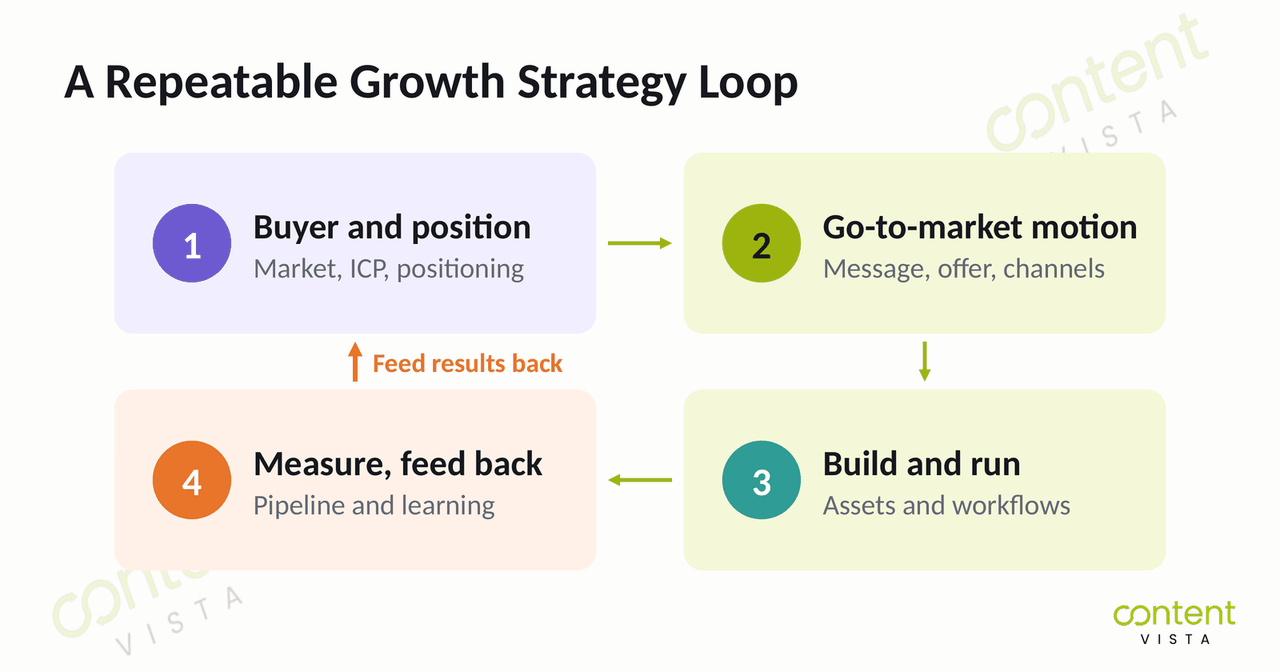
1. Get Clear on the Buyer and Your Position
Define the market, the ideal customer profile and the positioning.
This step answers the questions that should come before channel selection.
Who are you really trying to reach? What problem are you best placed to solve? Why should the buyer choose your approach over a familiar alternative?
Without this clarity, execution becomes scattered activity.
2. Design the Go-To-Market Motion
Here, the strategic choices are connected: the message, offer, buyer journey, distribution channels and hand-offs between marketing and sales.
The goal is not to collect tactics. It is to decide how the parts should work together.
3. Build and Run the System
This is where strategy becomes execution.
Assets are created, campaigns and workflows are launched, distribution is managed and the operating rhythm is maintained.
The work must be consistent enough to produce signals, not just activity.
4. Measure, Learn and Feed It Back
Evaluation is not a final report added after the work is done.
It tests whether the strategy is producing qualified pipeline, commercial movement and useful learning.
Those findings then feed back into the first decision, sharpening the market, buyer and positioning choices for the next cycle.
That loop matters.
You don't complete this once and file it away. It becomes the system your marketing runs on, with each cycle starting from better evidence than the last.
A Real Growth Strategy Case Study: Alirrium, Step by Step
Alirrium was an RPA and intelligent-automation consulting firm serving financial institutions.
Here’s what they were really up against:
In banking and finance, technical capability alone is not enough. Buyers at large financial institutions are senior, sceptical and surrounded by established consulting brands.
Alirrium needed credibility that could stand up in that environment. Borrowed attention from ads would not do it. It needed legitimate authority built through research and expertise.
Here's how the strategy came together, one decision at a time.
Step 1: Get Specific About Who They Were Really For
The first move was not to choose a channel. It was to define the buyer precisely.
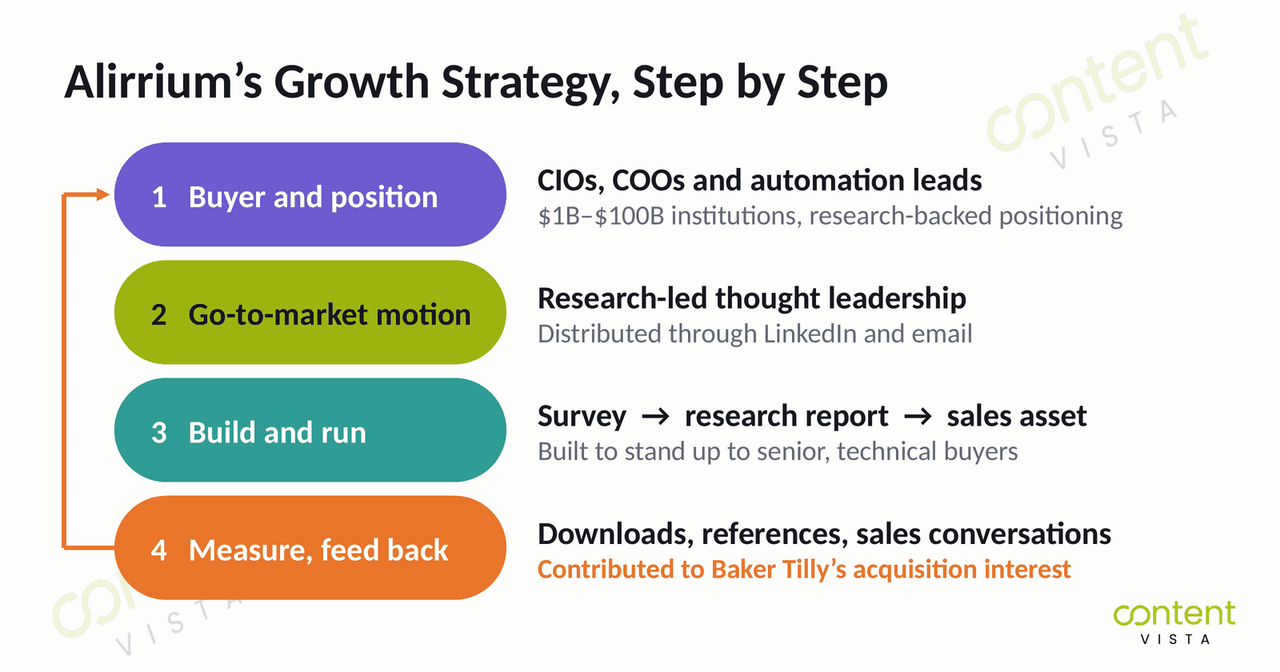
Alirrium focused on CIOs, COOs and automation leads at financial institutions in the $1 billion to $100 billion range.
That level of specificity mattered. The concerns, proof requirements and buying dynamics of these decision-makers were very different from those of a general business audience.
The positioning also had to account for a clear competitive reality: larger consulting firms could rely on brand recognition. Alirrium could not win the same way.
Instead, it positioned itself as a research-backed authority in banking and finance automation: a firm with a credible point of view, rather than simply another firm selling RPA services.
That is what this first step is meant to do. It makes the market, buyer and positioning decisions explicit before execution begins.
Not sure whether your own positioning is clear enough to support a focused go-to-market motion? The GTM Readiness & Positioning Clarity Audit can help identify where that foundation is still weak.
Step 2: Choose the Go-To-Market Motion
Once the buyer and positioning were clear, the next question was:
How do you earn attention from senior financial-services decision-makers without competing on ad spend or brand size?
The answer was a research-led thought-leadership motion.
Rather than producing generic content about automation, Alirrium would create original industry research designed for the exact people it wanted to reach. That research would then become the centre of its demand strategy.
Distribution was intentionally focused across two channels: LinkedIn and email.
LinkedIn created visibility and professional credibility around the research. Email enabled more direct distribution to the defined audience.
The channels were not treated as separate campaigns. They were two parts of the same go-to-market motion, carrying the same evidence and positioning to the same buying group.
Step 3: Build the Research-Led Authority Asset
This is where the strategy became an operating system.
The execution followed a deliberate authority-building sequence, designed to turn original insight into a credible commercial asset:
Original survey → industry research report → research-led sales asset.
The original survey created the evidence base. Through market research and competitive intelligence, the work moved beyond opinion and into findings that senior, technical buyers could take seriously.
Those findings were developed into a polished industry research report with the depth and presentation quality expected by a banking and finance audience.
The asset was built to feel credible enough to be referenced, shared and used in serious commercial conversations.
This was also where founder and executive positioning became practical rather than cosmetic. Authority did not come from posting more frequently. It came from giving the market something substantive to associate with Alirrium’s expertise.
Step 4: Measure What It Compounded Into
The outcome was more than content published or impressions generated.
Alirrium established credible authority in banking and finance RPA. The research attracted multiple downloads and industry references, while also opening research-led sales conversations with the market it had defined in step one.
Most significantly, the authority built through this system contributed to Baker Tilly's interest in acquiring Alirrium. The top-10 global accounting and consulting network announced the acquisition in October 2024.
You can review the full Alirrium case study for the broader client story.
And here’s the part most people miss:
Measurement did not end the process. The response to the research (who downloaded it, who referenced it and which conversations it opened) created better evidence about the market.
That evidence could then feed back into the first decision, sharpening the buyer definition and positioning for the next cycle.
That feedback loop is what makes this a growth system rather than a one-off campaign.
| Step | Strategic Purpose | What Alirrium Did | What It Enabled |
|---|---|---|---|
| 1. Buyer and positioning | Define the market, buyer and positioning. | Focused on CIOs, COOs and automation leads at $1B–$100B financial institutions; positioned Alirrium as a research-backed authority. | A precise buyer definition and a credible alternative to larger firms competing on brand recognition. |
| 2. Go-to-market motion | Design the go-to-market motion and demand strategy. | Built a research-led thought-leadership motion distributed through LinkedIn and email. | Consistent authority-building across two channels aimed at the same decision-makers. |
| 3. Build and run | Build and operate the system. | Ran an authority-building sequence: original survey → industry research report → research-led sales asset. | A substantive asset capable of supporting industry credibility and sales conversations. |
| 4. Measure and feed back | Measure outcomes and feed learning back into strategy. | Measured the response: downloads, industry references, research-led sales conversations and the wider authority outcome. | Stronger market credibility and authority that contributed to Baker Tilly’s acquisition interest. |
The Results and How to Read Them Honestly
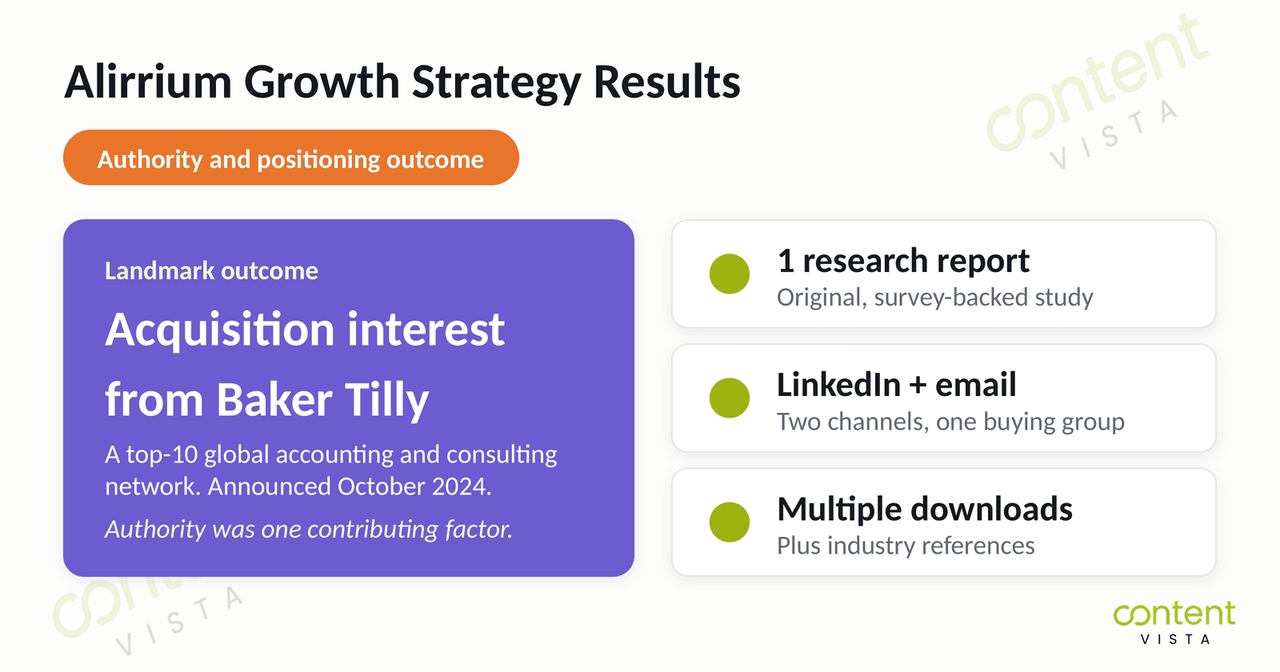
Alirrium’s result should be understood for what it was: an authority and positioning win with a landmark business outcome.
It was not a “we generated X leads in 30 days” story.
The strategy was designed to build credibility with senior banking and finance buyers, create stronger market evidence and open research-led commercial conversations.
| Outcome | Context |
|---|---|
| Acquisition interest from Baker Tilly | The authority built through the strategy contributed to Baker Tilly’s interest in acquiring Alirrium. The acquisition was announced in October 2024. |
| One original industry research report | The report gave Alirrium a substantive, research-backed asset for its banking and finance audience. |
| Dual-channel distribution | The research was distributed through LinkedIn and email to the defined decision-makers. |
| Multiple downloads and industry references | Banking and finance professionals downloaded and referenced the research, helping establish market credibility. |
That distinction matters.
Not every credible growth outcome should be reduced to a short-term lead count. In this case, the strategy created authority strong enough to support sales conversations and contribute to a major acquisition outcome.
Here's an honest caveat, too:
Baker Tilly and Alirrium had already been working together through a strategic alliance since 2022, a detail Baker Tilly noted in its own announcement. The research did not create that relationship, and it would be wrong to claim it single-handedly caused the deal.
What it did was strengthen the credibility and market standing Alirrium brought to the table. That is what “contributed to” means here, and it is exactly the kind of distinction a trustworthy case study should make out loud.
But commercial evidence matters too.
A supporting example is Akshar Business Consulting, which generated more than £200,000 in estimated pipeline and built an audience of over 4,000 newsletter subscribers through content-led, positioning-driven inbound.
Together, the two cases show different forms of proof. Alirrium demonstrates authority compounding into a landmark outcome, while Akshar shows a quantified pipeline result.
That specificity matters because buyers want proof they can check.
In UserEvidence's 2025 Evidence Gap report, a survey of 811 B2B buyers, sellers and marketers, about half of buyers named statistical evidence (51%) and case studies or testimonials (49%) as the most trustworthy types of customer evidence.
And TrustRadius's 2026 B2B Buying Disconnect report found that 74% of buyers use reviews to inform purchase decisions, while 94% of buyers who use AI for research fact-check its answers at least some of the time.
Real evidence works because it gives the reader something concrete to evaluate.
Curious what a result like this could look like as a revenue number for your business? Use the Revenue Milestone Gap Calculator.
When This Kind of Growth Strategy Won't Work for You
Let’s be real for a second:
A research-led authority strategy is not the right move for every business, every buyer or every growth problem.
When NOT to use this approach
Do not prioritise a research-led authority play if:
* You need qualified leads this month.
* You have no differentiated point of view or credible data to contribute.
* Your buyers do not use thought leadership or expert evidence to evaluate vendors.
* Positioning is not your actual constraint.
* Your funnel, follow-up, offer or sales process is broken further downstream.
The biggest limitation is timing.
Authority compounds over quarters, not days. Research, distribution and market credibility need time to build recognition.
If the immediate problem is an empty pipeline and a short cash runway, this should not be your only growth motion. You may need a more direct acquisition channel while the authority system develops in parallel.
The approach also depends on substance.
A polished report cannot rescue a generic point of view. If you do not have original data, credible experience or a perspective that changes how the buyer sees the problem, the output will look like branded content rather than useful evidence.
Buyer behaviour matters too.
Some buying groups actively look for research, expert commentary and peer signals. Others make decisions mainly through price, availability, procurement requirements or established relationships.
The strategy must match how your market actually buys.
Then there is the bottleneck question.
Sometimes positioning is not the problem. Your market may already understand the offer, while poor conversion, weak sales follow-up or disconnected systems prevent growth.
In that case, building more authority treats the wrong part of the system.
The timing logic is often explained through the 95-5 heuristic, proposed by Professor John Dawes in his 2021 Ehrenberg-Bass Institute paper for the LinkedIn B2B Institute. It suggests that roughly 95% of B2B buyers are out of market at any given time.
Dawes is clear that the figure is a heuristic, not a precise rule, and it will not hold exactly for every sector. Your own number depends on how often buyers in your category purchase.
The practical point is simple: an authority strategy mainly builds memory with buyers who may purchase later. It should not be mistaken for a mechanism that instantly converts the small group already buying today.
How to Read and Write a Growth Strategy Case Study That Means Something
Here’s the checklist I’d use:
A strong growth strategy case study should let you reconstruct the thinking, not just admire the result.
By the end, you should understand who the strategy was for, what was wrong, how the diagnosis was reached, what system guided the decisions, what was built, what changed and what could transfer to another business.
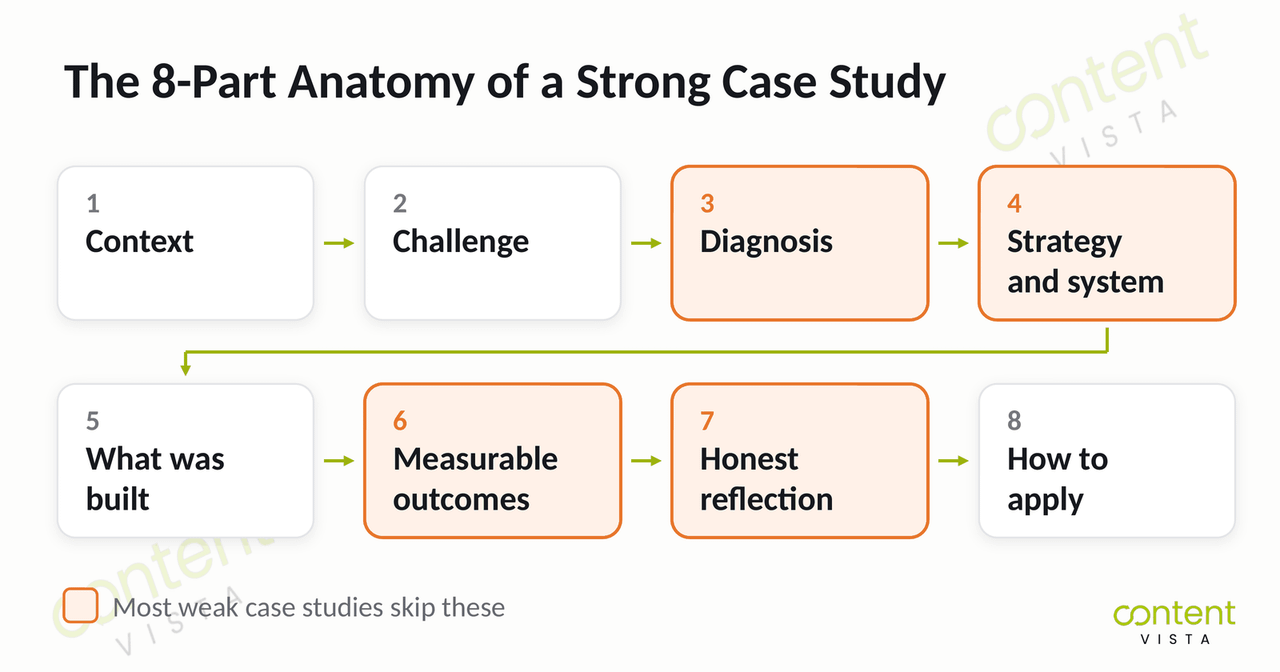
| Part | What It Should Explain | What a Weak Version Looks Like |
|---|---|---|
| 1. Context | The company, market, offer and buyer the strategy was designed for. | A vague introduction with no indication of who the result applies to. |
| 2. Challenge | The specific growth constraint or commercial problem that needed solving. | Broad language such as “wanted to grow” or “needed more awareness.” |
| 3. Diagnosis | How the team identified the real problem instead of reacting to symptoms. | A tactic appears without explaining why it was chosen. |
| 4. Strategy and System | The strategic direction and named operating system connecting the decisions. | A collection of disconnected tactics presented as a strategy. |
| 5. What Was Built | The assets, workflows, campaigns, processes or infrastructure actually created. | Phrases such as “we executed the strategy” with no operational detail. |
| 6. Measurable Outcomes | Results such as qualified pipeline, revenue, CAC, LTV or conversion, reported with a baseline and timeframe. | A vanity metric with no starting point, commercial context or measurement period. |
| 7. Honest Reflection | The limits, trade-offs and situations where the approach would not transfer. | A flawless victory story with no caveats or decision support. |
| 8. How to Apply It | The principles another business can adapt without blindly copying the tactics. | A closing sales pitch that gives the reader no usable next step. |
And here’s the tell:
If a case study skips the diagnosis, the system, the timeframe or the honest reflection, it is probably a brag disguised as evidence.
Pay particular attention to the results section.
Strong B2B case studies do not simply say “pipeline increased” or “conversion improved.” They state the baseline, the outcome and the period over which the change occurred.
Where relevant, they report qualified pipeline, revenue, customer acquisition cost, lifetime value and conversion, rather than whichever metric creates the most flattering headline.
That same structure works when you are writing a case study yourself.
Start with the business context, show how the real constraint was identified, explain the system behind the decisions, document what was built and report only the outcomes you can substantiate.
The reader should leave with proof and a method. Without both, the case study does not mean much.
How to Put This to Work in Your Own Growth Strategy
The lesson from Alirrium is not that every business should publish an industry report.
It is that growth becomes more repeatable when each decision sits inside a connected system.
Start with the buyer and your position. Are you genuinely clear on who you are for, what problem you solve best and why the right buyer should believe your positioning?
If that foundation is weak, more content or more outreach will usually create more noise, not better growth. Our guide to brand positioning strategy walks through how to sharpen it.
Then design the go-to-market motion. Decide how your message, demand strategy, channels and sales hand-offs should work together. A go-to-market strategy template can help you get those choices onto one page.
Next, build and run the system consistently enough to generate real evidence.
Finally, measure what is producing qualified pipeline, commercial movement and useful learning. Feed those findings back into your buyer and positioning decisions, and begin the next cycle with better information.
Here’s the reframe:
Most teams do not have only a lead problem or a content problem. They have a missing system.
Activity is happening, but the market, positioning, channels, execution and measurement are not connected.
That is why the fastest place to start is not another campaign. It is finding out where your system is currently leaking.
Find out where your growth system is actually leaking. Start with the GTM Readiness & Positioning Clarity Audit.
The audit gives you a practical starting point for examining whether your market definition, positioning and go-to-market readiness are strong enough to support execution.
Where the gaps run across several parts of the system, marketing strategy and growth consulting can help connect the decisions instead of treating each symptom as a separate project.
And if you would rather talk the system through, you can schedule a strategy call. No grand commitment, just a focused conversation about where the constraint may actually sit.
Growth Strategy Case Study FAQs
What is a growth strategy case study?
A growth strategy case study is a documented account of how a business diagnosed a growth constraint, chose a strategic direction, built a system and measured the outcome. A strong case explains the reasoning and execution behind the result, not just the final headline.
What should a good growth strategy case study include?
A good case study should include the business context, the challenge, the diagnosis, the strategy, what was built, measurable outcomes, honest limitations and practical takeaways. Results should be reported with a baseline and timeframe wherever those details are available.
What’s an example of a growth strategy?
One example is a research-led go-to-market motion aimed at a clearly defined buying group. In practice, that means deciding how the positioning, demand strategy, channels and sales hand-offs will work together before execution begins.
Why don’t famous-company growth case studies work for my business?
They often remove the context that made the original tactic successful. A referral programme used by a global technology brand may not transfer to a mid-market B2B firm with a longer sales cycle, multiple decision-makers and a different level of market awareness.
How do you measure whether a growth strategy worked?
Measure the commercial outcome the strategy was designed to influence. Depending on the objective, that may include qualified pipeline, revenue, conversion, customer acquisition cost, lifetime value or retention, always compared with a clear baseline and timeframe.
How is a growth strategy different from a marketing plan?
A growth strategy defines where growth will come from, which market and buyers to prioritise and how the business will create an advantage. A marketing plan is downstream of that strategy: it translates those choices into campaigns, channels, timelines, budgets and responsibilities.
How long does a growth strategy take to show results?
The timeframe depends on the growth constraint and the chosen motion. Direct acquisition activity may create signals sooner, while positioning, research-led authority and demand creation usually compound over quarters rather than days.