Quick Summary
- A brand positioning strategy defines the unique space your business owns in the minds of your ideal customers.
- Strong positioning makes every marketing activity, from content and advertising to sales conversations, work together instead of competing for attention.
- Weak positioning does the opposite, forcing you to spend more to achieve less.
If your marketing creates activity but not pipeline, you probably don't have a marketing problem.
You probably have a positioning problem.
Here's the problem: many startups and SMEs spend months refining campaigns, testing channels, publishing content and buying ads.
Yet they still struggle to become the obvious choice.
The market notices them, but it doesn't remember them. Prospects compare them on price instead of value.
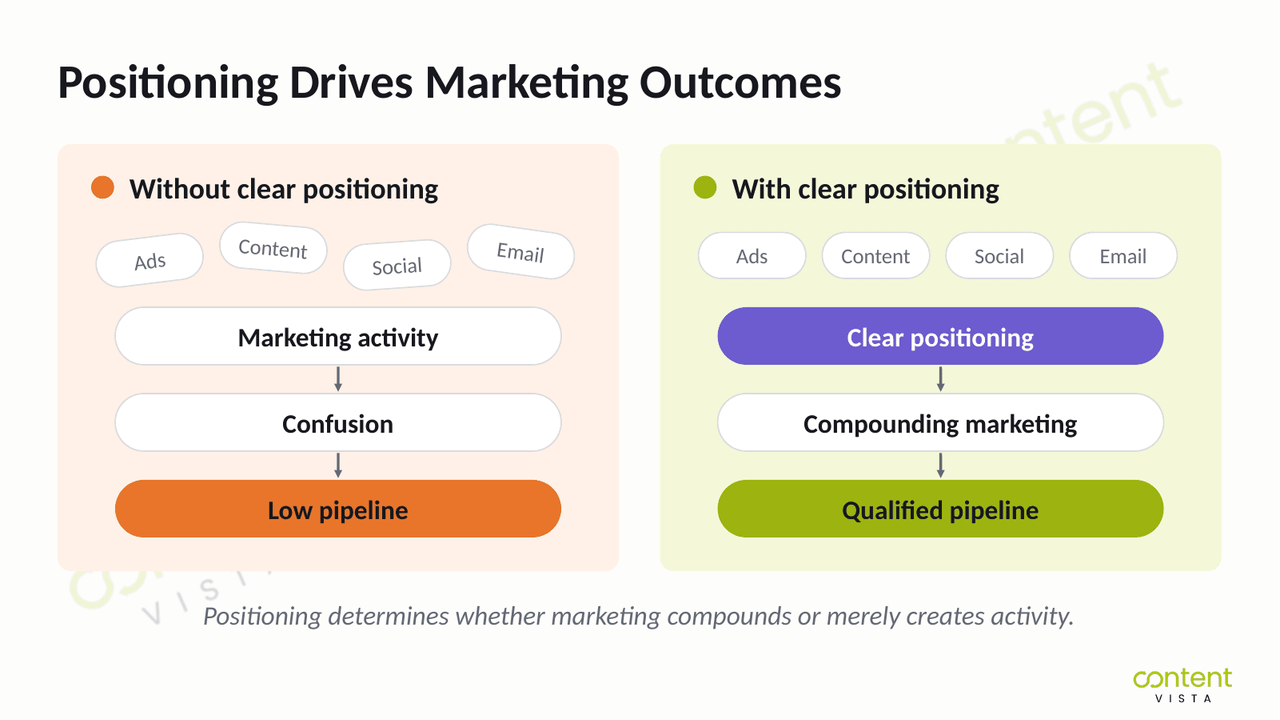
Marketing becomes a series of disconnected activities instead of a system that compounds over time.
The uncomfortable truth is this: tactics amplify whatever position you already occupy in your customer's mind.
If that position is vague, every additional marketing dollar works harder just to explain who you are.
The good news? Brand positioning isn't about inventing a catchy tagline or sounding different for the sake of it.
It's about creating a clear reason for the right customers to choose you over every credible alternative, and making every marketing effort reinforce that choice.
What Is a Brand Positioning Strategy?
Positioning isn't what you say about your business: it's what your customers remember when they need a solution.
That's an important distinction because many businesses assume they have a positioning strategy when they've really created a logo, a tagline or a messaging document.
Those are valuable assets, but they're not the strategy itself.
Brand positioning vs branding
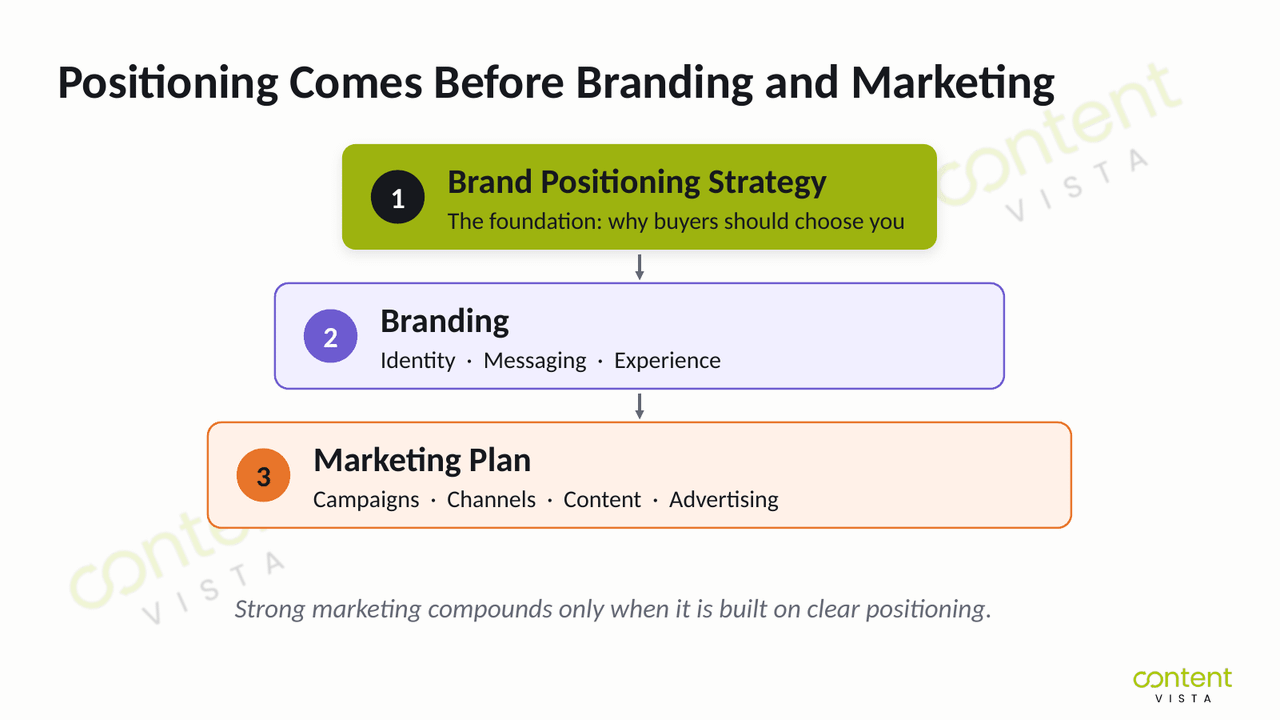
Branding is how your business expresses itself. It includes your visual identity, tone of voice, website, messaging and overall customer experience.
Positioning comes first.
It determines the strategic idea those branding elements are designed to reinforce.
If positioning answers, "Why should customers choose us?", branding answers, "How do we consistently communicate that answer?"
Without clear positioning, branding may look polished but still fail to create preference.
Brand positioning vs a marketing plan
This is another distinction that often gets blurred.
A marketing plan explains how you'll attract attention through campaigns, channels, budgets, content and timelines.
A positioning strategy decides what those marketing activities should consistently communicate.
In other words, your positioning should remain relatively stable while your marketing plan evolves with changing goals, budgets and market conditions.
If you reverse that order and create campaigns before defining your position, you risk generating plenty of activity without building lasting market recognition.
The same logic applies to your marketing as a whole. Our breakdown of marketing strategy vs tactics shows why the plan should always follow the strategy.
Why Positioning Decides Whether Your Marketing Compounds (or Wastes Money)
Founders often assume that if marketing isn't producing pipeline, they need better campaigns.
More content. Better ads. A bigger budget.
In reality, those tactics usually amplify what's already there.
If your positioning is unclear, every campaign has to spend time explaining who you are before it can persuade anyone to choose you.
If your positioning is clear, every touchpoint reinforces the same market perception, making future marketing more efficient.
The evidence points to the same conclusion.
Key Metrics
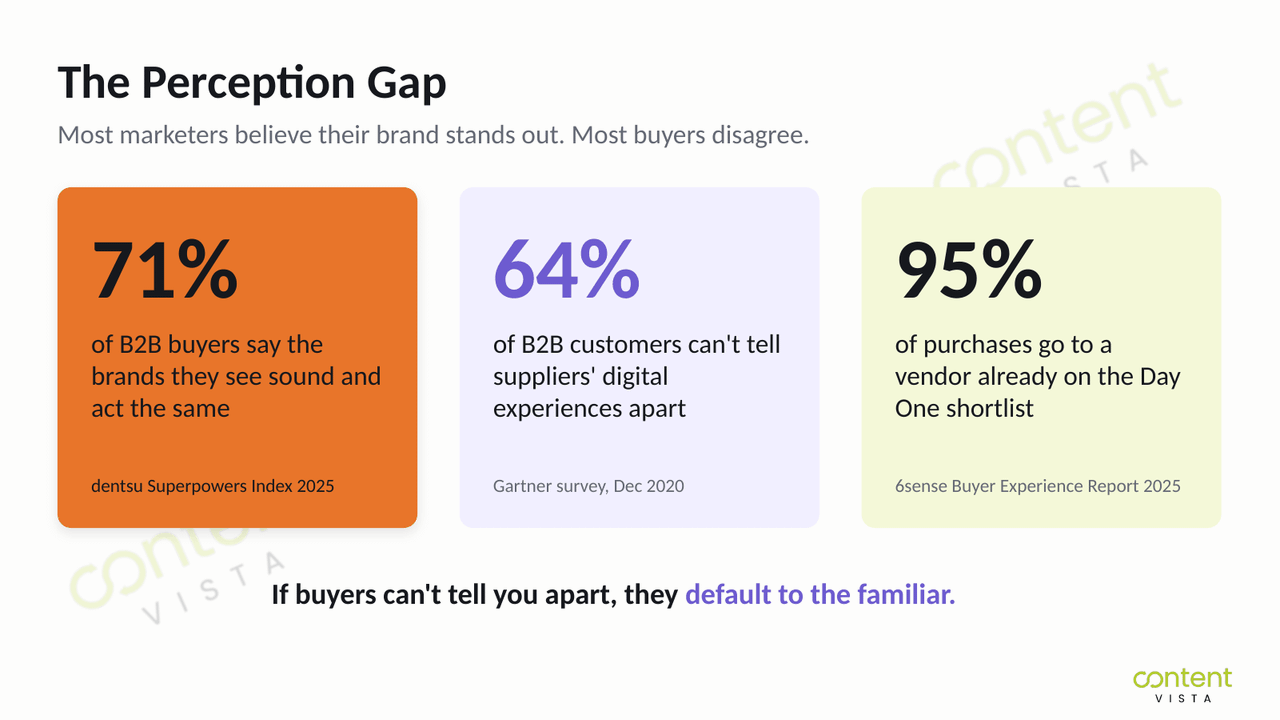
71% of B2B buyers say the brands they encounter sound and act the same, even though most marketers believe their own brand stands out. (dentsu's 2025 Superpowers Index research)
64% of B2B customers can't tell the difference between one B2B brand's digital experience and another's. (Gartner's survey of more than 1,100 B2B customers, December 2020)
In 95% of purchases, the winning vendor was already on the buyer's Day One shortlist, so your brand can be ruled out before the first sales conversation even begins. (6sense's 2025 B2B Buyer Experience Report)
So what does that mean for you?
Those numbers reveal a perception gap.
Businesses judge themselves by what they know internally: their product, expertise and effort.
Buyers judge them by what they can quickly understand.
If every competitor sounds similar, customers don't spend more time comparing. They default to familiar names, perceived category leaders or the lowest-risk option.
That's why positioning isn't "brand fluff."
It's a commercial filter that determines whether your marketing compounds or continually starts from zero.
It's also why positioning comes first in any growth plan: every downstream activity depends on it.
Before you optimise campaigns, improve conversion rates or scale demand generation, your market must understand who you are, who you're for and why your difference matters.
Without that clarity:
Content educates but doesn't create preference.
Advertising generates clicks but not qualified demand.
Sales conversations begin with explanations instead of conviction.
With it, every campaign reinforces the same strategic idea, making your marketing more memorable, more efficient and easier to scale.
That's why we treat positioning as the operating system behind growth, not as a branding exercise completed once and forgotten.
If you'd like to see how positioning connects to the rest of the growth engine, explore our guide to revenue-driven marketing strategy.
Differentiation vs Distinctiveness: The Distinction Most Guides Miss
One of the biggest reasons positioning efforts fail is that businesses chase differentiation while neglecting distinctiveness, or worse, assume they're the same thing.
They're not.
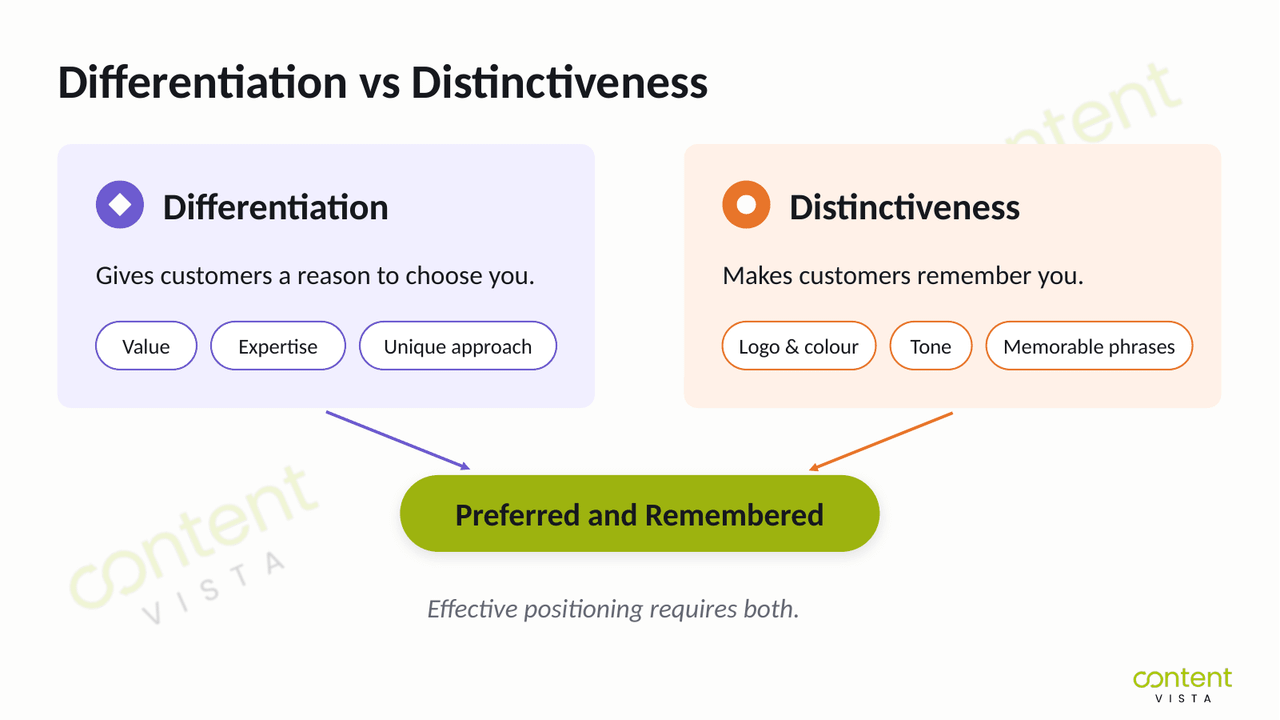
Differentiation answers the buyer's question:
"Why should I choose you instead of another option?"
Distinctiveness answers a different question:
"Will I remember you when it's time to buy?"
A strong positioning strategy needs both.
Differentiation gives customers a meaningful reason to prefer your business.
That reason might come from your expertise, approach, customer experience, business model or the specific problem you solve better than competitors.
Distinctiveness ensures those differences don't disappear into a crowded market.
It consists of the recognisable cues your audience repeatedly associates with your business: your visual identity, messaging style, naming conventions, tone of voice, memorable phrases and other consistent brand assets that make you easier to identify.
Just as importantly, distinctiveness increases the likelihood that your brand comes to mind when a relevant buying situation arises.
Marketing researchers often describe this as improving mental availability: being easy to recall at the right moment.
It also means strengthening the links between your brand and important category entry points, the situations, problems or triggers that prompt someone to begin looking for a solution.
A business that is differentiated but not distinctive may be appreciated by existing customers but forgotten by future ones.
A business that is distinctive but not differentiated may be remembered, but not chosen.
The goal isn't to pick one.
It's to build a positioning strategy where meaningful differentiation creates preference and distinctive brand assets make that preference easy to recall.
| Differentiation | Distinctiveness | Why It Matters |
|---|---|---|
| Creates a meaningful reason to choose your business. | Makes your business instantly recognisable and memorable. | Together they increase both customer preference and recall. |
| Focuses on value, expertise, offer, positioning and competitive advantage. | Focuses on brand assets such as visual identity, messaging, tone and other consistent cues. | Consistency strengthens recognition over time. |
| Answers, "Why should I buy from you?" | Answers, "Will I think of you when I need this?" | Winning brands answer both questions. |
The Main Types of Brand Positioning Strategies
So which positioning strategy is right for your business?
It depends on where the opportunity, or the gap, exists in your market.
Many founders make the mistake of trying to position themselves as everything: premium, affordable, innovative, customer-centric and easy to use.
The result is a message that doesn't stand for anything memorable.
Strong positioning is about choosing the primary reason customers should remember and prefer you.
That doesn't mean your business can't excel in multiple areas. It means your market should immediately associate your brand with one dominant idea.
Here's how the most common positioning strategies work and where they fit best.
| Positioning Strategy | What It Means | Best Fit | Example |
|---|---|---|---|
| Price / Value | Offer the best balance between cost and value, rather than simply being the cheapest. | Cost-conscious startups, service businesses, and software products competing in mature markets. | A SaaS platform that positions itself as enterprise-level capability without enterprise pricing. |
| Quality-Led | Win by delivering superior performance, expertise or outcomes worth paying more for. | Professional services, specialist consultancies, premium B2B software and technical products. | A cybersecurity consultancy known for deep technical expertise rather than low fees. |
| Convenience | Reduce friction by making a task dramatically faster, simpler or easier to complete. | Workflow software, fintech, logistics and productivity tools. | Stripe simplifying online payment integration for developers. |
| Customer Service-Led | Differentiate through responsiveness, onboarding, support and long-term partnership. | Agencies, managed services, enterprise SaaS and recurring-service businesses. | A managed IT provider known for proactive support and rapid issue resolution. |
| Innovation / Differentiation-Led | Introduce a new approach, technology or business model that changes how customers solve a problem. | Technology startups, AI companies and product innovators entering competitive markets. | Figma rethinking collaborative design workflows in the browser. |
| Category Creation | Define a new market category instead of competing within an existing one. | Businesses introducing a genuinely different way of thinking about an established problem. | Slack positioning workplace communication around channels rather than internal email. |
The important takeaway isn't choosing the "best" strategy: it's choosing the one your market can understand and remember.
A startup with limited brand awareness usually gains more by owning one clear positioning than by trying to compete on every dimension at once.
Once that position becomes established, you can expand your messaging without diluting what customers already associate with your business.
How to Actually Position Your Brand: The Positioning Architecture™ Process
Most positioning advice starts with a template:
"For X, we are Y and Z."
That's useful, but only after you've done the strategic work.
A positioning statement doesn't create a position. It documents one.
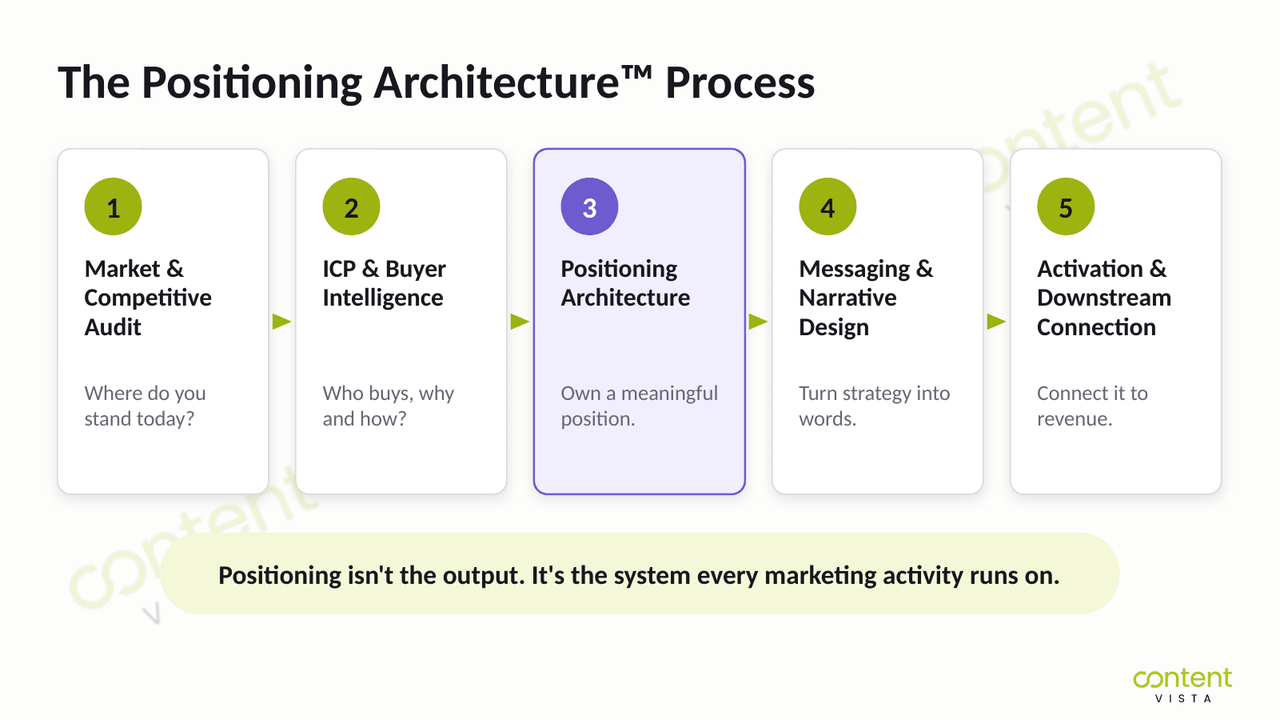
Let's make this practical. The Positioning Architecture™ Process is designed to answer five sequential questions.
Skip one and every step after it becomes an educated guess.
Step 1: How does the market see you today?
Before deciding where you want to position your brand, understand where you're positioned already.
Start with evidence, not assumptions.
Review competitor messaging, customer interviews, sales call notes, proposal feedback, review sites, win/loss conversations and website analytics.
Look for recurring language, buying objections and patterns in how prospects compare you against alternatives.
The goal isn't simply to identify competitors. It's to uncover the whitespace they aren't occupying and the perceptions your customers already hold.
Strong positioning begins with observation: not brainstorming.
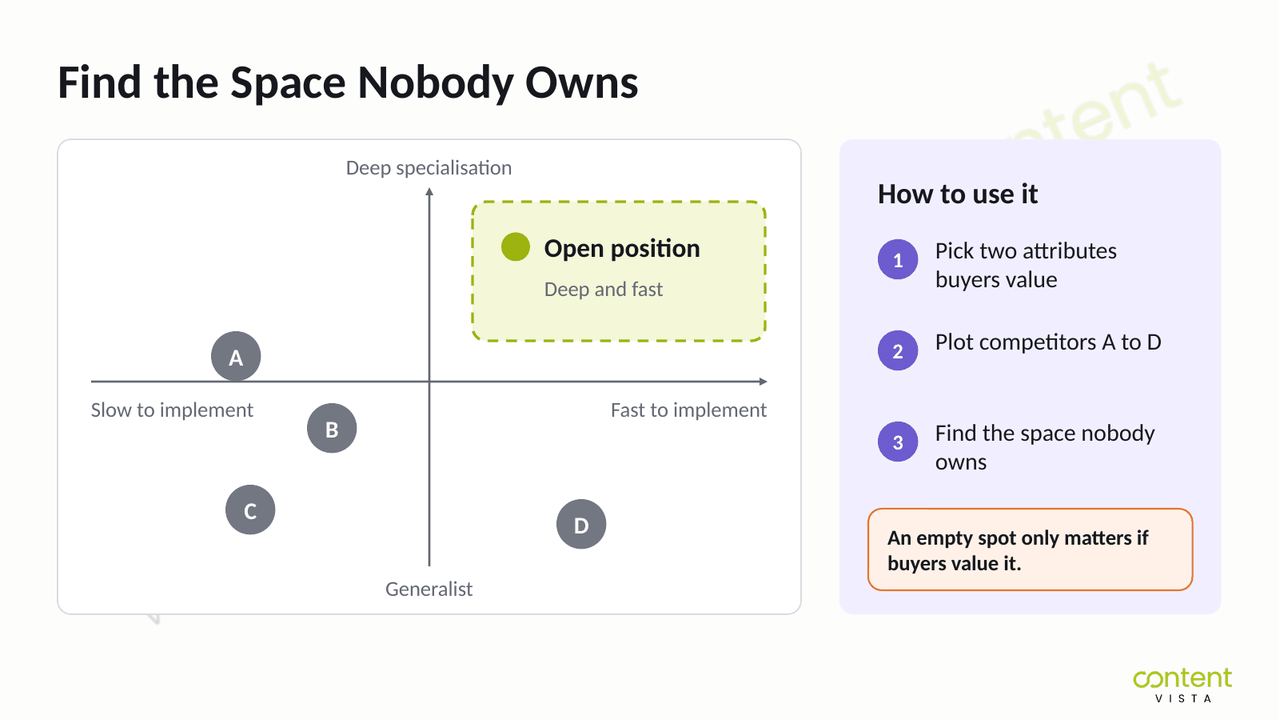
Here's a simple way to make that whitespace visible: plot your main competitors on a positioning map.
Pick the two attributes your buyers care about most (for example, depth of specialisation and speed of implementation), then place each competitor on the grid.
Look for the space nobody owns. Just remember: an empty spot only matters if real buyers value what sits there.
If you'd rather bring in an outside view for this step, it's exactly where our market research and competitive intelligence work begins.
Step 2: Who actually buys and why now?
Traditional buyer personas often describe demographics.
Positioning requires buyer intelligence.
Ask questions such as:
What triggers someone to start looking for a solution?
What problem suddenly becomes urgent?
What risks are they trying to reduce?
Which alternatives do they compare?
Which channels influence their decision before speaking with sales?
Instead of building fictional personas, build a decision map.
Positioning becomes far stronger when it's based on buying behaviour rather than assumptions about job titles or company size.
Step 3: What position should you own?
Now define the strategic foundation.
This is where your Positioning Architecture™ comes together:
The category you want customers to place you in.
The meaningful difference you want to be known for.
Why that difference matters to your ideal customer.
The evidence that makes your claim believable.
Notice what's missing: slogans.
Your position should be clear enough that future messaging, campaigns, product decisions and sales conversations naturally reinforce the same idea instead of introducing new ones.
Step 4: How do you turn strategy into memorable messaging?
A great position only creates value if people can understand it quickly.
Translate your strategic position into language that is consistent across every customer touchpoint:
Website headlines
Sales presentations
LinkedIn profiles
Product pages
Proposal documents
Email campaigns
Demand generation assets
The objective isn't repeating identical words everywhere. It's ensuring every interaction reinforces the same strategic narrative.
Consistency builds recognition. Recognition builds trust.
Step 5: How does positioning drive revenue?
This is where many positioning projects fail.
The final deliverable isn't a PDF stored in a shared folder: it's a marketing system that consistently expresses your position.
Your positioning should influence:
Content strategy
Demand generation campaigns
Lead capture offers
Sales qualification
Website conversion messaging
Customer onboarding
Product marketing
This is the point where positioning hands over to your go-to-market strategy.
If you want a practical way to sequence that hand-over, our 90-day go-to-market strategy template walks you through it.
When positioning reaches these downstream activities, marketing stops behaving like disconnected campaigns and starts operating as a connected growth system.
That is when positioning becomes a commercial asset rather than a branding exercise.
How to Write a Brand Positioning Statement
By this point, you've done the hard work: understanding your market, your buyers and the position you want to own.
Now it's time to capture that thinking in a positioning statement.
Here's the formula most marketers use:
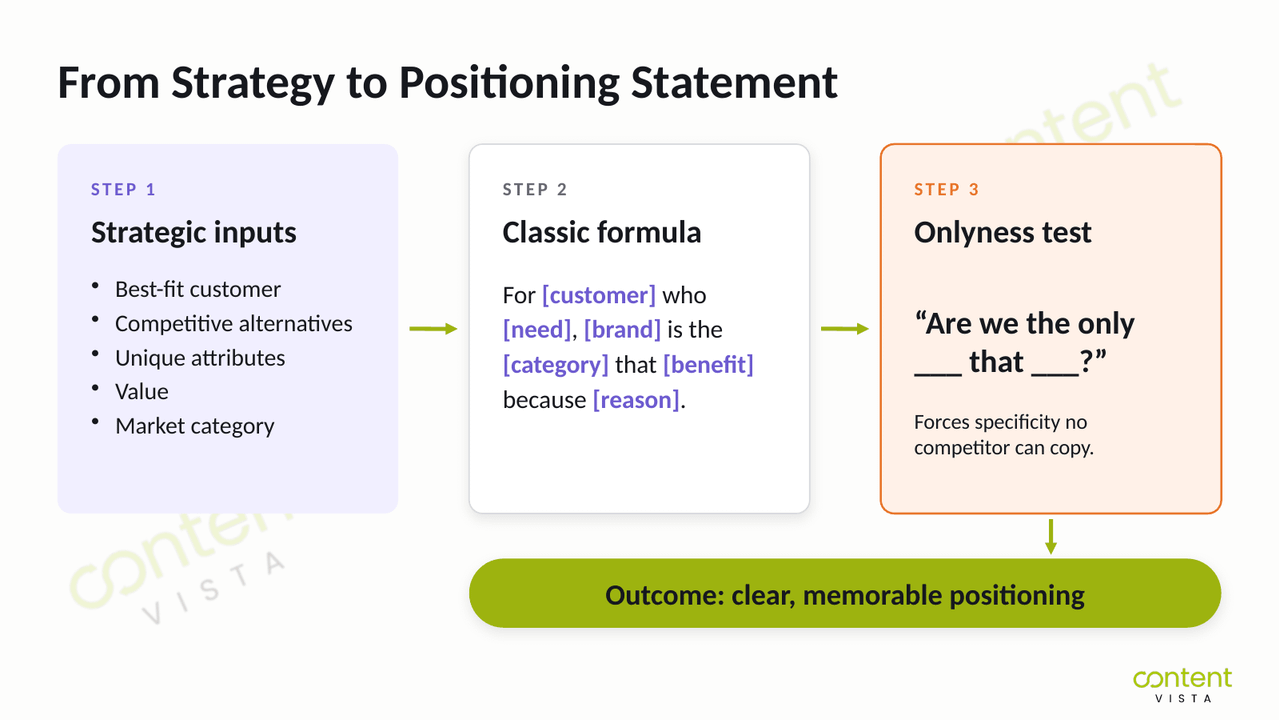
For [target customer] who [has a specific need], [brand] is the [market category] that [delivers the primary benefit] because [reason to believe].
It's a solid starting point because it forces clarity.
But on its own, it also produces positioning statements that sound interchangeable.
Here's how to make it not sound like everyone else's.
Start with the strategic inputs, not the template
A strong positioning statement is the output of good strategy: not a brainstorming exercise.
Before writing a single sentence, pressure-test it against five strategic components popularised by April Dunford in her positioning book Obviously Awesome.
Competitive alternatives: What are customers using instead of you today?
Unique attributes: What can you genuinely claim that competitors cannot?
Value: Why do those differences matter to the customer?
Best-fit customer: Who benefits most from those differences?
Market category: What category should customers place you in?
If any of those answers feel vague, your positioning statement will too.
Then challenge it with the "Onlyness" test
Once you've drafted your statement, apply Marty Neumeier's "Onlyness" framing from his book Zag.
Ask yourself:
"Are we the only ______ that ______?"
The goal isn't to manufacture a claim that no competitor can ever challenge. It's to force specificity.
For example, "We're an innovative software company" could describe hundreds of businesses.
"We're the only project management platform built specifically for distributed engineering teams that need real-time technical collaboration" is far harder to confuse with everyone else.
A worked B2B example
Imagine a startup (let's call it ProposalFlow) selling AI-powered proposal software to consulting firms.
Using the classic template:
For consulting firms that lose time creating customised client proposals, ProposalFlow is the proposal automation platform that helps teams create high-quality proposals faster because it combines AI-assisted drafting with reusable consulting-specific knowledge libraries.
Now apply the Onlyness test:
ProposalFlow is the only proposal automation platform designed specifically for consulting firms that combines AI-generated drafting with reusable consulting expertise, helping teams produce customised proposals without starting from scratch every time.
Notice what changed.
The second version is more specific about who it's for, what category it belongs to and why it deserves to exist.
That's the difference between filling in a template and building a position customers can actually remember.
The Famous Positioning "Rules" and How to Use Them Without Getting Burned
If you've spent any time reading about branding or marketing strategy, you've probably seen the same "rules" repeated over and over.
They're useful, but only if you understand what they were actually intended to do.
Here's what they really mean, and where they start to break.
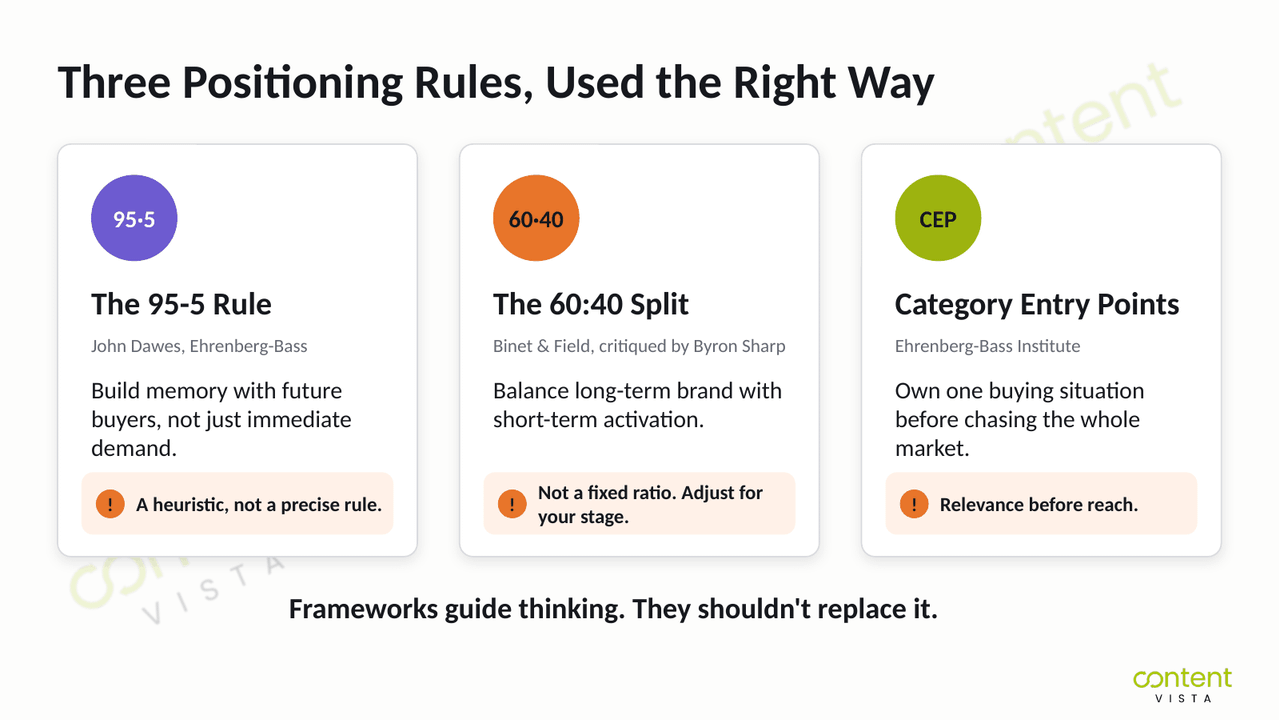
The 95-5 rule: Think of it as a heuristic, not a law
The 95-5 rule comes from 2021 research by Professor John Dawes of the Ehrenberg-Bass Institute, written for the LinkedIn B2B Institute.
It suggests that, at any given moment, up to 95% of potential business buyers are not in the market, while only around 5% are ready to buy.
The important implication isn't the exact ratio.
It's that positioning shouldn't exist solely to persuade today's buyers.
It should also build memory with tomorrow's buyers, so your brand is easier to recall when their need eventually arises.
Dawes himself is clear on this point. In the Ehrenberg-Bass Institute's paper on the 95-5 rule, he cautions that the 95% figure is "not meant to be a precise rule."
The real split varies by category and by how often buyers in your market switch providers.
Treat it as a strategic heuristic that shifts your thinking from chasing immediate demand to building long-term preference.
The 60:40 brand-to-activation split: Direction, not doctrine
Another widely quoted principle comes from Les Binet and Peter Field, whose IPA effectiveness research argued that long-term growth typically benefits from balancing brand building with short-term sales activation.
The original guidance usually appears as a 60:40 split in favour of brand.
For B2B, Binet and Field's work with the LinkedIn B2B Institute put the balance closer to 46% brand and 54% activation.
The mistake is treating those percentages as universal.
They vary depending on factors such as market maturity, competitive pressure, growth stage and existing brand awareness.
Byron Sharp of the Ehrenberg-Bass Institute goes further. He has described the 60:40 rule as "terrible, very misleading", arguing that it was built on awards-entry data that can't support a fixed formula.
The lesson isn't to copy a ratio.
It's to avoid starving long-term brand memory while chasing short-term lead generation.
Category entry points: The practical opportunity for startups and SMEs
Most smaller businesses can't outspend established competitors to become famous overnight.
They don't need to.
Instead, identify the buying situations where you can become the obvious choice.
These situations, often called category entry points, are the moments, problems or triggers that cause someone to begin looking for a solution.
Rather than trying to own an entire category, own a specific buying context.
For example, instead of positioning yourself as "project management software," you might become the platform known for managing complex engineering handoffs.
Instead of being another marketing agency, you become the specialist businesses think of when they need to align positioning before scaling demand generation.
That approach is far more achievable for startups and SMEs because it builds recognition where it matters most: at the moment buying decisions begin.
The common thread behind all three ideas is simple: don't treat popular marketing frameworks as universal laws. Use them as strategic guides, adapt them to your market, and validate them against your own customers instead of blindly following industry averages.
Is Your Positioning Actually Working? A Quick Clarity Check
A positioning strategy shouldn't just sound good in a workshop: it should make every marketing and sales conversation easier.
If you're unsure whether your positioning is working, don't start by redesigning your website or rewriting your tagline.
Pressure-test the strategy itself.
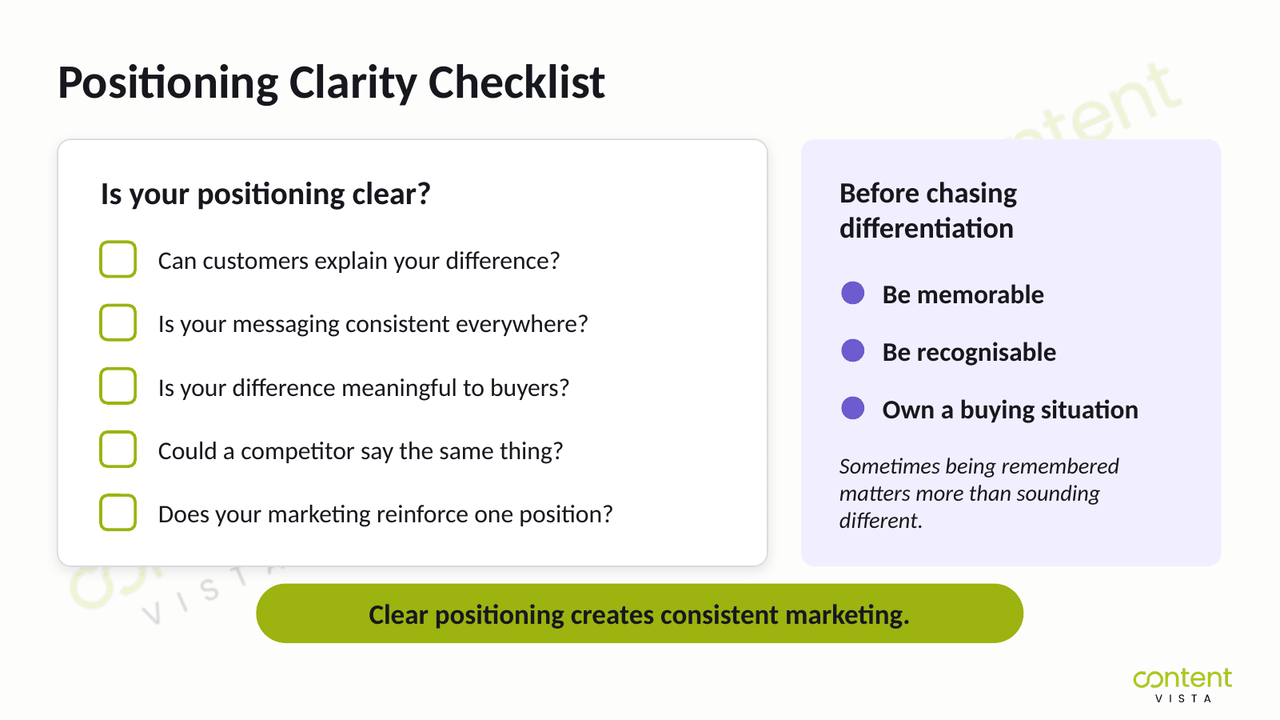
Positioning Clarity Checklist
Use the questions below as a quick self-assessment.
□ Can someone outside your business explain what makes you different after hearing your positioning once?
□ Does your leadership, sales, and marketing team describe your business in essentially the same way?
□ Is your difference meaningful to your ideal customer or merely true about your business?
□ Would your best customers immediately recognise themselves in your messaging?
□ Could your biggest competitor honestly make the same positioning claim?
□ Does your website reinforce your positioning within the first few seconds of a visit?
□ Do your content, campaigns, proposals and sales conversations consistently communicate the same strategic idea?
□ Does your positioning naturally influence your demand generation, lead capture and conversion strategy?
If you answered "No" or "I'm not sure" to several of these questions, your positioning likely isn't providing the strategic foundation your marketing needs.
That doesn't necessarily mean you need a new brand.
It usually means your current position hasn't been clearly defined, validated or consistently activated.
Run the GTM Readiness & Positioning Clarity Audit to identify whether the gaps are in your market positioning, messaging, buyer alignment or go-to-market strategy.
Take the GTM Readiness & Positioning Clarity AuditWhen not to chase differentiation
Here's the contrarian view that many positioning guides leave out:
You don't always need to be dramatically different.
In crowded markets, being consistently recognisable and easy to buy from can outperform trying to invent a completely new story.
If your customers already understand the category, your priority may be increasing distinctiveness, strengthening recall, improving discoverability or owning a specific buying situation.
That's often smarter than forcing a unique claim that customers don't value.
In other words, don't pursue differentiation for its own sake.
Pursue a position that helps customers recognise you, remember you and confidently choose you when the need arises.
Common Brand Positioning Mistakes (and How to Fix Them)
We've seen these mistakes repeatedly with startups and SMEs.
The good news is that most positioning problems aren't caused by a bad business: they're caused by unclear strategic decisions.
Here are the most common ones, why they hurt and how to fix them.
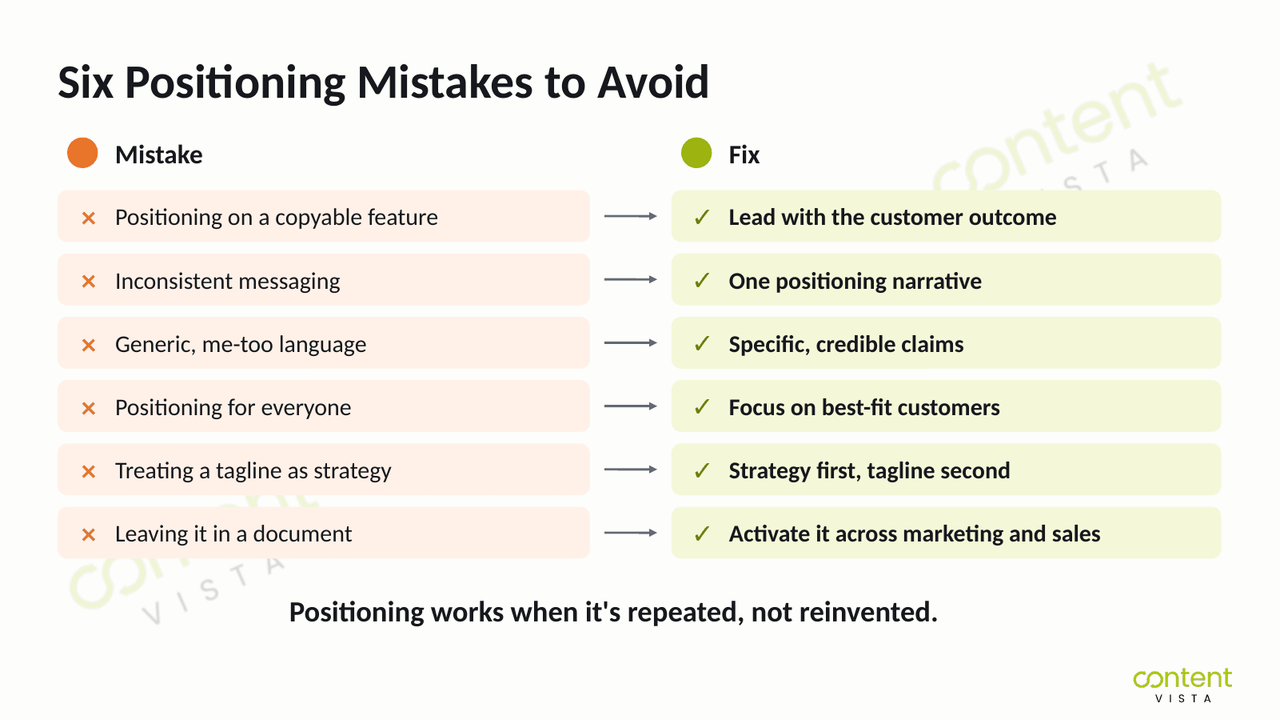
Positioning around a feature anyone can copy
The mistake: Building your positioning around a product feature, pricing model or process improvement.
Why it hurts: Competitors can usually replicate features much faster than they can replicate trust, expertise or reputation.
The fix: Position around the customer outcome you consistently deliver and the strategic reason customers should choose you: not the feature itself.
Describing your business differently every time
The mistake: Every founder, salesperson, and marketer explains the business in a different way.
Why it hurts: Inconsistent messaging weakens recognition and makes it harder for buyers to remember what you actually stand for.
The fix: Establish one clear positioning narrative and ensure it is reflected across your website, sales conversations, proposals and marketing.
Sounding exactly like your competitors
The mistake: Using generic phrases like "innovative," "customer-centric," or "end-to-end solutions" simply because everyone else does.
Why it hurts: If every competitor makes the same claim, it stops functioning as a differentiator.
The fix: Replace generic language with specific claims that reflect your unique expertise, audience, or approach, and support those claims with credible evidence.
Trying to appeal to everyone
The mistake: Keeping your positioning broad so that no potential customer feels excluded.
Why it hurts: Broad positioning usually creates weak positioning. Buyers struggle to understand who you're really built for.
The fix: Optimise for your best-fit customers first. Clear positioning often attracts more qualified opportunities than generic messaging ever will.
Confusing a tagline with a positioning strategy
The mistake: Believing that a memorable slogan is the strategy itself.
Why it hurts: A tagline communicates your position: it doesn't define it.
The fix: Build the strategy first, then let the tagline emerge from the positioning rather than trying to reverse the process.
Never activating the positioning
The mistake: Completing a positioning exercise and leaving it in a presentation deck.
Why it hurts: Positioning only creates value when it shapes demand generation, website messaging, sales enablement, content and customer experience.
The fix: Treat positioning as an operating system for marketing, not a branding deliverable. Every campaign should reinforce the same strategic idea.
The pattern behind almost every positioning mistake is the same: businesses spend too much time trying to sound different and too little time ensuring every customer interaction consistently reinforces one clear position. Consistency, not constant reinvention, is what turns positioning into a competitive advantage.
What Strong Positioning Looks Like in Practice
Strong positioning doesn't just make a brand sound different: it changes what the market notices, talks about, and ultimately buys.
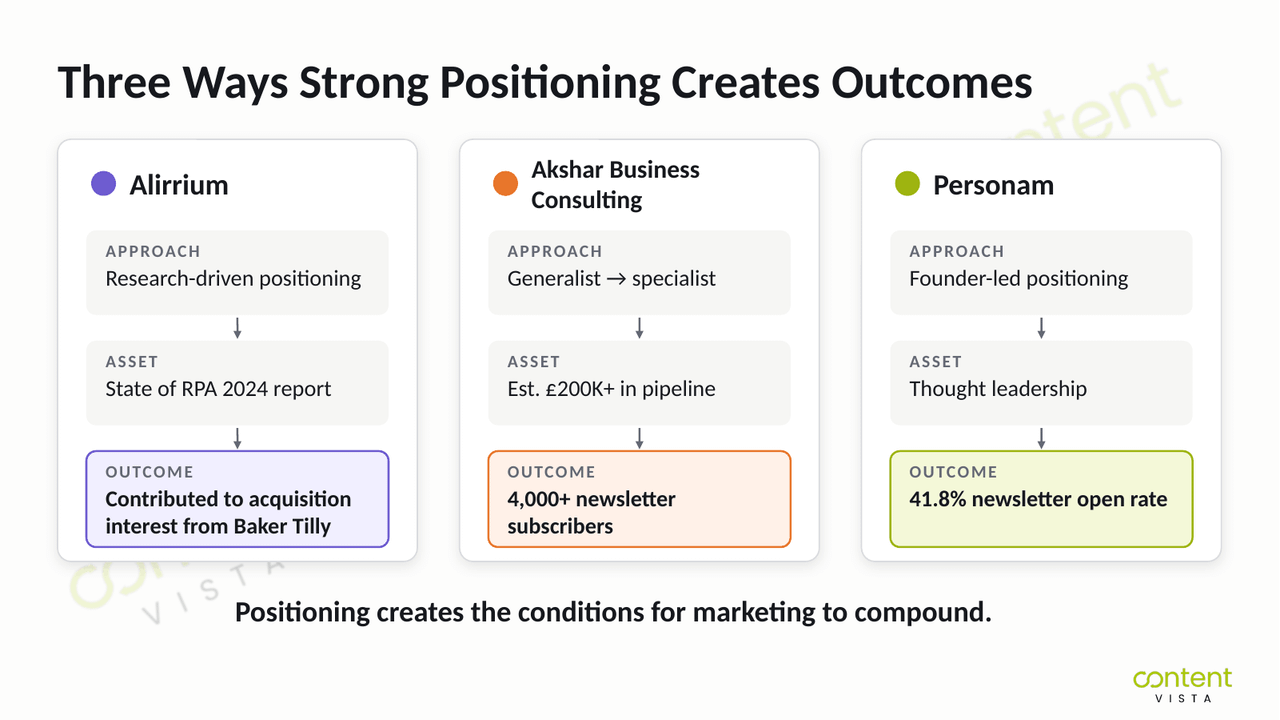
Research-driven positioning: Alirrium
For Alirrium, the goal wasn't simply to improve messaging.
It was to establish a position the market would naturally associate with authority.
Instead of relying on promotional content, the strategy centred on research-driven positioning.
The result was the State of RPA 2024 report, a flagship industry asset designed to contribute original insights rather than repeat existing opinions.
That approach elevated the conversation from "what we do" to "what we know."
The outcome extended beyond brand awareness.
The positioning helped establish Alirrium as a credible voice in its category and contributed to acquisition interest from Baker Tilly.
Rather than trying to out-market competitors, the business strengthened its market position by becoming a recognised source of industry intelligence.
For a detailed breakdown of the approach, see our research-driven positioning case study.
Repositioning from generalist to specialist
Akshar Business Consulting followed a different path.
Instead of competing as a broad business consultancy, the brand repositioned around a more focused specialist identity.
That clearer market position supported more targeted marketing, contributing to an estimated £200K+ in pipeline and the growth of a newsletter community to 4,000+ subscribers.
These results reinforced the value of positioning before scaling demand generation.
Founder-led positioning that builds trust
Personam demonstrates another variation of the same principle.
Rather than hiding behind a corporate brand, the strategy leaned into founder-led positioning, using consistent thought leadership to build credibility with the right audience.
That approach contributed to a 41.8% newsletter open rate, showing how clear positioning can improve engagement as well as visibility.
These examples share a common pattern: none began with a new logo or a better tagline. They began with a clearer strategic position. Once that foundation was in place, content, demand generation and thought leadership became far more effective because they all reinforced the same market narrative.
Brand Positioning Strategy: FAQs
What is a brand positioning strategy?
A brand positioning strategy is the strategic decision about the place your business should occupy in the minds of your ideal customers.
It defines who you serve, the category you compete in, why you're meaningfully different and why customers should believe your claims. Everything from branding to demand generation should reinforce this position.
What's the difference between brand positioning and branding?
Positioning is the strategy; branding is its expression.
Positioning determines the perception you want to own in the market, while branding brings that position to life through your visual identity, messaging, tone of voice and customer experience.
What are the main types of brand positioning?
The most common approaches include price/value, quality-led, convenience, customer service-led, innovation-led and category creation.
The right strategy depends on where your business can create meaningful value and where there is room to stand apart in the market: not on which approach is most popular.
How do you write a brand positioning statement?
Start with research, not writing.
Once you've defined your ideal customer, market category, meaningful difference, value and proof, use a simple structure such as: For [target customer], [brand] is the [category] that [benefits] because [reason to believe]. The statement should document your strategy: not create it.
What's the difference between differentiation and distinctiveness?
Differentiation explains why customers should choose you over alternatives. Distinctiveness helps customers recognise and remember you through consistent brand assets and associations.
Strong brands build both: a meaningful reason to buy and a memorable identity that comes to mind in buying situations.
How is positioning different for B2B vs B2C?
The principles remain the same, but the buying process changes.
B2B positioning usually focuses on business outcomes, risk reduction, stakeholder alignment and long-term value, while B2C positioning often places greater emphasis on personal benefits, emotion, convenience or lifestyle. In both cases, clarity is more valuable than complexity.
How do startups and SMEs position against bigger competitors?
Smaller businesses rarely win by trying to be everything to everyone.
Instead, they should position around a clearly defined customer segment, a specific buying situation or a specialised capability that larger competitors overlook. Focus beats familiarity when resources are limited.
How do you know if your positioning is working?
Your positioning is working when customers consistently understand what makes you different and your team communicates the same story.
You'll also notice marketing becomes more cohesive and sales conversations become easier, because prospects already understand your value before they engage. Strong positioning creates alignment across the entire growth system.
What's the difference between a marketing strategy and a marketing plan?
A marketing strategy defines what you are trying to achieve and why, including your positioning, target audience, competitive approach and growth priorities.
A marketing plan defines how you will execute that strategy through campaigns, channels, budgets, timelines and responsibilities. The plan should always follow the strategy, not replace it.
Your Next Move
If there's one idea to take away from this guide, it's this: positioning isn't a branding exercise. It's a growth decision.
Every downstream activity depends on it.
Your website, messaging, demand generation, sales conversations, content strategy and campaigns can only compound when they're reinforcing the same strategic position.
Without that foundation, marketing becomes a series of disconnected tactics.
With it, every interaction helps strengthen the same perception in the minds of your buyers.
Most positioning work ends in a brand guidelines PDF.
Ours ends in pipeline.
That's why positioning is the first step in the CORE Growth System, the approach we lay out in our guide to revenue-driven marketing strategy. If you want to understand how positioning fits into a complete revenue engine, start there.
And if you're already questioning whether your current positioning is helping you or holding you back, your next step isn't another messaging workshop.
It's identifying exactly where the strategic gaps exist.
Discover whether your biggest growth constraint is your market positioning, messaging, ICP alignment or go-to-market strategy. It takes about three minutes.
Take the GTM Readiness & Positioning Clarity AuditIf you need hands-on support translating those insights into a differentiated market position, explore our Brand & Market Positioning service.
Already clear on your position but still short of your growth targets? The Revenue Milestone Gap Calculator shows what's standing between you and your next revenue milestone.