Quick Summary
- Most businesses don't have a marketing strategy. They have a collection of marketing activities.
- Content gets published, ads get launched and emails get sent, but none of it is connected to revenue.
- This guide shows you how to build a revenue-driven marketing strategy with the CORE Growth System™.
So what exactly is a marketing strategy?
A marketing strategy is the system your marketing runs on. It defines who you serve, how you position your offer, which channels you use and how attention moves through a repeatable path that generates pipeline, customers and growth.
Why Most "Marketing Strategies" Never Touch Revenue
Here's the problem:
Most companies are busy marketing.
They're posting on LinkedIn. Running campaigns. Publishing content. Sending newsletters. Launching webinars. Testing ads.
And yet when someone asks a simple question:
"Which of these activities is actually generating revenue?"
The answer is often unclear.
That's because activity is not a strategy.
A marketing calendar is not a strategy.
A channel plan is not a strategy.
A list of campaigns is not a strategy.
Many businesses mistake motion for progress.
They stay busy executing tactics without first building the system that connects those tactics to business outcomes.
The result?
Marketing becomes difficult to measure.
Teams argue over attribution.
Budgets get allocated based on opinions instead of evidence.
And growth becomes inconsistent because every quarter feels like starting from scratch.
The underlying issue is rarely effort.
In fact, most teams are working incredibly hard.
The real issue is the absence of a system.
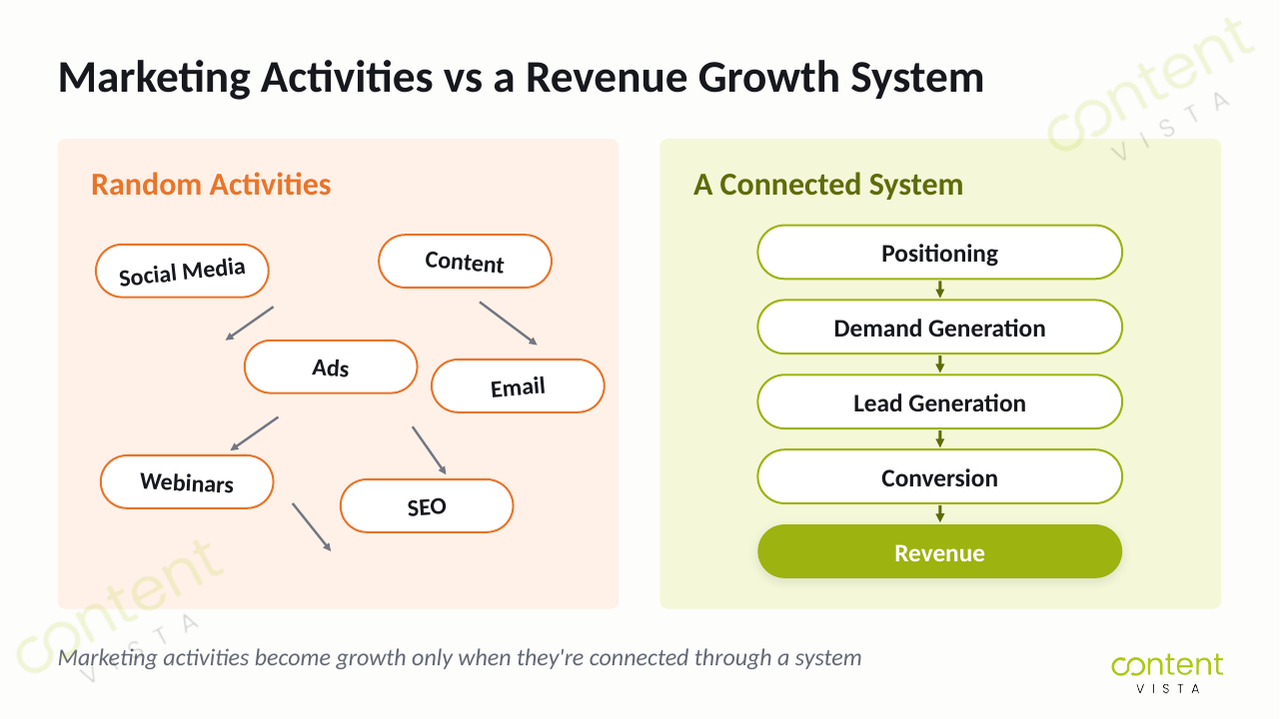
A revenue-driven marketing strategy is not a collection of disconnected activities.
It is a structured system that answers a sequence of critical questions:
Who are we trying to reach?
Why should they choose us?
How do we generate attention?
How do we convert attention into demand?
How do we convert demand into qualified opportunities?
How do we measure whether the system is working?
When these pieces are disconnected, marketing becomes expensive guesswork.
When they work together, marketing becomes a growth engine.
This distinction matters more heading into 2027 than it ever has.
Today's buyers move across multiple channels before making a decision.
They consume content, evaluate alternatives, compare vendors and often engage with a brand long before they speak to sales.
Without a clear system connecting positioning, demand generation, lead generation, conversion and measurement, it's almost impossible to tell what is driving growth and what is simply creating noise.
That's what this guide is designed to solve.
Instead of treating marketing as a collection of campaigns, we'll treat it as one connected growth system that links strategy, execution and revenue.
By the end, you'll have a practical blueprint for building a marketing strategy that doesn't stop at awareness or engagement.
It creates a measurable path to pipeline and business growth.
And if you'd rather have a team build that system with you, that's exactly what our marketing strategy and growth consulting work is designed to do.
Strategy, Plan, Tactics: What's the Actual Difference?
One of the most common reasons marketing underperforms has nothing to do with execution quality.
It's confusion.
People use the words strategy, plan and tactics interchangeably, even though they're solving completely different problems.
And that confusion creates a dangerous pattern:
Teams spend months debating tactics without ever making the strategic decisions those tactics are supposed to support.
So let's settle the distinction.
| Strategy | Plan | Tactics |
|---|---|---|
| Defines who you're targeting, how you'll win and where you'll focus. | Translates strategic choices into a sequenced roadmap. | Individual actions used to execute the plan. |
| Long-term direction and competitive choices. | Priorities, timelines, ownership and execution sequence. | Campaigns, ads, content pieces, webinars, emails, landing pages. |
| Answers "What are we trying to achieve and why?" | Answers "How will we get there?" | Answers "What are we doing this week?" |
| Example: Position the company as the authority for growth systems. | Build thought leadership, launch demand generation assets, implement lead nurturing. | Publish a LinkedIn post, run a webinar, launch a newsletter campaign. |
So What Does That Mean for You?
Imagine a company decides it needs more leads.
A tactical response is:
"Let's run LinkedIn ads."
A planning response is:
"Let's launch a 90-day lead generation campaign across LinkedIn, email and webinars."
A strategic response is:
"Which audience should we target, what problem are we uniquely positioned to solve, and what customer acquisition model gives us the highest probability of sustainable growth?"
Notice the difference.
The tactic changes.
The plan evolves.
But the strategy determines whether either of them make sense in the first place.
This is why many marketing initiatives feel disconnected.
Teams are often executing activities before they've made the choices that should guide those activities.
Tactics create movement. Plans create coordination. Strategy creates direction. Without direction, even well-executed marketing can produce disappointing results.
The Strategy-or-Tactics Test
Not sure whether you're working on strategy or just shuffling tactics?
Ask yourself these questions:
Question 1: Does this decision change who we're targeting?
If yes, you're likely working on strategy.
If not, you're probably working on a tactic.
Question 2: Does this decision affect multiple channels?
A strategic decision influences content, ads, sales conversations, positioning and messaging.
A tactic usually affects one activity.
Question 3: Would this still matter if the channel disappeared tomorrow?
If LinkedIn vanished tomorrow, would the decision still matter?
Positioning, audience selection and value proposition would.
Posting schedules and campaign formats would not.
Question 4: Does this decision improve revenue predictability?
Strategy should increase confidence in future growth.
Tactics create opportunities but don't necessarily create predictability.
Question 5: Are we choosing where NOT to compete?
Real strategy involves trade-offs.
If your decision doesn't require saying "no" to something, it may not be strategic at all.
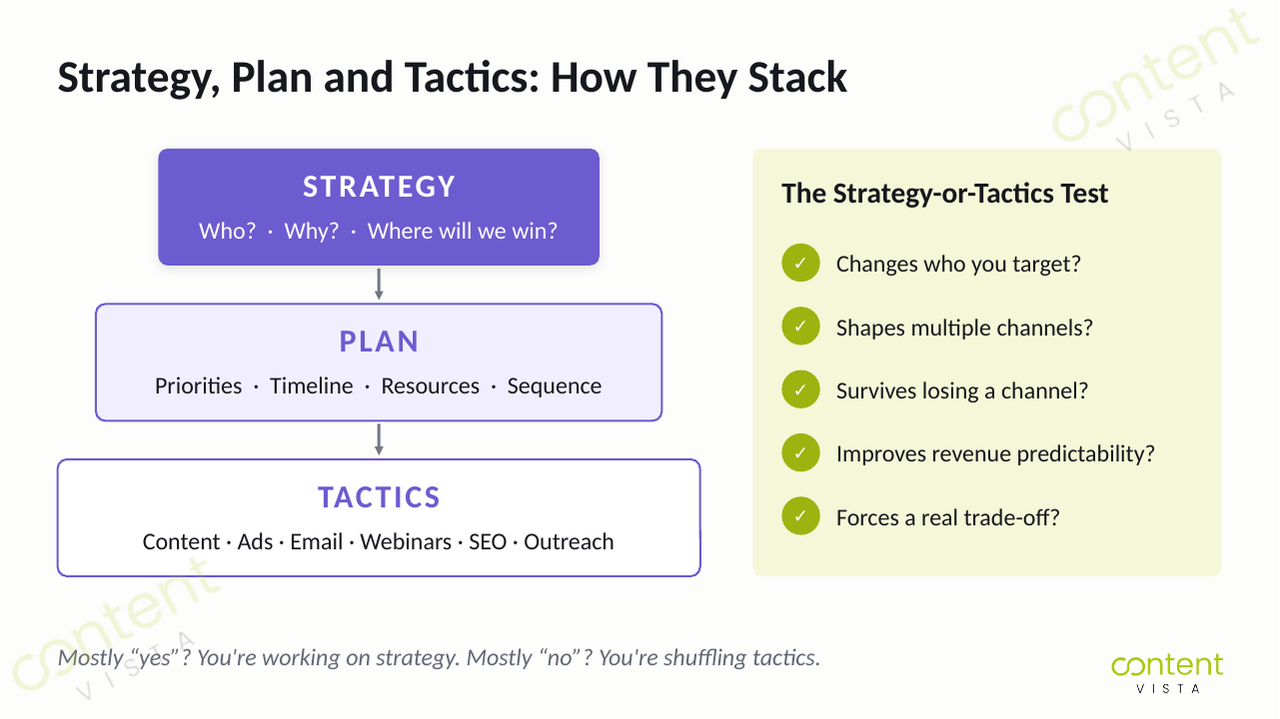
The simplest way to think about it is this:
Strategy determines the game you're playing.
The plan determines how you'll play it.
Tactics are the individual moves you make during the game.
Get the strategy wrong and no amount of tactical excellence will consistently produce revenue.
If Everyone Has a Strategy, Why Doesn't It Work?
Here's the part most people miss:
The problem is no longer that companies don't have a marketing strategy.
The problem is that most strategies never become revenue systems.
For years, marketing advice focused on getting organisations to become more strategic. Create a content strategy. Build a marketing strategy. Develop a go-to-market strategy.
That advice worked.
Today, most organisations already have some form of strategy in place.
In Content Marketing Institute and MarketingProfs' B2B benchmark survey for 2025, 95% of B2B marketers said they had a content strategy.
Yet only 29% rated that strategy as extremely or very effective. And among those who rated it moderately effective or worse, the most common reason was a lack of clear goals.
The follow-up B2B Content and Marketing Trends: Insights for 2026 report found that 97% now have a strategy.
Among the marketers whose strategy improved, 74% credited strategy refinement. Only 51% credited new technology.
That's an important signal.
If nearly everyone has a strategy but only a minority consider it highly effective, the bottleneck isn't strategy adoption.
It's strategy execution and system design.
The Real Failure Point
Most marketing strategies are built as collections of campaigns.
A content campaign.
A webinar campaign.
A paid media campaign.
A social media campaign.
Each initiative may perform reasonably well on its own.
The problem is that they rarely connect to each other in a way that compounds.
One team focuses on awareness.
Another focuses on lead generation.
A third focuses on sales enablement.
Meanwhile, nobody owns the system that connects them together.
The result is fragmented growth.
Marketing activity increases, but revenue outcomes remain unpredictable.
The biggest marketing problem isn't a lack of activity. It's a lack of connection between activities.
Why Growth Stops Compounding
Consider two companies generating the same amount of marketing activity.
The first runs isolated campaigns.
The second operates from a connected growth system.
The first company starts over every quarter.
The second company builds assets, audience trust, market positioning, demand signals and conversion pathways that improve over time.
That's the difference between campaigns and systems.
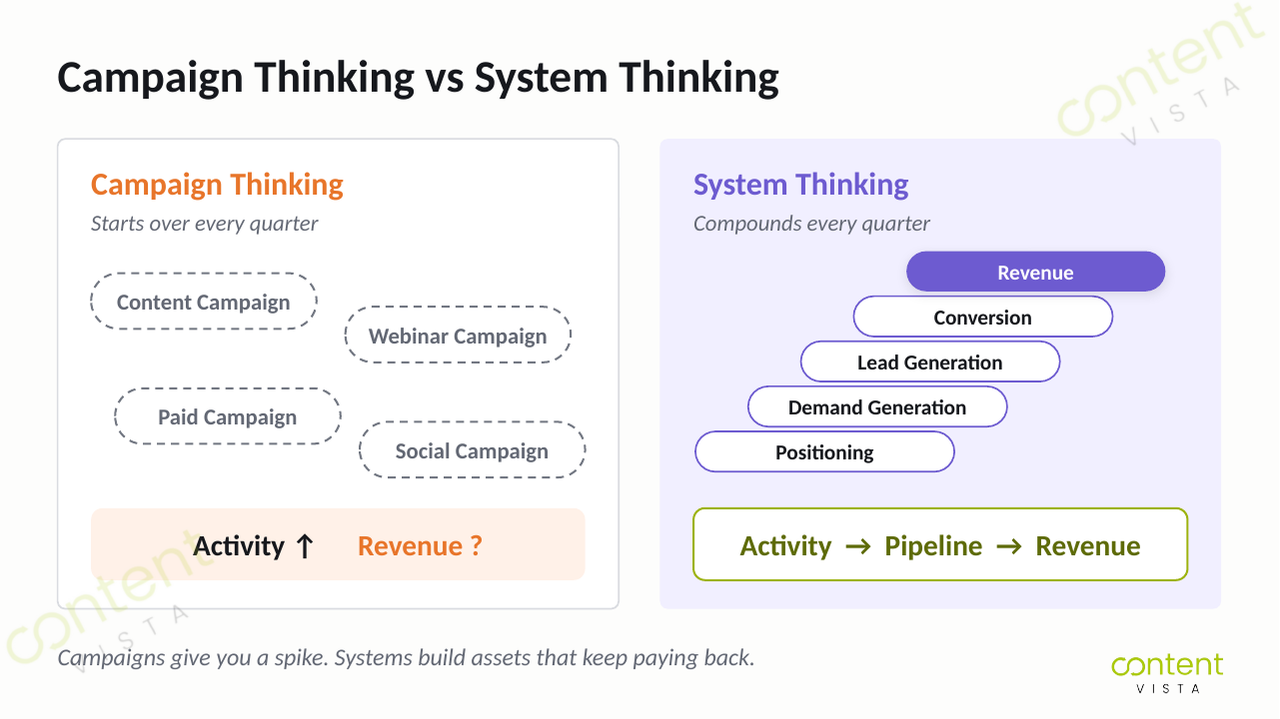
When goals are vague, channels operate independently and success metrics differ across teams, marketing becomes difficult to scale.
What appears to be a strategy is often just a list of activities with a shared budget.
A true revenue-driven strategy behaves differently.
Every activity supports a larger objective.
Every channel plays a defined role.
Every metric connects to business outcomes.
And every improvement strengthens the system rather than a single campaign.
This is the idea we'll build on throughout the rest of this guide.
Instead of treating strategy as a document, we'll treat it as a connected system: one that links positioning, demand, conversion and measurement into a repeatable path to revenue.
The CORE Growth System: From Idea to Execution
If traditional marketing frameworks explain individual parts of growth, the CORE Growth System™ explains how those parts work together.
At its simplest, CORE is a revenue-focused operating system for marketing.
It gives you a structured way to move from strategic thinking to measurable business outcomes, without losing the connection between the two.
It has four stages:
Clarify
Define who you serve, what problem you solve, how you're positioned and where growth opportunities exist.
This is where audience selection, category choice, positioning, messaging and market research happen.
Orchestrate
Decide how you'll create and capture demand.
This is where you choose your go-to-market motion, sequence your channels and balance building future demand with capturing buyers who are ready now.
Run
Turn the strategy into a working system.
Conversion infrastructure gets built. Content is created for the whole buying committee. Founder authority becomes a demand channel. And sales and marketing start operating as one team.
Evaluate
Measure performance against business outcomes.
What's generating qualified pipeline? What's converting? What's stalling growth? What assumptions need revisiting?
Most importantly, insights from Evaluate feed directly back into Clarify.
That's why CORE is a loop, not a line.
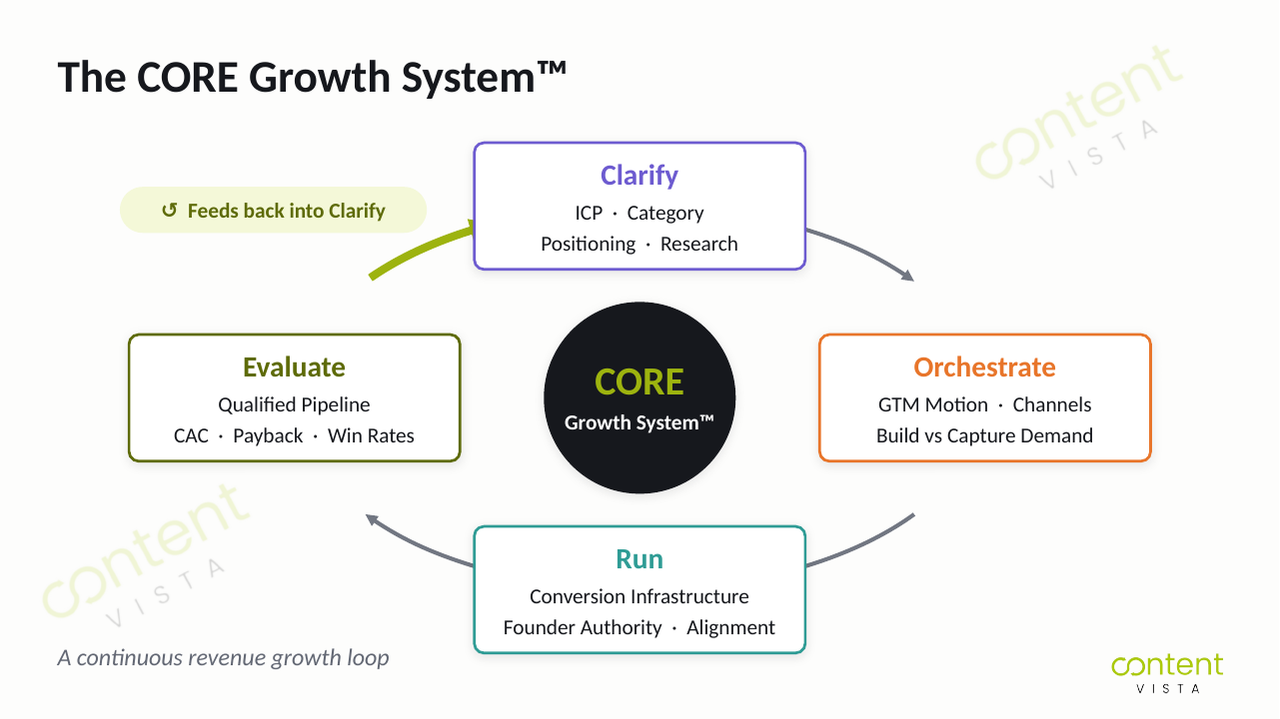
Many marketing models stop at planning or execution.
CORE is designed around continuous improvement.
Instead of treating strategy as a document that gets reviewed once a year, it treats strategy as an evolving system that gets smarter with every cycle.
The strongest marketing strategies are not built once and followed forever. They are continuously refined through feedback, execution and measurement.
If you've learned the classic marketing models, you don't have to throw them out.
Each one slots into a stage.
STP (Segmentation, Targeting, Positioning) lives inside Clarify.
Channel planning and marketing mix decisions (the 4 Ps) live inside Orchestrate.
Funnel design and conversion work live inside Run.
Performance analysis and attribution live inside Evaluate.
CORE is the connective layer that links them into a single revenue-focused system.
| CORE Stage | What It Covers | The Question It Answers |
|---|---|---|
| Clarify | Ideal customer profile (ICP), category, positioning, messaging, market and competitor research | Who are we for, and why should they choose us? |
| Orchestrate | Go-to-market motion, channel sequencing, the balance between building future demand and capturing current demand | How do we create demand and capture it? |
| Run | Conversion infrastructure, content for the buying committee, founder authority, sales and marketing alignment | How does the system actually operate day to day? |
| Evaluate | Qualified pipeline, customer acquisition cost, payback, win rates, the feedback loop into Clarify | Is it driving revenue, and is it getting better? |
Throughout the rest of this guide, we'll break down each stage and show how they work together to create a repeatable path from idea to execution to revenue.
Stage 1 - Clarify: Get Ruthlessly Clear on Market, ICP and Position
Let's make this practical.
Before you choose channels, launch campaigns, create content or invest in marketing technology, you need clarity.
Not surface-level clarity.
Strategic clarity.
Because no marketing system can outperform a weak understanding of who it's trying to serve.
Most growth problems don't start with execution.
They start much earlier.
A company isn't clear on its ideal customer profile (ICP). Its positioning sounds similar to everyone else in the market.
It competes in a category it hasn't intentionally chosen. And its messaging is built on assumptions rather than evidence.
The result?
Marketing becomes reactive.
Every campaign feels like an experiment.
Every channel seems equally important.
Every quarter starts with the same question:
"Who exactly are we trying to attract?"
The Three Decisions That Shape Everything Else
The Clarify stage forces three foundational decisions:
1. Define Your ICP
Not everyone who could buy from you should be your focus.
A useful ICP goes beyond demographics or firmographics.
It identifies the specific buyer profile most likely to experience the problem you solve and generate long-term value.
2. Define Your Category
What market are you actually competing in?
Many companies accidentally define themselves too narrowly or too broadly.
The category you choose determines who you're compared against, what alternatives buyers evaluate and how they understand your offer.
3. Define Your Position
Positioning is not a tagline.
Positioning is the strategic decision about what you are, who you're for, and why you're a better choice than the available alternatives, including doing nothing.
This is where strong brand and market positioning work creates leverage across every channel that follows.
If a prospect can't quickly understand who you're for, what problem you solve and why you're different, no amount of marketing execution will consistently create demand.
Research Replaces Assumptions
One of the biggest mistakes companies make is building strategy from internal opinions instead of external reality.
The Clarify stage should be informed by research, not guesses.
That means:
Mapping competitors and alternatives
Understanding buyer motivations and objections
Identifying category trends
Finding market gaps competitors are ignoring
Testing messaging assumptions against real customer language
This is where structured market research and competitive intelligence becomes valuable.
A Simple Example
Imagine two marketing agencies.
Agency A positions itself as a "full-service digital marketing agency."
Agency B positions itself as a growth systems partner helping B2B companies connect demand generation, lead generation and funnel performance to revenue.
Both may offer similar services.
But one has made a clear strategic choice.
The other has not.
That's the purpose of Clarify.
Not to create more marketing activity.
To create the strategic foundation that makes every future decision easier, more focused and more effective.
Not sure whether your positioning, ICP and GTM strategy are aligned?
Take the GTM Readiness & Positioning Clarity Audit to identify positioning gaps, audience misalignment and strategic bottlenecks before investing further in execution.
Stage 2 - Orchestrate: Build Demand and Capture It
Once you've clarified who you're targeting and how you're positioned, the next challenge is orchestration.
This is where many marketing strategies start breaking down.
Why?
Because companies try to be everywhere at once.
LinkedIn. SEO. Email. Webinars. Paid media. Partnerships. Founder content. PR.
Everything gets launched simultaneously, but nothing receives enough focus to become effective.
A revenue-driven strategy works differently.
It chooses a go-to-market motion and sequences execution deliberately.
Instead of asking, "Which channels should we use?", ask:
"Which channels are most likely to move our ideal buyers through the buying journey?"
That's the foundation of a strong go-to-market strategy.
The Reality Most Teams Ignore
Here's something that feels counterintuitive at first:
Most of your future customers are not ready to buy today.
Professor John Dawes of the Ehrenberg-Bass Institute, working with LinkedIn's B2B Institute, popularised what's now called the 95-5 rule.
It suggests that at any given moment, roughly 95% of potential B2B buyers are out-of-market, while only around 5% are actively looking to buy.
Treat it as a directional heuristic, not a precise law.
Dawes himself has said the 95% figure isn't meant to be precise for every sector. The real ratio varies by category, purchase cycle and market.
What matters is the implication.
If only a small percentage of buyers are actively purchasing today, a strategy focused exclusively on lead capture leaves future demand untouched.
At the same time, a strategy focused only on awareness may struggle to generate near-term pipeline.
The job of orchestration is balancing both.
Build Future Demand, Capture Current Demand
A revenue-driven marketing system does two things simultaneously:
Builds mental availability among out-of-market buyers.
Captures intent from in-market buyers.
Think of it this way:
Brand-building increases the chance you'll be remembered when a buying need eventually appears.
Activation helps convert people who already have that need today.
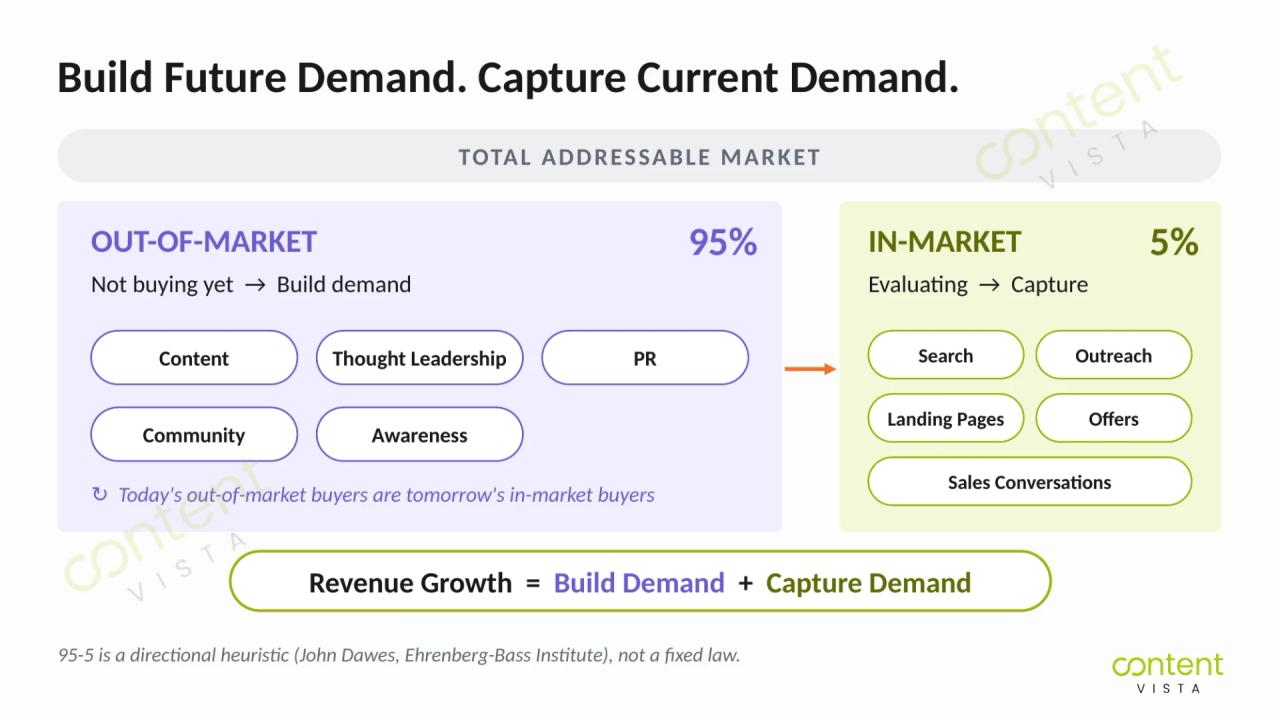
Neither works particularly well in isolation.
The companies that compound growth over time typically invest in both.
The Brand vs Activation Question
This is where discussions around the famous 60:40 ratio often become oversimplified.
Les Binet and Peter Field's work suggested that many brands benefit from a mix weighted toward long-term brand building, while still investing in short-term activation.
For B2B specifically, their later research with the LinkedIn B2B Institute put the optimal split closer to 46% brand and 54% activation.
Binet himself has said the ratio is a guideline, not an iron rule.
And Byron Sharp of the Ehrenberg-Bass Institute has gone further, publicly criticising the 60:40 rule as misleading because it was built on awards-entry data.
So what does that mean for you?
The right balance varies by market, category, business model, budget and growth stage.
Cash-constrained SMEs, for example, may reasonably run a more activation-heavy mix while still investing in brand-building where they can.
The lesson isn't to copy a ratio.
The lesson is to avoid choosing one side exclusively.
If Clarify answers "Who are we for?" and "Why should buyers care?", Orchestrate answers "How do we consistently stay visible before they need us and easy to find when they do?"
This is the strategic purpose of orchestration.
Not maximising channels.
Not maximising activity.
Maximising the connection between future demand and present revenue.
Stage 3 - Run: Turn the Strategy Into a Working System
Here's how this actually gets built.
Most marketing strategies don't fail because they're wrong.
They fail because they never become operational.
A strategy only creates value when it's translated into systems, workflows, assets and processes that consistently move prospects toward a buying decision.
This is the purpose of the Run stage.
It's where positioning becomes content.
Where demand becomes pipeline.
And where marketing stops being a collection of campaigns and starts functioning as a revenue engine.
Build the Conversion Infrastructure First
Many companies focus on traffic before they build conversion infrastructure.
That's backwards.
Before scaling attention, you need a system that can convert attention into conversations.
That system often includes:
Landing pages aligned to specific buyer problems
Lead magnets and diagnostic tools
Email nurture sequences
CRM workflows
Qualification processes
Meeting booking flows
Sales handoff mechanisms
This is the work typically addressed through marketing systems and funnel design.
Without infrastructure, more traffic simply creates more pipeline leakage.
Without workflows, demand doesn't compound.
You're Not Marketing to One Person
One of the biggest mistakes in B2B marketing is assuming a single buyer reads a single piece of content and makes a purchasing decision.
That's rarely how buying works.
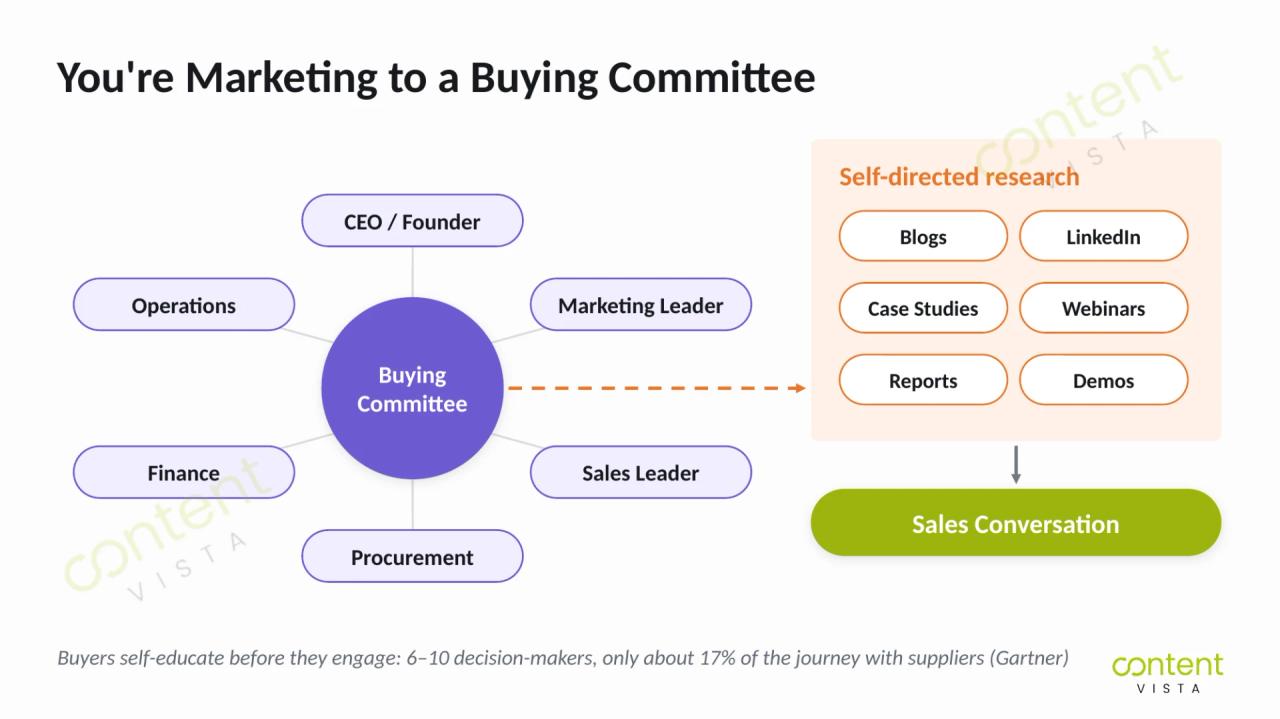
Gartner's research on complex B2B purchases has found that a typical buying group involves six to ten decision-makers.
The same research, based on a survey of 750 B2B buyers, found that buyers spend only about 17% of their buying journey meeting with potential suppliers. The rest is largely self-directed.
That changes how content should be created.
You aren't building content for a lead.
You're building content for a buying committee.
One stakeholder may care about ROI.
Another may care about implementation risk.
Another may care about operational complexity.
A strong content system addresses all of them.
Founder Authority as a Demand Channel
This is also where founder authority becomes a growth channel.
In many categories, buyers trust people before they trust brands.
At Content Vista, we use a model called the Authority Engine™ to turn founder expertise into demand.
At a high level, it works like this:
Founder insights create original thinking.
Content distributes those insights.
Audience trust accumulates over time.
Demand is generated before a sales conversation begins.
For companies where expertise is a competitive advantage, founder and executive positioning becomes an important demand generation asset.
Sales and Marketing Must Operate as One System
The final piece is alignment.
Marketing generates demand.
Sales converts demand.
Revenue requires both.
Yet many organisations still operate as though these functions are separate.
The data shows how much this matters.
In CMI's 2025 benchmark survey, 43% of B2B marketers named aligning content across sales and marketing as a challenge.
And in the 2026 edition, 45% of marketers who rated their efforts effective named alignment with sales as one of the factors that moved the needle.
The exact numbers matter less than the pattern.
When sales and marketing define leads differently, use different messaging or optimise for different outcomes, revenue quietly leaks from the system.
The Run stage is not about executing more activities. It's about ensuring every activity, asset, workflow and team contributes to the same revenue outcome.
That's what separates busy execution from a working system.
And that's what transforms a marketing strategy into a growth engine.
Stage 4 - Evaluate: Measure Revenue, Then Compound It
Most marketing measurement breaks down because teams measure what's easy instead of what's useful.
Clicks.
Impressions.
Engagement rates.
MQL volume.
Dashboard metrics may look impressive, but they don't necessarily tell you whether the business is growing.
The purpose of the Evaluate stage is to answer a much simpler question:
"Is the system generating profitable revenue?"
If the answer is unclear, you don't have a measurement problem.
You have a visibility problem.
Measure the Metrics That Matter
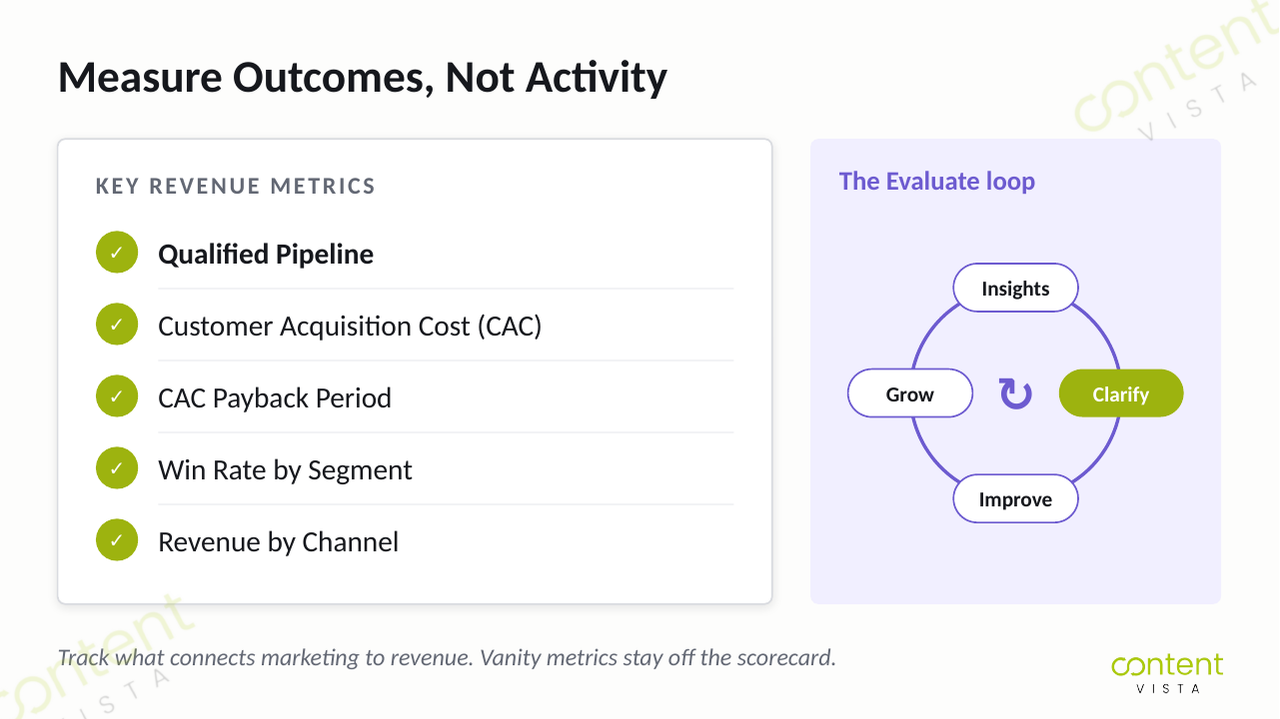
A revenue-driven marketing strategy focuses on outcomes, not activity.
Instead of asking how many leads entered the funnel, ask:
How much qualified pipeline did we generate?
Which customer segments convert best?
How much does it cost to acquire a customer?
How quickly do we recover that acquisition cost?
Which channels produce the highest-quality opportunities?
These metrics help you understand whether the growth system is becoming more efficient over time.
| Metric | What It Tells You |
|---|---|
| Qualified Pipeline | The future revenue opportunity generated by marketing and sales activity. |
| Customer Acquisition Cost (CAC) | The total cost required to acquire a new customer. |
| CAC Payback Period | How quickly customer revenue recovers acquisition investment. |
| Win Rate by Segment | Which audience segments convert most effectively into customers. |
| Revenue by Channel | Which channels contribute meaningful business outcomes rather than activity alone. |
If you're unsure whether you're calculating acquisition economics correctly, use the True CAC & Marketing ROI Calculator to see where your marketing investment is actually creating returns.
Evaluation Is Not the End of the Process
Many companies treat reporting as a monthly ritual.
Numbers go into a dashboard.
Charts get reviewed.
Then everyone moves on.
That's not evaluation.
Evaluation is decision-making.
The purpose of measurement is to improve future strategy.
If one segment consistently produces higher win rates, your ICP may need refinement.
If one channel creates pipeline but not revenue, your funnel may need adjustment.
If acquisition costs keep rising, your positioning or channel mix may need rethinking.
Every insight should feed directly back into the Clarify stage.
This is where the compounding effect begins.
Find the Gap Between Current and Target Revenue
For founders, the most valuable outcome of evaluation is visibility.
Visibility into where you are today.
Visibility into where you want to be.
And visibility into the gap between the two.
The best growth systems don't just measure performance. They continuously reduce uncertainty about what drives revenue.
That's why CORE ends with Evaluate and immediately loops back to Clarify.
Each cycle produces better assumptions.
Better decisions.
Better execution.
And ultimately, better business outcomes.
To see the gap between your current growth trajectory and your target revenue, use the Revenue Milestone Gap Calculator.
The goal isn't simply to track numbers. It's to understand what must change in the system to reach the next stage of growth.
What This Looks Like When It Works
Frameworks are useful.
But the real question is:
"What happens when a company actually applies them?"
A revenue-driven marketing strategy should create measurable business outcomes, not just better-looking dashboards.
When positioning, demand, conversion infrastructure and measurement work together, different businesses see different outcomes depending on where their bottleneck sits.
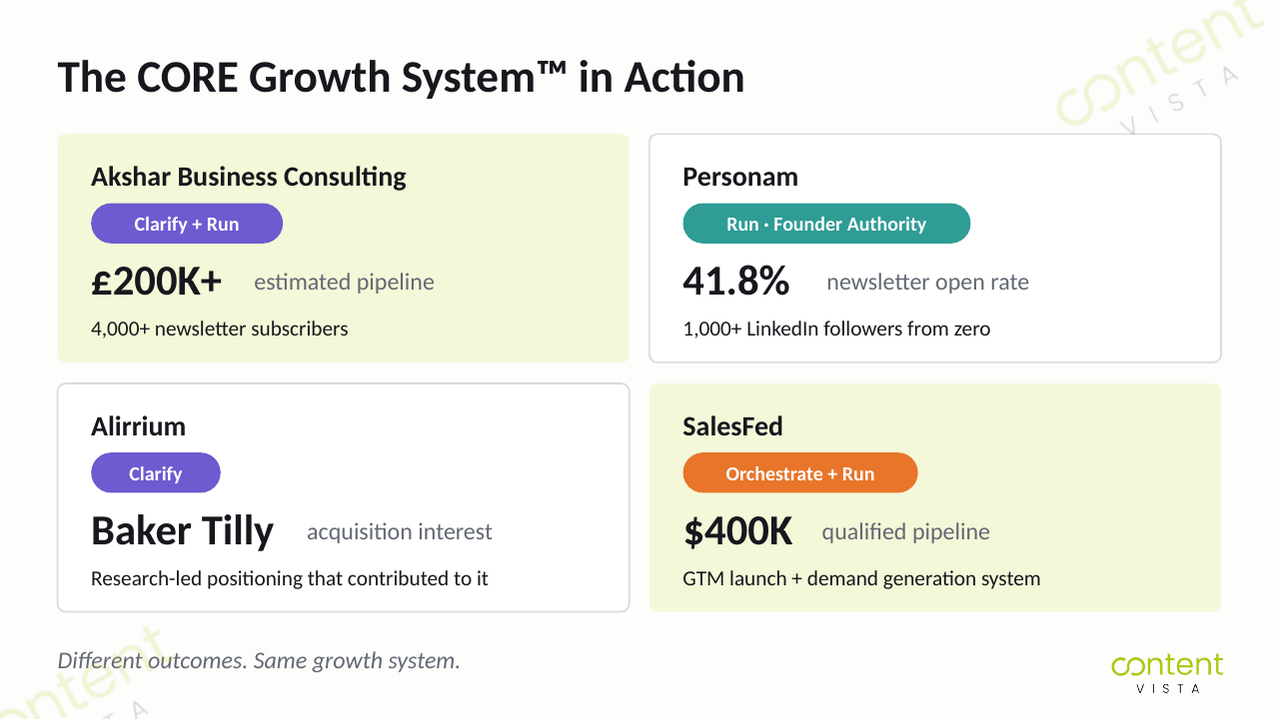
Akshar Business Consulting: Clarify + Run
For Akshar Business Consulting, growth started with strategic repositioning and content-led demand generation.
The business was repositioned to support UK market expansion, while an inbound content engine was built alongside it.
The result:
£200K+ in estimated pipeline through content-led inbound
4,000+ newsletter subscribers
This is a good example of how the Clarify and Run stages reinforce one another.
Better positioning created a stronger foundation. Consistent execution created demand over time.
Read the full Akshar Business Consulting case study.
Personam: Founder Authority in Action
For Personam, the challenge wasn't lead generation.
It was visibility.
The work focused on founder positioning within the cybersecurity category and building audience trust from zero.
The outcome included:
41.8% newsletter open rate
1,000+ LinkedIn followers built from zero
Founder authority in a competitive, technical market
This shows how founder-led demand generation can become a meaningful part of the Run stage when expertise is a differentiator.
Read the full Personam case study.
Alirrium: Research Before Execution
Alirrium highlights the importance of the Clarify stage.
Rather than starting with campaigns, the work focused on research-driven positioning and genuine thought leadership in banking and finance RPA.
That positioning work contributed to acquisition interest from Baker Tilly, a top-10 global accounting and consulting network.
This is what happens when strategy becomes a competitive asset rather than a marketing exercise.
Read the full Alirrium case study.
SalesFed: Orchestrate + Run
For SalesFed, the opportunity centred on bringing a go-to-market launch and a demand generation system together for a brand starting from zero.
The outcome:
$400K in qualified pipeline from a GTM launch and demand generation system
This reflects the value of the Orchestrate stage.
Instead of isolated campaigns, the focus was on building a coordinated growth engine that connected positioning, execution and conversion.
Read the full SalesFed case study.
The Common Pattern
These examples span different industries, business models and growth objectives.
Yet they share the same underlying principle.
None of the outcomes came from a single campaign.
None came from chasing a new channel.
And none came from adding more marketing activity.
The strongest results usually emerge when positioning, demand generation, conversion systems and measurement operate as one connected system rather than as separate marketing initiatives.
That's the real purpose of the CORE Growth System.
Not to give you another marketing framework to admire.
To create a repeatable path from strategy to execution to measurable business outcomes.
When You Don't Actually Need a New Strategy
Here's when you can skip all this.
Not every growth problem is a strategy problem.
In fact, one of the most common mistakes companies make is assuming they need a new marketing strategy when what they actually need is better execution.
A new framework won't fix inconsistent publishing.
A positioning workshop won't solve slow sales follow-up.
And rewriting your strategy document won't automatically create pipeline.
Sometimes the highest-leverage move is simply running the existing system harder and more consistently.
Situation 1: Your Positioning Is Already Working
If prospects clearly understand:
Who you help
What problem you solve
Why you're different
...and that positioning is consistently generating conversations, you may not need a strategic reset.
You may need more distribution, more content, more outreach or more sales capacity.
The bottleneck is volume, not direction.
Situation 2: Your Funnel Converts Well, but Traffic Is Low
Imagine your landing pages convert.
Your sales process performs well.
Your close rates are healthy.
But pipeline volume remains inconsistent.
In that situation, redesigning the strategy may not be the answer.
The more practical question is:
"How do we get more qualified people into a system that's already working?"
The challenge is demand generation, not strategy.
Situation 3: You're Constantly Restarting Instead of Compounding
Many teams fall into a cycle of perpetual reinvention.
Every quarter brings:
A new messaging framework
A new channel
A new campaign idea
A new strategy deck
Meanwhile, the previous initiatives never get enough time to compound.
In these situations, discipline often creates more growth than innovation.
A good strategy executed consistently usually outperforms a brilliant strategy that is constantly being replaced.
A Simple Test
Before investing in a major strategic overhaul, ask:
Are we unclear about our market, ICP or positioning?
Are our channels and funnel disconnected?
Are we struggling to measure revenue impact?
Or are we simply under-executing a strategy that already makes sense?
If the answer is the last one, your next growth breakthrough may not come from building a new strategy.
It may come from committing to the one you already have.
That's an important distinction.
Because the goal isn't to create strategy documents.
The goal is to create revenue.
The Mistakes That Quietly Kill Marketing Strategies
Most marketing strategies don't fail dramatically.
They fail quietly.
A few incorrect assumptions. A few disconnected decisions. A few metrics that look good but don't drive growth.
Over time, these small mistakes compound into missed revenue opportunities.
Here are the most common ones and the fastest ways to fix them.
Mistake 1: Choosing Tactics Before Clarifying Positioning
Many teams start by asking:
"Should we invest in LinkedIn, SEO, webinars or paid ads?"
But channels only amplify what already exists.
If your positioning is unclear, better execution simply spreads confusion faster.
Quick Fix: Define your ICP, category and differentiated position before making channel decisions.
Mistake 2: Trying to Be Everywhere at Once
Marketing teams often launch multiple channels simultaneously because every channel appears important.
The result is fragmented execution and mediocre performance across all of them.
Quick Fix: Choose a primary go-to-market motion and sequence channels based on where your buyers are most likely to engage.
Mistake 3: Measuring MQL Volume Instead of Revenue Signals
Large lead numbers can create a false sense of progress.
More leads do not automatically mean more customers.
A marketing strategy should be evaluated based on business outcomes, not form fills.
Quick Fix: Track qualified pipeline, customer acquisition cost, win rates and revenue contribution, and treat lead volume as a supporting signal at best.
Mistake 4: Treating Brand and Demand Generation as Either/Or
Some companies focus entirely on awareness.
Others focus only on immediate lead capture.
Both approaches create blind spots.
Long-term growth requires creating future demand and capturing present demand.
Quick Fix: Build visibility with out-of-market buyers while keeping clear pathways for in-market buyers to take action.
Mistake 5: Running Sales and Marketing as Separate Functions
Marketing generates leads.
Sales closes deals.
But when those teams operate independently, prospects experience inconsistent messaging and friction throughout the buying process.
Quick Fix: Align definitions, goals, messaging and reporting around shared revenue outcomes.
Mistake 6: Treating Strategy as a One-Time Project
Markets change.
Buyers change.
Competitors change.
A strategy created once and never revisited gradually becomes less relevant.
Quick Fix: Use a continuous improvement loop where performance insights regularly feed back into audience selection, positioning and go-to-market decisions.
The most successful marketing strategies rarely win because of a secret tactic. They win because they avoid the small mistakes that quietly prevent growth from compounding.
The good news is that none of these problems require a complete restart.
Most can be fixed by reconnecting your strategy, execution and measurement into a single revenue-focused system.
Where Marketing Strategy Sits in the Bigger Picture
Here's how the pieces connect.
A marketing strategy is not the growth engine itself.
It's the foundation the growth engine is built on.
Without strategy, demand generation becomes random activity.
Without strategy, lead generation becomes a collection of disconnected campaigns.
And without strategy, it's difficult to understand why growth is happening, or why it isn't.
The CORE Growth System exists because marketing success depends on more than execution.
You need clarity on your market, positioning, audience, channels, measurement model and revenue objectives before tactical programmes can consistently perform.
That's why strategy comes first.
But it doesn't stop there.
Once the strategic foundation is in place, the next challenge is building demand among out-of-market buyers and capturing demand from buyers who are already in-market.
That's the role of a demand generation strategy.
Demand generation creates awareness, trust, category understanding and buying intent before a prospect is actively looking for a solution.
From there, a lead generation system converts that demand into qualified conversations, opportunities and pipeline.
Think of the relationship like this:
Marketing strategy determines where you're going.
Demand generation creates market interest.
Lead generation captures and converts that interest.
Sales turns opportunities into revenue.
Measurement improves the entire system over time.
Strategy is not a standalone activity. It is the foundation layer that connects demand generation, lead generation, sales execution and revenue growth into one operating system.
That's why high-performing companies rarely optimise these functions independently.
They treat them as interconnected parts of a larger growth system.
The stronger the strategic foundation, the more effectively every layer above it can perform.
Marketing Strategy: Frequently Asked Questions
What is a marketing strategy?
A marketing strategy is the system that connects your market, positioning, channels, messaging and budget to business outcomes.
It defines who you're targeting, why they should choose you and how you'll turn attention into demand, pipeline and revenue. Strategy provides direction; tactics and campaigns operate within it.
What's the difference between a marketing strategy and a marketing plan?
A marketing strategy defines the choices you're making: your audience, positioning, priorities and competitive approach.
A marketing plan translates those choices into execution through campaigns, timelines, resources and responsibilities. Strategy determines where you're going; the plan determines how you'll get there.
What's the difference between marketing strategy and marketing tactics?
Marketing strategy is the overarching approach that determines who you're targeting and how you'll win in the market.
Marketing tactics are the specific actions used to execute that strategy, such as publishing content, running ads, hosting webinars or launching email campaigns. Tactics support strategy, not the other way around.
What are the 4 Ps of marketing and are they still relevant?
The 4 Ps are Product, Price, Place and Promotion. They're still useful because they help you think through how an offer is brought to market.
But on their own they're not a strategy. Modern marketing strategies combine the 4 Ps with positioning, customer research, demand generation and revenue measurement.
How do you build a marketing strategy from scratch?
Start by researching your market, customers, competitors and category. Then define your ideal customer profile, positioning and value proposition.
From there, choose your go-to-market approach, design your demand generation and lead generation systems, set revenue-focused measurement and build feedback loops that improve performance over time.
How is a revenue-driven marketing strategy different from a normal one?
A traditional marketing strategy often focuses on awareness, engagement or campaign performance.
A revenue-driven marketing strategy starts with business outcomes and works backward. It connects positioning, demand generation, lead generation, conversion and measurement into one system designed to produce pipeline and revenue, not just activity.
How long does a marketing strategy take to show results?
It depends on your market, sales cycle, channel mix and starting point.
Activation-focused initiatives can generate results within weeks, while positioning, brand-building and content-led demand generation usually need several months to compound. The goal is sustainable growth, not just short-term wins.
How much should you budget for marketing strategy?
There's no universal percentage, because budgets vary by growth stage, industry, goals and business model.
As a reference point, Gartner's 2026 CMO Spend Survey found marketing budgets averaged 7.8% of company revenue in 2026, up from 7.7% in 2025.
Keep in mind that most respondents were companies with over $1 billion in revenue. Use benchmarks as reference points, and build your budget around growth objectives and expected returns.
Ready to See If Your Foundation Is Built to Scale?
A marketing strategy doesn't create growth on its own.
Growth happens when positioning, demand generation, lead generation, conversion and measurement work together as a connected system.
If you're struggling to connect marketing activity to revenue, the problem may not be effort.
It may be a lack of clarity around your market, positioning, go-to-market motion or growth infrastructure.
The good news is that these gaps can be identified before you invest more time, budget or resources into execution.
Discover whether your growth foundation is strong enough to support scalable demand generation and predictable revenue growth.
Take the GTM Readiness & Positioning Clarity AuditThe goal isn't to create a more impressive marketing plan.
It's to build a system that consistently turns strategic clarity into measurable business outcomes.