Quick Summary
- A B2B marketing budget shouldn't begin with channel line items.
- Start with the growth system the business needs, then fund both demand creation and demand capture across it.
- Benchmark range: most B2B segments average roughly 7% to 10% of revenue, depending on business model and company size (Gartner and The CMO Survey, 2026 editions).
Marketing Budget Planning Isn't a Spreadsheet Problem
Definition: Marketing budget planning is the process of deciding how much to invest, where that investment should support the growth system and how spending will create, capture, convert and measure demand.
It connects business goals, buyer behaviour, marketing capacity and expected outcomes before money is assigned to individual channels.
Most marketing budgets are built backwards.
A team lists expected costs for paid media, content, events, software, agencies and campaigns.
Those numbers are totalled and compared with last year's spend. Then they're defended using a percentage of revenue that may or may not reflect what the business is trying to achieve.
The spreadsheet may balance. The growth system often doesn't.
That's how money leaks. It rarely comes down to one obviously bad campaign. It usually comes from disconnected investments.
Content is funded without distribution. Paid acquisition is funded without conversion infrastructure.
Lead generation is funded without nurture. Technology is bought without the processes or people needed to use it.
Every line item looks reasonable in isolation. Yet the combined system can't reliably move a buyer from awareness to revenue.
Effective marketing budget planning starts with a different question:
What system must marketing fund to achieve the business objective?
That system may need to create future demand, capture existing demand and convert attention into qualified opportunities.
It may also need to support long buying cycles, equip sales and produce usable performance data. Channel decisions come later.
This is the budgeting layer of a revenue-driven marketing strategy.
So instead of asking, "How much should we spend on LinkedIn, SEO, events or paid search?", ask:
What demand must we create?
What demand can we capture now?
Where does the buyer journey currently break?
Which capabilities must operate continuously?
Which campaigns should accelerate the system rather than substitute for it?
The core thesis of this guide is straightforward:
That shift turns your budget from a cost ledger into a growth allocation model.
How Much Should You Spend on Marketing? (The Honest Benchmark)
Here's where most guides get this wrong: they quote a single "ideal" percentage, often 2% to 5% of revenue.
As if every business had the same growth stage, market position, sales cycle and cost structure.
The better answer is a range, interpreted in context.
The two most-watched surveys put average marketing budgets at 7.8% to 9.0% of company revenue. For B2B companies, the segment averages run from about 7% to 10%.
Why the gap? The samples are different.
Gartner's 2026 CMO Spend Survey found marketing budgets at 7.8% of company revenue, up slightly from 7.7% in 2025. The vast majority of its 401 respondents work at companies with more than $1 billion in revenue.
The 2026 edition of The CMO Survey, run by Duke's Fuqua School of Business with Deloitte and the American Marketing Association, put the figure at 9.0%, down from 9.4% the year before. Its 308 US marketing leaders come from a much broader mix of company sizes.
Enterprise-heavy samples report lower percentages because large companies often have established brands, mature infrastructure and far bigger revenue bases.
Broader samples show higher ratios because growing companies must invest harder to build awareness, pipeline and market share.
| Source (type) | Marketing as % of revenue | Notes |
|---|---|---|
| Gartner 2026 CMO Spend Survey (analyst firm) | 7.8% | Up from 7.7% in 2025; 401 leaders, mostly at $1B+ revenue companies |
| The CMO Survey 2026 - Duke/Deloitte/AMA (research consortium) | 9.0% | Down from 9.4% in 2025; 308 US leaders, about 65% from B2B firms |
| The CMO Survey 2026 - B2B product companies (research consortium) | 7.0% | Lowest of the four business models measured |
| The CMO Survey 2026 - B2B services companies (research consortium) | 10.1% | For comparison, B2C product companies sit at 12.0% |
Key Metrics
* 7.8% of revenue: Gartner's enterprise-skewed 2026 benchmark
* 9.0% of revenue: The CMO Survey's broader US sample (2026)
* 7.0%: B2B product companies in The CMO Survey
* 10.1%: B2B services companies in the same survey
Stage matters just as much as sector.
An early-stage or category-building company may need to invest above the benchmark. It has to create demand, establish credibility, test channels and build infrastructure all at once.
A mature company focused on efficiency, retention or defending an established market position may operate at a lower percentage.
That doesn't make the higher spender reckless or the lower spender disciplined. The real question is whether the spend matches the growth job.
So use revenue percentage as a sanity check. Don't treat it as the budget itself.
A benchmark can tell you whether your proposed investment looks unusually low or high.
It can't tell you how much should fund demand creation, demand capture, conversion infrastructure, sales enablement or measurement.
The actual plan must be built from growth goals, funnel economics, market maturity and the capabilities required to execute. The later steps in this guide show you how.
Why Most B2B Budgets Leak Money (The Demand You're Ignoring)
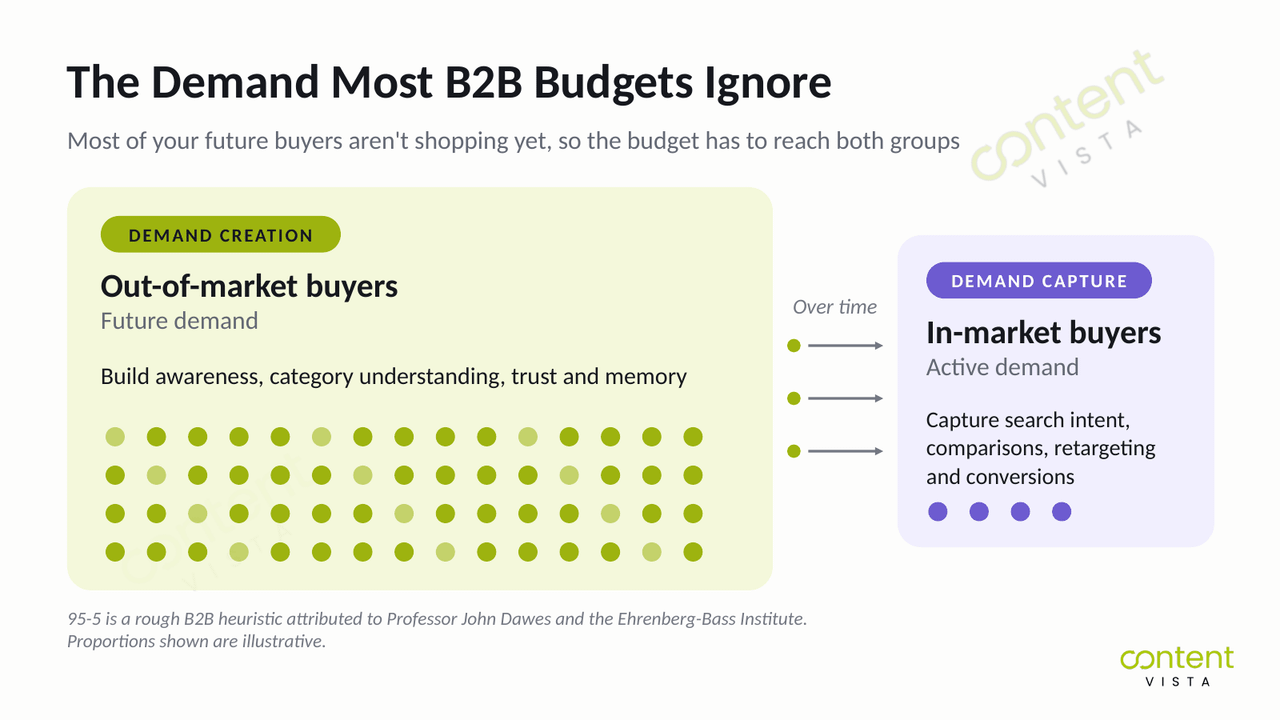
Most B2B marketing budgets are designed to capture demand that already exists.
They fund SEO content targeting high-intent buyer terms, paid search for solution-aware prospects, retargeting for website visitors, comparison pages, lead forms and sales-led campaigns.
These activities matter. But they mainly compete for people who are already researching vendors or getting ready to buy.
Here's the problem: most potential buyers aren't shopping today.
Professor John Dawes of the Ehrenberg-Bass Institute put a rough number on this in his paper on advertising effectiveness and the 95-5 rule. Directionally, only around 5% of B2B buyers are in-market at any given moment. The other 95% won't buy for months, or even years.
Dawes himself says the 95% figure isn't meant to be a precise rule for every sector. Treat it as a heuristic.
Even so, it exposes a serious budgeting weakness.
When nearly all your spending is aimed at in-market buyers, you keep fighting competitors for the same small pool of active demand.
That produces a familiar pattern:
Paid channels perform while spending is active, then pipeline falls when campaigns pause.
Search teams compete for increasingly expensive high-intent keywords.
Retargeting repeatedly reaches the same small audience.
Sales teams exhaust existing demand faster than marketing replenishes it.
Quarterly targets trigger short-term campaigns that create another temporary spike.
This is the hidden leak.
The budget may generate leads, yet fail to grow the number of buyers who know, trust and remember your brand before they enter the market.
Funding the future pipeline requires demand generation.
That means educating out-of-market buyers, building category understanding and creating familiarity well before a sales conversation becomes possible.
You can see this in our work with Akshar Business Consulting. Its content-led inbound system built 4,000+ newsletter subscribers and an estimated £200K+ in pipeline.
Demand capture still has an essential role. When a buyer becomes active, your business must be discoverable, persuasive and easy to evaluate.
But capture can't harvest demand that the wider marketing system never helped create.
A resilient B2B budget funds two different jobs: creating future demand among buyers who are not ready yet and capturing intent when those buyers eventually enter the market.
So what does that mean for your budget?
Channel allocation can't begin with last year's campaign list. You first need to decide how much investment should build tomorrow's market and how much should convert today's opportunity.
Before You Allocate a Rupee or Dollar, Check This
The mistake is simple: many companies start with the spreadsheet before they've made the strategic decisions that should control it.
A budget is part of the marketing plan. The plan sits downstream of strategy.
If your positioning is vague, your ideal customer profile is too broad or your go-to-market motion is undefined, channel allocation becomes guesswork with financial approval attached.
Budgeting on a fuzzy strategy just funds the fog faster.
You may spend on paid acquisition without knowing which buyers are most likely to convert. You may fund content for an audience too broad to remember the message.
You may invest in lead generation while sales and marketing disagree about what a qualified opportunity looks like.
Every activity can look reasonable on its own while the combined spend fails to create useful pipeline.
This is the practical difference between marketing strategy vs tactics.
Strategy defines who you're trying to reach, what position you want to own, how buyers purchase and where the business will compete. Tactics determine what you execute within those choices.
And if you're unsure about your market or your competitors, that's a job for market research and competitive intelligence before it's a job for the budget.
The Budget-Readiness Checklist
Use this checklist before allocating spend:
Is your positioning locked and differentiated?
Is your go-to-market motion defined: who you sell to and how they buy?
Can you measure qualified pipeline, not just MQLs?
Do you know your rough revenue target for the period?
Is there agreement between sales and marketing on what "qualified" means?
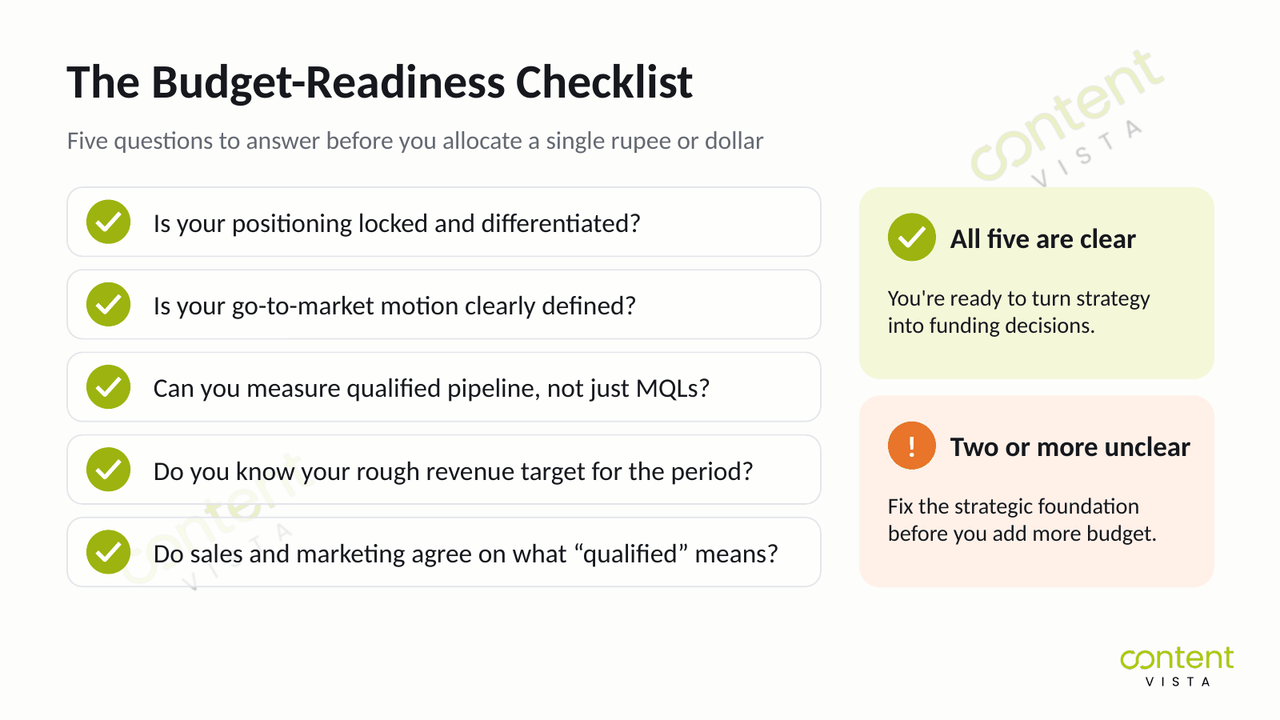
If all five answers are clear, you're ready to translate strategy into funding decisions.
If two or more remain uncertain, the immediate problem isn't the size of the budget. It's the strategic foundation beneath it.
Fix the positioning, commercial definitions, measurement logic and sales-marketing alignment before committing more money.
That may call for focused marketing strategy and growth consulting.
This isn't an argument for delaying action indefinitely. It's a way to make sure the budget funds deliberate choices rather than unresolved assumptions.
Before you allocate more budget, assess whether your positioning and go-to-market foundation are clear enough to support confident growth decisions.
Take the GTM Readiness & Positioning Clarity AuditThe 4 Marketing Budgeting Models and Which One Fits You
There's no single "correct" way to build a marketing budget.
The right model depends on how mature your business is, how reliable your funnel data is and whether leadership is prioritising stability, efficiency or growth.
Here's where most teams go wrong: they choose a model because it's familiar, rather than because it fits the decision they need to make.
A percentage-of-revenue model is fast, but too blunt to guide serious allocation. Top-down budgeting creates discipline, but may start with an arbitrary ceiling.
Bottom-up budgeting is more operationally grounded, but can become an expensive wish list.
Objective-based budgeting is usually the strongest fit for growth planning. But only when the assumptions underneath it are credible.
| Model | How it works | Best for | Where it fails |
|---|---|---|---|
| Percentage-of-revenue | Set budget as a fixed % of current or projected revenue | A fast sanity-check; stable, established firms | Ignores goals; can under-fund growth or over-fund stagnation |
| Top-down | Leadership sets a total figure; marketing allocates within it | Tight-cashflow periods; board-driven planning | Number can be disconnected from what goals actually require |
| Bottom-up | Build from the activities and costs needed to hit goals | Goal-led teams that know their funnel maths | Can balloon; needs discipline and a hard ceiling |
| Objective / goal-based | Start from the revenue goal, reverse-engineer the spend | Growth-stage firms tying spend to pipeline targets | Only as good as your funnel and conversion data |
Which model should you use?
Use percentage-of-revenue when you need a quick benchmark or a board-level sanity check. Don't use it as the final allocation logic.
Use top-down when cash constraints are real and non-negotiable.
In that situation, the question isn't "What would the ideal plan cost?" It's "What is the highest-value system we can fund within this ceiling?"
Use bottom-up when your team understands channel costs, conversion rates, capacity and execution requirements. It works well for planning, but every activity must still earn its place.
Use objective-based budgeting when the business has a clear revenue or pipeline goal and enough data to reverse-engineer the required investment.
In practice, the strongest approach is often hybrid.
Start with the objective, build the required budget from the bottom up, compare it with revenue benchmarks and then apply a top-down constraint if necessary.
Use the models together: objective-based for direction, bottom-up for detail, percentage-of-revenue for a reality check and top-down for financial discipline.
How to Build a B2B Marketing Budget (Step by Step)
Let's make this practical.
A useful B2B marketing budget starts with the commercial outcome, works backwards through the funnel and only then assigns money to channels.
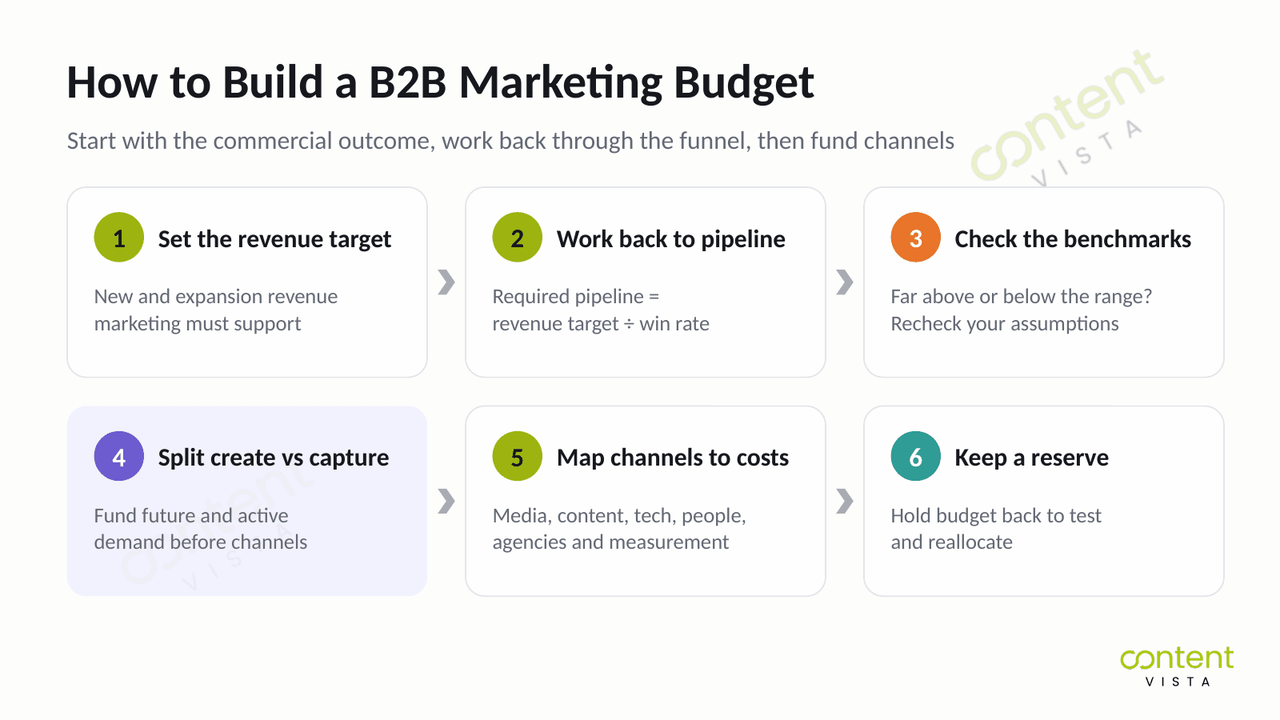
1. Start with the revenue target
Define the incremental revenue marketing is expected to support during the planning period.
Be clear about whether this means new business, expansion revenue or both.
That target should reflect your wider go-to-market motion: who you sell to, how those buyers make decisions and where marketing contributes to the journey.
2. Work backwards into required pipeline
A simple starting calculation is:
Required qualified pipeline = Revenue target ÷ average win rate
Many sales teams then check the result against a pipeline-coverage multiple, often quoted as 3x to 5x the revenue target.
Treat that multiple as a planning convention only. There's no empirical basis for a universal coverage ratio.
The coverage you actually need changes with sales-cycle length, deal quality, forecast accuracy and the consistency of your conversion data.
Illustrative example only: Suppose the business wants ₹1 crore in new revenue and wins 25% of its qualified pipeline value.
₹1 crore ÷ 25% = ₹4 crore of qualified pipeline required (4x coverage).
This doesn't tell you the final budget. But it gives marketing and sales a concrete demand target to fund.
Want to size spend against your next revenue milestone? Try the Revenue Milestone Gap Calculator.
3. Sanity-check the result against revenue benchmarks
Compare the investment implied by your pipeline maths with the revenue-percentage benchmarks covered earlier.
If your plan requires far more than the benchmark, inspect the assumptions. Your acquisition costs, conversion rates or growth expectations may be unrealistic.
If it requires far less, check whether you've left out people, technology, content production, sales enablement or measurement.
The benchmark tests the plan. It shouldn't replace it.
4. Split the budget between creating and capturing demand
Decide how much investment must build awareness and preference among future buyers, and how much must capture buyers already showing intent.
Do this before choosing channels. Otherwise, the existing campaign list will quietly dictate the strategy.
The next section explains how to make this split.
5. Map each job to channels and full costs
Translate the create-and-capture allocation into actual execution requirements:
Media and distribution
Content and creative production
Technology and data
Internal team capacity
Agencies, specialists and contractors
Sales enablement and nurture
Measurement and optimisation
A go-to-market strategy template can help you connect these investments to audiences, buying stages, responsibilities and outcomes.
6. Keep a reserve for testing and reallocation
Don't commit every rupee or dollar on day one.
Hold back a defined reserve for experiments, emerging opportunities and shifting funds away from underperforming activity.
A budget should create accountability without removing adaptability.
Review it against pipeline quality, conversion performance and strategic learning, not merely whether each department spent its allocation.
The Create-vs-Capture Split: Where Your Budget Should Actually Go
This is the decision most marketing budgets skip.
Once you've clarified your positioning, audience, growth target and go-to-market logic, the next question isn't simply which channels to fund.
It's how much of the budget should create future demand, and how much should capture demand that already exists.
If you've read our guide to revenue-driven marketing strategy, this is the allocation decision inside the CORE Growth System™. Either way, make it before any single channel gets funded.
The two buckets are distinct:
Create: Fund awareness, category understanding, trust and memory among out-of-market buyers who aren't ready to act yet.
Capture: Fund the channels and assets that harvest existing intent when buyers begin searching, comparing and engaging.
The right split isn't fixed.
It should reflect company stage, market maturity, cash constraints and how much demand already exists.
| Stage | Lean toward | Why | Watch-out |
|---|---|---|---|
| Early-stage / newly funded | More Capture | Need pipeline now to prove the model and survive | Don't zero out Create; you mortgage future pipeline |
| Growth-stage | Balanced, tilting to Create | Capture is working; now build the out-of-market audience | Capture alone caps your ceiling |
| Established / category leader | Protect a larger Create allocation | Mental availability compounds and defends share | Cutting Create in downturns is a common, costly reflex |
The practical lesson is simple.
Survival-stage businesses may need to lean harder into capture, but no company should eliminate demand creation completely.
Once capture begins working consistently, more investment can move toward building the future buyer pool.
The split should also change over time.
That's where your results review comes in. Compare the plan with actual results: pipeline quality, conversion, sales velocity, branded demand, audience growth and channel contribution.
Those findings should feed the next planning cycle. Where necessary, they should send you back to your positioning and targeting before you reallocate.
Create builds the market you will sell into later. Capture converts the market that is ready now. A durable budget must fund both.
Brand vs Lead Gen: What the Evidence Actually Says
Here's the part nobody tells you: the famous brand-versus-activation split is useful as a planning prompt, but dangerous as a fixed rule.
The widely cited 60:40 split (60% toward long-term brand building and 40% toward short-term activation) comes from Les Binet and Peter Field's effectiveness research, first published by the IPA in The Long and the Short of It in 2013.
It's often repeated as though it applies universally.
It doesn't.
In 2022, Professor Byron Sharp of the Ehrenberg-Bass Institute publicly called the 60:40 rule "very misleading", arguing it was built on a flawed dataset of awards entries.
That critique matters. The original guidance is frequently stripped of its context, then applied mechanically across categories, company stages and buying environments.
For B2B, Binet and Field's 5 Principles of Growth in B2B Marketing report for the LinkedIn B2B Institute (2019) pointed to a more activation-heavy balance: about 46% brand building and 54% activation.
Treat that as directional research guidance, not a precise allocation formula.
In short: no single number is "correct." What matters is that both long-term memory building and short-term demand conversion get explicit funding.
This maps directly to the Create-vs-Capture split:
Brand building supports Create: awareness, trust, category understanding and mental availability among buyers who aren't yet in-market.
Activation supports Capture: search, retargeting, offers, lead generation, sales conversion and other activity aimed at current demand.
A company under immediate revenue pressure may lean more heavily toward activation.
A recognised brand with working capture channels may protect a larger brand-building allocation to strengthen future demand and defend market share.
Use 60:40 and 46:54 as reference points, not formulas. Your actual split should reflect growth stage, cash pressure, category maturity, existing brand strength and what your results show is working.
Planning vs Results: How to Know If Your Budget Is Working
A marketing budget isn't finished when the spreadsheet is approved. It's tested when the plan meets the market.
This is where you close the loop. Compare what the budget was meant to produce with what actually happened, then use those findings to shape the next allocation cycle.
You don't need dozens of dashboard metrics. For budget planning, a few commercial inputs matter most:
CAC payback period: How long it takes to recover the cost of acquiring a customer. Under roughly 12 months is a common reference point, but it's a convention that came out of venture-backed SaaS, not a law. Businesses with longer sales cycles and higher contract values often run beyond it.
LTV:CAC ratio: The relationship between customer lifetime value and acquisition cost. A ratio of about 3:1 or higher is David Skok's widely used heuristic. Read it alongside margin, retention and cash flow.
Pipeline coverage against plan: Whether the qualified pipeline created during the period is enough to support the revenue target at your expected win rate.
Keep the emphasis on qualified pipeline and revenue, not headline MQL volume.
A campaign can generate a large number of leads and still weaken the budget if few become credible sales opportunities.
At the end of the period, ask:
Did the planned spend create enough qualified pipeline?
Did acquisition costs move in the expected direction?
Which Create investments strengthened future demand?
Which Capture investments converted active demand efficiently?
Where did conversion, capacity or execution break down?
Those answers become the inputs for next quarter's budget.
Strong performers may receive more funding. Weak activities may be improved, reduced or removed.
And some strategic assumptions may need revisiting before the next plan gets built.
Check whether your spend is actually paying back. Use the calculator to see what customer acquisition is really costing and whether your current marketing investment is producing sustainable returns.
Run the True CAC & Marketing ROI CalculatorWhen a Bigger Budget Won't Fix Anything
More budget doesn't repair a broken marketing system. It only lets the same weaknesses operate at a larger scale.
That's the real issue: some companies don't have an underinvestment problem.
They have a clarity, conversion, alignment or measurement problem.
A larger budget is unlikely to help when:
Positioning is too vague for buyers to understand why the offer is different.
The funnel leaks between attention, enquiry, qualification and sales follow-up.
Sales and marketing don't agree on what "qualified" means.
Tracking can't connect activity to pipeline and revenue.
Campaigns are launched without a clear audience, role or success condition.
More leads are entering a process that already fails to convert them.
In those situations, adding spend may produce more clicks, impressions, form fills or MQLs. It may even create the appearance of momentum.
But if the underlying system is weak, the business simply pays more to generate the same low-quality outcome.
The fix isn't to stop investing in marketing. It's to fix the system before scaling the spend.
Clarify the positioning. Tighten the ideal customer profile. Repair the handoffs. Define qualification.
Build reliable tracking. Identify where conversion breaks.
Then increase the budget where the system can use it productively.
Spend smart before you spend more. A healthy budget amplifies a working growth system; it cannot substitute for one.
Marketing Budget Planning: FAQs
What percentage of revenue should go to marketing?
There's no universal percentage. Gartner's 2026 CMO Spend Survey put marketing budgets at 7.8% of revenue in a mostly large-enterprise sample, while The CMO Survey's 2026 edition reported 9.0% across a broader US sample. Use these as source-typed benchmarks, not fixed rules.
How do I plan a marketing budget step by step?
Start with the revenue target and work backwards into the qualified pipeline you need. Test the result against revenue-percentage benchmarks, split investment between creating and capturing demand, map that split to channels and full delivery costs, and keep a reserve for testing and reallocation.
How much should a B2B company spend on marketing?
The CMO Survey's 2026 edition reported 7.0% of revenue for B2B product companies and 10.1% for B2B services companies. The right level for you still depends on growth stage, margins, market maturity, buying cycle and how much infrastructure must be built.
What's the difference between top-down and bottom-up budgeting?
Top-down budgeting begins with a total figure set by leadership, after which marketing allocates the available amount. Bottom-up budgeting calculates the activities, resources and costs required to reach specific goals. Top-down controls spend; bottom-up tests what execution realistically requires.
How should I split my budget across channels?
Don't begin with channels. First divide the budget between demand creation and demand capture. Then fund channels according to the role they play, their full costs, buyer behaviour, funnel performance and your team's ability to execute them well.
How much should go to brand vs lead generation?
The often-cited 60:40 brand-to-activation split is contested and shouldn't be treated as a law. B2B-focused research from Binet and Field for the LinkedIn B2B Institute suggested about 46% brand and 54% activation as directional guidance. Your split should reflect stage, cash pressure, brand strength and current demand.
Should I cut the marketing budget in a downturn?
Cutting indiscriminately can weaken future pipeline. In The CMO Survey's 2026 edition, executives focused on cutting expenses 53.1% of the time when profits fell short, and when they did, marketing was cut ahead of other expense categories 45.4% of the time. Review weak activities, but avoid automatically eliminating demand-creation investment, because its effects compound over longer periods.
How do I know if my budget is working?
Track qualified pipeline, closed revenue, CAC payback, LTV:CAC and pipeline coverage against plan. Avoid using MQL volume as the headline measure. The purpose of measurement is to improve the next allocation cycle, not merely to report activity.
Build a Budget That Funds a System, Not a Scramble
The strongest marketing budget isn't the one with the neatest channel split or the most ambitious percentage.
It's the one that funds a clear growth system.
Start with a sound strategy. Work backwards from revenue. Fund both demand creation and demand capture.
Then use results to improve the next allocation cycle.
That's the core principle: budget the system, not the channels.
The number matters, but what it funds matters more.
A well-built budget turns a revenue-driven marketing strategy into coordinated execution instead of another round of disconnected campaigns.
Before you allocate more budget, check whether your positioning and go-to-market foundation are clear enough to support it.
Take the GTM Readiness & Positioning Clarity Audit