Quick Summary
- Most marketing waste starts before execution, when businesses choose markets, messages, channels or offers without enough evidence.
- A market research strategy closes that gap.
- It turns customer, competitor and category intelligence into clear positioning, go-to-market and investment decisions.
The Real Cost of Guessing About Your Market
Here’s the problem: businesses often treat research as something to complete before the “real work” begins.
A team commissions interviews, circulates a survey, downloads a few industry reports and builds a polished deck.
Then the findings sit apart from the decisions that actually shape revenue. Which audience to prioritise. What problem to lead with. How to position the offer. Which channels deserve investment. What the go-to-market plan should test first.
That disconnect is expensive.
CB Insights' analysis of 431 venture-backed startups that shut down since 2023 found that poor product-market fit was a root cause in 43% of the cases where a reason could be identified.
Marketers feel the same pain on the spend side. In a Rakuten Marketing survey of more than 1,000 marketers, reported by WARC, respondents estimated that around 26% of their budgets went on the wrong channels or strategies.
These figures describe different problems, but they point to the same underlying failure: action begins before the market is understood well enough to guide it.
Research alone does not prevent waste. Decisions informed by research do.
A customer interview is useful only when it changes how you define the buying problem. Competitor analysis matters only when it sharpens your positioning.
Channel research creates value when it helps you decide where to invest and where to hold back. Market sizing becomes commercially relevant when it influences priorities, expectations or resource allocation.
That is the bridge many market research processes are missing.
This guide shows you how to build a market research strategy that moves deliberately from evidence to interpretation, from interpretation to choice and from choice to revenue action.
The goal is simple: fewer expensive assumptions.
What a Market Research Strategy Actually Is (and Isn't)
A market research strategy is bigger than a survey, a collection of customer quotes or a spreadsheet of competitor features. Those are research activities.
The strategy is the system that decides what evidence you need, why you need it, how you will gather it and which decision it must inform.
So what does that actually mean?
It means research shouldn’t operate as a standalone project that ends when the report is delivered.
It should work as the evidence layer of your wider revenue-driven marketing strategy, shaping what you sell, whom you prioritise, how you position the offer and where your marketing resources go.
In our own client work, this is the first stage of what we call The CORE Growth System™: clarify the market before you build, run or measure anything on top of it.
Without that evidence, everything downstream may still move. It just moves on assumptions.
This distinction also prevents a common strategic error: treating a marketing plan and a marketing strategy as the same thing.
A marketing strategy defines the choices behind growth: the priority market, customer problem, positioning, value proposition, route to market and competitive advantage.
A marketing plan comes later. It converts those choices into campaigns, channels, timelines, responsibilities and budgets.
If the strategy is unclear, the plan merely organises uncertain activity more efficiently.
So research earns its keep only when it changes or validates a decision.
A competitor review should expose a positioning opportunity. Customer interviews should clarify which problems carry urgency and buying intent. Market analysis should help you decide which segment deserves attention now and which can wait.
The value lies in reducing uncertainty before you commit time, budget and reputation to execution.
Market Research vs Competitive Intelligence vs Market Intelligence
These terms are often used interchangeably, which creates unnecessary confusion. They are related, but they do different jobs.
Market research helps you understand the market and the people buying within it. It examines customer needs, behaviours, priorities, perceptions, demand patterns and willingness to act.
Competitive intelligence helps you understand the alternatives buyers are comparing you against.
It looks at competitor positioning, offers, messaging, strengths, weaknesses, routes to market and the spaces where your business may be able to win.
Market intelligence is the broader, ongoing signal layer.
It combines customer, competitor, category, economic, regulatory and channel developments to help the business detect change and respond before assumptions go stale.
The myth to avoid is that these are competing disciplines. They work best as complementary inputs into the same set of strategic decisions.
| Discipline | Primary focus | Decision it supports |
|---|---|---|
| Market research | Buyers, demand, needs, behaviours, perceptions and market conditions | Which audience to prioritise, which problem matters most and what buyers need to believe before acting |
| Competitive intelligence | Competitors, substitutes, positioning, offers, messaging, strengths and weaknesses | Where the business can differentiate, how it can compete and which spaces are already crowded |
| Market intelligence | Ongoing signals across customers, competitors, the category, channels, regulation and the wider environment | What is changing, what requires attention and when strategy needs to adapt |
Used together, they create a more reliable evidence base.
Market research may reveal what customers value. Competitive intelligence shows how rivals are already addressing that value. Market intelligence tells you whether the conditions around both are changing.
One gives you depth, one gives you context and one gives you continuity.
A strong market research strategy connects all three instead of treating them as isolated reports. If you want a team to run that intelligence layer for you, that is exactly what our market research and competitive intelligence work is built for.
The Building Blocks: Primary, Secondary, Qualitative, Quantitative
Let’s make this practical: these four terms describe different ways of gathering evidence. None of them is a strategy on its own.
The useful question isn’t, “Which method is best?” It is, “Which decision are we trying to make, and what evidence would reduce the uncertainty around it?”
Primary research gives you evidence collected directly for your current question.
Customer interviews, surveys, observation, usability sessions and social listening can all sit here. Use it when you need fresh insight into a specific audience, problem, offer or buying decision.
Secondary research uses evidence that already exists: industry reports, public datasets, analyst commentary, search trends, competitor materials, customer reviews and internal historical data.
It is usually the fastest way to understand the landscape before deciding what must be investigated directly.
Qualitative research explains the “why.” Interviews, open-ended survey responses, observation, review analysis and social listening help uncover language, motives, objections, context and decision criteria.
Quantitative research shows the “how many,” “how often” or “which option wins.”
Structured surveys, behavioural analytics, market sizing and performance data help test prevalence, compare segments and prioritise choices.
| Research type | What it is | Best for | Watch-out |
|---|---|---|---|
| Primary research | New evidence collected directly for the decision at hand | Testing assumptions about buyers, needs, messaging, demand and behaviour | Poor questions or biased samples can create false confidence |
| Secondary research | Existing evidence gathered from internal or external sources | Understanding the market, category, competitors, trends and known patterns quickly | The data may be outdated, too broad or based on a different context |
| Qualitative research | Evidence that explores motives, language, perceptions and context | Discovering why buyers behave as they do and how they describe the problem | It reveals depth, not statistical prevalence |
| Quantitative research | Numerical evidence used to measure patterns, differences and scale | Validating priorities, comparing segments and estimating how common a finding is | Numbers can measure the wrong thing precisely if the question is poorly framed |
The core methods become more useful when tied to a decision:
Interviews help refine positioning, value propositions and buying criteria.
Surveys help validate whether observed needs or preferences are widespread enough to prioritise.
Social listening and review analysis reveal recurring language, frustrations, alternatives and emerging concerns.
Observation and behavioural data show what people actually do, which may differ from what they say.
Secondary research helps frame market size, category dynamics, competitor patterns and the questions your primary research still needs to answer.
A strong market research strategy rarely relies on one method alone. It combines methods to move from discovery to validation.
Qualitative evidence surfaces the pattern. Quantitative evidence tests its significance. Primary and secondary sources provide the context you need to act on it.
Why B2B Market Research Plays by Different Rules
B2B research can’t be approached like consumer research with a different questionnaire.
In many consumer categories, you may be trying to understand one person’s preferences, habits or response to a product.
In B2B, the “buyer” is usually a group of people with different priorities, different levels of influence and different definitions of risk.
Gartner's research on the B2B buying journey puts the typical buying group for a complex B2B solution at six to ten decision-makers.
These stakeholders may represent finance, operations, leadership, procurement, IT, marketing or the team that will actually use the solution.
That changes the research question.
It is no longer enough to ask, “What does our customer want?” You need to understand:
Who first recognises the problem?
Who researches possible solutions?
Who controls the budget?
Who can block the purchase?
Which stakeholders care about growth, efficiency, security, compliance or implementation?
What evidence will help the group reach internal agreement?
You also control far less of the journey than most teams assume.
The same Gartner research found that buyers spend only about 17% of their purchase time meeting with potential suppliers. When several vendors are in play, any one supplier may get just 5–6% of that time.
And buyers increasingly want it that way. Gartner's March 2026 sales survey of 646 B2B buyers found that 67% prefer a rep-free buying experience.
| Signal | Research implication | Source |
|---|---|---|
| Complex buying groups often involve 6–10 decision-makers | Research roles, priorities, objections, influence and consensus, not only a single persona | Gartner |
| Buyers spend about 17% of the journey with suppliers and roughly 5–6% with any one supplier | Study the self-directed research journey and the information buyers need before speaking with sales | Gartner |
| The eventual winner was on the initial shortlist 92% of the time | Research how brands enter the initial consideration set, not only how sales teams convert active opportunities | 6sense 2026 Global B2B Buyer Experience Report (vendor first-party research) |
Here’s the craziest part:
6sense's 2026 Global B2B Buyer Experience Report, based on 4,611 recent B2B buyers, found the eventual winner was already on the buyer’s initial shortlist 92% of the time.
Buyers also spent roughly 60% of an average 10.3-month cycle in selection before contacting any seller. And the vendor they favoured before that first contact went on to win 82% of the time.
Because this is vendor first-party research, treat it as a strong directional finding. It shouldn’t be read as a universal law.
Here’s where most teams go wrong: they research B2B markets as though they’re testing a flavour preference.
The real task is to understand buying committees, internal consensus, the self-directed journey, initial shortlists and the difference between buyers who are actively evaluating and those who aren’t yet in-market.
The 95:5 rule from Professor John Dawes, published through the Ehrenberg-Bass Institute and the LinkedIn B2B Institute, is useful here as a heuristic.
It suggests that only around 5% of B2B buyers are in-market at any given time. The other 95% won’t buy for months or years, so they need long-term memory-building before a buying need arises.
Dawes himself says the 95% figure isn’t meant to be precise for every sector. Your category’s purchase cycle will change the split, so use it as a lens for your research, not a law.
The Research Tools That Actually Feed Your Strategy
Classic research models are useful, but only when they help you make a decision.
Think about it this way: SWOT, Porter’s Five Forces, PESTEL, market sizing, STP, Jobs-to-Be-Done, buyer personas, win-loss analysis and voice-of-customer research are all evidence inputs.
Each answers a different strategic question.
Understanding the market environment
PESTEL analysis examines political, economic, social, technological, environmental and legal forces. Use it to identify external changes that could affect demand, risk, timing or market entry.
Porter’s Five Forces helps assess the competitive structure of a market: rivalry, new entrants, substitutes, supplier power and buyer power.
It should inform decisions about market attractiveness, pricing pressure, differentiation and defensibility.
TAM, SAM and SOM market sizing helps separate the total theoretical opportunity from the market you can realistically serve and capture.
The purpose is to set realistic priorities, investment levels and revenue expectations. An impressive number for a presentation is a side effect at best.
Deciding where and how to compete
SWOT analysis brings internal strengths and weaknesses together with external opportunities and threats.
It is most useful after the underlying research has been completed. Without evidence, SWOT quickly becomes a collection of opinions.
Segmentation, Targeting and Positioning (STP) turns market evidence into choices. It helps you decide which segments exist, which deserve priority and how the offer should be positioned for the selected audience.
This is where market research becomes strategy. It happens when the business decides whom it will prioritise and what it wants to be known for. Our guide to brand positioning strategy goes deeper on that choice.
Understanding buyers and their decisions
Jobs-to-Be-Done research explores the progress buyers are trying to make and the circumstances that cause them to seek a solution.
It can help sharpen product design, messaging, category framing and demand-generation themes.
Ideal customer profiles and buyer personas organise evidence around the accounts and people most likely to need, value, influence, purchase or use the solution.
They should reflect actual buying conditions instead of fictional personalities or superficial demographic details.
Voice-of-customer research captures the language customers use to describe their problems, desired outcomes, objections, alternatives and decision criteria.
Those findings can directly inform positioning, website copy, content themes, sales messaging and offer design.
Win-loss analysis examines why opportunities were won, lost, delayed or abandoned. It is especially valuable because it studies real buying decisions rather than hypothetical preferences.
These tools create value only when their findings are translated into a choice: which market to enter, which segment to prioritise, which problem to own, how to position the offer or where to invest next.
The mistake isn’t choosing the “wrong” model. It is completing several analyses without connecting their findings.
These analyses should build on one another until you have enough evidence to make a deliberate revenue decision.
The Research-to-Decision Handoff: Turning Findings Into Moves
Research creates value only when it changes what the business does next.
That sounds obvious. But this is where many market research strategies break down.
Teams collect useful evidence, present the findings and then leave decision-makers to work out what those findings mean for positioning, messaging, go-to-market priorities or demand investment.
The missing step is the Research-to-Decision Handoff.
It is a simple decision device designed to make sure every major research input ends in a specific commercial choice.
Think of it as one rule: no research stream should begin without a decision destination.
| Research input | What it tells you | The decision it drives |
|---|---|---|
| Competitive intelligence | How competitors position themselves, which claims dominate the category, where offers look interchangeable and which customer needs remain weakly served | Positioning decision: where you can credibly differentiate and what space you want the market to associate with your brand |
| Buyer intelligence, including voice-of-customer, Jobs-to-Be-Done and ICP research | Which problems carry urgency, how buyers describe them, what outcomes they value, who influences the purchase and which objections slow action | Messaging decision: which problem to lead with, what language to use and which proof buyers need to believe the offer |
| Market sizing through TAM, SAM and SOM | The scale of the opportunity, the realistic serviceable market and the portion the business can reasonably pursue with its current capabilities | GTM-priority decision: which market, segment, geography or use case should receive attention first |
| Demand signals and win-loss evidence | Where interest is emerging, why buyers progress or disengage, which opportunities convert and how much of the market is actively buying versus not yet in-market | Demand-allocation decision: how to balance short-term in-market capture with long-term out-of-market demand creation |
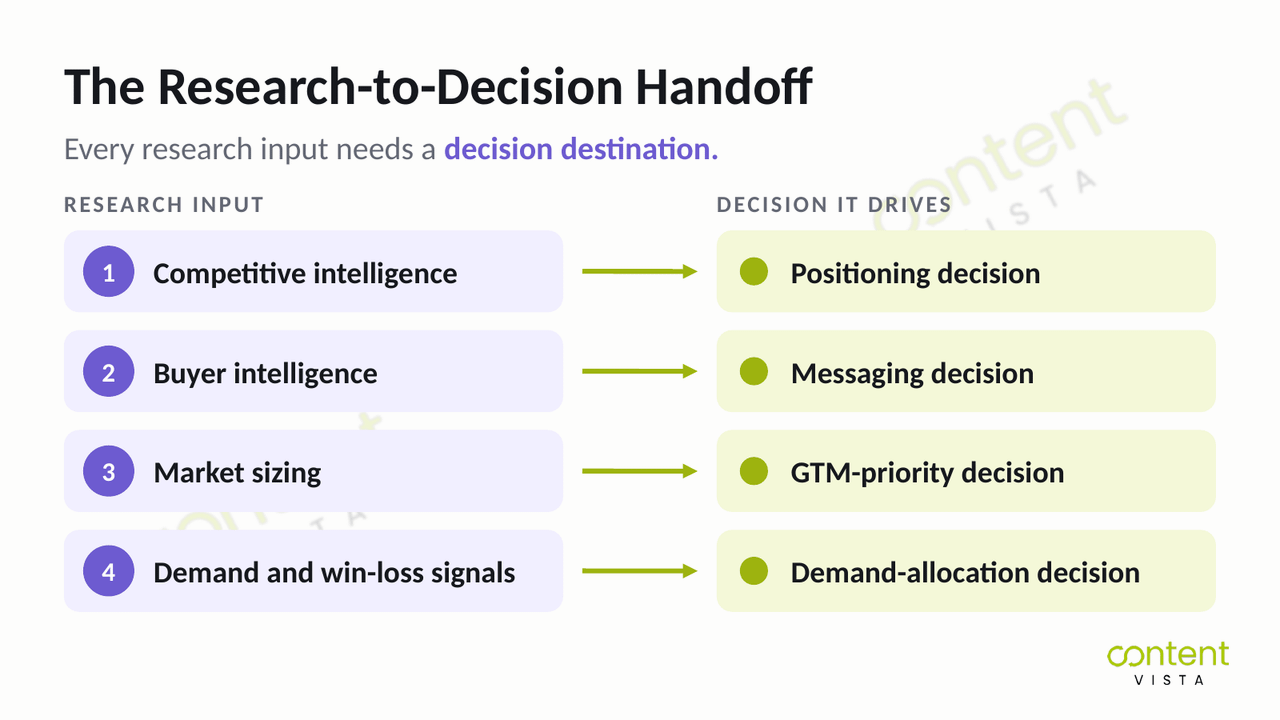
The mapping should feel obvious in hindsight.
Competitor evidence sharpens positioning. Buyer evidence shapes messaging. Market size guides GTM focus. Demand evidence decides where budget and attention go.
Each of those decisions has a natural next home. Positioning choices feed brand and market positioning. GTM priorities feed your go-to-market strategy, and if you want to turn them into a working plan, our go-to-market strategy template is a practical place to start.
When these connections are explicit, research stops being a reporting function. It becomes a decision system.
Not sure whether your positioning and go-to-market decisions are supported by enough evidence? Use the GTM Readiness & Positioning Clarity Audit to identify where strategic clarity is missing before execution begins.
What This Looks Like in Practice: The Alirrium Story
For Alirrium, the research was never meant to be a standalone content asset. It was built to strengthen the company’s position in a specific market.
Content Vista developed an original industry survey and used the findings to produce Alirrium's State of RPA report, titled State of RPA in Financial Institutions 2024.
The report gave Alirrium something more valuable than another opinion-led article: original evidence from the market it wanted to influence.
That evidence helped the company speak with greater authority about robotic process automation in financial institutions.
Instead of repeating broad industry claims, Alirrium could contribute its own research to the conversation and use it to support its positioning in banking RPA.
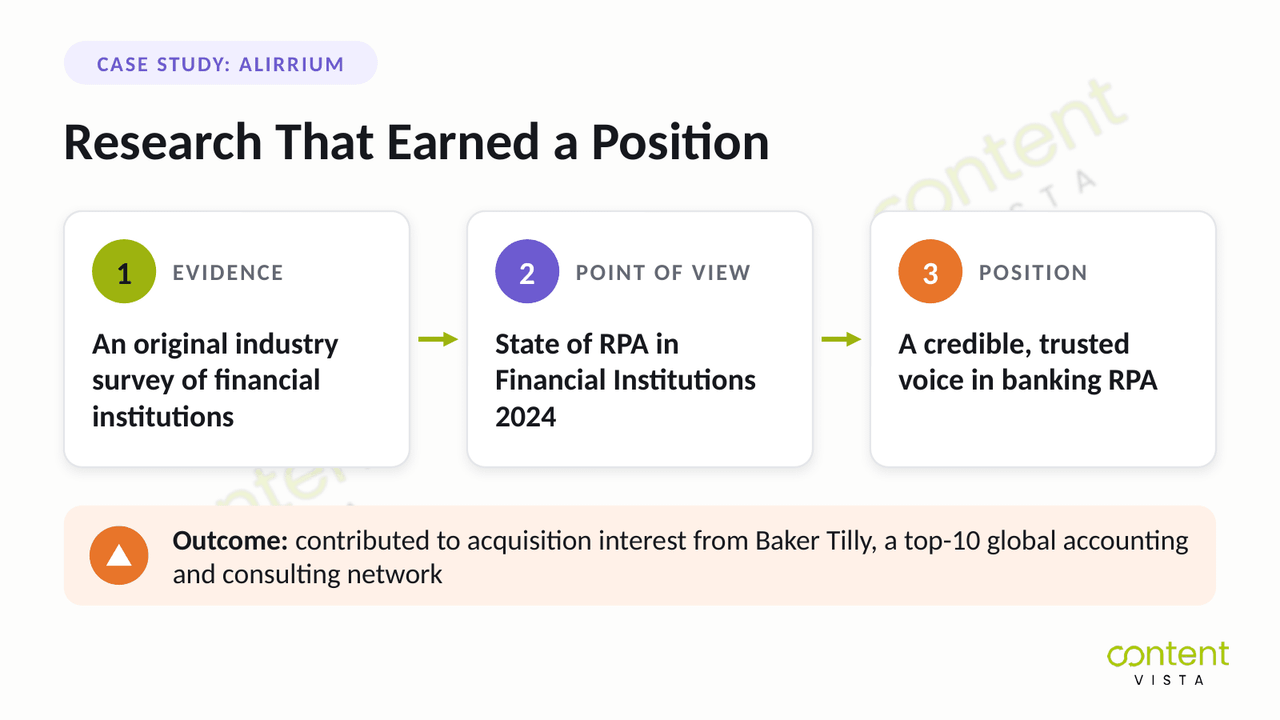
This is the Research-to-Decision Handoff in practice.
The survey created market evidence. The report translated that evidence into a credible point of view. That point of view strengthened how Alirrium could present its expertise to the market.
The work also contributed to acquisition interest from Baker Tilly, a top-10 global accounting and consulting network.
The lesson isn’t that every business needs to publish an industry report. It is that research becomes strategically valuable when it is designed around the position the business wants to earn.
A generic survey would have created data. A research-led authority asset created something more useful: evidence that could shape market perception, support strategic positioning and give decision-makers a reason to take the company seriously.
The same pattern shows up elsewhere in our work. Personam's 26-competitor market study shaped how an AI cybersecurity platform launched its brand. And Akshar's competitive repositioning for UK expansion was built on market research that went on to support £200K+ in estimated pipeline.
That is the difference between conducting research and using research as part of a market strategy.
How to Run a Lean Research Cycle (Without a Big Budget)
Let’s make this practical: useful market research doesn’t always require a large sample, an expensive platform or a months-long engagement.
It requires a clear decision, enough reliable evidence to reduce uncertainty and the discipline to stop researching once you can act responsibly.
1. Define the decision first
Start with the choice the research must support.
Instead of asking, “What do customers think about our brand?”, ask, “Which customer segment should we prioritise for the next go-to-market campaign?” or “Which buyer problem should lead our positioning?”
A precise decision keeps the research focused and prevents unnecessary data collection.
2. Gather the cheapest sufficient signal
Use existing evidence before commissioning new research.
Review customer conversations, sales notes, win-loss feedback, website behaviour, search patterns, competitor messaging, industry reports and public customer reviews.
Then fill only the gaps that matter. A small number of focused interviews may be enough to uncover recurring language or objections. A short survey may help validate whether those patterns appear across a wider group.
You’re aiming for sufficient evidence for the decision being made. Perfect certainty isn’t on the menu.
3. Analyse for patterns, contradictions and gaps
Don’t reduce the analysis to a list of responses. Look for:
themes that appear repeatedly;
differences between segments or buying roles;
contradictions between what buyers say and what they do;
assumptions the evidence challenges;
questions that remain unresolved.
4. Translate the findings into a decision
State the conclusion in operational terms: what will change, what will stay the same and what the team will test next.
“Customers value support” is a finding. “Lead with implementation confidence in the positioning and add onboarding proof to the sales journey” is a decision.
5. Revisit the decision as new evidence appears
Good research is cyclical. Revisit the decision when performance data, buyer feedback, market conditions or win-loss signals challenge the original conclusion.
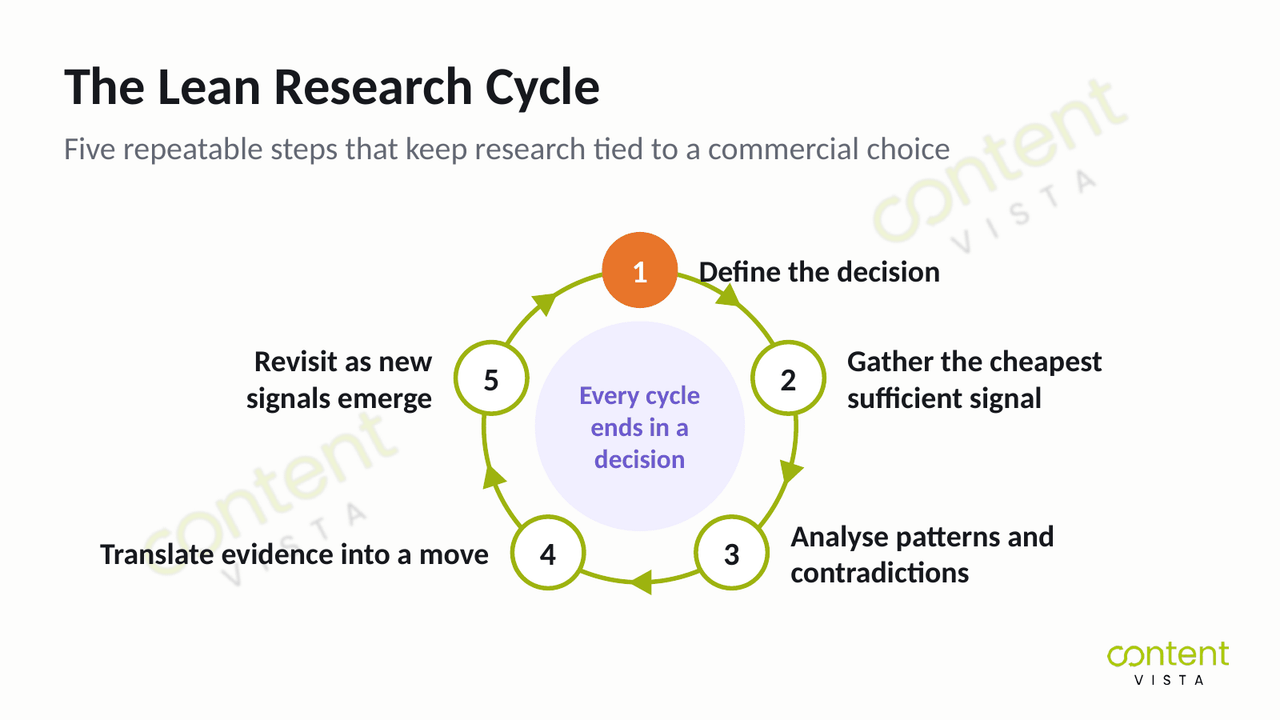
| Research level | Typical inputs | Time, cost and effort |
|---|---|---|
| Rapid signal check | Existing analytics, sales notes, customer reviews, competitor materials and internal data | Lowest cost and effort; useful for framing the decision and identifying evidence gaps |
| Focused primary research | Targeted interviews, a short survey, observation or structured win-loss conversations | Moderate effort; appropriate when internal and secondary evidence cannot resolve the decision |
| Ongoing validation | Campaign results, sales feedback, customer conversations and market monitoring | Light but recurring effort; prevents the original decision from becoming an outdated assumption |
A lean research cycle is complete when it produces a defensible decision. The length of the report has nothing to do with it.
Before deciding what to research, identify the growth gap that deserves the most attention. Use the Revenue Milestone Gap Calculator to size the gap between where you are and where you need to be.
When You Should Stop Researching and Start Moving
More research isn’t always a sign of rigour. Sometimes it is a way to postpone a decision.
The mistake is simple: teams keep gathering evidence after the decision is already clear enough to test.
You should stop researching and start moving when:
You already have consistent product-market fit signals. Customers understand the value, the problem is real and the same buying patterns keep appearing.
The cost of delay is now greater than the cost of being slightly wrong. Waiting for perfect certainty may mean losing momentum, missing a market window or delaying feedback that only execution can produce.
New research is no longer changing the decision. If every additional interview confirms what you already know, the next useful signal will probably come from the market’s response.
You are researching to feel safe rather than to choose. When the question shifts from “What do we still need to know?” to “Can we be completely certain?”, research has become avoidance.
The right stopping point is enough evidence to make a responsible decision, define the risk and run the next test. Certainty never arrives.
A strong market research strategy includes a stopping rule.
Before the work begins, decide what evidence would be sufficient to move forward, what uncertainty you can tolerate and which assumptions must be tested in execution.
Research should reduce avoidable risk. It can’t remove every risk.
At some point, research has to hand the decision to planning and execution. Otherwise, the business stays well-informed but inactive.
5 Reasons Market Research Never Reaches Strategy
Here’s where most teams go wrong: they complete the research, but never complete the handoff.
The result is a collection of findings that may be accurate, interesting and well-presented, yet still disconnected from the decisions that shape growth.
They start without a decision in mind
The research question is too broad: “What does the market think?” or “What are competitors doing?”
Without a defined decision, the work expands endlessly and produces insight without direction. Start with the choice the evidence must support.
They treat research as a one-time project
Markets change. Buyer priorities shift. Competitor claims evolve.
A report completed once and never revisited quickly becomes a snapshot of an old reality. Research should run as a recurring signal layer in your strategy, instead of an annual exercise that gets archived.
They copy B2C methods into a B2B buying environment
A single buyer preference can’t represent a committee decision. B2B research must account for multiple stakeholders, internal politics, risk, consensus and the self-directed buying journey.
Researching only the end user may leave the actual blockers invisible.
They mistake a competitor spreadsheet for competitive intelligence
Listing competitor features, prices and website claims is data collection.
Competitive intelligence asks what those patterns mean: where the category is crowded, which promises are overused and where your business can credibly differentiate. The spreadsheet is an input. The conclusion is what you do with it.
They never translate findings into positioning or messaging
This is the most expensive failure. Teams document what buyers say, then keep using the same value proposition, website copy, sales narrative and campaign themes.
A useful finding should change something. It should sharpen the audience, problem, promise, proof or priority.
Research reaches strategy only when every important finding is assigned to a decision, an owner and a next move.
Where Research Fits in the System Your Marketing Runs On
Market research isn’t a side project sitting outside marketing. It is where the system begins.
Research establishes the evidence behind the strategy: which market to prioritise, which buyers matter most, what problem deserves attention, how the offer should be positioned and what assumptions still need testing.
That clarity then feeds everything that follows.
Planning turns the evidence into a go-to-market approach, channel priorities, messaging architecture, responsibilities and workflows.
Execution converts those choices into campaigns, content, outreach, sales enablement, landing pages and conversion activity.
Measurement shows what happened and what changed. It then sends new evidence back into research, so your next decision is better informed.
That is why research shouldn’t be something you “finish” before marketing starts. It should stay connected to planning, execution and measurement.
A strong marketing strategy does more than reference customer insights or competitor findings. It shows exactly how those findings shaped the audience, positioning, GTM priorities, demand allocation and success criteria.
Research starts the loop, but performance keeps it honest. Research creates the first decision; performance data tells you whether that decision should hold, adapt or be replaced.
When the connection is intact, market research becomes more than a source of insight.
It becomes the evidence infrastructure that helps your entire growth system learn, adjust and compound.
Is Your Research Actually Strategy-Ready?
So, where does that leave you?
A research process is strategy-ready when it gives the business enough clarity to make and defend a commercial decision.
Use this quick checklist:
Do you begin with a specific decision the research must support?
Are you studying the full B2B buying group, not only one user or contact?
Does the research reveal where you can credibly differentiate?
Does buyer evidence directly shape your positioning and messaging?
Does market sizing influence GTM priorities rather than sit in a presentation?
Do demand and win-loss signals affect how you allocate attention and budget?
Is there a clear point at which research hands off to action?
If several answers are “no,” you may not have a data problem. You may have a connection problem between evidence and strategy.
Find out where your go-to-market thinking is clear and where assumptions may still be driving execution. Take the GTM Readiness & Positioning Clarity Audit.
The goal is to make the next decision more deliberate, without making research more complicated.
Frequently Asked Questions
What is a market research strategy?
A market research strategy is a structured plan for gathering and interpreting evidence about buyers, competitors, demand and market conditions.
Its purpose is to reduce uncertainty around commercial decisions such as positioning, messaging, market selection, go-to-market priorities and demand investment.
What’s the difference between market research and competitive intelligence?
Market research focuses primarily on buyers, needs, demand, behaviours and market conditions. Competitive intelligence focuses on competitors, substitutes, positioning, offers, strengths and weaknesses.
Both feed the same strategic decisions, but they answer different questions and support different choices.
How is B2B market research different from B2C?
B2B market research must account for buying committees, multiple stakeholders, longer decision journeys, internal consensus, risk and procurement requirements.
B2C research may focus more heavily on individual preferences and behaviour, while B2B research must examine how groups make and influence decisions.
How much does market research cost for a small business?
The cost depends on the decision, method, sample and depth required.
A small business can begin with low-cost secondary research, internal data, customer reviews, sales conversations and focused interviews before investing in larger surveys or external research support.
What are the main types of market research?
The main categories are primary and secondary research, along with qualitative and quantitative research.
Common methods include interviews, surveys, observation, social listening, customer-review analysis, win-loss conversations, competitor analysis, behavioural analytics and industry-report review.
How do you turn market research into a marketing strategy?
Translate each research input into a specific decision.
Buyer evidence should shape messaging, competitor evidence should sharpen positioning, market sizing should guide GTM priorities and demand or win-loss signals should influence how marketing resources are allocated.
When should you stop doing market research and start acting?
Stop when you have enough evidence to make a responsible decision and further research is no longer changing the conclusion.
You’re looking for sufficient clarity to define the risk, choose a direction and test it through execution. Complete certainty isn’t the bar.
Do you need market research if you already have product-market fit?
Yes, but the purpose changes.
Instead of proving basic demand, research can help identify stronger segments, improve positioning, understand changing buyer priorities, assess new markets, refine messaging and detect when established assumptions are becoming outdated.
What is the market research process, step by step?
Define the decision first, review existing evidence and identify the remaining gaps. Then gather the cheapest sufficient signal and analyse patterns and contradictions.
Finally, translate the findings into a commercial choice, act on it and revisit it when new market or performance evidence emerges.