
Quick Summary
- A go-to-market strategy is not a launch presentation.
- It's the connected system that aligns positioning, audience, channels, messaging, sales motions and measurement so a launch can generate pipeline instead of just attention.
- In this guide, you'll get 5 real go-to-market strategy examples, a practical fill-in template and a 90-day execution plan you can use to take a product, service or offer to market with clarity.
Your Go-to-Market Strategy Shouldn't Die on a Slide
Most go-to-market strategies look impressive in a boardroom.
The slides are polished. The positioning sounds sharp. The launch date is circled on the calendar.
Then reality arrives.
Marketing starts creating campaigns. Sales builds its own narrative. Leadership expects results.
Pipeline stalls. The launch gets blamed.
And six months later, everyone is wondering why a strategy that looked so promising never translated into revenue.
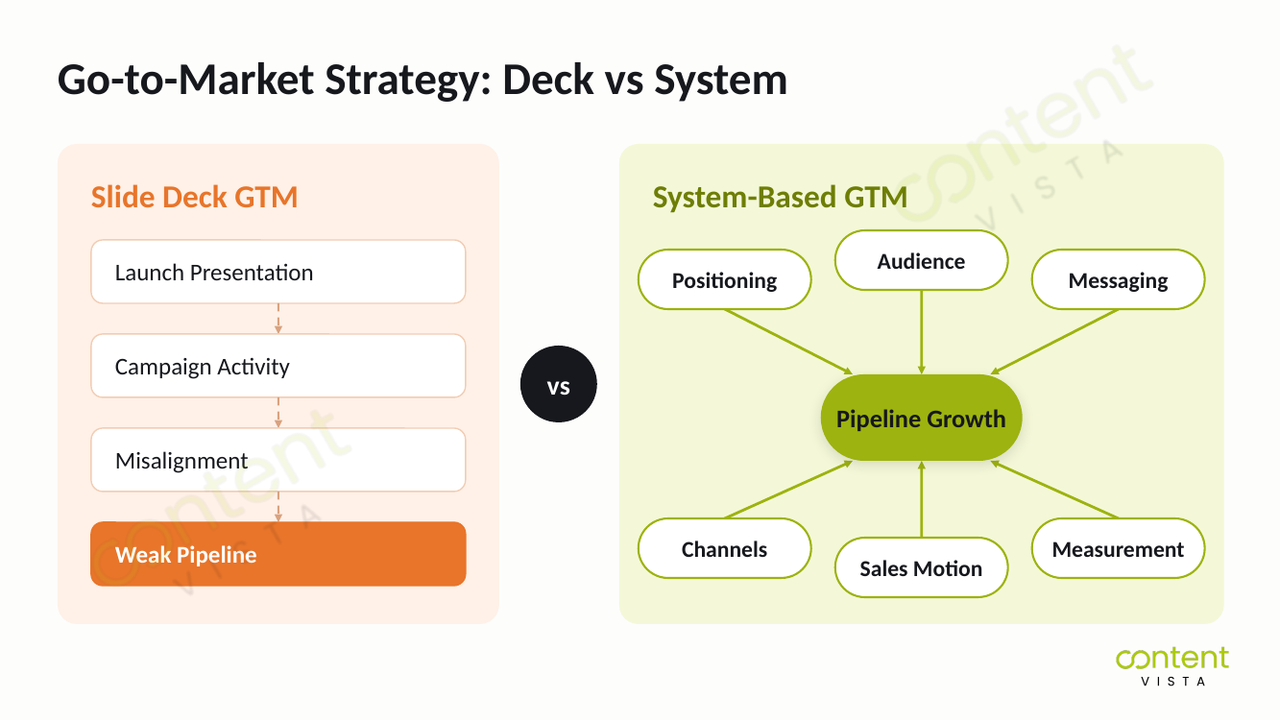
Here's the problem: a go-to-market strategy is not a one-time slide deck. It's the connected system your launch runs on.
A strong GTM strategy aligns who you're targeting, what problem you're solving and how you're positioned.
It also connects the channels you'll use, how sales and marketing work together and what success actually looks like.
Without those connections, launches generate activity. They rarely generate predictable pipeline.
That's why many companies don't struggle with launching.
They struggle with making the launch keep working after day one.
In this guide, we'll move beyond generic frameworks and theory.
You'll see:
5 practical go-to-market strategy examples and why they worked
A fill-in GTM template you can adapt for your own launch (free PDF, no sign-up)
A step-by-step 90-day execution plan that turns strategy into measurable momentum
Whether you're launching a new product, entering a new market, repositioning an existing offer or scaling a service business, the goal is the same.
Build a go-to-market system that survives first contact with the real world.
What is a go-to-market strategy?
A go-to-market (GTM) strategy is the framework that defines how a company brings a product, service, or offer to market. It connects the target audience, positioning, messaging, channels, pricing, sales approach and success metrics into a coordinated system designed to generate adoption, revenue and pipeline growth.
Elements of a go-to-market strategy
Ideal Customer Profile (ICP)
Define exactly who the offer is for and which buyers are most likely to benefit from it.Positioning and Value Proposition
Clarify why the market should care, what problem you solve and how you're different from alternatives.Go-to-Market Motion
Determine how growth will happen: product-led, sales-led, marketing-led, community-led, developer-first or a hybrid approach.Channels
Select the channels that will create awareness, generate demand and drive conversions.Pricing Strategy
Align pricing with perceived value, market expectations and the economics of customer acquisition.Messaging
Create consistent narratives that resonate with buyers at different stages of the decision process.Metrics and Success Criteria
Establish how performance will be measured, from pipeline creation and conversion rates to revenue outcomes.
A useful way to think about a go-to-market strategy is that it answers one central question:
How will this offer reliably reach the right buyers and convert market attention into revenue?
This is where many organisations get confused.
They treat a strategy, a plan and a campaign as if they're the same thing.
They're not.
A go-to-market strategy defines the system.
A go-to-market plan defines how that system will be executed.
A campaign is one of the activities running inside that plan.
For example, a LinkedIn campaign might generate awareness. A webinar might generate demand. An outbound sequence might create sales conversations.
But none of those activities are a go-to-market strategy by themselves.
Without a clear GTM strategy, teams often end up optimising individual tactics while the overall launch struggles to gain traction.
The result? Plenty of activity, but very little alignment between marketing, sales, positioning and pipeline generation.
In the next section, we'll break down the difference between a strategy, a plan and a campaign in practical terms so you can avoid one of the most common GTM mistakes.
Go-to-market strategy vs marketing strategy vs marketing plan: what's the difference?
If you've spent any time researching growth, you've probably seen these terms used interchangeably.
That's a mistake.
A marketing strategy, a go-to-market strategy and a marketing plan are connected, but they solve different problems.
Confusing them usually leads to one of two outcomes. Teams create campaigns without a strategy, or they build strategies that never get put into action.
Here's the difference that actually matters:
A marketing strategy is the overarching system that guides how a company creates demand, builds brand authority, acquires customers and grows revenue over time.
A go-to-market strategy sits beneath that. It's focused on a specific launch, offer, product, service, market expansion or repositioning effort.
It answers the question: How will we successfully bring this particular offer to this particular market?
A marketing plan comes after both. It's the execution layer that translates strategy into activities, timelines, responsibilities, budgets, campaigns and deliverables.
| Area | Marketing Strategy | Go-to-Market Strategy | Marketing Plan |
|---|---|---|---|
| Primary Purpose | Define how the business grows through marketing | Define how a specific offer enters and wins in a market | Define how execution will happen |
| Scope | Company-wide and long-term | Offer-specific or launch-specific | Campaigns, activities, timelines and tasks |
| Key Question | How do we create sustainable growth? | How do we successfully bring this offer to market? | What exactly needs to happen next? |
| Time Horizon | Ongoing | Launch or growth initiative focused | Weeks, months or quarters |
For most readers of this guide, the immediate need is a go-to-market strategy.
You already have something you're trying to launch, scale, reposition or commercialise.
The challenge isn't building a five-year marketing vision.
The challenge is creating alignment between audience, positioning, messaging, channels, sales execution and measurement so that the launch generates pipeline.
Think of it this way:
Marketing strategy defines the direction.
Go-to-market strategy defines the route.
The marketing plan defines the daily driving instructions.
Miss the first, and you lack direction. Miss the second, and your launch stalls. Miss the third, and nothing gets executed.
If it's the bigger picture that's missing, that's where marketing strategy and growth consulting comes in before you build a launch on top of it.
The rest of this guide focuses on the middle layer: building a go-to-market strategy that can survive contact with the market and produce measurable business outcomes.
5 real go-to-market strategy examples (and what made each one work)
The best way to understand go-to-market strategy is to see it in action.
What's interesting about the companies below is that none of them succeeded because they had better tactics.
They succeeded because they matched their product, market, positioning and growth motion in a way that created momentum.
1. Slack: Product-Led Growth Turned Users Into the Sales Team
Here's what's clever about what Slack did: it removed friction from adoption.
Instead of relying on enterprise sales conversations to prove value, Slack made it easy for teams to start using the product immediately through a generous freemium model.
The value proposition was simple and memorable: be less busy.
Once one team adopted Slack, other teams inside the same organisation often followed.
The product itself became the distribution engine. Every new user increased the likelihood of additional users joining.
The go-to-market motion was product-led growth (PLG).
Users experienced the value before making a purchasing decision, reducing the need for traditional top-down selling.
The lesson to borrow: if your product becomes more valuable as more people use it, your GTM strategy should make sharing and expansion effortless.
Salesforce agreed to acquire Slack at an enterprise value of approximately $27.7 billion, according to Salesforce's announcement of the deal, and completed the acquisition in July 2021.
2. Salesforce: Sales-Led Growth Through Category Creation
Salesforce didn't just sell CRM software.
It challenged the dominant way CRM software was delivered.
At a time when many businesses relied on on-premise systems, Salesforce positioned itself around cloud-based CRM and reinforced that positioning through its famous "No Software" messaging.
Rather than competing feature-for-feature, it reframed the category itself.
The go-to-market motion was sales-led. Salesforce invested heavily in enterprise sales, relationship-building and customer acquisition processes designed for larger organisations.
What made the strategy work wasn't just the sales team.
It was the combination of a strong market narrative and a sales engine capable of turning that narrative into revenue.
The lesson to borrow: sometimes the fastest path to growth is not winning an existing category. It's redefining the category buyers use to evaluate solutions.
3. HubSpot: Content as the Go-to-Market Engine
HubSpot's GTM strategy was built around education long before content marketing became mainstream.
The company popularised the concept of "inbound marketing" and then created content, tools, resources and training around that category.
Instead of interrupting buyers, HubSpot focused on helping them solve problems.
The motion combined content-led growth, inbound demand generation and category creation.
Free tools attracted users. Educational content generated trust. Search visibility created a continuous stream of prospects.
Later, a freemium CRM created a natural path from audience to customer.
What's notable is that the content wasn't supporting the GTM strategy: it was the GTM strategy.
The model still compounds today. HubSpot reported total revenue of $3.13 billion for 2025 in its full-year 2025 results.
The lesson to borrow: if buyers need education before they can buy, content can become a primary growth mechanism rather than a supporting marketing activity.
4. Stripe: Developer-First Go-to-Market
Stripe recognised something many software companies missed.
Developers were often the first people evaluating payment infrastructure.
Instead of focusing primarily on executive buyers, Stripe optimised for the people implementing the product.
The company became known for clean APIs, excellent onboarding and documentation that made integration easier.
The result was a developer-first GTM motion.
Rather than forcing prospects through complex sales processes, Stripe reduced friction and accelerated adoption through product experience and documentation quality.
In many ways, the documentation itself became part of the marketing function. Developers could understand, evaluate and implement the product with minimal assistance.
The lesson to borrow: identify the real decision-maker or influencer in the buying journey and design your go-to-market strategy around how they actually evaluate solutions.
5. Notion: Community-Led Growth Through Flexibility
Notion's growth wasn't driven by aggressive advertising.
It was driven by people showing other people what they built.
The product's flexibility allowed users to create workflows, dashboards, knowledge bases, project systems and personal productivity setups.
Those creations naturally became demonstrations of the product's value.
The GTM motion was community-led growth.
Templates encouraged sharing. Ambassadors expanded reach. User-generated content amplified awareness.
The community became an extension of the company's distribution network.
Instead of controlling every use case, Notion embraced adaptability and allowed customers to shape how the product was used.
Notion was valued at $10 billion in its October 2021 funding round.
The lesson to borrow: when customers can customise and showcase outcomes, every successful user can become a powerful acquisition channel.
Slack, Salesforce, HubSpot, Stripe, and Notion all grew differently: but the underlying pattern is the same. Each company aligned its product, audience, positioning and distribution around a specific go-to-market motion rather than trying to be everywhere at once.
That's the key takeaway.
These aren't just company success stories. They're examples of different go-to-market motions: product-led, sales-led, content-led, developer-led and community-led.
The next question is obvious: which motion is right for your business?
That's where most go-to-market strategies either gain traction or break down.
Which go-to-market motion is right for you?
After looking at Slack, Salesforce, HubSpot, Stripe and Notion, it's tempting to ask:
"Which GTM framework should I use?"
But that's not quite the right question.
Product-led, sales-led, community-led and the other motions aren't rival theories you have to pick a side on.
They're different ways of creating adoption, demand and revenue.
The real challenge is choosing the motion that best matches your product, buyer behaviour, sales cycle and market conditions.
So which one fits you? Let's make this practical.
If buyers can experience value quickly without talking to a salesperson, a product-led motion may work.
If deals are large, complex and involve multiple stakeholders, a sales-led approach is often more effective.
If buyers need education before they're ready to purchase, a marketing-led or content-led motion can create demand efficiently.
If your product becomes more valuable when people share it, a community-led approach may accelerate growth.
And if technical users are the primary evaluators, a developer-first motion can dramatically reduce friction.
The key is alignment.
The best go-to-market strategies don't copy what worked for another company. They select the motion that fits how their buyers actually make decisions.
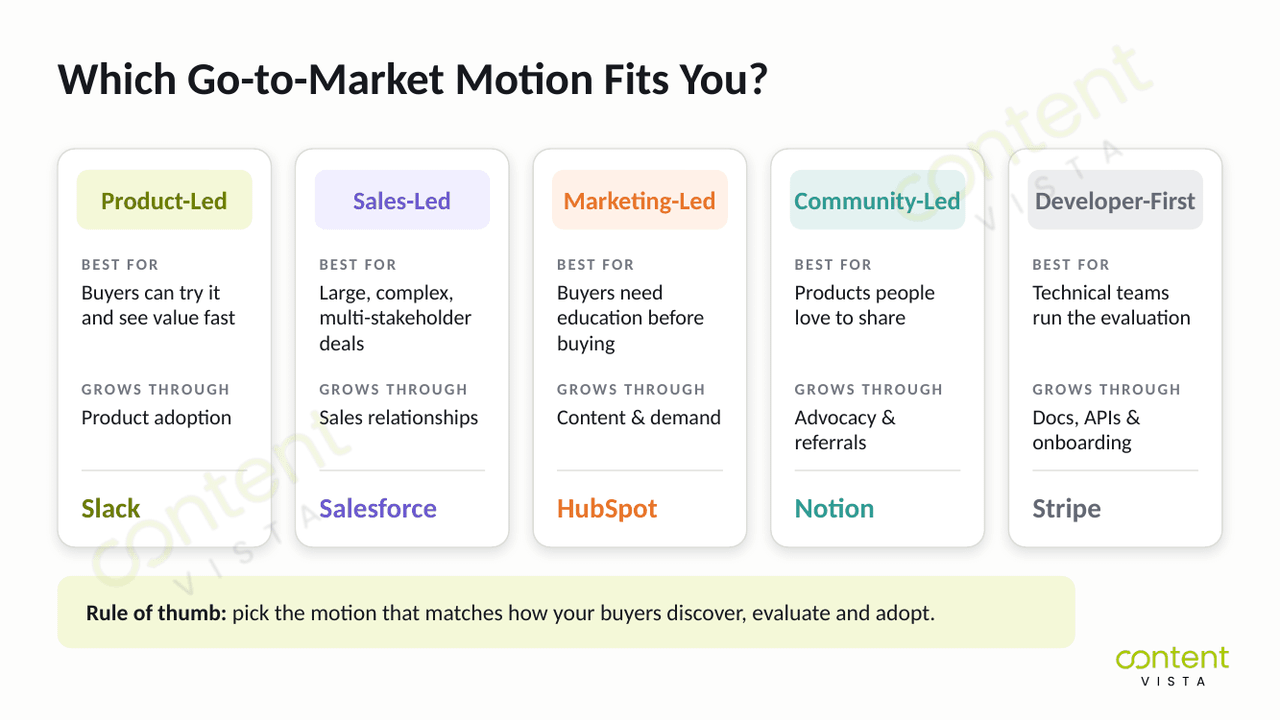
| Motion | Best For | Primary Growth Mechanism | Key Advantage | Example |
|---|---|---|---|---|
| Product-Led | Products users can try and experience quickly | Product adoption and user expansion | Low-friction customer acquisition | Slack |
| Sales-Led | High-value, complex or enterprise purchases | Direct sales conversations and relationship building | Greater control over complex buying journeys | Salesforce |
| Marketing-Led | Markets where education influences buying decisions | Content, campaigns, demand generation and thought leadership | Scalable awareness and demand creation | HubSpot |
| Community-Led | Products that benefit from sharing, advocacy or collaboration | User-generated content, referrals and community participation | High trust and organic growth | Notion |
| Developer-First | Technical products evaluated by developers or technical teams | Documentation, onboarding, APIs and implementation experience | Reduced adoption friction and stronger technical credibility | Stripe |
One more important point: many successful companies combine multiple motions.
A company might use content marketing to generate awareness, product-led onboarding to create adoption and a sales team to convert larger accounts.
The motion that dominates depends on where the biggest growth leverage exists.
Don't choose a go-to-market motion because it's trendy. Choose it because it matches how your buyers discover, evaluate and adopt solutions.
The next step is understanding why so many GTM strategies stall, whichever motion they choose.
Why most go-to-market strategies fail
Most strategy work dies in a slide deck.
The launch gets announced. The messaging gets approved. The roadmap gets presented.
Everyone leaves the meeting feeling aligned.
Then the actual market shows up.
Marketing runs campaigns. Sales creates its own narrative. Different stakeholders interpret the positioning differently.
Pipeline stalls. Momentum fades.
The problem isn't usually a lack of strategy.
It's that the strategy was designed to describe a launch, not run one.
The launch-deck trap
A slide deck can explain a go-to-market strategy.
It cannot execute one.
Here's why: today's buying environment is far more complex than most launch plans assume.
Forrester's State of Business Buying, 2026 found that a typical B2B buying decision now involves 13 internal stakeholders and nine external influencers.
That number rises for more complex or strategic purchases.
And most of those people would rather not talk to a salesperson at all.
In Gartner's survey of 646 B2B buyers, run in August–September 2025, 67% said they prefer a rep-free buying experience, and 45% had used AI during a recent purchase.
So what does that mean for your launch?
Buyers are forming opinions from your website, your content, their peers and AI tools long before sales gets a seat at the table.
Every one of those touchpoints has to tell the same story.
In that environment, disconnected marketing activities become expensive.
A LinkedIn campaign can't compensate for weak positioning.
A sales sequence can't fix messaging confusion.
A webinar won't solve ICP misalignment.
When every channel operates independently, the buying experience becomes fragmented.
And fragmented go-to-market systems struggle to win against connected ones.
So what does that mean in practice?
A real go-to-market strategy doesn't end when the launch happens.
It keeps working after the announcement.
It aligns messaging, channels, sales motions, buyer journeys and measurement into a system that compounds over time.
Instead of creating a burst of activity around launch day, it creates an operating model that continuously turns market attention into pipeline.
And it learns. What you see in the market feeds straight back into who you target and how you position.
That feedback loop sits at the heart of the CORE Growth System™, the way we approach revenue-driven marketing strategy at Content Vista. If you want the bigger picture beyond a single launch, that guide walks you through it.
A launch is an event. A go-to-market strategy is the system that determines whether that event creates a sustained pipeline or quickly fades into noise.
Not sure whether your positioning, ICP, messaging and GTM motion are aligned? Run the GTM Readiness & Positioning Clarity Audit before you build your launch plan.
The go-to-market strategy template (fill this in)
Let's make this practical.
By now, you've seen examples of successful go-to-market strategies and the different motions companies use to drive growth.
The next step is building your own.
The good news? Most GTM strategies are more complicated than they need to be.
If you can answer the seven prompts below clearly and honestly, you'll have the spine of a go-to-market strategy that can actually be executed.
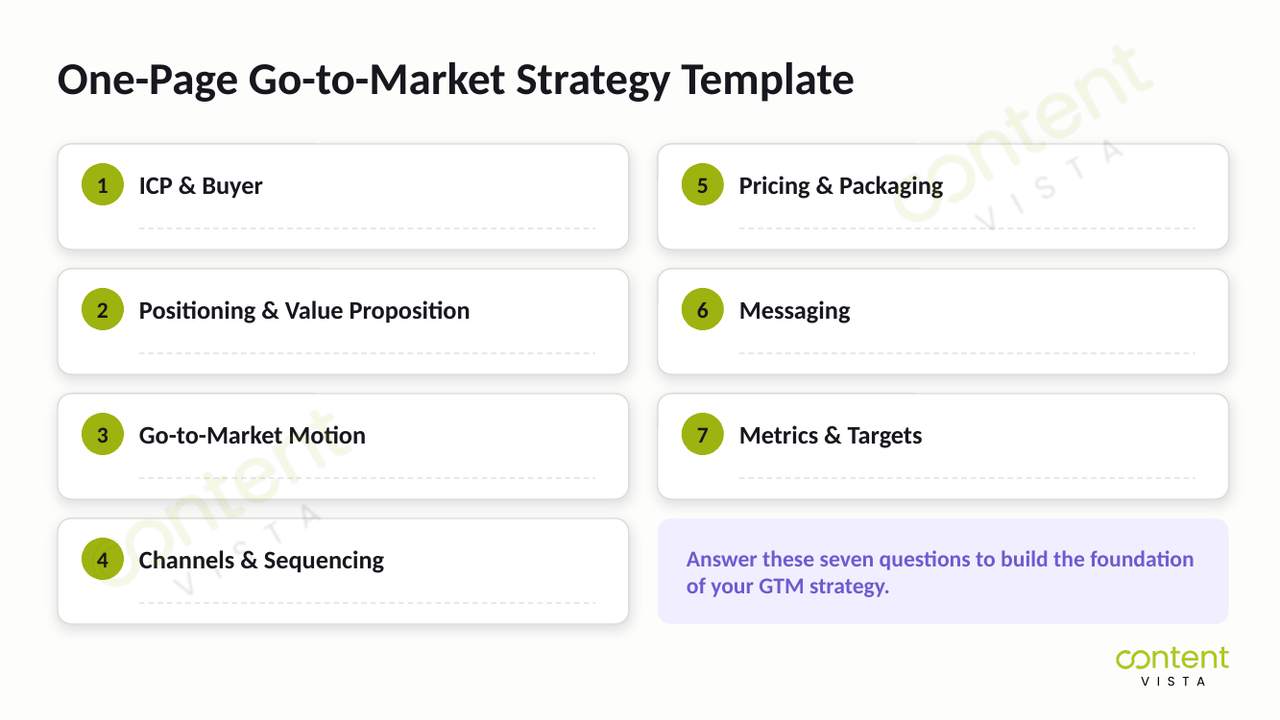
Copy these prompts, answer them honestly and you've got the foundation of your GTM strategy.
Want a ready-made version? Download the free go-to-market strategy template (PDF). It includes all seven prompts, the 90-day plan and the Strategy-or-Tactics Test, and you can type straight into it. No sign-up needed.
Ideal customer profile (ICP) & buyer
Who is this offer specifically for and who is involved in the buying decision?
Prompt:
Which companies, customer segments or buyers experience this problem most acutely and who influences the purchase decision?
The goal isn't to identify everyone who could buy.
It's to identify the people most likely to buy.
If you don't have solid data on your market yet, start with market and competitor research before you fill in the rest.
Positioning & value proposition
Why should your target audience choose you instead of doing nothing or choosing an alternative?
Prompt:
What problem do we solve, for whom and why are we the best option available?
Strong positioning creates clarity.
Weak positioning creates confusion that no amount of marketing can fix.
Stuck here? Our guide to brand positioning strategy walks through the process step by step, and our brand and market positioning team can build it with you.
Go-to-market motion
How will adoption happen?
Prompt:
Will growth be primarily product-led, sales-led, marketing-led, community-led, developer-first or a combination of these?
Choose the motion that reflects how buyers naturally evaluate and adopt solutions: not the motion that's currently popular.
Channels & sequencing
Where will buyers discover, evaluate and engage with your offer?
Prompt:
Which channels will create awareness, generate demand, nurture consideration and drive conversion and in what sequence?
Many GTM strategies fail because they choose channels without mapping the buyer journey that connects them.
Pricing & packaging
How will you package and monetise the offer?
Prompt:
What pricing model, offer structure and packaging approach best align with buyer expectations and business goals?
Pricing isn't just a revenue decision.
It's also a positioning decision.
Messaging
What story will the market hear?
Prompt:
What core message, supporting proof points, objections and outcomes will be communicated consistently across all channels?
If different departments describe your offer differently, buyers will struggle to understand it.
Metrics & targets
How will you know the strategy is working?
Prompt:
What pipeline, revenue, customer acquisition, conversion and growth targets will define success over the next 90 days?
This is where many teams make critical mistakes.
They launch without connecting their GTM strategy to a measurable commercial outcome.
A go-to-market strategy should ultimately support a revenue objective, not just marketing activity.
Before finalising your GTM targets, calculate the gap between your current performance and your desired revenue milestone using the Revenue Milestone Gap Calculator. This helps ensure your go-to-market strategy is aligned with realistic growth requirements.
A strong GTM strategy is surprisingly simple on paper: the right audience, clear positioning, the right motion, coordinated channels, aligned pricing, consistent messaging and measurable targets. Complexity usually appears during execution: not strategy design.
Once you've completed these seven sections, you'll have more than a planning document.
You'll have a strategic blueprint that can guide execution, alignment and decision-making across your launch.
How do you build a go-to-market plan in 90 days?
Most go-to-market guides stop after the strategy template.
That's where execution problems begin.
A go-to-market strategy only creates value when it turns into coordinated action.
That's why the next step is a time-phased operating plan that moves you from clarity to execution.
Here's how it breaks down: three 30-day phases, each with one job.
Get clear. Design the system. Launch and learn.
The full plan is also on page two of the free GTM template, with a checkbox for every task.
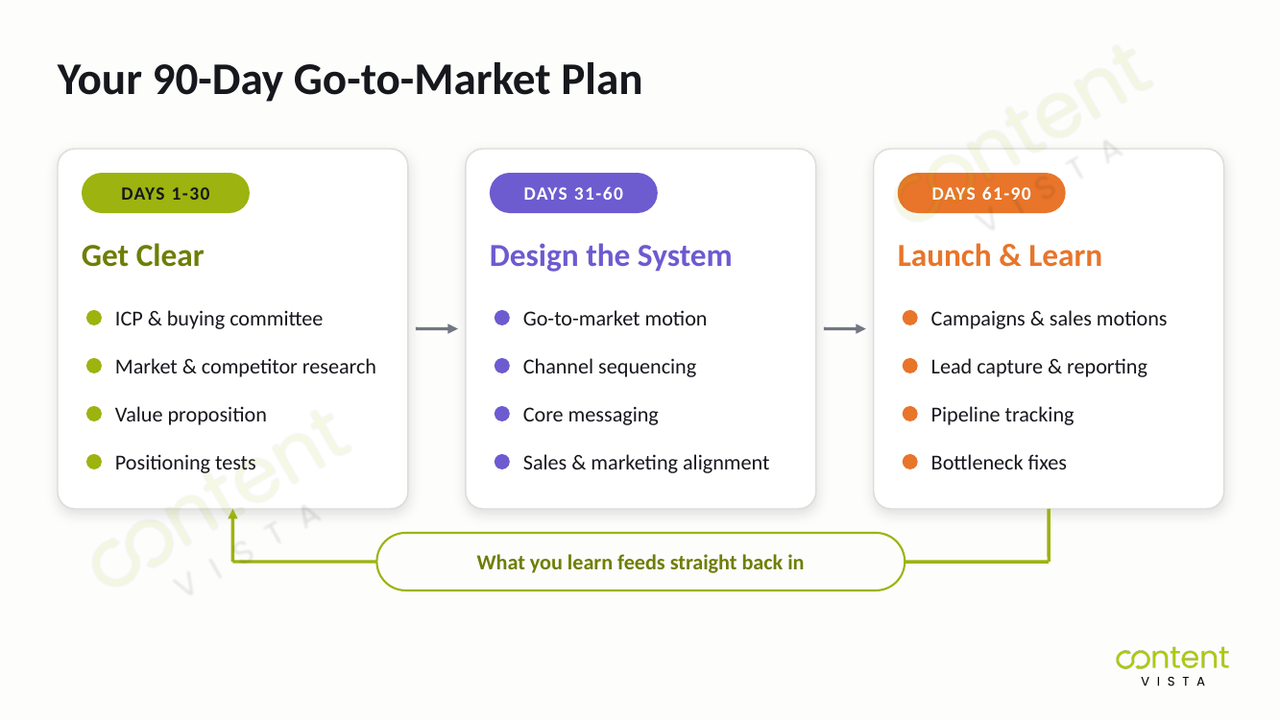
Days 1-30: Get clear on who you're selling to and why
The first month is about eliminating assumptions.
Before you choose channels, campaigns or growth tactics, you need confidence that you're targeting the right audience with the right positioning.
During this phase, focus on:
Defining your ideal customer profile (ICP)
Mapping the buying committee and decision process
Conducting market and competitor research
Clarifying your value proposition
Testing positioning assumptions
Identifying the most important customer problems to solve
Think of this as building the strategic foundation.
Every mistake made here gets amplified later.
In practical terms, week one often looks like stakeholder interviews, customer conversations, market analysis and positioning workshops rather than campaign planning.
Days 31-60: Design your go-to-market system
Once the strategic foundation is clear, move into design.
This is where your go-to-market strategy takes shape.
The objective is to translate clarity into a coordinated growth system.
During this phase, focus on:
Selecting your primary go-to-market motion
Designing channel strategy and sequencing
Creating core messaging frameworks
Aligning sales and marketing teams
Defining launch priorities
Establishing campaign architecture
Mapping how prospects move from awareness to opportunity
Many organisations skip this stage and jump directly from research into execution.
That's usually where launches start to fragment.
This phase ensures every channel, message and activity supports the same commercial objective.
Days 61-90: Launch, measure and learn
The final phase is where strategy enters the market.
Launch activity begins. But equally important, measurement begins.
Focus on:
Activating campaigns
Launching sales motions
Publishing content and demand-generation assets
Standing up lead-capture and reporting infrastructure
Tracking pipeline creation and conversion signals
Identifying bottlenecks and optimisation opportunities
Most teams think evaluation happens after a launch.
High-performing teams evaluate from day one.
What you learn here feeds straight back into your ICP, positioning and messaging.
That's the loop that makes the system get better every quarter.
The goal isn't simply to launch.
The goal is to create a system that learns and improves as it runs.
The most effective go-to-market plans don't treat launch day as the finish line. They treat it as the beginning of a feedback loop that continuously improves positioning, messaging, channel performance and pipeline generation.
What this looks like in practice
Here's the part most launch plans miss: the results come from the connections, not the individual channels.
When we built the go-to-market launch for SalesFed, a brand starting from zero in the federal contracting space, an integrated launch across search, content, webinar funnels and CRM generated $400K in qualified pipeline within six months.
For Alirrium, research-led positioning and thought leadership contributed to acquisition interest from Baker Tilly.
Neither result came from a single campaign.
Both came from getting the foundations right first, then connecting every channel to them.
If you're trying to accelerate this process, a structured sprint can compress months of uncertainty into a few focused weeks.
The Marketing OS Sprint is designed to help teams move from strategic clarity to a practical 90-day GTM roadmap without getting stuck in endless planning cycles.
And if you'd rather have a partner design and run the full launch with you, that's exactly what our go-to-market strategy work is built for.
By the end of 90 days, you shouldn't just have a launch behind you.
You should have a functioning go-to-market system that can be measured, improved and scaled.
Do you have a strategy or just a list of tactics?
Be honest with yourself here.
Many teams think they have a go-to-market strategy when what they actually have is a collection of activities.
A webinar plan.
A LinkedIn campaign.
A launch email sequence.
A content calendar.
An outbound motion.
Those things may all be useful. But tactics are not a strategy.
A strategy connects decisions. Tactics execute decisions.
The fastest way to tell the difference is to run the Strategy-or-Tactics Test.
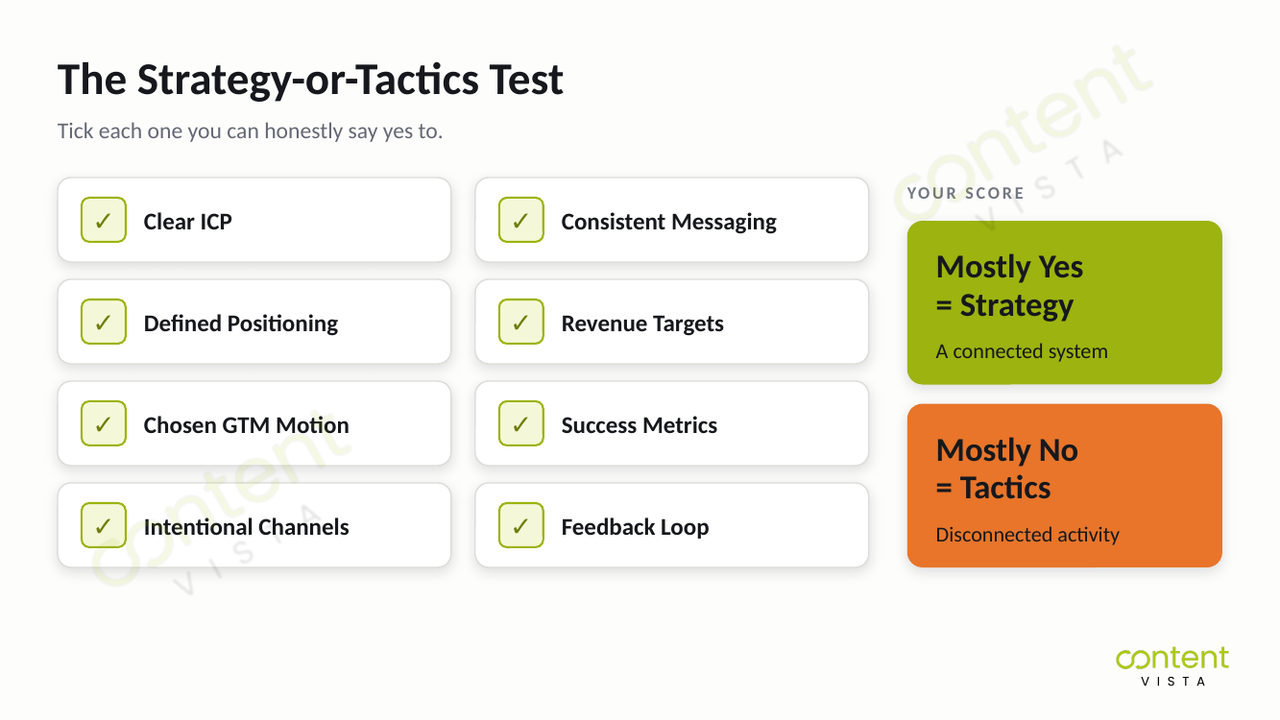
The Strategy-or-Tactics Test
Answer each question with a simple yes or no.
Can you clearly define your ideal customer profile without using broad labels like "small businesses" or "enterprise companies"?
Do you have a positioning statement that explains why buyers should choose you instead of alternatives or the status quo?
Have you intentionally selected a primary go-to-market motion (product-led, sales-led, marketing-led, community-led or developer-first)?
Is there a documented rationale for why you're using specific channels rather than simply following industry trends?
Do sales, marketing and leadership describe the offer using the same core message?
Have you connected your launch activities to measurable pipeline, revenue or growth targets?
Do you know which metrics will determine whether the launch is succeeding or failing?
Is there a process for evaluating results and feeding insights back into future decisions?
If you answered "no" to several of these questions, you probably don't have a go-to-market strategy yet.
You have tactics.
And that's not a criticism: it's one of the most common problems in growth execution.
For a deeper look at the difference, read our guide to marketing strategy vs tactics.
A strategy creates alignment between audience, positioning, motion, channels, messaging and measurement. Tactics are the activities that operate inside that system. If the connections don't exist, you're managing activity: not a go-to-market strategy.
The goal of this test isn't perfection.
The goal is identifying the gaps before launch day.
Because once execution starts, missing strategic decisions become significantly more expensive to fix.
A disconnected launch can still generate activity. But a connected go-to-market strategy is far more likely to generate sustainable pipeline and repeatable growth.
Common go-to-market mistakes (and how to fix them)
If you've made one of the mistakes below, you're in good company.
Most failed go-to-market efforts don't collapse because teams work too little.
They fail because effort gets applied in the wrong order.
The good news? Most of these problems are fixable once you can see them.
Common mistakes and quick fixes
Common Mistake: Treating the go-to-market strategy as a launch event rather than an operating system.
Quick Fix: Design the GTM to continue generating pipeline after launch day through ongoing execution, measurement and iteration.Common Mistake: Choosing channels before defining the ICP.
Quick Fix: Identify exactly who you're targeting before deciding where and how to reach them.Common Mistake: Positioning that sounds like everyone else's.
Quick Fix: Focus on a specific problem, audience and differentiated outcome instead of generic claims like "innovative," "leading" or "end-to-end."Common Mistake: Selecting a go-to-market motion because it's trendy.
Quick Fix: Choose the motion that matches how your buyers actually discover, evaluate and purchase solutions.Common Mistake: Marketing, sales and leadership using different messages.
Quick Fix: Create a shared messaging framework that every customer-facing team works from.Common Mistake: Measuring activity instead of business outcomes.
Quick Fix: Tie campaigns, content, outreach and channel investments to pipeline, revenue and conversion targets.Common Mistake: No clear owner for pipeline generation.
Quick Fix: Establish accountability for pipeline creation, measurement and reporting across the customer journey.Common Mistake: Launching without a feedback loop.
Quick Fix: Build evaluation into the process from day one so insights continuously improve positioning, messaging and execution.
Most go-to-market failures aren't caused by bad tactics. They're caused by missing strategic decisions upstream. When the ICP, positioning, motion, messaging and measurement are aligned, execution becomes dramatically easier.
Notice a pattern?
Almost every mistake above traces back to one issue: disconnects between strategy and execution.
That's exactly why successful teams treat go-to-market as part of a larger system.
They get clear first, design the system second, execute consistently and measure continuously, rather than jumping straight into launch activities.
When you don't need a full go-to-market strategy
Here's something most consultants won't tell you:
Sometimes a full go-to-market strategy is overkill.
Not every growth initiative requires workshops, frameworks, planning sessions and a 90-day roadmap.
Scenario 1: You don't have market validation yet
If you're still figuring out whether customers actually want the product, your biggest problem isn't go-to-market execution.
It's validation.
In this situation, spend your time talking to customers, testing assumptions and proving demand before investing in a full GTM build.
Scenario 2: You're making a small iteration to an existing offer
Launching a new pricing tier, adding a feature or releasing a minor product enhancement usually doesn't require a complete go-to-market redesign.
Instead, update the relevant messaging, enablement and channel assets within your existing motion.
Scenario 3: Your positioning and growth engine are already working
Your ICP is clear. Your positioning is proven. Your channels are producing predictable pipeline.
If you're expanding within an established motion, a full GTM strategy exercise may add unnecessary complexity.
Focus on optimisation rather than reinvention.
So when is a full GTM strategy worth it?
When you're entering a new market, launching a new offer, changing positioning, targeting a different buyer or trying to create a repeatable growth system.
That's when getting the go-to-market design right pays for itself.
If the problem is uncertainty, validate. If the problem is execution, optimise. If the problem is alignment between market, positioning, motion and growth, build a full go-to-market strategy.
The goal isn't to create more strategy documents.
The goal is to apply the right level of strategic thinking to the problem you're actually trying to solve.
How long does a go-to-market strategy take to build?
The honest answer?
Longer than most teams expect and shorter than most teams fear.
A proper go-to-market strategy is not something you create in an afternoon workshop.
But it also shouldn't take six months of endless planning.
The timeline depends on how much clarity already exists.
If your ICP, positioning and market understanding are well-defined, the process moves faster. If those fundamentals are still unclear, most of the effort belongs in the first phase.
Using the 90-day structure above, here's what the process typically looks like:
| Phase | Time | Who's Involved |
|---|---|---|
| Get clear (ICP, positioning, research) | Days 1-30 | Founders, leadership, product, sales, marketing, customer-facing teams |
| Design the system (motion, channels, messaging) | Days 31-60 | Marketing, sales, leadership, growth and revenue stakeholders |
| Launch, measure and learn | Days 61-90 | Marketing, sales, operations, leadership, reporting owners |
The biggest mistake is assuming one department can build the strategy alone.
Marketing may own parts of the process. But positioning, buyer understanding, sales motions, pricing decisions and revenue targets usually require cross-functional input.
That's why strong GTM strategies tend to emerge from collaboration rather than delegation.
The goal isn't to spend 90 days planning. The goal is to spend 90 days moving from strategic clarity to a functioning go-to-market system that is actively generating and measuring pipeline.
If your market, positioning and buyers are already well understood, the timeline can compress significantly.
If those foundations are uncertain, rushing the first phase usually creates bigger delays later during execution.
What metrics show your go-to-market strategy is working?
A lot of teams track activity.
Website traffic.
Content output.
Email open rates.
Social engagement.
Those metrics can be useful. But they don't tell you whether your go-to-market strategy is creating business outcomes.
The real question is:
Is the strategy generating efficient, repeatable revenue growth?
Here's what to actually watch.
| Metric | What It Tells You | Healthy Direction |
|---|---|---|
| Qualified Pipeline | Whether your GTM system is creating genuine sales opportunities, not just attention | Increasing |
| Win Rate | How effectively your positioning, messaging and sales process convert opportunities into customers | Increasing |
| Customer Acquisition Cost (CAC) | The total cost of acquiring a new customer | Decreasing |
| CAC Payback Period | How long it takes to recover acquisition costs from customer revenue | Shortening |
| Sales Cycle Length | How quickly buyers move from first engagement to closed business | Shortening |
Notice that these metrics work together.
If qualified pipeline is growing but win rates are falling, you may have a targeting or positioning problem.
If win rates are strong but CAC keeps rising, your acquisition model may be becoming less efficient.
If pipeline is healthy but sales cycles are getting longer, friction may exist somewhere in the buying journey.
That's why evaluating a go-to-market strategy requires looking at the system, not a single number.
If you're trying to understand acquisition efficiency, calculate your true customer acquisition economics using the True CAC & Marketing ROI Calculator. It can help identify whether growth is actually becoming more efficient over time.
The most important GTM metric is usually the qualified pipeline. It sits upstream of revenue and reveals whether your positioning, messaging, channels and motion are creating the right buying opportunities in the first place.
The goal isn't to track more metrics.
It's to track the handful of metrics that tell you whether your go-to-market system is creating sustainable growth and where the next optimisation opportunity exists.
Go-to-market strategy FAQs
What is a go-to-market strategy, with an example?
A go-to-market strategy is the connected system used to bring a specific product, service or offer to a specific market. It aligns your target customer, positioning, messaging, channels, pricing and sales motion. For example, Slack used a product-led go-to-market strategy, allowing teams to adopt the product through a generous freemium model before expanding usage across organisations.
What are the 5 elements of a go-to-market strategy?
The core elements are: target customer (ICP), positioning and value proposition, go-to-market motion, channels and distribution, and measurement. Most organisations also include pricing, packaging and messaging because those decisions directly influence adoption, conversion and revenue outcomes.
What's the difference between a go-to-market strategy and a marketing strategy?
A marketing strategy defines how the business creates and captures demand over time. A go-to-market strategy focuses on bringing a specific offer to a specific market. A marketing plan sits downstream from both and contains the execution details, campaigns, timelines and activities.
What does a 90-day go-to-market plan look like?
A practical 90-day go-to-market plan follows three phases. The first 30 days focus on market research, ICP definition and positioning. The next 30 days focus on motion selection, channel design and messaging. The final 30 days focus on launch execution, pipeline generation, measurement and optimisation.
What are the main go-to-market motions?
The most common go-to-market motions are product-led, sales-led, marketing-led, community-led and developer-first. Think of them as strategic choices rather than rival frameworks: they determine how buyers discover, evaluate, adopt and purchase your offer.
How long does it take to build a GTM strategy?
Most teams can create a workable go-to-market strategy within 30-60 days if they already understand their market. Building, validating, launching and running the strategy as a complete system typically takes closer to 90 days.
What metrics show a GTM strategy is working?
The most useful indicators are qualified pipeline, win rate, customer acquisition cost (CAC), CAC payback period and sales-cycle length. Together, these metrics reveal whether your strategy is generating the right opportunities, converting them efficiently and producing sustainable growth.
When do you not need a full go-to-market strategy?
You may not need a full go-to-market strategy if you're still validating whether a market exists, making a minor iteration to an existing offer or operating a proven acquisition system with stable positioning. In those situations, focused testing and optimisation are usually more valuable than a complete GTM rebuild.
Before you scale spend, pressure-test your strategy
Most launches don't fail because of poor execution.
They fail because the strategy underneath them was never connected in the first place.
A go-to-market strategy is not a launch announcement, a campaign calendar or a collection of channels.
It's the system your launch runs on.
It connects your ICP, positioning, motion, messaging, channels and measurement into something that can create pipeline long after launch day is over.
In this guide, you've seen what that looks like in practice: real go-to-market strategy examples, a fill-in template, a way to choose the right motion and a 90-day plan to put it all into action.
The question now isn't whether you have a launch plan.
It's whether the strategy behind it is strong enough to justify putting more budget, people and expectations behind it.
Before you scale spend, pressure-test the foundations.
Take the GTM Readiness & Positioning Clarity Audit to identify gaps in your positioning, market alignment, messaging and go-to-market readiness before they become expensive execution problems.
The strongest go-to-market strategies compound because they start with clarity, connect every moving part and continuously improve through feedback.
That's what turns a launch into pipeline.