Quick Summary
- CEO personal branding strategy is an inbound demand channel, not a popularity contest, when it is built as a system.
- The goal is not to make a CEO visible everywhere; it is to turn executive expertise into trust, category clarity and qualified conversations with the right ICP.
- This guide gives you the reframe, The Authority Engine™ operating model, an ICP-first content approach and a practical way to measure what matters: pipeline influence, market trust and sales conversations.
Why most CEO personal branding advice quietly fails
Here’s the problem:
Most CEO personal branding advice is built for visibility, not revenue.
It tells founders and executives to post more often, share opinions, build a following, sound authentic and become “more visible.” None of that is wrong.
But by itself, it does not create an inbound pipeline.
It usually creates scattered attention: more impressions, more likes, maybe more profile views, but not necessarily more trust from the right buyers.
That is where the frustration starts.
A CEO may already have strong expertise. Their team may respect them, and clients may trust them once they get into a conversation.
The market may even see them as credible. But credibility alone does not automatically create demand.
Expertise earns respect. A system turns that expertise into buyer belief, category clarity and qualified conversations.
This is why many executive brands feel active but commercially weak.
The CEO is visible, but the message is not tied to a clear ICP. The content is consistent, but not connected to a strategic point of view.
The audience grows, but the right buyers still do not understand why this leader, this company and this solution should matter now.
The real question is not, “How do we make the CEO more popular?”
It is: “How do we turn executive expertise into a repeatable trust-building channel?”
That is the reframe this guide is built around.
What is a CEO personal branding strategy?
A CEO personal branding strategy is a structured plan for turning an executive’s expertise, point of view, credibility and visibility into market trust. It defines who the CEO must influence, what they should be known for, where they should show up and how their authority supports business growth.
At a basic level, a CEO personal brand is different from a corporate brand.
The corporate brand answers: “What does the company stand for?”
The CEO's personal brand answers: “Why should the market trust the person leading it?”
Both matter.
A strong company brand creates recognition, consistency, and commercial credibility. A strong CEO brand adds a human authority layer on top of that.
It gives buyers, partners, investors, talent and industry stakeholders a person to believe, follow and remember.
But this is where most definitions stop too early.
They describe CEO personal branding as reputation management, thought leadership, visibility or social media presence. Those are pieces of the system. They are not the strategy.
Think about it this way:
If the CEO is posting consistently but the content is not tied to the company’s category, ICP, market problem, strategic point of view or sales narrative, the brand may become visible without becoming commercially useful.
A real CEO personal branding strategy connects four things:
The CEO’s lived expertise
The buyer’s actual problem
The company’s market position
The trust needed before a sales conversation happens
That is why this article treats CEO personal branding as the authority layer of a growth system.
The goal is not to turn the CEO into an influencer. The goal is to make executive expertise easier for the right market to understand, trust and act on.
When done well, the CEO’s brand helps clarify the category, educate the market, de-risk the buying decision and create warmer inbound conversations.
It becomes part of demand generation, not because the CEO is famous, but because their thinking helps the right buyers see the problem differently.
Does CEO personal branding actually drive pipeline?
Yes, but not in the simplistic “post more, get leads” way.
CEO personal branding drives the pipeline when it helps the right buyers trust the company before they ever speak to sales.
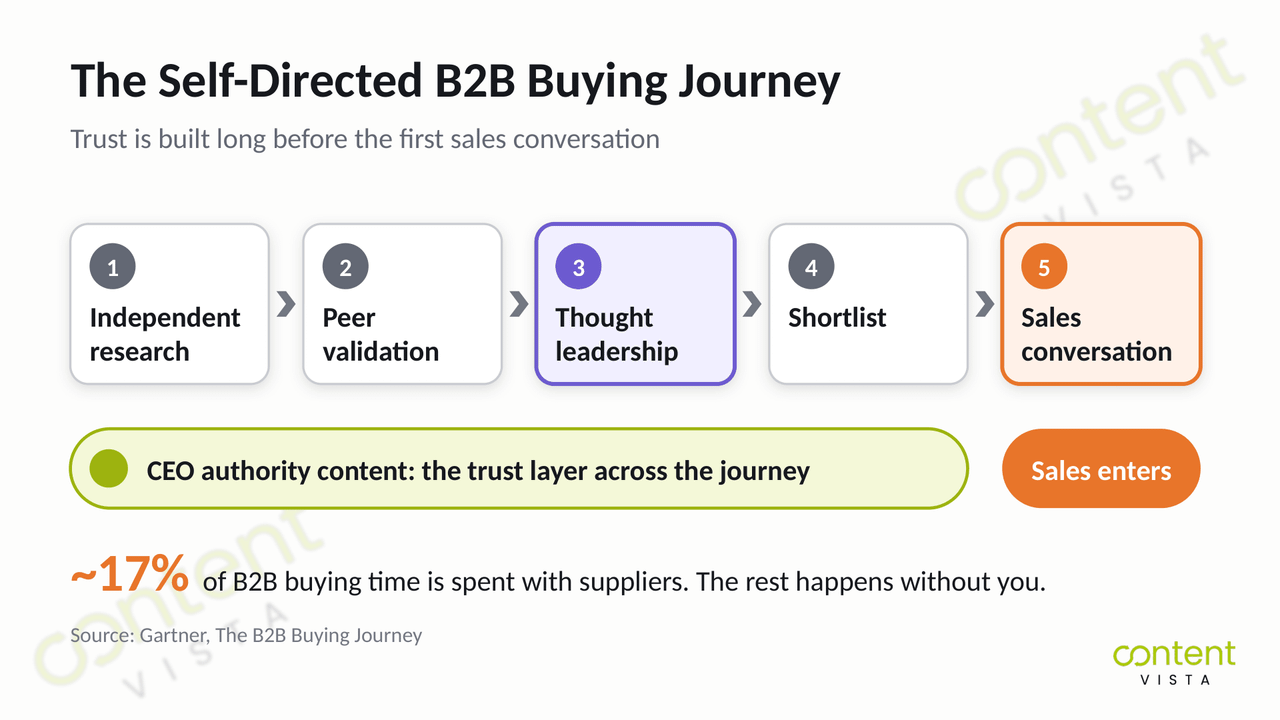
That matters because modern B2B buying is increasingly self-directed, committee-led and research-heavy.
According to Gartner's research on the B2B buying journey, complex B2B purchases typically involve 6-10 decision-makers, and buyers spend only about 17% of their buying time meeting with potential suppliers.
That 17% is split across every supplier being considered, not just your company. When buyers compare several options, the time spent with any one sales rep may be as little as 5-6%.
And the shift is accelerating. In Gartner's March 2026 sales survey of 646 B2B buyers, 67% said they prefer a rep-free buying experience, up from 61% in the previous year's survey.
So what does that mean for you?
It means the buyer is forming opinions long before your sales team gets a meaningful conversation.
They are reading, comparing, asking peers, checking LinkedIn, reviewing leadership content, watching how your company explains the problem and deciding whether your point of view feels credible.
That is where CEO authority becomes commercially important.
A CEO’s personal brand is not a replacement for positioning, sales, product or demand generation. But it can become the trust layer that makes all of them work better.
When the CEO consistently explains the market problem, challenges weak assumptions, clarifies what buyers should look for and shows strategic judgment, the buyer gets a reason to trust the company earlier in the journey.
The trust data supports this.
The 2024 Edelman-LinkedIn B2B Thought Leadership Impact Report found that 75% of B2B decision-makers and C-suite leaders say a piece of thought leadership led them to research a product or service they were not previously considering.
The same research found that 73% say thought leadership is a more trustworthy basis for judging a company’s capability than its marketing materials and product sheets.
That is the real pipeline argument.
Not “CEO posts get likes.”
But: executive expertise, made visible and structured around the buyer’s questions, can shape consideration before the buyer enters the sales process.
It helps your company become easier to trust, easier to remember and easier to include on the shortlist.
Personal branding is a demand channel, not a popularity contest
Here’s the shift:
A CEO's personal brand should not sit outside the growth strategy as a separate “visibility project.” It should sit inside the same system that turns market clarity into a pipeline.
It is not the whole strategy. It is not a substitute for positioning.
And it is not a shortcut around weak offers, unclear ICPs or broken funnels.
It is one demand channel inside a broader revenue-driven marketing strategy, the part that turns what your leader knows into trust the market can feel.
Here is how the two approaches compare in practice:
| Dimension | The visibility approach | The demand-system approach | Business impact |
|---|---|---|---|
| Starting point | The founder's bio and achievements | The buyer's problems and the buying committee | Content that resonates with real decision-makers |
| Goal | Followers, likes and reach | Qualified inbound pipeline | A measurable contribution to growth |
| Measurement | Vanity metrics | Pipeline influence, deal velocity and shortlist inclusion | A business case leadership can defend |
| Structure | Random acts of posting | A connected operating system | Authority that compounds over time |
The demand-system approach needs an operating model. That is what The Authority Engine™ is for.
It takes what the CEO knows, believes, sees and has learned. It then converts that into strategic content, repeatable narratives, buyer education, trust-building assets and measurable commercial signals.
That distinction matters.
Posting is an activity. Authority is an asset. Demand is the outcome of putting that asset into a system.
When the CEO shares disconnected opinions, the market may notice.
When the CEO repeatedly clarifies the buyer’s problem, challenges category assumptions, explains what good looks like and connects that thinking back to the company’s positioning, the brand becomes easier to trust before the sales conversation starts.
That is the “aha”:
The CEO is not trying to become popular.
The CEO is helping the market understand why the problem matters, why the company’s point of view is credible and why the next conversation is worth having.
The Authority Engine™: how executive authority becomes pipeline
Let’s make this practical:
The Authority Engine™ is the operating system for turning a CEO’s expertise into market trust and inbound demand. It is not a content calendar.
It is a connected loop that extracts what the CEO knows, shapes it into a strategic point of view, distributes it through the right themes and channels, engages the right audience, and connects that attention back to the pipeline.
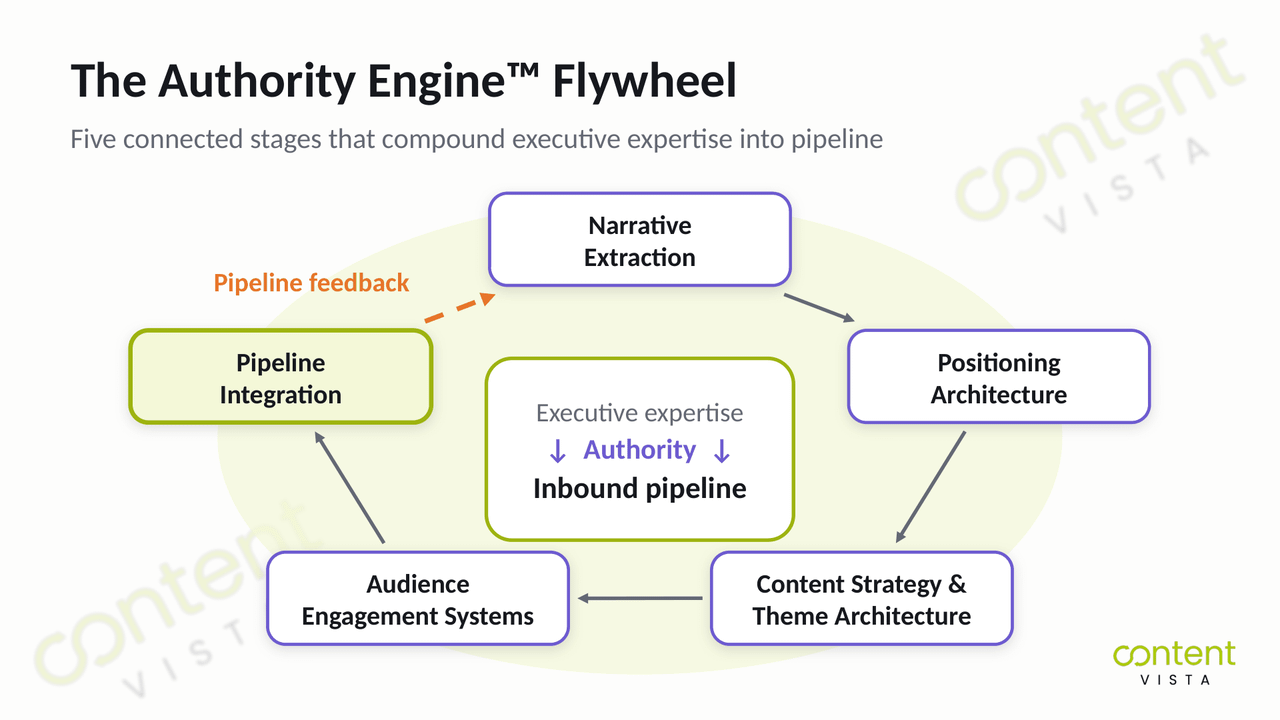
1. Narrative Extraction
This is where the raw material comes from.
Before the CEO starts posting, speaking or publishing, you need to extract the ideas that actually make them credible.
That means hard-earned lessons, market beliefs, customer patterns, category frustrations, contrarian opinions, founder stories, decision principles and repeated sales-room insights.
The output is not “content ideas.” The output is a strategic bank of executive thinking that can be turned into repeatable narratives.
2. Positioning Architecture
Narrative without positioning becomes scattered opinion.
Positioning Architecture connects the CEO’s point of view to the company’s ICP, category, market problem and commercial direction.
This is where you define what the CEO should be known for, who they must influence, which problems they should repeatedly clarify and which beliefs the market needs to adopt before buying.
This is also where Founder & Executive Positioning becomes critical: the personal brand must reinforce the business strategy, not compete with it.
3. Content Strategy & Theme Architecture
Once the positioning is clear, the content system needs structure.
Theme Architecture turns executive expertise into recurring content territories: market education, category POV, buyer mistakes, founder lessons, strategic frameworks, customer problems, industry shifts and decision guidance.
This prevents random posting. It gives the CEO a repeatable way to show up with depth while making the message easier for buyers to remember.
4. Audience Engagement Systems
Authority does not build through broadcasting alone.
The CEO needs an engagement system around the right audience: ICP accounts, industry peers, partners, customers, analysts, media, investors, creators and internal leaders.
This includes thoughtful commenting, strategic replies, relationship-building, newsletter or community touchpoints, event participation and direct conversations sparked by content.
The output is not just reach. It is familiarity with the people who shape demand.
5. Pipeline Integration
This is the step most CEO branding advice misses.
Authority must connect to the commercial system. That means clear routes from executive content to diagnostics, service pages, newsletter assets, webinars, sales conversations, case studies and CRM signals.
The goal is not to attribute every post to a closed deal.
The goal is to make authority visible inside the buying journey, so sales teams hear warmer context, prospects understand the point of view earlier and inbound conversations become easier to qualify.
The Authority Engine compounds because each loop sharpens the next one: market feedback improves the narrative, narrative strengthens positioning, positioning improves content, content attracts better conversations and those conversations reveal what buyers need to hear next.
Before building a CEO authority engine, pressure-test whether your positioning and GTM story are clear enough to support it. Take the GTM Readiness & Positioning Clarity Audit.
Start from the buyer, not the bio
Here’s where most teams go wrong:
They start CEO personal branding with the executive’s bio.
They ask: What is the CEO’s story? What are their values? What makes them different? What topics do they want to talk about?
Those questions matter, but they are not the starting point. They are inward-looking.
If you start there, you usually end up with a polished personal narrative that sounds credible but does not help the buyer think, decide or advocate.
The better starting point is the buyer.
In complex B2B purchases, Gartner notes that buying groups often involve 6-10 decision-makers. That means your CEO rarely speaks to one person.
They may need to influence the economic buyer, the technical evaluator, the department head, the internal champion, procurement, and hidden stakeholders who shape the decision without ever appearing in your CRM.
That changes the job of executive authority.
The CEO’s point of view should not simply answer, “What do I believe?” It should answer:
What problem does our best-fit buyer need to understand better?
What false assumptions are slowing their decision?
What risks do internal champions need help explaining?
What language can help the buying committee align around the problem?
What belief must change before our solution feels necessary?
This is why positioning has to come before publishing.
You need clarity on who you serve, what problem you own, what category belief you are building and why your perspective is worth trusting.
That is also why brand and market positioning matters before content scale. If you want to work through that foundation first, our guide to brand positioning strategy walks through it step by step.
The hidden-buyer data makes this even more important.
The 2025 Edelman-LinkedIn B2B Thought Leadership Impact Report found that 79% of hidden decision-makers are more likely to advocate for a company’s proposal in the RFP process when that company consistently produces high-quality thought leadership.
In other words, your CEO content is not just for the person who books the call.
It is for the people behind the scenes who help decide whether your company belongs on the shortlist.
That is the real ICP-first move: reverse-engineer the CEO’s narrative from the buying committee’s doubts, risks, priorities and internal persuasion needs.
Not from the executive’s résumé.
What should a CEO actually post about?
The best CEO content pillars do not come from the founder’s résumé. They come from the buyer’s problems.
A weak content strategy starts with: “What topics can the CEO talk about?”
A stronger one starts with: “What does our best-fit buyer need to understand before they trust us?”
That one shift changes everything.
Instead of building pillars around generic themes like leadership, culture, growth, innovation and entrepreneurship, build them around the moments where your buyer is confused, stuck, misled or under pressure.
Those are the places where executive expertise can create demand.
A practical CEO content system might include pillars like:
Market problem: what is changing, breaking or becoming harder for the buyer?
Buyer mistakes: what do companies commonly misunderstand before they look for help?
Category point of view: what does the CEO believe the market needs to stop, start or rethink?
Decision guidance: how should buyers evaluate options, risks, trade-offs or partners?
Proof of thinking: what lessons, frameworks, stories, or operating principles show how the company thinks?
Company narrative: how does the business solve the problem differently, without turning every post into a pitch?
This is the Content Strategy & Theme Architecture stage of The Authority Engine™.
It turns raw executive insight into repeatable content territories, so the CEO does not have to reinvent the strategy every week.
LinkedIn is usually the primary node for this because it is where buyers, peers, partners, talent and industry operators already evaluate professional credibility. If you need a starting bank of formats, our list of LinkedIn post ideas is a useful place to begin.
But LinkedIn is not the whole strategy.
The strongest CEO authority systems use LinkedIn as the front door, then connect it to newsletters, webinars, podcasts, website content, sales enablement, founder notes, case studies and internal thought leadership assets.
The tone matters too.
CEO content should sound like a sharp human with lived experience, not a corporate brochure wearing a personal profile picture.
Over-delegation is the risk here. A team can run the engine, but they cannot manufacture the founder’s judgment from nothing.
A simple operating rhythm works best:
The CEO supplies raw insight through voice notes, short interviews, meeting debriefs, sales-call reflections or rough bullets.
The team turns that into structured themes, drafts, edits, repurposed assets and publishing workflows. The CEO reviews for accuracy, sharpness and voice.
That is sustainable for time-poor founders.
The goal is not to make the CEO spend hours writing posts. The goal is to build a system where their real thinking reaches the right market consistently.
Why authority compounds (the 95-5 reality)
Most CEO personal branding fails because teams expect every post to create immediate demand.
But most of your market is not ready to buy right now.
That is the useful idea behind the 95-5 rule, developed by Professor John Dawes of the Ehrenberg-Bass Institute and published in the Ehrenberg-Bass Institute and LinkedIn B2B Institute's How B2B Brands Grow research.
The principle is simple: at any given time, a small share of your market is actively buying, while a much larger share is out-of-market but may buy later.
The important caveat: this is a heuristic, not a literal law.
Dawes himself has said the 95% figure is not meant to be a precise rule, and the split will vary by category.
The point is not that every market is precisely 95% out-of-market and 5% in-market. The point is that future buyers matter.
That is where executive authority compounds.
If your CEO only creates content for buyers who are ready to act today, the strategy becomes too narrow. It starts sounding like sales enablement in public.
But when the CEO consistently explains the market problem, names common mistakes, challenges weak assumptions and teaches buyers how to think, the brand builds familiarity before the buying window opens.
In short:
Authority content works because it earns memory before urgency.
The out-of-market buyer may not need a vendor this quarter. But they can still begin to trust a point of view, remember a category narrative and associate the CEO’s company with a specific problem.
Then, when they move in-market, the company is no longer a cold option. It is already familiar.
That is why consistency matters.
Not because the algorithm demands constant posting, but because trust is built through repeated, useful signals over time.
How do you measure executive thought leadership ROI?
That’s the real issue:
Most teams measure CEO personal branding like social media performance, not like a demand channel.
They look at followers, likes, impressions, comments and post reach. Those numbers are not useless, but they are not the business case.
A post can perform well publicly and create no meaningful buyer movement.
Another post can get modest engagement but influence a high-value prospect, support an internal champion or make a sales conversation warmer.
To measure executive thought leadership ROI, separate visibility from influence.
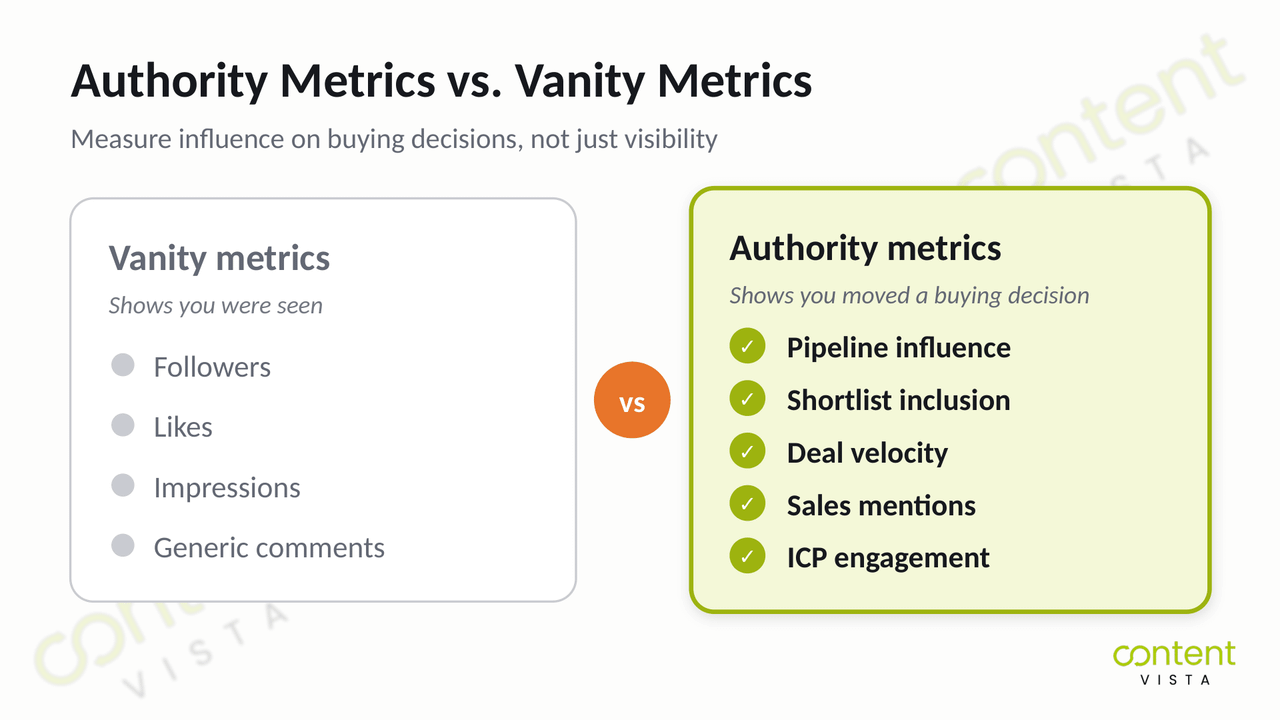
| Metric type | What to track | What it tells you |
|---|---|---|
| Authority metrics | Pipeline influence, sales conversations referencing CEO content, shortlist inclusion, deal velocity, account engagement, share of voice | Whether executive authority is shaping trust, consideration and buying conversations |
| Vanity metrics | Followers, likes, impressions, generic comments, profile views | Whether content is visible, but not necessarily whether it is influencing demand |
The mistake is expecting clean last-touch attribution from a trust-building channel.
A buyer may read a CEO’s posts for months, share one internally and mention the company in a team discussion.
Then they arrive through branded search, a referral, a webinar or a direct website visit. If you only measure the final click, executive authority will look weaker than it actually is.
You are not alone in this gap.
Edelman and LinkedIn's 2024 research found that only 29% of thought leadership producers can link sales leads or business wins back to specific thought leadership efforts.
That is why measurement has to work like a feedback loop, not a final-click report.
You are not just asking, “Which post generated a lead?” You are asking, “Is CEO authority improving the quality, speed, and warmth of our market conversations?”
That is exactly what the Pipeline Integration stage of The Authority Engine™ is for.
Thought leadership should connect to CRM notes, sales feedback, content-assisted opportunities, diagnostic completions, newsletter replies, event conversations and account-level engagement.
Key metrics to track:
* Pipeline influenced by executive content
* Sales calls where CEO content is mentioned
* Shortlist or RFP inclusion influenced by thought leadership
* Deal velocity for content-aware opportunities
* Share of voice around the CEO’s core category themes
* Quality of inbound conversations
* Engagement from ICP accounts, not just broad audience growth
Want to benchmark whether your founder authority is actually supporting demand? Use the Founder Authority & Audience Engine Benchmark to see your authority score and your biggest audience-engine gap.
Common mistakes that turn authority into noise
The mistake is simple:
Teams confuse activity with authority.
A CEO can post consistently, sound polished and still fail to build meaningful demand if the content is not connected to positioning, buyer problems and pipeline.
Executive authority does not come from being present everywhere. It comes from being repeatedly useful to the right market.
Common mistakes that weaken CEO authority:
Over-delegation into faceless corporate soup: The post sounds like the company wrote it, not the CEO. Fix it by capturing the CEO’s actual judgment through interviews, voice notes, sales-call reflections and sharp editing.
Résumé-led narrative instead of buyer-led narrative: The content talks about the CEO’s journey, achievements and values, but not the buyer’s problem. Fix it by starting every theme with the ICP’s pain, risk, confusion or decision point.
Chasing followers instead of pipeline: The team optimises for reach, likes and audience size, even if the audience is commercially irrelevant. Fix it by tracking ICP engagement, sales mentions, shortlist influence and qualified conversations.
Inconsistency: The CEO appears in bursts, then disappears. Fix it with a lightweight operating rhythm where the CEO supplies raw insight and the team runs the publishing engine.
Posting without positioning: The content is thoughtful but scattered, so the market does not know what the CEO or company should be remembered for. Fix it by tying content pillars to a clear category point of view, buyer problem and commercial narrative.
The deeper issue is not that these teams lack content ideas. It is that they lack an authority system.
When CEO branding is not anchored in the buyer, the category, and the company’s growth strategy, it becomes noise.
When it is structured through The Authority Engine™, it becomes a repeatable way to build trust before buyers raise their hands.
When NOT to invest in CEO personal branding
CEO personal branding is powerful when the foundation is ready. But it is not always the first move.
Sometimes, the honest answer is: fix the foundation first.
When NOT to invest in CEO personal branding yet:
When positioning is unclear: If the company cannot clearly explain who it serves, what problem it owns and why its point of view matters, CEO content will only amplify confusion. Fix the positioning first.
When the founder cannot provide raw input: A team can edit, structure, repurpose and run the publishing system. But if the CEO cannot give interviews, voice notes, opinions, examples or decision-making insight, the content will become generic.
When the conversion path is broken: If people trust the CEO but land on a vague website, unclear offer, weak proof or confusing next step, authority will leak before it becomes a pipeline. Fix the buyer journey first.
When the goal is only popularity: If the business is chasing followers, impressions or personal fame without a commercial narrative, the strategy will drift. Define the role of authority inside the growth system first.
When there is no internal follow-through: If inbound interest is not captured, qualified, nurtured or routed to sales, CEO visibility will create attention without a system to convert it.
This does not mean executive authority should wait forever. It means sequencing matters.
CEO personal branding works best once the foundation is strong enough to support it: clear ICP, clear positioning, clear narrative, clear offer and a conversion path that can turn trust into action.
What this looks like when it works
A strong CEO personal branding strategy does not start with “be more active.”
It starts with market understanding, positioning clarity and a system for turning executive expertise into trust.
A good example is Personam, where we built founder personal branding in B2B cybersecurity from zero.
The work did not begin with random content topics. It began with a 26-competitor market study that informed the positioning.
That mattered because cybersecurity buyers do not need another generic founder voice.
They need a clear point of view, category relevance and trust signals that make the company easier to understand and remember.
From that foundation, the authority system helped build:
41.8% newsletter open rate
21.2% newsletter click-through rate
1,000+ LinkedIn followers from zero
The important point is not that LinkedIn grew.
The important point is that founder authority was built around a clear market narrative rather than disconnected posting.
Another example is Akshar Business Consulting.
There, founder-led positioning helped turn expertise into an audience and an inbound engine. The result was £200K+ in estimated pipeline, 4,000+ newsletter subscribers and an Adobe CFO speaking engagement.
Neither example works because the founder became “popular.”
They work because the founder’s expertise was connected to a business narrative, a content system and a buyer-facing point of view.
That is the difference between personal branding as activity and personal branding as an authority engine.
Building it as a system that compounds
So where do you start?
Start by deciding whether CEO personal branding is going to be treated as a content activity or a growth system.
That is the difference between vanity branding and a real demand channel.
Vanity branding asks, “What should the CEO post this week?”
A demand system asks, “What market belief are we trying to build, which buyers need to hear it, how will we repeat it and where does that attention go next?”
You can build this in-house if you already have three things: positioning clarity, access to the CEO’s real thinking, and a team that can turn raw insight into strategy, content, engagement and pipeline signals.
In that case, the job is not to outsource the CEO’s voice. It is to create a repeatable operating rhythm around it.
You may need outside help when the issue is more foundational: unclear ICP, weak category narrative, scattered content themes, no executive point of view or no connection between authority and GTM.
That is where Marketing Strategy & Growth Consulting becomes useful, not as “personal branding support,” but as the strategic layer that makes the authority system worth building.
The first move is positioning clarity.
Before you scale executive visibility, pressure-test the company story, the buyer problem, the category point of view, and the GTM path. Our go-to-market strategy template gives you a structured way to do exactly that.
Then build in order.
Get the positioning clear. Build the engine around the CEO’s real thinking. Measure what creates trust, conversations and pipeline influence, and feed what you learn back into the narrative.
That is how CEO personal branding stops being a weekly posting habit and becomes a compounding authority channel.
Frequently asked questions
What is a CEO personal branding strategy?
A CEO personal branding strategy is a structured plan for turning executive expertise into market trust. It defines what the CEO should be known for, who they need to influence, what point of view they should own and how that authority supports business growth.
Does CEO personal branding actually drive revenue or pipeline?
Yes, when it is built as a demand channel, not a visibility exercise. CEO personal branding can support pipeline by building trust before buyers speak to sales, strengthening the company’s point of view and making inbound conversations warmer and more qualified.
How do you measure the ROI of executive thought leadership?
Measure influence, not just direct attribution. Track signals such as pipeline influence, sales conversations that reference CEO content, shortlist inclusion, deal velocity, ICP engagement, share of voice and the quality of inbound conversations. Followers and likes are secondary indicators, not the business case.
What's the difference between personal branding and corporate branding?
Corporate branding explains what the company stands for. CEO personal branding explains why the market should trust the person leading it. The strongest growth systems use both: the company brand creates clarity, while the CEO brand adds human authority, judgment and credibility.
How much time does CEO personal branding take?
It depends on the operating model. The CEO should not need to write everything personally, but they must provide raw insight consistently. A practical system uses founder interviews, voice notes, meeting reflections and sales-call observations, then lets the team structure, edit, publish and repurpose.
Should a CEO use a ghostwriter for LinkedIn content?
Yes, if the ghostwriter is used to sharpen the CEO’s thinking, not replace it. The risk is outsourcing the voice completely. A good process captures the CEO’s actual judgment, examples, language and point of view, then turns that into clear, publishable content.
What should a CEO post about?
A CEO should post about buyer problems, market shifts, category beliefs, decision mistakes, strategic frameworks, customer lessons and the company’s point of view. The best content pillars are not built from the CEO’s résumé. They are built from what the ICP needs to understand before buying.
Which platforms should executives use?
LinkedIn is usually the primary platform for B2B executive authority, but it should not be the whole strategy. CEO content should connect to a wider system: newsletters, webinars, podcasts, website content, sales enablement, case studies, events and internal thought leadership assets.
What are the risks of CEO personal branding?
The main risks are over-delegation, vague positioning, inconsistency, chasing vanity metrics, and creating content disconnected from the buyer journey. CEO personal branding becomes risky when it amplifies confusion. It becomes useful when it reinforces clear positioning, buyer trust and pipeline strategy.
The cost of staying invisible
Staying invisible does not keep the market neutral.
While your CEO stays quiet, your competitors may be educating the same buyers, shaping the same category conversations and helping internal champions explain why their approach makes sense.
And B2B leaders do rethink suppliers after engaging with a competitor’s thinking.
In Edelman and LinkedIn's 2024 study, roughly 70% of C-suite leaders said a piece of thought leadership made them question whether to continue working with a current supplier.
That is the real cost of weak executive authority.
Not fewer likes, but fewer moments where your company is remembered, trusted and considered before the sales conversation begins.
CEO personal branding is not about becoming louder.
It is about making executive expertise visible in a way that supports the buyer’s journey, strengthens the company’s point of view and creates warmer paths into the pipeline.
But authority only compounds when it has a system behind it.
That system starts with positioning clarity: who you serve, what problem you own, why your perspective is different and how your GTM story turns trust into action.
Before you scale CEO visibility, pressure-test whether your positioning and GTM story are strong enough to support it. Take the GTM Readiness & Positioning Clarity Audit.