Quick Summary
- A LinkedIn content strategy for founders is a system for deciding what you want to be known for, publishing consistently in formats your buyers engage with, growing the right audience and turning attention into conversations and qualified pipeline.
- Lead with the founder's profile and use the company page as the proof layer.
- Aim to post 2-5 times a week, at a rhythm you can keep up.
You post on LinkedIn. People react. A few familiar names comment.
Maybe the impressions even look encouraging.
But the pipeline doesn't move.
That's the gap most LinkedIn content strategy advice fails to solve. It teaches you how to fill a calendar, find post ideas or improve engagement.
Useful? Sometimes. But if you're a founder or part of a B2B leadership team, the real question is different:
How does all this posting turn into actual sales conversations and qualified pipeline?
For that, you need more than a posting schedule.
You need a system that connects what you want to be known for, who publishes the content, what your buyers care about, how you build the right audience and what happens after someone pays attention.
That's what this guide is built to help you create.
You'll see how the founder profile, company page and team should work together instead of competing for the same job. You'll get an eight-step process for building your strategy, a practical path from post to conversation, and a better way to measure whether LinkedIn is influencing your pipeline.
We'll also look at what changed on LinkedIn in 2025-2026, what those changes mean for your content in 2027, and the real work involved in sustaining a founder-led presence.
No endless list of post ideas. No chasing reach for the sake of reach.
Let's do this.
What Is a LinkedIn Content Strategy? (And What It Isn't)
A LinkedIn content strategy is a documented plan for what you'll say on LinkedIn, who will say it, which formats you'll use, how often you'll publish and how that content will move the right buyers from attention to meaningful conversations with you.
That last part matters.
A posting schedule tells you when to publish. A list of LinkedIn post ideas for founders tells you what you could write about.
Both are useful. Neither is a strategy on its own.
A real strategy connects the pieces: what you want to be known for, the problems your buyers care about and whether the founder, company or team should speak.
It also covers the formats you can sustain, the audience you want to reach and the next step you want interested buyers to take.
So what does that mean?
If you're publishing consistently but the right people aren't starting conversations, the answer usually isn't another list of 50 post ideas.
You have a system problem, not a tactics problem.
You might be talking about topics that attract peers instead of buyers. Your founder may be silent while the company page does all the publishing.
Your posts may earn attention without giving interested readers a natural path to learn more, connect or start a conversation. Or you may be measuring success entirely through impressions and likes.
A LinkedIn content strategy brings those decisions together.
The goal is to make each part of your LinkedIn presence support the next: from what you're known for, to who pays attention, to the conversations that can eventually become qualified opportunities.
Why Most LinkedIn Content Strategies Never Create Pipeline
You can publish consistently, earn engagement and still create very little pipeline.
The problem is rarely that you need more content. It's usually that the strategy was never designed to connect expertise, audience and attention to sales conversations in the first place.
Here's where most founders go wrong:
1. They're written for the wrong person.
A lot of LinkedIn advice is designed for social media managers whose job is to keep the channel active and improve engagement.
A founder has a different job. Your content needs to help the right buyers understand what you know, what you believe and why they should want a conversation with you.
2. Reach and likes become the goal.
High impressions can tell you that a post travelled. They don't tell you whether the right buyer noticed it, visited your profile or started a conversation.
When reach becomes the finish line, it's easy to optimise for attention that never becomes commercial intent.
3. Random acts of marketing take over.
One week you share a founder lesson. The next, a company announcement. Then nothing for two weeks before a trend inspires another post.
Each piece may work individually, but the market never gets a consistent signal about what you should be known for. Nothing compounds.
4. Only the company page posts.
For founder-led B2B businesses, hiding all the expertise behind a company logo leaves a major trust-building opportunity unused.
The founder should carry the point of view and expertise. The company page should reinforce it with proof, context and evidence of delivery.
5. There's no path from post to conversation.
Someone reads your post. Then what?
If your profile doesn't explain what you do, your content offers no natural next step and nobody follows up, attention simply disappears. The post did its job. The surrounding system didn't.
Measurement makes the gap even clearer.
In the 2024 Edelman-LinkedIn research, only 29% of B2B companies said they could link sales leads or business wins back to specific thought-leadership efforts.
In other words, publishing content and proving its commercial contribution are often two separate problems.
Not sure which of these is holding you back? The free Founder Authority & Audience Engine Benchmark scores your authority, audience and content-to-pipeline gaps in a few minutes.
Why LinkedIn Is Still Worth a Founder's Time in 2027
Yes, LinkedIn is still worth a founder's time in 2027, though not because every post will generate a lead.
Its real value sits earlier in the buying journey. Strong founder-led content can build familiarity, trust and preference while potential buyers are still researching, forming opinions and deciding which companies belong on their shortlist.
The evidence for that behaviour is strong.
Edelman and LinkedIn's 2024 B2B Thought Leadership Impact research found that 73% of decision-makers see thought leadership as a more trustworthy basis for assessing a company's capabilities than its marketing materials.
75% said a piece of thought leadership had led them to research a product or service they weren't previously considering.
86% said they'd be moderately or very likely to invite a company producing consistently high-quality thought leadership into an RFP process. And 60% said they'd be more willing to pay a premium to work with an organisation that produces it.
The influence doesn't stop with the obvious buyer.
Edelman-LinkedIn's 2025 research found that after engaging with thought leadership, 41% of hidden decision-makers and 35% of target decision-makers said a C-suite executive had encouraged them to consider a vendor.
And much of that decision-making happens before sales gets involved.
Forrester's 2025 Buyers' Journey Survey found that 68% of B2B buyers already have a front-runner vendor in mind at the very start of their purchase process, and that front-runner wins 80% of the time.
Separately, 6sense's 2024 Buyer Experience Report found that 81% of buyers already had a preferred vendor at the time of first contact.
So what does that mean?
Most future buyers aren't shopping from you today. A strong demand generation strategy uses content to reach those out-of-market buyers before they raise their hand.
On LinkedIn, your job is to become familiar, credible and useful enough to make the shortlist before someone fills in a form or accepts a sales call.
There is a counterpoint: organic LinkedIn reach has become harder to earn. Richard van der Blom's 2025 research found a sharp decline in average views, engagement and follower growth.
That doesn't make LinkedIn irrelevant. It makes random posting harder to justify.
When distribution is harder, consistent expertise and relevance to the right buyers matter more than simply publishing more.
Founder Profile, Company Page or Team: Who Should Post What?
For a founder-led B2B company, these accounts shouldn't compete for the same job. The founder profile leads, the company page proves and the team amplifies.
The founder builds trust through expertise and point of view. The company validates those claims with evidence. Team members add specialist depth and put more credible people in front of potential buyers.
| Account | Main job | Best content | What it proves | How it supports pipeline |
|---|---|---|---|---|
| Founder profile | Build trust and point of view | Opinions, lessons, stories, frameworks you use, behind-the-scenes decisions | That a credible person with real expertise stands behind the company | Starts conversations; buyers reach out to people, not logos |
| Company page | Provide proof and context | Case studies, client results, product or service updates, hiring, event recaps | That the company is real, active and delivering results | Gives buyers something to check after seeing the founder's posts |
| Team members | Extend reach and depth of expertise | Their own lessons and specialist insights, genuine reshares with their own take | That the expertise runs deeper than one person | Puts more credible voices in front of the buying committee |
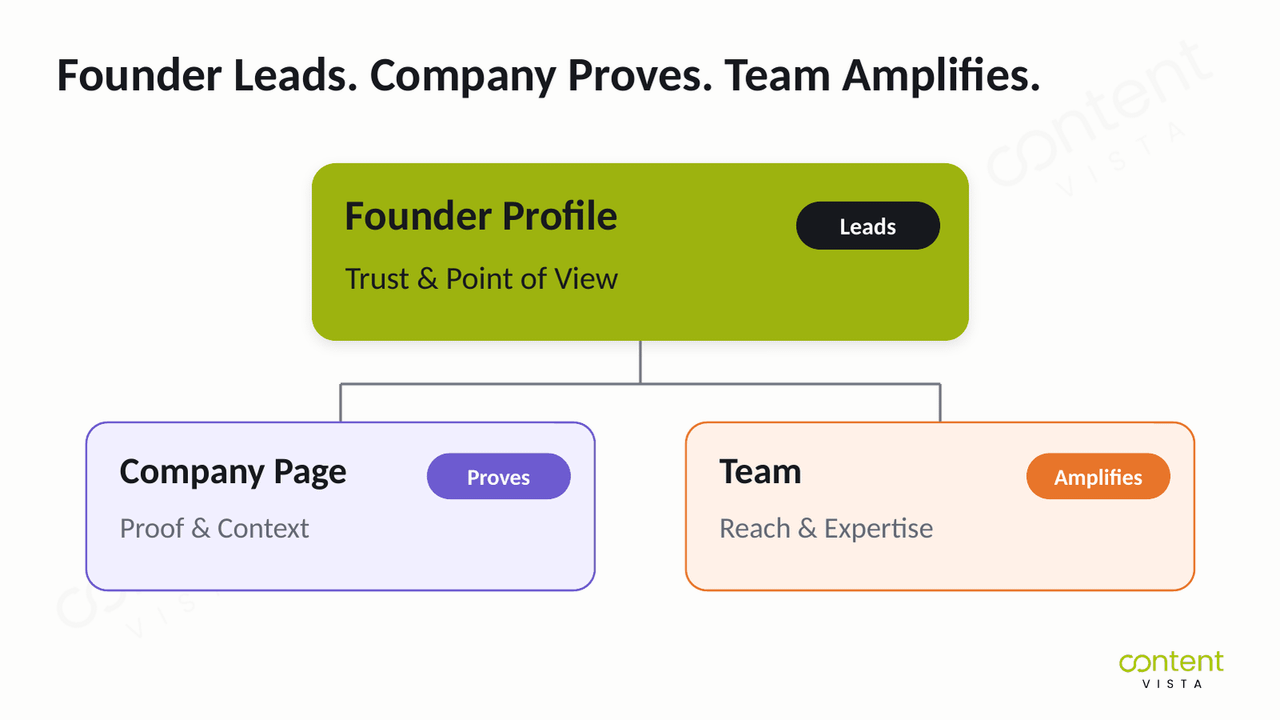
Think about it this way: your founder profile is the trust layer.
Independent LinkedIn studies consistently find that personal profiles reach far more people than company pages. That's why founder-led content should carry the strongest opinions, lessons and expertise.
If you're a CEO deciding how visible to be, our guide to CEO personal branding strategy goes deeper on that choice.
But that doesn't make the company page redundant.
The company page is your proof layer. A buyer who discovers you through a founder post may visit the business page next.
Case studies, results, company updates and evidence of delivery answer a different question: Can this company actually do what its founder talks about?
Your team adds a third layer: depth.
A strategist, salesperson or subject-matter expert can contribute perspectives the founder cannot. But employee posting only works when it feels genuine.
Copy-pasting the same company post across ten profiles creates repetition. Give people room to add their own experience, interpretation or specialist take.
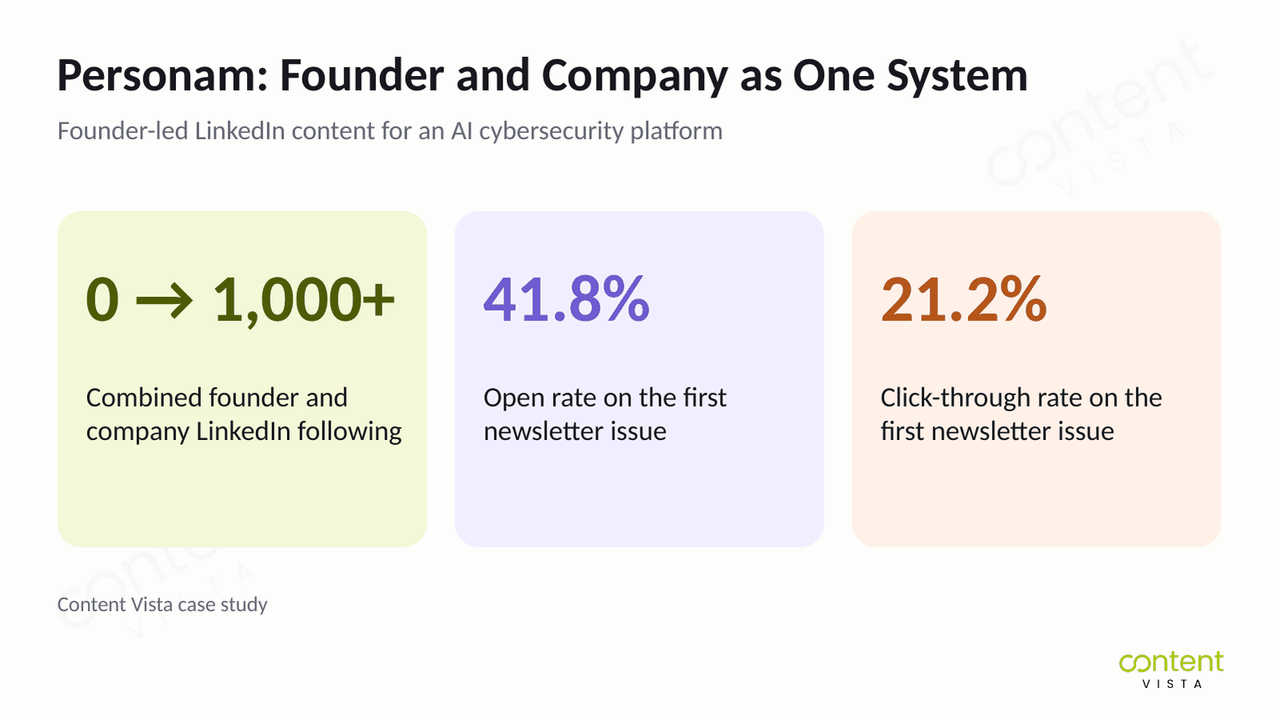
Personam shows what this can look like when the accounts work together.
Content Vista built founder Chuck Faughnan’s personal brand while running the founder and company LinkedIn presence as one connected system.
The combined founder and company following grew from zero to 1,000+, and the first issue of the monthly newsletter achieved a 41.8% open rate and 21.2% click-through rate. You can see how we built Personam's founder and company presence.
The takeaway: you don't have to choose between founder, company and team.
Give each one a clear role, then make them reinforce the same market position from different angles.
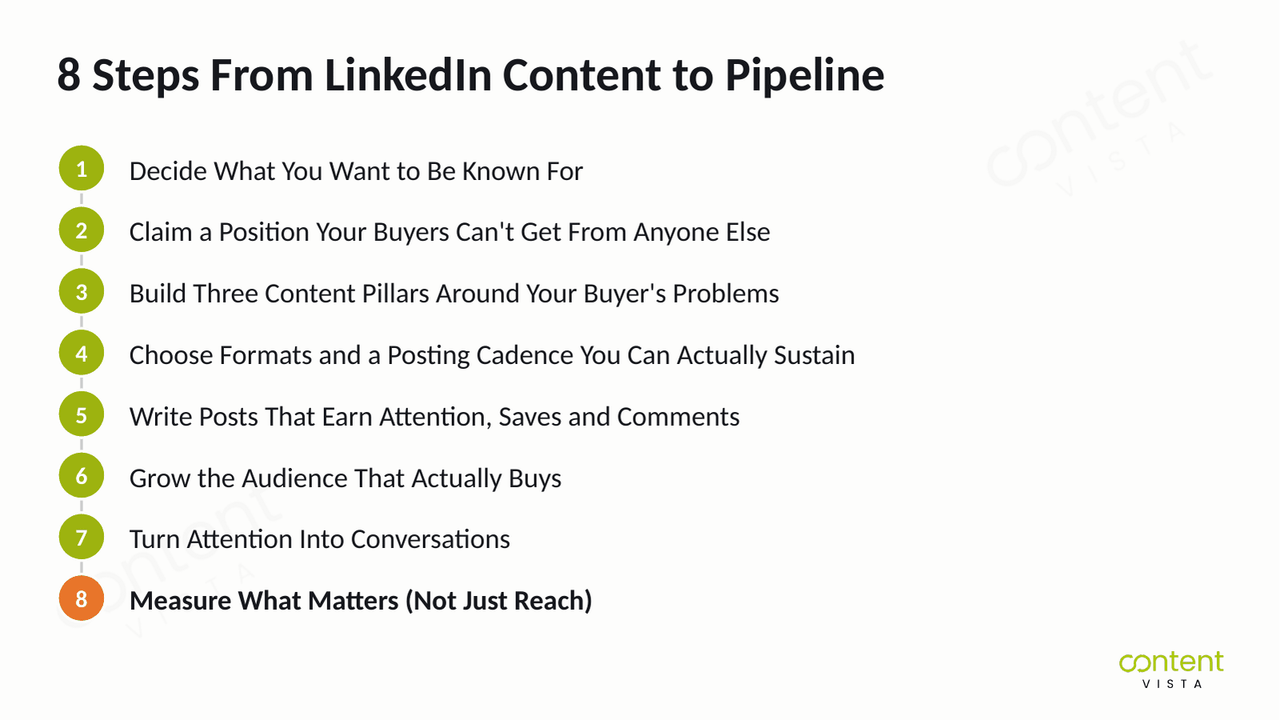
How to Build a LinkedIn Content Strategy That Creates Pipeline (8 Steps)
A LinkedIn content strategy that creates pipeline needs more than good posts.
You need to decide what you want to be known for, build content around buyer problems, earn the right audience, create a path from attention to conversation and measure whether those conversations become real opportunities.
Here's how to build that system, step by step.
Step 1: Decide What You Want to Be Known For
Pick the one or two topics you want buyers to associate with your name.
Start with expertise, not content ideas.
What problems have you repeatedly solved? What have you learned from building your company, serving clients or watching your market change?
More importantly, what do you believe about those problems that isn't already being repeated across LinkedIn?
Your founder story matters here, but only when it helps explain your perspective.
Instead of simply telling people how you started the business, connect your experiences to the decisions, mistakes and observations that shaped how you work today.
If your positioning still feels broad, ask yourself:
What do clients repeatedly thank me for?
What problem do people ask me for advice about?
What do I disagree with in my industry?
What have I learned through experience that my buyers would find useful?
Then narrow it down.
"Marketing" is too broad. "Building B2B demand before buyers enter an active sales cycle" gives you a much clearer territory.
Narrow beats broad because repetition builds association. You want the right buyer to see a problem and think of you before they need a vendor.
Step 2: Claim a Position Your Buyers Can't Get From Anyone Else
Decide which conversation in your market you'll own, and how you're different.
Once you know your territory, look at what everyone else in it is saying.
Review the founders, consultants and companies your buyers already follow. Which topics keep appearing? Which claims sound interchangeable? Which important buyer questions are being ignored?
That gap is where your position can become useful.
Now write a one-line positioning statement for your LinkedIn presence. A practical structure is:
I help [specific audience] understand or solve [specific problem] through [distinct perspective or expertise].
This isn't necessarily your LinkedIn headline. It's an internal filter.
If a potential post doesn't strengthen that association, ask whether you need to publish it.
If the underlying position isn't clear yet, work through your brand positioning strategy before trying to solve the problem with more content. Our brand and market positioning work can help there.
For founder-specific work, founder and executive positioning helps turn expertise into a clearer market point of view.
It's also worth checking that your LinkedIn plan sits inside a revenue-driven marketing strategy, so your content supports the same commercial goals as the rest of your marketing.
Step 3: Build Three Content Pillars Around Your Buyer's Problems
Choose three recurring themes based on what your buyers struggle with, not what you like talking about.
Start with your ideal customer profile, then go one level deeper: who is involved in the buying decision?
The CFO may care about financial risk and return. An operations lead may care about implementation and disruption.
The person who will use your service every day may care about completely different details.
Your recurring themes should help answer those questions.
Illustrative example: a B2B consultancy founder might use:
Commercial problem diagnosis: why growth or operational problems happen.
Decision and implementation guidance: how buyers should evaluate options and make better decisions.
Proof and lessons from the field: what real projects, mistakes and outcomes have taught the founder.
Within each theme, vary the content. Publish a point of view one day, a practical how-to next, then proof, a client lesson or a relevant personal story.
This gives you consistency without repeating yourself.
It also turns content and thought leadership into an ongoing system, so you aren't searching for something new to say every morning.
Step 4: Choose Formats and a Posting Cadence You Can Actually Sustain
Post 2-5 times a week in two or three formats you can keep up for months.
Buffer's analysis of more than 2 million LinkedIn posts from over 94,000 accounts found that posting 2-5 times a week is the sweet spot for improving both reach and engagement.
Posting more still helps, but each extra post adds less than the one before.
The important word is sustain.
Five posts this week followed by three weeks of silence is less useful than a cadence you can maintain. Choose formats that fit both your ideas and your production capacity.
The format data also gives you a useful starting point:
| Format | Average engagement rate |
|---|---|
| Document (carousel) posts | 7.00% |
| Multi-image posts | 6.45% |
| Video | 6.00% |
| Single image | About 5.30% |
| Text only | About 4.50% |
Source: Socialinsider's 2026 LinkedIn benchmarks, based on about 2.45 million posts from 26,000 company pages. Personal profiles may behave differently.
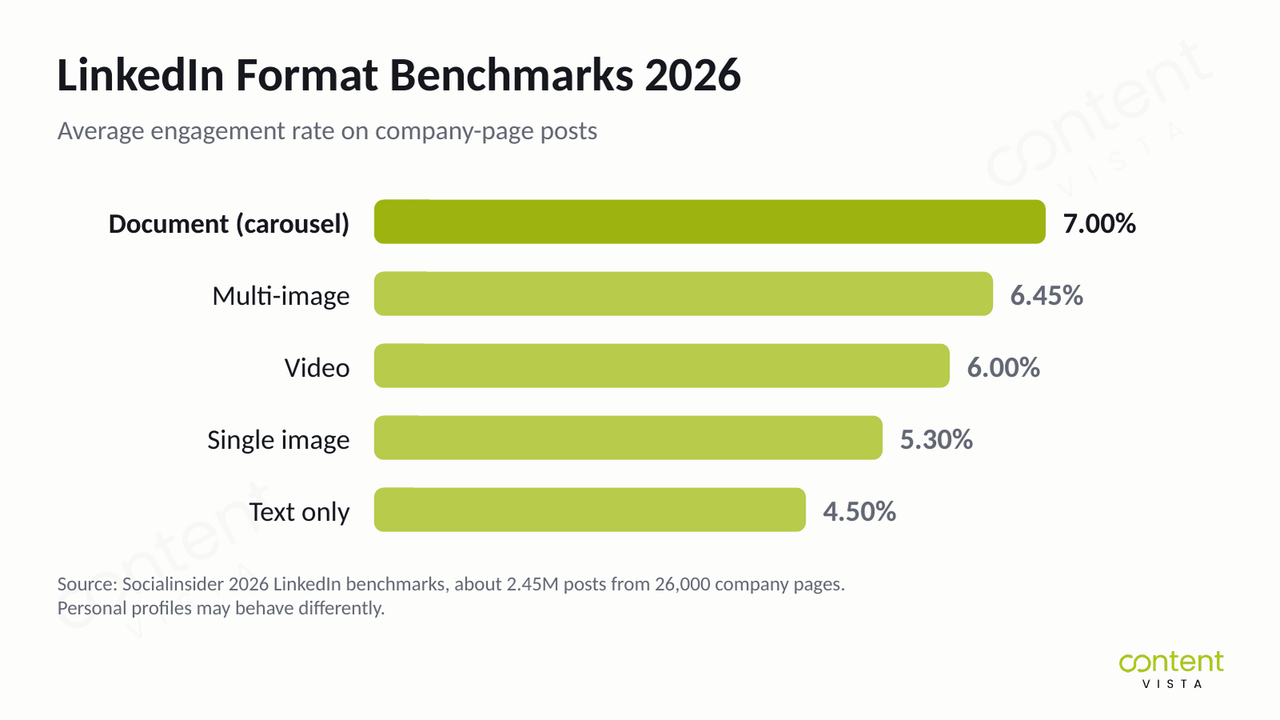
The top of that ranking is close. Socialinsider's Q3 2026 tracking showed document and multi-image posts level at 6.40%.
Native video deserves attention too: Richard van der Blom's 2025 LinkedIn research found video engagement grew 69% year on year.
Don't turn those benchmarks into rigid rules.
Use them to decide which types of LinkedIn posts and formats are worth testing, then judge them against your own audience and business outcomes.
For planning your weekly mix, use our LinkedIn content calendar template.
Step 5: Write Posts That Earn Attention, Saves and Comments
Write posts people stop for, read to the end and save.
Start with the first one or two lines. Their job is to earn enough curiosity for the reader to continue.
Illustrative hook examples:
Contrarian: "Most founders don't have a LinkedIn consistency problem. They have a positioning problem."
Lesson: "We changed one part of our process after seeing the same mistake three times."
Specific problem: "Your LinkedIn posts are getting likes. So why aren't buyers starting conversations?"
Then deliver on the hook.
AuthoredUp's analysis found that posts of around 800-1,000 characters performed best, and that saves and reposts were among the strongest drivers of reach.
That makes usefulness more important than stretching a simple idea into a long post.
Keep paragraphs short. Use white space. Make the post easy to scan without reducing every thought to a slogan.
Be deliberate with external links too.
Van der Blom's 2026 research found that putting an external link in the post body reduced median reach by about 18.8%. Lead with the value first and add a link where it naturally helps the reader take the next step.
AI can help draft, restructure and tighten your writing. It shouldn't manufacture your expertise.
Your opinions, experiences, stories and language need to remain recognisably yours.
For more execution examples, see our LinkedIn post captions and formulas.
Step 6: Grow the Audience That Actually Buys
Grow your audience deliberately, among the people who could become clients.
Audience growth shouldn't mean collecting as many followers as possible.
Start with strategic commenting. Add thoughtful observations to posts from buyers, relevant operators and respected peers before and after publishing your own content.
"Great post!" doesn't build authority. A useful addition to the conversation can.
Connect with people who fit your ideal customer profile when there's genuine context for doing so.
When people comment on your posts, reply. Treat the comments section as part of the content, and give it the same care.
A LinkedIn newsletter can deepen that relationship over time by giving interested readers a recurring reason to engage with your expertise.
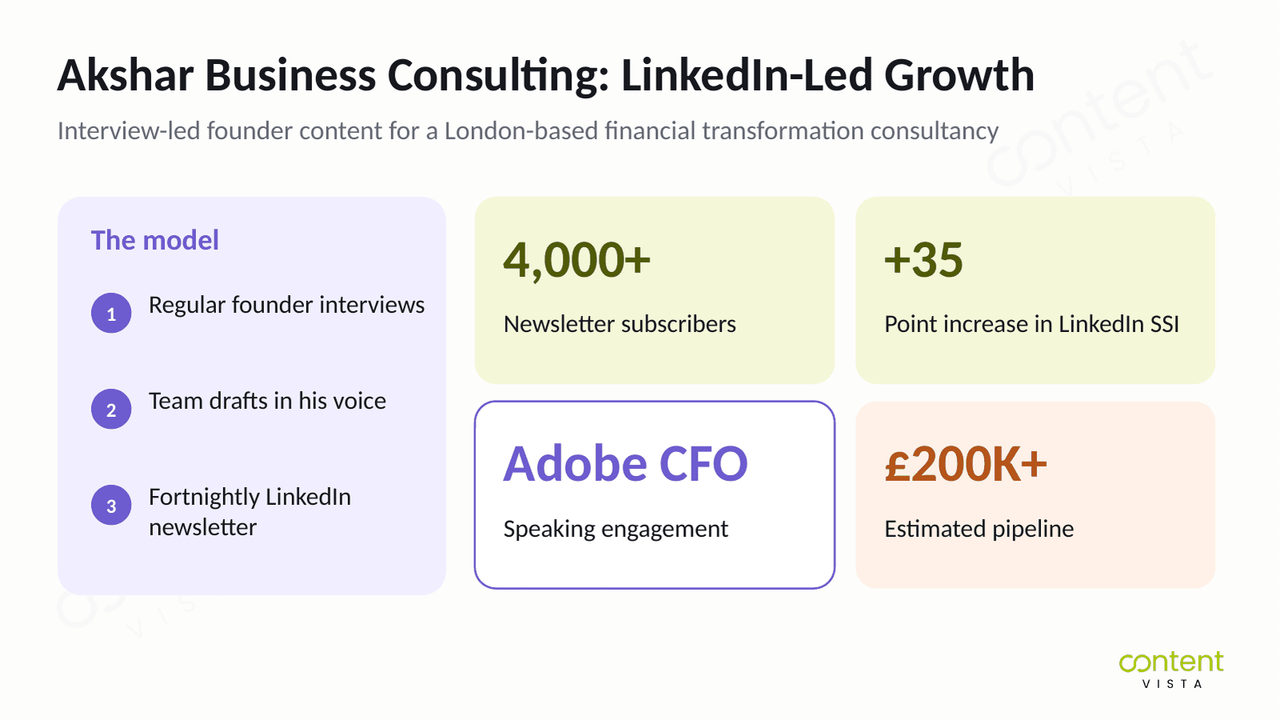
Akshar Business Consulting is a useful example.
Content Vista used regular interviews with founder Tejas Parikh to turn his expertise into consistent content, so he didn't have to write everything himself.
The fortnightly LinkedIn newsletter grew to 4,000+ subscribers and his LinkedIn Social Selling Index (SSI) rose by 35 points.
The content also led to an Adobe CFO speaking engagement, and the work generated £200K+ in estimated pipeline. Read more about Akshar Business Consulting's LinkedIn-led growth.
This is where social media and community growth becomes more useful than simply increasing follower count.
For the engagement side in more detail, see our LinkedIn engagement strategy.
Step 7: Turn Attention Into Conversations
Give interested readers an easy, natural next step and know what you'll do when they take it.
The path you're building is simple:
Post → profile visit → connection request or DM → conversation → qualified opportunity.
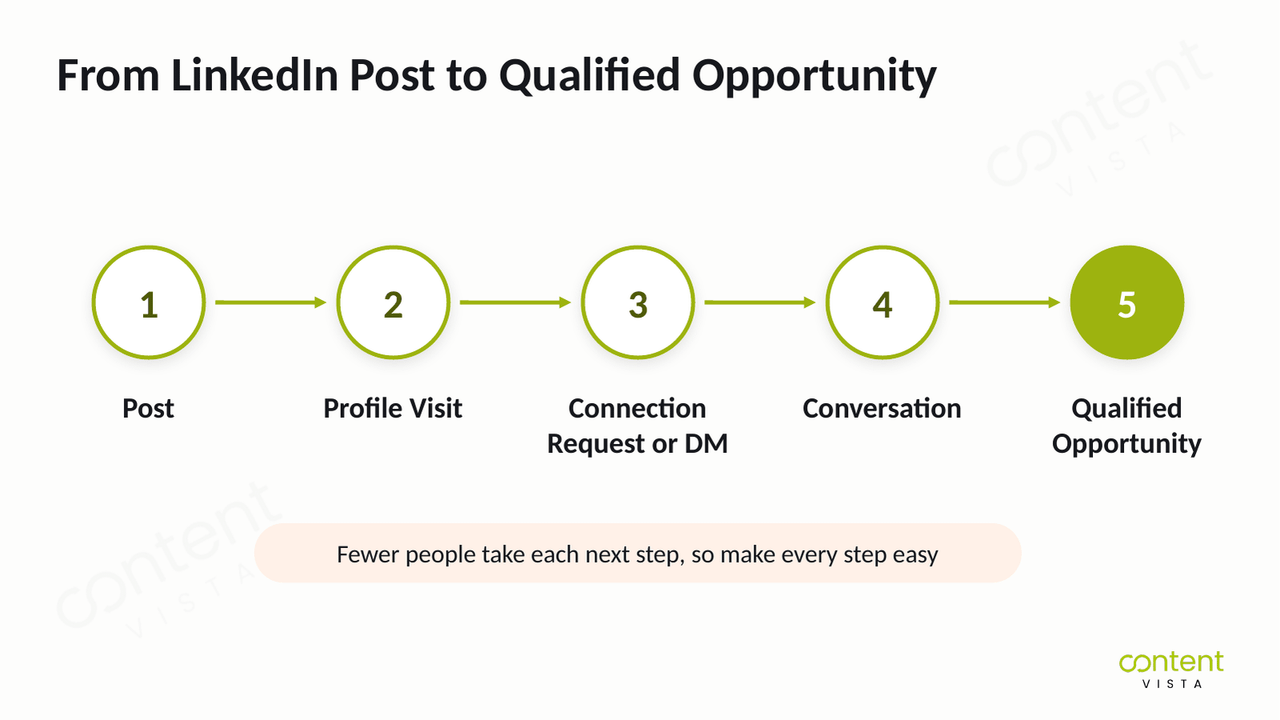
Start with your profile. Treat it like a landing page.
Your headline should make your relevance clear. Your featured section should give interested buyers somewhere useful to go. And your profile should make the offer understandable without requiring detective work.
Then look at what happens when somebody engages.
Respond thoughtfully to relevant connection requests. If you start a DM, begin with context or value before any pitch.
Move towards a call only when the conversation suggests there's a genuine fit.
Your posts can occasionally create that next step directly. Invite readers to comment or DM when you have a useful resource that genuinely extends the post.
Your strongest posts can also support sales outside LinkedIn.
Turn them into one-pagers, or use them in follow-up emails when a prospect asks a question you've already answered well.
If you want to add outbound prospecting on top of your content, our LinkedIn lead generation strategy guide covers that side. Inbound vs outbound lead generation explains how the two work together.
When you want help, our LinkedIn lead generation and sales enablement services cover the outreach and follow-up.
And if you'd rather have the outreach run for you, the LinkedIn Growth Engine uses ICP targeting and personalised connection outreach to book qualified sales calls.
Step 8: Measure What Matters (Not Just Reach)
Track the signals that show your content is creating conversations and pipeline, as well as views.
Reach, impressions, engagement and profile views matter. But they're early signals.
The harder question is whether the right people are moving closer to a conversation.
LinkedIn influence is also easy to miss in attribution software.
A buyer might read your posts for months, discuss your company internally, then visit the website directly or arrive through a referral. The final recorded source doesn't necessarily show everything that influenced the decision.
That's why self-reported attribution matters.
Add a simple "How did you hear about us?" question to your forms and sales conversations. Record the answers consistently.
The measurement gap is real. As noted earlier, Edelman-LinkedIn's 2024 research found only 29% of B2B companies could link sales leads or business wins back to specific thought-leadership efforts.
Key Metrics
| Early signals (is the content working?) | Pipeline signals (is it creating business?) |
|---|---|
| Reach and impressions among your target buyers | Inbound DMs and connection requests from ideal-fit buyers |
| Comments and saves | Sales conversations started |
| Profile views | Meetings booked and qualified opportunities |
| Follower and newsletter subscriber growth among your ideal buyers | "LinkedIn" named in self-reported attribution; pipeline-influenced revenue |
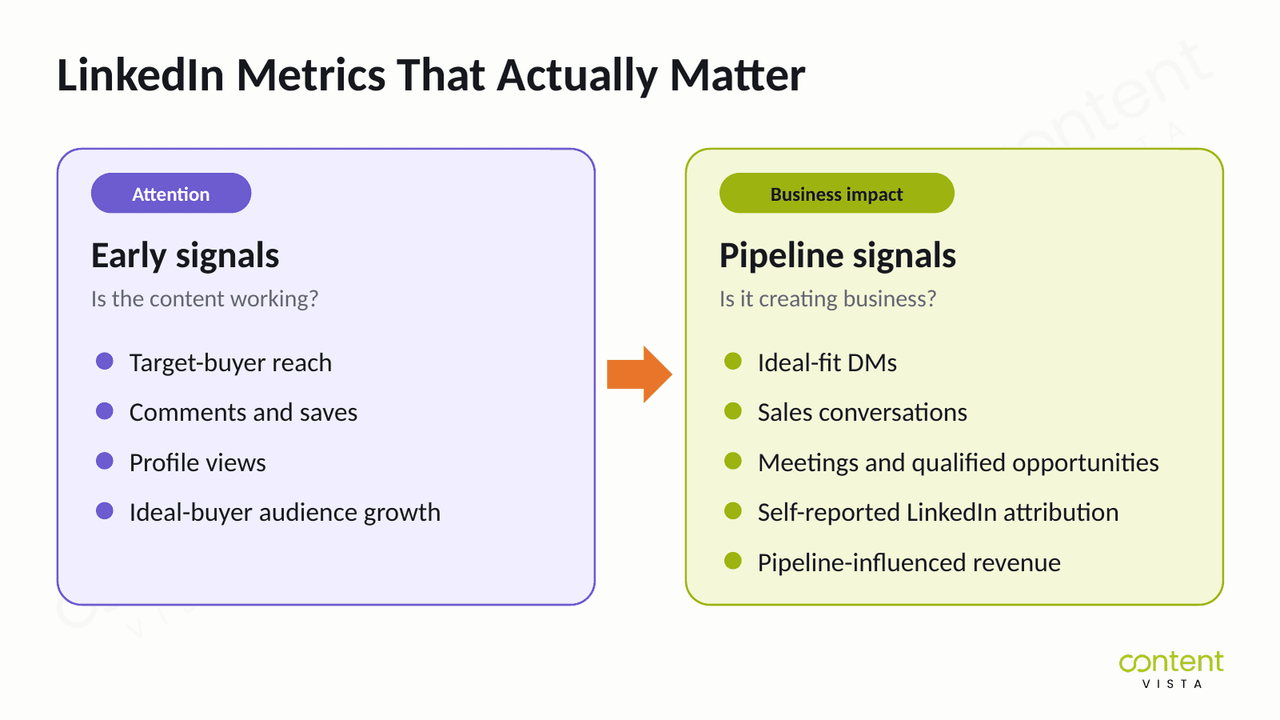
Run a simple monthly review.
Which topics attracted the right people? Which posts started conversations? Which formats generated saves or useful comments? What should you repeat, refine or stop?
Take the free Founder Authority & Audience Engine Benchmark. You'll get your authority score, your audience engine score and the biggest gaps between your content and your pipeline.
Benchmark my LinkedIn presence
What Changed on LinkedIn in 2025-2026 (and What It Means for 2027)
LinkedIn became harder to win through volume alone in 2025-2026.
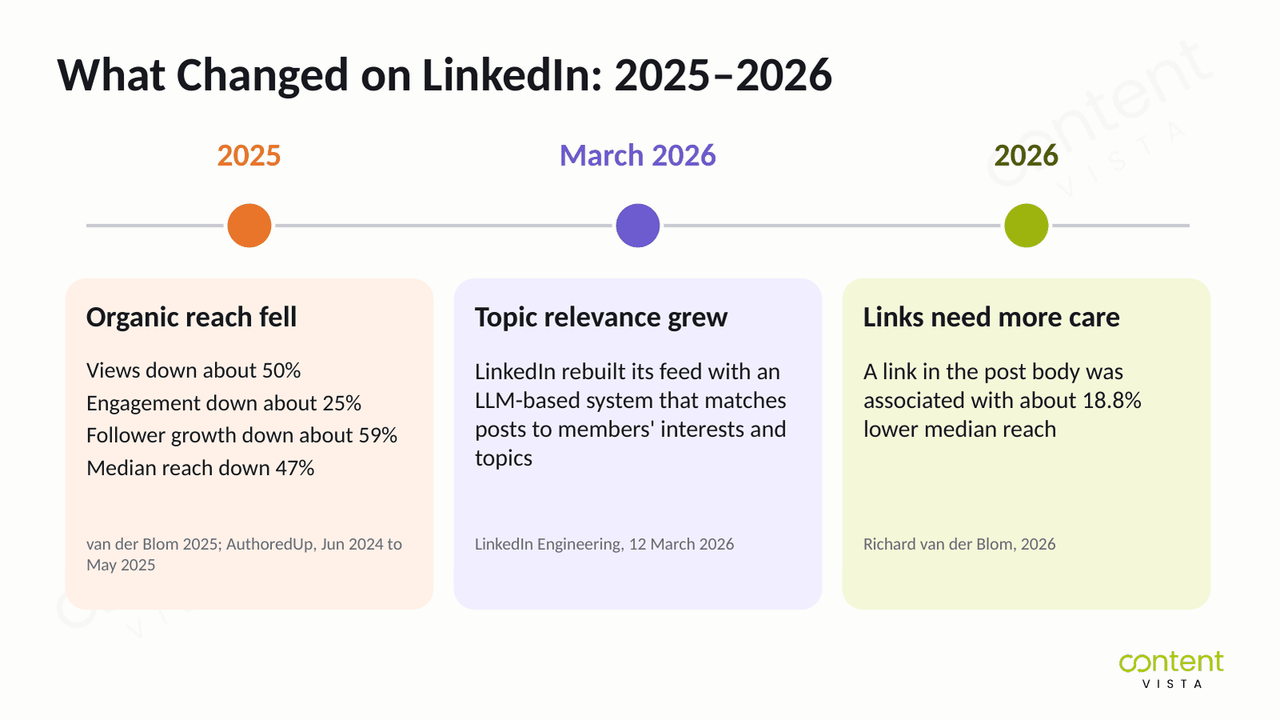
Organic reach fell sharply in 2025. In March 2026, LinkedIn rebuilt its feed around an LLM-based system that matches posts to members' interests and topics. And 2026 research linked external links in post bodies to lower median reach.
The practical response for 2027 is straightforward: stay focused on a few topics, publish consistently, create genuinely useful content and stop trying to manufacture engagement.
2025: Organic distribution became tougher.
Richard van der Blom's 2025 analysis of 1.8 million LinkedIn posts found that views fell by roughly 50% year on year, engagement declined by roughly 25% and follower growth dropped by roughly 59%.
AuthoredUp found a similar pattern: median post reach fell 47% between June 2024 and May 2025.
March 2026: Topic relevance became more important.
On 12 March 2026, LinkedIn's engineering team described a rebuilt, LLM-based feed system that matches posts to each member's interests and topics, including content from beyond their immediate network.
For founders, the practical implication is to avoid jumping between unrelated subjects. Consistently publishing around two or three areas of expertise gives your content a clearer topical identity.
2026: External links require more care.
Van der Blom's 2026 research found that including an external link in the post body was associated with about an 18.8% reduction in median reach.
That doesn't mean "never use links". Lead with useful content first, then include a link when it genuinely helps the reader take the next step.
The practical playbook is simple: stay focused on your core topics, write posts worth saving or responding to, use external links deliberately and avoid engagement bait designed only to trigger reactions.
For the deeper mechanics, see how the LinkedIn algorithm works in 2027.
We'll update this section as LinkedIn changes. Last reviewed: November 2026.
The LinkedIn "Rules" You Keep Hearing: 3/2/1, 4-1-1, 5-5-5 and 70-20-10
You'll hear plenty of formulas for what to post on LinkedIn and how often to engage.
But only the 4-1-1 rule has a clearly traceable origin. The others are community rules of thumb that have evolved into different versions over time.
None of them is an official LinkedIn algorithm rule. Treat them as habits that can build consistency. They aren't requirements for getting reach.
| Rule | What people say it means | Where it comes from | Verdict |
|---|---|---|---|
| 4-1-1 | For every self-promotional post, share one relevant post from someone else and four pieces of others' content | Traceable origin: coined by Andrew Davis (Tippingpoint Labs), popularised by Joe Pulizzi; originally for Twitter | Useful reminder to keep self-promotion low; not a LinkedIn algorithm rule |
| 3/2/1 | Varies (for example, three value posts, two personal, one promotional) | Community rule of thumb, no authoritative source | Fine as a habit; don't treat it as a standard |
| 5-5-5 | A daily engagement habit (for example, engage with five people, comment on five posts) | Community rule of thumb, no authoritative source | Good for building a commenting routine |
| 70-20-10 | 70% value, 20% shared or curated, 10% promotional | Loose guideline borrowed from elsewhere, not research-derived | Reasonable starting mix; adjust to your buyers |
The useful part of these formulas is the discipline they create.
A founder who needs structure might use 5-5-5 as a reminder to engage regularly, or 70-20-10 to stop every post from becoming promotional.
The mistake is treating the numbers as optimisation instructions.
Your buyers don't care whether today's post completes a formula. They care whether what you're publishing helps them understand a problem, make a decision or see your expertise differently.
In short: the best rule is the one that keeps you showing up consistently with useful content for your buyers.
How Your LinkedIn Posts Can Get You Cited in AI Search
LinkedIn content now has value beyond the LinkedIn feed.
AI tools such as ChatGPT Search and Google AI Mode cite LinkedIn heavily, particularly content published by individual profiles.
And you don't need a viral post to be useful to AI search. Focused, educational content with modest engagement can still become a source when AI systems answer relevant questions.
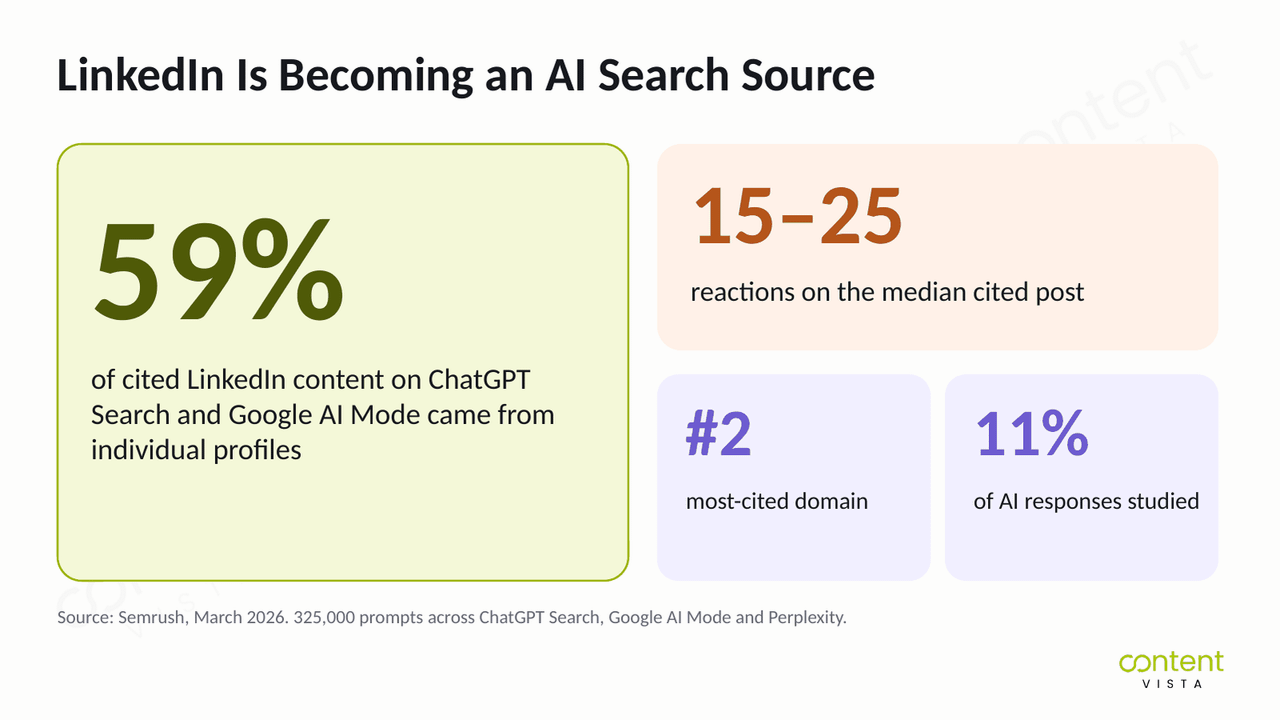
Semrush's March 2026 study of 89,000 LinkedIn URLs cited in AI search analysed 325,000 prompts across ChatGPT Search, Google AI Mode and Perplexity.
It found LinkedIn was the second most-cited domain, appearing in about 11% of AI responses on average.
More importantly for founders, 59% of the LinkedIn content cited on ChatGPT Search and Google AI Mode came from individual profiles. The median cited LinkedIn post had only 15-25 reactions.
That changes the value of a useful post.
You aren't only publishing for the people who happen to see it in their feed that day. Your expertise can be rediscovered when someone later asks an AI tool a question related to the topic.
Profound's analysis of 1.4 million citations between November 2025 and February 2026 also found LinkedIn was the most-cited domain for professional and B2B queries.
So what does that mean for your strategy?
Stay focused on topics you genuinely know. Write clear, explanatory posts that answer specific buyer questions.
Use plain language so your point is easy to understand without surrounding context. Then deepen the same themes through longer LinkedIn articles or newsletters where the subject warrants it.
You don't need to manufacture virality. You need to build a useful, consistent body of expertise that both buyers and AI systems can discover.
For a deeper look, see our guide to getting your business cited by AI search.
How Much Time Does a Founder's LinkedIn Strategy Really Take?
A founder's LinkedIn strategy only works if you can sustain it for months, well beyond a motivated two-week burst.
The workload goes beyond writing posts. You need time for deciding what to say, reviewing content, engaging with relevant people and following up when attention becomes a conversation.
You can manage the entire process yourself, or have a team turn your thinking into content while you stay involved where your voice matters most.
Here's the part nobody tells you: writing is only one slice of the work. Here's where the rest of the time goes.
| Activity | What it involves | Do-it-yourself | Interview-led (a team writes from your thinking) |
|---|---|---|---|
| Planning | Choosing topics and scheduling posts | You plan each week | The team plans; you approve |
| Writing | Drafting and editing posts | You write everything | Short regular interviews; the team drafts in your voice; you review |
| Engaging | Commenting and replying | You | Still mostly you, because comments must be genuine |
| Conversations | DMs, calls, follow-up | You | Always you (or your sales team) |
| Measuring | Monthly review of signals | You | The team prepares; you decide |
How much time this takes depends mostly on two things: your posting cadence and how much of the writing you do yourself.
The interview-led model reduces the founder's writing workload without removing the founder from the content.
Instead of staring at a blank document, you talk through your ideas, experiences, client questions and opinions. The team turns that thinking into drafts, and you review them for accuracy and voice.
That's the model used in the Akshar Business Consulting work: regular founder interviews supplied the thinking behind the content while the execution happened around them.
But some parts shouldn't be fully outsourced.
A team can research, plan, draft and report. It can't authentically replace you in every comment, DM or buyer conversation.
Those interactions are where people experience the person behind the content, and where trust can begin turning into commercial conversations.
So the right model keeps you involved. It protects the founder's time while keeping their expertise and relationships at the centre.
A Sample 30-Day LinkedIn Content Plan for Founders
You don't need to reinvent your LinkedIn strategy every Monday.
The plan below gives you a practical first month: establish what you want to be known for, reinforce those topics consistently, introduce proof and then create natural opportunities for conversations.
Treat this as a sample to adapt, not a fixed rule. Your topics, formats and frequency should reflect your buyers, expertise and available time.
The goal is a repeatable rhythm you can sustain after day 30, well beyond a one-off posting challenge.
| Week | Focus | Posts | Daily engagement habit |
|---|---|---|---|
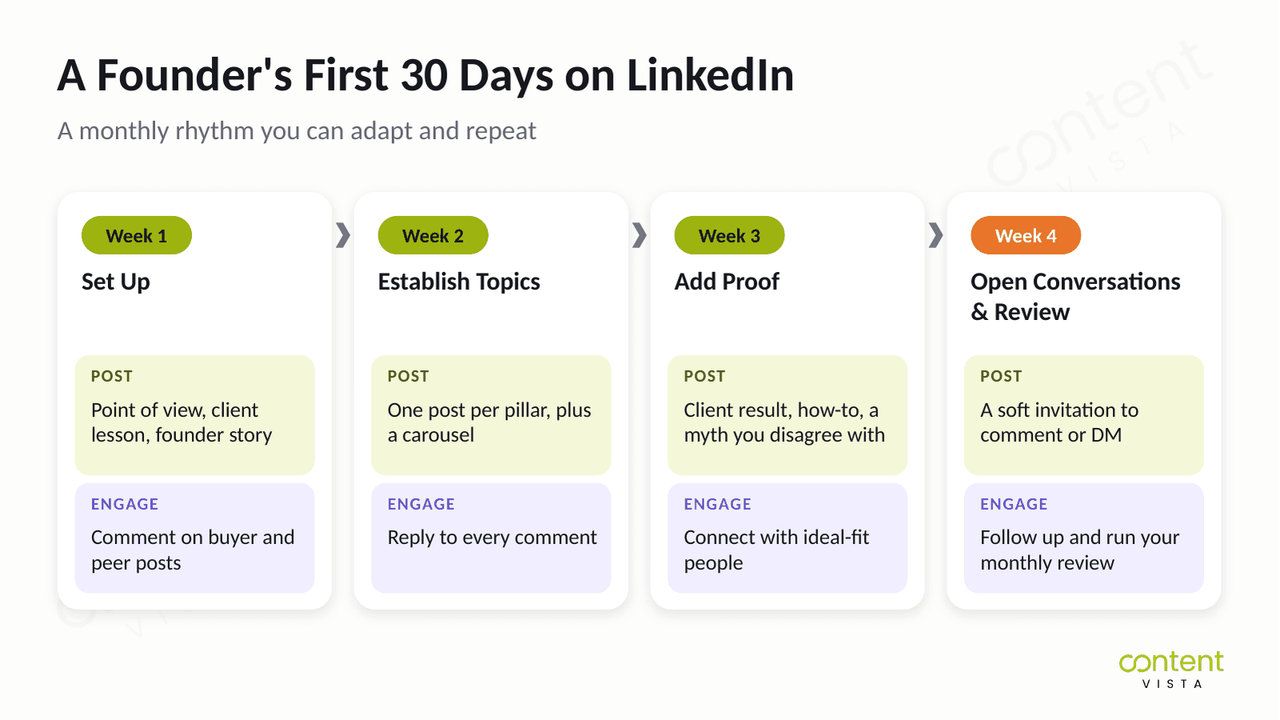
| Week 1 | Set up: sharpen your profile, choose your three content pillars, write your positioning line | 3 posts: your point of view, a lesson from client work, a short founder story | Comment thoughtfully on posts from buyers and peers |
| Week 2 | Establish your topics | 3-4 posts: one per pillar plus one document (carousel) post | Reply to every comment on your posts; keep commenting daily |
| Week 3 | Add proof | 3-4 posts: a client result or case story, a how-to, a myth you disagree with | Connect with ideal-fit people who engage, with a short personal note |
| Week 4 | Open conversations and review | 3-4 posts: including one with a soft invitation (for example, comment or DM for a resource) | Follow up on conversations; run your first monthly review |
Notice how the month progresses. You aren't publishing four disconnected weeks of content.
Week 1 establishes your position. Week 2 reinforces it. Week 3 adds evidence. Week 4 creates opportunities for relevant conversations and gives you enough information to review what worked.
At the end of the month, don't automatically replace everything with new ideas.
Keep the topics and formats that attracted the right buyers, refine what underperformed and use real questions from comments and conversations to shape the next month.
For more guidance on choosing individual topics, see what to post on LinkedIn.
7 LinkedIn Content Mistakes Founders Keep Making
A founder can post consistently and still get very little business value from LinkedIn.
Usually, the problem isn't a lack of effort. It's that the content is attracting the wrong people, communicating an unclear position, or stopping at engagement without creating a path towards conversation.
The mistake is simple: treating LinkedIn as a publishing task when it should be a connected business system.
1. Posting Before Deciding What You Want to Be Known For
If you haven't chosen the topics you want buyers to associate with you, your content becomes a collection of unrelated thoughts.
Decide what expertise and problems you want to own first. Let individual post ideas come afterwards.
2. Writing for Your Peers Instead of Your Buyers
Industry peers often engage with technical opinions and insider debates, which can make that content feel successful.
But your buyers may be asking much more practical questions. Write for the problems, risks and decisions they actually face.
3. Leaving LinkedIn to the Company Page
Your company page has an important role, but it shouldn't carry the entire strategy.
Use the founder profile to communicate expertise and point of view, then let the company page provide proof and context.
4. Chasing Likes, Virality or Engagement Bait
A widely seen post isn't automatically a commercially useful one.
Optimising every idea for reactions can pull your content away from the specific subjects your buyers care about. Prioritise relevance and useful engagement over attention for its own sake.
5. Pitching in DMs Before There's Any Relationship
Someone liking your post or accepting a connection request isn't an invitation for an immediate sales pitch.
Start with context and a genuine conversation. Move towards a commercial discussion when there's an actual problem and fit.
6. Only Measuring Reach and Followers
Reach, profile views and follower growth help you understand whether content is gaining attention. They don't tell you whether LinkedIn is creating business.
Track ideal-fit DMs, conversations, meetings, qualified opportunities and self-reported attribution alongside those early signals.
7. Letting AI Write Your Voice for You or Quitting After a Few Weeks
AI can help you draft, edit and repurpose. It shouldn't replace your experiences, opinions or language with generic content.
And don't expect a few weeks of posting to build the market association you're after. The strategy needs a cadence you can sustain.
When LinkedIn Shouldn't Be Your Main Channel
LinkedIn can be a strong channel for founder-led B2B growth, but it shouldn't automatically be your main channel.
If your buyers aren't there, your positioning is unclear, you can't sustain the work, or you need pipeline immediately, putting more effort into content won't solve the underlying problem.
Your buyers genuinely aren't active on LinkedIn.
Start with buyer behaviour, not channel popularity.
If the people involved in buying your product or service don't use LinkedIn to research, learn or engage professionally, invest where they actually spend their attention.
You can't commit to showing up consistently for several months.
Founder-led content works through repeated exposure to your expertise and point of view.
If you can only publish in occasional bursts, LinkedIn is unlikely to work as a dependable content engine.
Your positioning isn't clear yet.
If you can't explain who you help, which problem you solve and why your approach is different, more content can amplify that lack of clarity rather than fix it.
If your positioning still feels fuzzy, start with the free GTM Readiness & Positioning Clarity Audit.
You need pipeline this month.
Content compounds over time. It shouldn't carry the full burden of an immediate revenue target.
Pair LinkedIn content with targeted outbound and sales activity while you build the authority and audience that can support future demand.
That combination also reduces dependence on last-minute prospecting when opportunities slow down, which is the pattern behind the feast-or-famine pipeline cycle.
So the real question isn't whether every founder should be on LinkedIn.
It's whether LinkedIn has the right buyers, a clear message and enough sustained effort to play a meaningful role in your growth system.
Go Deeper on Each Part of Your LinkedIn Strategy
Use these guides to go deeper into the specific parts of your LinkedIn content strategy as you build and improve your system:
LinkedIn post ideas for founders - Practical ideas for turning your expertise, experiences and buyer questions into posts.
Types of LinkedIn posts and formats - Understand the different post formats and where each can fit into your strategy.
What to post on LinkedIn - How to choose useful topics instead of posting disconnected ideas.
LinkedIn profile optimization - Turn your profile into a clearer representation of who you help and what you know.
LinkedIn personal branding for founders - Build a recognisable founder presence around your expertise and point of view.
LinkedIn content calendar (with template) - Organise your topics and publishing cadence into a repeatable plan.
LinkedIn post captions: examples and formulas - Structure stronger openings, bodies and calls to action.
LinkedIn engagement strategy - Build relevant conversations around the content you publish.
The LinkedIn algorithm in 2027 - Understand the current distribution signals without chasing algorithm hacks.
FAQs
What is a LinkedIn content strategy?
A LinkedIn content strategy is a repeatable system for deciding what you want to be known for, who you need to reach, what you should publish and how that attention becomes business conversations.
It goes beyond a posting calendar. For founders, the goal is to connect expertise, consistent publishing, engagement and follow-up to commercial outcomes.
Should founders post from their personal profile or the company page?
Founders should use both, but they have different jobs. The founder's personal profile should lead with expertise, opinions, experiences and conversations.
The company page supports that activity with proof, company news, resources and brand context. Think of the founder profile as the voice and the company page as the supporting evidence.
How often should a founder post on LinkedIn?
A practical starting point is two to five posts per week. Buffer's analysis of more than 2 million LinkedIn posts found this range is the sweet spot for improving both reach and engagement.
Posting more can still help, but each extra post adds less. Choose a cadence you can maintain, rather than publishing heavily for a short period and then disappearing.
What content formats work best on LinkedIn in 2027?
For company pages, document posts (often called carousels) led engagement in Socialinsider's 2026 benchmarks, followed by multi-image posts and video.
That doesn't mean every founder should publish only carousels. Format should follow the idea: use documents for structured explanations, images when visuals add context, and video when your delivery or demonstration adds value.
What is the 4-1-1 rule on LinkedIn?
The 4-1-1 rule suggests that for every self-promotional post, you share one relevant post from another source and four pieces of other people's content.
It's traceable to Andrew Davis of Tippingpoint Labs and was popularised by Joe Pulizzi, originally for Twitter. It's a useful guard against self-promotion, not an official LinkedIn algorithm rule.
What are the 3/2/1 and 5-5-5 rules on LinkedIn?
Both are community-created habits rather than official LinkedIn rules, and their definitions vary.
3/2/1 commonly describes a mix such as three value posts, two personal posts and one promotional post. 5-5-5 generally refers to a daily engagement routine, such as engaging with five people and commenting on five posts. Use them for consistency, not as algorithm instructions.
What is the 70-20-10 rule in content marketing?
The 70-20-10 rule is a loose content-mix guideline, often read as 70% useful content, 20% shared or curated content and 10% promotional content.
It isn't a research-derived LinkedIn standard. It can give you a starting structure, but your actual mix should reflect what your buyers need and what supports your positioning.
Do external links hurt LinkedIn reach?
They can. Richard van der Blom's 2026 research found that putting an external link directly in a LinkedIn post was associated with a median reach reduction of about 18.8%.
That doesn't mean you should stop linking. When the destination matters, use the link. When reach matters more, lead with the full value in the post itself and share the link when readers ask for it.
Can I use AI to write my LinkedIn posts?
Yes. AI can help you organise ideas, draft posts, edit, tighten language and repurpose existing thinking. But the underlying expertise, experiences and opinions should remain yours.
If AI starts deciding what you believe and replacing your natural language with generic copy, you're automating the part of founder content that makes it valuable in the first place.
How do I know if LinkedIn content is creating pipeline?
Look beyond reach and followers. Track whether your content generates relevant conversations, ideal-fit inbound messages, meetings, qualified opportunities and self-reported attribution, such as prospects telling you they found or followed you through LinkedIn.
Those signals connect publishing activity to actual commercial movement, so engagement stops being treated as the end result.
How long before LinkedIn content produces results?
There's no reliable universal timeline. LinkedIn content compounds over time, and early indicators such as relevant engagement, profile activity and conversations usually move before qualified pipeline appears.
Content Vista's Inbound Magnet System is designed to compound over 60-90 days. That's how the system is structured. It isn't an industry benchmark for when every business should expect results.
Should my team post on LinkedIn too?
Yes, when their participation is genuine. Team members can add perspectives the founder or company page can't by sharing their own expertise, experiences and take on relevant industry problems.
Avoid turning employees into distribution accounts for identical company messaging. The value comes from credible individual voices adding to the expertise your business wants to demonstrate.
Turn Your LinkedIn Content Into a Pipeline System
A strong LinkedIn content strategy comes back to a few fundamentals: know what you stand for, get the right accounts posting, show up consistently, create a clear path from content to conversations, and measure the signals that actually matter to pipeline.
Do those things together and LinkedIn stops being another channel you need to keep feeding.
It becomes a system for building authority, staying visible to the right buyers and creating opportunities for relevant conversations over time.
That's the core idea behind this guide: LinkedIn content is a pipeline system, not a posting calendar.
Posts are only one part of it. Positioning, distribution, engagement, follow-up and measurement are what connect those posts to commercial outcomes.
The free Founder Authority & Audience Engine Benchmark shows how strong your authority and audience are today, and exactly where your content stops turning into conversations.
Take the free benchmarkWant it built with you? See our founder and executive positioning work or use the Marketing Growth System Finder to see which growth system fits your business.